REVIEW 3 major objections 5 minor 83 references
You never have enough J/$\psi$ events: the case for a J/$\psi$ factory
T0 review · 3 major / 5 minor · reviewed 2026-08-06 · deepseek-v4-flash
Pith's one-line read A future J/psi factory could measure the strange-hyperon weak-phase difference near the Standard Model level of 0.01 degrees and improve the neutral-kaon CPT limit by an order of magnitude.
desk verdict A competent white paper for a J/psi factory, but the flagship sensitivities rest on unverified systematic-scaling assumptions that need to be stated as assumptions. read the letter →
The pith
A machine-rendered reading of the paper's core claim, the machinery that carries it, and where it could break.
The reading
What carries the argument
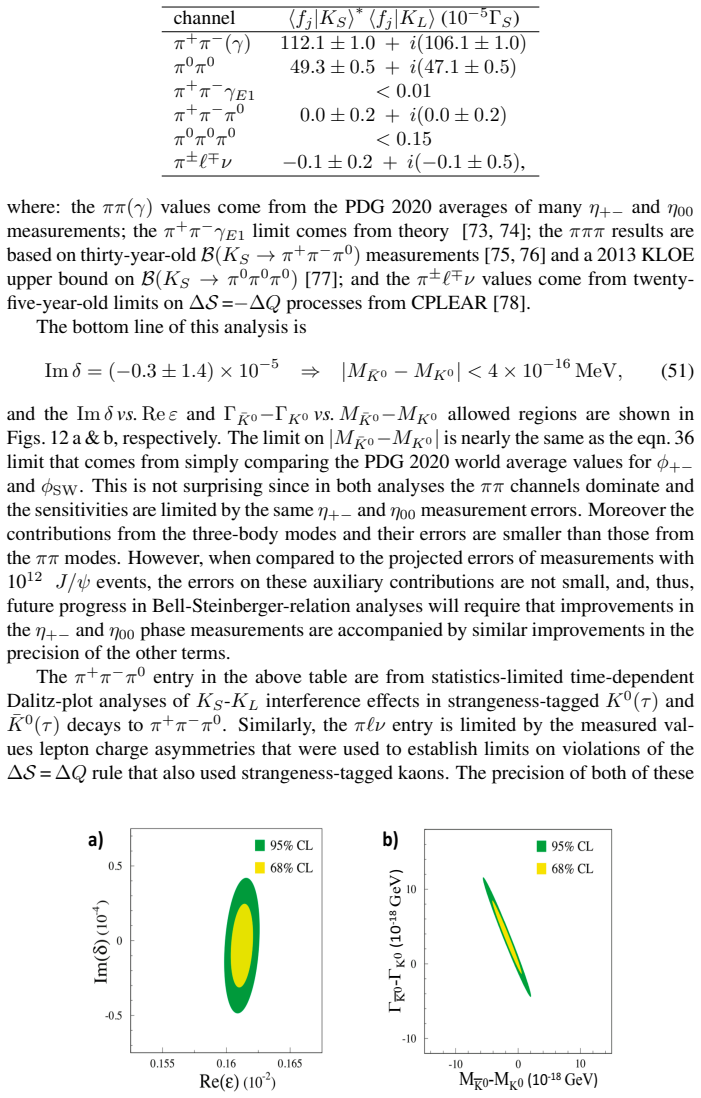
The machinery for the hyperon claim is the entangled $J/\psi\to\Xi\bar{\Xi}$ event, analyzed through a nine-angle spin-density-matrix formalism in which a $4\times4$ correlation matrix $C_{\mu\nu}$ encodes the $\Xi$ polarizations and spin correlations, and Lee-Yang parameters ($\alpha_Y$, $\beta_Y$, $\gamma_Y$, equivalently $\phi_Y$) are extracted from the fully correlated angular distribution. The key observable is $B^{\Xi}_{\rm CP}=(\beta_\Xi+\beta_{\bar\Xi})/(\alpha_\Xi-\alpha_{\bar\Xi})=\tan(\xi_P^\Xi-\xi_S^\Xi)$, which the paper stresses is not suppressed by the small strong-interaction phase differences that dilute the familiar $A^{\Lambda}_{\rm CP}$ asymmetries. For the CPT claim, the machinery is the strangeness-tagged $K^0(\tau)/\bar K^0(\tau)$ wave function, whose $K_S$-$K_L$ interference terms have opposite signs and oscillate as $\cos(\Delta M\tau-\phi_j)$; the reduced asymmetry $A'_{\pi\pi}$ isolates $\phi_j=\phi_{\rm SW}+\Delta\phi_{\rm CPT}$. The Bell-Steinberger relation $\sum_j \langle f_j|K_S\rangle^*\langle f_j|K_L\rangle = \tfrac12(\Gamma_S+\Gamma_L+2i\Delta M)\langle K_S|K_L\rangle$ converts the measured channel amplitudes into an exact determination of $\mathrm{Im}\,\delta$, and hence of $M_{\bar K^0}-M_{K^0}$. On the accelerator side, monochromatization with dispersion at the interaction point is the practical enabler, raising the visible $e^+e^-\to J/\psi$ cross-section from 3.4 microbarns toward the full 90 microbarns.
What would settle it
A complete end-to-end Monte Carlo of $10^{12}$ $J/\psi$ decays through a realistic high-rate detector would settle the claims: if the fitted uncertainty on $\phi_{\rm SW}+\Delta\phi_{\rm CPT}$ does not approach $0.05^\circ$, or if the hyperon weak-phase difference retains a systematic floor above about $0.1^\circ$ when control samples are scaled up a thousandfold, the two headline projections are not realizable.
Extended reading notes
Core claim
The central claim is that a specialized near-future facility with multi-trillion $J/\psi$ decays would be a discovery machine for two precision probes that are uniquely enabled by the $J/\psi$ event topology, not merely a statistics upgrade of the light-hadron program. For CP violation, the paper points out that $J/\psi \to \Xi\bar{\Xi}$ events are nearly ideal: the $\Xi$ and $\bar{\Xi}$ are produced back-to-back in a spin-entangled state with equal polarizations, decay in vacuum, and the proton and antiproton directions measure the $\Lambda$ spin event by event, giving an effective polarization of one and a twentyfold sensitivity gain. The current combined limit $|\xi_P - \xi_S| < 0.94^\circ$ is statistically limited, and the quoted $0.1^\circ$ systematics are themselves mostly statistical errors from control samples, so a multi-trillion-event sample plausibly reaches the Standard Model sensitivity of about $-0.01^\circ\pm 0.01^\circ$. For CPT, $10^{12}$ $J/\psi$ decays tag roughly two billion $K^0\to\pi^+\pi^-$ and $\bar K^0\to\pi^+\pi^-$ decays through the charge of the accompanying kaon; the simulated strangeness-tagged interference pattern gives $\phi_{\rm SW} + \Delta\phi_{\rm CPT} = 43.51^\circ \pm 0.05^\circ$, meaning $|M_{\bar K^0} - M_{K^0}|\approx 4\times10^{-17}$ MeV. The Bell-Steinberger relation is then available to elevate this into an exact, phase-convention-independent determination of $\mathrm{Im}\,\delta$, provided the auxiliary kaon decay inputs are improved in step with the $\pi\pi$ phases.
Load-bearing premise
The forward projections collapse if systematic uncertainties at a future $J/\psi$ factory do not shrink with larger control samples; the paper explicitly relies on the quoted $0.1^\circ$ systematics being mostly statistical in origin, and if a $10^{12}$-event detector instead introduces new backgrounds, trigger losses, or reconstruction inefficiencies, neither claim follows.
Editorial extensions
If this is right
- If the projected sensitivity holds, any measured $\xi_P-\xi_S$ above the few-hundredths-of-a-degree level would be evidence for new physics in the parity-conserving $P$-wave amplitudes of hyperon decay, since the Standard Model expectation is about $-0.01^\circ$.
- A $10^{12}$-event sample would improve the neutral-kaon CPT limit from about $4\times10^{-16}$ MeV to about $4\times10^{-17}$ MeV, an order of magnitude better than the 1990s regenerator and tagged-kaon measurements.
- The $\Xi\bar{\Xi}$ and $\Xi^0\bar{\Xi}^0$ channels already deliver $\Lambda$ CP asymmetries competitive with a sample ten times larger in $J/\psi\to\Lambda\bar\Lambda$; at factory statistics these become independent probes with different systematics.
- A rigorous Bell-Steinberger analysis at the new precision requires matching improvements in the $\pi^+\pi^-\pi^0$, semileptonic, and $K_S\to 3\pi^0$ inputs, so the decades-old limits on those channels would otherwise become the bottleneck.
- Monochromatization of the $e^+e^-$ beams could increase the visible $J/\psi$ cross-section by a factor of ten or more without higher beam currents, making multi-trillion samples feasible at modest cost.
Reading between the lines
- Beyond the paper, the decisive test of its projections is detector-dependent: a full end-to-end simulation at $10^{12}$ events that includes pile-up, trigger rates, beam backgrounds, and vertex resolution would show whether the statistical gains survive reconstruction losses.
- Beyond the paper, the same strangeness-tagged sample could improve the $\mathrm{Re}\,\delta$ determination from $\Delta S=\Delta Q$-violating semileptonic kaon decays, tightening the Bell-Steinberger global fit from a direction the $\pi\pi$ phase measurement does not constrain.
- Beyond the paper, the 'no saturation' history is a heuristic, not a guarantee; the cleanest quantitative check of the factory concept would be a complete Bell-Steinberger Monte Carlo at $10^{12}$ events including all auxiliary channels, not just the $\pi\pi$ modes.
- Beyond the paper, a monochromatized factory's tagged $\eta$, $\eta'$, and $f_0(980)$ samples would grow in proportion to the $J/\psi$ sample, so long-standing questions about the four-quark structure of the light scalar mesons could be settled at much higher significance.
Editorial analysis
A structured set of objections, weighed in public.
Referee Report
Summary. The paper is a written version of a symposium talk. It reviews the growth of J/ψ event samples from BES through BESIII and argues that a future dedicated J/ψ factory with about 10^12 J/ψ decays would open two qualitatively new measurements: (i) CP violation in strange hyperon decays, specifically ξP−ξS in Ξ decays, with a projected sensitivity near the Standard Model level of about 0.01° (Section 2.4), and (ii) CPT tests using strangeness-tagged neutral kaons from J/ψ decays, with a simulated statistical precision of 43.51° ± 0.05° on ϕSW + ΔϕCPT (Section 3.4.1, Eq. (41)), corresponding to |M_K0bar − M_K0| ≈ 4 × 10^−17 MeV. The paper assembles the standard Lee-Yang parameter formalism, the Perotti et al. spin-correlation framework, published BESIII results, and the Bell-Steinberger relation. It also discusses monochromatized beams as a route to increasing the visible J/ψ cross section.
Significance. The paper's historical narrative is supported by specific published examples (X(1835), η1(1855), X(2370), f0-a0 mixing), and the closing list of strangeness physics contributions is a useful reminder of the role of kaons and hyperons in constructing the Standard Model. Its main quantitative content is the extrapolation of BESIII sensitivities to a multi-trillion J/ψ sample. The hyperon CP formalism and the Bell-Steinberger relation are standard and are, for the most part, correctly presented; the use of published BESIII measurements and the explicit reliance on the BESIII-affiliated simulation of ref. [65] are transparent. The projected observables are concrete and can in principle be tested by a future experiment. However, the forward projections depend on assumptions about the scaling of systematic uncertainties and on a statistical-only simulated error; these points need to be stated and quantified. With those caveats addressed, the paper would be a credible and valuable roadmap for a J/ψ factory.
major comments (3)
- [Section 2.4, Eq. (16)] The central projection that a multi-trillion J/ψ sample could measure ξP−ξS near the 0.01° SM level depends on the assertion that BESIII's quoted 0.1° systematic errors are 'for the most part statistical errors associated with the numbers of control sample events.' This assertion is not substantiated in the manuscript: no decomposition of the 0.11° systematic error in Eq. (16) is given, and no model of irreducible systematic floors (magnetic-field mapping, detector alignment, background topologies, control-sample sizes) is provided for the proposed specialized detector. Because Eq. (21) sets a target near 0.01°, the projection requires reducing the current systematic error by more than an order of magnitude; a fixed floor of the current size would invalidate the claim. Please add a quantitative systematic-scaling argument or clearly label this as a favorable, unverified assumption.
- [Section 3.4.1, Eq. (41)] The simulated sensitivity ϕSW + ΔϕCPT = 43.51° ± 0.05° is quoted with statistical errors only, but extracting a CPT-violating phase from this sum requires the external input ϕSW = 43.5° ± 0.1° from Eq. (32), whose uncertainty does not decrease with J/ψ statistics. The claim of an order-of-magnitude improvement over the E773 and CPLEAR results in Eq. (42) is therefore incomplete unless the 0.1° uncertainty on ϕSW and the systematic contributions from regeneration, vertex resolution, and acceptance are included. Please provide a total error budget for the proposed measurement, or restrict the claim to statistical sensitivity.
- [Section 3.5] The Bell-Steinberger discussion correctly notes that the auxiliary inputs—π+π−π0, semileptonic, and especially KS→3π0—are statistics-limited and based on older data, and that future progress will require corresponding improvements in those terms. This materially qualifies the order-of-magnitude improvement claim for |M_K0bar − M_K0| made in Section 3.4.1: the Eq. (51) limit is not dominated solely by J/ψ-statistics-limited ππ phases, and no proposal is given for improving the 3π0 entry without a new φ factory. The manuscript should state which route (direct ϕ+−/ϕ00 phases versus Bell-Steinberger) is being claimed to reach the quoted mass sensitivity and quantify the required auxiliary-term improvements.
minor comments (5)
- [Throughout] There are several typographical and grammatical errors, including 'amd' in Section 3.3.1, 'none the world's major particle physics developed' in Section 4, and 'of of' in the Figure 10 caption; a careful proofread is needed.
- [Section 3.4.1] The phrase 'the existing eqn. 36 limit' appears to refer to the limit quoted in Eq. (25), since Eq. (36) is the conversion formula rather than the limit itself; please correct this cross-reference to avoid confusion.
- [Figure 11] The axis label 'K0decay time (tS)' is unclear; please use a dimensionless variable such as τ/τS and define it in the caption.
- [References] Reference [49] is listed as 'To be published' without an arXiv number; if a preprint is available, it should be cited so readers can verify the quoted Ξ−Ξ+ errors.
- [Appendix A] The monochromatization discussion would benefit from stating the assumed beam energy spreads that correspond to the curves in Figure 13, so that the quoted visible cross sections can be reproduced from the formulas.
Circularity Check
No significant circularity: forward projections are extrapolations from published data and an explicit Monte Carlo sensitivity study, not recycled inputs.
full rationale
The paper's quantitative claims are extrapolations, not derived predictions that reduce to their inputs. The hyperon CP sensitivity (Sec. 2.4) scales BESIII's published ξP−ξS uncertainty (Eq. 16) with the assumed larger event samples and improved detector design; no equation forces the projected near-0.01° sensitivity to equal an input, and the SM target (Eq. 21) comes from an independent calculation [40]. The CPT projection (Sec. 3.4.1) is based on an explicit Monte Carlo study [65] in which events were generated with φ_SW=43.5° and Δφ_CPT=0; the fitted value 43.51°±0.05° (Eq. 41) is transparently a sensitivity estimate, and the paper's actual claim is the 0.05° statistical precision, not a new measurement of φ_SW. The Bell–Steinberger discussion uses external PDG, KLOE, CPLEAR, and E773 measurements as inputs and does not recycle the paper's own outputs. The cited BESIII results are published experimental data rather than paper-specific fitted values, so they serve as independent evidence. The weakest point—whether systematic errors at a future facility really scale down with control-sample statistics—is an unverified assumption about detector performance, which is a correctness risk rather than a circularity. The paper therefore contains no self-definitional, fitted-input-as-prediction, or self-citation-chain circularity.
Assumptions & free parameters
free parameters (3)
- J/psi event sample size =
10^12 events
- c.m. energy spread of monochromatized beams =
80 keV rms
- Detector solid-angle coverage =
|cos theta| <= 0.85
assumptions (4)
- domain assumption Parity conservation in e+e- -> J/psi -> Xi anti-Xi production makes Xi and anti-Xi polarizations exactly equal.
- standard math The Wigner-Weisskopf effective Hamiltonian and the Bell-Steinberger relation describe neutral kaon decays, with Im delta as the CPT-violation parameter.
- ad hoc to paper BESIII systematic errors are mostly statistical in origin and will shrink with larger control samples at a future facility.
- ad hoc to paper A future detector can reconstruct multi-track Xi and kaon decay chains with backgrounds no worse than BESIII.
Cite this review
Pith. "Pith review of You never have enough J/$\psi$ events: the case for a J/$\psi$ factory." pith.science (2026). https://pith.science/paper/ALSN2FUK
@misc{pith2026250620975,
  author       = {Pith},
  title        = {Pith review of: You never have enough J/$\psi$ events: the case for a J/$\psi$ factory},
  year         = {2026},
  howpublished = {\url{https://pith.science/paper/ALSN2FUK}},
  note         = {Machine review of arXiv:2506.20975}
}
abstract
In a talk at an IHEP-Beijing symposium celebrating the 50th anniversary of the discovery of the J/$\psi$, I reminisced about some of the interesting phenomena that were observed in J/$\psi$ decays in the BES, BESII, and BESIII detectors during the 35 year long BES experimental program. The three order of magnitude increase in the J/$\psi$ event samples and the improved detector capabilities that occurred during this time led to a persistent series of interesting discoveries and new insights. As more J/$\psi$ events were collected, the scientific interest in them increased and the breadth of physics topics that are addressed by them expanded. In addition, I speculated on what might happen if, in the next few decades, the magnitude of J/$\psi$ data samples and the detector capabilities continued to increase at similar paces. In particular, I emphasize the possibilities of searches for CP violation in strange hyperon decays and testing the CPT~theorem with strangeness-tagged neutral kaon decays.
Figures


Figures from the paper (11 more)



Reference graph
Works this paper leans on
-
[65]
Measurement of CP violation of neutral kaon system in J/ψ decay at the Super Tau-Charm Facility
Jian-Yu Zhang, Cheng-Dong Fu, Hai-Bo Li, Liang Liu, and Xiao-Rong Zhou. Measurement of CP violation of neutral kaon system in J/ψ decay at the Super Tau-Charm Facility. 9 2022
work page 2022
-
[1]
J. Z. Bai et al. Structure analysis of the f(J) (1710) in the radiative decay J / psi —> gamma K+ K-. Phys. Rev. Lett., 77:3959–3962, 1996
1996
-
[2]
J. Z. Bai et al. Partial wave analysis of J / psi – > gamma (eta pi+ pi-). Phys. Lett. B, 446:356–362, 1999
1999
-
[3]
S. X. Nakamura, Q. Huang, J. J. Wu, H. P. Peng, Y . Zhang, and Y . C. Zhu. Three- body unitary coupled-channel approach to radiative J/ψ decays and η(1405/1475). Phys. Rev. D, 109(1):014021, 2024
2024
-
[4]
N. N. Achasov, A. A. Kozhevnikov, and G. N. Shestakov. Isospin breaking decay η(1405) → f0(980)π0 → 3π. Phys. Rev. D, 92(3):036003, 2015
work page 2015
-
[5]
M. Ablikim et al. The sigma pole in J / psi — > omega pi+ pi-. Phys. Lett. B , 598:149–158, 2004. 23
work page 2004
-
[6]
M. Ablikim et al. Evidence for kappa meson production in J/psi — > anti-K* (892)0 K+ pi- process. Phys. Lett. B, 633:681–690, 2006
work page 2006
-
[7]
Navas et al
S. Navas et al. Review of particle physics. Phys. Rev. D, 110(3):030001, 2024
2024
Show all 83 references
-
[8]
J. Z. Bai et al. Observation of a near threshold enhancement in the p anti-p mass spectrum from radiative J / psi — > gamma p anti-p decays. Phys. Rev. Lett. , 91:022001, 2003
2003
-
[9]
Ablikim et al
M. Ablikim et al. Observation of a resonance X(1835) in J / psi - > gamma pi+ pi- eta-prime. Phys. Rev. Lett., 95:262001, 2005
2005
-
[10]
Productions of X(1835) as baryonium with siz- able gluon content
Gui-Jun Ding and Mu-Lin Yan. Productions of X(1835) as baryonium with siz- able gluon content. Eur . Phys. J. A, 28:351–360, 2006
2006
-
[11]
Observation of an anomalous line shape of the η′π+π− mass spectrum near the p¯p mass threshold in J/ψ → γη ′π+π−
Medina Ablikim et al. Observation of an anomalous line shape of the η′π+π− mass spectrum near the p¯p mass threshold in J/ψ → γη ′π+π−. Phys. Rev. Lett., 117(4):042002, 2016
2016
-
[12]
Ablikim et al
M. Ablikim et al. Observation of an Isoscalar Resonance with Exotic J P C=1−+ Quantum Numbers in J/ψ → γηη ′. Phys. Rev. Lett. , 129(19):192002, 2022. [Erratum: Phys.Rev.Lett. 130, 159901 (2023)]
2023
-
[13]
Rodas et al
A. Rodas et al. Determination of the pole position of the lightest hybrid meson candidate. Phys. Rev. Lett., 122(4):042002, 2019
2019
-
[14]
Determination of Spin-Parity Quantum Numbers of X(2370) as 0−+ from J/ψ → γK 0 ¯K 0η′
Medina Ablikim et al. Determination of Spin-Parity Quantum Numbers of X(2370) as 0−+ from J/ψ → γK 0 ¯K 0η′. Phys. Rev. Lett. , 132(18):181901, 2024
2024
-
[15]
Ablikim et al
M. Ablikim et al. Observation of a0 0(980)-f0(980) Mixing. Phys. Rev. Lett. , 121(2):022001, 2018
2018
-
[16]
Light meson physics at BESIII
Shuang-Shi Fang. Light meson physics at BESIII. Natl. Sci. Rev., 8(11):nwab052, 2021
2021
-
[17]
N. N. Achasov, S. A. Devyanin, and G. N. Shestakov. The S* Delta0 Mixing as the Threshold Phenomenon. Phys. Lett. B, 88:367–371, 1979
1979
-
[18]
Nikolai Nikolaevich Achasov and G. N. Shestakov. Strong isospin symmetry breaking in light scalar meson production. Phys. Usp., 62(1):3–31, 2019
2019
-
[19]
Robert L. Jaffe. Multi-Quark Hadrons. 1. The Phenomenology of (2 Quark 2 anti-Quark) Mesons. Phys. Rev. D, 15:267, 1977
1977
-
[20]
V . A. Rubakov and M. E. Shaposhnikov. Electroweak baryon number noncon- servation in the early universe and in high-energy collisions. Usp. Fiz. Nauk , 166:493–537, 1996
1996
-
[21]
Augusto Alves, Jr
A. Augusto Alves, Jr. et al. The LHCb Detector at the LHC. JINST, 3:S08005, 2008
2008
- [22]
-
[23]
and Nir Y
Gershon T. and Nir Y . CP Violation in the Quark Sector. Phys. Rev. D , 110(3):280, 2024. Review article in the PDG 2024 review. 24
2024
-
[24]
Observation of charge-parity symmetry breaking in baryon de- cays
Roel Aaij et al. Observation of charge-parity symmetry breaking in baryon de- cays. 3 2025
2025
-
[25]
Large CP violation in Λ0 b → pK −π+π− and its U-spin partner decays
Xiao-Gang He, Chia-Wei Liu, and Jusak Tandean. Large CP violation in Λ0 b → pK −π+π− and its U-spin partner decays. 3 2025
2025
-
[26]
Kagan, and Yosef Nir
Yuval Grossman, Alexander L. Kagan, and Yosef Nir. New physics and CP vio- lation in singly Cabibbo suppressed D decays. Phys. Rev. D, 75:036008, 2007
2007
-
[27]
Aaij et al
R. Aaij et al. Evidence for CP violation in time-integrated D0 → h−h+ decay rates. Phys. Rev. Lett., 108:111602, 2012
2012
-
[28]
Observation of CP Violation in Charm Decays
Roel Aaij et al. Observation of CP Violation in Charm Decays. Phys. Rev. Lett., 122(21):211803, 2019
2019
-
[29]
SU(3) symmetry breaking and CP vio- lation in D -> PP decays
Hai-Yang Cheng and Cheng-Wei Chiang. SU(3) symmetry breaking and CP vio- lation in D -> PP decays. Phys. Rev. D, 86:014014, 2012
2012
-
[30]
Robinson
Yuval Grossman and Dean J. Robinson. SU(3) Sum Rules for Charm Decay. JHEP, 04:067, 2013
2013
-
[31]
Abel et al
C. Abel et al. Measurement of the Permanent Electric Dipole Moment of the Neutron. Phys. Rev. Lett., 124(8):081803, 2020
2020
-
[32]
Andrew et al
V . Andrew et al. Improved limit on the electric dipole moment of the electron. Nature, 562(7727):355–360, 2018
2018
-
[33]
Roussy et al
Tanya S. Roussy et al. An improved bound on the electron’s electric dipole mo- ment. Science, 381(6653):adg4084, 2023
2023
-
[34]
Abe et al
K. Abe et al. Hyper-Kamiokande Design Report. unpublished, 5 2018
2018
-
[35]
Abi et al
B. Abi et al. Long-baseline neutrino oscillation physics potential of the DUNE experiment. Eur . Phys. J. C, 80(10):978, 2020
2020
-
[36]
Leptogenesis
Sacha Davidson, Enrico Nardi, and Yosef Nir. Leptogenesis. Phys. Rept. , 466:105–177, 2008
2008
-
[37]
Lai et al
A. Lai et al. A Precise measurement of the direct CP violation parameter Re(ϵ′/ϵ). Eur . Phys. J. C, 22:231–254, 2001
2001
-
[38]
Alavi-Harati et al
A. Alavi-Harati et al. Observation of direct CP violation in KS,L → ππ decays. Phys. Rev. Lett., 83:22–27, 1999
1999
-
[39]
Andrzej J. Buras. The ϵ′/ϵ-Story: 1976-2021. Acta Phys. Polon. B , 52(1):7–41, 2021
1976
-
[40]
Valencia
Jusak Tandean and G. Valencia. CP violation in hyperon nonleptonic decays within the standard model. Phys. Rev. D, 67:056001, 2003
2003
-
[41]
Valencia
Xiao-Gang He, Hitoshi Murayama, Sandip Pakvasa, and G. Valencia. CP vio- lation in hyperon decays from supersymmetry. Phys. Rev. D , 61:071701, 2000. arXiv:hep-ph/9909562
2000 arXiv
-
[42]
Polarization observables in e+e− annihilation to a baryon-antibaryon pair
Elisabetta Perotti, Göran Fäldt, Andrzej Kupsc, Stefan Leupold, and Jiao Jiao Song. Polarization observables in e+e− annihilation to a baryon-antibaryon pair. Phys. Rev. D, 99(5):056008, 2019. 25
2019
-
[43]
T. D. Lee, J. Steinberger, G. Feinberg, P. K. Kabir, and Chen-Ning Yang. Possible Detection of Parity Nonconservation in Hyperon Decay. Phys. Rev., 106:1367– 1369, 1957
1957
-
[44]
Donoghue and Sandip Pakvasa
John F. Donoghue and Sandip Pakvasa. Signals of CP Nonconservation in Hy- peron Decay. Phys. Rev. Lett., 55:162, 1985
1985
-
[45]
Martin Hoferichter, Jacobo Ruiz de Elvira, Bastian Kubis, and Ulf-G. Meißner. Roy–Steiner-equation analysis of pion–nucleon scattering. Phys. Rept. , 625:1– 88, 2016
2016
-
[46]
Meson-baryon scattering to one-loop order in heavy baryon chiral perturbation theory
Bo-Lin Huang, Jin-Sheng Zhang, Yun-De Li, and Norbert Kaiser. Meson-baryon scattering to one-loop order in heavy baryon chiral perturbation theory. Phys. Rev. D, 96(1):016021, 2017
2017
-
[47]
Probing CP symmetry and weak phases with entangled double-strange baryons
Medina Ablikim et al. Probing CP symmetry and weak phases with entangled double-strange baryons. Nature, 606(7912):64–69, 2022
2022
-
[48]
Tests of CP symmetry in entangled Ξ0-¯Ξ0 pairs
Medina Ablikim et al. Tests of CP symmetry in entangled Ξ0-¯Ξ0 pairs. Phys. Rev. D, 108(3):L031106, 2023
2023
-
[49]
Precise Measurement of Matter-Antimatter Asymmetry with Entangled Hyperon Antihyperon pairs
Medina Ablikim et al. Precise Measurement of Matter-Antimatter Asymmetry with Entangled Hyperon Antihyperon pairs. To be published, 2025
2025
-
[50]
Ablikim et al
M. Ablikim et al. Precision measurements of decay parameters and CP asym- metry in Λ decays. 4 2022. arXiv:2204.11058
2022
-
[51]
Parametrization of the Kobayashi-Maskawa Matrix
Lincoln Wolfenstein. Parametrization of the Kobayashi-Maskawa Matrix. Phys. Rev. Lett., 51:1945, 1983. the PDG 2020 central values are η = 0.355, A = 0.84, & λ = 0.2245
1945
-
[52]
Schwinger
Julian S. Schwinger. The Theory of quantized fields. 1. Phys. Rev., 82:914–927, 1951
1951
-
[53]
Chekanov et al
S. Chekanov et al. Search for contact interactions, large extra dimensions and finite quark radius in e p collisions at HERA. Phys. Lett. B, 591:23–41, 2004
2004
-
[54]
H. A. Bethe. The Electromagnetic shift of energy levels. Phys. Rev., 72:339–341, 1947
1947
-
[55]
F. J. Dyson. The Radiation theories of Tomonaga, Schwinger, and Feynman. Phys. Rev., 75:486–502, 1949
1949
-
[56]
K. G. Wilson and John B. Kogut. The Renormalization group and the epsilon expansion. Phys. Rept., 12:75–199, 1974
1974
-
[57]
Limits on Massless Particles
Steven Weinberg and Edward Witten. Limits on Massless Particles. Phys. Lett. B, 96:59–62, 1980
1980
-
[58]
P. A. Zyla et al. Review of Particle Physics. PTEP, 2020(8):083C01, 2020
2020
-
[59]
Bigi and A
Ikaros I. Bigi and A. I. Sanda. CP violation, volume 9. Cambridge University Press, 9 2009
2009
-
[60]
Schubert
Klaus R. Schubert. T Violation and CPT Tests in Neutral-Meson Systems. Prog. Part. Nucl. Phys., 81:1–38, 2015. 26
2015
-
[61]
R. L. Workman and Others. Review of Particle Physics. PTEP, 2022:083C01, 2022
2022
-
[62]
J. R. Batley et al. A Precision measurement of direct CP violation in the decay of neutral kaons into two pions. Phys. Lett. B, 544:97–112, 2002
2002
-
[63]
Abouzaid et al
E. Abouzaid et al. Precise Measurements of Direct CP Violation, CPT Symmetry, and Other Parameters in the Neutral Kaon System. Phys. Rev. D , 83:092001,
-
[64]
Colangelo, J
G. Colangelo, J. Gasser, and H. Leutwyler.ππ scattering. Nucl. Phys. B, 603:125– 179, 2001
2001
-
[66]
Apostolakis et al
A. Apostolakis et al. A Determination of the CP violation parameter η+− from the decay of strangeness tagged neutral kaons. Phys. Lett. B, 458:545–552, 1999
1999
-
[67]
Schwingenheuer et al
B. Schwingenheuer et al. CPT tests in the neutral kaon system. Phys. Rev. Lett., 74:4376–4379, 1995
1995
-
[68]
Briere and Bruce Winstein
Roy A. Briere and Bruce Winstein. Determining the phase of a strong scat- tering amplitude from its momentum dependence to better than 1-degree: The Example of Kaon regeneration. Phys. Rev. Lett. , 75:402–405, 1995. [Erratum: Phys.Rev.Lett. 75, 2070 (1995)]
1995
-
[69]
Angelopoulos et al
A. Angelopoulos et al. Measurement of the neutral kaon regeneration amplitude in carbon at momenta below 1-GeV/c. Phys. Lett. B, 413:422–430, 1997
1997
-
[70]
J. S. Bell and J. Steinberger. Weak Interactions of Kaons. In Proceedings of the Oxford Int. Conf. on Elementary Particles, pages 195–222, 1965
1965
-
[71]
Determination of CP and CPT violation parameters in the neutral kaon system using the Bell-Steinberger relation and data from the KLOE experiment
Giancarlo D’Ambrosio and Gino Isidori. Determination of CP and CPT violation parameters in the neutral kaon system using the Bell-Steinberger relation and data from the KLOE experiment. JHEP, 12:011, 2006
2006
-
[72]
Antonelli, G
M. Antonelli, G. D’Ambrosio, and M.S. Sozzi. cpt invariance testa in neutral kaon decay (pdg review article). PTEP, 2022:871, 2022
2022
-
[73]
Radiative kaon decays K+- — > pi+- pi0 gamma and direct CP violation
Hai-Yang Cheng. Radiative kaon decays K+- — > pi+- pi0 gamma and direct CP violation. Phys. Rev. D, 49:3771–3774, 1994
1994
-
[74]
CP violation in kaon decays
Giancarlo D’Ambrosio and Gino Isidori. CP violation in kaon decays. Int. J. Mod. Phys. A, 13:1–94, 1998
1998
-
[75]
Zou et al
Y . Zou et al. New measurement of the amplitude of the CP conserving decay KS → π+π−π0. Phys. Lett. B, 369:362–366, 1996
1996
-
[76]
Adler et al
R. Adler et al. CPLEAR results on the CP parameters of neutral kaons decaying to π+π−π0. Phys. Lett. B, 407:193–200, 1997
1997
-
[77]
Babusci et al
D. Babusci et al. A new limit on the CP violating decay KS → 3π0 with the KLOE experiment. Phys. Lett. B, 723:54–60, 2013. 27
2013
-
[78]
Angelopoulos et al
A. Angelopoulos et al. A Determination of the CPT violation parameter Re(delta) from the semileptonic decay of strangeness tagged neutral kaons. Phys. Lett. B , 444:52–60, 1998
1998
-
[79]
Pontecorvo
B. Pontecorvo. Inverse beta processes and nonconservation of lepton charge. Zh. Eksp. Teor . Fiz., 34:247, 1957
1957
-
[80]
A. Renieri. Possibility of Achieving Very High-Energy Resolution in electron-Positron Storage Rings. https://lib- extopc.kek.jp/preprints/PDF/1975/7506/7506061.pdf, 2 1975
1975
-
[81]
I. Ya. Protopopov, A. N. Skrinsky, and A. A. Zholents. ENERGY MONOCHROMATIZATION OF PARTICLE INTERACTION IN STORAGE RINGS. 1 1979
1979
-
[82]
Zholents
Alexander A. Zholents. Polarized J / psi mesons at a tau charm factory with a monochromator scheme. 6 1992
1992
-
[83]
V . I. Telnov. Monochromatization of e+e− colliders with a large crossing angle. 8 2020. 28
2020
Reviewed August 6, 2026 · model on record in the stance chip above.
Discussion (0). Continue with ORCID to comment.