REVIEW 3 major objections 4 minor 1 cited by
PoseMaster: A Unified 3D Native Framework for Stylized Pose Generation
T0 review · 3 major / 4 minor · reviewed 2026-08-06 · deepseek-v4-flash
Pith's one-line read PoseMaster claims that 3D pose stylization can be done in a single native 3D generation pass using a densified 3D skeleton as the control signal, replacing cascaded 2D-to-3D pipelines and yielding meshes aligned closely enough to be…
desk verdict A real advance in 3D pose conditioning, but the quantitative claims are inflated by a best-of-36 azimuth metric that can't measure pose alignment. read the letter →
The pith
A machine-rendered reading of the paper's core claim, the machinery that carries it, and where it could break.
The reading
What carries the argument
The load-bearing mechanism is the 3D skeleton encoder and its input representation. A standard skeleton's sparse joints are converted into a fixed-size dense point cloud via distance-weighted interpolation along each bone, with bone directional vectors attached to every point; two point-transformer blocks project this $P\in\mathbb{R}^{N\times 6}$ condition into a 1024-dimensional token that is concatenated at the token level with DINOv2 image features inside a flow-matching DiT. The data engine is the second half of the machinery: it aligns skeletons and meshes under identical normalization so that the diffusion objective (Eq. 2) supervises pose and geometry jointly on over 500K humanoid objects.
What would settle it
Re-run the published comparison with a fixed view (the canonical front view used for the predicted meshes) instead of the best-of-36 azimuth match and check whether PoseMaster's MAE/SIM advantage over Hunyuan3D 2.1 holds; or, directly, measure the RMS joint error between the predicted mesh's inferred skeleton and the conditioning skeleton after Procrustes alignment.
Extended reading notes
Core claim
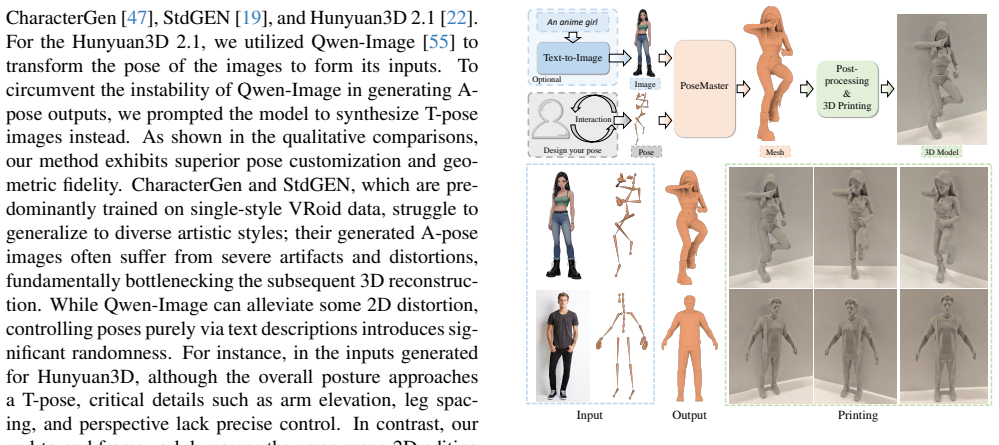
The central discovery is that a conditional flow-matching 3D diffusion transformer can consume a dense 3D skeleton representation alongside an image and directly synthesize a mesh whose pose matches the skeleton. The paper argues this works because the skeleton is densified by distance-weighted interpolation along each bone, and every sampled point carries both coordinates and a bone-direction vector ($P\in\mathbb{R}^{N\times 6}$), giving the network explicit topological and spatial structure that sparse joints lack. Trained on the large-scale triplet dataset, the model achieves state-of-the-art MAE/SIM on pose canonicalization (4.59 MAE vs. 4.97 for StdGen) and on arbitrary-pose stylization (5.28 MAE vs. 6.75 for Hunyuan3D 2.1) even when baselines are given the target-pose image directly. The paper also reports that this strict skeleton-mesh alignment lets a user-specified skeleton act as a controllable rigging condition, so animated assets follow from a skinning model without retargeting.
Load-bearing premise
Two load-bearing assumptions give here: the evaluation scores each predicted mesh against whichever of 36 azimuth-rendered ground-truth normals matches best, so a systematic rotation of the generated pose is never penalized; and the training triplets assume that auto-rigged skeletons from a fine-tuned UniRig are accurately registered to the mesh, with no accuracy check of those rigs.
Editorial extensions
If this is right
- Pose canonicalization from arbitrary-pose images no longer needs a 2D canonicalization stage; feeding the 3D skeleton directly yields A/T-pose meshes with lower normal error than CharacterGen and StdGen.
- For arbitrary-pose stylization, a source image plus target 3D skeleton beats image-conditioned 3D native generators even when those baselines receive the target-pose image itself.
- User-provided skeletons can drive the output mesh's topology, making the model a controllable alternative to autoregressive rigging models like UniRig and Puppeteer.
- Automated skinning can turn PoseMaster outputs into animatable assets driven by existing motion sequences, skipping retargeting.
- Fine-grained details such as hands, skirts, and hair, as well as high-frequency geometry, remain limited at 512 resolution, so the system is a single-stage base for later refinement modules.
Reading between the lines
- If the strict-alignment claim survives a fixed-view evaluation, skeleton-conditioned 3D generation could be extended to non-humanoid topologies (e.g., creatures or mechanical rigs) by swapping the skeleton definition and retraining on the same triplet engine.
- The same densified-skeleton conditioning could serve as an editing handle in latent space: interpolating between two skeletons might interpolate poses, enabling pose blending that 2D cascade pipelines cannot do natively.
- A testable extension is to fine-tune the skeleton encoder with a differentiable pose-consistency loss that re-estimates the skeleton from the generated mesh, so the inference-time metric matches the training objective and the azimuth-selection concern is directly addressed.
- The paper's reported speedup (23.48s vs. 32.98s/61.54s) suggests that single-stage 3D-native generation is also a latency win; if replicated, this favors native 3D architectures over 2D-lifting stacks for production pipelines.
Editorial analysis
A structured set of objections, weighed in public.
Referee Report
Summary. PoseMaster proposes a single-stage 3D native generation model for stylized pose generation. The model takes a single reference image and a 3D skeleton as input, densifies the skeleton into a 256-point point cloud with per-point directional features, encodes this with a point transformer, and injects the result into a Hunyuan3D 2.1 backbone. The training data come from a newly constructed image-skeleton-mesh triplets dataset built by combining animated characters and static meshes, including auto-rigged static assets. The paper reports state-of-the-art results on pose canonicalization and arbitrary-pose stylization, together with an animation/rigging application, and claims strict spatial alignment between generated meshes and conditioning skeletons.
Significance. If the quantitative claims held, the paper would make a meaningful contribution by replacing 2D-skeleton cascade pipelines with a direct 3D condition and by addressing a real data scarcity problem. The skeleton densification with directional encoding is a simple, plausible mechanism, and the qualitative figures suggest genuine benefits for complex poses and self-occluded regions. The data engine is a substantial asset: the described scale (500K objects, millions of pairs) and the cross-pose pairing strategy are plausible sources of the method's generalization. However, the headline evaluation is weakened by a rotation-invariant metric, and the absence of key baselines and error statistics means the significance is conditional on additional evidence.
major comments (3)
- [Sec. 9.1, Tables 1-4] The reported MAE/SIM metric selects the best match among 36 azimuthal renderings of the ground-truth mesh against a fixed front view of the predicted mesh. This makes the score invariant to any constant yaw rotation of the generated mesh, including a 90 or 180 degree rotation relative to the conditioning skeleton. With this protocol, Tables 1-4 cannot support the abstract's claim of 'strict spatial alignment between the generated 3D meshes and the conditioning skeletons,' nor the Sec. 6 rigging application, which depends on exactly that alignment. The paper should report fixed-view metrics, or a direct skeleton-to-mesh correspondence metric such as mean joint error between the generated mesh and the input skeleton, and apply the same protocol to all methods.
- [Sec. 5.2.1 and Tables 1-4] All quantitative comparisons are single numbers on a 50-image VRoid subset with no error bars, confidence intervals, or significance tests, and the VRoid test images come from the same source as the training data. The comparisons also omit SKDream, a recent skeleton-conditioned 3D method discussed in Sec. 2.2; the paper states in Sec. 5.2.2 that a fair comparison is difficult, but then provides no quantitative or qualitative comparison with it. Without error bounds, train/test separation, and the missing skeleton-based baseline, the repeated claim of 'significantly outperforms state-of-the-art methods' is not fully established. Please add statistical evaluation, clarify the train/test split for VRoid, and either include SKDream or justify its omission with concrete evidence.
- [Sec. 9.2, Data details] For static meshes, the corresponding skeletons are produced by an autoregressive model fine-tuned from UniRig, but the paper reports no validation of these inferred rigs. If the auto-rigged skeletons are systematically misaligned with the mesh surface, the training triplets violate the premise of 'strictly aligned' data, and the model learns from erroneous pose labels. The paper should include an accuracy check of the auto-rigging stage, for example joint-to-surface distance or bone-length error on a held-out set of manually rigged meshes.
minor comments (4)
- [Eq. (4), Sec. 4.2.2] The classifier-free guidance scale lambda in Eq. (4) is never reported. Since this scale directly controls the strength of pose adherence versus image appearance, please provide its value and, ideally, a small sensitivity study.
- [Sec. 5.3.1, Figure 7] The pose representation ablation compares sparse joints with the proposed dense point cloud only qualitatively; a quantitative table would strengthen the claim that the densification and directional features are the cause of the improvement.
- [Sec. 11] The Limitation section discusses spatial resolution and fine-grained details but does not mention that the evaluation protocol includes a best-of-36 azimuthal alignment step. If the protocol is retained, the accompanying caveat should be stated explicitly.
- [Abstract and Sec. 1] There are minor capitalization inconsistencies, e.g., 'the 3d pose stylization' appears in the Abstract and in Sec. 1; these should be corrected to '3D'.
Circularity Check
No circular derivation; the evaluation metric concern is a validity issue, not circularity.
full rationale
PoseMaster is an empirical system rather than a derivation. The pose-conditioned generator is trained on image-skeleton-mesh triplets, so the claimed pose alignment is a learned input-output mapping, not a quantity fitted to the evaluation set. The self-citations to Hunyuan3D 2.1 (backbone initialization, watertight preprocessing) overlap with the author team, but the reported gains are measured against Hunyuan3D 2.1 itself as a baseline (Tables 1-3), so the citation is not load-bearing in a circular sense. The best-of-36 azimuth normal-metric protocol in Sec. 9.1 is a legitimate evaluation-validity concern because it can conceal rotational misalignment, but it is not a circularity: it is a selection statistic over a nuisance parameter, not a fitted parameter renamed as a prediction, and it does not enter the training or generation process. No equation or definition in the paper makes an output equal to its input by construction, and the central claim is supported by external benchmarks and ablations rather than by a self-referential fit.
Assumptions & free parameters
free parameters (4)
- skeleton densification interval =
0.005
- point cloud size after FPS =
256
- CFG guidance scale lambda =
not reported
- fine-tuning learning rate =
1e-5
assumptions (4)
- standard math Flow matching / rectified flow objective
- domain assumption Strict spatial registration between skeletons and meshes holds for the constructed dataset
- ad hoc to paper Best-of-36 azimuthal alignment is an appropriate evaluation for pose fidelity
- domain assumption The 3D skeleton, excluding hair and skirt bones, is sufficient to define a humanoid pose
Cite this review
Pith. "Pith review of PoseMaster: A Unified 3D Native Framework for Stylized Pose Generation." pith.science (2026). https://pith.science/paper/OPYP36QS
@misc{pith2026250621076,
  author       = {Pith},
  title        = {Pith review of: PoseMaster: A Unified 3D Native Framework for Stylized Pose Generation},
  year         = {2026},
  howpublished = {\url{https://pith.science/paper/OPYP36QS}},
  note         = {Machine review of arXiv:2506.21076}
}
read the original abstract
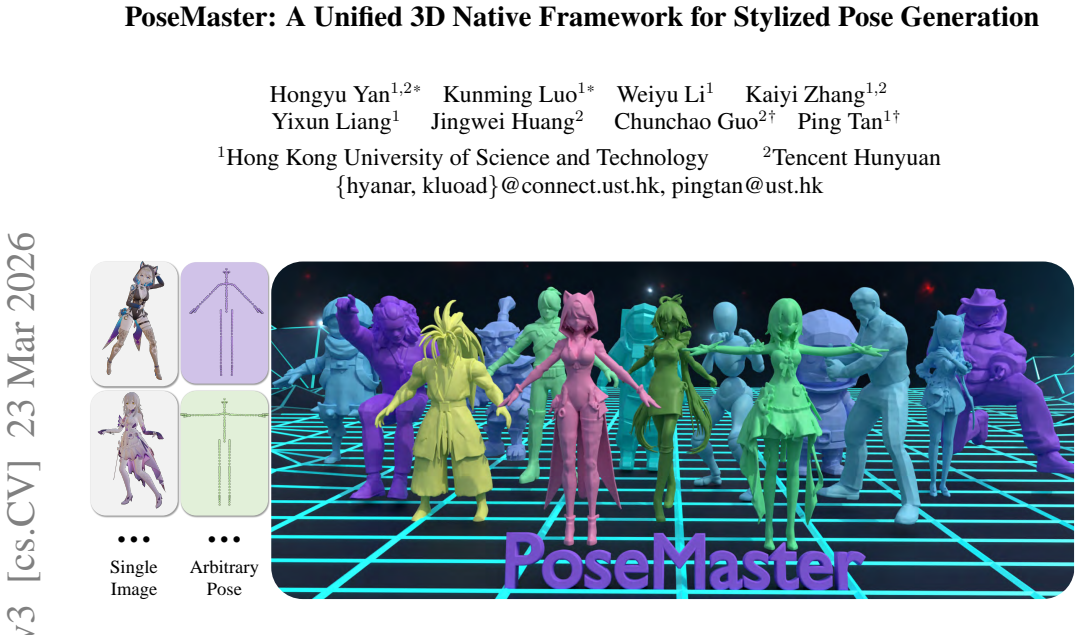
Pose stylization, which aims to synthesize stylized content aligning with target poses, serves as a fundamental task across 2D, 3D, and video domains. In the 3D realm, prevailing approaches typically rely on a cascade pipeline: first manipulating the image pose via 2D foundation models and subsequently lifting it into 3D representations. However, this paradigm limits the precision and diversity of the 3d pose stylization. To this end, we propose a novel paradigm for 3D pose stylization that unifies pose stylization and 3D generation within a cohesive framework. This integration minimizes the risk of cumulative errors and enhances the model's efficiency and effectiveness. In addition, diverging from previous works that typically utilize 2D skeleton images as guidance, we directly utilize the 3D skeleton because it can provide a more accurate representation of 3D spatial and topological relationships, which significantly enhances the model's capacity to achieve richer and more precise pose stylization. Moreover, we develop a scalable data engine to construct a large-scale dataset of ''Image-Skeleton-Mesh'' triplets, enabling the model to jointly learn identity preservation and geometric alignment. Extensive experiments demonstrate that PoseMaster significantly outperforms state-of-the-art methods in both qualitative and quantitative metrics. Owing to the strict spatial alignment between the generated 3D meshes and the conditioning skeletons, PoseMaster enables the direct creation of animatable assets when coupled with automated skinning models, highlighting its compelling potential for automated character rigging.
Figures


Figures from the paper (14 more)




Forward citations
Cited by 1 Pith paper
-
Axolotl3D: a Unified Framework for Faithful 3D Shape Completion
A single diffusion model, fine-tuned from Hunyuan3D, completes 3D shapes from any mix of images, masks, cameras, and point clouds, reaching state-of-the-art or competitive accuracy on Toys4K and OmniObject3D.
Reference graph
Works this paper leans on
-
[1]
https://openai.com/index/hello-gpt-4o/
Gpt4-o, 2025. https://openai.com/index/hello-gpt-4o/. 2
2025
-
[2]
https://aistudio.google.com/models/gemini- 2-5-flash-image
Nanobanana, 2025. https://aistudio.google.com/models/gemini- 2-5-flash-image. 2
work page 2025
- [3]
- [4]
- [5]
- [6]
- [7]
-
[8]
V oxset: Sparse voxel set tokenizer for 3d shape generation
Anonymous. V oxset: Sparse voxel set tokenizer for 3d shape generation. InSubmitted to The Fourteenth International Conference on Learning Representations, 2025. under re- view. 3
work page 2025
Show all 81 references
-
[9]
Dreamavatar: Text-and-shape guided 3d hu- man avatar generation via diffusion models.arXiv preprint arXiv:2304.00916, 2023
Yukang Cao, Yan-Pei Cao, Kai Han, Ying Shan, and Kwan- Yee K Wong. Dreamavatar: Text-and-shape guided 3d hu- man avatar generation via diffusion models.arXiv preprint arXiv:2304.00916, 2023. 2
2023 arXiv
-
[10]
Openpose: Realtime multi-person 2d pose estimation using part affinity fields.IEEE transactions on pattern analysis and machine intelligence, 43(1):172–186,
Zhe Cao, Gines Hidalgo, Tomas Simon, Shih-En Wei, and Yaser Sheikh. Openpose: Realtime multi-person 2d pose estimation using part affinity fields.IEEE transactions on pattern analysis and machine intelligence, 43(1):172–186,
-
[11]
Lafite: A generative latent field for 3d native texturing.arXiv preprint arXiv:2512.04786, 2025
Chia-Hao Chen, Zi-Xin Zou, Yan-Pei Cao, Ze Yuan, Guan Luo, Xiaojuan Qi, Ding Liang, Song-Hai Zhang, and Yuan- Chen Guo. Lafite: A generative latent field for 3d native texturing.arXiv preprint arXiv:2512.04786, 2025. 14
2025
-
[12]
Ultra3d: Efficient and high- fidelity 3d generation with part attention.arXiv preprint arXiv:2507.17745, 2025
Yiwen Chen, Zhihao Li, Yikai Wang, Hu Zhang, Qin Li, Chi Zhang, and Guosheng Lin. Ultra3d: Efficient and high- fidelity 3d generation with part attention.arXiv preprint arXiv:2507.17745, 2025. 3
2025 arXiv
-
[13]
Learning implicit fields for generative shape modeling
Zhiqin Chen and Hao Zhang. Learning implicit fields for generative shape modeling. InCVPR, pages 5939–5948,
-
[14]
3dtopia-xl: High-quality 3d pbr asset generation via primitive diffusion.arXiv preprint arXiv:2409.12957, 2024
Zhaoxi Chen, Jiaxiang Tang, Yuhao Dong, Ziang Cao, Fangzhou Hong, Yushi Lan, Tengfei Wang, Haozhe Xie, Tong Wu, Shunsuke Saito, Liang Pan, Dahua Lin, and Zi- wei Liu. 3dtopia-xl: High-quality 3d pbr asset generation via primitive diffusion.arXiv preprint arXiv:2409.12957, 2024. 3
2024 arXiv
-
[15]
Human- rig: Learning automatic rigging for humanoid character in a large scale dataset
Zedong Chu, Feng Xiong, Meiduo Liu, Jinzhi Zhang, Mingqi Shao, Zhaoxu Sun, Di Wang, and Mu Xu. Human- rig: Learning automatic rigging for humanoid character in a large scale dataset. InProceedings of the Computer Vision and Pattern Recognition Conference, pages 304–313, 2025. 4
2025
-
[16]
Objaverse-xl: A universe of 10m+ 3d objects.Advances in Neural Informa- tion Processing Systems, 36:35799–35813, 2023
Matt Deitke, Ruoshi Liu, Matthew Wallingford, Huong Ngo, Oscar Michel, Aditya Kusupati, Alan Fan, Christian Laforte, Vikram V oleti, Samir Yitzhak Gadre, et al. Objaverse-xl: A universe of 10m+ 3d objects.Advances in Neural Informa- tion Processing Systems, 36:35799–35813, 2023. 4
2023
-
[17]
Objaverse: A universe of annotated 3d objects
Matt Deitke, Dustin Schwenk, Jordi Salvador, Luca Weihs, Oscar Michel, Eli VanderBilt, Ludwig Schmidt, Kiana Ehsani, Aniruddha Kembhavi, and Ali Farhadi. Objaverse: A universe of annotated 3d objects. InProceedings of the IEEE/CVF conference on computer vision and pattern reco...
2023
-
[18]
Geowiz- ard: Unleashing the diffusion priors for 3d geometry esti- mation from a single image
Xiao Fu, Wei Yin, Mu Hu, Kaixuan Wang, Yuexin Ma, Ping Tan, Shaojie Shen, Dahua Lin, and Xiaoxiao Long. Geowiz- ard: Unleashing the diffusion priors for 3d geometry esti- mation from a single image. InEuropean Conference on Computer Vision, pages 241–258. Springer, 2024. 5
2024
-
[19]
Stdgen: Semantic-decomposed 3d character generation from single images.arXiv preprint arXiv:2411.05738, 2024
Yuze He, Yanning Zhou, Wang Zhao, Zhongkai Wu, Kai- wen Xiao, Wei Yang, Yong-Jin Liu, and Xiao Han. Stdgen: Semantic-decomposed 3d character generation from single images.arXiv preprint arXiv:2411.05738, 2024. 2, 3, 4, 6, 13, 15
2024 arXiv
-
[20]
Lrm: Large reconstruction model for single image to 3d.arXiv preprint arXiv:2311.04400, 2023
Yicong Hong, Kai Zhang, Jiuxiang Gu, Sai Bi, Yang Zhou, Difan Liu, Feng Liu, Kalyan Sunkavalli, Trung Bui, and Hao Tan. Lrm: Large reconstruction model for single image to 3d.arXiv preprint arXiv:2311.04400, 2023. 3
2023 arXiv
-
[21]
Animate anyone: Consistent and controllable image- to-video synthesis for character animation
Li Hu. Animate anyone: Consistent and controllable image- to-video synthesis for character animation. InProceedings of the IEEE/CVF Conference on Computer Vision and Pattern Recognition, pages 8153–8163, 2024. 2, 6
2024
-
[22]
Hunyuan3d 2.1: From images to high- fidelity 3d assets with production-ready pbr material.arXiv preprint arXiv:2506.15442, 2025
Team Hunyuan3D, Shuhui Yang, Mingxin Yang, Yifei Feng, Xin Huang, Sheng Zhang, Zebin He, Di Luo, Haolin Liu, Yunfei Zhao, et al. Hunyuan3d 2.1: From images to high- fidelity 3d assets with production-ready pbr material.arXiv preprint arXiv:2506.15442, 2025. 3, 4, 5, 6, 7, 8, 12, 15
2025 arXiv
-
[23]
Avatar- craft: Transforming text into neural human avatars with pa- rameterized shape and pose control
Ruixiang Jiang, Can Wang, Jingbo Zhang, Menglei Chai, Mingming He, Dongdong Chen, and Jing Liao. Avatar- craft: Transforming text into neural human avatars with pa- rameterized shape and pose control. InProceedings of the IEEE/CVF International Conference on Computer Vision, p...
2023
-
[24]
Marigold: Affordable adaptation of diffusion- based image generators for image analysis.arXiv preprint arXiv:2505.09358, 2025
Bingxin Ke, Kevin Qu, Tianfu Wang, Nando Metzger, Shengyu Huang, Bo Li, Anton Obukhov, and Konrad Schindler. Marigold: Affordable adaptation of diffusion- based image generators for image analysis.arXiv preprint arXiv:2505.09358, 2025. 5
2025 arXiv
-
[25]
Dreamhuman: Animatable 3d avatars from text.Advances in Neural Information Processing Systems, 36:10516–10529,
Nikos Kolotouros, Thiemo Alldieck, Andrei Zanfir, Ed- uard Bazavan, Mihai Fieraru, and Cristian Sminchisescu. Dreamhuman: Animatable 3d avatars from text.Advances in Neural Information Processing Systems, 36:10516–10529,
-
[26]
Hunyuan3d 2.5: Towards high- fidelity 3d assets generation with ultimate details.arXiv preprint arXiv:2506.16504, 2025
Zeqiang Lai, Yunfei Zhao, Haolin Liu, Zibo Zhao, Qingxi- ang Lin, Huiwen Shi, Xianghui Yang, Mingxin Yang, Shuhui Yang, Yifei Feng, et al. Hunyuan3d 2.5: Towards high- fidelity 3d assets generation with ultimate details.arXiv preprint arXiv:2506.16504, 2025. 14, 15
2025 arXiv
-
[27]
Natex: Seamless texture generation as latent color diffusion.arXiv preprint arXiv:2511.16317, 2025
Zeqiang Lai, Yunfei Zhao, Zibo Zhao, Xin Yang, Xin Huang, Jingwei Huang, Xiangyu Yue, and Chunchao Guo. Natex: Seamless texture generation as latent color diffusion.arXiv preprint arXiv:2511.16317, 2025. 14
2025
-
[28]
Ln3diff: Scalable latent neural fields diffusion for speedy 3d generation
Yushi Lan, Fangzhou Hong, Shuai Yang, Shangchen Zhou, Xuyi Meng, Bo Dai, Xingang Pan, and Chen Change Loy. Ln3diff: Scalable latent neural fields diffusion for speedy 3d generation. InECCV, 2024. 3
2024
-
[29]
Gaussiananything: Interactive point cloud latent diffu- sion for 3d generation
Yushi Lan, Shangchen Zhou, Zhaoyang Lyu, Fangzhou Hong, Shuai Yang, Bo Dai, Xingang Pan, and Chen Change Loy. Gaussiananything: Interactive point cloud latent diffu- sion for 3d generation. InICLR, 2025. 3
2025
-
[30]
Point cloud gan.arXiv preprint arXiv:1810.05795, 2018
Chun-Liang Li, Manzil Zaheer, Yang Zhang, Barnabas Poc- zos, and Ruslan Salakhutdinov. Point cloud gan.arXiv preprint arXiv:1810.05795, 2018. 3
2018 arXiv
-
[31]
Era3d: High-resolution multiview diffusion using efficient row-wise attention.arXiv preprint arXiv:2405.11616, 2024
Peng Li, Yuan Liu, Xiaoxiao Long, Feihu Zhang, Cheng Lin, Mengfei Li, Xingqun Qi, Shanghang Zhang, Wenhan Luo, Ping Tan, et al. Era3d: High-resolution multiview diffusion using efficient row-wise attention.arXiv preprint arXiv:2405.11616, 2024. 3
2024 arXiv
-
[32]
Craftsman: High-fidelity mesh generation with 3d native generation and interactive geometry refiner.arXiv preprint arXiv:2405.14979, 2024
Weiyu Li, Jiarui Liu, Rui Chen, Yixun Liang, Xuelin Chen, Ping Tan, and Xiaoxiao Long. Craftsman: High-fidelity mesh generation with 3d native generation and interactive geometry refiner.arXiv preprint arXiv:2405.14979, 2024. 3, 4, 6, 7, 8, 12
2024 arXiv
-
[33]
Step1x-3d: Towards high-fidelity and con- trollable generation of textured 3d assets.arXiv preprint arXiv:2505.07747, 2025
Weiyu Li, Xuanyang Zhang, Zheng Sun, Di Qi, Hao Li, Wei Cheng, Weiwei Cai, Shihao Wu, Jiarui Liu, Zihao Wang, et al. Step1x-3d: Towards high-fidelity and con- trollable generation of textured 3d assets.arXiv preprint arXiv:2505.07747, 2025. 3
2025 arXiv
-
[34]
Triposg: High- fidelity 3d shape synthesis using large-scale rectified flow models.CoRR, abs/2502.06608, 2025
Yangguang Li, Zi-Xin Zou, Zexiang Liu, Dehu Wang, Yuan Liang, Zhipeng Yu, Xingchao Liu, Yuan-Chen Guo, Ding Liang, Wanli Ouyang, and Yan-Pei Cao. Triposg: High- fidelity 3d shape synthesis using large-scale rectified flow models.CoRR, abs/2502.06608, 2025. 3
2025 arXiv
-
[35]
Sparc3d: Sparse representation and construc- tion for high-resolution 3d shapes modeling.arXiv preprint arXiv:2505.14521, 2025
Zhihao Li, Yufei Wang, Heliang Zheng, Yihao Luo, and Bihan Wen. Sparc3d: Sparse representation and construc- tion for high-resolution 3d shapes modeling.arXiv preprint arXiv:2505.14521, 2025. 15
2025 arXiv
-
[36]
Unitex: Univer- sal high fidelity generative texturing for 3d shapes.arXiv preprint arXiv:2505.23253, 2025
Yixun Liang, Kunming Luo, Xiao Chen, Rui Chen, Hongyu Yan, Weiyu Li, Jiarui Liu, and Ping Tan. Unitex: Univer- sal high fidelity generative texturing for 3d shapes.arXiv preprint arXiv:2505.23253, 2025. 14
2025 arXiv
-
[37]
Tada! text to animatable digital avatars
Tingting Liao, Hongwei Yi, Yuliang Xiu, Jiaxiang Tang, Yangyi Huang, Justus Thies, and Michael J Black. Tada! text to animatable digital avatars. In2024 International Con- ference on 3D Vision (3DV), pages 1508–1519. IEEE, 2024. 2
2024
-
[38]
Flow straight and fast: Learning to generate and transfer data with rectified flow.arXiv preprint arXiv:2209.03003, 2022
Xingchao Liu, Chengyue Gong, and Qiang Liu. Flow straight and fast: Learning to generate and transfer data with rectified flow.arXiv preprint arXiv:2209.03003, 2022. 3
2022 arXiv
-
[39]
Deepfashion: Powering robust clothes recog- nition and retrieval with rich annotations
Ziwei Liu, Ping Luo, Shi Qiu, Xiaogang Wang, and Xi- aoou Tang. Deepfashion: Powering robust clothes recog- nition and retrieval with rich annotations. InProceedings of IEEE Conference on Computer Vision and Pattern Recogni- tion (CVPR), 2016. 15, 16
2016
-
[40]
Black, Derek Nowrouzezahrai, Liam Paull, and Weiyang Liu
Zhen Liu, Yao Feng, Michael J. Black, Derek Nowrouzezahrai, Liam Paull, and Weiyang Liu. Meshd- iffusion: Score-based generative 3d mesh modeling. In International Conference on Learning Representations,
-
[41]
Wonder3d: Sin- gle image to 3d using cross-domain diffusion.arXiv preprint arXiv:2310.15008, 2023
Xiaoxiao Long, Yuan-Chen Guo, Cheng Lin, Yuan Liu, Zhiyang Dou, Lingjie Liu, Yuexin Ma, Song-Hai Zhang, Marc Habermann, Christian Theobalt, et al. Wonder3d: Sin- gle image to 3d using cross-domain diffusion.arXiv preprint arXiv:2310.15008, 2023. 3
-
[42]
Ctr3d: Cross-view token reduction for dense multi-view generation
Kunming Luo, Hongyu Yan, Yuan Liu, Zihao Zhang, Manyuan Zhang, Wenping Wang, and Ping Tan. Ctr3d: Cross-view token reduction for dense multi-view generation. InThirteenth International Conference on 3D Vision. 3
-
[43]
Polygen: An autoregressive generative model of 3d meshes
Charlie Nash, Yaroslav Ganin, SM Ali Eslami, and Peter Battaglia. Polygen: An autoregressive generative model of 3d meshes. InInternational conference on machine learning, pages 7220–7229. PMLR, 2020. 3
2020
-
[44]
Maxime Oquab, Timoth ´ee Darcet, Theo Moutakanni, Huy V . V o, Marc Szafraniec, Vasil Khalidov, Pierre Fernandez, Daniel Haziza, Francisco Massa, Alaaeldin El-Nouby, Rus- sell Howes, Po-Yao Huang, Hu Xu, Vasu Sharma, Shang- Wen Li, Wojciech Galuba, Mike Rabbat, Mido Assran, Ni...
2023
-
[45]
Deepsdf: Learning con- tinuous signed distance functions for shape representation
Jeong Joon Park, Peter Florence, Julian Straub, Richard Newcombe, and Steven Lovegrove. Deepsdf: Learning con- tinuous signed distance functions for shape representation. InCVPR, pages 165–174, 2019. 3
2019
-
[46]
Controlnext: Powerful and effi- cient control for image and video generation.arXiv preprint arXiv:2408.06070, 2024
Bohao Peng, Jian Wang, Yuechen Zhang, Wenbo Li, Ming- Chang Yang, and Jiaya Jia. Controlnext: Powerful and effi- cient control for image and video generation.arXiv preprint arXiv:2408.06070, 2024. 2
2024 arXiv
-
[47]
Charactergen: Efficient 3d character generation from single images with multi-view pose canon- icalization.ACM Transactions on Graphics (TOG), 43(4): 1–13, 2024
Hao-Yang Peng, Jia-Peng Zhang, Meng-Hao Guo, Yan-Pei Cao, and Shi-Min Hu. Charactergen: Efficient 3d character generation from single images with multi-view pose canon- icalization.ACM Transactions on Graphics (TOG), 43(4): 1–13, 2024. 2, 3, 4, 6, 12, 13, 15, 18
2024
-
[48]
Pointnet++: Deep hierarchical feature learning on point sets in a metric space.Advances in neural information processing systems, 30, 2017
Charles Ruizhongtai Qi, Li Yi, Hao Su, and Leonidas J Guibas. Pointnet++: Deep hierarchical feature learning on point sets in a metric space.Advances in neural information processing systems, 30, 2017. 5
2017
-
[49]
Xcube: Large-scale 3d generative modeling using sparse voxel hierarchies
Xuanchi Ren, Jiahui Huang, Xiaohui Zeng, Ken Museth, Sanja Fidler, and Francis Williams. Xcube: Large-scale 3d generative modeling using sparse voxel hierarchies. InPro- ceedings of the IEEE/CVF Conference on Computer Vision and Pattern Recognition, 2024. 3
2024
-
[50]
High-resolution image syn- thesis with latent diffusion models
Robin Rombach, Andreas Blattmann, Dominik Lorenz, Patrick Esser, and Bj¨orn Ommer. High-resolution image syn- thesis with latent diffusion models. InCVPR, 2022. 2
2022
-
[51]
Meshgpt: Generating triangle meshes with decoder-only transformers
Yawar Siddiqui, Antonio Alliegro, Alexey Artemov, Ta- tiana Tommasi, Daniele Sirigatti, Vladislav Rosov, Angela Dai, and Matthias Nießner. Meshgpt: Generating triangle meshes with decoder-only transformers. InProceedings of the IEEE/CVF conference on computer vision and patter...
2024
-
[52]
Puppeteer: Rig and animate your 3d models.Ad- vances in Neural Information Processing Systems, 2025
Chaoyue Song, Xiu Li, Fan Yang, Zhongcong Xu, Jiacheng Wei, Fayao Liu, Jiashi Feng, Guosheng Lin, and Jianfeng Zhang. Puppeteer: Rig and animate your 3d models.Ad- vances in Neural Information Processing Systems, 2025. 8
2025
-
[53]
Animate-x: Universal character image ani- mation with enhanced motion representation.arXiv preprint arXiv:2410.10306, 2024
Shuai Tan, Biao Gong, Xiang Wang, Shiwei Zhang, Dandan Zheng, Ruobing Zheng, Kecheng Zheng, Jingdong Chen, and Ming Yang. Animate-x: Universal character image ani- mation with enhanced motion representation.arXiv preprint arXiv:2410.10306, 2024. 2, 12
-
[54]
Unianimate: Taming unified video diffusion mod- els for consistent human image animation.arXiv preprint arXiv:2406.01188, 2024
Xiang Wang, Shiwei Zhang, Changxin Gao, Jiayu Wang, Xiaoqiang Zhou, Yingya Zhang, Luxin Yan, and Nong Sang. Unianimate: Taming unified video diffusion mod- els for consistent human image animation.arXiv preprint arXiv:2406.01188, 2024. 2, 6
2024 arXiv
-
[55]
Qwen-image technical report.arXiv preprint arXiv:2508.02324, 2025
Chenfei Wu, Jiahao Li, Jingren Zhou, Junyang Lin, Kaiyuan Gao, Kun Yan, Sheng-ming Yin, Shuai Bai, Xiao Xu, Yilei Chen, et al. Qwen-image technical report.arXiv preprint arXiv:2508.02324, 2025. 2, 12, 13, 14, 15
2025 arXiv
-
[56]
Direct3d: Scalable image-to-3d generation via 3d latent diffusion transformer
Shuang Wu, Youtian Lin, Feihu Zhang, Yifei Zeng, Jingxi Xu, Philip Torr, Xun Cao, and Yao Yao. Direct3d: Scalable image-to-3d generation via 3d latent diffusion transformer. arXiv preprint arXiv:2405.14832, 2024. 3
2024 arXiv
-
[57]
Direct3d-s2: Gigascale 3d gener- ation made easy with spatial sparse attention.CoRR, abs/2505.17412, 2025
Shuang Wu, Youtian Lin, Feihu Zhang, Yifei Zeng, Yikang Yang, Yajie Bao, Jiachen Qian, Siyu Zhu, Xun Cao, Philip Torr, and Yao Yao. Direct3d-s2: Gigascale 3d gener- ation made easy with spatial sparse attention.CoRR, abs/2505.17412, 2025. 3, 15
2025 arXiv
-
[58]
Structured 3d latents for scalable and versatile 3d gen- eration
Jianfeng Xiang, Zelong Lv, Sicheng Xu, Yu Deng, Ruicheng Wang, Bowen Zhang, Dong Chen, Xin Tong, and Jiaolong Yang. Structured 3d latents for scalable and versatile 3d gen- eration. InProceedings of the Computer Vision and Pattern Recognition Conference, pages 21469–21480, 202...
2025
-
[59]
Omnicontrol: Control any joint at any time for human motion generation.arXiv preprint arXiv:2310.08580,
Yiming Xie, Varun Jampani, Lei Zhong, Deqing Sun, and Huaizu Jiang. Omnicontrol: Control any joint at any time for human motion generation.arXiv preprint arXiv:2310.08580,
-
[60]
Hypermotion: Dit- based pose-guided human image animation of complex mo- tions, 2025
Shuolin Xu, Siming Zheng, Ziyi Wang, HC Yu, Jinwei Chen, Huaqi Zhang, Bo Li, and Peng-Tao Jiang. Hypermotion: Dit- based pose-guided human image animation of complex mo- tions, 2025. 2
2025
-
[61]
Skdream: Con- trollable multi-view and 3d generation with arbitrary skele- tons
Yuanyou Xu, Zongxin Yang, and Yi Yang. Skdream: Con- trollable multi-view and 3d generation with arbitrary skele- tons. InProceedings of the Computer Vision and Pattern Recognition Conference, pages 314–325, 2025. 2, 3, 6
2025
-
[62]
Ulip: Learning a unified representation of language, images, and point clouds for 3d understanding
Le Xue, Mingfei Gao, Chen Xing, Roberto Mart ´ın-Mart´ın, Jiajun Wu, Caiming Xiong, Ran Xu, Juan Carlos Niebles, and Silvio Savarese. Ulip: Learning a unified representation of language, images, and point clouds for 3d understanding. InProceedings of the IEEE/CVF conference on...
2023
-
[63]
Symmcompletion: High-fidelity and high-consistency point cloud completion with symmetry guidance
Hongyu Yan, Zijun Li, Kunming Luo, Li Lu, and Ping Tan. Symmcompletion: High-fidelity and high-consistency point cloud completion with symmetry guidance. InProceed- ings of the AAAI Conference on Artificial Intelligence, pages 9094–9102, 2025. 5
2025
-
[64]
Fbnet: Feedback network for point cloud completion
Xuejun Yan, Hongyu Yan, Jingjing Wang, Hang Du, Zhi- hong Wu, Di Xie, Shiliang Pu, and Li Lu. Fbnet: Feedback network for point cloud completion. InEuropean conference on computer vision, pages 676–693. Springer, 2022. 5
2022
-
[65]
Pointflow: 3d point cloud generation with continuous normalizing flows.arXiv, 2019
Guandao Yang, Xun Huang, Zekun Hao, Ming-Yu Liu, Serge Belongie, and Bharath Hariharan. Pointflow: 3d point cloud generation with continuous normalizing flows.arXiv, 2019. 3
2019
-
[66]
Hi3dgen: High-fidelity 3d geometry generation from im- ages via normal bridging.arXiv preprint arXiv:2503.22236,
Chongjie Ye, Yushuang Wu, Ziteng Lu, Jiahao Chang, Xi- aoyang Guo, Jiaqing Zhou, Hao Zhao, and Xiaoguang Han. Hi3dgen: High-fidelity 3d geometry generation from im- ages via normal bridging.arXiv preprint arXiv:2503.22236,
-
[67]
3dshape2vecset: A 3d shape representation for neu- ral fields and generative diffusion models.ACM Transactions on Graphics (TOG), 42(4):1–16, 2023
Biao Zhang, Jiapeng Tang, Matthias Niessner, and Peter Wonka. 3dshape2vecset: A 3d shape representation for neu- ral fields and generative diffusion models.ACM Transactions on Graphics (TOG), 42(4):1–16, 2023. 3
2023
-
[68]
Avatarverse: High-quality & stable 3d avatar creation from text and pose
Huichao Zhang, Bowen Chen, Hao Yang, Liao Qu, Xu Wang, Li Chen, Chao Long, Feida Zhu, Kang Du, and Min Zheng. Avatarverse: High-quality & stable 3d avatar creation from text and pose. 2023. 2
2023
-
[69]
One model to rig them all: Diverse skeleton rigging with unirig.ACM Trans
Jia-Peng Zhang, Cheng-Feng Pu, Meng-Hao Guo, Yan-Pei Cao, and Shi-Min Hu. One model to rig them all: Diverse skeleton rigging with unirig.ACM Trans. Graph., 44(4),
-
[70]
Adding conditional control to text-to-image diffusion models
Lvmin Zhang, Anyi Rao, and Maneesh Agrawala. Adding conditional control to text-to-image diffusion models. In Proceedings of the IEEE/CVF international conference on computer vision, pages 3836–3847, 2023. 2, 6
2023
-
[71]
Clay: A controllable large-scale generative model for creat- ing high-quality 3d assets.ACM Transactions on Graphics (TOG), 43(4):1–20, 2024
Longwen Zhang, Ziyu Wang, Qixuan Zhang, Qiwei Qiu, Anqi Pang, Haoran Jiang, Wei Yang, Lan Xu, and Jingyi Yu. Clay: A controllable large-scale generative model for creat- ing high-quality 3d assets.ACM Transactions on Graphics (TOG), 43(4):1–20, 2024. 3, 4
2024
-
[72]
Joint2human: High-quality 3d human genera- tion via compact spherical embedding of 3d joints
Muxin Zhang, Qiao Feng, Zhuo Su, Chao Wen, Zhou Xue, and Kun Li. Joint2human: High-quality 3d human genera- tion via compact spherical embedding of 3d joints. InPro- ceedings of the IEEE/CVF Conference on Computer Vision and Pattern Recognition, pages 1429–1438, 2024. 5
2024
-
[73]
Avatarstu- dio: High-fidelity and animatable 3d avatar creation from text.International Journal of Computer Vision, pages 1–19,
Xuanmeng Zhang, Jianfeng Zhang, Chenxu Zhang, Jun Hao Liew, Huichao Zhang, Yi Yang, and Jiashi Feng. Avatarstu- dio: High-fidelity and animatable 3d avatar creation from text.International Journal of Computer Vision, pages 1–19,
-
[74]
Easycontrol: Adding efficient and flexible control for diffusion transformer.arXiv preprint arXiv:2503.07027, 2025
Yuxuan Zhang, Yirui Yuan, Yiren Song, Haofan Wang, and Jiaming Liu. Easycontrol: Adding efficient and flexible control for diffusion transformer.arXiv preprint arXiv:2503.07027, 2025. 2
2025 arXiv
-
[75]
Uni-controlnet: All-in-one control to text-to-image diffusion models.Advances in Neural Information Processing Sys- tems, 36:11127–11150, 2023
Shihao Zhao, Dongdong Chen, Yen-Chun Chen, Jianmin Bao, Shaozhe Hao, Lu Yuan, and Kwan-Yee K Wong. Uni-controlnet: All-in-one control to text-to-image diffusion models.Advances in Neural Information Processing Sys- tems, 36:11127–11150, 2023. 2
2023
-
[76]
Michelangelo: Conditional 3d shape generation based on shape-image-text aligned latent representation
Zibo Zhao, Wen Liu, Xin Chen, Xianfang Zeng, Rui Wang, Pei Cheng, BIN FU, Tao Chen, Gang YU, and Shenghua Gao. Michelangelo: Conditional 3d shape generation based on shape-image-text aligned latent representation. In NeurIPS, 2023. 3
2023
-
[77]
Uni3d: Exploring unified 3d representation at scale.arXiv preprint arXiv:2310.06773,
Junsheng Zhou, Jinsheng Wang, Baorui Ma, Yu-Shen Liu, Tiejun Huang, and Xinlong Wang. Uni3d: Exploring unified 3d representation at scale.arXiv preprint arXiv:2310.06773,
-
[78]
3d shape generation and completion through point-voxel diffusion
Linqi Zhou, Yilun Du, and Jiajun Wu. 3d shape generation and completion through point-voxel diffusion. InProceed- ings of the IEEE/CVF international conference on computer vision, pages 5826–5835, 2021. 3
2021
-
[79]
Additional Details In this section, we provide additional details to clarify our method, including metric computation, data details, and skeleton definition. 9.1. Metric Computation Given the sensitivity of Chamfer Distance (CD) to shape alignment and point distribution—partic...
-
[80]
Fol- lowing these comparisons, we provide a comprehensive analysis of the computational efficiency and structural ro- bustness of our proposed framework
Additional Experimental Results In this section, we present extended comparative evalua- tions, featuring additional qualitative visualizations for both arbitrary-pose stylization and pose canonicalization. Fol- lowing these comparisons, we provide a comprehensive analysis of ...
-
[81]
Limitation and Discussion First, we acknowledge that native 3D pose stylization re- mains a highly challenging task. While our framework demonstrates strong overall pose controllability, synthesiz- ing fine-grained geometric details—such as intricate hand gestures, flowing ski...
Reviewed August 6, 2026 · model on record in the stance chip above.
Discussion (0). Sign in to comment.