REVIEW 3 major objections 6 minor 62 references
One model completes 3D shapes from images, masks, cameras, and partial point clouds, outperforming task-specific pipelines on both clean and occluded benchmarks.
Reviewed by Pith at T0; open to challenge. T0 means a machine referee read the full paper against a public rubric. the ladder, T0–T4 →
A single diffusion model, fine-tuned from Hunyuan3D, completes 3D shapes from any mix of images, masks, cameras, and point clouds, reaching state-of-the-art or competitive accuracy on Toys4K and OmniObject3D.
T0 review reviewed 2026-08-01 challenge →
load-bearing objection Solid, honest engineering paper with a plausible unified conditioning stack; verdict conditional on code release and real-occlusion validation. the 3 major comments →
Axolotl3D: a Unified Framework for Faithful 3D Shape Completion
The pith
A machine-rendered reading of the paper's core claim, the machinery that carries it, and where it could break.
The reading
Core claim
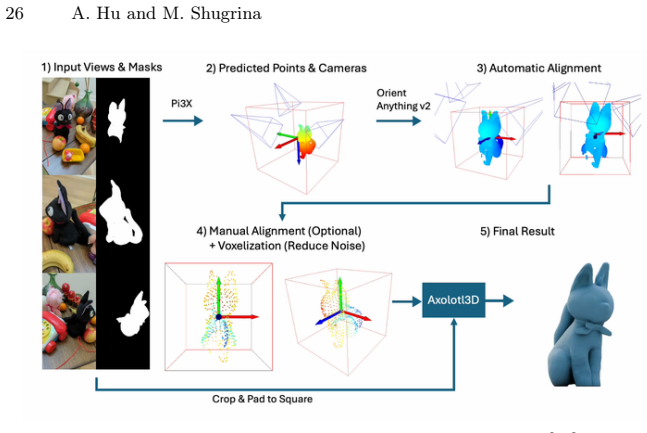
Axolotl3D shows that one model, jointly conditioned on images, visibility masks, camera parameters, and a partial point cloud, can complete 3D shapes faithfully across single-view generation, sparse multi-view reconstruction, occlusion completion, and geometry-aware editing. The point cloud is the geometric anchor: it keeps generated geometry faithful to known regions, while camera Plücker embeddings and mask-biased cross-attention ensure multi-view consistency and prevent occluded image tokens from interfering. A unified training strategy synthesizes diverse conditioning regimes—random brush/box occluders, large-area point dropout, and simulated edit regions—from large-scale mesh data, enab
What carries the argument
The central mechanism is multi-modal condition-token fusion through mask-biased cross-attention in a flow-based diffusion transformer. Images are encoded with a self-supervised visual encoder and enriched with Plücker ray embeddings from camera parameters; the partial point cloud is encoded into a fixed-length latent by a point-cloud encoder; and per-view visibility masks are patchified into an attention bias that sets occluded visual tokens to negative infinity. A gated feed-forward network projects each modality's tokens to a shared channel dimension, and learnable modality embeddings keep visual and geometric tokens distinct. The training pipeline is equally load-bearing: it synthesizes s
Load-bearing premise
The training-time synthetic data pipeline—random brush/box occluders, large-area point dropout, and simulated edit masks—adequately represents the partial, noisy, and misaligned observations encountered in real capture.
What would settle it
Feed the model a real SLAM-style capture with predicted monocular depth and estimated camera poses, without manual alignment, and compare F-score against a high-quality scan. If performance drops substantially below the simulated-test numbers while a baseline trained on real partial data does not, or if adding per-point Gaussian noise of 0.1 in normalized units plus 5-degree pose jitter collapses geometric metrics, the claim that the synthetic regime transfers to real inputs is refuted.
If this is right
- A single model can replace separate amodal-completion, multi-view reconstruction, and editing modules, simplifying real-world capture and content-creation pipelines.
- The point-cloud anchor makes outputs faithful to known geometry, which is directly useful for physics simulation, robotics, and digital-twins where complete watertight meshes are needed.
- Explicit camera conditioning makes the model resilient to moderate camera pose and focal-length perturbations, as shown under simulated noise.
- The synthetic conditioning-regime training recipe can be reused to build unified multi-modal 3D models for other input types or tasks.
- Lower output variance across runs means more consistent and predictable results for production use.
Where Pith is reading between the lines
- The main transfer risk is the synthetic-to-real gap: if real capture noise (depth discontinuities, misalignment, irregular surfaces) exceeds what the random occluders and point dropout simulate, benchmark gains may not carry over to actual SLAM or monocular-depth inputs.
- The editing formulation is a natural testbed for inpainting-based 3D editing; a direct test would measure how well untouched regions are preserved by comparing pre-edit and post-edit geometry outside the edit box.
- Because training fixes camera distance and intrinsics, extending to variable intrinsics and closer viewpoints is a concrete next step that would broaden applicability to handheld captures.
- The framework is shape-only; swapping or augmenting the latent decoder with a textured representation could extend it to texture completion, which the authors list as future work.
Editorial analysis
A structured set of objections, weighed in public.
Referee Report
Summary. The paper introduces Axolotl3D, a diffusion-based 3D shape completion model built by adapting Hunyuan3D 2.1's DiT. It takes up to six posed images, visibility masks, and a partial point cloud; images are encoded with DINOv2 and Plücker camera embeddings, points with a pretrained VecSetX encoder, and the resulting tokens feed mask-biased cross-attention. Training synthesizes single-view, sparse multi-view, occluded, large-dropout, and editing conditioning regimes from 407k meshes. On Toys4K and OmniObject3D, the model is evaluated with F-score/vIoU/CD under clean and occluded conditions, with ablations, 2048-point robustness, and predicted-depth robustness. The paper claims state-of-the-art performance while acknowledging that the multi-view results are comparable to concurrent ShapeR; applications include editing and image-to-3D.
Significance. If the framework and results hold, the contribution is useful: a single model unifying posed multi-view reconstruction, single-view completion under occlusion, and geometry-aware editing, with explicit point-cloud anchoring. The experimental design is generally careful: ICP alignment for all methods, point-budget control, a 2048-point ablation, predicted-depth and camera-perturbation tests, and genuine ablations showing that the point condition is the dominant component. The main value is system-level unification rather than a new mathematical derivation; the evidence for 'faithful' behavior in real capture is the weakest link.
major comments (3)
- [Table 1, §4.3] The claim that Axolotl3D is state-of-the-art in all evaluated settings is not supported by the reported metrics. In the multi-view OmniObject3D rows, ShapeR obtains higher vIoU (0.4412 vs 0.4127 without occlusion; 0.4123 vs 0.3967 with occlusion) and lower CD (0.1329 vs 0.1389 without; 0.1443 vs 0.1467 with), while Axolotl3D wins on F-score and variance. The abstract's 'state-of-the-art performance' should be qualified, e.g., 'comparable to ShapeR on multi-view OmniObject3D and superior on single-view and Toys4K'; §4.3 acknowledges this only in the body.
- [§3.2, §C.1, §E] The central 'faithful completion under occlusion' evidence is obtained with synthetic occluders from the same family as the training augmentation (brush/box masks in §3.2; box/cylinder/sphere/cone primitives in §C.1), so Table 1 largely measures fit to that synthetic occlusion prior. The only real-world evidence is qualitative (§4.6, Figs. 8/11, §C.3), and §E lists sensitivities to noisy points, fixed camera distances/intrinsics, and thin structures. The claim that the method is occlusion-robust for real capture is therefore not yet quantitatively established; temper the claim or add a small real-capture/sensor-noise evaluation.
- [§4.2] AmodalGen3D [61] is the closest prior combining multi-view reasoning, occlusion handling, and partial point conditioning, yet it is omitted because its code is unavailable. While code unavailability is a practical constraint, the paper still claims state-of-the-art performance; without this baseline the benchmark cannot resolve whether the unified framework advances over the strongest specialized/nearest system. State explicitly that the claim is relative to available methods and to the listed baselines, or include numbers from the cited report if trustworthy.
minor comments (6)
- [§4.1] Typo: 'initalization' should be 'initialization'.
- [Tables 1–3] The captions use 'Tb.' inconsistently; standardize to 'Table'.
- [§C.1] The sentence 'For each mesh, we sample 3 occluders from the set of basic shapes with equal probability.' appears twice in consecutive paragraphs; remove the duplicate.
- [Fig. 15] Caption contains a stray space: 'T oys4k' should be 'Toys4K'.
- [Table 2] The caption should state why camera-perturbation entries are N/A for SAM3D and Hy3D-Omni; the reason currently appears only in the body text.
- [Eq. (6)] The notation for F_m and F_c is unclear; define the elementwise product of masks and the normalization explicitly.
Circularity Check
No significant circularity: Axolotl3D's claims are empirical and evaluated on held-out benchmarks.
full rationale
The paper's central claim is an empirical system result: a diffusion transformer is fine-tuned to denoise shape latents conditioned on images, masks, cameras, and point clouds, and then evaluated on held-out Toys4K/OmniObject3D meshes. No load-bearing step reduces to its own inputs by construction. The point-cloud condition is an input signal, not a fitted target; the diffusion training loss is defined on ground-truth shape latents, not on the evaluation metrics. The reported F-score/vIoU/CD numbers compare generated meshes against held-out ground-truth meshes, and no training constant is fitted to those benchmarks. Self-citations ([7], [13], [30]) appear only in the simulation application and do not support the main completion claim. The closest concern is that the main-table point conditions are back-projected from ground-truth depth and that occluders are synthetic geometric primitives; however, this is an evaluation-protocol and synthetic-to-real domain-gap issue, not a circular reduction, and the same ground-truth-derived conditions are given to all point-conditioned baselines. The paper's own §E candidly lists sensitivity to noisy points, fixed camera distances/intrinsics, and thin-structure failures, which further indicates the claimed gains are empirical and contingent rather than definitionally forced.
Axiom & Free-Parameter Ledger
free parameters (4)
- Synthetic occlusion probabilities (p_occl = 0.25 single-view, 1.0 multi-view; p_mask = 0.5) =
0.25 / 1.0 / 0.5 (hand-set)
- Conditioning point count =
8192 (2048 in ablation; 2048 cap for Hy3D-Omni)
- Inference CFG scale and steps =
5 and 50
- Fine-tuned model weights (Hunyuan3D DiT + adapters) =
not released
axioms (5)
- domain assumption Synthetic occluders (box, cylinder, sphere, cone) and brush/bbox masks are representative of real-world occlusions.
- domain assumption VecSetX, pretrained on ShapeNet-v2, encodes partial point clouds with fidelity sufficient to anchor faithful completion.
- domain assumption DINOv2 visual features plus Plücker camera embeddings are sufficient to align multiple views in a shared 3D coordinate frame.
- domain assumption Fine-tuning Hunyuan3D 2.1 transfers its large-scale single-image 3D prior to multi-modal completion.
- domain assumption F-score, vIoU, and Chamfer Distance after ICP alignment are valid proxies for faithful 3D completion.
Cite this review
Pith. "Pith review of Axolotl3D: a Unified Framework for Faithful 3D Shape Completion." pith.science (2026). https://pith.science/paper/NXZW7O73
@misc{pith2026260720660,
  author       = {Pith},
  title        = {Pith review of: Axolotl3D: a Unified Framework for Faithful 3D Shape Completion},
  year         = {2026},
  howpublished = {\url{https://pith.science/paper/NXZW7O73}},
  note         = {Machine review of arXiv:2607.20660}
}
read the original abstract
Recent 3D generative models produce high-quality geometry from a single image using large-scale priors and diffusion architectures. However, they assume complete visibility and single-view inputs, limiting applicability in multi-view, occluded, or editing scenarios. Although prior works address these challenges individually, they lack a unified framework for controllable 3D completion under diverse conditioning signals. We present Axolotl3D, a multi-modal and occlusion-aware 3D generation model that jointly conditions on images, visibility masks, camera parameters, and a partial point cloud. The point cloud serves as a geometric anchor promoting faithful shape completion, while camera parameters ensure consistent multi-view alignment in a shared 3D coordinate system. A unified training strategy synthesizes diverse conditioning regimes from large-scale 3D data, enabling robust cross-modal reasoning. Experiments on Toys4K and OmniObject3D demonstrate state-of-the-art performance under both clean and occluded settings, as well as strong results in real-world reconstruction and geometry-consistent editing.
Figures




Reference graph
Works this paper leans on
-
[1]
In: Proceedings of the IEEE/CVF Conference on Computer Vision and Pattern Recognition (CVPR)
Barda, A., Gadelha, M., Kim, V.G., Aigerman, N., Bermano, A.H., Groueix, T.: Instant3dit: Multiview inpainting for fast editing of 3d objects. In: Proceedings of the IEEE/CVF Conference on Computer Vision and Pattern Recognition (CVPR). pp. 16273–16282 (June 2025)
2025
-
[2]
In: Sensor fusion IV: control paradigms and data structures
Besl, P.J., McKay, N.D.: Method for registration of 3-d shapes. In: Sensor fusion IV: control paradigms and data structures. vol. 1611, pp. 586–606. Spie (1992)
1992
-
[3]
arXiv preprint arXiv:1512.03012 (2015)
Chang, A.X., Funkhouser, T., Guibas, L., Hanrahan, P., Huang, Q., Li, Z., Savarese, S., Savva, M., Song, S., Su, H., et al.: Shapenet: An information-rich 3d model repository. arXiv preprint arXiv:1512.03012 (2015)
Pith/arXiv arXiv 2015
-
[4]
In: The Fourteenth International Conference on Learning Representations (2026), https://openreview.net/forum?id=z0QLeooEEf
Chang, J., Ye, C., Wu, Y., Chen, Y., Zhang, Y., Luo, Z., Li, C., Zhi, Y., Han, X.: Reconviagen: Towards accurate multi-view 3d object reconstruction via generation. In: The Fourteenth International Conference on Learning Representations (2026), https://openreview.net/forum?id=z0QLeooEEf
2026
-
[5]
arXiv preprint arXiv:2511.16624 (2025)
Chen, X., Chu, F.J., Gleize, P., Liang, K.J., Sax, A., Tang, H., Wang, W., Guo, M., Hardin, T., Li, X., et al.: Sam 3d: 3dfy anything in images. arXiv preprint arXiv:2511.16624 (2025)
Pith/arXiv arXiv 2025
-
[6]
In: Proceedings of the IEEE/CVF Conference on Computer Vision and Pattern Recognition (CVPR)
Collins, J., Goel, S., Deng, K., Luthra, A., Xu, L., Gundogdu, E., Zhang, X., Vicente, T.F.Y., Dideriksen, T., Arora, H., Guillaumin, M., Malik, J.: Abo: Dataset and benchmarks for real-world 3d object understanding. In: Proceedings of the IEEE/CVF Conference on Computer Vision and Pattern Recognition (CVPR). pp. 21126–21136 (June 2022)
2022
-
[7]
arXiv preprint arXiv:2510.22975 (2025)
Dagli, R., Xiang, D., Modi, V., Loop, C., Tsang, C.F., Chen, A.H., Hu, A., State, G., Levin, D.I., Shugrina, M.: Vomp: Predicting volumetric mechanical property fields. arXiv preprint arXiv:2510.22975 (2025)
arXiv 2025
-
[8]
Advances in Neural Information Processing Systems36, 35799–35813 (2023)
Deitke, M., Liu, R., Wallingford, M., Ngo, H., Michel, O., Kusupati, A., Fan, A., Laforte, C., Voleti, V., Gadre, S.Y., et al.: Objaverse-xl: A universe of 10m+ 3d objects. Advances in Neural Information Processing Systems36, 35799–35813 (2023)
2023
-
[9]
IEEE Transactions on Pattern Analysis and Machine Intelligence40(3), 611–625 (2018)
Engel, J., Koltun, V., Cremers, D.: Direct sparse odometry. IEEE Transactions on Pattern Analysis and Machine Intelligence40(3), 611–625 (2018). https://doi.org/ 10.1109/TPAMI.2017.2658577
arXiv 2018
-
[10]
In: Proceedings of the Computer Vision and Pattern Recognition Conference (CVPR)
Erkoç, Z., Gümeli, C., Wang, C., Nießner, M., Dai, A., Wonka, P., Lee, H.Y., Zhuang, P.: Preditor3d: Fast and precise 3d shape editing. In: Proceedings of the Computer Vision and Pattern Recognition Conference (CVPR). pp. 640–649 (June 2025)
2025
-
[11]
arXiv preprint arXiv:2508.18271 (2025)
Feng, H., Liu, J., Tang, J., Wu, G., Chen, B., Lai, J., Wang, G.: Objfiller-3d: Consistent multi-view 3d inpainting via video diffusion models. arXiv preprint arXiv:2508.18271 (2025)
Pith/arXiv arXiv 2025
-
[12]
International Journal of Computer Vision129(12), 3313–3337 (2021)
Fu, H., Jia, R., Gao, L., Gong, M., Zhao, B., Maybank, S., Tao, D.: 3d-future: 3d furniture shape with texture. International Journal of Computer Vision129(12), 3313–3337 (2021). https://doi.org/10.1007/s11263-021-01534-z
-
[13]
arXiv preprint arXiv:2602.10173 (2026)
Fuji Tsang, C., Hu, A., Perel, O., Kolve, C., Shugrina, M.: Artisangs: Interactive tools for gaussian splat selection with ai and human in the loop. arXiv preprint arXiv:2602.10173 (2026)
arXiv 2026
-
[14]
arXiv preprint arXiv:2407.21783 (2024) Axolotl3D 17
Grattafiori, A., Dubey, A., Jauhri, A., Pandey, A., Kadian, A., Al-Dahle, A., Let- man, A., Mathur, A., Schelten, A., Vaughan, A., et al.: The llama 3 herd of models. arXiv preprint arXiv:2407.21783 (2024) Axolotl3D 17
Pith/arXiv arXiv 2024
-
[15]
In: Proceedings of the IEEE International Conference on Computer Vision (ICCV)
He, K., Zhang, X., Ren, S., Sun, J.: Delving deep into rectifiers: Surpassing human-level performance on imagenet classification. In: Proceedings of the IEEE International Conference on Computer Vision (ICCV). pp. 1026–1034 (2015). https://doi.org/10.1109/ICCV.2015.123
-
[16]
In: Advances in Neural Information Processing Systems
Ho, J., Jain, A., Abbeel, P.: Denoising diffusion probabilistic models. In: Advances in Neural Information Processing Systems. vol. 33, pp. 6840– 6851 (2020), https://proceedings.neurips.cc/paper_files/paper/2020/file/ 4c5bcfec8584af0d967f1ab10179ca4b-Paper.pdf
2020
-
[17]
In: NeurIPS 2021 Work- shop on Deep Generative Models and Downstream Applications (2021), https: //openreview.net/forum?id=qw8AKxfYbI
Ho, J., Salimans, T.: Classifier-free diffusion guidance. In: NeurIPS 2021 Work- shop on Deep Generative Models and Downstream Applications (2021), https: //openreview.net/forum?id=qw8AKxfYbI
2021
-
[18]
arXiv preprint arXiv:2602.04349 (2026)
Hsiao, T.F., Ruan, B.K., Liu, Y.L., Shuai, H.H.: Vecset-edit: Unleashing pre- trained lrm for mesh editing from single image. arXiv preprint arXiv:2602.04349 (2026)
Pith/arXiv arXiv 2026
-
[19]
In: Proceedings of the Computer Vision and Pattern Recognition Conference (CVPR)
Huang, Z., Guo, Y.C., An, X., Yang, Y., Li, Y., Zou, Z.X., Liang, D., Liu, X., Cao, Y.P., Sheng, L.: Midi: Multi-instance diffusion for single image to 3d scene genera- tion. In: Proceedings of the Computer Vision and Pattern Recognition Conference (CVPR). pp. 23646–23657 (June 2025)
2025
-
[20]
arXiv preprint arXiv:2506.15442 (2025)
Hunyuan3D, T., Yang, S., Yang, M., Feng, Y., Huang, X., Zhang, S., He, Z., Luo, D., Liu, H., Zhao, Y., et al.: Hunyuan3d 2.1: From images to high-fidelity 3d assets with production-ready pbr material. arXiv preprint arXiv:2506.15442 (2025)
Pith/arXiv arXiv 2025
-
[21]
arXiv preprint arXiv:2509.21245 (2025)
Hunyuan3D, T., Zhang, B., Guo, C., Liu, H., Yan, H., Shi, H., Huang, J., Yu, J., Li, K., Wang, P., et al.: Hunyuan3d-omni: A unified framework for controllable generation of 3d assets. arXiv preprint arXiv:2509.21245 (2025)
arXiv 2025
-
[22]
In: International Con- ference on 3D Vision (3DV)
Keetha, N., Müller, N., Schönberger, J., Porzi, L., Zhang, Y., Fischer, T., Knapitsch, A., Zauss, D., Weber, E., Antunes, N., Luiten, J., Lopez-Antequera, M., Bulò, S.R., Richardt, C., Ramanan, D., Scherer, S., Kontschieder, P.: MapA- nything: Universal feed-forward metric 3D reconstruction. In: International Con- ference on 3D Vision (3DV). IEEE (2026)
2026
-
[23]
ACM Transactions On Graphics (TOG)42(4) (2023)
Kerbl, B., Kopanas, G., Leimkuehler, T., Drettakis, G.: 3d gaussian splatting for real-time radiance field rendering. ACM Transactions On Graphics (TOG)42(4) (2023). https://doi.org/10.1145/3592433, https://doi.org/10.1145/3592433
doi:10.1145/3592433 2023
-
[24]
ACM Transactions On Graphics (TOG)42(4) (July 2023), https://repo-sam.inria.fr/fungraph/3d-gaussian-splatting/
Kerbl, B., Kopanas, G., Leimkühler, T., Drettakis, G.: 3d gaussian splatting for real-time radiance field rendering. ACM Transactions On Graphics (TOG)42(4) (July 2023), https://repo-sam.inria.fr/fungraph/3d-gaussian-splatting/
2023
-
[25]
In: Proceedings of the IEEE/CVF Conference on Computer Vision and Pattern Recognition (CVPR)
Khanna, M., Mao, Y., Jiang, H., Haresh, S., Shacklett, B., Batra, D., Clegg, A., Undersander, E., Chang, A.X., Savva, M.: Habitat synthetic scenes dataset (hssd- 200): An analysis of 3d scene scale and realism tradeoffs for objectgoal navigation. In: Proceedings of the IEEE/CVF Conference on Computer Vision and Pattern Recognition (CVPR). pp. 16384–16393 ...
2024
-
[26]
In: Proceedings of the IEEE/CVF Conference on Computer Vision and Pattern Recognition (CVPR)
Kong,X.,Liu,S.,Lyu,X.,Taher,M.,Qi,X.,Davison,A.J.:Eschernet:Agenerative model for scalable view synthesis. In: Proceedings of the IEEE/CVF Conference on Computer Vision and Pattern Recognition (CVPR). pp. 9503–9513 (June 2024)
2024
-
[27]
In: The Fourteenth International Conference on Learning Representations (2026), https://openreview.net/forum?id=yirunib8l8
Lin, H., Chen, S., Liew, J.H., Chen, D.Y., Li, Z., Zhao, Y., Peng, S., Guo, H., Zhou, X., Shi, G., Feng, J., Kang, B.: Depth anything 3: Recovering the visual space from any views. In: The Fourteenth International Conference on Learning Representations (2026), https://openreview.net/forum?id=yirunib8l8
2026
-
[28]
In: Proceedings of the IEEE/CVF Conference on Computer Vision and Pattern Recognition (CVPR)
Liu, M., Shi, R., Chen, L., Zhang, Z., Xu, C., Wei, X., Chen, H., Zeng, C., Gu, J., Su, H.: One-2-3-45++: Fast single image to 3d objects with consistent multi- view generation and 3d diffusion. In: Proceedings of the IEEE/CVF Conference on Computer Vision and Pattern Recognition (CVPR). pp. 10072–10083 (June 2024) 18 A. Hu and M. Shugrina
2024
-
[29]
In: International Conference on Learning Representations (ICLR) (2019), https://openreview.net/ forum?id=Bkg6RiCqY7
Loshchilov, I., Hutter, F.: Decoupled weight decay regularization. In: International Conference on Learning Representations (ICLR) (2019), https://openreview.net/ forum?id=Bkg6RiCqY7
2019
-
[30]
Modi, V., Fuji Tsang, C., Shugrina, M., Daviet, G.: Tackling gaussian splats, physics simulation and visualization with nvidia kaolin and warp libraries. In: Proceedings of the Special Interest Group on Computer Graphics and Interactive Techniques Conference Labs. SIGGRAPH Labs ’25, Association for Computing Machinery,NewYork,NY,USA(2025).https://doi.org/...
arXiv 2025
-
[31]
ACM Transactions on Graphics (TOG) 43(4), 1–11 (2024)
Modi, V., Sharp, N., Perel, O., Sueda, S., Levin, D.I.: Simplicits: Mesh-free, geometry-agnostic elastic simulation. ACM Transactions on Graphics (TOG) 43(4), 1–11 (2024)
2024
-
[32]
ACM Transactions on Graphics (TOG)43(6), 1–19 (2024)
Moenne-Loccoz, N., Mirzaei, A., Perel, O., de Lutio, R., Martinez Esturo, J., State, G., Fidler, S., Sharp, N., Gojcic, Z.: 3d gaussian ray tracing: Fast tracing of particle scenes. ACM Transactions on Graphics (TOG)43(6), 1–19 (2024)
2024
-
[33]
arXiv preprint arXiv:2304.07193 (2023)
Oquab, M., Darcet, T., Moutakanni, T., Vo, H., Szafraniec, M., Khalidov, V., Fernandez, P., Haziza, D., Massa, F., El-Nouby, A., et al.: Dinov2: Learning robust visual features without supervision. arXiv preprint arXiv:2304.07193 (2023)
Pith/arXiv arXiv 2023
-
[34]
In: Proceedings of the IEEE/CVF Conference on Computer Vision and Pattern Recognition (CVPR)
Ozguroglu, E., Liu, R., Surís, D., Chen, D., Dave, A., Tokmakov, P., Vondrick, C.: pix2gestalt: Amodal segmentation by synthesizing wholes. In: Proceedings of the IEEE/CVF Conference on Computer Vision and Pattern Recognition (CVPR). pp. 3931–3940 (June 2024)
2024
-
[35]
In: Advances in Neural Information Processing Systems
Qi, C.R., Yi, L., Su, H., Guibas, L.J.: Pointnet++: Deep hierarchical feature learn- ing on point sets in a metric space. In: Advances in Neural Information Processing Systems. vol. 30 (2017), https://proceedings.neurips.cc/paper_files/paper/2017/ file/d8bf84be3800d12f74d8b05e9b89836f-Paper.pdf
2017
-
[36]
arXiv preprint arXiv:2506.21544 (2025)
Qu, Y., Dai, S., Li, X., Wang, Y., Shen, Y., Cao, L., Ji, R.: Deocc-1-to-3: 3d de-occlusion from a single image via self-supervised multi-view diffusion. arXiv preprint arXiv:2506.21544 (2025)
Pith/arXiv arXiv 2025
-
[37]
In: The Thirteenth International Conference on Learning Representations (2025), https://openreview.net/forum?id=Ha6RTeWMd0
Ravi, N., Gabeur, V., Hu, Y.T., Hu, R., Ryali, C., Ma, T., Khedr, H., Rädle, R., Rolland, C., Gustafson, L., Mintun, E., Pan, J., Alwala, K.V., Carion, N., Wu, C.Y., Girshick, R., Dollar, P., Feichtenhofer, C.: SAM 2: Segment anything in images and videos. In: The Thirteenth International Conference on Learning Representations (2025), https://openreview.n...
2025
-
[38]
In: Proceedings of the IEEE/CVF Conference on Computer Vision and Pattern Recognition (CVPR)
Rombach, R., Blattmann, A., Lorenz, D., Esser, P., Ommer, B.: High-resolution image synthesis with latent diffusion models. In: Proceedings of the IEEE/CVF Conference on Computer Vision and Pattern Recognition (CVPR). pp. 10684– 10695 (June 2022)
2022
-
[39]
In: Proceedings of the IEEE Conference on Computer Vision and Pattern Recognition (CVPR) (June 2016)
Schonberger, J.L., Frahm, J.M.: Structure-from-motion revisited. In: Proceedings of the IEEE Conference on Computer Vision and Pattern Recognition (CVPR) (June 2016)
2016
-
[40]
arXiv preprint arXiv:2601.11514 (2026)
Siddiqui, Y., Frost, D., Aroudj, S., Avetisyan, A., Howard-Jenkins, H., DeTone, D., Moulon, P., Wu, Q., Li, Z., Straub, J., Newcombe, R., Engel, J.: Shaper: Robust conditional 3d shape generation from casual captures. arXiv preprint arXiv:2601.11514 (2026)
arXiv 2026
-
[41]
In: Advances in Neural Information Processing Systems
Sitzmann, V., Rezchikov, S., Freeman, B., Tenenbaum, J., Durand, F.: Light field networks: Neural scene representations with single-evaluation rendering. In: Advances in Neural Information Processing Systems. vol. 34, pp. 19313– 19325 (2021), https://proceedings.neurips.cc/paper_files/paper/2021/file/ a11ce019e96a4c60832eadd755a17a58-Paper.pdf Axolotl3D 19
2021
-
[42]
In: Proceedings of the IEEE/CVF Conference on Computer Vision and Pattern Recognition (CVPR)
Stojanov, S., Thai, A., Rehg, J.M.: Using shape to categorize: Low-shot learn- ing with an explicit shape bias. In: Proceedings of the IEEE/CVF Conference on Computer Vision and Pattern Recognition (CVPR). pp. 1798–1808 (June 2021)
2021
-
[43]
In: Proceedings of the IEEE/CVF Winter Conference on Applications of Computer Vision (WACV)
Suvorov, R., Logacheva, E., Mashikhin, A., Remizova, A., Ashukha, A., Silvestrov, A., Kong, N., Goka, H., Park, K., Lempitsky, V.: Resolution-robust large mask inpainting with fourier convolutions. In: Proceedings of the IEEE/CVF Winter Conference on Applications of Computer Vision (WACV). pp. 2149–2159 (January 2022)
2022
-
[44]
In: Proceedings of the IEEE/CVF Confer- ence on Computer Vision and Pattern Recognition (CVPR)
Wang, J., Chen, M., Karaev, N., Vedaldi, A., Rupprecht, C., Novotny, D.: Vggt: Visual geometry grounded transformer. In: Proceedings of the IEEE/CVF Confer- ence on Computer Vision and Pattern Recognition (CVPR). pp. 5294–5306 (June 2025)
2025
-
[45]
arXiv preprint arXiv:2106.10689 (2023)
Wang, P., Liu, L., Liu, Y., Theobalt, C., Komura, T., Wang, W.: Neus: Learning neural implicit surfaces by volume rendering for multi-view reconstruction. arXiv preprint arXiv:2106.10689 (2023)
Pith/arXiv arXiv 2023
-
[46]
In: The Fourteenth International Conference on Learning Representations (2026), https: //openreview.net/forum?id=DTQIjngDta
Wang, Y., Zhou, J., Zhu, H., Chang, W., Zhou, Y., Li, Z., Chen, J., Pang, J., Shen, C., He, T.: $\pi^3$: Permutation-equivariant visual geometry learning. In: The Fourteenth International Conference on Learning Representations (2026), https: //openreview.net/forum?id=DTQIjngDta
2026
-
[47]
In: The Thirty- ninth Annual Conference on Neural Information Processing Systems (2026), https: //openreview.net/forum?id=n3armuTFit
Wang, Z., Zhang, Z., Xu, J., Wang, J., Pang, T., Du, C., Zhao, H., Zhao, Z.: Orient anything v2: Unifying orientation and rotation understanding. In: The Thirty- ninth Annual Conference on Neural Information Processing Systems (2026), https: //openreview.net/forum?id=n3armuTFit
2026
-
[48]
Conference on Computer Vision and Pattern Recognition (CVPR) (2025)
Wu, Q., Martinez Esturo, J., Mirzaei, A., Moenne-Loccoz, N., Gojcic, Z.: 3dgut: Enabling distorted cameras and secondary rays in gaussian splatting. Conference on Computer Vision and Pattern Recognition (CVPR) (2025)
2025
-
[49]
In: Proceedings of the IEEE/CVF Inter- national Conference on Computer Vision
Wu, T., Zheng, C., Guan, F., Vedaldi, A., Cham, T.J.: Amodal3r: Amodal 3d reconstruction from occluded 2d images. In: Proceedings of the IEEE/CVF Inter- national Conference on Computer Vision. pp. 9181–9193 (2025)
2025
-
[50]
In: Proceedings of the IEEE/CVF Conference on Computer Vision and Pattern Recognition (CVPR)
Wu, T., Zhang, J., Fu, X., Wang, Y., Ren, J., Pan, L., Wu, W., Yang, L., Wang, J., Qian, C., Lin, D., Liu, Z.: Omniobject3d: Large-vocabulary 3d object dataset for realistic perception, reconstruction and generation. In: Proceedings of the IEEE/CVF Conference on Computer Vision and Pattern Recognition (CVPR). pp. 803–814 (June 2023)
2023
-
[51]
Tech report (2025)
Xiang, J., Chen, X., Xu, S., Wang, R., Lv, Z., Deng, Y., Zhu, H., Dong, Y., Zhao, H., Yuan, N.J., Yang, J.: Native and compact structured latents for 3d generation. Tech report (2025)
2025
-
[52]
In: Proceedings of the IEEE/CVF conference on computer vision and pattern recognition
Xiang, J., Lv, Z., Xu, S., Deng, Y., Wang, R., Zhang, B., Chen, D., Tong, X., Yang, J.: Structured 3d latents for scalable and versatile 3d generation. In: Proceedings of the IEEE/CVF conference on computer vision and pattern recognition. pp. 21469–21480 (2025)
2025
-
[53]
In: Proceedings of the European Conference on Computer Vision (ECCV)
Xu, C., Li, A., Chen, L., Liu, Y., Shi, R., Su, H., Liu, M.: Sparp: Fast 3d ob- ject reconstruction and pose estimation from sparse views. In: Proceedings of the European Conference on Computer Vision (ECCV). p. 143–163 (2024)
2024
-
[54]
arXiv preprint arXiv:2506.21076 (2025)
Yan, H., Luo, K., Li, W., Liang, Y., Li, S., Huang, J., Guo, C., Tan, P.: Posemaster: Generating 3d characters in arbitrary poses from a single image. arXiv preprint arXiv:2506.21076 (2025)
Pith/arXiv arXiv 2025
-
[55]
ACM Transactions On Graphics (TOG)44(4) (2025)
Yao, K., Zhang, L., Yan, X., Zeng, Y., Zhang, Q., Xu, L., Yang, W., Gu, J., Yu, J.: Cast: Component-aligned 3d scene reconstruction from an rgb image. ACM Transactions On Graphics (TOG)44(4) (2025). https://doi.org/10.1145/3730841, https://doi.org/10.1145/3730841 20 A. Hu and M. Shugrina
doi:10.1145/3730841 2025
-
[56]
In: Proceedings of the IEEE/CVF Conference on Computer Vision and Pattern Recognition (CVPR)
Yu, X., Xu, M., Zhang, Y., Liu, H., Ye, C., Wu, Y., Yan, Z., Zhu, C., Xiong, Z., Liang, T., Chen, G., Cui, S., Han, X.: Mvimgnet: A large-scale dataset of multi- view images. In: Proceedings of the IEEE/CVF Conference on Computer Vision and Pattern Recognition (CVPR). pp. 9150–9161 (June 2023)
2023
-
[57]
https://github.com/1zb/VecSetX (2025)
Zhang, B.: Vecsetx. https://github.com/1zb/VecSetX (2025)
2025
-
[58]
ACM Transactions On Graphics (TOG)42(4), 1–16 (2023)
Zhang, B., Tang, J., Niessner, M., Wonka, P.: 3dshape2vecset: A 3d shape repre- sentation for neural fields and generative diffusion models. ACM Transactions On Graphics (TOG)42(4), 1–16 (2023)
2023
-
[59]
ACM Transactions On Graphics (TOG)43(4) (2024)
Zhang, L., Wang, Z., Zhang, Q., Qiu, Q., Pang, A., Jiang, H., Yang, W., Xu, L., Yu, J.: Clay: A controllable large-scale generative model for creating high- quality 3d assets. ACM Transactions On Graphics (TOG)43(4) (2024). https: //doi.org/10.1145/3658146
doi:10.1145/3658146 2024
-
[60]
arXiv preprint arXiv:2507.07410 (2025)
Zhang,X.,Irshad,M.Z.,Yezzi,A.,Tsai,Y.C.,Kira,Z.:Eschernet++:Simultaneous amodal completion and scalable view synthesis through masked fine-tuning and enhanced feed-forward 3d reconstruction. arXiv preprint arXiv:2507.07410 (2025)
Pith/arXiv arXiv 2025
-
[61]
arXiv preprint arXiv:2511.21945 (2025)
Zhou, J., Tai, Y.W.: Amodalgen3d: Generative amodal 3d object reconstruction from sparse unposed views. arXiv preprint arXiv:2511.21945 (2025)
Pith/arXiv arXiv 2025
-
[62]
In: Proceedings of the European Conference on Computer Vision (ECCV)
Zuo, Q., Gu, X., Dong, Y., Zhao, Z., Yuan, W., Qiu, L., Bo, L., Dong, Z.: High- fidelity 3d textured shapes generation by sparse encoding and adversarial decoding. In: Proceedings of the European Conference on Computer Vision (ECCV). pp. 52– 69 (2024). https://doi.org/10.1007/978-3-031-72684-2_4 Supplementary Material Contents A Model Architecture ..........
This paper was first reviewed by deepseek-v4-flash on August 1, 2026.
discussion (0)
Sign in with ORCID, Apple, or X to comment. Anyone can read and Pith papers without signing in.