Reevaluating the electrical impact of atomic carbon impurities in MoS2
Pith reviewed 2026-05-19 08:05 UTC · model grok-4.3
The pith
Carbon impurities in MoS2 form deep charge levels that trap carriers rather than dope the material electrically.
A machine-rendered reading of the paper's core claim, the machinery that carries it, and where it could break.
Core claim
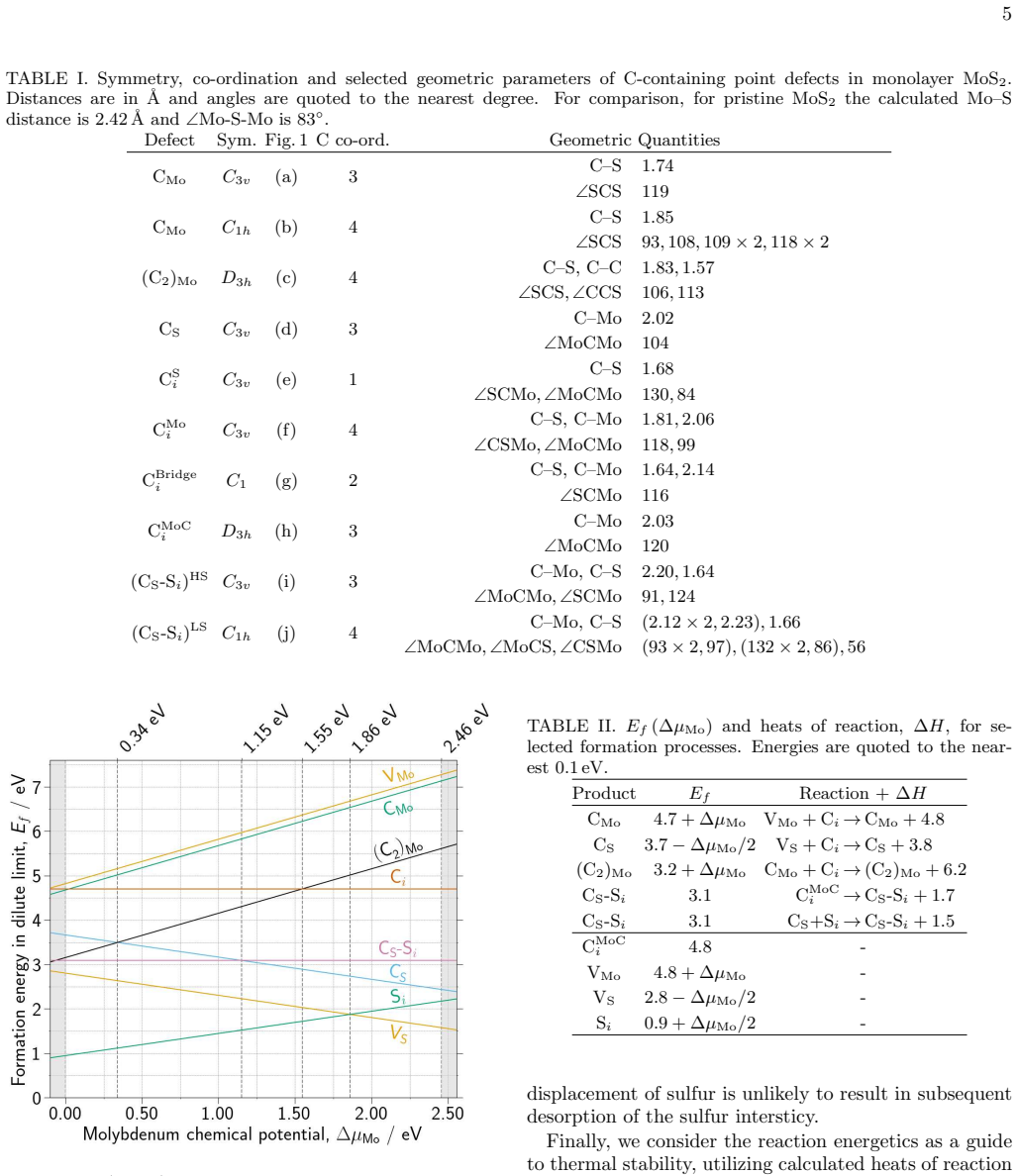
Extensive calculations of formation energies and charge transition levels for carbon point defects in MoS2 show that every energetically favorable configuration produces only deep levels and therefore functions as a carrier trap, with no evidence that carbon impurities contribute to electrical doping.
What carries the argument
Density functional theory modeling of formation energies and thermodynamic charge transition levels for substitutional and interstitial carbon atoms in MoS2 supercells.
If this is right
- Carbon contamination during growth would introduce recombination centers that reduce carrier lifetime and mobility in MoS2-based devices.
- Electrical transport measurements on carbon-exposed samples should show compensation or trapping behavior rather than net doping.
- The supplied electronic and vibrational spectra enable direct comparison with experiment to confirm carbon defect identities.
- Minimizing carbon incorporation during synthesis becomes important for achieving predictable electrical characteristics.
Where Pith is reading between the lines
- Similar deep-trap behavior may appear in other transition metal dichalcogenides when carbon is present as an impurity.
- Growth protocols that reduce carbon exposure could improve device yield even if other impurities remain.
- Interactions between carbon defects and common native defects such as sulfur vacancies warrant separate investigation.
Load-bearing premise
The chosen density functional and supercell sizes give accurate formation energies and charge transition levels for the carbon defects without large finite-size or functional errors.
What would settle it
Spectroscopic or electrical measurements on MoS2 samples with controlled carbon content that detect shallow donor or acceptor levels instead of deep trap states.
Figures



read the original abstract
Transition metal dichalcogenides, a family of two-dimensional compounds, are of interest for a range of technological applications. MoS2, the most researched member of this family, is hexagonal, from which monolayers may be isolated. Under ambient conditions and during growth/processing, contamination by impurities can occur, of which carbon is significant due to its presence in the common growth techniques. We have performed extensive computational investigations of carbon point defects, examining substitutional and interstitial locations. Previously unreported thermodynamically stable configurations, four-fold co-ordinated mono-carbon and di-carbon substitutions of Mo, and a complex of carbon substitution of sulfur bound to interstitial sulfur have been identified. We find no evidence to support recent assertions that carbon defects are responsible for electrical doping of MoS2, finding all energetically favorable forms have only deep charge transition levels and would act as carrier traps. To aid unambiguous identification of carbon defects, we present electronic and vibrational data for comparison with spectroscopy.
Editorial analysis
A structured set of objections, weighed in public.
Referee Report
Summary. The manuscript reports DFT calculations on carbon point defects in monolayer MoS2, identifying new thermodynamically stable configurations including four-fold coordinated mono-carbon and di-carbon substitutions on Mo sites as well as a C_S–S_i complex. The central claim is that all low-energy carbon defects exhibit only deep charge transition levels and therefore function as carrier traps rather than sources of electrical doping, contradicting recent experimental interpretations. Electronic densities of states and vibrational spectra are also computed to facilitate spectroscopic identification.
Significance. If the positioning of the charge transition levels relative to the MoS2 band edges is robust, the result would remove carbon from the list of candidate dopants in MoS2 and redirect attention to other impurities or mechanisms. The explicit provision of spectroscopic fingerprints is a useful contribution for experimental verification.
major comments (1)
- [Computational Details] Computational Details section: the supercell sizes employed for charged-defect calculations and the electrostatic correction scheme (image-charge plus potential alignment) are not accompanied by explicit convergence tests with respect to cell size or vacuum thickness. Given that residual errors of 0.2–0.3 eV can shift a nominally deep level toward a band edge, this information is required to substantiate the claim that all favorable defects produce only deep levels.
minor comments (2)
- [Abstract] The abstract states that four-fold coordinated mono-carbon and di-carbon substitutions of Mo are 'previously unreported'; a brief comparison with the defect database or prior literature would strengthen this novelty claim.
- [Results] Figure 4 (or equivalent) showing the thermodynamic transition levels would benefit from explicit marking of the valence- and conduction-band edges obtained with the same functional and k-point sampling.
Simulated Author's Rebuttal
We thank the referee for their careful reading and constructive feedback on our manuscript. We address the single major comment below and will incorporate the requested information into the revised version.
read point-by-point responses
-
Referee: Computational Details section: the supercell sizes employed for charged-defect calculations and the electrostatic correction scheme (image-charge plus potential alignment) are not accompanied by explicit convergence tests with respect to cell size or vacuum thickness. Given that residual errors of 0.2–0.3 eV can shift a nominally deep level toward a band edge, this information is required to substantiate the claim that all favorable defects produce only deep levels.
Authors: We appreciate this observation. Our calculations used a 5×5 supercell with 15 Å vacuum and the standard image-charge correction plus potential alignment. We have now performed additional convergence tests with 6×6 and 7×7 supercells and vacuum thicknesses up to 25 Å. The charge transition levels for the low-energy carbon defects shift by at most 0.12 eV, remaining more than 0.6 eV from either band edge and therefore deep. We will add a short paragraph and a supplementary table documenting these tests and the precise correction parameters to the revised Computational Details section. revision: yes
Circularity Check
No circularity: standard DFT defect calculations rest on external benchmarks
full rationale
The paper reports first-principles calculations of carbon defect formation energies and thermodynamic charge transition levels in MoS2 using density functional theory. These quantities are obtained from total-energy differences and eigenvalue alignments relative to the host band edges, employing standard supercell corrections and functionals whose parameters are not fitted to the present defect data. No equation or result is shown to reduce by construction to a quantity defined inside the same study, and the central claim (deep levels implying carrier traps) follows directly from the computed positions without self-definitional loops or load-bearing self-citations that presuppose the outcome.
Axiom & Free-Parameter Ledger
axioms (1)
- domain assumption Density functional theory with the chosen functional and supercell approach yields reliable formation energies and charge transition levels for point defects in MoS2.
Lean theorems connected to this paper
-
IndisputableMonolith/Cost/FunctionalEquation.leanwashburn_uniqueness_aczel unclear?
unclearRelation between the paper passage and the cited Recognition theorem.
We find no evidence to support recent assertions that carbon defects are responsible for electrical doping of MoS2, finding all energetically favorable forms have only deep charge transition levels and would act as carrier traps.
-
IndisputableMonolith/Foundation/AlphaCoordinateFixation.leanJ_uniquely_calibrated_via_higher_derivative unclear?
unclearRelation between the paper passage and the cited Recognition theorem.
Formation energies Ef(X) = Et(X) − ∑ ni μi … PBE generalized gradient approximation
What do these tags mean?
- matches
- The paper's claim is directly supported by a theorem in the formal canon.
- supports
- The theorem supports part of the paper's argument, but the paper may add assumptions or extra steps.
- extends
- The paper goes beyond the formal theorem; the theorem is a base layer rather than the whole result.
- uses
- The paper appears to rely on the theorem as machinery.
- contradicts
- The paper's claim conflicts with a theorem or certificate in the canon.
- unclear
- Pith found a possible connection, but the passage is too broad, indirect, or ambiguous to say the theorem truly supports the claim.
Reference graph
Works this paper leans on
-
[1]
K. S. Novoselov, A. K. Geim, S. V. Morozov, D. Jiang, Y. Zhang, S. V. Dubonos, I. V. Grigorieva, and A. A. Firsov, Science 306, 666–669 (2004)
work page 2004
- [2]
-
[3]
W. T. Cong, Z. Tang, X. G. Zhao, and J. H. Chu, Scien- tific Reports 5, 9361 (2015)
work page 2015
-
[4]
C. Li, Q. Cao, F. Wang, Y. Xiao, Y. Li, J.-J. Delaunay, and H. Zhu, Chem. Soc. Rev. 47, 4981–5037 (2018)
work page 2018
-
[5]
Y. Yin, Z. Zhang, C. Shao, J. Robertson, and Y. Guo, npj 2D Mat. and Appl. 6, 1 (2022)
work page 2022
-
[6]
B. Radisavljevic, M. B. Whitwick, and A. Kis, ACS Nano 5, 9934 (2011)
work page 2011
-
[7]
D. Jariwala, V. K. Sangwan, L. J. Lauhon, T. J. Marks, and M. C. Hersam, ACS Nano 8, 1102 (2014)
work page 2014
-
[8]
C. R. Ryder, J. D. Wood, S. A. Wells, and M. C. Hersam, ACS Nano 10, 3900–3917 (2016)
work page 2016
-
[9]
K. K. Kam and B. A. Parkinson, J. Phys. C 86, 463–467 (1982). 9
work page 1982
-
[10]
J. Gusakova, X. Wang, L. L. Shiau, A. Krivosheeva, V. Shaposhnikov, V. Borisenko, V. Gusakov, and B. K. Tay, Phys. Status Solidi A 214, 1700218 (2017)
work page 2017
-
[11]
K. F. Mak, C. Lee, J. Hone, J. Shan, and T. F. Heinz, Phys. Rev. Lett. 105, 136805 (2010)
work page 2010
-
[12]
J. O. Island, A. Kuc, E. H. Diependaal, R. Bratschitsch, H. S. van der Zant, T. Heine, and A. Castellanos-Gomez, Nanoscale 8, 2589–2593 (2016)
work page 2016
-
[13]
Y. L. Huang, Y. Chen, W. Zhang, S. Y. Quek, C.-H. Chen, L.-J. Li, W.-T. Hsu, W.-H. Chang, Y. J. Zheng, W. Chen, and A. T. S. Wee, Nature Comm. 6, 6298 (2015)
work page 2015
-
[14]
B. Radisavljevic, A. Radenovic, J. Brivio, V. Giacometti , and A. Kis, Nature Nano. 6, 147–150 (2011)
work page 2011
-
[15]
A. Castellanos-Gomez, M. Poot, G. A. Steele, H. S. van der Zant, N. Agra ¨ ıt, and G. Rubio-Bollinger, Adv. Mat. 24, 772–775 (2012)
work page 2012
-
[16]
M. Bernardi, M. Palummo, and J. C. Grossman, Nano Letters 13, 3664–3670 (2013)
work page 2013
-
[17]
D. Jariwala, A. R. Davoyan, J. Wong, and H. A. Atwater, ACS Photonics 4, 2962–2970 (2017)
work page 2017
-
[18]
K.-H. Kim, M. Andreev, S. Choi, J. Shim, H. Ahn, J. Lynch, T. Lee, J. Lee, K. N. Nazif, A. Kumar, P. Ku- mar, H. Choo, D. Jariwala, K. C. Saraswat, and J.-H. Park, ACS Nano 16, 8827–8836 (2022)
work page 2022
-
[19]
M. Tsai, M. Li, J. R. Retamal, K. Lam, Y. Lin, K. Sue- naga, L. Chen, G. Liang, L. Li, and J. He, Adv. Mat. 29, 1701168 (2017)
work page 2017
-
[20]
D. Kwak, H. Ra, M. Jeong, A. Lee, and J. Lee, Adv. Mat. Interfaces 5, 1800671 (2018)
work page 2018
-
[21]
K. Nassiri Nazif, A. Daus, J. Hong, N. Lee, S. Vaziri, A. Kumar, F. Nitta, M. E. Chen, S. Kananian, R. Islam, K.-H. Kim, J.-H. Park, A. S. Y. Poon, M. L. Brongersma, E. Pop, and K. C. Saraswat, Nature Comm. 12, 7034 (2021)
work page 2021
- [22]
-
[23]
K. Nassiri Nazif, A. Kumar, J. Hong, N. Lee, R. Islam, C. J. McClellan, O. Karni, J. van de Groep, T. F. Heinz, E. Pop, M. L. Brongersma, and K. C. Saraswat, Nano Letters 21, 3443–3450 (2021)
work page 2021
-
[24]
W. Zhou, X. Zou, S. Najmaei, Z. Liu, Y. Shi, J. Kong, J. Lou, P. M. Ajayan, B. I. Yakobson, and J.-C. Idrobo, Nano Letters 13, 2615 (2013)
work page 2013
-
[25]
Q. Xu, G. Yang, and W. Zheng, Mater. Today Comm. 22, 100772 (2020)
work page 2020
-
[26]
A. M. Z. Tan, C. Freysoldt, and R. G. Hennig, 4, 064004 (2020)
work page 2020
- [27]
- [28]
-
[29]
J.-Y. Noh, H. Kim, and Y.-S. Kim, Phys. Rev. B 89, 205417 (2014)
work page 2014
-
[30]
V. Gusakov, J. Gusakova, and B. K. Tay, Phys. Status Solidi B 259, 2100479 (2021)
work page 2021
-
[31]
S. KC, R. C. Longo, R. Addou, R. M. Wallace, and K. Cho, Nanotechnol. 25, 375703 (2014)
work page 2014
- [32]
-
[33]
C. M. Schaefer, J. M. Caicedo Roque, G. Sauthier, J. Bousquet, C. H´ ebert, J. R. Sperling, A. P´ erez-Tom´ as, J. Santiso, E. del Corro, and J. A. Garrido, Chem. of Mat. 33, 4474–4487 (2021)
work page 2021
- [34]
-
[35]
Y. Park, N. Li, D. Jung, L. T. Singh, J. Baik, E. Lee, D. Oh, Y. D. Kim, J. Y. Lee, J. Woo, S. Park, H. Kim, G. Lee, G. Lee, and C.-C. Hwang, npj 2D Mat. and Appl. 7, 60 (2023)
work page 2023
-
[36]
S. Kim, A. Konar, W.-S. Hwang, J. H. Lee, J. Lee, J. Yang, C. Jung, H. Kim, J.-B. Yoo, J.-Y. Choi, Y. W. Jin, S. Y. Lee, D. Jena, W. Choi, and K. Kim, Nature Comm. 3, 1011 (2012)
work page 2012
-
[37]
Z. Yin, H. Li, H. Li, L. Jiang, Y. Shi, Y. Sun, G. Lu, Q. Zhang, X. Chen, and H. Zhang, ACS Nano 6, 74–80 (2011)
work page 2011
-
[38]
H. Schmidt, S. Wang, L. Chu, M. Toh, R. Kumar, W. Zhao, A. H. Castro Neto, J. Martin, S. Adam, B. ¨Ozyilmaz, and G. Eda, Nano Letters 14, 1909–1913 (2014)
work page 1909
-
[39]
H. Li, Z. Yin, Q. He, H. Li, X. Huang, G. Lu, D. W. Fam, A. I. Tok, Q. Zhang, and H. Zhang, Small 8, 63–67 (2011)
work page 2011
- [40]
-
[41]
K.-K. Liu, W. Zhang, Y.-H. Lee, Y.-C. Lin, M.-T. Chang, C.-Y. Su, C.-S. Chang, H. Li, Y. Shi, H. Zhang, C.-S. Lai, and L.-J. Li, Nano Letters 12, 1538–1544 (2012)
work page 2012
-
[42]
B. W. Baugher, H. O. Churchill, Y. Yang, and P. Jarillo- Herrero, Nano Letters 13, 4212–4216 (2013)
work page 2013
-
[43]
J.-H. Ahn, W. M. Parkin, C. H. Naylor, A. T. Johnson, and M. Drndi´ c, Scientific Reports 7, 4075 (2017)
work page 2017
- [44]
-
[45]
A. K. Auni, J. Manopo, I. S. Sianturi, A. Hadju, A. L. Ivansyah, Y. Darma, and F. Muttaqien, ACS Appl. Nano Mat. 7, 28098–28105 (2024)
work page 2024
-
[46]
J. He, K. Wu, R. Sa, Q. Li, and Y. Wei, Appl. Phys. Lett. 96, 10.1063/1.3318254 (2010)
-
[47]
X. D. Li, Y. M. Fang, S. Q. Wu, and Z. Z. Zhu, AIP Adv. 5, 082504 (2015)
work page 2015
-
[48]
Bound States of Charged Adatoms on MoS2: Screening and Multivalley Effects
M. Aghajanian, A. A. Mostofi, and J. Lischner, Bound states of charged adatoms on MoS 2: Screening and mul- tivalley effects (2018), arXiv:1805.02167 [cond-mat.mes- hall]
work page internal anchor Pith review Pith/arXiv arXiv 2018
- [49]
-
[50]
M. J. Rayson and P. R. Briddon, Phys. Rev. B 80, 205104 (2009)
work page 2009
- [51]
-
[52]
J. P. Perdew, K. Burke, and M. Ernzerhof, Phys. Rev. Lett. 77, 3865 (1996)
work page 1996
- [53]
-
[54]
C. Hartwigsen, S. Goedecker, and J. Hutter, Phys. Rev. B 58, 3641 (1998)
work page 1998
- [55]
-
[56]
J. P. Goss, M. J. Shaw, and P. R. Briddon, in Theory of Defects in Semiconductors , Topics in Applied Physics, Vol. 104, edited by D. A. Drabold and S. K. Estreicher 10 (2007) pp. 69–94
work page 2007
-
[57]
H. J. Monkhorst and J. D. Pack, Phys. Rev. B 13, 5188 (1976)
work page 1976
-
[58]
O. K. Le, V. Chihaia, M.-P. Pham-Ho, and D. N. Son, Royal Soc. Chem. Adv. 10, 4201 (2020)
work page 2020
- [59]
-
[60]
N. N. Hieu, V. V. Ilyasov, T. V. Vu, N. A. Poklonski, H. V. Phuc, L. T. Phuong, B. D. Hoi, and C. V. Nguyen, Superlattices and Microstructures 115, 10 (2018)
work page 2018
-
[61]
S. B. Zhang and J. E. Northrup, Phys. Rev. Lett. 67, 2339 (1991)
work page 1991
-
[62]
F. Goto, J. Phys. Soc. Jap. 21, 895–906 (1966)
work page 1966
-
[63]
A. G. Gaydon and W. G. Penney, Proc. R. Soc. London, Ser. A 183, 374–388 (1945)
work page 1945
-
[64]
G. Henkelman, B. P. Uberuaga, and H. J´ onsson, J. Chem. Phys. 113, 9901 (2000)
work page 2000
- [65]
- [66]
- [67]
-
[68]
Y. J. Cho, Y. Sim, J.-H. Lee, N. T. Hoang, and M.-J. Seong, Current Applied Physics 45, 99–104 (2023)
work page 2023
-
[69]
D. Zhu, H. Shu, F. Jiang, D. Lv, V. Asokan, O. Omar, J. Yuan, Z. Zhang, and C. Jin, npj 2D Mat. and Appl. 1, 8 (2017)
work page 2017
-
[70]
J. Yue, J. Jian, P. Dong, L. Luo, and F. Chang, IOP Mater. Sci. Eng. 592, 012044 (2019)
work page 2019
-
[71]
Brewer, Cohesive energies of the elements , Tech
L. Brewer, Cohesive energies of the elements , Tech. Rep. (Lawrence Berkeley National Lab. (LBNL), Berkeley, CA (United States), 1975)
work page 1975
-
[72]
L.-p. Feng, J. Su, and Z.-t. Liu, J. Appl. Cryst. 613, 122 (2014)
work page 2014
-
[73]
L.-p. Feng, H.-q. Sun, A. Li, J. Su, Y. Zhang, and Z.-t. Liu, Mater. Chem. Phys. 209, 146–151 (2018)
work page 2018
-
[74]
H. Wolff and J. Szydlowski, Canadian J. Chem. 63, 1708–1712 (1985). Supplementary Information for: Reevaluating the electrical impact of atomic carbon impurities in MoS 2 James Ramsey, 1 Faiza Alhamed, 1, 2 J. P. Goss, 1 P. R. Briddon, 1 and M. J. Rayson 1 1School of Mathematics, Statistics and Physics, Newcastle U niversity, Newcastle upon Tyne, NE1 7RU, ...
work page 1985
discussion (0)
Sign in with ORCID, Apple, or X to comment. Anyone can read and Pith papers without signing in.