REVIEW 4 major objections 4 minor 56 references
GoIRL: Graph-Oriented Inverse Reinforcement Learning for Multimodal Trajectory Prediction
T0 review · 4 major / 4 minor · reviewed 2026-08-06 · deepseek-v4-flash
Pith's one-line read A maximum-entropy inverse reinforcement learning predictor with graph-based map features matches or beats supervised baselines on Argoverse and nuScenes, and reroutes its plans when the drivable area changes.
desk verdict GoIRL has a real feature-adaptor contribution and a coherent IRL-based predictor, but the SOTA claim on Argoverse is contradicted by its own appendix and the generalization story is anecdotal. read the letter →
The pith
A machine-rendered reading of the paper's core claim, the machinery that carries it, and where it could break.
The reading
What carries the argument
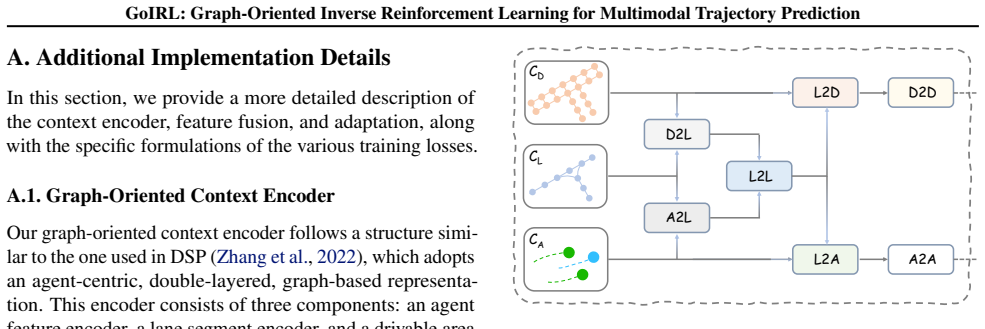
The feature adaptor is the load-bearing component: it maps vectorized lane and drivable-area features into a uniform 50x50 grid aligned with the drivable-area graph, zero-pads undrivable cells, and downsamples to a 25x25 MDP state space. This is what lets a maximum-entropy IRL pipeline, which needs grid-structured states and rewards, consume the graph representations that power modern supervised predictors. Without it, IRL-based forecasters are stuck with rasterized bird's-eye-view inputs; with it, the reward network can combine topology, lane connectivity, and drivable-area geometry in one objective.
What would settle it
Sample a large random subset of Argoverse or nuScenes validation scenes, edit a random connected patch of drivable cells to undrivable at inference time, and measure the fraction of GoIRL's top-K sampled plans that still cross the patch. If that fraction does not drop substantially compared with unmodified scenes, or does not drop more than the fraction for a supervised baseline, the claimed IRL generalization advantage is unsupported.
Extended reading notes
Core claim
On its own terms, the paper's discovery is that the MaxEnt IRL paradigm, long limited to rasterized grid worlds, can be grafted onto vectorized context representation and still reach leaderboard-topping accuracy. The reward function is a neural network whose input is a coarse grid assembled by assigning lane-graph and drivable-area node features to cells. Approximate value iteration converts the reward into a MaxEnt policy; MCMC sampling draws plan sequences that are converted to Bezier-curve proposals, clustered into K modes, refined with fine-grained local features, and scored by the product of a classification probability and the MCMC mode frequency. The paper's reported single-model Argoverse brier-minFDE6 is 1.7957 and its nuScenes minADE5 is 0.86, both better than the baselines in the paper's main comparison tables. The claimed generalization advantage is qualitative: when free cells are edited to undrivable, GoIRL's sampled plans avoid the new obstacle, while the supervised DSP baseline does not.
Load-bearing premise
The generalization claim rests on the assumption that a reward network trained on normal maps, when handed a map with formerly free cells marked undrivable, re-optimizes its policy to avoid them as reliably as if it had seen such edited maps in training, a behavior shown in only three hand-picked examples and no aggregate measurement.
Editorial extensions
If this is right
- IRL-based predictors can consume vectorized lane-graph context via the feature adaptor, closing the representation gap that previously confined them to rasterized bird's-eye-view inputs.
- Changing the drivable-area map at inference time changes the policy's sampled plans, so novel map configurations can be handled without retraining the network.
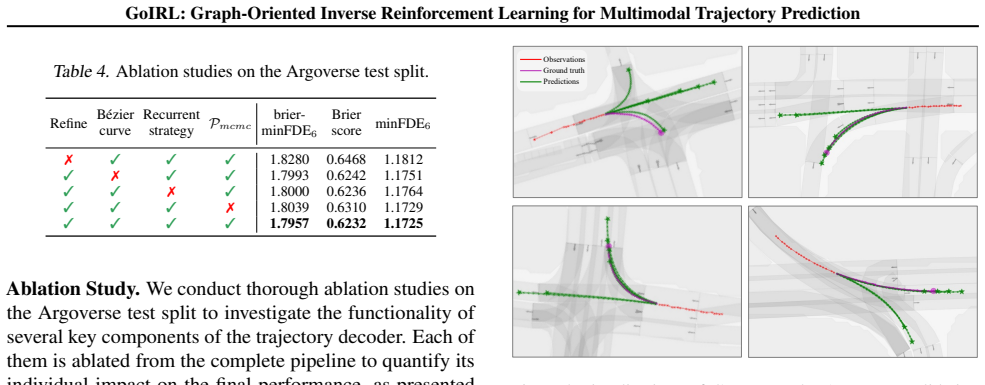
- Fusing classifier probabilities with MCMC-derived mode frequencies improves the Brier score (confidence quality) over classifier-only scoring, as shown in the ablation table.
- Reported single-model results on Argoverse (brier-minFDE6 = 1.7957) and nuScenes (minADE5 = 0.86) position the IRL predictor competitively with or above the supervised baselines listed in the paper.
Reading between the lines
- If the rerouting behavior holds on a random sample rather than three hand-picked cases, the same reward could be reused by downstream planners to respond to temporary closures and construction zones by editing the drivable-area input alone.
- The dependence on a 25x25 grid and a fixed action set means the advantage of the IRL stage is most pronounced for map-driven maneuvers; socially complex interactions may lean heavily on the fine-scale refinement stage, whose contribution the ablations show to be substantial.
- A natural testable extension is to report the fraction of sampled plans that cross newly undrivable cells over a large validation sample, which would convert the qualitative generalization claim into a quantitative one.
Editorial analysis
A structured set of objections, weighed in public.
Referee Report
Summary. The paper proposes GoIRL, a two-stage trajectory prediction framework. A graph-based context encoder represents lanes, drivable areas, and agents in vectorized form; a feature adaptor projects these features into a grid; and maximum-entropy inverse reinforcement learning (MaxEnt IRL) is used to infer a reward and policy over that grid. Trajectory proposals are then sampled from the learned policy via MCMC, parameterized as Bézier curves, clustered, and refined, with probabilities fused from the classifier and the sampling distribution. Experiments on Argoverse and nuScenes are reported, along with ablations and qualitative demonstrations aimed at showing generalization to drivable-area changes.
Significance. If the reported performance were correct, GoIRL would be a valuable demonstration that an IRL-based predictor with vectorized graph context can be competitive with supervised forecasting models; the feature-adapter idea is a sensible bridge between graph encoders and grid-based IRL, and the hierarchical decoder is coherent. The paper also includes honest failure cases and a component-wise ablation, which is helpful. However, the central 'state-of-the-art' claim on Argoverse is contradicted by the paper's own appendix table, and the nuScenes comparison is too sparse to support the claimed ranking. The generalization claim rests on qualitative examples only. These issues affect the paper's main stated contributions.
major comments (4)
- [Abstract, §4.2, Appendix Table 5] The stated 'state-of-the-art' claim on Argoverse is contradicted by the paper's own appendix. Appendix Table 5 reports QCNet with brier-minFDE6 1.693 and SEPT with 1.682, both below GoIRL's 1.695 on the same metric, while the main Tables 1 and 2 omit these methods. GoIRL's own reported value also changes across tables: 1.7957 in Table 1, 1.6947 in Table 2, and 1.695 in Table 5. Since brier-minFDE6 is identified as the official ranking metric, the paper's own numbers do not show GoIRL as the best entry on Argoverse. The main tables, the abstract, and the conclusion need to be reconciled with the full leaderboard; as written, the central empirical claim is internally inconsistent.
- [§4.2, Table 3] The claim of 'top-ranked performance' on nuScenes is not supported by Table 3, which compares only P2T, PGP, MacFormer, and Goal-LBP. These are not sufficient to establish a state-of-the-art ranking on the nuScenes leaderboard, and no recent supervised leaderboard entries are included. The comparison should either cover the relevant leaderboard entries or the claim should be softened to 'competitive on the evaluated baselines.'
- [§4.3, Appendix C.2] The claimed superiority of IRL over supervised models under drivable-area changes is supported only by qualitative examples: Figure 5 shows one T-junction scenario and Appendix Figure 8 shows a few additional scenes. There is no aggregate evaluation over a set of systematically modified drivable-area scenarios, no protocol for constructing those modifications, and no quantitative comparison with DSP or any other supervised baseline under the same modifications. A concrete quantitative test is needed before claiming superior generalization.
- [§3.4, Algorithm 1] The MaxEnt IRL stage is the core novelty, but the paper does not specify how the terminal state distribution Sgoal is parameterized or trained, nor how the number of value-iteration steps N is chosen. The statement that Algorithm 1 yields the MaxEnt policy after N steps is asserted rather than demonstrated. Please provide the objective for the terminal-state network and at least an ablation over N or a convergence diagnostic.
minor comments (4)
- [§4.1, Appendix A.1] The grid size is given as 100×100 in the main text and as 50×50 (HG=WG=50) in the appendix; these need to be reconciled.
- [Tables 1, 2, and 5] The tables should state explicitly whether results are on the validation or test split and whether each row is a single model or an ensemble; the appendix currently mixes entries from both categories without clearly distinguishing them.
- [Eq. (3)] The gradient expression ∇LD = (µD − E[µ])∇R is notationally imprecise; please expand it to show that the gradient is taken with respect to the reward parameters and that µD and E[µ] are visitation-frequency vectors.
- [Figure 3] The labels in Figure 3 are difficult to read in the reproduced PDF; increasing the font size of the submodule labels would improve clarity.
Circularity Check
No circular derivation: MaxEnt reward fitting and supervised decoding are compositional; self-citations to DSP/SIMPL are non-load-bearing, though the SOTA claim conflicts with the paper's own Appendix Table 5.
full rationale
The derivation chain is not circular. The reward R is learned by maximizing the log-likelihood of quantized demonstrations (Eq. 3) via soft value iteration (Algorithm 1), and the trajectory decoder is trained separately under Huber regression and Hinge classification losses (Eq. 12) with winner-takes-all selection. Test outputs are therefore not fitted parameters renamed as predictions: Eq. 10 adds a supervised offset to a Bezier proposal, and Eq. 11 normalizes the product of a learned classifier score and the MCMC frequency Pmcmc, both of which are model outputs rather than copies of the training labels. The drivable-area generalization experiment is a forward-pass sensitivity of the CNN reward to zero-padded cells rather than a tautology; it is only qualitative, so it is weak evidence, not circular. The paper does rely on the authors' own DSP and SIMPL for the graph encoder template and the ensemble strategy, but those are published and externally evaluated, and the central MaxEnt IRL plus feature-adaptor derivation does not reduce to them. One non-circular internal inconsistency: Appendix Table 5 lists QCNet (brier-minFDE6 1.693) and SEPT (1.682) versus GoIRL's 1.695, contradicting the abstract's state-of-the-art claim; this is a correctness and support issue rather than a circularity.
Assumptions & free parameters
free parameters (8)
- Grid cell resolution =
1.0 m
- Coarse grid dimension =
100x100, downsampled to 25x25
- Planning horizon H =
25
- Bezier curve degree n =
5
- Oversample count L =
600
- Mode count K =
6 for Argoverse, 10 for nuScenes
- Loss weights alpha, beta, gamma =
alpha=1, beta=1, gamma=3
- Number of value iteration steps N =
not reported
assumptions (6)
- standard math Maximum entropy IRL distribution P(tau) = exp(R(tau))/Z correctly models expert trajectory distribution.
- domain assumption The finite MDP with a 25x25 coarse grid, 9 discrete actions, deterministic transitions, and horizon H=25 is a sufficient abstraction of driving behavior for trajectory prediction.
- ad hoc to paper The terminal state distribution can be inferred by neural networks rather than specified a priori.
- ad hoc to paper Approximate value iteration in Algorithm 1 converges to the MaxEnt policy after N steps.
- domain assumption A degree-5 Bezier curve can represent all relevant future trajectories, including sharp turns and sudden stops.
- ad hoc to paper Assigning fused drivable-area features to the nearest grid cell and zero-padding undrivable cells preserves lane and drivable-area topology for the IRL reward.
Cite this review
Pith. "Pith review of GoIRL: Graph-Oriented Inverse Reinforcement Learning for Multimodal Trajectory Prediction." pith.science (2026). https://pith.science/paper/NNNOCNFU
@misc{pith2026250621121,
  author       = {Pith},
  title        = {Pith review of: GoIRL: Graph-Oriented Inverse Reinforcement Learning for Multimodal Trajectory Prediction},
  year         = {2026},
  howpublished = {\url{https://pith.science/paper/NNNOCNFU}},
  note         = {Machine review of arXiv:2506.21121}
}
read the original abstract
Trajectory prediction for surrounding agents is a challenging task in autonomous driving due to its inherent uncertainty and underlying multimodality. Unlike prevailing data-driven methods that primarily rely on supervised learning, in this paper, we introduce a novel Graph-oriented Inverse Reinforcement Learning (GoIRL) framework, which is an IRL-based predictor equipped with vectorized context representations. We develop a feature adaptor to effectively aggregate lane-graph features into grid space, enabling seamless integration with the maximum entropy IRL paradigm to infer the reward distribution and obtain the policy that can be sampled to induce multiple plausible plans. Furthermore, conditioned on the sampled plans, we implement a hierarchical parameterized trajectory generator with a refinement module to enhance prediction accuracy and a probability fusion strategy to boost prediction confidence. Extensive experimental results showcase our approach not only achieves state-of-the-art performance on the large-scale Argoverse & nuScenes motion forecasting benchmarks but also exhibits superior generalization abilities compared to existing supervised models.
Figures


Figures from the paper (5 more)



Reference graph
Works this paper leans on
-
[1]
write newline
" write newline "" before.all 'output.state := FUNCTION n.dashify 't := "" t empty not t #1 #1 substring "-" = t #1 #2 substring "--" = not "--" * t #2 global.max substring 't := t #1 #1 substring "-" = "-" * t #2 global.max substring 't := while if t #1 #1 substring * t #2 global.max substring 't := if while FUNCTION format.date year duplicate empty "emp...
-
[2]
R., Deshpande, A., and Motional, H
Afshar, S., Deo, N., Bhagat, A., Chakraborty, T., Shao, Y., Buddharaju, B. R., Deshpande, A., and Motional, H. C. Pbp: Path-based trajectory prediction for autonomous driving. In 2024 IEEE International Conference on Robotics and Automation (ICRA), pp.\ 12927--12934. IEEE, 2024
work page 2024
-
[3]
Neural machine translation by jointly learning to align and translate
Bahdanau, D., Cho, K., and Bengio, Y. Neural machine translation by jointly learning to align and translate. International Conference on Learning Representations (ICLR), 2015
work page 2015
-
[4]
Caesar, H., Bankiti, V., Lang, A. H., Vora, S., Liong, V. E., Xu, Q., Krishnan, A., Pan, Y., Baldan, G., and Beijbom, O. nuscenes: A multimodal dataset for autonomous driving. In Proceedings of the IEEE/CVF conference on computer vision and pattern recognition, pp.\ 11621--11631, 2020
work page 2020
-
[5]
Argoverse: 3d tracking and forecasting with rich maps
Chang, M.-F., Lambert, J., Sangkloy, P., Singh, J., Bak, S., Hartnett, A., Wang, D., Carr, P., Lucey, S., Ramanan, D., et al. Argoverse: 3d tracking and forecasting with rich maps. In Proceedings of the IEEE/CVF Conference on Computer Vision and Pattern Recognition, pp.\ 8748--8757, 2019
work page 2019
-
[6]
End-to-end autonomous driving: Challenges and frontiers
Chen, L., Wu, P., Chitta, K., Jaeger, B., Geiger, A., and Li, H. End-to-end autonomous driving: Challenges and frontiers. arXiv, 2306.16927, 2023
arXiv 2023
-
[7]
Multimodal trajectory predictions for autonomous driving using deep convolutional networks
Cui, H., Radosavljevic, V., Chou, F.-C., Lin, T.-H., Nguyen, T., Huang, T.-K., Schneider, J., and Djuric, N. Multimodal trajectory predictions for autonomous driving using deep convolutional networks. In 2019 international conference on robotics and automation (icra), pp.\ 2090--2096. IEEE, 2019
work page 2019
-
[8]
Deo, N. and Trivedi, M. M. Trajectory forecasts in unknown environments conditioned on grid-based plans. arXiv preprint arXiv:2001.00735, 2020
arXiv 2001
Show all 56 references
-
[9]
Multimodal trajectory prediction conditioned on lane-graph traversals
Deo, N., Wolff, E., and Beijbom, O. Multimodal trajectory prediction conditioned on lane-graph traversals. In Conference on Robot Learning, pp.\ 203--212, 2021
2021
-
[10]
Macformer: Map-agent coupled transformer for real-time and robust trajectory prediction
Feng, C., Zhou, H., Lin, H., Zhang, Z., Xu, Z., Zhang, C., Zhou, B., and Shen, S. Macformer: Map-agent coupled transformer for real-time and robust trajectory prediction. IEEE Robotics and Automation Letters, 2023
2023
-
[11]
A connection between generative adversarial networks, inverse reinforcement learning, and energy-based models
Finn, C., Christiano, P., Abbeel, P., and Levine, S. A connection between generative adversarial networks, inverse reinforcement learning, and energy-based models. arXiv preprint arXiv:1611.03852, 2016 a
2016 arXiv
-
[12]
Guided cost learning: Deep inverse optimal control via policy optimization
Finn, C., Levine, S., and Abbeel, P. Guided cost learning: Deep inverse optimal control via policy optimization. In International conference on machine learning, pp.\ 49--58. PMLR, 2016 b
2016
-
[13]
Learning robust rewards with adverserial inverse reinforcement learning
Fu, J., Luo, K., and Levine, S. Learning robust rewards with adverserial inverse reinforcement learning. In International Conference on Learning Representations, 2018
2018
-
[14]
Vectornet: Encoding hd maps and agent dynamics from vectorized representation
Gao, J., Sun, C., Zhao, H., Shen, Y., Anguelov, D., Li, C., and Schmid, C. Vectornet: Encoding hd maps and agent dynamics from vectorized representation. In Proceedings of the IEEE/CVF Conference on Computer Vision and Pattern Recognition, pp.\ 11525--11533, 2020
2020
-
[15]
Dynamic scenario representation learning for motion forecasting with heterogeneous graph convolutional recurrent networks
Gao, X., Jia, X., Li, Y., and Xiong, H. Dynamic scenario representation learning for motion forecasting with heterogeneous graph convolutional recurrent networks. IEEE Robotics and Automation Letters, 8 0 (5): 0 2946--2953, 2023
2023
-
[16]
Home: Heatmap output for future motion estimation
Gilles, T., Sabatini, S., Tsishkou, D., Stanciulescu, B., and Moutarde, F. Home: Heatmap output for future motion estimation. In 2021 IEEE International Intelligent Transportation Systems Conference (ITSC), pp.\ 500--507. IEEE, 2021
2021
-
[17]
Thomas: Trajectory heatmap output with learned multi-agent sampling
Gilles, T., Sabatini, S., Tsishkou, D., Stanciulescu, B., and Moutarde, F. Thomas: Trajectory heatmap output with learned multi-agent sampling. International Conference on Learning Representations (ICLR), 2022 a
2022
-
[18]
Gohome: Graph-oriented heatmap output for future motion estimation
Gilles, T., Sabatini, S., Tsishkou, D., Stanciulescu, B., and Moutarde, F. Gohome: Graph-oriented heatmap output for future motion estimation. In 2022 international conference on robotics and automation (ICRA), pp.\ 9107--9114. IEEE, 2022 b
2022
-
[19]
A., Kahou, S
Girgis, R., Golemo, F., Codevilla, F., Weiss, M., D'Souza, J. A., Kahou, S. E., Heide, F., and Pal, C. Latent variable sequential set transformers for joint multi-agent motion prediction. International Conference on Learning Representations (ICLR), 2022
2022
-
[20]
Densetnt: End-to-end trajectory prediction from dense goal sets
Gu, J., Sun, C., and Zhao, H. Densetnt: End-to-end trajectory prediction from dense goal sets. In Proceedings of the IEEE/CVF International Conference on Computer Vision, pp.\ 15303--15312, 2021
2021
-
[21]
End-to-end trajectory distribution prediction based on occupancy grid maps
Guo, K., Liu, W., and Pan, J. End-to-end trajectory distribution prediction based on occupancy grid maps. In Proceedings of the IEEE/CVF Conference on Computer Vision and Pattern Recognition, pp.\ 2242--2251, 2022
2022
-
[22]
Social gan: Socially acceptable trajectories with generative adversarial networks
Gupta, A., Johnson, J., Fei-Fei, L., Savarese, S., and Alahi, A. Social gan: Socially acceptable trajectories with generative adversarial networks. In Proceedings of the IEEE conference on computer vision and pattern recognition, pp.\ 2255--2264, 2018
2018
-
[23]
Hastings, W. K. Monte carlo sampling methods using markov chains and their applications. Biometrika, 57 0 (1): 0 97--109, 1970
1970
-
[24]
and Ermon, S
Ho, J. and Ermon, S. Generative adversarial imitation learning. Advances in neural information processing systems, 29, 2016
2016
-
[25]
Multimodal trajectory prediction: A survey
Huang, R., Xue, H., Pagnucco, M., Salim, F., and Song, Y. Multimodal trajectory prediction: A survey. arXiv preprint arXiv:2302.10463, 2023 a
2023 arXiv
-
[26]
Conditional predictive behavior planning with inverse reinforcement learning for human-like autonomous driving
Huang, Z., Liu, H., Wu, J., and Lv, C. Conditional predictive behavior planning with inverse reinforcement learning for human-like autonomous driving. IEEE Transactions on Intelligent Transportation Systems, 2023 b
2023
-
[27]
Multimodal deep generative models for trajectory prediction: A conditional variational autoencoder approach
Ivanovic, B., Leung, K., Schmerling, E., and Pavone, M. Multimodal deep generative models for trajectory prediction: A conditional variational autoencoder approach. IEEE Robotics and Automation Letters, 6 0 (2): 0 295--302, 2020
2020
-
[28]
M., Ziebart, B
Kitani, K. M., Ziebart, B. D., Bagnell, J. A., and Hebert, M. Activity forecasting. In Computer Vision--ECCV 2012: 12th European Conference on Computer Vision, Florence, Italy, October 7-13, 2012, Proceedings, Part IV 12, pp.\ 201--214. Springer, 2012
2012
-
[29]
Socially compliant mobile robot navigation via inverse reinforcement learning
Kretzschmar, H., Spies, M., Sprunk, C., and Burgard, W. Socially compliant mobile robot navigation via inverse reinforcement learning. The International Journal of Robotics Research, 35 0 (11): 0 1289--1307, 2016
2016
-
[30]
Lan, Z., Jiang, Y., Mu, Y., Chen, C., and Li, S. E. Sept: Towards efficient scene representation learning for motion prediction. arXiv preprint arXiv:2309.15289, 2023
2023 arXiv
-
[31]
Learning lane graph representations for motion forecasting
Liang, M., Yang, B., Hu, R., Chen, Y., Liao, R., Feng, S., and Urtasun, R. Learning lane graph representations for motion forecasting. In European Conference on Computer Vision, pp.\ 541--556. Springer, 2020
2020
-
[32]
Feature pyramid networks for object detection
Lin, T.-Y., Doll \'a r, P., Girshick, R., He, K., Hariharan, B., and Belongie, S. Feature pyramid networks for object detection. In Proceedings of the IEEE conference on computer vision and pattern recognition, pp.\ 2117--2125, 2017
2017
-
[33]
S., and Sapp, B
Nayakanti, N., Al-Rfou, R., Zhou, A., Goel, K., Refaat, K. S., and Sapp, B. Wayformer: Motion forecasting via simple & efficient attention networks. arXiv preprint arXiv:2207.05844, 2022
2022 arXiv
-
[34]
Ng, A. Y. and Russell, S. J. Algorithms for inverse reinforcement learning. In Proceedings of the Seventeenth International Conference on Machine Learning, pp.\ 663--670, 2000
2000
-
[35]
A., Abbeel, P., Peters, J., et al
Osa, T., Pajarinen, J., Neumann, G., Bagnell, J. A., Abbeel, P., Peters, J., et al. An algorithmic perspective on imitation learning. Foundations and Trends in Robotics , 7 0 (1-2): 0 1--179, 2018
2018
-
[36]
R., Su, H., Mo, K., and Guibas, L
Qi, C. R., Su, H., Mo, K., and Guibas, L. J. Pointnet: Deep learning on point sets for 3d classification and segmentation. In Proceedings of the IEEE conference on computer vision and pattern recognition, pp.\ 652--660, 2017
2017
-
[37]
Scene compliant trajectory forecast with agent-centric spatio-temporal grids
Ridel, D., Deo, N., Wolf, D., and Trivedi, M. Scene compliant trajectory forecast with agent-centric spatio-temporal grids. IEEE Robotics and Automation Letters, 5 0 (2): 0 2816--2823, 2020
2020
-
[38]
Motion transformer with global intention localization and local movement refinement
Shi, S., Jiang, L., Dai, D., and Schiele, B. Motion transformer with global intention localization and local movement refinement. Advances in Neural Information Processing Systems, 35: 0 6531--6543, 2022
2022
-
[39]
Y., and Chen, Q
Song, H., Luan, D., Ding, W., Wang, M. Y., and Chen, Q. Learning to predict vehicle trajectories with model-based planning. In Conference on Robot Learning, pp.\ 1035--1045, 2021
2021
-
[40]
S., Nayakanti, N., Cornman, A., Chen, K., Douillard, B., Lam, C
Varadarajan, B., Hefny, A., Srivastava, A., Refaat, K. S., Nayakanti, N., Cornman, A., Chen, K., Douillard, B., Lam, C. P., Anguelov, D., et al. Multipath++: Efficient information fusion and trajectory aggregation for behavior prediction. In 2022 International Conference on Ro...
2022
-
[41]
Attention is all you need
Vaswani, A., Shazeer, N., Parmar, N., Uszkoreit, J., Jones, L., Gomez, A., Kaiser, L., and I., P. Attention is all you need. Advances in Neural Information Processing Systems, pp.\ 5998--6008, 2017
2017
-
[42]
Ganet: Goal area network for motion forecasting
Wang, M., Zhu, X., Yu, C., Li, W., Ma, Y., Jin, R., Ren, X., Ren, D., Wang, M., and Yang, W. Ganet: Goal area network for motion forecasting. In 2023 IEEE International Conference on Robotics and Automation (ICRA), pp.\ 1609--1615. IEEE, 2023
2023
-
[43]
Z., Ondruska, P., and Posner, I
Wulfmeier, M., Rao, D., Wang, D. Z., Ondruska, P., and Posner, I. Large-scale cost function learning for path planning using deep inverse reinforcement learning. The International Journal of Robotics Research, 36 0 (10): 0 1073--1087, 2017
2017
-
[44]
Improving out-of-distribution generalization of trajectory prediction for autonomous driving via polynomial representations
Yao, Y., Yan, S., Goehring, D., Burgard, W., and Reichardt, J. Improving out-of-distribution generalization of trajectory prediction for autonomous driving via polynomial representations. In 2024 IEEE/RSJ International Conference on Intelligent Robots and Systems (IROS), pp.\ ...
2024
-
[45]
Yao, Z., Li, X., Lang, B., and Chuah, M. C. Goal-lbp: Goal-based local behavior guided trajectory prediction for autonomous driving. IEEE Transactions on Intelligent Transportation Systems, 2023
2023
-
[46]
Tpcn: Temporal point cloud networks for motion forecasting
Ye, M., Cao, T., and Chen, Q. Tpcn: Temporal point cloud networks for motion forecasting. In Proceedings of the IEEE/CVF Conference on Computer Vision and Pattern Recognition, pp.\ 11318--11327, 2021
2021
-
[47]
Meta-inverse reinforcement learning with probabilistic context variables
Yu, L., Yu, T., Finn, C., and Ermon, S. Meta-inverse reinforcement learning with probabilistic context variables. Advances in neural information processing systems, 32, 2019
2019
-
[48]
End-to-end interpretable neural motion planner
Zeng, W., Luo, W., Suo, S., Sadat, A., Yang, B., Casas, S., and Urtasun, R. End-to-end interpretable neural motion planner. In Proceedings of the IEEE/CVF Conference on Computer Vision and Pattern Recognition, pp.\ 8660--8669, 2019
2019
-
[49]
Lanercnn: Distributed representations for graph-centric motion forecasting
Zeng, W., Liang, M., Liao, R., and Urtasun, R. Lanercnn: Distributed representations for graph-centric motion forecasting. In 2021 IEEE/RSJ International Conference on Intelligent Robots and Systems (IROS), pp.\ 532--539. IEEE, 2021
2021
-
[50]
Trajectory prediction with graph-based dual-scale context fusion
Zhang, L., Li, P., Chen, J., and Shen, S. Trajectory prediction with graph-based dual-scale context fusion. In 2022 IEEE/RSJ International Conference on Intelligent Robots and Systems (IROS), pp.\ 11374--11381. IEEE, 2022
2022
-
[51]
Simpl: A simple and efficient multi-agent motion prediction baseline for autonomous driving
Zhang, L., Li, P., Liu, S., and Shen, S. Simpl: A simple and efficient multi-agent motion prediction baseline for autonomous driving. IEEE Robotics and Automation Letters, 2024
2024
-
[52]
Integrating kinematics and environment context into deep inverse reinforcement learning for predicting off-road vehicle trajectories
Zhang, Y., Wang, W., Bonatti, R., Maturana, D., and Scherer, S. Integrating kinematics and environment context into deep inverse reinforcement learning for predicting off-road vehicle trajectories. In Conference on Robot Learning, pp.\ 894--905. PMLR, 2018
2018
-
[53]
Hivt: Hierarchical vector transformer for multi-agent motion prediction
Zhou, Z., Ye, L., Wang, J., Wu, K., and Lu, K. Hivt: Hierarchical vector transformer for multi-agent motion prediction. In Proceedings of the IEEE/CVF Conference on Computer Vision and Pattern Recognition, pp.\ 8823--8833, 2022
2022
-
[54]
Query-centric trajectory prediction
Zhou, Z., Wang, J., Li, Y.-H., and Huang, Y.-K. Query-centric trajectory prediction. In Proceedings of the IEEE/CVF Conference on Computer Vision and Pattern Recognition, pp.\ 17863--17873, 2023
2023
-
[55]
D., Maas, A
Ziebart, B. D., Maas, A. L., Bagnell, J. A., Dey, A. K., et al. Maximum entropy inverse reinforcement learning. In AAAI, volume 8, pp.\ 1433--1438. Chicago, IL, USA, 2008
2008
-
[56]
D., Ratliff, N., Gallagher, G., Mertz, C., Peterson, K., Bagnell, J
Ziebart, B. D., Ratliff, N., Gallagher, G., Mertz, C., Peterson, K., Bagnell, J. A., Hebert, M., Dey, A. K., and Srinivasa, S. Planning-based prediction for pedestrians. In 2009 IEEE/RSJ International Conference on Intelligent Robots and Systems, pp.\ 3931--3936. IEEE, 2009
2009
Reviewed August 6, 2026 · model on record in the stance chip above.
Discussion (0). Sign in to comment.