Meson spectroscopy of exotic symmetries of Ising criticality in Rydberg atom arrays
Pith reviewed 2026-05-19 07:48 UTC · model grok-4.3
The pith
Rydberg atom arrays detect confinement of Ising excitations into bound states under D^{(1)}_8 symmetry in ladder configurations.
A machine-rendered reading of the paper's core claim, the machinery that carries it, and where it could break.
Core claim
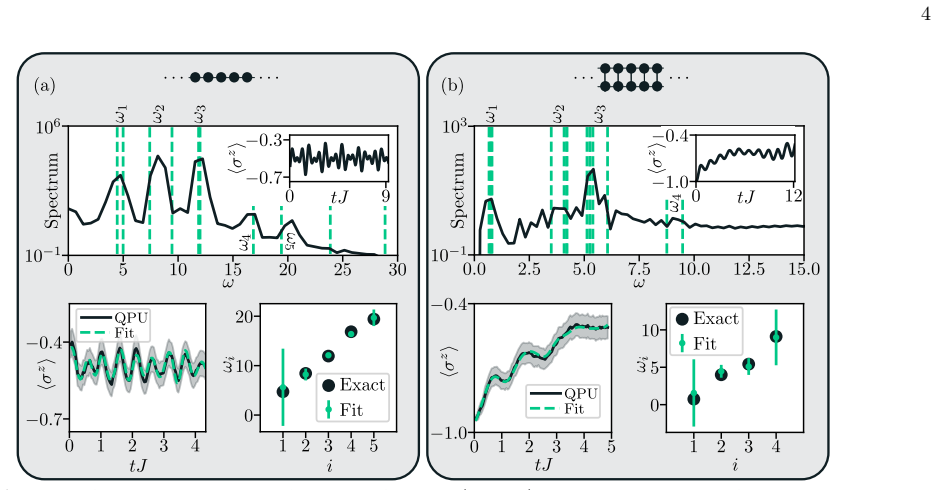
The critical point of the 1D Ising chain is described by a conformal Ising field theory integrable under magnetic perturbation, yielding massive particles associated with E8. Weakly coupling two such chains into a ladder breaks integrability and confines the excitations into bound states organized by D^{(1)}_8 symmetry. Using Rydberg atoms to realize both configurations, mass spectra consistent with E8 are identified in chains, and the first signatures of the D^{(1)}_8 bound-state spectrum appear in ladders.
What carries the argument
The D^{(1)}_8 symmetry that organizes the bound-state spectrum arising from confinement in the weakly coupled Ising ladder.
If this is right
- Signatures of E8 excitations are observed at the single-chain critical point in the Rydberg array.
- Weak inter-chain coupling confines Ising excitations into bound states in the ladder geometry.
- The Rydberg platform enables tunable realization of chain and ladder configurations to probe symmetry emergence.
- Direct evidence is provided for confinement driven by inter-chain coupling, which was previously elusive.
Where Pith is reading between the lines
- This approach could be extended to study stronger couplings or different geometries to explore other emergent symmetries.
- Similar confinement phenomena might be testable in other quantum simulation platforms like trapped ions or superconducting circuits.
- Non-equilibrium dynamics of these confined bound states could reveal new information about symmetry breaking in critical systems.
Load-bearing premise
The Rydberg atom array Hamiltonian accurately realizes the ideal weakly coupled Ising ladder model, allowing observed spectral features to be attributed to the theoretical D8 bound states without dominant imperfections or peak misidentification.
What would settle it
An experiment or calculation that shows the observed energy ratios in the ladder spectrum do not match those predicted for the D^{(1)}_8 bound states, or that attributes the peaks to experimental noise rather than confinement effects.
Figures




read the original abstract
The Ising model serves as a canonical platform for exploring emergent symmetry in quantum critical systems. The critical point of the 1D Ising chain is described by a conformal Ising field theory, which remains integrable in the presence of a magnetic perturbation, leading to massive particles associated with the exceptional Lie algebra $E_8$. Weakly coupling two Ising chains into a ladder breaks this integrability and is predicted to confine the elementary excitations of each chain into a richer spectrum of bound states organized by a $\mathcal{D}^{(1)}_8$ symmetry. Experimental signatures of $E_8$ excitations have arguably been observed in scattering studies of the spin chain material CoNb$_2$O$_6$, but direct evidence of confinement driven by inter-chain coupling has remained elusive. Here, we probe these emergent symmetries in a Rydberg atom quantum processing unit, leveraging its tunable geometry to realize both chain and ladder configurations. We identify mass spectra consistent with $E_8$ at the single-chain critical point and, in the weakly coupled ladder, report the first signatures of confinement of Ising excitations into the bound-state spectrum predicted by $\mathcal{D}^{(1)}_8$ symmetry. Our results demonstrate the power of Rydberg platforms for investigating symmetry emergence in quantum many-body systems and provide a direct window into the interplay of confinement, geometry, and criticality.
Editorial analysis
A structured set of objections, weighed in public.
Referee Report
Summary. The paper reports an experimental realization of the critical 1D Ising chain and a weakly coupled Ising ladder using a Rydberg atom array quantum processor. It identifies mass spectra consistent with the E8 particle content at the single-chain critical point and, in the ladder geometry, reports signatures of confinement into bound states organized by D^{(1)}_8 symmetry, claiming the first such experimental observation of inter-chain confinement effects.
Significance. If the central claims hold after quantitative validation, the work would constitute a significant advance by providing tunable, programmable access to confinement and exotic symmetries in integrable quantum field theories, extending prior observations in materials such as CoNb2O6 to a fully controllable simulator platform. It demonstrates the utility of Rydberg arrays for probing emergent phenomena at the intersection of criticality, geometry, and integrability.
major comments (2)
- [Results / spectral analysis] Data analysis section (or equivalent results subsection on spectral extraction): the claims of spectra 'consistent with' E8 and 'signatures' of D^{(1)}_8 bound states rest on qualitative peak identification without reported details on peak fitting procedures, error bars, background subtraction, or robustness to post-selection and calibration choices. This is load-bearing for the central claim, as the reader's assessment notes the absence of these quantitative elements leaves the mass-ratio assignments open to alternative interpretations.
- [Hamiltonian realization / model fidelity] Section on effective Hamiltonian and model validation (likely Methods or supplementary material): the attribution of observed ladder peaks to D^{(1)}_8 bound states assumes the Rydberg array realizes an ideal nearest-neighbor Ising ladder plus tunable inter-chain coupling, with longer-range van der Waals tails, next-nearest-neighbor terms, and blockade corrections negligible compared to the reported mass splittings. The manuscript must provide explicit bounds on these perturbations (e.g., via numerical simulations or calibration data) to exclude that residual interactions produce similar features under a different perturbation.
minor comments (2)
- [Figures and text] Figure captions and main text should explicitly label which theoretical mass ratios (from prior D8 literature) are being compared to which experimental peaks, including any scaling or fitting of the overall mass scale.
- [Abstract] The abstract's phrasing 'consistent with E8' and 'first signatures' could be made more precise by indicating the number of resolved peaks and the level of quantitative agreement achieved.
Simulated Author's Rebuttal
We thank the referee for their positive assessment of the significance of our work and for the constructive major comments. We address each point below and have revised the manuscript to strengthen the quantitative support for our claims.
read point-by-point responses
-
Referee: [Results / spectral analysis] Data analysis section (or equivalent results subsection on spectral extraction): the claims of spectra 'consistent with' E8 and 'signatures' of D^{(1)}_8 bound states rest on qualitative peak identification without reported details on peak fitting procedures, error bars, background subtraction, or robustness to post-selection and calibration choices. This is load-bearing for the central claim, as the reader's assessment notes the absence of these quantitative elements leaves the mass-ratio assignments open to alternative interpretations.
Authors: We agree that additional quantitative details are required to support the peak assignments. In the revised manuscript we will expand the relevant results subsection (and add supplementary material) to include: explicit peak-fitting procedures (Lorentzian profiles with reported widths, amplitudes, and reduced-chi-squared values); statistical and systematic error bars on all extracted mass ratios; a description of the background-subtraction protocol; and robustness checks under variations in post-selection thresholds and calibration parameters, accompanied by supplementary figures that demonstrate the stability of the reported mass ratios. These additions will allow readers to evaluate the uniqueness of the E8 and D8^(1) interpretations. revision: yes
-
Referee: [Hamiltonian realization / model fidelity] Section on effective Hamiltonian and model validation (likely Methods or supplementary material): the attribution of observed ladder peaks to D^{(1)}_8 bound states assumes the Rydberg array realizes an ideal nearest-neighbor Ising ladder plus tunable inter-chain coupling, with longer-range van der Waals tails, next-nearest-neighbor terms, and blockade corrections negligible compared to the reported mass splittings. The manuscript must provide explicit bounds on these perturbations (e.g., via numerical simulations or calibration data) to exclude that residual interactions produce similar features under a different perturbation.
Authors: We acknowledge that explicit bounds on non-ideal terms were not provided. In the revised manuscript we will add a dedicated subsection (or supplementary section) containing: (i) numerical simulations of the full Rydberg Hamiltonian that retain the van der Waals tails, next-nearest-neighbor couplings, and blockade corrections; (ii) direct comparison of the resulting spectra with the ideal nearest-neighbor Ising ladder; and (iii) quantitative upper bounds on the perturbation strengths relative to the observed mass splittings, together with experimental calibration data confirming that these residuals remain well below the scale of the reported features. This material will demonstrate that the observed ladder peaks cannot be reproduced by the residual interactions alone. revision: yes
Circularity Check
No circularity: experimental spectra matched to external theory
full rationale
The paper is an experimental study realizing Ising chains and ladders in Rydberg atom arrays and reporting observed mass spectra. The E8 and D^{(1)}_8 bound-state predictions are taken from established prior literature on conformal field theory and integrable perturbations, not derived or fitted within this work. No load-bearing step reduces a claimed prediction to a fitted parameter or self-citation chain; spectral features are compared to independent theoretical benchmarks. The derivation chain is self-contained against external references.
Axiom & Free-Parameter Ledger
axioms (1)
- domain assumption The Rydberg atom array can be tuned to realize the 1D Ising chain and weakly coupled ladder Hamiltonians with controllable interchain coupling.
Lean theorems connected to this paper
-
IndisputableMonolith/Foundation/AlexanderDuality.leanalexander_duality_circle_linking echoes?
echoesECHOES: this paper passage has the same mathematical shape or conceptual pattern as the Recognition theorem, but is not a direct formal dependency.
Weakly coupling two Ising chains into a ladder breaks this integrability and is predicted to confine the elementary excitations of each chain into a richer spectrum of bound states organized by a D^{(1)}_8 symmetry.
-
IndisputableMonolith/Foundation/ArithmeticFromLogic.leanLogicNat recovery and orbit structure echoes?
echoesECHOES: this paper passage has the same mathematical shape or conceptual pattern as the Recognition theorem, but is not a direct formal dependency.
the spectrum of bound states have universal energy ratios dictated by the E8 symmetry... shift in symmetry underscores the sensitivity of emergent phenomena to the underlying geometry
What do these tags mean?
- matches
- The paper's claim is directly supported by a theorem in the formal canon.
- supports
- The theorem supports part of the paper's argument, but the paper may add assumptions or extra steps.
- extends
- The paper goes beyond the formal theorem; the theorem is a base layer rather than the whole result.
- uses
- The paper appears to rely on the theorem as machinery.
- contradicts
- The paper's claim conflicts with a theorem or certificate in the canon.
- unclear
- Pith found a possible connection, but the passage is too broad, indirect, or ambiguous to say the theorem truly supports the claim.
Forward citations
Cited by 1 Pith paper
-
Quench dynamics of the quantum XXZ chain with staggered interactions: Exact results and simulations on digital quantum computers
Exact closed-form size-independent expressions for von Neumann and Rényi entanglement entropies plus Loschmidt echoes are obtained for quench dynamics in the staggered XXZ antiferromagnetic chain in the flat-band limi...
Reference graph
Works this paper leans on
-
[1]
G. Mussardo, Statistical field theory: an introduction to exactly solved models in statistical physics (Oxford Uni- versity Press, USA, 2010)
work page 2010
-
[2]
A. B. Zamolodchikov, Integrals of motion and S-matrix of the (scaled) T = Tc Ising model with magnetic field, In- ternational Journal of Modern Physics A 4, 4235 (1989)
work page 1989
- [3]
-
[4]
A. LeClair, A. Ludwig, and G. Mussardo, Integrability of coupled conformal field theories, Nuclear Physics B 512, 523–542 (1998)
work page 1998
- [5]
- [6]
-
[7]
S. B. Rutkevich, Energy spectrum of bound-spinons in the quantum Ising spin-chain ferromagnet, Journal of Statistical Physics 131, 917–939 (2008)
work page 2008
-
[8]
Greensite, An introduction to the confinement problem, Vol
J. Greensite, An introduction to the confinement problem, Vol. 821 (Springer, 2011)
work page 2011
- [10]
-
[11]
J. Vovrosh and J. Knolle, Confinement and entanglement dynamics on a digital quantum computer, Scientific Re- ports 11, 10.1038/s41598-021-90849-5 (2021)
-
[12]
F. Liu, R. Lundgren, P. Titum, G. Pagano, J. Zhang, C. Monroe, and A. V. Gorshkov, Confined quasipar- ticle dynamics in long-range interacting quantum spin chains, Physical Review Letters 122, 10.1103/phys- revlett.122.150601 (2019)
-
[13]
W. L. Tan, P. Becker, F. Liu, G. Pagano, K. S. Collins, A. De, L. Feng, H. B. Kaplan, A. Kyprianidis, R. Lund- gren, W. Morong, S. Whitsitt, A. V. Gorshkov, and C. Monroe, Domain-wall confinement and dynamics in a quantum simulator, Nature Physics 17, 742–747 (2021)
work page 2021
-
[14]
F. B. Ramos, M. Lencs´ es, J. C. Xavier, and R. G. Pereira, Confinement and bound states of bound states in a transverse-field two-leg Ising ladder, Phys. Rev. B 102, 014426 (2020)
work page 2020
-
[15]
G. Lagnese, F. M. Surace, M. Kormos, and P. Calabrese, Confinement in the spectrum of a Heisenberg–Ising spin ladder, Journal of Statistical Mechanics: Theory and Ex- periment 2020, 093106 (2020)
work page 2020
-
[16]
A. Browaeys and T. Lahaye, Many-body physics with individually controlled Rydberg atoms, Nature Physics 16, 132–142 (2020)
work page 2020
-
[17]
P. Schauss, Quantum simulation of transverse Ising mod- els with Rydberg atoms, Quantum Science and Technol- ogy 3, 023001 (2018)
work page 2018
- [18]
-
[19]
J. Vovrosh, R. Mukherjee, A. Bastianello, and J. Knolle, Dynamical hadron formation in long-range interacting quantum spin chains, PRX Quantum 3, 10.1103/prxquantum.3.040309 (2022)
-
[20]
S. Birnkammer, A. Bastianello, and M. Knap, Prether- malization in one-dimensional quantum many-body sys- tems with confinement, Nature Communications 13, 10.1038/s41467-022-35301-6 (2022)
- [21]
- [22]
-
[23]
A. Milsted, J. Liu, J. Preskill, and G. Vidal, Collisions of false-vacuum bubble walls in a quantum spin chain, PRX Quantum 3, 10.1103/prxquantum.3.020316 (2022)
- [24]
-
[25]
J. Schuhmacher, G.-X. Su, J. J. Osborne, A. Gandon, J. C. Halimeh, and I. Tavernelli, Observation of hadron scattering in a lattice gauge theory on a quantum com- puter (2025), arXiv:2505.20387 [quant-ph]. 6
-
[26]
J. Knaute and P. Hauke, Relativistic meson spectra on ion-trap quantum simulators, Phys. Rev. A 105, 022616 (2022)
work page 2022
-
[27]
L. Henriet, L. Beguin, A. Signoles, T. Lahaye, A. Browaeys, G.-O. Reymond, and C. Jurczak, Quantum computing with neutral atoms, Quantum 4, 327 (2020)
work page 2020
-
[28]
Menu, Gaussian-state approaches to quantum spin systems away from equilibrium , Ph.D
R. Menu, Gaussian-state approaches to quantum spin systems away from equilibrium , Ph.D. thesis, Universit´ e de Lyon (2020)
work page 2020
-
[29]
P. Calabrese and J. Cardy, Time Dependence of Correla- tion Functions Following a Quantum Quench, Phys. Rev. Lett. 96, 136801 (2006)
work page 2006
-
[30]
E. H. Lieb and D. W. Robinson, The finite group velocity of quantum spin systems, Commun.Math. Phys. 28, 251 (1972)
work page 1972
-
[31]
M. Kebriˇ c, J. C. Halimeh, U. Schollw¨ ock, and F. Grusdt, Confinement in 1+1d Z2 lattice gauge theories at finite temperature (2024), arXiv:2308.08592 [cond-mat.quant- gas]
-
[32]
J. Mildenberger, W. Mruczkiewicz, J. C. Halimeh, Z. Jiang, and P. Hauke, Confinement in a Z2 lattice gauge theory on a quantum computer, Nature Physics 21, 312–317 (2025)
work page 2025
- [33]
-
[34]
C. Lamb, Y. Tang, R. Davis, and A. Roy, Ising me- son spectroscopy on a noisy digital quantum simulator, Nature Communications 15, 10.1038/s41467-024-50206- 2 (2024)
-
[35]
J. Vovrosh, K. E. Khosla, S. Greenaway, C. Self, M. S. Kim, and J. Knolle, Simple mitigation of global depolar- izing errors in quantum simulations, Physical Review E 104, 10.1103/physreve.104.035309 (2021)
-
[36]
D. P. Kingma and J. Ba, Adam: A method for stochastic optimization (2017), arXiv:1412.6980 [cs.LG]
work page internal anchor Pith review Pith/arXiv arXiv 2017
-
[37]
D. Gonz´ alez-Cuadra, M. Hamdan, T. V. Zache, B. Braverman, M. Kornjaˇ ca, A. Lukin, S. H. Cant´ u, F. Liu, S.-T. Wang, A. Keesling, M. D. Lukin, P. Zoller, and A. Bylinskii, Observation of string breaking on a (2 + 1)d rydberg quantum simulator, Nature 642, 321–326 (2025)
work page 2025
-
[38]
A. Yoshinaga, H. Hakoshima, T. Imoto, Y. Matsuzaki, and R. Hamazaki, Emergence of Hilbert space fragmen- tation in Ising models with a weak transverse field, Phys- ical Review Letters 129, 10.1103/physrevlett.129.090602 (2022)
-
[39]
L. Zhao, P. R. Datla, W. Tian, M. M. Aliyu, and H. Loh, Observation of quantum thermalization restricted to Hilbert space fragments and 𭟋2k scars, Phys. Rev. X 15, 011035 (2025)
work page 2025
- [40]
-
[41]
T. J. Osborne, Hamiltonian complexity, Rep. Prog. Phys. 75, 022001 (2012)
work page 2012
-
[42]
Coleman, Introduction to Many-Body Physics (Cam- bridge University Press, Cambridge, 2015)
P. Coleman, Introduction to Many-Body Physics (Cam- bridge University Press, Cambridge, 2015)
work page 2015
-
[43]
PyTorch: An Imperative Style, High-Performance Deep Learning Library
A. Paszke, S. Gross, F. Massa, A. Lerer, J. Brad- bury, G. Chanan, T. Killeen, Z. Lin, N. Gimelshein, L. Antiga, A. Desmaison, A. K¨ opf, E. Yang, Z. De- Vito, M. Raison, A. Tejani, S. Chilamkurthy, B. Steiner, L. Fang, J. Bai, and S. Chintala, Pytorch: An impera- tive style, high-performance deep learning library (2019), arXiv:1912.01703 [cs.LG]
work page internal anchor Pith review Pith/arXiv arXiv 2019
-
[44]
S. Juli` a-Farr´ eet al., An exhaustive noise model of a neu- tral atom quantum processing unit (2025), manuscript in preparation. 7 Appendix A: Simulating the Ising model with Rydberg atoms Rydberg atom arrays provide a versatile and highly controllable platform for simulating quantum spin models, including variants of the transverse-field Ising model. I...
work page 2025
discussion (0)
Sign in with ORCID, Apple, or X to comment. Anyone can read and Pith papers without signing in.