REVIEW 3 major objections 5 minor 35 references
Holistic Surgical Phase Recognition with Hierarchical Input Dependent State Space Models
T0 review · 3 major / 5 minor · reviewed 2026-08-06 · deepseek-v4-flash
Pith's one-line read The paper proposes a hierarchical input-dependent state space model that processes entire surgical videos and reports new state-of-the-art phase recognition on Cholec80, MICCAI2016, and Heichole.
desk verdict The architecture is genuinely novel and the results are striking, but the implementation section's '100 frames' statement directly contradicts the full-video framing and must be resolved before the headline claims can be trusted. read the letter →
The pith
A machine-rendered reading of the paper's core claim, the machinery that carries it, and where it could break.
The reading
What carries the argument
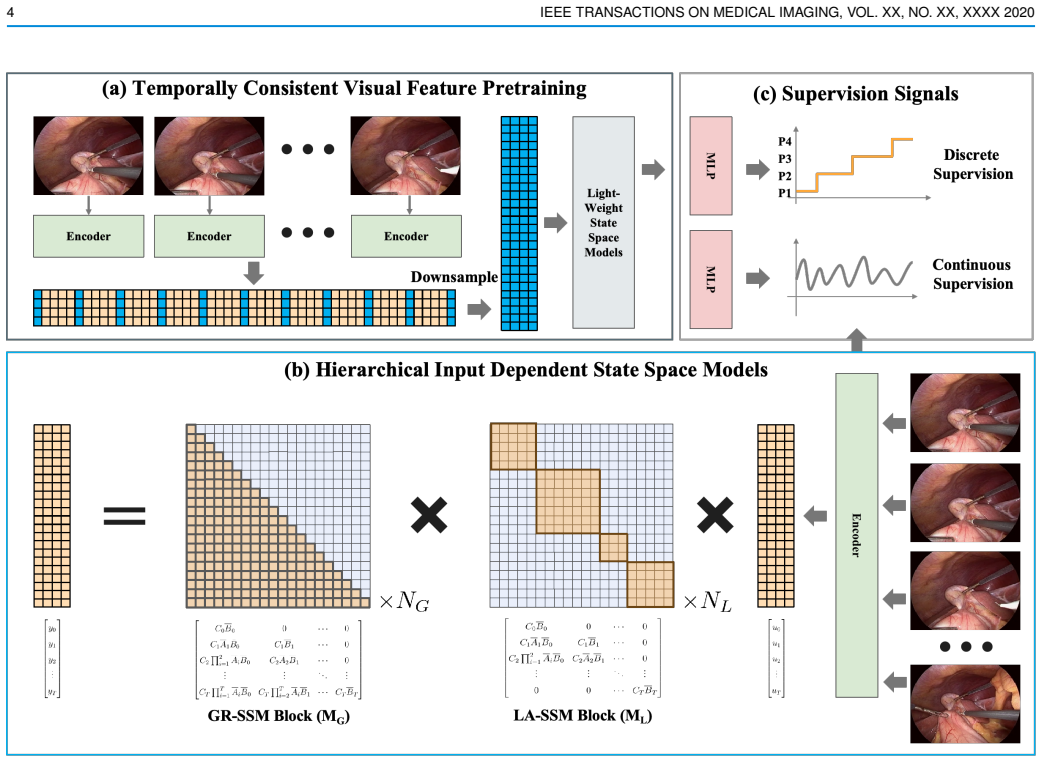
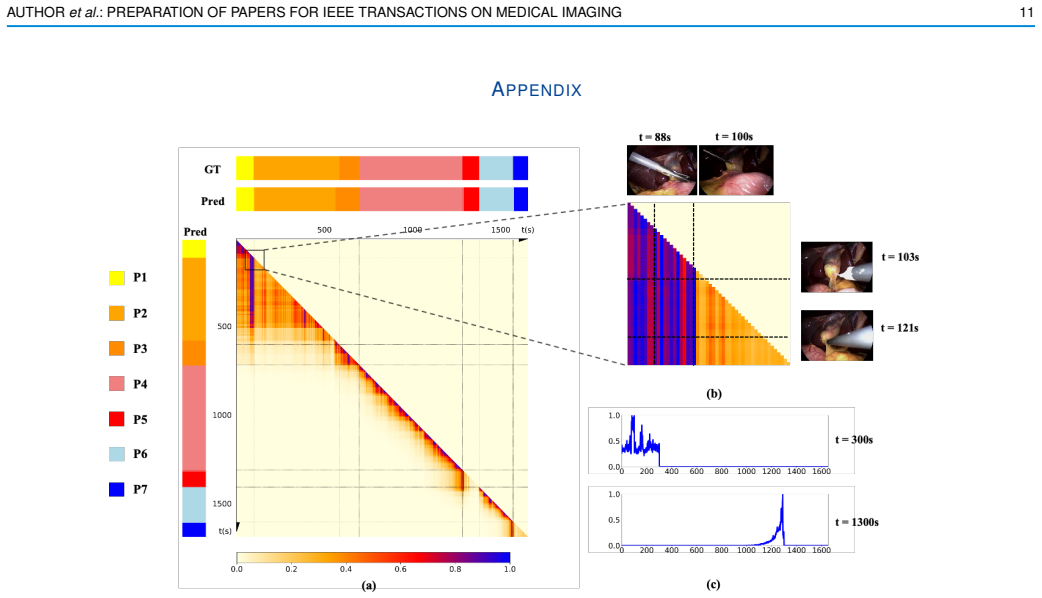
The central object is the Hierarchical Input-Dependent State Space Model, built from two block types: local-aggregation SSM blocks (LA-SSM) and global-relation SSM blocks (GR-SSM). Each block discretizes an input-dependent ordinary differential equation with a per-frame timescale $\Delta_t$, so the state transition matrix $\mathbf{A}_t$ and input matrix $\mathbf{B}_t$ depend on the current frame; the LA-SSM block uses a block-diagonal matrix mixer to aggregate local dynamics inside pseudo-phase windows proposed by a Phase Proposal Network, while the GR-SSM block uses the full matrix mixer to relate every frame to every other frame at linear cost. The temporal selective activation property, seen when large $\Delta_t$ resets the state and small $\Delta_t$ preserves it, lets the model emphasize or ignore frames and is visualized as sharp $\Delta_t$ changes at phase boundaries.
What would settle it
Run HID-SSM with the PPN's pseudo-phase boundaries replaced by random splits of the same average length; if accuracy and Jaccard do not drop substantially on Cholec80, the claimed local-dynamics advantage from learned windowing is not doing the work attributed to it. Alternatively, feed oracle ground-truth phase boundaries to the LA-SSM windows and check whether performance improves beyond PPN windows.
Extended reading notes
Core claim
The central claim is that a Hierarchical Input-Dependent State Space Model (HID-SSM) can process full-length surgical videos and predict the phase of every frame better than transformer- and CNN-based alternatives. The model stacks local-aggregation SSM blocks, which operate within windows proposed by a Phase Proposal Network, on top of global-relation SSM blocks that mix information across the whole sequence, and it is trained with both discrete phase labels and continuous phase-progress targets. In the paper's experiments, the causal variant reaches 94.5% accuracy on Cholec80 and the contextual variant reaches 96.2%, with corresponding gains on MICCAI2016 and Heichole, which the paper reports as new state-of-the-art results.
Load-bearing premise
The method assumes the Phase Proposal Network finds pseudo-phase boundaries accurate enough that, when each LA-SSM block's window is set to a predicted pseudo-phase, frames from different surgical phases are not mixed together.
Editorial extensions
If this is right
- Full-video processing at linear cost becomes practical, so surgical phase recognition need not rely on fixed-size windowing or multi-GPU transformer training.
- The hierarchical local-global design gives an internal segmentation (pseudo-phases) that makes local aggregation semantically coherent, improving fine-grained phase-transition recognition.
- Training with continuous phase-progress supervision alongside discrete labels regularizes the SSM and improves transition awareness.
- Visualizations of the matrix mixer and $\Delta_t$ offer interpretability: the model retrieves information from hundreds of frames back and resets its state at phase jumps.
- The reported margins (+2.8%, +4.3%, +12.9%) set a new state of the art on the three datasets under the relaxed and unrelaxed protocols used.
Reading between the lines
- If the margin on Heichole (+12.9 F1) generalizes, the largest gains come in low-data settings, suggesting the hierarchical SSM's inductive bias matters most where transformer training data is scarce; this is an editorial inference, not a paper claim.
- The same architecture could transfer to other long-video tasks with natural segment structure, such as action segmentation or procedural video understanding, where pseudo-phase proposals could come from any coarse temporal segmenter.
- A direct ablation that corrupts or replaces PPN pseudo-phase boundaries would isolate how much of the gain comes from learned windowing versus the SSM blocks themselves; this is testable and the paper does not report it.
- Because the contextual (bidirectional) HID-SSM substantially outperforms the causal version on Heichole, online causal deployment may require accepting a tradeoff; the paper reports both so a practitioner could choose based on latency constraints.
Signed reviews
Editorial analysis
A structured set of objections, weighed in public.
Referee Report
Summary. This manuscript proposes HID-SSM, a hierarchical input-dependent state space model for surgical phase recognition, with the stated goal of making decisions on full-length surgical videos at linear computational cost. The method consists of a temporally consistent visual feature extractor (Swin backbone pre-trained with a shallow SSM head), a local-aggregation SSM block whose windowing is driven by a phase proposal network, a global-relation SSM block, and a hybrid discrete-continuous supervision scheme. Experiments are reported on Cholec80, MICCAI2016, and Heichole, claiming state-of-the-art accuracy with large margins (+2.8%, +4.3%, +12.9%). The paper also provides qualitative visualizations of the learned matrix mixers and of the input-dependent timescale dynamics. The central empirical claim depends on an experimental protocol whose description is internally inconsistent: Section V-B states that every surgical video is downsampled to 100 frames, which contradicts the full-video framing and the qualitative analysis showing timestep 300.
Significance. If the central claim is substantiated, the paper would be a meaningful advance: it adapts selective state space models to surgical phase recognition, combines local and global temporal modeling in a hierarchical way, and provides a clear matrix-mixer interpretation plus a temporal-activation analysis. The empirical gains over transformer-based baselines are large, particularly on Heichole. The manuscript also honestly discloses a non-determinism limitation in Section VI. However, the significance is contingent on the experimental protocol being verifiable and on the full-video claim being tested; the current text leaves the central condition ambiguous, and the claimed superiority cannot be assessed without resolving this ambiguity and without code or error bars for key results. The architectural novelty is moderate—the components are combinations of known SSM ideas—but the application and the reported results could still be valuable if reproducible.
major comments (3)
- [§V-B, Implementation Details] The text states: "we first uniformly downsample the video to 1 fps and feed the resulting sequence of frames into the visual feature extractor, which further downsample every surgical video to 100 frames." This directly contradicts the abstract and introduction's claim that the model enables "decision making on full-length videos," and it is inconsistent with Section V-C2 and Figure 3, which analyze a row at timestep t=300 and claim retrieval of information from "hundreds of timesteps earlier." A fixed 100-frame input is not a full surgical video; it is a short subsample. If this description is accurate, the reported SOTA numbers in Tables I-III are for 100-frame clips, not complete surgeries, and the comparisons with prior work that process longer sequences are not apples-to-apples. The load-bearing experimental condition must be clarified and, if necessary, the experiments rerun on full-length sequences to support the paper's central claim.
- [§IV-C, Phase Proposal Network and LA-SSM] The window size for each LA-SSM block is set to the length of the pseudo-phase predicted by the PPN, which is trained on the same ground-truth phase labels used for final supervision. This creates a self-referential dependency: if the PPN misplaces boundaries, the local aggregation will mix frames from different phases and the claimed local-dynamics advantage degrades. The manuscript does not report PPN accuracy, nor does it provide an ablation with fixed windows, oracle windows, or a sensitivity analysis of boundary errors. This is a load-bearing component of the architecture, and its reliability is not demonstrated.
- [§VI, Limitation and Table III] Section VI discloses that non-deterministic ID-SSM behavior causes performance fluctuations of around 1% in the final model, yet Table III (Heichole) reports only point estimates without error bars or confidence intervals. Given that the claimed improvement over MuST is +12.9%, the absence of any variance measure for the primary Heichole result makes it impossible to judge whether the improvement is significant relative to the disclosed 1% fluctuation. At minimum, multiple-seed results with standard deviations should be reported for all tables, and the discussion should address the interaction between the disclosed randomness and the reported margins.
minor comments (5)
- [§V-C1 and References] The text refers to "Surgformer [29]" but reference [29] is LoViT; Surgformer has reference [7]. The in-text citation should be corrected to avoid confusion.
- [§III, Equation (1)] Equation (1) writes x'(t) = A x(t-1) + B u(t), which is not a standard continuous ODE (the derivative should depend on x(t), not x(t-1)). This is likely a typo but should be fixed.
- [Table I header] The column header "Architechture" should be spelled "Architecture." Similar typos appear elsewhere (e.g., "publically" in the abstract).
- [§V-A, Cholec80] The text says "split the dataset into 40 videos for training, 8 videos for validation, and 32 videos for testing" and then "The final performance is reported on all 40 evaluation videos." This is confusing because the 40 evaluation videos include both validation and test; please clarify the exact evaluation protocol.
- [General] No ablation studies are provided for the three claimed components (temporally consistent feature extractor, LA-SSM, GR-SSM, or the dual-supervision loss). Adding even a simple ablation table would help attribute the reported gains and is standard for a methods paper.
Circularity Check
No load-bearing circularity: the SOTA claims rest on external benchmarks, with only a mild self-referential PPN label loop in the LA-SSM windowing and a separate full-length-vs-100-frame consistency risk.
-
other
[Sec. IV-C, Phase Proposal Network (PPN)]
"The PPN is trained in a supervised manner using the cross-entropy loss between the predicted phase labels ˆzp and the ground truth annotations z. Simultaneous to the training of PPN, the obtained pseudo-phases are used to determine the window size of LA-SSM. The window size is set with the length of each pseudo-phase, to ensure that each LA-SSM block SS i processes video segments that are locally consistent."
The LA-SSM module, whose purpose is to 'effectively capture intricate local dynamics', partitions the input using pseudo-phase boundaries, and the PPN that produces those boundaries is supervised by the very ground-truth phase annotations z used for the final phase-recognition head. The local windowing is therefore a fitted function of the target labels rather than an independent structural prior, which makes the local-aggregation design partly self-referential: if the PPN already locates the phases, the claimed benefit of aggregating within 'semantically coherent' windows is partially presupposed rather than independently demonstrated, and no ablation of PPN boundary quality is provided.
full rationale
The central claims (Tables I–III) are empirical comparisons on public benchmarks under standard protocols, and no evaluation metric is defined in terms of a fitted parameter or of the model's own outputs, so the Cholec80, MICCAI2016, and Heichole results have independent content. The discretization and recurrence (Eqs. 2, 6, 8) follow standard SSM mathematics cited to external work (Mamba [21], Mamba-2 [22]); the authors' own prior SSM papers ([19], [20]) appear only as related-work background and are not invoked to force any design choice, so the self-citation rule does not raise the score. The one genuine self-referential loop is the LA-SSM windowing described in Sec. IV-C, where the window sizes come from the PPN, which is trained on the same phase labels used for final supervision; this is a mild design-level circularity rather than an equation-level reduction, since the final prediction is a separate head scored on held-out ground truth. Separately, the manuscript is internally inconsistent about sequence length: Sec. V-B states the visual feature extractor 'further downsample[s] every surgical video to 100 frames', yet Sec. V-C2 and Fig. 3 display rows at t=300 and claim retrieval of information from 'several hundred timesteps earlier'; this undermines the full-video SOTA claim as a correctness and verifiability risk, not as a circularity. The non-determinism limitation in Sec. VI is orthogonal to the derivation chain. Overall: no significant circularity; the score of 2 reflects only the minor PPN label loop and the background self-citations.
Assumptions & free parameters
free parameters (6)
- loss mixing weight alpha =
0.7
- GR-SSM depth NG =
4 or 5 depending on dataset and causality
- feature-extractor SSM depth Ns =
2
- PPN depth Nq =
3
- LA-SSM depth NL =
1
- sequence length cap =
100 frames
assumptions (5)
- standard math Standard SSM discretization and matrix-mixer algebra correctly describe the Mamba-style input-dependent state space model.
- domain assumption ImageNet-pretrained Swin Tiny features transfer to laparoscopic video frames.
- ad hoc to paper A single epoch of pretraining with a shallow SSM head imparts temporally consistent features that survive dropping the head.
- ad hoc to paper Pseudo-phase windows produced by the PPN are semantically coherent enough for block-diagonal local modeling.
- domain assumption Relaxed evaluation with a 10-second tolerance reflects clinically meaningful phase recognition.
Cite this review
Pith. "Pith review of Holistic Surgical Phase Recognition with Hierarchical Input Dependent State Space Models." pith.science (2026). https://pith.science/paper/KUMCDAFD
@misc{pith2026250621330,
  author       = {Pith},
  title        = {Pith review of: Holistic Surgical Phase Recognition with Hierarchical Input Dependent State Space Models},
  year         = {2026},
  howpublished = {\url{https://pith.science/paper/KUMCDAFD}},
  note         = {Machine review of arXiv:2506.21330}
}
read the original abstract
Surgical workflow analysis is essential in robot-assisted surgeries, yet the long duration of such procedures poses significant challenges for comprehensive video analysis. Recent approaches have predominantly relied on transformer models; however, their quadratic attention mechanism restricts efficient processing of lengthy surgical videos. In this paper, we propose a novel hierarchical input-dependent state space model that leverages the linear scaling property of state space models to enable decision making on full-length videos while capturing both local and global dynamics. Our framework incorporates a temporally consistent visual feature extractor, which appends a state space model head to a visual feature extractor to propagate temporal information. The proposed model consists of two key modules: a local-aggregation state space model block that effectively captures intricate local dynamics, and a global-relation state space model block that models temporal dependencies across the entire video. The model is trained using a hybrid discrete-continuous supervision strategy, where both signals of discrete phase labels and continuous phase progresses are propagated through the network. Experiments have shown that our method outperforms the current state-of-the-art methods by a large margin (+2.8% on Cholec80, +4.3% on MICCAI2016, and +12.9% on Heichole datasets). Code will be publicly available after paper acceptance.
Figures


Figures from the paper (5 more)



Reference graph
Works this paper leans on
-
[1]
T. Neumuth, “Surgical process modeling,” Innovative Surgical Sciences, vol. 2, 05 2017
work page 2017
-
[2]
Machine learning for surgical phase recognition a systematic review,
C. Garrow, K.-F. Kowalewski, L. Li, M. Wagner, M. Schmidt, S. Engel- hardt, D. Hashimoto, H. Kenngott, S. Bodenstedt, S. Speidel, B. M ¨uller, and F. Nickel, “Machine learning for surgical phase recognition a systematic review,” Annals of Surgery , vol. Publish Ahead of Print, 11 2020
work page 2020
-
[3]
Endonet: A deep architecture for recognition tasks on laparoscopic videos,
A. P. Twinanda, S. Shehata, D. Mutter, J. Marescaux, M. de Mathelin, and N. Padoy, “Endonet: A deep architecture for recognition tasks on laparoscopic videos,” 2016
work page 2016
-
[4]
Temporal memory relation network for workflow recognition from surgical video,
Y . Jin, Y . Long, C. Chen, Z. Zhao, Q. Dou, and P.-A. Heng, “Temporal memory relation network for workflow recognition from surgical video,” 2021
work page 2021
-
[5]
Not end-to-end: Explore multi-stage architecture for online surgical phase recognition,
F. Yi and T. Jiang, “Not end-to-end: Explore multi-stage architecture for online surgical phase recognition,” 2021
work page 2021
-
[6]
X. Gao, Y . Jin, Y . Long, Q. Dou, and P.-A. Heng, “Trans-svnet: Accurate phase recognition from surgical videos via hybrid embedding aggregation transformer,” 2021
work page 2021
-
[7]
S. Yang, L. Luo, Q. Wang, and H. Chen, “Surgformer: Surgical transformer with hierarchical temporal attention for surgical phase recognition,” 2024
work page 2024
-
[8]
Efficiently modeling long sequences with structured state spaces,
A. Gu, K. Goel, and C. R ´e, “Efficiently modeling long sequences with structured state spaces,” 2022
2022
Show all 35 references
-
[9]
Simplified state space layers for sequence modeling,
J. T. H. Smith, A. Warrington, and S. W. Linderman, “Simplified state space layers for sequence modeling,” 2023
2023
-
[10]
Hungry hungry hippos: Towards language modeling with state space models,
D. Y . Fu, T. Dao, K. K. Saab, A. W. Thomas, A. Rudra, and C. R ´e, “Hungry hungry hippos: Towards language modeling with state space models,” 2023
2023
-
[11]
Sv-rcnet: Workflow recognition from surgical videos using recurrent convolutional network,
Y . Jin, Q. Dou, H. Chen, L. Yu, J. Qin, C.-W. Fu, and P.-A. Heng, “Sv-rcnet: Workflow recognition from surgical videos using recurrent convolutional network,”IEEE Transactions on Medical Imaging, vol. PP, pp. 1–1, 12 2017
2017
-
[12]
Czempiel, M
T. Czempiel, M. Paschali, M. Keicher, W. Simson, H. Feussner, S. T. Kim, and N. Navab, TeCNO: Surgical Phase Recognition with Multi- stage Temporal Convolutional Networks, p. 343–352. Springer Interna- tional Publishing, 2020
2020
-
[13]
Ms-tcn: Multi-stage temporal convolutional network for action segmentation,
Y . A. Farha and J. Gall, “Ms-tcn: Multi-stage temporal convolutional network for action segmentation,” 2019
2019
-
[14]
Attention is all you need,
A. Vaswani, N. Shazeer, N. Parmar, J. Uszkoreit, L. Jones, A. N. Gomez, L. Kaiser, and I. Polosukhin, “Attention is all you need,” 2023
2023
-
[15]
Multi- task recurrent convolutional network with correlation loss for surgical video analysis,
Y . Jin, H. Li, Q. Dou, H. Chen, J. Qin, C.-W. Fu, and P.-A. Heng, “Multi- task recurrent convolutional network with correlation loss for surgical video analysis,” 2019
2019
-
[16]
Multi-task temporal convo- lutional networks for joint recognition of surgical phases and steps in gastric bypass procedures,
S. Ramesh, D. Dall’Alba, C. Gonzalez, T. Yu, P. Mascagni, D. Mutter, J. Marescaux, P. Fiorini, and N. Padoy, “Multi-task temporal convo- lutional networks for joint recognition of surgical phases and steps in gastric bypass procedures,” International Journal of Computer Assist...
2021
-
[17]
Combining recurrent, convolutional, and continuous-time models with linear state-space layers,
A. Gu, I. Johnson, K. Goel, K. Saab, T. Dao, A. Rudra, and C. R ´e, “Combining recurrent, convolutional, and continuous-time models with linear state-space layers,” 2021
2021
-
[18]
Hippo: Recurrent memory with optimal polynomial projections,
A. Gu, T. Dao, S. Ermon, A. Rudra, and C. Re, “Hippo: Recurrent memory with optimal polynomial projections,” 2020
2020
-
[19]
Liquid structural state-space models,
R. Hasani, M. Lechner, T.-H. Wang, M. Chahine, A. Amini, and D. Rus, “Liquid structural state-space models,” 2022
2022
-
[20]
Liquid time- constant networks,
R. Hasani, M. Lechner, A. Amini, D. Rus, and R. Grosu, “Liquid time- constant networks,” 2020
2020
-
[21]
Mamba: Linear-time sequence modeling with selective state spaces,
A. Gu and T. Dao, “Mamba: Linear-time sequence modeling with selective state spaces,” 2024
2024
-
[22]
Transformers are ssms: Generalized models and efficient algorithms through structured state space duality,
T. Dao and A. Gu, “Transformers are ssms: Generalized models and efficient algorithms through structured state space duality,” 2024
2024
-
[23]
Hydra: Bidirectional state space models through generalized matrix mixers,
S. Hwang, A. Lahoti, T. Dao, and A. Gu, “Hydra: Bidirectional state space models through generalized matrix mixers,” 2024
2024
-
[24]
Sr-mamba: Effective surgical phase recognition with state space model,
R. Cao, J. Wang, and Y .-H. Liu, “Sr-mamba: Effective surgical phase recognition with state space model,” 2024
2024
-
[25]
Swin transformer: Hierarchical vision transformer using shifted windows,
Z. Liu, Y . Lin, Y . Cao, H. Hu, Y . Wei, Z. Zhang, S. Lin, and B. Guo, “Swin transformer: Hierarchical vision transformer using shifted windows,” 2021
2021
-
[26]
On the parameterization and initialization of diagonal state space models,
A. Gu, A. Gupta, K. Goel, and C. R ´e, “On the parameterization and initialization of diagonal state space models,” 2022
2022
-
[27]
Miccai modeling and monitoring of computer assisted interventions challenge
A. Twinanda, S. Shehata, D. Mutter, J. Marescaux, M. De Math- elin, and N. Padoy, “Miccai modeling and monitoring of computer assisted interventions challenge.” http://camma.u-strasbg.fr/ m2cai2016/, 2016
2016
-
[28]
Hard frame detection and online mapping for surgical phase recognition,
F. Yi and T. Jiang, “Hard frame detection and online mapping for surgical phase recognition,” in Medical Image Computing and Computer Assisted Intervention – MICCAI 2019 (D. Shen, T. Liu, T. M. Peters, L. H. Staib, C. Essert, S. Zhou, P.-T. Yap, and A. Khan, eds.), (Cham), pp....
2019
-
[29]
Lovit: Long video transformer for surgical phase recognition,
Y . Liu, M. Boels, L. C. Garcia-Peraza-Herrera, T. Vercauteren, P. Das- gupta, A. Granados, and S. Ourselin, “Lovit: Long video transformer for surgical phase recognition,” 2023
2023
-
[30]
Skit: a fast key information video transformer for online surgical phase recognition,
Y . Liu, J. Huo, J. Peng, R. Sparks, P. Dasgupta, A. Granados, and S. Ourselin, “Skit: a fast key information video transformer for online surgical phase recognition,” in2023 IEEE/CVF International Conference on Computer Vision (ICCV) , pp. 21017–21027, 2023
2023
-
[31]
Pixel-wise recognition for holistic surgical scene understand- ing,
N. Ayobi, S. Rodr ´ıguez, A. P ´erez, I. Hern ´andez, N. Aparicio, E. Des- sevres, S. Pe ˜na, J. Santander, J. I. Caicedo, N. Fern ´andez, and P. Ar- bel´aez, “Pixel-wise recognition for holistic surgical scene understand- ing,” 2024
2024
-
[32]
Must: Multi-scale transformers for surgical phase recognition,
A. P ´erez, S. Rodr´ıguez, N. Ayobi, N. Aparicio, E. Dessevres, and P. Ar- bel´aez, “Must: Multi-scale transformers for surgical phase recognition,” 2024
2024
-
[33]
The tum lapchole dataset for the m2cai 2016 workflow challenge,
R. Stauder, D. Ostler, M. Kranzfelder, S. Koller, H. Feußner, and N. Navab, “The tum lapchole dataset for the m2cai 2016 workflow challenge,” 2017
2016
-
[34]
Comparative validation of machine learning algorithms for surgical workflow and skill analysis with the heichole benchmark,
M. Wagner, B.-P. M ¨uller-Stich, A. Kisilenko, D. Tran, P. Heger, L. M ¨undermann, D. M. Lubotsky, B. M ¨uller, T. Davitashvili, M. Capek, A. Reinke, T. Yu, A. Vardazaryan, C. I. Nwoye, N. Padoy, X. Liu, E.-J. Lee, C. Disch, H. Meine, T. Xia, F. Jia, S. Kondo, W. Reiter, Y . J...
2021
-
[35]
Imagenet large scale visual recognition challenge,
O. Russakovsky, J. Deng, H. Su, J. Krause, S. Satheesh, S. Ma, Z. Huang, A. Karpathy, A. Khosla, M. Bernstein, A. C. Berg, and L. Fei- Fei, “Imagenet large scale visual recognition challenge,” 2015. AUTHOR et al.: PREPARATION OF PAPERS FOR IEEE TRANSACTIONS ON MEDICAL IMAGING ...
2015
Reviewed August 6, 2026 · model on record in the stance chip above.
Discussion (0). Continue with ORCID to comment.