REVIEW 4 major objections 5 minor 124 references
TITAN: Query-Token based Domain Adaptive Adversarial Learning
T0 review · 4 major / 5 minor · reviewed 2026-08-06 · deepseek-v4-flash
Pith's one-line read A variance-based split of the target domain plus query-token adversarial alignment is claimed to push source-free object detection to new state of the art, with mAP gains up to +22.7 over prior methods.
desk verdict TITAN's central variance-based target split is vacuous under its own dropout=0.0 setting, and the headline gains do not match the tables; the method as written cannot run as an SF-DAOD method. read the letter →
The pith
A machine-rendered reading of the paper's core claim, the machinery that carries it, and where it could break.
The reading
What carries the argument
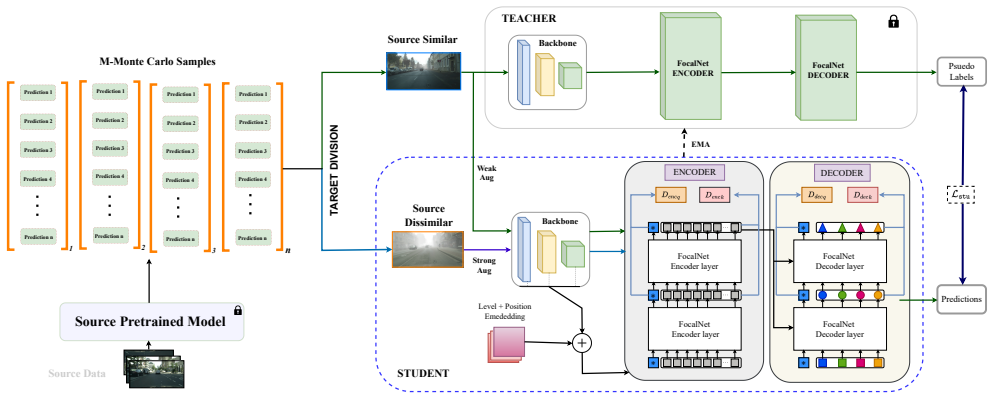
The central object is the detection variance $v_i = v_{b_i} v_{c_i}$, the product of a bounding-box coordinate variance and a class-score variance estimated from $M$ stochastic forward passes under dropout; ranking target images by this variance and thresholding at a rank fraction $\sigma$ divides the target into easy and hard subsets. Around this, the method adds adversarial learning to a transformer detector: a domain query is concatenated to the encoder and decoder token sequences and passed through domain discriminators with a domain label $d$, and each token is also passed through per-token discriminators, all trained through gradient reversal so the detector learns domain-invariant representations. A cascaded loss sums these query and token losses over encoder and decoder layers with balancing coefficients $\lambda_{encq}$ and $\lambda_{decq}$.
What would settle it
Run the released training code with the target-division ranks randomly permuted (easy/hard labels shuffled) and check whether the mAP gain persists; or inspect whether the domain discriminator's $d=0$ branch receives real source images during adaptation, which would break the claim of a strictly source-free setting.
Extended reading notes
Core claim
The paper introduces TITAN, a source-free domain adaptive object detection method built on the claim that the target domain can be partitioned into source-similar (easy) and source-dissimilar (hard) subsets by ranking images with a detection variance computed from Monte-Carlo dropout forward passes. It further claims that the teacher-student training instability, caused by noisy pseudo-labels under domain shift, can be suppressed by adversarially aligning features at both the query level and the per-token level inside a FocalNet-DINO transformer detector. The reported result is state-of-the-art performance on four natural-image benchmarks (C2F, C2B, S2C, K2C) and on two cross-dataset breast-cancer detection tasks, with the largest gains appearing where prior source-free methods were weakest.
Load-bearing premise
The adversarial losses need two labeled domains ($d=0$ for source and $d=1$ for target), so the method secretly assumes either that source images are available after all, or that the high-variance 'easy' half of the target data behaves like the source domain well enough to stand in for it; neither is established.
Editorial extensions
If this is right
- If the reported gains hold, source-free detection can be solved by partitioning the target domain rather than by accessing source data or source-feature statistics.
- The query-token adversarial module is a plug-in for transformer detectors, so it could transfer to other DETR-style architectures beyond FocalNet-DINO.
- The medical results suggest that cross-institution and cross-machine breast cancer screening can work without sharing patient data, provided the variance-similarity link holds on clinical images.
- The large margins over prior SF-DAOD methods on C2F, C2B, and S2C imply that target division plus adversarial alignment can rescue student-teacher pipelines from early collapse.
Reading between the lines
- The variance ranking may be picking up pseudo-label noise or detection difficulty rather than true source-similarity; the paper does not separate these explanations, and a test using oracle source-feature distances would clarify which one drives the gains.
- Because the adversarial losses explicitly use source-labeled samples ($d=0$), a strictly source-free implementation would need to generate or substitute source-like features from the easy subset; this is an engineering step the paper leaves implicit.
- The medical recall jumps (0.25 to 0.78, 0.15 to 0.51) are far larger than the natural-image gains, hinting that the partition may be exploiting small-target count or class-imbalance effects rather than pure domain alignment; per-image false-positive analysis would test this.
- A direct comparison against random assignment of easy/hard labels, or against a confidence-based (low-score) split, would isolate whether the variance criterion itself carries the benefit or whether any two-group split helps the adversarial objective.
Editorial analysis
A structured set of objections, weighed in public.
Referee Report
Summary. TITAN proposes a source-free domain-adaptive object detection (SF-DAOD) method built on FocalNet-DINO. The method first partitions the unlabeled target domain into source-similar (easy) and source-dissimilar (hard) subsets using a Monte-Carlo-dropout estimate of detection variance, and then applies query-token and token-wise adversarial losses inside a student-teacher framework to align the two groups. The paper reports large improvements over prior SF-DAOD and UDA methods on four natural-image benchmarks (C2F, C2B, S2C, K2C) and two medical benchmarks (RSNA-to-INBreast and DDSM-to-INBreast), with ablations attributing much of the gain to the target division and adversarial components.
Significance. If the method worked as described, TITAN would be a significant advance: the variance-based target partition is a novel and potentially useful mechanism for source-free detection, the reported gains over strong baselines such as PETS and A2SFOD are substantial, and the inclusion of medical imaging benchmarks addresses a relevant privacy-constrained application. The paper also contains reproducibility-friendly elements: explicit hyperparameter tables, augmentation details, and a supplemental theoretical derivation. However, the central mechanisms as written are not operational. The MC-dropout variance is identically zero under the paper's own dropout=0.0 configuration, the adversarial losses require source-domain labels that the source-free setting forbids, and the medical experiments train and test on the same target images. These issues are load-bearing rather than cosmetic, so the empirical and conceptual claims cannot be accepted in their present form.
major comments (4)
- [Section 3.1, Eqs. (2)-(3); Supplementary Table 7] The target partition mechanism is degenerate under the reported configuration. Section 3.1 defines the detection variance via M Monte-Carlo forward passes 'using dropout,' but Supplementary Table 7 lists dropout: 0.0 for the FocalNet-DINO configuration. With dropout probability zero, every forward pass is deterministic, so b^m_ij = mean(b_ij) and c^m_ij = mean(c_ij) for all m, giving v_b_i = v_c_i = v_i = 0 for every image. The rank r_i is then arbitrary and the threshold sigma no longer separates source-similar from source-dissimilar images. Since Table 5 and the abstract attribute a large part of the reported improvement to this target division, the central causal mechanism collapses.
- [Section 3.2, Eqs. (5),(7); Section 3.3, Eqs. (8)-(9); Fig. 2] The adversarial losses require two labeled domains, but the paper declares the setting source-free. Equations (5), (7), (8), and (9) use a domain label d taking value 0 for source images and 1 for target images, and Fig. 2 shows 'Source Data' entering the pipeline. The manuscript states in the abstract and Section 3 that source data is unavailable during adaptation. If the intended d=0 class is instead the easy target subset used as a source proxy, that substitution is nowhere stated, derived, or validated. As written, the method either assumes source data that the problem definition forbids or, in the proxy interpretation, aligns the target to itself rather than to the source.
- [Supplementary Section B.2, Table 6] The medical benchmarks are evaluated on the same images used for adaptation. The supplementary note explicitly says that for medical datasets the whole target dataset is used 'during training and testing,' and Table 6 confirms that for RSNA-BSD1K, INBreast, and DDSM the target train and test sets have identical sizes (e.g., 410/410 for INBreast and 1000/1000 for RSNA-BSD1K). This means the reported FROC curves and AUC values on R2In and D2In are not measured on unseen target data, so the SOTA claims on these benchmarks are not supported.
- [Section 3.1, Fig. 1] The stated intuition for the variance-based partition is internally contradictory. The text says 'A higher variance suggests a stronger resemblance to the source domain' but also 'the model exhibits greater uncertainty (hard samples) when predicting source-similar images, leading to elevated variance values.' These two statements assign opposite meanings to high variance: one calls high-variance images easy/source-similar, the other calls them hard. No evidence is provided that detection variance is monotonically related to source-domain resemblance, and the paper's own description does not specify which notion of 'hard' is meant.
minor comments (5)
- [Section 1 and Table 1] The reported C2F mAP is inconsistent: Section 1 lists 50.2 for TITAN, while Table 1 reports 52.2; the abstract's improvement figures (+22.7, +22.2, +21.1, +3.7) appear to be relative percentages computed from the stated absolute numbers, but they are not labeled as such.
- [Table 5] The ablation table is difficult to parse: the column headers and checkmarks do not make it clear which rows correspond to query-based versus token-wise losses, and the text refers to 'TITAN applied to the last encoder and decoder layers' without defining which acronym denotes the full method.
- [Fig. 4 and Fig. 7] The caption of Fig. 4 labels the method 'SFA (Ours)' although the paper's method is TITAN, and the caption of Fig. 7 says 'Quantitative results' when the content is qualitative; these labels should be corrected.
- [Supplementary Section A] The theoretical proof is titled 'Proof of Preposition' and uses a five-layer decomposition while Section 3.4 states that the discriminators are three-layer MLPs; the proof should be reconciled with the architecture actually used.
- [References] Several references are incomplete or garbled, e.g., reference [7] has a corrupted author list, and some entries lack venue or page information; a careful copyedit is needed.
Circularity Check
TITAN's variance-defined 'source-similar' subset makes its adversarial alignment a self-alignment of target data, and the MC-dropout variance is identically zero under the paper's own dropout=0 setting.
-
self definitional
[Section 3.1 (target division), Section 3.2 Eq. (5), Fig. 2]
"Even though the source data is inaccessible, the source-pretrained model retains crucial knowledge about the source domain... If vl i ≥ σ, we categorize Xi as source-similar; otherwise, it is deemed source-dissimilar. ... d is the domain label, taking the value 0 for source images and 1 for target images."
The source-similar and source-dissimilar labels are assigned by the variance threshold (vl_i ≥ σ), so 'source similarity' is not measured against the actual source; it is definitionally whatever has high variance under the source-pretrained model. The adversarial loss that supposedly closes the source-target gap is written with d=0 for 'source images' and d=1 for 'target images', but in the declared source-free setting the only candidates for d=0 are the paper's self-defined easy target images (or, per Fig. 2, source data that the source-free setting forbids). In either horn, the alignment is between two partitions of target data, so the claimed source-to-target transfer reduces to target self-alignment.
-
other
[Section 3.1, Eqs. (2)-(3); Supplementary Table 7]
"This approximation is achieved by conducting M stochastic forward passes while keeping the detection model unchanged [5]. ... dropout | Dropout | 0.0"
Equations (2)-(3) define v_bi and v_ci as the mean squared deviation of M Monte-Carlo forward passes. With dropout probability 0.0, every forward pass has identical weights and activations, so b^m_ij = \bar b_ij and c^m_ij = \bar c_ij for all m, making v_bi = v_ci = v_i = 0 for every image. The rank r_i is then arbitrary, and the threshold σ cannot separate source-similar from source-dissimilar images. The paper's core variance-to-source-similarity mechanism therefore produces no easy/hard split under its own hyperparameters; any gain credited to target division cannot be traced to the proposed mechanism. This is a by-construction degeneracy of the central derivation chain.
full rationale
The paper's main claimed derivation is: variance of MC-dropout predictions partitions the target into source-similar (easy) and source-dissimilar (hard) subsets; query-token adversarial losses then align these subsets to transfer from source to target. That chain is circular or vacuous at its two load-bearing joints. First, 'source-similar' is defined by the very variance criterion that is supposed to diagnose source similarity, and the adversarial losses, which formally require d=0 source images, can only be executed in the source-free setting by using the easy target subset as the source side; the alignment is therefore target-to-target, not source-to-target. Second, the variance computation itself is degenerate under the paper's own configuration: Supplementary Table 7 sets dropout to 0.0, so the Monte-Carlo passes are deterministic, forcing all variances to zero and making the easy/hard partition arbitrary. The reported mAP numbers are externally benchmarked against other methods, so those numbers are not circular in themselves; what is circular is the paper's attribution of those numbers to TITAN's proposed mechanism. The generalization bound is imported from prior work [2,33] but is not a self-citation and does not bear on the core adaptation claim. No load-bearing self-citation chain is present; the circularity is internal to the method's own definitions and hyperparameters.
Assumptions & free parameters
free parameters (3)
- sigma (target division threshold) =
not reported
- M (number of Monte Carlo dropout passes) =
not reported
- lambda_encq and lambda_decq =
0.1 and 0.1
assumptions (4)
- ad hoc to paper Higher detection variance implies higher recall and stronger source-domain resemblance.
- domain assumption A domain discriminator can be trained with source and target labels in a source-free setting.
- domain assumption Monte Carlo dropout approximates predictive variance for the detector.
- standard math Standard spectral-norm covering bounds for MLP discriminators.
invented entities (1)
-
Domain query token (q_enc^d, q_dec^d)
Cite this review
Pith. "Pith review of TITAN: Query-Token based Domain Adaptive Adversarial Learning." pith.science (2026). https://pith.science/paper/YRX2PSET
@misc{pith2026250621484,
  author       = {Pith},
  title        = {Pith review of: TITAN: Query-Token based Domain Adaptive Adversarial Learning},
  year         = {2026},
  howpublished = {\url{https://pith.science/paper/YRX2PSET}},
  note         = {Machine review of arXiv:2506.21484}
}
read the original abstract
We focus on the source-free domain adaptive object detection (SF-DAOD) problem when source data is unavailable during adaptation and the model must adapt to an unlabeled target domain. The majority of approaches for the problem employ a self-supervised approach using a student-teacher (ST) framework where pseudo-labels are generated via a source-pretrained model for further fine-tuning. We observe that the performance of a student model often degrades drastically, due to the collapse of the teacher model, primarily caused by high noise in pseudo-labels, resulting from domain bias, discrepancies, and a significant domain shift across domains. To obtain reliable pseudo-labels, we propose a Target-based Iterative Query-Token Adversarial Network (TITAN), which separates the target images into two subsets: those similar to the source (easy) and those dissimilar (hard). We propose a strategy to estimate variance to partition the target domain. This approach leverages the insight that higher detection variances correspond to higher recall and greater similarity to the source domain. Also, we incorporate query-token-based adversarial modules into a student-teacher baseline framework to reduce the domain gaps between two feature representations. Experiments conducted on four natural imaging datasets and two challenging medical datasets have substantiated the superior performance of TITAN compared to existing state-of-the-art (SOTA) methodologies. We report an mAP improvement of +22.7, +22.2, +21.1, and +3.7 percent over the current SOTA on C2F, C2B, S2C, and K2C benchmarks, respectively.
Figures


Figures from the paper (4 more)


Reference graph
Works this paper leans on
-
[1]
Attention is all you need
Vaswani Ashish. Attention is all you need. Advances in neural information processing systems, 30:I, 2017. 2
2017
-
[2]
Spectrally-normalized margin bounds for neural networks
Peter L Bartlett, Dylan J Foster, and Matus J Telgarsky. Spectrally-normalized margin bounds for neural networks. Advances in neural information processing systems , 30,
-
[3]
Weakly supervised deep detection networks
Hakan Bilen and Andrea Vedaldi. Weakly supervised deep detection networks. In Proceedings of the IEEE conference on computer vision and pattern recognition , pages 2846– 2854, 2016. 2
2016
-
[4]
Weakly supervised object detection with convex clustering
Hakan Bilen, Marco Pedersoli, and Tinne Tuytelaars. Weakly supervised object detection with convex clustering. In Proceedings of the IEEE conference on computer vision and pattern recognition, pages 1081–1089, 2015. 2
2015
-
[5]
Weight uncertainty in neural networks
Charles Blundell, Julien Cornebise, Koray Kavukcuoglu, and Daan Wierstra. Weight uncertainty in neural networks. In ICML, page 1613–1622, 2015. 3
2015
-
[6]
End- to-end object detection with transformers
Nicolas Carion, Francisco Massa, Gabriel Synnaeve, Nicolas Usunier, Alexander Kirillov, and Sergey Zagoruyko. End- to-end object detection with transformers. In European conference on computer vision , pages 213–229. Springer,
-
[7]
Rsna screening mammog- raphy breast cancer detection
C Carr, F Kitamura, J K-Cramer, J Mongan, K Andriole, M V , M Riopel, R Ball, and S Dane. Rsna screening mammog- raphy breast cancer detection. 2022. 2, 6, 8, 3
2022
-
[8]
Harmonizing transferability and discriminability for adapting object detectors
Chaoqi Chen, Zebiao Zheng, Xinghao Ding, Yue Huang, and Qi Dou. Harmonizing transferability and discriminability for adapting object detectors. In CVPR, pages 8866–8875,
Show all 124 references
-
[9]
Domain adaptive faster r-cnn for object detection in the wild
Yuhua Chen, Wen Li, Christos Sakaridis, Dengxin Dai, and Luc Van Gool. Domain adaptive faster r-cnn for object detection in the wild. InProceedings of the IEEE Conference on Computer Vision and Pattern Recognition (CVPR), 2018. 6, 7
2018
-
[10]
Domain adaptive faster r-cnn for object detection in the wild
Yuhua Chen, Wen Li, Christos Sakaridis, Dengxin Dai, and Luc Van Gool. Domain adaptive faster r-cnn for object detection in the wild. In Proceedings of the IEEE conference on computer vision and pattern recognition , pages 3339– 3348, 2018. 1
2018
-
[11]
No more discrim- ination: Cross city adaptation of road scene segmenters
Yi-Hsin Chen, Wei-Yu Chen, Yu-Ting Chen, Bo-Cheng Tsai, Yu-Chiang Frank Wang, and Min Sun. No more discrim- ination: Cross city adaptation of road scene segmenters. In Proceedings of the IEEE International Conference on Computer Vision, pages 1992–2001, 2017. 1
1992
-
[12]
Towards large-scale small object detection: Survey and benchmarks
Gong Cheng, Xiang Yuan, Xiwen Yao, Kebing Yan, Qinghua Zeng, Xingxing Xie, and Junwei Han. Towards large-scale small object detection: Survey and benchmarks. IEEE Trans- actions on Pattern Analysis and Machine Intelligence, 2023. 2
2023
-
[13]
Adversarial alignment for source free object detection
Qiaosong Chu, Shuyan Li, Guangyi Chen, Kai Li, and Xiu Li. Adversarial alignment for source free object detection. In Proceedings of the AAAI Conference on Artificial Intelli- gence, pages 452–460, 2023. 1, 2, 3, 6, 7
2023
-
[14]
Weakly supervised object localization with multi- fold multiple instance learning
Ramazan Gokberk Cinbis, Jakob Verbeek, and Cordelia Schmid. Weakly supervised object localization with multi- fold multiple instance learning. IEEE transactions on pattern analysis and machine intelligence, 39(1):189–203,
-
[15]
The cityscapes dataset for semantic urban scene understanding
Marius Cordts, Mohamed Omran, Sebastian Ramos, Timo Rehfeld, Markus Enzweiler, Rodrigo Benenson, Uwe Franke, Stefan Roth, and Bernt Schiele. The cityscapes dataset for semantic urban scene understanding. In Proceed- ings of the IEEE conference on computer vision and pattern re...
2016
-
[16]
Up-detr: Unsupervised pre-training for object detection with transformers
Zhigang Dai, Bolun Cai, Yugeng Lin, and Junying Chen. Up-detr: Unsupervised pre-training for object detection with transformers. In Proceedings of the IEEE/CVF conference on computer vision and pattern recognition , pages 1601– 1610, 2021. 2
2021
-
[17]
Imagenet: A large-scale hierarchical image database
Jia Deng, Wei Dong, Richard Socher, Li-Jia Li, Kai Li, and Li Fei-Fei. Imagenet: A large-scale hierarchical image database. In 2009 IEEE conference on computer vision and pattern recognition, pages 248–255. Ieee, 2009. 2
2009
-
[18]
Un- biased mean teacher for cross-domain object detection
Jinhong Deng, Wen Li, Yuhua Chen, and Lixin Duan. Un- biased mean teacher for cross-domain object detection. In Proceedings of the IEEE/CVF Conference on Computer Vi- sion and Pattern Recognition (CVPR) , pages 4091–4101,
-
[19]
Un- biased mean teacher for cross-domain object detection
Jinhong Deng, Wen Li, Yuhua Chen, and Lixin Duan. Un- biased mean teacher for cross-domain object detection. In Proceedings of the IEEE/CVF Conference on Computer Vi- sion and Pattern Recognition, pages 4091–4101, 2021. 2, 7
2021
-
[20]
Harmo- nious teacher for cross-domain object detection
Jinhong Deng, Dongli Xu, Wen Li, and Lixin Duan. Harmo- nious teacher for cross-domain object detection. In Proceed- ings of the IEEE/CVF Conference on Computer Vision and Pattern Recognition, pages 23829–23838, 2023. 6
2023
-
[21]
Confident anchor-induced multi-source free domain adaptation
Jiahua Dong, Zhen Fang, Anjin Liu, Gan Sun, and Tongliang Liu. Confident anchor-induced multi-source free domain adaptation. Advances in Neural Information Processing Systems, 34:2848–2860, 2021. 1
2021
-
[22]
An image is worth 16x16 words: Trans- formers for image recognition at scale
Alexey Dosovitskiy, Lucas Beyer, Alexander Kolesnikov, Dirk Weissenborn, Xiaohua Zhai, Thomas Unterthiner, Mostafa Dehghani, Matthias Minderer, Georg Heigold, Syl- vain Gelly, et al. An image is worth 16x16 words: Trans- formers for image recognition at scale. arXiv preprint a...
2010 arXiv
-
[23]
The pascal visual object classes (voc) challenge
Mark Everingham, Luc Van Gool, Christopher KI Williams, John Winn, and Andrew Zisserman. The pascal visual object classes (voc) challenge. International journal of computer vision, 88:303–338, 2010. 1, 2
2010
-
[24]
Dropout as a bayesian approximation: Representing model uncertainty in deep learning
Yarin Gal and Zoubin Ghahramani. Dropout as a bayesian approximation: Representing model uncertainty in deep learning. In ICML, pages 1050–1059, 2016. 3
2016
-
[25]
Domain-adversarial training of neural networks
Yaroslav Ganin, Evgeniya Ustinova, Hana Ajakan, Pas- cal Germain, Hugo Larochelle, François Laviolette, Mario March, and Victor Lempitsky. Domain-adversarial training of neural networks. Journal of machine learning research, 17(59):1–35, 2016. 1, 6
2016
-
[26]
Csda: Learning category-scale joint feature for domain adaptive object detection
Changlong Gao, Chengxu Liu, Yujie Dun, and Xueming Qian. Csda: Learning category-scale joint feature for domain adaptive object detection. In Proceedings of the IEEE/CVF International Conference on Computer Vision, pages 11421– 11430, 2023. 6, 7
2023
-
[27]
Vision meets robotics: The kitti dataset
Andreas Geiger, Philip Lenz, Christoph Stiller, and Raquel Urtasun. Vision meets robotics: The kitti dataset. The International Journal of Robotics Research, 32(11):1231– 1237, 2013. 1, 5, 2
2013
-
[28]
Fast r-cnn
Ross Girshick. Fast r-cnn. In Proceedings of the IEEE international conference on computer vision, pages 1440– 1448, 2015. 2
2015
-
[29]
Improving transferability for domain adaptive detection transformers
Kaixiong Gong, Shuang Li, Shugang Li, Rui Zhang, Chi Harold Liu, and Qiang Chen. Improving transferability for domain adaptive detection transformers. In Proceedings of the 30th ACM International Conference on Multimedia, pages 1543–1551, 2022. 6, 7
2022
-
[30]
Generative adversarial nets
Ian Goodfellow, Jean Pouget-Abadie, Mehdi Mirza, Bing Xu, David Warde-Farley, Sherjil Ozair, Aaron Courville, and Yoshua Bengio. Generative adversarial nets. Advances in neural information processing systems, 27, 2014. 5
2014
-
[31]
Boosting weakly supervised object detection using fusion and priors from hallucinated depth
Cagri Gungor and Adriana Kovashka. Boosting weakly supervised object detection using fusion and priors from hallucinated depth. In Proceedings of the IEEE/CVF Winter Conference on Applications of Computer Vision, pages 739– 748, 2024. 2
2024
-
[32]
Recent advances in deep learning theory
Fengxiang He and Dacheng Tao. Recent advances in deep learning theory. arXiv preprint arXiv:2012.10931, 2020. 5
2012 arXiv
-
[33]
Why resnet works? residuals generalize
Fengxiang He, Tongliang Liu, and Dacheng Tao. Why resnet works? residuals generalize. IEEE transactions on neural networks and learning systems, 31(12):5349–5362, 2020. 5
2020
-
[34]
Cross domain object detection by target-perceived dual branch distillation
Mengzhe He, Yali Wang, Jiaxi Wu, Yiru Wang, Hanqing Li, Bo Li, Weihao Gan, Wei Wu, and Yu Qiao. Cross domain object detection by target-perceived dual branch distillation. In Proceedings of the IEEE/CVF Conference on Computer Vision and Pattern Recognition (CVPR), pages 9570–9580,
-
[35]
Cross domain object detection by target-perceived dual branch distillation
Mengzhe He, Yali Wang, Jiaxi Wu, Yiru Wang, Hanqing Li, Bo Li, Weihao Gan, Wei Wu, and Yu Qiao. Cross domain object detection by target-perceived dual branch distillation. In Proceedings of the IEEE/CVF Conference on Computer Vision and Pattern Recognition, pages 9570–9580, 2022. 6, 7
2022
-
[36]
Multi-adversarial faster-rcnn for unrestricted object detection
Zhenwei He and Lei Zhang. Multi-adversarial faster-rcnn for unrestricted object detection. In Proceedings of the IEEE/CVF international conference on computer vision , pages 6668–6677, 2019. 1
2019
-
[37]
Fcns in the wild: Pixel-level adversarial and constraint-based adaptation
Judy Hoffman, Dequan Wang, Fisher Yu, and Trevor Darrell. Fcns in the wild: Pixel-level adversarial and constraint-based adaptation. arXiv preprint arXiv:1612.02649, 2016. 1
2016 arXiv
-
[38]
Cycada: Cycle-consistent adversarial domain adaptation
Judy Hoffman, Eric Tzeng, Taesung Park, Jun-Yan Zhu, Phillip Isola, Kate Saenko, Alexei Efros, and Trevor Darrell. Cycada: Cycle-consistent adversarial domain adaptation. In ICML, pages 1989–1998, 2018. 1
1989
-
[39]
Every pixel matters: Center-aware feature alignment for domain adaptive object detector
Cheng-Chun Hsu, Yi-Hsuan Tsai, Yen-Yu Lin, and Ming- Hsuan Yang. Every pixel matters: Center-aware feature alignment for domain adaptive object detector. In Computer Vision–ECCV 2020: 16th European Conference, Glasgow, UK, August 23–28, 2020, Proceedings, Part IX 16 , pages 73...
2020
-
[40]
Model adaptation: Historical contrastive learning for unsu- pervised domain adaptation without source data
Jiaxing Huang, Dayan Guan, Aoran Xiao, and Shijian Lu. Model adaptation: Historical contrastive learning for unsu- pervised domain adaptation without source data. Advances in Neural Information Processing Systems, 34:3635–3649,
-
[41]
Model adaptation: Historical contrastive learning for un- supervised domain adaptation without source data, 2022
Jiaxing Huang, Dayan Guan, Aoran Xiao, and Shijian Lu. Model adaptation: Historical contrastive learning for un- supervised domain adaptation without source data, 2022. 6
2022
-
[42]
Aqt: Adversarial query transformers for domain adaptive object detection
Wei-Jie Huang, Yu-Lin Lu, Shih-Yao Lin, Yusheng Xie, and Yen-Yu Lin. Aqt: Adversarial query transformers for domain adaptive object detection. In IJCAI, pages 972–979, 2022. 1, 6, 7
2022
-
[43]
Cross-domain weakly-supervised object detection through progressive domain adaptation
Naoto Inoue, Ryosuke Furuta, Toshihiko Yamasaki, and Kiyoharu Aizawa. Cross-domain weakly-supervised object detection through progressive domain adaptation. In Pro- ceedings of the IEEE conference on computer vision and pattern recognition, pages 5001–5009, 2018. 1
2018
-
[44]
Decoupled adaptation for cross-domain object detection, 2022
Junguang Jiang, Baixu Chen, Jianmin Wang, and Ming- sheng Long. Decoupled adaptation for cross-domain object detection, 2022. 6, 7
2022
-
[45]
Variational model perturbation for source-free do- main adaptation
Mengmeng Jing, Xiantong Zhen, Jingjing Li, and Cees Snoek. Variational model perturbation for source-free do- main adaptation. Advances in Neural Information Process- ing Systems, 35:17173–17187, 2022. 1
2022
-
[46]
Driving in the matrix: Can virtual worlds replace human- generated annotations for real world tasks? arXiv preprint arXiv:1610.01983, 2016
Matthew Johnson-Roberson, Charles Barto, Rounak Mehta, Sharath Nittur Sridhar, Karl Rosaen, and Ram Vasudevan. Driving in the matrix: Can virtual worlds replace human- generated annotations for real world tasks? arXiv preprint arXiv:1610.01983, 2016. 5, 8, 2
-
[47]
Haupt- mann
Guoliang Kang, Lu Jiang, Yi Yang, and Alexander G. Haupt- mann. Contrastive adaptation network for unsupervised domain adaptation. In CVPR, pages 4893–4902, 2019. 3
2019
-
[48]
To miss-attend is to misalign! residual self-attentive feature alignment for adapting object detectors
Vaishnavi Khindkar, Chetan Arora, Vineeth N Balasubrama- nian, Anbumani Subramanian, Rohit Saluja, and CV Jawa- har. To miss-attend is to misalign! residual self-attentive feature alignment for adapting object detectors. In Proceed- ings of the IEEE/CVF Winter Conference on Ap...
2022
-
[49]
Adam: A method for stochastic optimization
Diederik P Kingma and Jimmy Ba. Adam: A method for stochastic optimization. arXiv preprint arXiv:1412.6980,
-
[50]
Weakly supervised virus capsid detection with image-level annotations in electron microscopy images
Hannah Kniesel, Leon Sick, Tristan Payer, Tim Bergner, Kavitha Shaga Devan, Clarissa Read, Paul Walther, Timo Ropinski, and Pedro Hermosilla. Weakly supervised virus capsid detection with image-level annotations in electron microscopy images. In The Twelfth International Confe...
2023
-
[51]
A curated mammography data set for use in computer-aided detection and diagnosis research
Rebecca Sawyer Lee, Francisco Gimenez, Assaf Hoogi, Kanae Kawai Miyake, Mia Gorovoy, and Daniel L Rubin. A curated mammography data set for use in computer-aided detection and diagnosis research. Scientific data, 4(1):1–9,
-
[52]
Spatial attention pyramid network for unsupervised domain adaptation, 2020
Congcong Li, Dawei Du, Libo Zhang, Longyin Wen, Tiejian Luo, Yanjun Wu, and Pengfei Zhu. Spatial attention pyramid network for unsupervised domain adaptation, 2020. 7
2020
-
[53]
Source-free object detection by learning to overlook domain style
Shuaifeng Li, Mao Ye, Xiatian Zhu, Lihua Zhou, and Lin Xiong. Source-free object detection by learning to overlook domain style. In Proceedings of the IEEE/CVF Conference on Computer Vision and Pattern Recognition, pages 8014– 8023, 2022. 2, 3, 6, 7
2022
-
[54]
Sigma: Semantic- complete graph matching for domain adaptive object de- tection
Wuyang Li, Xinyu Liu, and Yixuan Yuan. Sigma: Semantic- complete graph matching for domain adaptive object de- tection. In Proceedings of the IEEE/CVF Conference on Computer Vision and Pattern Recognition (CVPR), pages 5291–5300, 2022. 6
2022
-
[55]
A free lunch for unsuper- vised domain adaptive object detection without source data,
Xianfeng Li, Weijie Chen, Di Xie, Shicai Yang, Peng Yuan, Shiliang Pu, and Yueting Zhuang. A free lunch for unsuper- vised domain adaptive object detection without source data,
-
[56]
A free lunch for unsu- pervised domain adaptive object detection without source data
Xianfeng Li, Weijie Chen, Di Xie, Shicai Yang, Peng Yuan, Shiliang Pu, and Yueting Zhuang. A free lunch for unsu- pervised domain adaptive object detection without source data. In Proceedings of the AAAI Conference on Artificial Intelligence, pages 8474–8481, 2021. 2, 3, 6
2021
-
[57]
Cross-domain adaptive teacher for object detection
Yu-Jhe Li, Xiaoliang Dai, Chih-Yao Ma, Yen-Cheng Liu, Kan Chen, Bichen Wu, Zijian He, Kris Kitani, and Peter Vajda. Cross-domain adaptive teacher for object detection. In Proceedings of the IEEE/CVF Conference on Computer Vision and Pattern Recognition, pages 7581–7590, 2022. 6
2022
-
[58]
Cross-domain adaptive teacher for object detection,
Yu-Jhe Li, Xiaoliang Dai, Chih-Yao Ma, Yen-Cheng Liu, Kan Chen, Bichen Wu, Zijian He, Kris Kitani, and Peter Vajda. Cross-domain adaptive teacher for object detection,
-
[59]
Do we really need to access the source data? source hypothesis transfer for un- supervised domain adaptation
Jian Liang, Dapeng Hu, and Jiashi Feng. Do we really need to access the source data? source hypothesis transfer for un- supervised domain adaptation. In International conference on machine learning, pages 6028–6039. PMLR, 2020. 1
2020
-
[60]
Microsoft coco: Common objects in context
Tsung-Yi Lin, Michael Maire, Serge Belongie, James Hays, Pietro Perona, Deva Ramanan, Piotr Dollár, and C Lawrence Zitnick. Microsoft coco: Common objects in context. In Computer Vision–ECCV 2014: 13th European Conference, Zurich, Switzerland, September 6-12, 2014, Proceedings...
2014
-
[61]
Focal loss for dense object detection
Tsung-Yi Lin, Priya Goyal, Ross Girshick, Kaiming He, and Piotr Dollár. Focal loss for dense object detection. In ICCV, pages 2980–2988, 2017. 2
2017
-
[62]
Periodically exchange teacher-student for source-free object detection
Qipeng Liu, Luojun Lin, Zhifeng Shen, and Zhifeng Yang. Periodically exchange teacher-student for source-free object detection. In Proceedings of the IEEE/CVF International Conference on Computer Vision, pages 6414–6424, 2023. 1, 2, 3, 6, 7
2023
-
[63]
Source-free domain adaptation for semantic segmentation
Yuang Liu, Wei Zhang, and Jun Wang. Source-free domain adaptation for semantic segmentation. In Proceedings of the IEEE/CVF Conference on Computer Vision and Pattern Recognition, pages 1215–1224, 2021. 1
2021
-
[64]
Cigar: Cross-modality graph reasoning for domain adaptive object detection
Yabo Liu, Jinghua Wang, Chao Huang, Yaowei Wang, and Yong Xu. Cigar: Cross-modality graph reasoning for domain adaptive object detection. In Proceedings of the IEEE/CVF Conference on Computer Vision and Pattern Recognition, pages 23776–23786, 2023. 6, 7
2023
-
[65]
Learning feature decomposition for domain adaptive monocular depth esti- mation
Shao-Yuan Lo, Wei Wang, Jim Thomas, Jingjing Zheng, Vishal M Patel, and Cheng-Hao Kuo. Learning feature decomposition for domain adaptive monocular depth esti- mation. In 2022 IEEE/RSJ International Conference on Intelligent Robots and Systems (IROS), pages 8376–8382. IEEE, 2022. 1
2022
-
[66]
Crots: Cross-domain teacher–student learning for source-free domain adaptive semantic segmen- tation
Xin Luo, Wei Chen, Zhengfa Liang, Longqi Yang, Siwei Wang, and Chen Li. Crots: Cross-domain teacher–student learning for source-free domain adaptive semantic segmen- tation. International Journal of Computer Vision, 132(1): 20–39, 2024. 3
2024
-
[67]
Codet: Co-occurrence guided region-word alignment for open-vocabulary object detection
Chuofan Ma, Yi Jiang, Xin Wen, Zehuan Yuan, and Xiaojuan Qi. Codet: Co-occurrence guided region-word alignment for open-vocabulary object detection. Advances in Neural Information Processing Systems, 36, 2024. 2
2024
-
[68]
Awada: Attention-weighted adversarial domain adaptation for object detection, 2022
Maximilian Menke, Thomas Wenzel, and Andreas Schwung. Awada: Attention-weighted adversarial domain adaptation for object detection, 2022. 7
2022
-
[69]
In- breast: toward a full-field digital mammographic database
Inês C Moreira, Igor Amaral, Inês Domingues, António Cardoso, Maria Joao Cardoso, and Jaime S Cardoso. In- breast: toward a full-field digital mammographic database. Academic radiology, 19(2):236–248, 2012. 2, 6, 8
2012
-
[70]
Ssal: Synergizing between self- training and adversarial learning for domain adaptive ob- ject detection
Muhammad Akhtar Munir, Muhammad Haris Khan, M Sar- fraz, and Mohsen Ali. Ssal: Synergizing between self- training and adversarial learning for domain adaptive ob- ject detection. Advances in Neural Information Processing Systems, 34:22770–22782, 2021. 6
2021
-
[71]
Unsupervised domain adap- tation of object detectors: A survey
Poojan Oza, Vishwanath A Sindagi, Vibashan Vishnukumar Sharmini, and Vishal M Patel. Unsupervised domain adap- tation of object detectors: A survey. IEEE Transactions on Pattern Analysis and Machine Intelligence, 2023. 1, 2, 6
2023
-
[72]
Automatic differentiation in pytorch
Adam Paszke, Sam Gross, Soumith Chintala, Gregory Chanan, Edward Yang, Zachary DeVito, Zeming Lin, Al- ban Desmaison, Luca Antiga, and Adam Lerer. Automatic differentiation in pytorch. In NIPS-W, 2017. 6
2017
-
[73]
Deep learning for detection of iso-dense, ob- scure masses in mammographically dense breasts
Krithika Rangarajan, Pranjal Aggarwal, Dhruv Kumar Gupta, Rohan Dhanakshirur, Akhil Baby, Chandan Pal, Arun Kumar Gupta, Smriti Hari, Subhashis Banerjee, and Chetan Arora. Deep learning for detection of iso-dense, ob- scure masses in mammographically dense breasts. European ra...
2023
-
[74]
Yolo9000: better, faster, stronger
Joseph Redmon and Ali Farhadi. Yolo9000: better, faster, stronger. In Proceedings of the IEEE conference on com- puter vision and pattern recognition , pages 7263–7271,
-
[75]
You only look once: Unified, real-time object de- tection
Joseph Redmon, Santosh Divvala, Ross Girshick, and Ali Farhadi. You only look once: Unified, real-time object de- tection. In Proceedings of the IEEE conference on computer vision and pattern recognition, pages 779–788, 2016. 2
2016
-
[76]
Faster r-cnn: Towards real-time object detection with re- gion proposal networks
Shaoqing Ren, Kaiming He, Ross Girshick, and Jian Sun. Faster r-cnn: Towards real-time object detection with re- gion proposal networks. Advances in neural information processing systems, 28, 2015. 2
2015
-
[77]
Seeking similarities over differences: Similarity-based do- main alignment for adaptive object detection
Farzaneh Rezaeianaran, Rakshith Shetty, Rahaf Aljundi, Daniel Olmeda Reino, Shanshan Zhang, and Bernt Schiele. Seeking similarities over differences: Similarity-based do- main alignment for adaptive object detection. InProceedings of the IEEE/CVF International Conference on Co...
2021
-
[78]
Foundations of machine learning, 2012
Afshin Rostamizadeh, Ameet Talwalkar, and Mehryar Mohri. Foundations of machine learning, 2012. 5
2012
-
[79]
Maximum classifier discrepancy for unsuper- vised domain adaptation
Kuniaki Saito, Kohei Watanabe, Yoshitaka Ushiku, and Tat- suya Harada. Maximum classifier discrepancy for unsuper- vised domain adaptation. In Proceedings of the IEEE con- ference on computer vision and pattern recognition, pages 3723–3732, 2018. 1
2018
-
[80]
Strong-weak distribution alignment for adaptive object detection
Kuniaki Saito, Yoshitaka Ushiku, Tatsuya Harada, and Kate Saenko. Strong-weak distribution alignment for adaptive object detection. In CVPR, pages 6956–6965, 2019. 3
2019
-
[81]
Strong-weak distribution alignment for adaptive object detection
Kuniaki Saito, Yoshitaka Ushiku, Tatsuya Harada, and Kate Saenko. Strong-weak distribution alignment for adaptive object detection. In Proceedings of the IEEE/CVF confer- ence on computer vision and pattern recognition , pages 6956–6965, 2019. 1
2019
-
[82]
Seman- tic foggy scene understanding with synthetic data
Christos Sakaridis, Dengxin Dai, and Luc Van Gool. Seman- tic foggy scene understanding with synthetic data. Interna- tional Journal of Computer Vision, 126:973–992, 2018. 5, 1, 2
2018
-
[83]
Fully convolutional one-stage 3d ob- ject detection on lidar range images
Zhi Tian, Xiangxiang Chu, Xiaoming Wang, Xiaolin Wei, and Chunhua Shen. Fully convolutional one-stage 3d ob- ject detection on lidar range images. Advances in Neural Information Processing Systems, 35:34899–34911, 2022. 2
2022
-
[84]
Adversarial discriminative domain adaptation
Eric Tzeng, Judy Hoffman, Kate Saenko, and Trevor Darrell. Adversarial discriminative domain adaptation. In Proceed- ings of the IEEE conference on computer vision and pattern recognition, pages 7167–7176, 2017. 1
2017
-
[85]
Sindagi, and Vishal M
Vibashan VS, Vikram Gupta, Poojan Oza, Vishwanath A. Sindagi, and Vishal M. Patel. Mega-cda: Memory guided attention for category-aware unsupervised domain adaptive object detection, 2021. 7
2021
-
[86]
Mixture of teacher experts for source-free do- main adaptive object detection
Vibashan Vs, Poojan Oza, Vishwanath A Sindagi, and Vishal M Patel. Mixture of teacher experts for source-free do- main adaptive object detection. In 2022 IEEE International Conference on Image Processing (ICIP), pages 3606–3610. IEEE, 2022. 2
2022
-
[87]
Instance relation graph guided source-free domain adaptive object detection
Vibashan VS, Poojan Oza, and Vishal M Patel. Instance relation graph guided source-free domain adaptive object detection. In Proceedings of the IEEE/CVF Conference on Computer Vision and Pattern Recognition, pages 3520–3530,
-
[88]
Towards on- line domain adaptive object detection
Vibashan VS, Poojan Oza, and Vishal M Patel. Towards on- line domain adaptive object detection. In Proceedings of the IEEE/CVF Winter Conference on Applications of Computer Vision, pages 478–488, 2023. 1
2023
-
[89]
Weakly supervised lesion detection and diagnosis for breast cancers with partially annotated ultrasound images
Jian Wang, Liang Qiao, Shichong Zhou, Jin Zhou, Jun Wang, Juncheng Li, Shihui Ying, Cai Chang, and Jun Shi. Weakly supervised lesion detection and diagnosis for breast cancers with partially annotated ultrasound images. IEEE Transac- tions on Medical Imaging, 2024. 2
2024
-
[90]
Exploring sequence feature alignment for domain adaptive detection transformers
Wen Wang, Yang Cao, Jing Zhang, Fengxiang He, Zheng- Jun Zha, Yonggang Wen, and Dacheng Tao. Exploring sequence feature alignment for domain adaptive detection transformers. In Proceedings of the 29th ACM International Conference on Multimedia, pages 1730–1738, 2021. 6, 7
2021
-
[91]
Point linking network for object detection
Xinggang Wang, Kaibing Chen, Zilong Huang, Cong Yao, and Wenyu Liu. Point linking network for object detection. arXiv preprint arXiv:1706.03646, 2017. 2
2017 arXiv
-
[92]
Towards universal object detection by domain attention
Xudong Wang, Zhaowei Cai, Dashan Gao, and Nuno Vas- concelos. Towards universal object detection by domain attention. In CVPR, pages 7289–7298, 2019. 3
2019
-
[93]
Domain-specific suppres- sion for adaptive object detection, 2021
Yu Wang, Rui Zhang, Shuo Zhang, Miao Li, YangYang Xia, XiShan Zhang, and ShaoLi Liu. Domain-specific suppres- sion for adaptive object detection, 2021. 7
2021
-
[94]
Alwod: Active learning for weakly-supervised object detection
Yuting Wang, Velibor Ilic, Jiatong Li, Branislav Kisaˇcanin, and Vladimir Pavlovic. Alwod: Active learning for weakly-supervised object detection. In Proceedings of the IEEE/CVF International Conference on Computer Vision, pages 6459–6469, 2023. 2
2023
-
[95]
Metateacher: Coordinating multi- model domain adaptation for medical image classification
Zhenbin Wang, Mao Ye, Xiatian Zhu, Liuhan Peng, Liang Tian, and Yingying Zhu. Metateacher: Coordinating multi- model domain adaptation for medical image classification. Advances in Neural Information Processing Systems , 35: 20823–20837, 2022. 1
2022
-
[96]
Adap- tive adversarial network for source-free domain adaptation
Haifeng Xia, Handong Zhao, and Zhengming Ding. Adap- tive adversarial network for source-free domain adaptation. In Proceedings of the IEEE/CVF international conference on computer vision, pages 9010–9019, 2021. 1
2021
-
[97]
Source data-free domain adaptation of object detector through domain-specific perturbation
Lin Xiong, Mao Ye, Dan Zhang, Yan Gan, Xue Li, and Yingying Zhu. Source data-free domain adaptation of object detector through domain-specific perturbation. International Journal of Intelligent Systems, 36, 2021. 6
2021
-
[98]
Source data-free domain adaptation of object detector through domain-specific perturbation
Lin Xiong, Mao Ye, Dan Zhang, Yan Gan, Xue Li, and Yingying Zhu. Source data-free domain adaptation of object detector through domain-specific perturbation. International Journal of Intelligent Systems, 36(8):3746–3766, 2021. 2, 3
2021
-
[99]
Exploring categorical regularization for domain adap- tive object detection, 2020
Chang-Dong Xu, Xing-Ran Zhao, Xin Jin, and Xiu-Shen Wei. Exploring categorical regularization for domain adap- tive object detection, 2020. 7
2020
-
[100]
H2fa r-cnn: Holistic and hierarchical feature align- ment for cross-domain weakly supervised object detection
Yunqiu Xu, Yifan Sun, Zongxin Yang, Jiaxu Miao, and Yi Yang. H2fa r-cnn: Holistic and hierarchical feature align- ment for cross-domain weakly supervised object detection. In 2022 IEEE/CVF Conference on Computer Vision and Pattern Recognition (CVPR), pages 14309–14319, 2022. 7
2022
-
[101]
Focal modulation networks
Jianwei Yang, Chunyuan Li, Xiyang Dai, and Jianfeng Gao. Focal modulation networks. Advances in Neural Information Processing Systems, 35:4203–4217, 2022. 1, 2, 3, 6
2022
-
[102]
Exploiting the intrinsic neighborhood structure for source-free domain adaptation
Shiqi Yang, Joost van de Weijer, Luis Herranz, Shangling Jui, et al. Exploiting the intrinsic neighborhood structure for source-free domain adaptation. Advances in neural informa- tion processing systems, 34:29393–29405, 2021. 1
2021
-
[103]
At- tracting and dispersing: A simple approach for source-free domain adaptation
Shiqi Yang, Shangling Jui, Joost van de Weijer, et al. At- tracting and dispersing: A simple approach for source-free domain adaptation. Advances in Neural Information Pro- cessing Systems, 35:5802–5815, 2022. 1
2022
-
[104]
Enhancing source- free domain adaptive object detection with low-confidence pseudo label distillation
Ilhoon Yoon, Hyeongjun Kwon, Jin Kim, Junyoung Park, Hyunsung Jang, and Kwanghoon Sohn. Enhancing source- free domain adaptive object detection with low-confidence pseudo label distillation. In European Conference on Com- puter Vision, pages 337–353. Springer, 2024. 6, 7
2024
-
[105]
Bdd100k: A diverse driving dataset for heterogeneous multitask learning
Fisher Yu, Haofeng Chen, Xin Wang, Wenqi Xian, Yingying Chen, Fangchen Liu, Vashisht Madhavan, and Trevor Dar- rell. Bdd100k: A diverse driving dataset for heterogeneous multitask learning. In Proceedings of the IEEE/CVF con- ference on computer vision and pattern recognition,...
2020
-
[106]
Mttrans: Cross- domain object detection with mean teacher transformer
Jinze Yu, Jiaming Liu, Xiaobao Wei, Haoyi Zhou, Yohei Nakata, Denis Gudovskiy, Tomoyuki Okuno, Jianxin Li, Kurt Keutzer, and Shanghang Zhang. Mttrans: Cross- domain object detection with mean teacher transformer. In European Conference on Computer Vision, pages 629–645. Spring...
2022
-
[107]
Weakly supervised object detection using proposal-and semantic-level relationships
Dingwen Zhang, Wenyuan Zeng, Jieru Yao, and Junwei Han. Weakly supervised object detection using proposal-and semantic-level relationships. IEEE Transactions on Pattern Analysis and Machine Intelligence, 44(6):3349–3363, 2020. 2
2020
-
[108]
Weakly supervised object localization and detection: A survey
Dingwen Zhang, Junwei Han, Gong Cheng, and Ming- Hsuan Yang. Weakly supervised object localization and detection: A survey. IEEE transactions on pattern analysis and machine intelligence, 44(9):5866–5885, 2021. 2
2021
-
[109]
Dino: Detr with improved denoising anchor boxes for end-to-end object detection
Hao Zhang, Feng Li, Shilong Liu, Lei Zhang, Hang Su, Jun Zhu, Lionel Ni, and Heung-Yeung Shum. Dino: Detr with improved denoising anchor boxes for end-to-end object detection. In The Eleventh International Conference on Learning Representations, 2022. 1, 2
2022
-
[110]
On the discrimination-generalization tradeoff in gans
Pengchuan Zhang, Qiang Liu, Dengyong Zhou, Tao Xu, and Xiaodong He. On the discrimination-generalization tradeoff in gans. arXiv preprint arXiv:1711.02771, 2017. 5
2017 arXiv
-
[111]
Divide and contrast: Source- free domain adaptation via adaptive contrastive learning
Ziyi Zhang, Weikai Chen, Hui Cheng, Zhen Li, Siyuan Li, Liang Lin, and Guanbin Li. Divide and contrast: Source- free domain adaptation via adaptive contrastive learning. Advances in Neural Information Processing Systems , 35: 5137–5149, 2022. 1
2022
-
[112]
Task-specific inconsistency alignment for domain adaptive object detection
Liang Zhao and Limin Wang. Task-specific inconsistency alignment for domain adaptive object detection. In Proceed- ings of the IEEE/CVF Conference on Computer Vision and Pattern Recognition (CVPR), pages 14217–14226, 2022. 6
2022
-
[113]
Masked retraining teacher- student framework for domain adaptive object detection
Zijing Zhao, Sitong Wei, Qingchao Chen, Dehui Li, Yifan Yang, Yuxin Peng, and Yang Liu. Masked retraining teacher- student framework for domain adaptive object detection. In Proceedings of the IEEE/CVF International Conference on Computer Vision, pages 19039–19049, 2023. 1, 6, 7
2023
-
[114]
End-to-end object detection with adaptive clustering transformer
Minghang Zheng, Peng Gao, Renrui Zhang, Kunchang Li, Xiaogang Wang, Hongsheng Li, and Hao Dong. End-to-end object detection with adaptive clustering transformer. arXiv preprint arXiv:2011.09315, 2020. 2
2011 arXiv
-
[115]
Ob- jects as points
Xingyi Zhou, Dequan Wang, and Philipp Krähenbühl. Ob- jects as points. arXiv preprint arXiv:1904.07850, 2019. 2
1904 arXiv
-
[116]
Detecting twenty-thousand classes using image-level supervision
Xingyi Zhou, Rohit Girdhar, Armand Joulin, Philipp Krähen- bühl, and Ishan Misra. Detecting twenty-thousand classes using image-level supervision. In European Conference on Computer Vision, pages 350–368. Springer, 2022. 2
2022
-
[117]
Adapting object detectors via selective cross-domain alignment
Xinge Zhu, Jiangmiao Pang, Ceyuan Yang, Jianping Shi, and Dahua Lin. Adapting object detectors via selective cross-domain alignment. In CVPR, pages 687–696, 2019. 3
2019
-
[118]
Deformable detr: Deformable trans- formers for end-to-end object detection
Xizhou Zhu, Weijie Su, Lewei Lu, Bin Li, Xiaogang Wang, and Jifeng Dai. Deformable detr: Deformable trans- formers for end-to-end object detection. arXiv preprint arXiv:2010.04159, 2020. 1, 2, 4
2010 arXiv
-
[119]
Object detection in 20 years: A survey
Zhengxia Zou, Keyan Chen, Zhenwei Shi, Yuhong Guo, and Jieping Ye. Object detection in 20 years: A survey. Proceedings of the IEEE, 111(3):257–276, 2023. 2 TITAN: Query-Token based Domain Adaptive Adversarial Learning Supplementary Material Sec. A provides additional theoretic...
2023
-
[120]
Cityscapes [15] is gathered from urban environments across 50 European cities, provides detailed annotations for 30 semantic classes across 8 categories. It comprises 5,000 high-quality annotated images and a larger set of 20,000 coarsely annotated images, all high-resolution ...
-
[121]
Foggy Cityscapes [82] is an extension of the Cityscapes dataset, designed to support research in devel- oping robust computer vision algorithms for autonomous Table 6. Details of Training Datasets Dataset Type Pre-training (Source) Unsupervised Adaptation (Target) Train Val/Te...
-
[122]
KITTI [27] is a promenient benchmark for computer vision and robotics, particularly in autonomous driving. Data was collected using a car-mounted sensor suite, including high-resolution color and grayscale cameras, a Velodyne laser scanner, and a GPS/IMU system, in urban, rura...
-
[123]
This dataset consists of 10,0000 images of urban environments under different weather conditions, lighting and traffic situations
SIM10k [46] is a synthetic dataset create using the Grand Theft Auto V (GTA V) engine, it simulates various driving scenarios providing diverse set of high-resolution images with detailed annotations. This dataset consists of 10,0000 images of urban environments under differen...
-
[124]
Dataset A to Dataset B
BDD100k [105] developed by the Berkeley DeepDrive (BDD) team, is one of the largest and most diverse driving video datasets available. It comprises of 100,000 driving videos and 100K keyframe images, and captures a wide range of driving scenarios across urban, suburban and rur...
Reviewed August 6, 2026 · model on record in the stance chip above.
Discussion (0). Sign in to comment.