REVIEW 3 major objections 5 minor 3 cited by
Potemkin Understanding in Large Language Models
T0 review · 3 major / 5 minor · reviewed 2026-08-06 · deepseek-v4-flash
Pith's one-line read Large language models routinely answer benchmark keystone questions correctly while holding interpretations no human would hold, so benchmark success does not certify conceptual understanding.
desk verdict Useful framework and benchmark, credible empirical gap, but the potemkin interpretation leans on an unmeasured human baseline that should be supplied before the strong claim is accepted. read the letter →
The pith
A machine-rendered reading of the paper's core claim, the machinery that carries it, and where it could break.
The reading
What carries the argument
The load-bearing object is the keystone set $S$: a minimal set of concept-relevant strings such that any human interpretation that agrees with the correct interpretation on $S$ must be the correct interpretation. Interpretations are defined as functions $f : X \to \{0,1\}$ over all concept-relevant strings $X$, with $F_h$ the space of human interpretations and $F_l$ the space of LLM interpretations. A potemkin is an $f \in F_l$ that matches $f^*$ on a keystone but not everywhere. The paper's two measurement procedures operationalize this: the benchmark compares correct definitions (the keystone) against classification, constrained generation, and editing; the automated procedure has the model answer a question, generate related questions, answer them, then grade those answers with the same model, treating disagreements as potemkins and noting this yields only a lower bound.
What would settle it
Present the study's classification, generation, and editing items to a group of people who give correct definitions of the same concepts; if those people fail at rates comparable to the models, the definition-application gap would not distinguish LLM understanding from human understanding.
Extended reading notes
Core claim
On the paper's own terms, the central discovery is that large language models exhibit potemkin understanding: an interpretation function $f$ that agrees with the correct interpretation $f^*$ on a keystone set $S$ yet differs from $f^*$ elsewhere, so the model can answer keystone questions without grasping the concept. The paper proves the formal claim that human-designed keystones are valid tests for an LLM only if the model's space of interpretations equals the human space, $F_l = F_h$. Empirically, the paper reports that models define the 32 tested concepts correctly 94.2% of the time, yet conditioned on a correct definition they solve classification, generation, and editing items at rates that imply potemkin rates of roughly 0.40 to 0.55; an automated self-grading procedure gives a lower bound on potemkin rate of 0.62 overall. The paper further reports that models often grade their own generated examples inconsistently, indicating that the failure reflects incoherent internal representations rather than a consistent alternative interpretation.
Load-bearing premise
The paper needs the premise that a person who can correctly define a concept must also be able to apply it in classification, generation, and editing; this 'keystone' property of definitions is asserted as a matter of faith and is not checked against human performance on the same use tasks.
Editorial extensions
If this is right
- Benchmark scores computed from keystone-style questions cannot be taken as evidence of conceptual understanding unless the model is known to be free of potemkins.
- The hold-out principle still guarantees performance on fresh questions drawn from the same distribution, so the invalidity claim is specifically about generalization beyond that distribution.
- Expanding keystone sets to include multiple use examples yields only modest gains, so adding a few application questions to an exam will not repair the invalid inference.
- The automated self-grading procedure provides a cheap, scalable screening tool for potemkin prevalence that requires only the model itself as a judge.
- Detecting and reducing potemkins becomes a target for training and evaluation pipelines, distinct from fixing hallucination or factual errors.
Reading between the lines
- If potemkins are a general phenomenon, then model evaluations that rely on benchmark accuracy alone will systematically overstate downstream competence on open-ended tasks, which may matter for high-stakes deployment decisions.
- The keystone framework suggests a direct constructive extension: build benchmarks by explicitly enumerating interpretation spaces, rather than sampling questions, to make the no-potemkins assumption testable.
- A natural test of the human-side assumption is to run the paper's classification, generation, and editing tasks on human participants who can define the concepts; if humans also fail at comparable rates, the measured gap would not establish non-human understanding.
- The incoherence results imply that model editing or fine-tuning that targets single facts may not repair conceptual understanding, since the same model holds conflicting representations of one concept.
Editorial analysis
A structured set of objections, weighed in public.
Referee Report
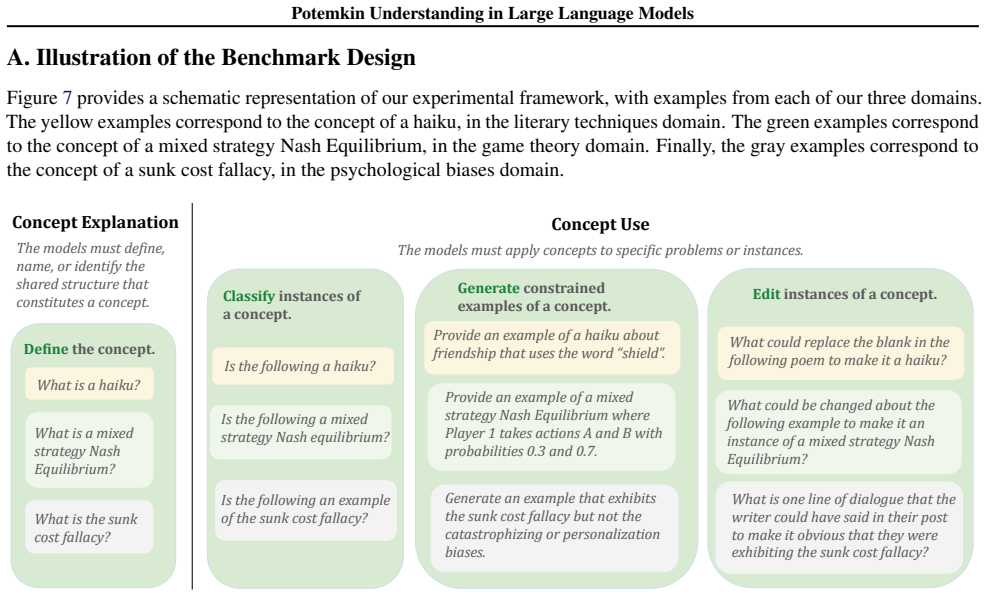
Summary. The paper introduces a formal framework for when human-designed benchmarks are valid tests of conceptual understanding in LLMs, arguing that such benchmarks are valid only if LLMs misunderstand concepts in the same structured ways humans do. It defines a 'keystone' set of questions that, if answered correctly by a human, force the correct interpretation, and defines 'potemkin understanding' as an LLM answering a keystone correctly while having a non-human, incorrect interpretation. The authors construct a benchmark across 32 concepts in literary techniques, game theory, and psychological biases, measuring how often models that correctly define a concept fail to apply it in classification, generation, and editing tasks. They also propose an automated self-grading procedure that yields a claimed lower bound on potemkin prevalence. Across 7-9 models, they report high rates of definition-use gaps and incoherence, concluding that existing benchmarks cannot be read as evidence of conceptual understanding in LLMs.
Significance. If the central claim holds, the paper addresses a fundamental question in LLM evaluation: it offers a formal explanation for why high benchmark scores need not imply conceptual understanding and provides two empirical procedures for detecting such failures. The benchmark dataset, with 3,159 labeled data points spanning three domains and multiple tasks, plus the publicly released code and data, is a valuable resource. The paper also connects to a broader literature on benchmark validity and model consistency, and the proposed 'potemkin' construct is likely to influence future evaluation methodology. The main empirical pattern—that models can define concepts correctly yet fail to apply them—is credible and consistent across models and tasks. However, the interpretation of this pattern as evidence of non-human understanding rests on an untested assumption about human concept use, which currently limits the strength of the conclusions.
major comments (3)
- [Section 3.1 and Discussion (third paragraph)] The keystone assumption is load-bearing but unvalidated. Section 3.1 states 'we have faith that humans who can clearly define the concept of a haiku have understood haikus,' and the Discussion responds to the 'too hard for humans' concern only with qualitative examples in Appendix J. The formal definition of potemkin understanding in Definition 2.1 requires the keystone set S to force the correct interpretation for all human interpretations f in Fh; this is an empirical claim about human concept use, not a logical consequence of being able to recite a definition. The paper never measures P(use correct | definition correct) for humans on the same 32 concepts and tasks. If human conditional accuracy on the generation or editing tasks is materially below ceiling, the observed LLM gaps would be at least partly explained by task difficulty rather than by non-human understanding. Since the headline conclusion (Section 5) that high potemkin rates invalidate benchmarks as measures of understanding depends on this assumption, the paper needs either a human baseline on these tasks or a substantially weakened claim.
- [Section 3.1, 3.3 and Definition 2.1] The empirical 'potemkin rate' is not the same as the formally defined potemkin. In Section 3.1, the keystone is operationalized as a single definition question, and the potemkin rate is defined in Section 3.3 as the proportion of use questions answered incorrectly conditional on a correct definition. But Definition 2.1 defines potemkin understanding as correct answers on a keystone set S that is guaranteed, for all human interpretations, to imply f = f*. The paper never verifies that a single definition question satisfies this keystone property, nor that a definition remains a keystone when the use tasks are as demanding as those in the benchmark. Therefore the measured quantity is more accurately described as a definition-use gap; calling it a potemkin rate presupposes the very assumption the paper needs to establish. This conflation affects the interpretation of Tables 1 and 6 and the title of the paper.
- [Section 4.2] The automatic procedure in Section 4.2 is not a lower bound on potemkins as defined in Definition 2.1. The procedure measures how often a model's self-judge grades the model's own answer to a self-generated question as incorrect. The argument that this is a lower bound on potemkin rate assumes that any judge disagreement indicates conceptual misunderstanding, but it does not involve a keystone set, nor does it condition on correct keystone answers in the formal sense. A model could answer keystone questions correctly and still generate questions that are difficult for the judge to grade consistently, so the 'potemkin rate (lower bound)' in Table 2 conflates self-consistency with potemkin understanding. Additionally, the role of the 'slightly incorrect response' control is not explained, and no results from that control are reported, so the reader cannot assess whether the judge is calibrated.
minor comments (5)
- [Appendix L, Table 7] The incoherence score for Claude-3.5 in game theory is reported as 1.04 (0.10), which exceeds the stated upper bound of 1 for 'as-good-as-random' performance; the paper should clarify whether scores above 1 are possible and what they indicate.
- [Figure 1 caption] The caption is difficult to parse: the panels are not labeled, and the text 'No Does out rhyme with soft?' is confusing. Please label the panels and describe each step clearly.
- [Section 4.2] The description of the judge procedure should define the 'expected response' explicitly and explain how the model's original answer is compared with the judge's grade; the current text leaves the reader to infer the comparison.
- [Section 2] The assertion that 'the space of human misunderstandings is predictable and sparse' is presented as fact without citation or supporting evidence; at minimum it should be labeled as an assumption of the framework.
- [Table 1 and Section 3.3] For the generation and editing tasks, no chance-level baseline is defined, yet the text implies that a potemkin rate of 1 corresponds to chance-level performance for all tasks; please specify the chance model used for these tasks or avoid the implication.
Circularity Check
No circularity: the potemkin rate is a transparent operationalization of the paper's own definition, and the 'faith' keystone assumption is a validity threat rather than a circular reduction.
full rationale
The paper's derivation chain is conditional and internally consistent. Definition 2.1 defines potemkin understanding as correct answers on a keystone set S with f != f*. Section 3.1 operationalizes a keystone as a single correct definition ('we have faith that humans who can clearly define the concept of a haiku have understood haikus') and Table 1 measures the potemkin rate as the percent of use questions answered incorrectly conditional on a correct definition. This is a direct measurement of the defined construct, not a result that presupposes its conclusion; the empirical rate is not used to justify the keystone assumption. The paper explicitly flags the main threat to this operationalization in the Section 3 Discussion ('Another concern is whether the use tasks we consider in the benchmark are too hard such that humans would fail these as well'), addressing it only qualitatively via Appendix J, and no human baseline for P(use correct | definition correct) is provided. That missing baseline is a substantive validity threat to the inference from conditional error rates to non-human misunderstanding, but it is a missing empirical premise, not a circular step: the conclusion is not assumed within the measurement. No fitted parameter is relabeled as a prediction, and the self-citations (Vafa et al. 2024a,b) appear only as related work, not as load-bearing justification. The lower-bound procedure in Section 4.2 is also a transparent operationalization of self-consistency rather than a circular derivation.
Assumptions & free parameters
assumptions (4)
- domain assumption Definitions are keystones for human understanding: a human who correctly defines a concept must be able to apply it correctly.
- domain assumption The space of human misunderstandings Fh is small and structured, so keystone sets exist.
- domain assumption An LLM's interpretation is representable as a function f: X -> {0,1} that can be elicited by prompting.
- domain assumption Self-disagreement in the automatic procedure reveals conceptual misunderstanding.
invented entities (2)
-
Potemkin understanding
-
Keystone set
Cite this review
Pith. "Pith review of Potemkin Understanding in Large Language Models." pith.science (2026). https://pith.science/paper/FSBWGUE7
@misc{pith2026250621521,
  author       = {Pith},
  title        = {Pith review of: Potemkin Understanding in Large Language Models},
  year         = {2026},
  howpublished = {\url{https://pith.science/paper/FSBWGUE7}},
  note         = {Machine review of arXiv:2506.21521}
}
read the original abstract
Large language models (LLMs) are regularly evaluated using benchmark datasets. But what justifies making inferences about an LLM's capabilities based on its answers to a curated set of questions? This paper first introduces a formal framework to address this question. The key is to note that the benchmarks used to test LLMs -- such as AP exams -- are also those used to test people. However, this raises an implication: these benchmarks are only valid tests if LLMs misunderstand concepts in ways that mirror human misunderstandings. Otherwise, success on benchmarks only demonstrates potemkin understanding: the illusion of understanding driven by answers irreconcilable with how any human would interpret a concept. We present two procedures for quantifying the existence of potemkins: one using a specially designed benchmark in three domains, the other using a general procedure that provides a lower-bound on their prevalence. We find that potemkins are ubiquitous across models, tasks, and domains. We also find that these failures reflect not just incorrect understanding, but deeper internal incoherence in concept representations.
Figures


Figures from the paper (8 more)




Forward citations
Cited by 3 Pith papers
-
Re:Form -- Reducing Human Annotations in Scalable Formal Software Verification with RL in LLMs: A Preliminary Study on Dafny
A minimal-prior pipeline with automated data curation and verifier-driven RL lets small LLMs generate verifiable Dafny specifications and beat larger proprietary models on a synthetic compositional benchmark.
-
Faster AI, Uneven Frontier: Rapid Crossings, a Jagged Frontier, and the Repositioning of Human Judgment
AI has rapidly crossed expert baselines on bounded tasks on a still-jagged frontier, so human work must shift from production to specification, verification, and oversight.
-
The wall confronting large language models
LLM scaling exponents near 0.1 imply that reducing loss tenfold would need 10^10 more compute, making scientific-grade reliability unreachable by brute-force scaling.
Reference graph
Works this paper leans on
-
[1]
write newline
" write newline "" before.all 'output.state := FUNCTION n.dashify 't := "" t empty not t #1 #1 substring "-" = t #1 #2 substring "--" = not "--" * t #2 global.max substring 't := t #1 #1 substring "-" = "-" * t #2 global.max substring 't := while if t #1 #1 substring * t #2 global.max substring 't := if while FUNCTION format.date year duplicate empty "emp...
-
[2]
Arkoudas, K. Gpt-4 can't reason. arXiv preprint arXiv:2308.03762, 2023
arXiv 2023
-
[3]
Belinkov, Y. and Bisk, Y. Synthetic and natural noise both break neural machine translation. arXiv preprint arXiv:1711.02173, 2017
arXiv 2017
-
[4]
Berglund, L., Tong, M., Kaufmann, M., Balesni, M., Stickland, A. C., Korbak, T., and Evans, O. The reversal curse: Llms trained on" a is b" fail to learn" b is a". arXiv preprint arXiv:2309.12288, 2023
arXiv 2023
-
[5]
Bowman, S. R. and Dahl, G. E. What will it take to fix benchmarking in natural language understanding? arXiv preprint arXiv:2104.02145, 2021
arXiv 2021
-
[6]
R., Angeli, G., Potts, C., and Manning, C
Bowman, S. R., Angeli, G., Potts, C., and Manning, C. D. A large annotated corpus for learning natural language inference. arXiv preprint arXiv:1508.05326, 2015
arXiv 2015
-
[7]
T., Li, Y., Lundberg, S., et al
Bubeck, S., Eldan, R., Gehrke, J., Horvitz, E., Kamar, E., Lee, P., Lee, Y. T., Li, Y., Lundberg, S., et al. Sparks of artificial general intelligence: Early experiments with gpt-4, 2023
work page 2023
-
[8]
With Little Power Comes Great Responsibility
Card, D., Henderson, P., Khandelwal, U., Jia, R., Mahowald, K., and Jurafsky, D. With little power comes great responsibility. arXiv preprint arXiv:2010.06595, 2020
work page Pith review arXiv 2010
Show all 65 references
-
[9]
Chang, S., Anderson, A., and Hofman, J. M. Chatbench: From static benchmarks to human-ai evaluation. arXiv preprint arXiv:2504.07114, 2025
2025 arXiv
-
[10]
N., Li, T., Li, D., Zhu, B., Zhang, H., Jordan, M., Gonzalez, J
Chiang, W.-L., Zheng, L., Sheng, Y., Angelopoulos, A. N., Li, T., Li, D., Zhu, B., Zhang, H., Jordan, M., Gonzalez, J. E., et al. Chatbot arena: An open platform for evaluating llms by human preference. In Forty-first International Conference on Machine Learning, 2024
2024
-
[11]
Church, K. W. and Hestness, J. A survey of 25 years of evaluation. Natural Language Engineering, 2019
2019
-
[12]
and Etzioni, O
Clark, P. and Etzioni, O. My computer is an honor student—but how intelligent is it? standardized tests as a measure of ai. AI Magazine, 2016
2016
-
[13]
Recognizing textual entailment: Rational, evaluation and approaches--erratum
Dagan, I., Dolan, B., Magnini, B., and Roth, D. Recognizing textual entailment: Rational, evaluation and approaches--erratum. Natural Language Engineering, 2010
2010
-
[14]
Testing ai on language comprehension tasks reveals insensitivity to underlying meaning
Dentella, V., G \"u nther, F., Murphy, E., Marcus, G., and Leivada, E. Testing ai on language comprehension tasks reveals insensitivity to underlying meaning. Scientific Reports, 2024
2024
-
[15]
and Meurers, D
Dickinson, M. and Meurers, D. Detecting errors in part-of-speech annotation. In 10th conference of the European chapter of the association for computational linguistics, 2003
2003
-
[16]
Measuring and improving consistency in pretrained language models
Elazar, Y., Kassner, N., Ravfogel, S., Ravichander, A., Hovy, E., Sch \"u tze, H., and Goldberg, Y. Measuring and improving consistency in pretrained language models. Transactions of the Association for Computational Linguistics, 2021
2021
-
[17]
Evaluating superhuman models with consistency checks
Fluri, L., Paleka, D., and Tram \`e r, F. Evaluating superhuman models with consistency checks. In 2024 IEEE Conference on Secure and Trustworthy Machine Learning (SaTML). IEEE, 2024
2024
-
[18]
W., Wallach, H., Iii, H
Gebru, T., Morgenstern, J., Vecchione, B., Vaughan, J. W., Wallach, H., Iii, H. D., and Crawford, K. Datasheets for datasets. Communications of the ACM, 2021
2021
-
[19]
Geirhos, R., Jacobsen, J.-H., Michaelis, C., Zemel, R., Brendel, W., Bethge, M., and Wichmann, F. A. Shortcut learning in deep neural networks. Nature Machine Intelligence, 2020
2020
-
[20]
Transformer feed-forward layers are key-value memories
Geva, M., Schuster, R., Berant, J., and Levy, O. Transformer feed-forward layers are key-value memories. arXiv preprint arXiv:2012.14913, 2020
2012 arXiv
-
[21]
R., and Goldberg, Y
Geva, M., Caciularu, A., Wang, K. R., and Goldberg, Y. Transformer feed-forward layers build predictions by promoting concepts in the vocabulary space. arXiv preprint arXiv:2203.14680, 2022
2022 arXiv
-
[22]
Dissecting recall of factual associations in auto-regressive language models
Geva, M., Bastings, J., Filippova, K., and Globerson, A. Dissecting recall of factual associations in auto-regressive language models. arXiv preprint arXiv:2304.14767, 2023
2023 arXiv
-
[23]
What can large language models do in chemistry? a comprehensive benchmark on eight tasks
Guo, T., Nan, B., Liang, Z., Guo, Z., Chawla, N., Wiest, O., Zhang, X., et al. What can large language models do in chemistry? a comprehensive benchmark on eight tasks. Advances in Neural Information Processing Systems, 2023
2023
-
[24]
Measuring massive multitask language understanding
Hendrycks, D., Burns, C., Basart, S., Zou, A., Mazeika, M., Song, D., and Steinhardt, J. Measuring massive multitask language understanding. arXiv preprint arXiv:2009.03300, 2020
2009 arXiv
-
[25]
D., Sordoni, A., and Courville, A
Hosseini, A., Reddy, S., Bahdanau, D., Hjelm, R. D., Sordoni, A., and Courville, A. Understanding by understanding not: Modeling negation in language models. arXiv preprint arXiv:2105.03519, 2021
2021 arXiv
-
[26]
A., Sathe, A., Lipkin, B., Kumar, U., Radkani, S., Clark, T
Ivanova, A. A., Sathe, A., Lipkin, B., Kumar, U., Radkani, S., Clark, T. H., Kauf, C., Hu, J., Pramod, R., Grand, G., et al. Elements of world knowledge (ewok): A cognition-inspired framework for evaluating basic world knowledge in language models. arXiv preprint arXiv:2405.09...
2024 arXiv
-
[27]
Adversarial example generation with syntactically controlled paraphrase networks
Iyyer, M., Wieting, J., Gimpel, K., and Zettlemoyer, L. Adversarial example generation with syntactically controlled paraphrase networks. arXiv preprint arXiv:1804.06059, 2018
2018 arXiv
-
[28]
S., and Lukasiewicz, T
Jang, M., Kwon, D. S., and Lukasiewicz, T. Accurate, yet inconsistent? consistency analysis on language understanding models. arXiv preprint arXiv:2108.06665, 2021
2021 arXiv
-
[29]
S., and Lukasiewicz, T
Jang, M., Kwon, D. S., and Lukasiewicz, T. Becel: Benchmark for consistency evaluation of language models. In Proceedings of the 29th International Conference on Computational Linguistics, 2022
2022
-
[30]
Jang, M. E. and Lukasiewicz, T. Consistency analysis of chatgpt. arXiv preprint arXiv:2303.06273, 2023
2023 arXiv
-
[31]
What disease does this patient have? a large-scale open domain question answering dataset from medical exams
Jin, D., Pan, E., Oufattole, N., Weng, W.-H., Fang, H., and Szolovits, P. What disease does this patient have? a large-scale open domain question answering dataset from medical exams. Applied Sciences, 2021
2021
-
[32]
Dynabench: Rethinking benchmarking in nlp
Kiela, D., Bartolo, M., Nie, Y., Kaushik, D., Geiger, A., Wu, Z., Vidgen, B., Prasad, G., Singh, A., Ringshia, P., et al. Dynabench: Rethinking benchmarking in nlp. arXiv preprint arXiv:2104.14337, 2021
2021 arXiv
-
[33]
a ldchen, S., Binder, A., Montavon, G., Samek, W., and M \
Lapuschkin, S., W \"a ldchen, S., Binder, A., Montavon, G., Samek, W., and M \"u ller, K.-R. Unmasking clever hans predictors and assessing what machines really learn. Nature communications, 2019
2019
-
[34]
L., Shrivastava, V., Li, S., Hashimoto, T., and Liang, P
Li, X. L., Shrivastava, V., Li, S., Hashimoto, T., and Liang, P. Benchmarking and improving generator-validator consistency of language models. arXiv preprint arXiv:2310.01846, 2023
2023 arXiv
-
[35]
Holistic evaluation of language models
Liang, P., Bommasani, R., Lee, T., Tsipras, D., Soylu, D., Yasunaga, M., Zhang, Y., Narayanan, D., Wu, Y., Kumar, A., et al. Holistic evaluation of language models. arXiv preprint arXiv:2211.09110, 2022
2022 arXiv
-
[36]
Truthfulqa: Measuring how models mimic human falsehoods
Lin, S., Hilton, J., and Evans, O. Truthfulqa: Measuring how models mimic human falsehoods. arXiv preprint arXiv:2109.07958, 2021
2021 arXiv
-
[37]
Mathbench: Evaluating the theory and application proficiency of llms with a hierarchical mathematics benchmark
Liu, H., Zheng, Z., Qiao, Y., Duan, H., Fei, Z., Zhou, F., Zhang, W., Zhang, S., Lin, D., and Chen, K. Mathbench: Evaluating the theory and application proficiency of llms with a hierarchical mathematics benchmark. arXiv preprint arXiv:2405.12209, 2024
2024 arXiv
-
[38]
Sycophancy in large language models: Causes and mitigations
Malmqvist, L. Sycophancy in large language models: Causes and mitigations. arXiv preprint arXiv:2411.15287, 2024
2024 arXiv
-
[39]
Locating and editing factual associations in gpt
Meng, K., Bau, D., Andonian, A., and Belinkov, Y. Locating and editing factual associations in gpt. Advances in Neural Information Processing Systems, 2022
2022
-
[40]
Mitchell, E., Lin, C., Bosselut, A., Finn, C., and Manning, C. D. Fast model editing at scale. arXiv preprint arXiv:2110.11309, 2021
2021 arXiv
-
[41]
Why ai is harder than we think
Mitchell, M. Why ai is harder than we think. arXiv preprint arXiv:2104.12871, 2021
2021 arXiv
-
[42]
D., Bender, E
Paullada, A., Raji, I. D., Bender, E. M., Denton, E., and Hanna, A. Data and its (dis) contents: A survey of dataset development and use in machine learning research. Patterns, 2021
2021
-
[43]
H., and Riedel, S
Petroni, F., Rockt \"a schel, T., Lewis, P., Bakhtin, A., Wu, Y., Miller, A. H., and Riedel, S. Language models as knowledge bases? arXiv preprint arXiv:1909.01066, 2019
1909 arXiv
-
[44]
A., and Lewis, M
Press, O., Zhang, M., Min, S., Schmidt, L., Smith, N. A., and Lewis, M. Measuring and narrowing the compositionality gap in language models. arXiv preprint arXiv:2210.03350, 2022
2022 arXiv
-
[45]
D., Bender, E
Raji, I. D., Bender, E. M., Paullada, A., Denton, E., and Hanna, A. Ai and the everything in the whole wide world benchmark. arXiv preprint arXiv:2111.15366, 2021
2021 arXiv
-
[46]
Do imagenet classifiers generalize to imagenet? In International conference on machine learning
Recht, B., Roelofs, R., Schmidt, L., and Shankar, V. Do imagenet classifiers generalize to imagenet? In International conference on machine learning. PMLR, 2019
2019
-
[47]
Reuel, A., Hardy, A., Smith, C., Lamparth, M., Hardy, M., and Kochenderfer, M. J. Betterbench: Assessing ai benchmarks, uncovering issues, and establishing best practices. arXiv preprint arXiv:2411.12990, 2024
2024 arXiv
-
[48]
why should i trust you?
Ribeiro, M. T., Singh, S., and Guestrin, C. " why should i trust you?" explaining the predictions of any classifier. In Proceedings of the 22nd ACM SIGKDD international conference on knowledge discovery and data mining, 2016
2016
-
[49]
T., Singh, S., and Guestrin, C
Ribeiro, M. T., Singh, S., and Guestrin, C. Semantically equivalent adversarial rules for debugging nlp models. In Proceedings of the 56th Annual Meeting of the Association for Computational Linguistics, 2018
2018
-
[50]
T., Guestrin, C., and Singh, S
Ribeiro, M. T., Guestrin, C., and Singh, S. Are red roses red? evaluating consistency of question-answering models. In Proceedings of the 57th Annual Meeting of the Association for Computational Linguistics, 2019
2019
-
[51]
T., Wu, T., Guestrin, C., and Singh, S
Ribeiro, M. T., Wu, T., Guestrin, C., and Singh, S. Beyond accuracy: Behavioral testing of nlp models with checklist. arXiv preprint arXiv:2005.04118, 2020
2005 arXiv
-
[52]
Models in the wild: On corruption robustness of neural nlp systems
Rychalska, B., Basaj, D., Gosiewska, A., and Biecek, P. Models in the wild: On corruption robustness of neural nlp systems. In Neural Information Processing. Springer, 2019
2019
-
[53]
Saba, W. S. Llms' understanding of natural language revealed. arXiv preprint arXiv:2407.19630, 2024
2024 arXiv
-
[54]
everyone wants to do the model work, not the data work
Sambasivan, N., Kapania, S., Highfill, H., Akrong, D., Paritosh, P., and Aroyo, L. M. “everyone wants to do the model work, not the data work”: Data cascades in high-stakes ai. In proceedings of the 2021 CHI Conference on Human Factors in Computing Systems, 2021
2021
-
[55]
H., Sch \"a rli, N., and Zhou, D
Shi, F., Chen, X., Misra, K., Scales, N., Dohan, D., Chi, E. H., Sch \"a rli, N., and Zhou, D. Large language models can be easily distracted by irrelevant context. In International Conference on Machine Learning. PMLR, 2023
2023
-
[56]
and Choi, Y
Shwartz, V. and Choi, Y. Do neural language models overcome reporting bias? In Proceedings of the 28th International Conference on Computational Linguistics, 2020
2020
-
[57]
S., Wei, J., Chung, H
Singhal, K., Azizi, S., Tu, T., Mahdavi, S. S., Wei, J., Chung, H. W., Scales, N., Tanwani, A., Cole-Lewis, H., Pfohl, S., et al. Large language models encode clinical knowledge. Nature, 2023
2023
-
[58]
Evaluating the factual consistency of large language models through summarization
Tam, D., Mascarenhas, A., Zhang, S., Kwan, S., Bansal, M., and Raffel, C. Evaluating the factual consistency of large language models through summarization. arXiv preprint arXiv:2211.08412, 2022
2022 arXiv
-
[59]
Y., Kleinberg, J., Mullainathan, S., and Rambachan, A
Vafa, K., Chen, J. Y., Kleinberg, J., Mullainathan, S., and Rambachan, A. Evaluating the world model implicit in a generative model. arXiv preprint arXiv:2406.03689, 2024 a
2024 arXiv
-
[60]
Do large language models perform the way people expect? measuring the human generalization function
Vafa, K., Rambachan, A., and Mullainathan, S. Do large language models perform the way people expect? measuring the human generalization function. arXiv preprint arXiv:2406.01382, 2024 b
2024 arXiv
-
[61]
On the planning abilities of large language models-a critical investigation
Valmeekam, K., Marquez, M., Sreedharan, S., and Kambhampati, S. On the planning abilities of large language models-a critical investigation. Advances in Neural Information Processing Systems, 2023
2023
-
[62]
T., Heer, J., and Weld, D
Wu, T., Ribeiro, M. T., Heer, J., and Weld, D. S. Errudite: Scalable, reproducible, and testable error analysis. In Proceedings of the 57th Annual Meeting of the Association for Computational Linguistics, 2019
2019
-
[63]
Kformer: Knowledge injection in transformer feed-forward layers
Yao, Y., Huang, S., Dong, L., Wei, F., Chen, H., and Zhang, N. Kformer: Knowledge injection in transformer feed-forward layers. In CCF International Conference on Natural Language Processing and Chinese Computing. Springer, 2022
2022
-
[64]
Wildchat: 1m chatgpt interaction logs in the wild
Zhao, W., Ren, X., Hessel, J., Cardie, C., Choi, Y., and Deng, Y. Wildchat: 1m chatgpt interaction logs in the wild. arXiv preprint arXiv:2405.01470, 2024
2024 arXiv
-
[65]
S., Zaheer, M., Bhojanapalli, S., Li, D., Yu, F., and Kumar, S
Zhu, C., Rawat, A. S., Zaheer, M., Bhojanapalli, S., Li, D., Yu, F., and Kumar, S. Modifying memories in transformer models. arXiv preprint arXiv:2012.00363, 2020
2012 arXiv
Reviewed August 6, 2026 · model on record in the stance chip above.
Discussion (0). Sign in to comment.