REVIEW 4 major objections 6 minor 56 references
AdaptGOT: A Pre-trained Model for Adaptive Contextual POI Representation Learning
T0 review · 4 major / 6 minor · reviewed 2026-08-15 · deepseek-v4-flash
Pith's one-line read Adaptive POI embeddings beat fixed pretrained baselines by up to 23.8%
desk verdict Empirical POI embedding work that deserves a review, but the headline 'task-adaptive without retraining' is not backed by the equations, and the JS-divergence loss is underspecified. read the letter →
The pith
A machine-rendered reading of the paper's core claim, the machinery that carries it, and where it could break.
The reading
What carries the argument
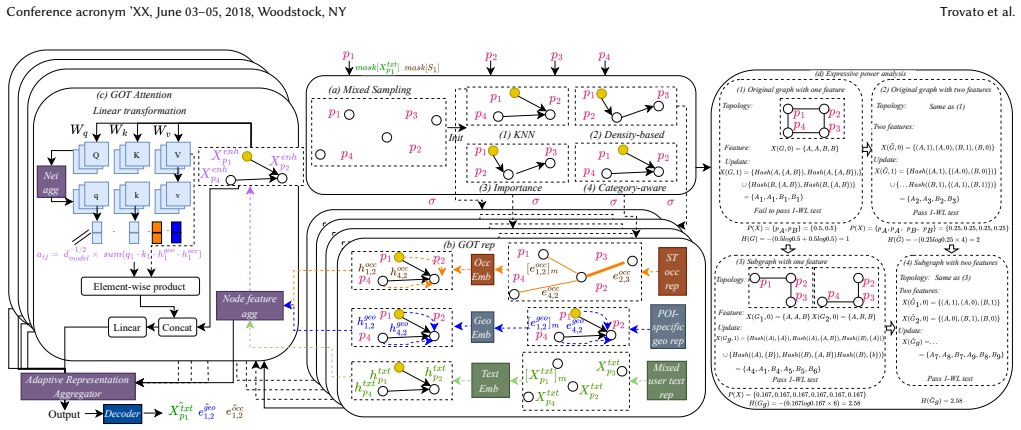
The load-bearing mechanism is the adaptive encoder–decoder built on a sparse mixture-of-experts (MoE) layer. Given four candidate subgraphs produced by KNN, density-based, importance, and category-aware sampling, the MoE gating function computes a sparse, task-dependent weighting, and the model minimizes the Jensen–Shannon divergence between the weighted subgraph feature distribution and the original graph feature distribution to preserve topological consistency. Around this sit the GOT attention module, which folds relative geographical position and normalized co-occurrence into the attention score while BERT-encoded review text forms node features, and a masked self-supervised objective that reconstructs text, geo, and co-occurrence signals. The expressive-power argument (Theorems 1–3) ties the design to the 1-WL isomorphism test: multi-context features reduce label conflicts and increase entropy, which is why mixed subgraphs are claimed to beat single-context message passing.
What would settle it
Run AdaptGOT with the JS divergence loss replaced by a fixed constant, keeping everything else identical, and compare the learned MoE gate weights and downstream Recall@K. If the gate weights and recall are unchanged, the JS term is not carrying the topological-consistency mechanism; conversely, if the term measurably changes which experts are selected, the claimed mechanism has a verifiable effect. A second check is to define $P(G_s)$ and $P(G)$ explicitly on a small POI graph and recompute Eq. (23) to see whether the minimized value actually tracks topological differences.
Extended reading notes
Core claim
On its own terms, AdaptGOT claims to establish that pre-trained POI representations are not required to be fixed. By jointly encoding geographical, co-occurrence, and textual signals in a modified graph attention mechanism and letting a sparse mixture-of-experts layer pick different subgraph topologies for different tasks, the model produces embeddings that outperform fixed pretrained baselines (CTLE, SpaBERT) and random or fixed initializations across three POI tasks on two real-world datasets. The paper also claims theoretical support: multiple contexts and multiple subgraphs increase the discriminative power and entropy of node embeddings under the 1-WL isomorphism test, which is offered as the reason mixed sampling improves expressiveness. Ablations attribute the gains to each component — removing the adaptive aggregator, the attention module, or any single context degrades recall — and a zero-shot cross-city experiment reports an average recall increase of 19.7%.
Load-bearing premise
The whole 'adaptive and topologically consistent' claim rests on the assumption that the Jensen–Shannon divergence in Eq. (23) is a well-defined objective between identifiable distributions of subgraph and original-graph features, yet the paper never defines how $P(G_s)$ and $P(G)$ are computed; if that term is not well-defined, the adaptive module reduces to a learned gating network and the stated mechanism is not doing the claimed work.
Editorial extensions
If this is right
- One pre-trained POI embedding can be adapted at inference time to tasks with different contextual emphases, so downstream models no longer need task-specific fine-tuning of the embedding layer.
- Cross-city transfer improves: in the paper's zero-shot experiment, AdaptGOT raises average recall by 19.7% over the fixed baselines, suggesting embeddings trained on one city can serve another.
- Each context channel earns its keep: ablations show removing geography, co-occurrence, text, or the adaptive aggregator lowers recall, so multi-context integration is doing measurable work.
- The expressive-power argument implies that adding more POI contexts or more subgraphs should keep improving label discrimination up to a point, with diminishing returns after four subgraphs as observed.
Reading between the lines
- If the JS-divergence term turns out not to be well-defined, the practical contribution likely survives as a task-adaptive gating network over multi-context subgraphs; the loss could be replaced by a simpler diversity or entropy regularizer.
- The same mixed-sampling-plus-MoE recipe could transfer to other geo-entity problems such as land-use classification, region-function identification, or route prediction, where no single neighborhood definition is correct for all queries.
- A direct test of the 1-WL argument would be to measure embedding entropy or oversmoothing (for example, average cosine similarity between neighboring node embeddings) across subgraph counts; the theory predicts less oversmoothing with more contexts.
Signed reviews
Editorial analysis
A structured set of objections, weighed in public.
Referee Report
Summary. The paper proposes AdaptGOT, a pre-training framework for POI embeddings. It combines mixed subgraph sampling (KNN, density, importance, and category-aware strategies), a GOT representation module that fuses geographical, co-occurrence, and textual information, a modified GOT attention mechanism, and an MoE-based 'adaptive representation aggregator' claimed to adjust POI representations across downstream tasks without retraining by minimizing a Jensen-Shannon divergence between subgraph and original graph distributions. The model is trained self-supervised with text, geography, and co-occurrence reconstruction losses. Experiments on Foursquare and Yelp evaluate next-POI recommendation, next-category prediction, and POI recommendation, with ablations, sensitivity analyses, and a zero-shot cross-city transfer test; the paper reports consistent recall improvements over SpaBERT, CTLE, and several other baselines.
Significance. If its mechanism claims were fully supported, AdaptGOT would be a useful contribution to POI representation learning: the multi-context sampling and GOT attention are sensible design choices, and the evaluation breadth (multiple datasets, tasks, ablations, cross-city transfer) is a strength. However, the central 'adaptive across tasks without retraining' claim is not implemented in the forward pass as written, and the JS-divergence objective is not operationalized. The empirical comparison also lacks variance reporting and selects hyperparameters on the evaluation metrics. The contribution is therefore currently under-supported, though these issues do not by themselves disprove the reported recall gains.
major comments (4)
- [§4.4, Eqs. (20)–(22)] The forward pass in Eqs. (20)–(22) computes h'_i from the GOT-attention output z_i and learned gating weights only; no task identifier, task loss, or downstream query appears in these equations. This contradicts the claim in Section 1 and Section 4.4 that the MoE aggregator 'dynamically adjusts POI representations across tasks without retraining': a fixed pretrained POI receives the same h'_i for next-POI recommendation, category prediction, and POI recommendation unless the downstream model fine-tunes the embedding. Please state precisely what 'adaptive across tasks' means operationally, or revise the claim to describe a fixed multimodal embedding.
- [§4.4, Eq. (23)] The JS-divergence term that is supposed to preserve 'topological consistency' is not operationalized. P(G_s) and P(G) are never defined or estimated, no equation links D_JS to h'_i or to a graph-topological quantity, and the claim that minimizing Eq. (23) aligns subgraph representations with global structure is therefore unsupported. As written, the adaptive representation aggregator reduces to a learned per-node gating network, and the JS loss contributes nothing identifiable to the mechanism. Define the distributions, give an estimator, and show how the loss affects the gating or expert outputs.
- [§3.2, Theorems 1–3] The theoretical claims supporting the 'expressive power' contribution are not established in the manuscript. The proofs are deferred to an anonymous external README, and the statements in Eqs. (4)–(6) are not formal: P_conflict and entropy are not defined on the same probability space, and the proof sketch ('feature space size grows exponentially') does not by itself imply the claimed 1-WL discriminative-power result. Either provide complete proofs in the paper or reframe these statements as intuition and empirical motivation.
- [§5.1.4 and Table 2] The empirical evidence for superiority is weakened by the absence of error bars and significance tests, and by the fact that key hyperparameters (number of subgraphs, heads, neighbors) are selected on the same Recall@K metrics used for the final comparison. Table 2 also contains cases where the advertised gain is zero or negligible, for example LA-Next POI Rec@5 under LSTPM: GOT 0.078 versus SpaBERT 0.078. Please report means over repeated runs with variance, use a validation-based selection protocol, and identify where the improvement is statistically reliable.
minor comments (6)
- [Throughout] The term 'GOT' is used ambiguously for both the model (AdaptGOT) and the representation module (GOT representation); Table 2's 'GOT' row should be labeled consistently to avoid confusion.
- [Abstract and template] There are numerous typos and formatting artifacts: 'POl' in the Abstract, 'onGeographical location' in the Abstract, the repeated 'the' in Section 4.4, and the placeholder ACM template with 2018 copyright and 'Conference acronym ’XX'.
- [§5.2.1] The text refers to 'Los Angeles' when the dataset column is labeled 'LA' for Louisiana; please make the city/state labels consistent.
- [Eqs. (8) and (28)] Equation (28) uses the notation g ∈ G(h_i) without defining the distribution over gates, and Eq. (8) uses N_den both as a set and as its cardinality; please clean up the notation.
- [Footnote 1] The footnote pointing to an anonymous README for the proofs and NDCG results is not an adequate substitute for material that should be in the paper or a stable repository; include the proofs and full metric tables in the manuscript.
- [Table 5] The zero-shot cross-city table does not state which source/target city is used for each column; without this information, the transfer claim is hard to interpret.
Circularity Check
The empirical headline results are partly circular because the model configuration is selected on the same Rec@K metrics used to substantiate superiority; the separate 'adaptive across tasks' claim is unsupported but not a circular derivation.
full rationale
The central empirical comparison is against external baselines (CTLE, SpaBERT, GETNext, FPMC, LSTPM, etc.) on two real-world datasets, so the claim of superior performance is not circular by construction. The only concrete circularity I can exhibit is the model-selection step: the number of subgraphs, number of heads, and other hyperparameters are tuned on Recall@K/NDCG for the same downstream tasks and datasets later used as evidence, without a described independent holdout; this makes the headline numbers partly fitted rather than predicted. This is a real circularity in the validation chain, but it does not reduce the whole architecture to its inputs because the model still encodes genuinely external data. I also flag, as non-circular correctness concerns, that Section 4.4's claim of task-adaptive representations 'without retraining' is unsupported: Eqs. 20-22 contain no task identifier or downstream query, so the same POI receives the same embedding across tasks; and Eq. 23's JS divergence is not operationalized because P(G_s) and P(G) are never defined or estimated. Theorems 1-3 defer proofs to an anonymous link, and reference [41] is by a co-author but is used only as a baseline, not as load-bearing justification. These issues reduce confidence but do not constitute a circular derivation of the empirical results.
Assumptions & free parameters
free parameters (5)
- Number of subgraphs/expert paths =
4
- Number of attention heads =
2
- Number of neighbor connections k in pre-training =
5 (with 15 recommended in sensitivity)
- KDE bandwidth b in density-based sampling =
not reported
- Smoothing constant gamma in importance and category sampling =
not reported
assumptions (4)
- domain assumption POI graph formulation: POIs are nodes of a graph whose edges are learnable and determined by node features (Section 3.2, following [50]).
- ad hoc to paper Multi-context enrichment strictly increases 1-WL discriminative power and embedding entropy (Theorems 1-3).
- domain assumption Mixed user review text aggregated per POI is a meaningful textual representation (Section 4.2.3).
- domain assumption Co-occurrence representation without time encoding supports zero-shot cross-city transfer (Section 4.2.1).
Cite this review
Pith. "Pith review of AdaptGOT: A Pre-trained Model for Adaptive Contextual POI Representation Learning." pith.science (2026). https://pith.science/paper/RDWMRKLK
@misc{pith2026250621612,
  author       = {Pith},
  title        = {Pith review of: AdaptGOT: A Pre-trained Model for Adaptive Contextual POI Representation Learning},
  year         = {2026},
  howpublished = {\url{https://pith.science/paper/RDWMRKLK}},
  note         = {Machine review of arXiv:2506.21612}
}
read the original abstract
Currently, considerable strides have been achieved in Point-of-Interest (POI) embedding methodologies, driven by the emergence of novel POI tasks like recommendation and classification. Despite the success of task-specific, end-to-end models in POI embedding, several challenges remain. These include the need for more effective multi-context sampling strategies, insufficient exploration of multiple POI contexts, limited versatility, and inadequate generalization. To address these issues, we propose the AdaptGOT model, which integrates both the (Adapt)ive representation learning technique and the Geographical-Co-Occurrence-Text (GOT) representation with a particular emphasis on Geographical location, Co-Occurrence and Textual information. The AdaptGOT model comprises three key components: (1) contextual neighborhood generation, which integrates advanced mixed sampling techniques such as KNN, density-based, importance-based, and category-aware strategies to capture complex contextual neighborhoods; (2) an advanced GOT representation enhanced by an attention mechanism, designed to derive high-quality, customized representations and efficiently capture complex interrelations between POIs; and (3) the MoE-based adaptive encoder-decoder architecture, which ensures topological consistency and enriches contextual representation by minimizing Jensen-Shannon divergence across varying contexts. Experiments on two real-world datasets and multiple POI tasks substantiate the superior performance of the proposed AdaptGOT model.
Figures


Figures from the paper (2 more)


Reference graph
Works this paper leans on
-
[1]
Chris Burges, Tal Shaked, Erin Renshaw, Ari Lazier, Matt Deeds, Nicole Hamilton, and Greg Hullender. 2005. Learning to rank using gradient descent. InProceedings of the 22nd international conference on Machine learning . 89–96
2005
-
[2]
Buru Chang, Yonggyu Park, Donghyeon Park, Seongsoon Kim, and Jaewoo Kang. 2018. Content-Aware Hierarchical Point-of-Interest Embedding Model for Successive POI Recommendation. In Proceedings of the 27th International Joint Conference on Artificial Intelligence (Stockholm, Sweden) (IJCAI’18). AAAI Press, 3301–3307
work page 2018
-
[3]
Jie Chen, Tengfei Ma, and Cao Xiao. 2018. FastGCN: Fast Learning with Graph Convolutional Networks via Importance Sampling. (1 2018). http://arxiv.org/ abs/1801.10247
arXiv 2018
-
[4]
Jianfei Chen, Jun Zhu, and Le Song. 2017. Stochastic training of graph con- volutional networks with variance reduction. arXiv preprint arXiv:1710.10568 (2017)
arXiv 2017
-
[5]
Meng Chen, Yan Zhao, Yang Liu, Xiaohui Yu, and Kai Zheng. 2020. Modeling spatial trajectories with attribute representation learning. IEEE transactions on knowledge and data engineering 34, 4 (2020), 1902–1914
work page 2020
-
[6]
Meng Chen, Lei Zhu, Ronghui Xu, Yang Liu, Xiaohui Yu, and Yilong Yin. 2021. Embedding Hierarchical Structures for Venue Category Representation. ACM Trans. Inf. Syst. 40, 3, Article 57 (nov 2021), 29 pages. doi:10.1145/3478285
-
[7]
Wei-Lin Chiang, Xuanqing Liu, Si Si, Yang Li, Samy Bengio, and Cho-Jui Hsieh
-
[8]
Weilin Cong, Rana Forsati, Mahmut Kandemir, and Mehrdad Mahdavi. 2020. Minimal variance sampling with provable guarantees for fast training of graph neural networks. In Proceedings of the 26th ACM SIGKDD International Conference on Knowledge Discovery & Data Mining . 1393–1403
2020
Show all 56 references
-
[9]
Yue Cui, Hao Sun, Yan Zhao, Hongzhi Yin, and Kai Zheng. 2021. Sequential- Knowledge-Aware Next POI Recommendation: A Meta-Learning Approach.ACM Trans. Inf. Syst. 40, 2, Article 23 (sep 2021), 22 pages. doi:10.1145/3460198
2021 doi
-
[10]
Jacob Devlin, Ming-Wei Chang, Kenton Lee, and Kristina Toutanova. 2018. BERT: Pre-training of Deep Bidirectional Transformers for Language Understanding. CoRR abs/1810.04805 (2018). arXiv:1810.04805 http://arxiv.org/abs/1810.04805
2018 arXiv
-
[11]
Ruixue Ding, Boli Chen, Pengjun Xie, Fei Huang, Xin Li, Qiang Zhang, and Yao Xu. 2023. A Multi-Modal Geographic Pre-Training Method. arXiv preprint arXiv:2301.04283 (2023)
2023 arXiv
-
[12]
Shanshan Feng, Gao Cong, Bo An, and Yeow Meng Chee. 2017. Poi2vec: Geo- graphical latent representation for predicting future visitors. In Proceedings of the AAAI Conference on Artificial Intelligence , Vol. 31
2017
-
[13]
Hazelton
Martin L. Hazelton. 2014. Kernel Smoothing. Wiley StatsRef: Statistics Reference Online
2014
-
[14]
Xiangnan He, Lizi Liao, Hanwang Zhang, Liqiang Nie, Xia Hu, and Tat-Seng Chua. 2017. Neural collaborative filtering. In Proceedings of the 26th international conference on world wide web . 173–182
2017
-
[15]
Wenbing Huang, Tong Zhang, Yu Rong, and Junzhou Huang. 2018. Adaptive sam- pling towards fast graph representation learning. Advances in neural information processing systems 31 (2018)
2018
-
[16]
Yannis Karmim, Elias Ramzi, Raphaël Fournier-S’niehotta, and Nicolas Thome
-
[17]
Minseok Kim, Jinoh Oh, Jaeyoung Do, and Sungjin Lee. 2022. Debiasing Neighbor Aggregation for Graph Neural Network in Recommender Systems. International Conference on Information and Knowledge Management, Proceedings , 4128–4132
2022
-
[18]
Diederik P Kingma and Jimmy Ba. 2014. Adam: A method for stochastic opti- mization. arXiv preprint arXiv:1412.6980 (2014)
2014 arXiv
-
[19]
Dejiang Kong and Fei Wu. 2018. HST-LSTM: A hierarchical spatial-temporal long-short term memory network for location prediction.. In IJCAI, Vol. 18. 2341–2347
2018
-
[20]
Yehuda Koren, Robert Bell, and Chris Volinsky. 2009. Matrix factorization tech- niques for recommender systems. Computer 42, 8 (2009), 30–37
2009
-
[21]
Yang Li, Yadan Luo, Zheng Zhang, Shazia Sadiq, and Peng Cui. 2019. Context- aware attention-based data augmentation for POI recommendation. In 2019 IEEE 35th International Conference on Data Engineering Workshops (ICDEW) . IEEE, 177–184
2019
-
[22]
Zekun Li, Jina Kim, Yao-Yi Chiang, and Muhao Chen. 2022. SpaBERT: A Pre- trained Language Model from Geographic Data for Geo-Entity Representation. arXiv:2210.12213 [cs.CL]
2022 arXiv
-
[23]
Defu Lian, Yongji Wu, Yong Ge, Xing Xie, and Enhong Chen. 2020. Geography- aware sequential location recommendation. In Proceedings of the 26th ACM SIGKDD international conference on knowledge discovery & data mining . 2009– 2019
2020
-
[24]
Yan Lin, Huaiyu Wan, Shengnan Guo, and Youfang Lin. 2021. Pre-training context and time aware location embeddings from spatial-temporal trajectories for user next location prediction. In Proceedings of the AAAI Conference on Artificial Intelligence, Vol. 35. 4241–4248
2021
-
[25]
Fan Liu, Zhiyong Cheng, Lei Zhu, Zan Gao, and Liqiang Nie. 2021. Interest-aware Message-Passing GCN for Recommendation. In WWW ’21: The Web Conference 2021, Virtual Event / Ljubljana, Slovenia, April 19-23, 2021 , Jure Leskovec, Marko Grobelnik, Marc Najork, Jie Tang, and Leil...
2021
-
[26]
Xin Liu, Yong Liu, and Xiaoli Li. 2016. Exploring the context of locations for personalized location recommendations.. In IJCAI. 1188–1194
2016
-
[27]
Steven Loria et al. 2018. textblob Documentation. Release 0.15 2, 8 (2018), 269
2018
-
[28]
Saeed Masoudnia and Reza Ebrahimpour. 2014. Mixture of experts: a literature survey. Artificial Intelligence Review 42 (2014), 275–293
2014
-
[29]
Christopher Morris, Gaurav Rattan, and Petra Mutzel. 2020. Weisfeiler and Leman go sparse: Towards scalable higher-order graph embeddings. In Advances in Neu- ral Information Processing Systems 33: Annual Conference on Neural Information Processing Systems 2020, NeurIPS 2020, ...
2020
-
[30]
Christopher Morris, Martin Ritzert, Matthias Fey, William L Hamilton, Jan Eric Lenssen, Gaurav Rattan, and Martin Grohe. 2019. Weisfeiler and leman go neural: Higher-order graph neural networks. In Proceedings of the AAAI conference on artificial intelligence, Vol. 33. 4602–4609
2019
-
[31]
Steffen Rendle, Christoph Freudenthaler, and Lars Schmidt-Thieme. 2010. Factor- izing personalized markov chains for next-basket recommendation. InProceedings of the 19th international conference on World wide web . 811–820
2010
-
[32]
N Shazeer, A Mirhoseini, K Maziarz, A Davis, Q Le, G Hinton, and J Dean. 2017. The sparsely-gated mixture-of-experts layer. Outrageously large neural networks (2017)
2017
-
[33]
Ke Sun, Tieyun Qian, Tong Chen, Yile Liang, Nguyen Hung, and Hongzhi Yin
-
[34]
Petar Veličković, Guillem Cucurull, Arantxa Casanova, Adriana Romero, Pietro Lio, and Yoshua Bengio. 2017. Graph attention networks. arXiv preprint arXiv:1710.10903 (2017)
2017 arXiv
-
[35]
Haotao Wang, Ziyu Jiang, Yuning You, Yan Han, Gaowen Liu, Jayanth Srinivasa, Ramana Rao Kompella, and Zhangyang Wang. 2023. Graph Mixture of Experts: Learning on Large-Scale Graphs with Explicit Diversity Modeling. (4 2023). http://arxiv.org/abs/2304.02806
2023 arXiv
-
[36]
Xinfeng Wang, Fumiyo Fukumoto, Jin Cui, Yoshimi Suzuki, Jiyi Li, and Dongjin Yu
-
[37]
Xiang Wang, Xiangnan He, Meng Wang, Fuli Feng, and Tat-Seng Chua. 2019. Neural graph collaborative filtering. In Proceedings of the 42nd international ACM SIGIR conference on Research and development in Information Retrieval . 165–174
2019
-
[38]
Keyulu Xu, Weihua Hu, Jure Leskovec, and Stefanie Jegelka. 2019. How Powerful are Graph Neural Networks?. In 7th International Conference on Learning Rep- resentations, ICLR 2019, New Orleans, LA, USA, May 6-9, 2019 . OpenReview.net. https://openreview.net/forum?id=ryGs6iA5Km
2019
-
[39]
Jingsong Yang, Guanzhou Han, Deqing Yang, Jingping Liu, Yanghua Xiao, Xiang Xu, Baohua Wu, and Shenghua Ni. 2023. M3pt: A multi-modal model for poi tag- ging. In Proceedings of the 29th ACM SIGKDD Conference on Knowledge Discovery and Data Mining. 5382–5392
2023
-
[40]
Kang Yang, Ruiyun Yu, Bingyang Guo, and Jie Li. 2024. Interaction Subgraph Sequential Topology-Aware Network for Transferable Recommendation. IEEE Trans. Knowl. Data Eng. 36, 10 (2024), 5221–5233. doi:10.1109/TKDE.2024.3384965
2024
-
[41]
Song Yang, Jiamou Liu, and Kaiqi Zhao. 2022. GETNext: Trajectory Flow Map Enhanced Transformer for Next POI Recommendation. In Proceedings of the 45th International ACM SIGIR Conference on Research and Development in Information Retrieval (<conf-loc>, <city>Madrid</city>, <cou...
2022
-
[42]
Di Yao, Chao Zhang, Jianhui Huang, and Jingping Bi. 2017. Serm: A recurrent model for next location prediction in semantic trajectories. In Proceedings of the 10 AdaptGOT: A Pre-trained Model for Adaptive Contextual POI Representation Learning Conference acronym ’XX, June 03–0...
2017
-
[43]
Kai-Lang Yao and Wu-Jun Li. 2021. Blocking-based Neighbor Sampling for Large-scale Graph Neural Networks. https://cs.nju.edu.cn/lwj/
2021
-
[44]
Feiyu Yin, Yong Liu, Zhiqi Shen, Lisi Chen, Shuo Shang, and Peng Han. 2023. Next POI Recommendation with Dynamic Graph and Explicit Dependency. In Thirty-Seventh AAAI Conference on Artificial Intelligence, AAAI 2023, Thirty- Fifth Conference on Innovative Applications of Artif...
2023
-
[45]
Hanqing Zeng, Hongkuan Zhou, Ajitesh Srivastava, Rajgopal Kannan, and Viktor Prasanna. 2019. Graphsaint: Graph sampling based inductive learning method. arXiv preprint arXiv:1907.04931 (2019)
2019 arXiv
-
[46]
Hao Zhang, Siyi Wei, Xiaojiao Hu, Ying Li, and Jiajie Xu. 2020. On accurate POI recommendation via transfer learning. Distributed and Parallel Databases 38 (2020), 585–599
2020
-
[47]
Qianru Zhang, Lianghao Xia, Xuheng Cai, Siu-Ming Yiu, Chao Huang, and Christian S Jensen. 2024. Graph augmentation for recommendation. In 2024 IEEE 40th International Conference on Data Engineering (ICDE) . IEEE, 557–569
2024
-
[48]
Zhenning Zhang, Boxin Du, and Hanghang Tong. 2022. SuGeR: A Subgraph- based Graph Convolutional Network Method for Bundle Recommendation. In Proceedings of the 31st ACM International Conference on Information & Knowledge Management, Atlanta, GA, USA, October 17-21, 2022 , Moha...
2022
-
[49]
Lingxiao Zhao, Wei Jin, Leman Akoglu, and Neil Shah. 2021. From stars to subgraphs: Uplifting any GNN with local structure awareness. arXiv preprint arXiv:2110.03753 (2021)
2021 arXiv
-
[50]
Zhehan Zhao, Lu Bai, Lixin Cui, Ming Li, Yue Wang, Lixiang Xu, and Edwin R Hancock. 2024. ENADPool: The Edge-Node Attention-based Differentiable Pool- ing for Graph Neural Networks. arXiv preprint arXiv:2405.10218 (2024)
2024 arXiv
-
[51]
Difan Zou, Ziniu Hu, Yewen Wang, Song Jiang, Yizhou Sun, and Quanquan Gu
-
[56]
(11 2019)
Ladies:Layer-Dependent Importance Sampling for Training Deep and Large Graph Convolutional Networks. (11 2019). Received 20 February 2007; revised 12 March 2009; accepted 5 June 2009 11
2019
-
[2019]
In Proceedings of the 25th ACM SIGKDD international conference on knowledge discovery & data mining
Cluster-gcn: An efficient algorithm for training deep and large graph convolutional networks. In Proceedings of the 25th ACM SIGKDD international conference on knowledge discovery & data mining . 257–266
-
[2020]
Proceedings of the AAAI Conference on Artificial Intelligence 34 (04 2020), 214–221
Where to Go Next: Modeling Long- and Short-Term User Preferences for Point-of-Interest Recommendation. Proceedings of the AAAI Conference on Artificial Intelligence 34 (04 2020), 214–221. doi:10.1609/aaai.v34i01.5353
2020 doi
-
[2023]
In Proceedings of the 46th International ACM SIGIR Conference on Research and Development in Information Retrieval
EEDN: Enhanced Encoder-Decoder Network with Local and Global Context Learning for POI Recommendation. In Proceedings of the 46th International ACM SIGIR Conference on Research and Development in Information Retrieval . 383–392
-
[2024]
ITEM: Improving Training and Evaluation of Message-Passing based GNNs for top-k recommendation. Trans. Mach. Learn. Res. 2024 (2024). https: //openreview.net/forum?id=9B6LM2uoEs
2024
Reviewed August 15, 2026 · model on record in the stance chip above.
Discussion (0). Continue with ORCID to comment.