REVIEW 4 major objections 5 minor 1 cited by
Scalable Dip-Coated Bragg Mirrors for Strong Light-Matter Coupling with 2D Perovskites
T0 review · 4 major / 5 minor · reviewed 2026-08-06 · deepseek-v4-flash
Pith's one-line read A solution-deposited porous-silica/titania mirror confines a 2D perovskite film strongly enough to form room-temperature exciton-polaritons with a reported 90 meV Rabi splitting.
desk verdict Solid fabrication paper with convincing qualitative strong-coupling evidence; the exact 90 meV Rabi splitting is fit-dependent and lacks a bare-cavity control. read the letter →
The pith
A machine-rendered reading of the paper's core claim, the machinery that carries it, and where it could break.
The reading
What carries the argument
The load-bearing object is the hybrid cavity: a bottom distributed Bragg mirror made of alternating dip-coated mesoporous SiO$_2$ and dense TiO$_2$ layers, a spin-coated (PEA)2PbI4 perovskite film about 80 nm thick as the active medium, and a sputtered 30 nm Ag top mirror, with PMMA interlayers that prevent charge transfer and smooth the surfaces. The mirror's high refractive-index contrast of about 0.8 is what lets five bilayers reach reflectance above 94%, and the withdrawal speed sets each layer's thickness, which sets the cavity photon energy. The theoretical machinery is a $2\times 2$ Hamiltonian with cavity photon energy $\omega_c(\theta)$, exciton energy $\omega_X$, and coupling $\Omega$; its eigenvalues give the upper and lower polariton branches, and a Green's function built from the same Hamiltonian with damping matrix $\mathrm{diag}(\gamma_c, \gamma_X)$ reproduces the angle-resolved reflectance. Tuning the cavity-exciton detuning $\delta$ by choosing the stop-band position is what moves the system from symmetric anticrossing to a regime where the lower polariton becomes excitonic and flat.
What would settle it
Measure the angle-resolved reflectance of the same five-bilayer stack before adding the perovskite and fit the bare cavity photon branch with the assumed $n_{\mathrm{eff}} = 1.45$; if that branch is not reproduced, or if a direct measurement of the anticrossing gap at zero detuning differs from 180 meV, the reported 90 meV Rabi splitting would be a model-dependent rather than intrinsic property of the structure.
Extended reading notes
Core claim
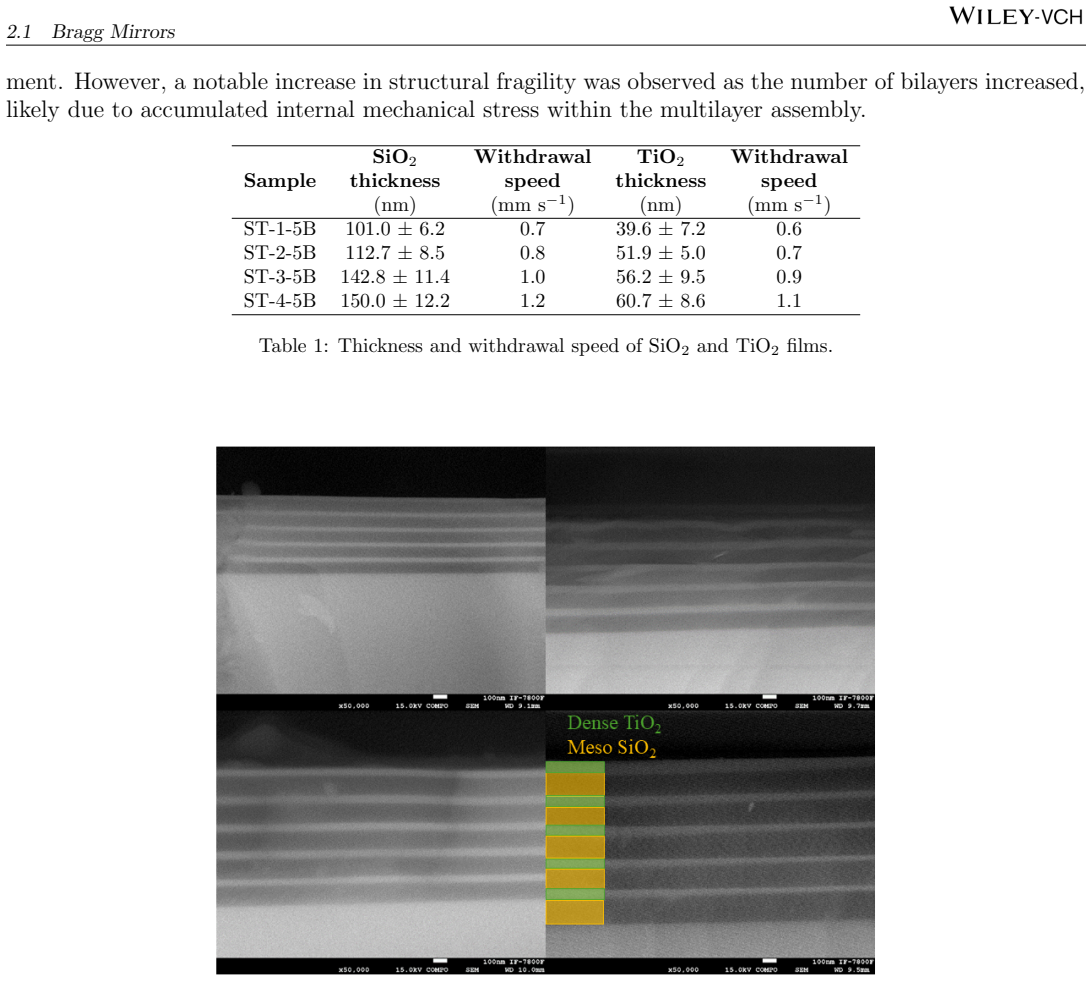
The paper claims that a hybrid Fabry-Pérot microcavity built from a bottom dip-coated Bragg mirror, a solution-processed film of the 2D perovskite (PEA)2PbI4, and a semi-transparent 30 nm silver top mirror reaches the strong light-matter coupling regime at room temperature. Angle-resolved reflectance and photoluminescence show two branches whose dispersion follows the eigenstates of a two-level Hamiltonian mixing an angular-dependent cavity photon with the perovskite exciton at 2.42 eV. The fitted vacuum Rabi coupling is $\Omega = 90$ meV, i.e. a normal-mode splitting of $2\Omega = 180$ meV, with damping ratios $2\Omega/\gamma_X = 12$ and $2\Omega/\gamma_c = 9$, so the cavity and exciton linewidths are narrow enough that the splitting is resolved. The same fabrication route also makes the mirror itself: alternating mesoporous SiO$_2$ ($n \approx 1.3$) and dense TiO$_2$ ($n \approx 2.1$) layers, whose roughly 0.8 index contrast gives more than 94% reflectance in five bilayers and a stop band that shifts from blue to red as the dip-coating withdrawal speed is increased.
Load-bearing premise
The reported 90 meV splitting comes from fitting the measured angle-resolved curves with a two-level model that assumes the cavity's effective refractive index of 1.45 and the loss rates rather than measuring them independently, so a different photon-dispersion model would shift the extracted value.
Editorial extensions
If this is right
- Five dip-coated bilayers are enough to reach over 94% reflectance, so polariton cavities of this type no longer require a 20-bilayer vacuum-deposited mirror.
- Because the stop band shifts across the visible range with withdrawal speed, the same material pair can be matched to different excitonic emitters by changing a deposition parameter rather than the chemistry.
- At room temperature the system sits deep in the strong-coupling regime ($2\Omega/\gamma_X = 12$, $2\Omega/\gamma_c = 9$), so the platform is a candidate for pursuing polariton condensation and low-threshold lasing.
- Detuning controls the hybrid character: positive detuning makes the lower polariton more excitonic and flat, and the angle-resolved photoluminescence indicates that the lower-branch population is governed by radiative pumping from the exciton reservoir rather than by thermal equilibrium.
- The same dip-coating protocol is repeatable enough that cavity detunings can be chosen over a range of $\delta/2\Omega$ from about $-0.05$ to $0.56$, giving a tunable playground for polariton dispersion engineering.
Reading between the lines
- The stop-band tunability suggests a direct extension: coat mirrors at intermediate withdrawal speeds and couple them to bromide-based 2D perovskites whose excitons sit at different energies; if the model is right, strong coupling should appear whenever the bare cavity mode crosses the exciton line.
- The photoluminescence bottleneck at small detuning implies that adding a relaxation channel toward $k_{\parallel} \approx 0$, such as a phonon sideband or a second cavity mode, could turn this platform into a low-threshold polariton laser; the paper does not explore that step.
- The paper's reported splitting appears as both 90 meV and $2\Omega = 180$ meV; quantitative comparisons with earlier perovskite cavities will require stating which convention is meant, because the two numbers differ by a factor of two.
- The residual structure-directing agent left in the porous silica after the 200 °C treatment is described as useful for blocking precursor infiltration; that residual porosity could be engineered as a built-in optical gradient, a possibility the paper leaves open.
Signed reviews
Editorial analysis
A structured set of objections, weighed in public.
Referee Report
Summary. The manuscript reports a bottom-up fabrication route for Bragg mirrors based on alternating mesoporous SiO2 and dense TiO2 films deposited by evaporation-induced self-assembly and dip-coating, with stop bands tunable across the visible range and reflectance up to 96% with five bilayers. The authors integrate a spin-coated film of the 2D perovskite (PEA)2PbI4 into a cavity formed by the dielectric mirror and a 30 nm Ag layer, and interpret angle-resolved reflectance and photoluminescence in terms of upper and lower polariton branches using a two-level Hamiltonian and a Green's function reflectance model. The central claim is room-temperature strong coupling with a Rabi splitting of 90 meV.
Significance. The fabrication advance is potentially significant: high-contrast, solution-processed distributed Bragg reflectors with few bilayers and tunable stop bands are useful for scalable polaritonic devices. The qualitative evidence for strong coupling (anticrossing in reflectance and matching photoluminescence dispersion at three detunings) is convincing, and the transfer-matrix description of the bare mirrors is a clear strength. The main weakness is that the quantitative Rabi splitting is not independently established: it rests on an assumed photon dispersion and on fitted parameters without uncertainty analysis. If the authors provide a bare-cavity control, correct the model equation, and report parameter uncertainties, the paper would make a solid contribution.
major comments (4)
- [Section 2.3, Eq. (2)] Equation (2) is not the eigenenergy of the Hamiltonian in Eq. (1) as written. With δ = ωc − ωX, the correct eigenvalues are ωX + δ/2 ± sqrt(δ^2 + 4Ω^2)/2, not ωX + δ ± sqrt(δ^2 + 4Ω^2)/2. The missing factor 1/2 on δ shifts the theoretical branches at nonzero detuning and can bias the fitted value of Ω. Please correct the equation and rerun the fits shown in Figs. 7 and 8.
- [Section 2.3, Eq. (4)] The quantitative value 2Ω = 180 meV (abstract: 'Rabi splitting of 90 meV') is obtained from a fit that assumes neff = 1.45 for the bare cavity dispersion, but no empty-cavity angle-resolved reflectance is shown to verify ωc(θ). With a five-bilayer bottom DBR (finite phase penetration) and a 30 nm Ag top mirror, the bare dispersion need not follow a homogeneous-index form; an incorrect ωc(θ) can shift the inferred splitting by tens of meV. Please report angle-resolved reflectance of the empty cavity or provide an independent measurement of ωc(θ), and show how neff is determined.
- [Abstract and Section 2.3] The manuscript uses 'Rabi splitting of 90 meV' in the abstract and conclusion while stating in Section 2.3 that 'we use a Rabi splitting of 2Ω = 180 meV'. At zero detuning the energy separation of the two polariton branches is 2Ω, so these statements are inconsistent. Please define Ω and the reported splitting precisely and give confidence intervals for the extracted parameters.
- [Section 2.3] The strong-coupling criterion is stated through the ratios 2Ω/γX = 12 and 2Ω/γc = 9, but the damping rates γX and γc are chosen, not measured. Please report the experimental exciton linewidth (e.g., from absorption or PL) and the cavity linewidth (e.g., from the reflectance dip of the empty cavity) so that the strong-coupling condition is supported by data rather than by assumption.
minor comments (5)
- [Figure 6 and Section 2.2] The Figure 6 caption contains a typo ('colected') and Section 2.2 uses 'Difractogram'; please proofread throughout.
- [Section 2.3] The sentence following the flattening discussion, 'for δ/2Ω = 0.56', is an incomplete sentence; please integrate it into the main text.
- [Equation (4)] Equation (4) is introduced without derivation or citation; please provide a reference or a short derivation so the connection between the Green's function and the measured reflectance is transparent.
- [Experimental Section] The Experimental Section does not specify the total cavity thickness or the expected zero-angle cavity energy, which would help the reader assess the reported detunings.
- [Data availability] Please add a data availability statement, as the fitting parameters and code are not released.
Circularity Check
No significant circularity: the Rabi splitting is a fitted phenomenological parameter, not a first-principles prediction, and the strong-coupling evidence rests on measured anticrossing.
full rationale
The derivation chain is not circular. The paper's central empirical claim is the observation of upper and lower polariton branches in angle-resolved reflectance (Fig. 7a-c) and PL (Fig. 8); this evidence is independent of the theoretical model. Equations (1)-(4) form a standard two-level/Green's function description whose parameters — 2Ω = 180 meV, ωX = 2.42 eV, neff = 1.45, and the damping ratios — are presented as modeling choices ('For the theoretical modeling, we use...') matched to the measured spectra, not as outputs of a first-principles derivation. The reported 90 meV Rabi splitting is therefore a fitted phenomenological value, and the agreement between theory and data is a consistency check rather than an independent prediction. That makes the quantitative number model-dependent (a bare-cavity dispersion measurement and error bars would strengthen it), but it does not make the argument circular by construction. The self-citations supporting the EISA/dip-coating fabrication methodology are not load-bearing for the polariton claim, and no cited uniqueness theorem or ansatz is used to forbid alternatives. No step reduces one equation to another by definition, so no circularity is exhibited.
Assumptions & free parameters
free parameters (3)
- Vacuum Rabi coupling Ω (reported as 2Ω = 180 meV) =
90 meV (half splitting)
- Effective refractive index neff =
1.45
- Damping rates γX and γc =
Set via ratios 2Ω/γX=12 and 2Ω/γc=9
assumptions (4)
- standard math Two-level Hamiltonian describing cavity photon and exciton hybridization (Eq. 1)
- domain assumption Green's function expression connecting reflectance to the photon Green's function (Eq. 4)
- standard math Transfer matrix method for multilayer reflectance
- domain assumption Refractive indices n_SiO2=1.3 and n_TiO2=2.1 from ellipsometry
Cite this review
Pith. "Pith review of Scalable Dip-Coated Bragg Mirrors for Strong Light-Matter Coupling with 2D Perovskites." pith.science (2026). https://pith.science/paper/AHI2OXHC
@misc{pith2026250621726,
  author       = {Pith},
  title        = {Pith review of: Scalable Dip-Coated Bragg Mirrors for Strong Light-Matter Coupling with 2D Perovskites},
  year         = {2026},
  howpublished = {\url{https://pith.science/paper/AHI2OXHC}},
  note         = {Machine review of arXiv:2506.21726}
}
abstract
We report a scalable and cost-effective method for fabricating high-performance Bragg mirrors using a bottom-up approach that combines evaporation-induced self-assembly (EISA) and dip-coating. The photonic crystals are composed of alternating mesoporous SiO$_2$ and dense TiO$_2$ layers, providing a high refractive index contrast ($\sim$0.8). This enables strong reflectance (up to 96%) with as few as five bilayers and precise control of the photonic stop band across the visible spectrum by simply adjusting the deposition parameters. Integration of a thin film of the two-dimensional perovskite (PEA)$_2$PbI$_4$ leads to strong light--matter coupling at room temperature. Angle-resolved reflectance and photoluminescence measurements reveal the formation of upper and lower polariton branches, with a Rabi splitting of 90 meV. The observed polaritonic dispersion is well described by a two-level system and Green's function formalism. This work demonstrates an efficient strategy for constructing tunable optical cavities using simple solution-based methods. The combination of high optical quality, spectral tunability, and strong coupling performance positions this platform as a promising candidate for low-threshold polariton lasers, nonlinear optics, and integrated optoelectronic devices.
Figures


Figures from the paper (5 more)


Forward citations
Cited by 1 Pith paper
-
Macroscopic coherence and vorticity in room-temperature polariton condensate confined in a self-assembled perovskite microcavity
CsPbBr3 microplatelets forming whispering-gallery microcavities exhibit polariton condensation, extended coherence, and quantized vortices at room temperature.
Reference graph
Works this paper leans on
-
[1]
Faustini, Journal of Sol-Gel Science and Technology 2020, 95 504
M. Faustini, Journal of Sol-Gel Science and Technology 2020, 95 504
work page 2020
-
[2]
R. M. Almeida, S. Portal, Current Opinion in Solid State and Materials Science 2003, 7, 2 151
work page 2003
-
[3]
R. M. Almeida, M. Clara Gonçalves , S. Portal, Journal of Non-Crystalline Solids 2004, 345-346 562
work page 2004
-
[4]
S. Rabaste, J. Bellessa, A. Brioude, C. Bovier, J. Plenet, R. Brenier, O. Marty, J. Mugnier, J. Dumas, Thin Solid Films 2002, 416, 1 242
work page 2002
-
[5]
M. C. Fuertes, F. J. López-Alcaraz, M. C. Marchi, H. E. Troiani, V. Luca, H. Míguez, G. J. A. A. Soler-Illia, Advanced Functional Materials 2007, 17, 8 1247
work page 2007
-
[6]
X. J. B. D. D. C. L. S. L. T. C. C. Z. X. Q. Wang Jun, Su Rui, ACS Nano 2018, 12 8382
work page 2018
-
[7]
G. J. A. A. Soler-Illia, P. C. Angelomé, M. C. Fuertes, D. Grosso, C. Boissiere, Nanoscale 2012, 4 2549
work page 2012
-
[8]
N. Hidalgo, M. E. Calvo, M. G. Bellino, G. J. A. A. Soler-Illia, H. Míguez, Advanced Functional Materials 2011, 21, 13 2534
work page 2011
Show all 38 references
-
[9]
Grosso, F
D. Grosso, F. Cagnol, G. J. d. A. A. Soler-Illia, E. L. Crepaldi, H. Amenitsch, A. Brunet-Bruneau, A. Bourgeois, C. Sanchez, Advanced Functional Materials 2004, 14 309
2004
-
[10]
Colodrero, M
S. Colodrero, M. Oca \ n a, H. Míguez, Langmuir 2008, 24, 9 4430
2008
-
[11]
Innocenzi, L
P. Innocenzi, L. Malfatti, Chem. Soc. Rev. 2013, 42 4198
2013
-
[12]
R. M. Gazoni, M. G. Bellino, M. Cecilia Fuertes, G. Giménez, G. J. A. A. Soler-Illia, M. L. M. Ricci, J. Mater. Chem. C 2017, 5 3445
2017
-
[13]
M. E. Calvo, N. Hidalgo, R. Schierholz, A. Kovács, A. Fernández, M. G. Bellino, G. J. A. A. Soler-Illia, H. Míguez, Nanoscale 2015, 7 16583
2015
-
[14]
J. J. Hopfield, Phys. Rev. 1958, 112 1555
1958
-
[15]
F. J. Garcia-Vidal, C. Ciuti, T. W. Ebbesen, Science 2021, 373, 6551 eabd0336
2021
-
[16]
D. D. N. T. D. O. G.-L. J. F. F. J. G.-V. F. J. K. M. V. M. H. Bujalance Clara, Caliò Laura, ACS Nano 2024, 18 4922
2024
-
[17]
Y. Bai, J. Yan, Q. Zhang, Y. Sun, Y. Zeng, F. Liu, M. Hu, S. Sun, J. Hu, Y. Yang, G. Hu, Advanced Materials 2025, 37, 24 2501669
2025
-
[18]
Polimeno, F
L. Polimeno, F. Todisco, R. Mastria, M. De Giorgi, A. Fieramosca, M. Pugliese, D. Ballarini, A. Grudinina, N. Voronova, D. Sanvitto, Advanced Materials n/a, n/a 2418612
-
[19]
H. Deng, G. Weihs, C. Santori, J. Bloch, Y. Yamamoto, Science 2002, 298, 5591 199
2002
-
[20]
Kasprzak, M
J. Kasprzak, M. Richard, S. Kundermann, A. Baas, P. Jeambrun, J. M. J. Keeling, F. M. Marchetti, M. H. Szyma \'n ska, R. Andr \'e , J. L. Staehli, V. Savona, P. B. Littlewood, B. Deveaud, L. S. Dang, Nature 2006, 443, 7110 409
2006
-
[21]
H. Deng, H. Haug, Y. Yamamoto, Rev. Mod. Phys. 2010, 82 1489
2010
-
[22]
A. Amo, J. Lefr \`e re, S. Pigeon, C. Adrados, C. Ciuti, I. Carusotto, R. Houdr \'e , E. Giacobino, A. Bramati, Nature Physics 2009, 5, 11 805
2009
-
[23]
K. G. Lagoudakis, M. Wouters, M. Richard, A. Baas, I. Carusotto, R. Andr \'e , L. S. Dang, B. Deveaud-Pl \'e dran, Nature Physics 2008, 4, 9 706
2008
-
[24]
Strang, V
A. Strang, V. Quirós-Cordero, P. Grégoire, S. Pla, F. Fernández-Lázaro, A. Sastre-Santos, C. Silva-Acuna, P. N. Stavrinou, N. Stingelin, Advanced Materials 2024, 36, 20 2212056
2024
-
[25]
J. Moon, Y. Mehta, K. Gundogdu, F. So, Q. Gu, Advanced Materials 2024, 36, 20 2211284
2024
-
[26]
Zhang, Y
S. Zhang, Y. Zhong, F. Yang, Q. Cao, W. Du, J. Shi, X. Liu, Photon. Res. 2020, 8, 11 A72
2020
-
[27]
S. R. D. T. T. H. X. Q. Zhang Qing, Shang Qiuyu, Nano Letters 2021, 21 103
2021
-
[28]
S. Das, S. Gholipour, M. Saliba, ENERGY & ENVIRONMENTAL MATERIALS 2019, 2, 2 146
2019
-
[29]
Y. Wang, G. Adamo, S. T. Ha, J. Tian, C. Soci, Advanced Materials 2025, 37, 8 2412952
2025
-
[30]
T. H. N. W. S. C. C. T. B. P. L.-K. M. K. F. N. G. T. K. J. T. S. C. S. A. K. C. K. M. G. C. J. J. E. J. M. A. D. Blancon J.-C., Stier A. V., Nature Communications 2018, 9 2254
2018
-
[31]
L. Guo, R. Zhao, X. Yang, L. Cheng, K. Zhang, H. Guo, M. Tao, X. Zhang, Y. Wang, Y. Song, Nano Energy 2025, 139 110918
2025
-
[32]
B. A. S. I. Z. Y. S. C. P. M. B. S. H. J. K. K. J. M. A. Ghosh Supriya, Pradhan Bapi, The Journal of Physical Chemistry Letters 2024, 15 7970
2024
-
[33]
R.-G. E. K. K. A. K. E. J. P. C. A. R. S. N. S.-A. C. S. K. A. R. M. V. C.-B. J.-P. Gomez-Dominguez Martin, Quirós-Cordero Victoria, ACS Photonics 2025, 12 2423
2025
-
[34]
D. A. F. S. D. S. F. P. M. C. D. L. P. Bertucci Simone, Megahd Heba, ACS Applied Materials Interfaces 2022, 14 19806
2022
-
[35]
Brudieu, A
B. Brudieu, A. L. Bris, J. Teisseire, F. Guillemot, G. Dantelle, S. Misra, P. R. i. Cabarrocas, F. Sorin, T. Gacoin, Advanced Optical Materials 2014, 2, 11 1105
2014
-
[36]
M. V. A. Romanova V. A., Matyushkin L. B., Glass Physics and Chemistry 2018, 44 7
2018
-
[37]
, " * write output.state after.block =
ENTRY address author booktitle chapter edition editor eid howpublished institution isbn issn journal key month note number organization pages publisher school series title type url volume year label INTEGERS output.state before.all mid.sentence after.sentence after.block FUNCT...
-
[38]
write newline
" write newline "" before.all 'output.state := FUNCTION n.dashify 't := "" t empty not t #1 #1 substring "-" = t #1 #2 substring "--" = not "--" * t #2 global.max substring 't := t #1 #1 substring "-" = "-" * t #2 global.max substring 't := while if t #1 #1 substring * t #2 gl...
Reviewed August 6, 2026 · model on record in the stance chip above.
Discussion (0). Continue with ORCID to comment.