REVIEW 3 major objections 4 minor 22 references
Nucleon-Quark Diquark-exchange Interaction
T0 review · 3 major / 4 minor · reviewed 2026-08-06 · deepseek-v4-flash
Pith's one-line read Diquark exchange between a quark and a nucleon is repulsive, and the sign comes from a missing fermion-loop minus sign.
desk verdict Useful derivation of the diquark propagator, but the central sign—and with it the claimed repulsion—is not fixed by the paper's own equations. read the letter →
The pith
A machine-rendered reading of the paper's core claim, the machinery that carries it, and where it could break.
The reading
What carries the argument
The load-bearing object is the composite axial-vector diquark field $\chi^a_\mu(x)=\epsilon^{abc}\bar q_b(x)C\gamma_\mu q_c(x)/(\hbar c)^2$, whose Feynman propagator is the time-ordered product $i(\Delta_F)^{ab}_{\mu\nu}(x'-x)=(0|T[\chi^a_\mu(x')\chi^{b\dagger}_\nu(x)]|0)$. The argument runs through a Wick expansion of that product: the surviving vacuum contractions are $-\langle AC\rangle\langle BD\rangle+\langle AD\rangle\langle BC\rangle$, combined with the charge-conjugation identity $C S_F C=-(i\gamma\cdot\partial-m_Q)$ and the color identity $\delta_{de}\delta_{cf}\epsilon^{acd}\epsilon^{bef}=+2\delta^{ab}$. This produces the signed trace structure $X_{\mu\nu}=-4\delta^{ab}\mathrm{Tr}[\gamma_\mu S_F\gamma_\nu(C\tilde S_F C)]$ and, after Pauli-Villars and dispersive regularization, an effective propagator with positive spectral density whose sign fixes the repulsive potential.
What would settle it
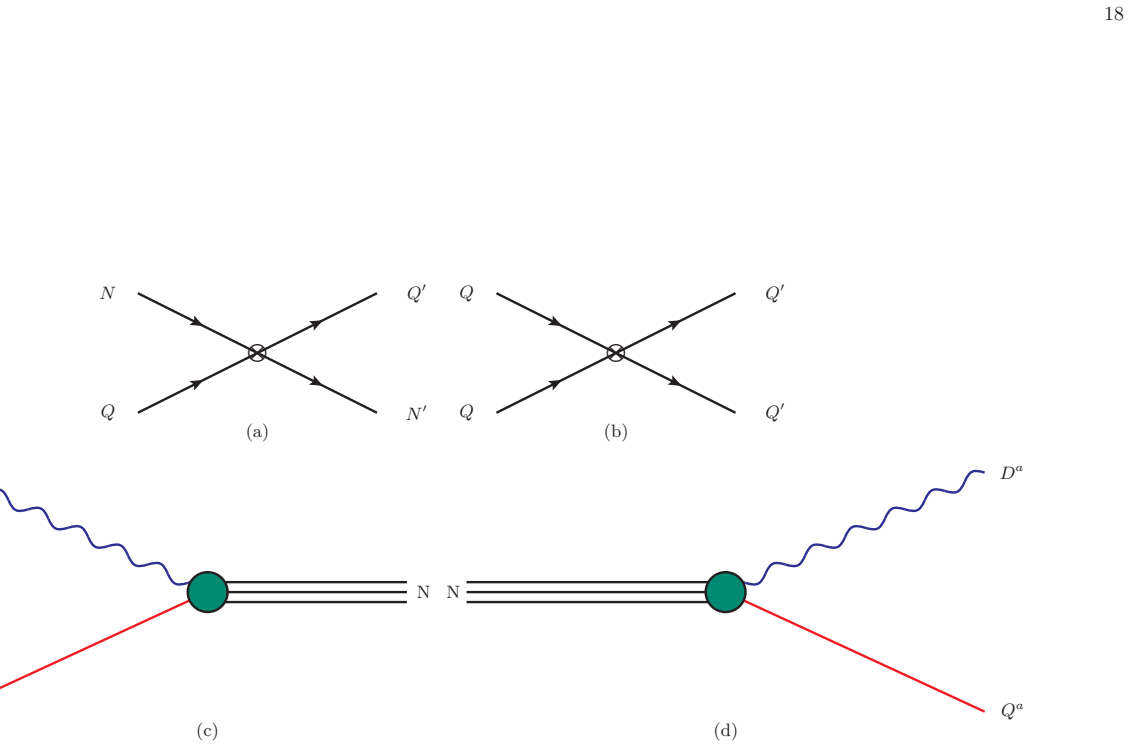
Recompute the NQ to QN amplitude from the two standard Feynman diagrams, diquark exchange and the corresponding quark-antiquark loop, with an independent sign convention; if the relative sign between the surviving contractions in Eq. (3.1) comes out opposite, the effective propagator changes sign and the potential becomes attractive.
Extended reading notes
Core claim
The paper claims that the effective axial-vector diquark propagator has the opposite sign to the corresponding quark-antiquark exchange. In momentum space it is written as $$i(\tilde{\$\Delta$})^{ab}_{\mu\nu}(k)=+2\,i\,\$delta^{{ab}}$\,\frac{\eta_{\mu\nu}-k_\mu k_\nu/$m_D^{2}$}{$k^{2}$-$m_D^{2}$+i\epsilon},$$ equivalently as $-i\,\delta^{ab}\,\tilde D(\Delta^2)(\eta_{\mu\nu}-\Delta_\mu\Delta_\nu/m_\chi^2)$ with $\tilde D>0$ for the spacelike potential form. The relative sign is traced to the Wick expansion of $(0|T[\chi^a_\mu(x')\chi^{b\dagger}_\nu(x)]|0)$: the surviving contraction terms are $-\langle AC\rangle\langle BD\rangle+\langle AD\rangle\langle BC\rangle$, which for two-quark exchange has no closed-fermion-loop minus sign, while the color contraction gives $+2\delta^{ab}$. With the $\gamma_5\gamma_\mu$ NQD coupling, this sign makes the NQ to QN interaction repulsive, a result the paper states is established without ambiguity.
Load-bearing premise
The load-bearing premise is that the Wick-expansion contraction signs in Eq. (3.1), including the surviving terms $-\langle AC\rangle\langle BD\rangle+\langle AD\rangle\langle BC\rangle$ and the identity $C S_F C=-(i\gamma\cdot\partial-m_Q)$, are the correct bookkeeping, since a sign error there would flip repulsion into attraction.
Editorial extensions
If this is right
- The quark-nucleon axial-vector diquark-exchange potential is repulsive in all partial waves examined; the statistical S-wave average is explicitly positive in Eq. (5.13).
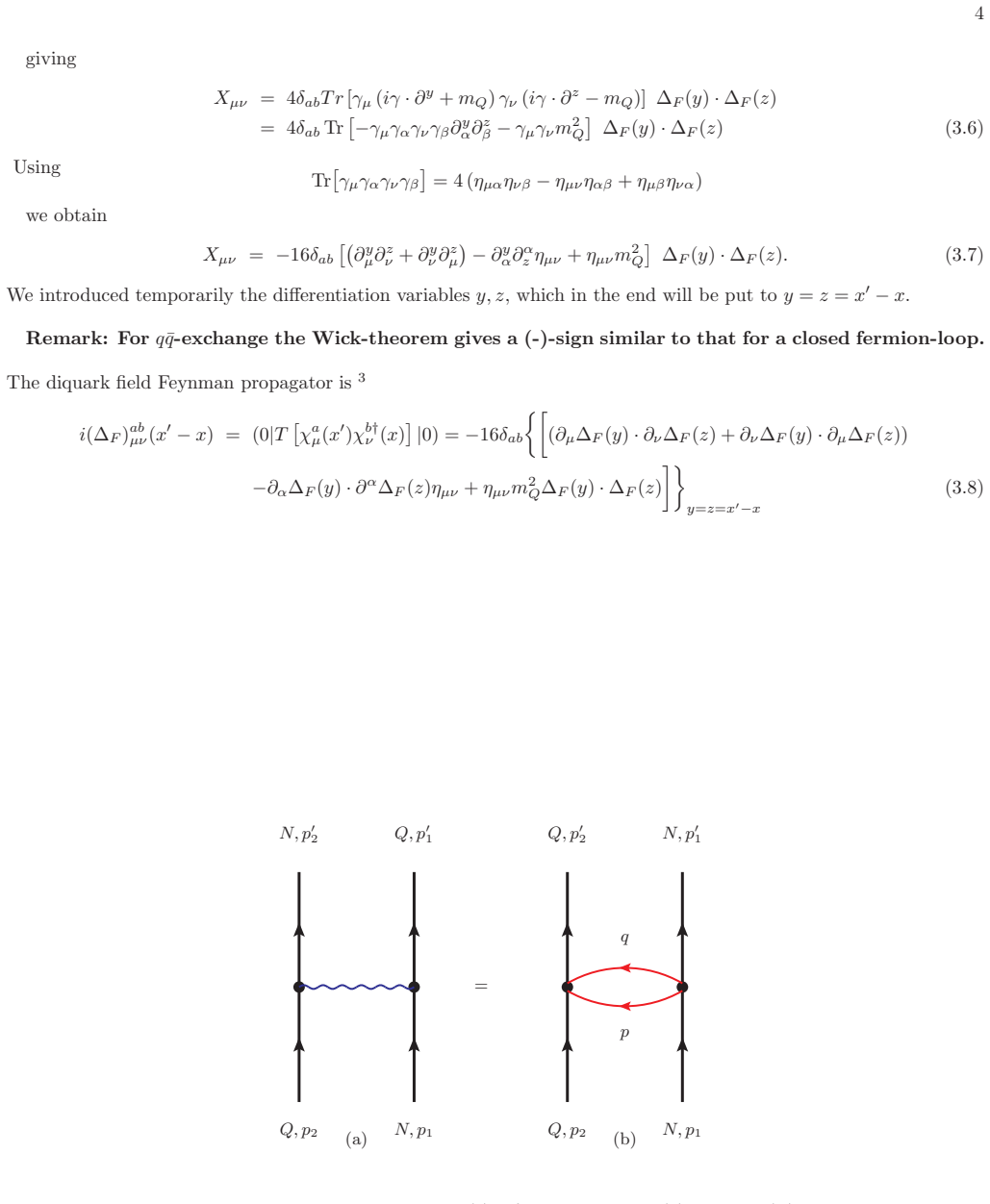
- The sign of the diquark propagator is opposite to that of vector and axial-vector meson exchange because the closed-fermion-loop minus sign present for rho and A1 exchange is absent for diquark exchange.
- The effective diquark propagator admits a spectral representation with a positive spectral function and no pole at zero momentum transfer, so it can be approximated by a repulsive Gaussian contact interaction.
- In the paper's referenced application, this repulsive interaction is used in mixed nuclear-quark matter calculations and supports neutron stars with masses near 2.1 solar masses.
Reading between the lines
- If the sign argument holds, the same color-antitriplet two-quark exchange logic should apply to the scalar and pseudoscalar diquarks from the second proton current; the paper finds those give a mixture of attraction and repulsion, so a full treatment may alter the partial-wave ordering.
- Because the repulsion grows with density, it could act as a repulsive wall between nucleon and quark phases near deconfinement, stiffening hybrid-star matter; this is a testable consequence for neutron-star mass-radius relations that the paper does not carry out.
- A direct cross-check of the contraction signs against a standard one-loop quark-antiquark diagram would settle whether the repulsive sign survives, since the paper's claim rests entirely on that bookkeeping and does not perform such a check.
Signed reviews
Editorial analysis
A structured set of objections, weighed in public.
Referee Report
Summary. The note derives the Feynman propagator for an effective axial-vector diquark field from the three-quark nucleon current, using Wick's theorem, a two-loop-type momentum integral, and a dispersion representation. The central claim is that diquark exchange in the process NQ -> QN produces a repulsive interaction, in contrast to quark-antiquark exchange, because of the sign of the diquark propagator. The paper then applies this effective propagator to construct a gaussian NQ potential and discusses consequences for mixed nuclear-quark matter, with additional appendices treating scalar and pseudoscalar diquarks and a thermodynamic partition-functional derivation.
Significance. If the sign of the axial-vector diquark-exchange potential is correct, the result is physically important: it would provide a QFT-based argument for a repulsive quark-nucleon interaction that has been used in mixed nuclear-quark matter equations of state and neutron-star studies. The paper has the merit of presenting an explicit Wick expansion, a dispersion treatment, and a clear identification of the color factor +2. However, the main physical conclusion rests on a sign that is not fixed consistently within the manuscript, so the significance is conditional on correcting this point.
major comments (3)
- [§IV–V, Eqs. (4.18), (4.19), (5.3)] The sign of the effective propagator is stated inconsistently. For spacelike momentum transfer, Eq. (4.18) gives i(Delta_F)^ab_mu_nu = + i times a positive spectral integral times (eta_mu_nu - k_mu k_nu/m_chi^2), whereas Eq. (5.3) gives i(~Delta_F)^ab_mu_nu = -i delta_ab ~D(Delta^2)(eta_mu_nu - Delta_mu Delta_nu/m_chi^2) with ~D(Delta^2)>0, and Eq. (4.19) also has the -i form with D(x)>0. These two forms are not equivalent, and the amplitude in Eq. (5.5) and the S-wave potential in Eq. (5.13) reverse sign if one replaces one by the other. Since the repulsion claim is the central result, this sign ambiguity is load-bearing and must be resolved.
- [Appendix D, Eq. (D8)] Appendix D introduces an explicit factor Sign=± in the mean-field Lagrangian (D8) and then fixes Sign=-1 'in order to agree' with Eq. (5.6). This is a consistency condition, not an independent derivation. The text asserts that the sign ambiguity is absent in the diquark-propagator calculation, but because the propagator calculation itself has the sign inconsistency described above, the appeal to Eq. (5.6) cannot resolve the ambiguity.
- [§VI and Appendix A] The conclusion in Section VI that the derivation establishes the repulsive QN potential without ambiguity depends entirely on the Wick-contraction signs in Eq. (3.1) and Appendix A. The paper does not cross-check these signs against a standard one-loop example, such as the analogous quark-antiquark exchange calculation. Given the sign flips among Eqs. (4.14), (4.17), (4.18), and (5.3), a transparent bookkeeping check or comparison with a textbook vacuum-polarization diagram is needed before the sign can be considered established.
minor comments (4)
- [§IV, Eq. (4.23)] The lower limit of the integral in Eq. (4.23) is m_Q^2, while the spectral density rho(s) in Eqs. (4.20) and (4.21) starts at 4m_Q^2. This inconsistency should be corrected.
- [§IV, Eqs. (4.19)–(4.22)] The notation mixes configuration-space and momentum-space quantities in Eq. (4.19): D(x) is a configuration-space function while the tensor contains k_mu. Please state explicitly which representation is being used at each step.
- [§V, Eq. (5.14)] The density-dependent deconfinement function gamma_D(rho_N, rho_D) is introduced without derivation and is not used in the potential derivation that precedes it. Its role in the paper should be clarified, or its discussion should be postponed to the application.
- [Abstract and Section VI] The phrase 'strong repulsion' in Section VI is stronger than what the note derives, since the potential strength depends on the free parameters Lambda, lambda_3, and M and no parameter set is fixed in this note. The sign of the repulsion is the derived quantity; the strength should be presented as application-dependent.
Circularity Check
No circular reduction in the Wick-to-dispersion chain; the repulsion claim rests on an asserted, internally inconsistent propagator sign (Eq. 5.3 vs Eq. 4.18), a correctness risk rather than circularity.
full rationale
The claimed derivation chain is a genuine first-principles computation, not a fit: the sign of the diquark T-product is fixed by Wick-contraction bookkeeping (Sec. III, App. A), the loop integral uses standard Pauli-Villars/dispersion machinery from Bjorken-Drell and Kallen, and the Section V potential is the stated algebraic consequence of the Feynman rule (5.3). Lambda, M, and lambda_3 are explicitly admitted as free/tunable parameters ('This parameter is a free parameter and can be used to tune'), so no fitted value is renamed a prediction. The self-citations ([1], [12]) are usage/motivation: the M_NS about 2.1 M_sun success claim and footnote 8's assertion that the potential in [1] is correct rest on [1], which Rijken coauthors, but they are not load-bearing for the propagator-sign derivation. The real weakness is a correctness (sign-error) failure, not circularity: Eq. (4.18) gives +i times a positive tensor at spacelike k^2 = -K^2, while the operative Feynman rule Eq. (5.3) is -i delta D~ with D~ > 0 — and replacing one sign by the other flips the S-wave potential (5.13) from repulsive to attractive. Appendix D concedes 'Sign= +/- is introduced which reflects the sign ambiguity in the partition functional approach' and fixes Sign = -1 'in order to agree with the interaction in Eqn. (5.6)', so Section VI's 'establishes without any ambiguity the repulsive' overclaims: the sign is asserted and then matched, not independently derived from the preceding equations. That is a missing-support/consistency flag, not a circular step meeting the quote-and-reduce bar: no equation is defined in terms of the conclusion and no parameter is fitted to the target conclusion. Score 2 reflects the non-load-bearing self-citation and the unsubstantiated 'without ambiguity' claim.
Assumptions & free parameters
free parameters (6)
- m_Q (constituent quark mass) =
not specified; used with m_chi about 2m_Q
- m_chi (effective diquark mass) =
about 2m_Q
- Lambda (Gaussian cutoff) =
not specified
- lambda_3 (NQD coupling constant) =
not specified
- M (mass scale in D_tilde approximation) =
not specified
- Sign in Appendix D =
-1
assumptions (5)
- standard math Wick's theorem and standard fermion contraction signs
- standard math Pauli-Villars regularization and dispersion relations
- domain assumption Local axial-vector diquark field with a single-particle pole
- ad hoc to paper Gaussian form-factor regulator
- ad hoc to paper Low-momentum vertex kinematics k^2 approximately (m_N - m_Q)^2
invented entities (2)
-
Effective axial-vector diquark field with pole mass m_chi
-
Density-dependent deconfinement function gamma_D(rho_N, rho_D)
Cite this review
Pith. "Pith review of Nucleon-Quark Diquark-exchange Interaction." pith.science (2026). https://pith.science/paper/A7CVC2FE
@misc{pith2026250622079,
  author       = {Pith},
  title        = {Pith review of: Nucleon-Quark Diquark-exchange Interaction},
  year         = {2026},
  howpublished = {\url{https://pith.science/paper/A7CVC2FE}},
  note         = {Machine review of arXiv:2506.22079}
}
abstract
In this note the nucleon-quark diquark-exchange interaction is derived using the Feynman-propagator for axial-vector diquark (D) exchange. The Feynman diquark propagator is derived and the result is a (-)-sign difference w.r.t. quark-antiquark exchange. This is due to the (-)-sign for a closed fermion loop, present in for example vector and axial-vector quark-antiquark exchange, but absent in the case of D-exchange. The calculations in these notes follow closely those for vacuum polarisation in the literature. Taking into account that the diquark D is a color $\left{\bar{3}_c\right\}$-state giving a factor +2. The result is an effective axial-vector diquark propagator. Application to $QN \rightarrow NQ$ gives a repulsive potential, which has been used in mixed nuclear-quark matter calculation.
Figures


Figures from the paper (4 more)



Reference graph
Works this paper leans on
-
[1]
Scalar Diquarks The spectral representation of the Diquark Feynman propagato r is i(∆F )S,ab(x′ −x) = (0 |T [ χa(x′)χb†(x) ] |0) = i ∫ ∞ s0 ds (∆F )ab(x′ −x);s) ρ(s). (C7) 14 In momentum space the propagator leads to the integral ~IS(k;m) = ∫ d4p (2π)4 ∫ d4q (2π)4 (2π)4δ4(p +q −k) [ p ·q +m2] × [ p2 −m2 +iǫ ] −1[ q2 −m2 +iǫ ] −1 . (C8) Following same step...
-
[2]
Pseudoscalar Diquarks The spectral representation of the Diquark Feynman propagato r is i(∆F )5,ab(x′ −x) = (0 |T [ χa 5(x′)χb† 5 (x) ] |0) = i ∫ ∞ s0 ds (∆F )ab(x′ −x);s) ρ(s). (C27) In momentum space the propagator leads to the integral ~I5(k;m) = ∫ d4p (2π)4 ∫ d4q (2π)4 (2π)4δ4(p +q −k) [ −p ·q +m2] × [ p2 −m2 +iǫ ] −1[ q2 −m2 +iǫ ] −1 . (C28) Followin...
-
[3]
Y. Yamamoto, N. Yasutake, and Th.A. Rijken, Phys. Rev. C 110, 025805 (2024)
work page 2024
-
[4]
B. L. Ioffe, Nucl. Phys. B 188, 317 (1981)
work page 1981
-
[5]
B. L. Ioffe, Z. Phys. C 18, 67 (1983)
work page 1983
-
[6]
J.D. Bjorken and S.D. Drell, I. Relativistic Quantum Mechanics, and II. relativistic Qu antum Fields , McGraw-Hill Pub- lishing Compan 1965
work page 1965
-
[7]
F. Mandl, Introduction to Quantum Field Theory , Interscience Publishers Ltd., London (1961), chapters 6 a nd 8
work page 1961
-
[8]
S.S. Schweber, Relativistic Quantum Field Theory , Harper & Row, New York, Evanston & London (1964), chapter 8
work page 1964
Show all 22 references
-
[9]
Nakanishi and I
N. Nakanishi and I. Ojima, Covariant Operator Formalism of Gauge Theories and Quantum Gravity, World Scientific Lecture Notes in Physics, Vol. 27 (1990)
1990
-
[10]
Pauli and F
W. Pauli and F. Villars, Rev. Mod. Phys. 21 , 434 91940
-
[11]
Nagels, Th.A
M.M. Nagels, Th.A. Rijken, and J.J. de Swart, Phys. Rev. D17, 768 (1978)
1978
-
[12]
deSwart and C.K
J.J. deSwart and C.K. Iddings, Phys. Rev. 128, 2810 (1962); Phys. Rev. 130, 319 (1963)
1962
-
[13]
Peskin and D.V
M.E. Peskin and D.V. Schroeder, Quantum Field Theory , section 7, Addison-Wesley Publishing Company 1995
1995
-
[14]
Rijken, M.M
Th.A. Rijken, M.M. Nagels, and Y. Yamamoto, Progress of Theoretical Physics, Suppl. 185 (2010) 14
2010
-
[15]
Yamamoto, N
Y. Yamamoto, N. Yasutake, and Th.A. Rijken, Phys. Rev. C 105, 015804 (2022)
2022
-
[16]
Yamamoto, N
Y. Yamamoto, N. Yasutake, and Th.A. Rijken, Phys. Rev. C 108, 035811 (2023)
2023
-
[17]
K¨ all´ en,Handbuch der Physik , Vol
G. K¨ all´ en,Handbuch der Physik , Vol. V- Part I, equation (29.35); Brandeis University Summ er Institute Lectures in Theoretical Physics 1962, Vol. 1
1962
-
[18]
Jauch and F
J.M. Jauch and F. Rohrlich, The Theory of Photons and Electrons , Springer-Verlag, New York Heidelberg Berlin 1976; Appendix A5
1976
-
[19]
Alford, K
M. Alford, K. Rajagopal, and F. Wilczek, Color-Flavor Locking and Chiral Symmetry Breaking in High D ensity QCD , arXiv:hep-ph/9804403v2 (1998)
1998 arXiv
-
[20]
Bender and F
C.M. Bender and F. Cooper, Ann. Phys. (NY) 109, 165 (1977)
1977
-
[21]
Kapusta and C
J.I. Kapusta and C. Gale, Finite-Temperature Field Theory. Principles and Applicat ions Cambridge University Press, Cambridge (1989), Chap. 11
1989
-
[22]
Walecka, Ann
J.D. Walecka, Ann. Phys. (NY) 83, 491 (1974). 99 8 This is a correction of the Appendix in [1]. W e stress that the used potential V (qN ) DQB (r) is correct as well as the results in [1]
1974
Reviewed August 6, 2026 · model on record in the stance chip above.
Discussion (0). Continue with ORCID to comment.