REVIEW 3 major objections 5 minor 2 cited by
Dissipative Kondo physics in the Anderson Impurity Model with two-body losses
T0 review · 3 major / 5 minor · reviewed 2026-08-06 · deepseek-v4-flash
Pith's one-line read Two-body losses protect Kondo physics in the Anderson impurity model: the spin relaxation rate shows a Kondo-Zeno crossover, and the Kondo peak survives weak loss, collapses at intermediate loss, and re-emerges at strong loss.
desk verdict A genuinely new dissipative impurity model with a credible Kondo-Zeno crossover; the predicted re-emergence of the Kondo peak rests only on NCA, so the spectral claim needs an independent benchmark. read the letter →
The pith
A machine-rendered reading of the paper's core claim, the machinery that carries it, and where it could break.
The reading
What carries the argument
The load-bearing object is the Non-Crossing Approximation dynamical map for the vectorized Lindblad equation, computed in the superfermion representation: it sums non-crossing hybridization diagrams self-consistently and gives impurity dynamics, steady states, and spectral functions in the thermodynamic limit. Exact finite-size dynamics via quantum trajectories on an $L=8$ chain with 1000 trajectories is used to benchmark density, double occupancy, and magnetization. The explanatory machinery is a generalized Schrieffer-Wolff transformation of the Lindbladian, which produces an effective Kondo model with a renormalized Kondo coupling and a residual nonlocal two-body loss term; the competition between these two scales is what the paper identifies as controlling the Kondo-Zeno physics.
What would settle it
Compute the impurity spectral function $A_\sigma(\omega)$ at $U=-2\epsilon_d=4\Gamma$ and $\gamma\gg U$ (for instance $\gamma=150\Gamma$) with a numerically exact method that resolves frequencies, such as time-dependent matrix-product-state trajectories on a longer chain or diagrammatic Monte Carlo; if no narrow zero-frequency resonance reappears in the strong-loss regime, the Kondo re-emergence is an artifact of the approximation.
Extended reading notes
Core claim
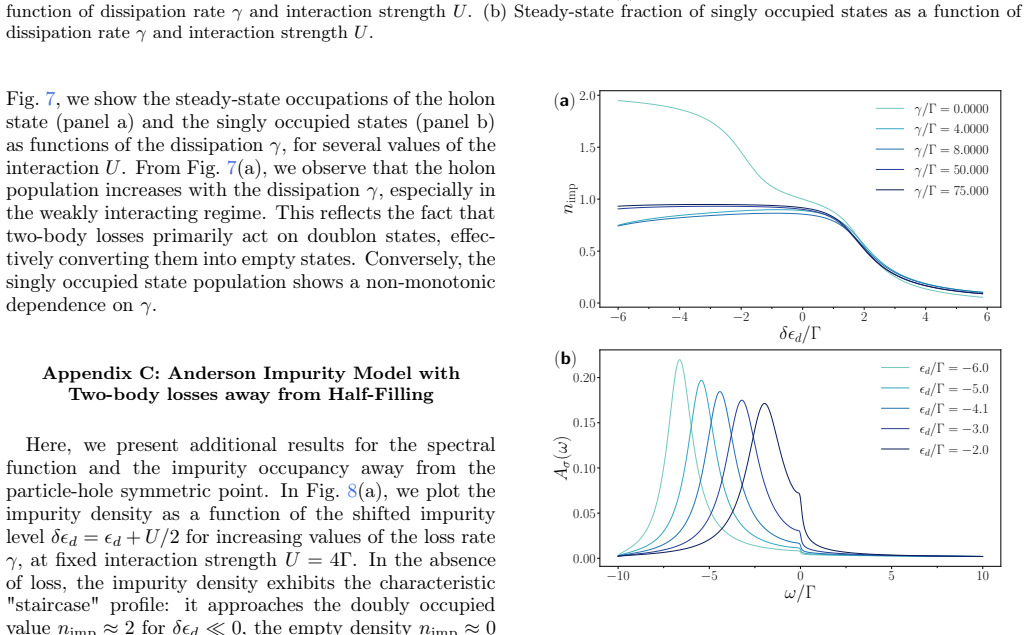
The central claim is that correlated two-body dissipation can stabilize, and at strong rates restore, Kondo correlations in the Anderson impurity model. Within the Non-Crossing Approximation the impurity spectral function $A_\sigma(\omega)$ at $U=-2\epsilon_d=4\Gamma$ shows a rapid collapse of the upper Hubbard band as $\gamma$ grows, while the zero-frequency Kondo resonance remains visible for weak loss with a strongly asymmetric line shape, disappears for $\gamma \sim U$, and then re-emerges as a small coherent peak for $\gamma \gg U$, where doublons are projected out and the impurity approaches half-filling. The spin relaxation rate extracted from $m_z(t)\sim e^{-t/\tau_K}$ is non-monotonic in $\gamma$, a Kondo-Zeno crossover, with the maximum near $\gamma\sim U$, and interactions suppress the rate at every $\gamma$. Exact quantum-trajectory dynamics on an $L=8$ chain reproduces the non-monotonic magnetization and the enhancement of antiferromagnetic impurity-bath correlations at strong loss. A dissipative Schrieffer-Wolff transformation yields an effective Kondo coupling $J=-8V^2(U^2+\gamma^2/2)/(U[U^2+\gamma^2])$ that stays finite as $\gamma\to\infty$, and a residual nonlocal two-body loss rate $\kappa_{\rm eff}=4V^2\gamma/(U^2+\gamma^2)$ that is small for both $U\gg\gamma$ and $\gamma\gg U$.
Load-bearing premise
The central spectral claim rests on the Non-Crossing Approximation, an uncontrolled approximation whose strong-dissipation accuracy is not checked by the exact finite-size benchmarks, since those check only density, double occupancy, and magnetization rather than the spectral function.
Editorial extensions
If this is right
- At weak two-body loss the Kondo resonance survives with an asymmetric line shape while the upper Hubbard band collapses, so the steady-state spectrum is strongly particle-hole asymmetric.
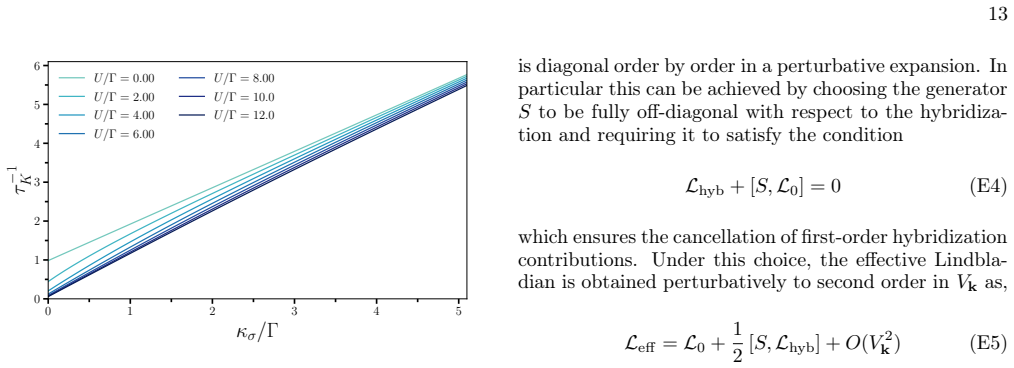
- The spin relaxation rate $\tau_K^{-1}$ is non-monotonic in $\gamma$, peaking near $\gamma\sim U$ and then dropping in the Kondo-Zeno regime; the Coulomb scale $U$ suppresses it at every loss rate.
- In the limit $\gamma\gg U$ the effective Kondo coupling $J$ remains finite, so the strongly dissipative impurity behaves like a half-filled Kondo system with small residual losses.
- Single-particle losses destroy the Kondo peak already for $\kappa_\sigma\sim 0.4\Gamma$ and have no strong-loss Kondo regeneration, which is why two-body losses are the protected channel.
- The residual nonlocal loss rate $\kappa_{\rm eff}=4V^2\gamma/(U^2+\gamma^2)$ is suppressed in both $U\gg\gamma$ and $\gamma\gg U$, explaining the two Kondo-stable regimes.
Reading between the lines
- Beyond the paper, the steady-state loss current (proportional to $2\gamma D_{ss}$) could serve as a direct experimental probe of the Kondo-Zeno crossover: it shares the same non-monotonic shape and is easier to measure than the impurity spectrum in cold-atom or quantum-gas experiments.
- The effective model suggests a parameter-free test of the mechanism: if $J(\gamma)$ controls the physics, the Kondo temperature should first dip and then recover as $\gamma/U$ grows at fixed $U/\Gamma$, a prediction that could be checked in engineered-loss quantum-dot or atomic-impurity platforms.
- A targeted numerical check would add weight to the re-emergence claim: compute $A_\sigma(\omega)$ at $\gamma=150\Gamma$ with an exact frequency-resolved method, since the paper's finite-size benchmarks cover only real-time observables, not the spectrum.
- The no-click versus quantum-jump comparison hints that strong-loss physics is controlled by the non-Hermitian Hamiltonian with complex interaction $U-i\gamma/2$, while weak-loss physics is dominated by jump events; separating these two mechanisms could generalize to other correlated dissipators.
Editorial analysis
A structured set of objections, weighed in public.
Referee Report
Summary. The paper studies the Anderson impurity model (AIM) with Markovian two-body losses, using the Non-Crossing Approximation (NCA) dynamical map to compute impurity dynamics, steady states, and spectral functions. The main claims are that two-body losses, combined with strong Coulomb repulsion, produce robust Kondo physics both at weak and strong dissipation: a suppressed spin relaxation rate with a Kondo-Zeno crossover, a spectral function in which the Kondo peak survives weak losses, is destroyed at intermediate losses, and re-emerges at strong losses, and an effective dissipative Schrieffer-Wolff model with a finite Kondo coupling and residual impurity-bath losses that are suppressed by strong correlations or strong losses. The NCA results are compared with exact finite-size quantum-trajectory simulations for density, double occupancy, magnetization, and a nearest-neighbor spin correlation, and with the case of single-particle losses.
Significance. If the central results hold, the paper would be a significant contribution to dissipative quantum impurity physics. It identifies a concrete mechanism—two-body losses—through which Kondo correlations are protected rather than destroyed, and it provides a parameter-free effective Kondo model whose coupling and residual loss rate follow directly from the original Lindbladian. The analytic Schrieffer-Wolff derivation, the self-consistent NCA implementation, and the exact finite-size trajectory data are valuable assets, and the comparison to single-particle losses sharpens the qualitative picture. The main caveat is that the spectral-function predictions, especially the Kondo-peak re-emergence, are obtained only within the NCA and are not benchmarked by an independent method, while the exact simulations validate only a subset of observables.
major comments (3)
- [Sec. III.C, Fig. 4] The central spectral prediction—the destruction and re-emergence of the Kondo peak—is obtained entirely within the NCA dynamical map, which is an uncontrolled truncation of the hybridization expansion for spectral functions. The exact finite-size benchmark in Sec. III.E validates n(t), D(t), m_z(t), and ⟨S_i · S_{i+1}⟩, but not A_σ(ω); the authors themselves state that direct quantitative comparison with NCA is 'less instructive' because of finite-size and geometry differences. Since the abstract and conclusions present the re-emergent Kondo peak as a headline result, this missing validation is load-bearing. I ask for either an independent spectral-function check (for example, time-dependent NRG, MPS-based open-system simulation, or an exact diagonalization quantum-regression calculation on a finite chain) or a clear statement in the abstract and conclusions that the spectral re-emergence is an NCA prediction that awaits independent confirmation.
- [Sec. IV and Appendix E] There is an internal inconsistency in the definition of the effective Kondo coupling. In the main text, Eq. (26) defines J_qk as the real part of V_k B_k + V_q B_k, and Eq. (27) therefore gives a real J. In Appendix E, however, Eq. (E13) defines J_qk = V_k B_k + V_q B_k as a complex quantity, and Eqs. (E14)–(E15) give complex asymptotic expressions; the residual loss rate κ_{qk,eff} is then derived from Im[J_qk] in Eq. (E28), which is essential to the claim that residual impurity-bath losses are suppressed by large U or large γ. These two definitions are contradictory. Please specify explicitly that the Hermitian part of −iH_Kondo (or Re[J]) generates the Kondo exchange while the anti-Hermitian part (Im[J]) generates the dissipative terms, and make the main-text notation consistent with Appendix E.
- [Abstract and Sec. III.E] The abstract states that 'the picture obtained with NCA is confirmed by numerical simulations of exact dynamics on finite-size chains,' but the exact simulations confirm only the non-monotonic magnetization dynamics, the suppression of double occupancy, and a suggestive enhancement of the nearest-neighbor spin correlation at large γ. They do not confirm the spectral function, which is the basis for the Kondo-peak destruction and re-emergence claim. Please qualify the confirmation to identify explicitly which observables are benchmarked and which predictions (in particular A_σ(ω)) remain NCA-specific.
minor comments (5)
- [Sec. II.A] There is a typo: 'Linbdlad' should be 'Lindblad' in the sentence introducing the Lindblad master equation.
- [References] Reference [10] contains garbled text in the author list: 'C. u. u. u. u. P. m. c. Moca' should be a proper author string.
- [Fig. 4 caption] The caption phrase 'the upper Hubbard band merges with the Kondo resonance and the lower one' is grammatically incomplete; please rephrase to clarify what merges with what.
- [Eq. (5)] The loss current I_loss is introduced as −d/dt Tr(ρ_t N_tot) without initially defining its sign convention; please define I_loss as a positive quantity before using it in the inset of Fig. 2(d).
- [Appendix E] In Eq. (E10), the expression for D_{kσ} contains a term (iε_d − iε_k − σγ) with a sign that is not explained; please verify and comment on the origin of the σγ term.
Circularity Check
No significant circularity: the central NCA and Schrieffer-Wolff results are outputs of the Lindblad dynamics, not fitted targets of the argument.
full rationale
The derivation chain is self-contained. The NCA dynamical map is constructed from the Lindblad equation (Eq. 3) via the superfermion representation and hybridization expansion (Sec. II.A, Eqs. 8-10); the spin relaxation rate in Fig. 3 is extracted from the computed magnetization m_z(t), which is a data-reduction step rather than a prediction from a fitted parameter. The spectral function in Fig. 4 is an output of the same dynamical map, and the claim that the Kondo peak re-emerges at strong loss is not assumed in the equations. The effective Schrieffer-Wolff model in Sec. IV is derived from the same Lindbladian through the generator condition (Eq. 22) and explicit second-order expressions (Eqs. 27 and 31); these are parameter-free consequences of the model, not fits to the NCA spectra. The finite-size quantum-jump benchmark in Sec. III.E independently solves the same Lindblad equation, although it checks only density, double occupancy, magnetization and nearest-neighbor spin correlations, not the spectral function itself; this is an external-validity limitation of the benchmark, not circularity. The self-citations (Refs. 46, 53, 54, 65) are methodological or interpretive and are not used as an external authority to force the central claim. Even if NCA were quantitatively inaccurate, that would make the spectral result approximate, not circular, because the calculation does not build the re-emergent peak into the approximation by construction.
Assumptions & free parameters
assumptions (5)
- domain assumption Two-body losses are Markovian and local, described by the Lindblad jump operator L = sqrt(gamma) d_up d_down.
- domain assumption The bath is noninteracting, initially at zero temperature, with a semicircular density of states, and the thermodynamic limit is taken before the long-time limit.
- domain assumption The NCA self-energy, keeping only non-crossing hybridization diagrams, gives reliable dynamics and steady-state spectral functions in the regimes studied.
- domain assumption The dissipative Schrieffer-Wolff generator S exists and the second-order expansion in the hybridization is valid for the parameters considered.
- standard math Wick's theorem can be applied to evaluate bath correlation functions in the hybridization expansion.
Cite this review
Pith. "Pith review of Dissipative Kondo physics in the Anderson Impurity Model with two-body losses." pith.science (2026). https://pith.science/paper/MJ6KKGUY
@misc{pith2026250622302,
  author       = {Pith},
  title        = {Pith review of: Dissipative Kondo physics in the Anderson Impurity Model with two-body losses},
  year         = {2026},
  howpublished = {\url{https://pith.science/paper/MJ6KKGUY}},
  note         = {Machine review of arXiv:2506.22302}
}
read the original abstract
We study a dissipative version of the Anderson Impurity model, where an interacting impurity is coupled to a fermionic reservoir and exposed to Markovian dissipation in the form of two-body losses. Using a self-consistent hybridization expansion based on the Non-Crossing Approximation (NCA) we compute the dynamics of the impurity, its steady-state and spectral function. We show that the interplay between strong Coulomb repulsion and correlated dissipation gives rise to robust signatures of Kondo physics both at weak and strong losses. These include a strongly suppressed spin relaxation rate, displaying a characteristic Kondo-Zeno crossover and a spectral function where doublon band is quickly destroyed by dissipation while the coherent Kondo peak remains visible for weak losses, then disappears at intermediate values and finally re-emerge as the system enters in the Kondo-Zeno regime. As compared to the case of single particle losses we show that two-body dissipation protects Kondo physics. The picture obtained with NCA is confirmed by numerical simulations of exact dynamics on finite-size chains. We interpret these results using a dissipative Schrieffer-Wolff transformation, which leads to an effective Kondo model with residual impurity-bath losses which are suppressed by strong correlations or strong losses.
Figures


Figures from the paper (6 more)


Forward citations
Cited by 2 Pith papers
-
Multibath Influence Matrices: Universal Scaling from Real-Time Dynamics
A multibath semigroup influence-matrix framework reproduces the two-channel-Kondo critical exponent and Kibble-Zurek scaling in the two-impurity Anderson model.
-
Kondo breakdown induced by non-Hermitian complex hybridization
Complex hybridization in a non-Hermitian Anderson impurity model drives Kondo breakdown at Im(1/Δ) = −1/E_d, with Bethe-ansatz support and a failure of the Lehmann representation.
Reference graph
Works this paper leans on
-
[1]
The generator S The constraint equation forS indicates that its struc- ture must include a diagonal component, acting sepa- rately within each Hilbert space and arising from the co- herent Hamiltonian, as well as an off-diagonal part that couples the original and tilde Hilbert spaces, generated by the dissipative quantum jump term. We therefore parametriz...
-
[2]
staircase
The results are averaged over 1000 trajectories. In Fig. 6(a), we plot the particle density at the im- purity site, which decays due to the two-body losses at γ >0. In contrast to the NCA results (Fig. 2(a)), we do not clearly observe a quasi-stationary state with a con- 8 0 4 8 12 16 20 t 0.0 0.2 0.4 0.6 0.8 1.0 1.2 n(t) (a) 0 4 8 12 16 20 t 0.00 0.05 0....
-
[3]
Derivation of the Effective Lindbladian The effective Lindbladian is composed of different con- tributions, which we now discuss in detail Leff = L0 + L′ imp + Lpair + LKondo + Lscatt + Ldiss (E12) The first contribution is the diagonal part of the Lind- bladian. LKondo = −i HKondo − ˜HKondo describes a Kondo coupling between the impurity spin and the spi...
-
[4]
Effective Non-local Two-body Losses Having derived the effective dissipative terms induced by two-body losses, we now explore how to recast this non-local two-body loss term into a Lindblad form, ex- plicitly identifying both the quantum jump operators and the non-Hermitian contribution. To proceed, we begin by expressing the dissipative part arising from...
-
[5]
A. C. Hewson,Cambridge Studies in Magnetism (Cam- bridge University Press, Cambridge, 1993)
work page 1993
-
[6]
J. Kondo, Resistance Minimum in Dilute Mag- netic Alloys, Progress of Theoretical Physics 32, 37 (1964), https://academic.oup.com/ptp/article- pdf/32/1/37/5193092/32-1-37.pdf
work page 1964
-
[7]
P. W. Anderson, Localized magnetic states in metals, Phys. Rev.124, 41 (1961)
1961
-
[8]
P. Nozières, A “fermi-liquid”description of the kondo problem at low temperatures, Journal of Low Temper- ature Physics17, 31 (1974)
work page 1974
Show all 83 references
-
[9]
K. G. Wilson, The renormalization group: Critical phe- nomena and the kondo problem, Rev. Mod. Phys.47, 16 773 (1975)
1975
-
[10]
Pustilnik and L
M. Pustilnik and L. Glazman, Kondo effect in quantum dots, Journal of Physics: Condensed Matter 16, R513 (2004)
2004
-
[11]
N. Roch, S. Florens, T. A. Costi, W. Wernsdorfer, and F. Balestro, Observation of the underscreened kondo ef- fect in a molecular transistor, Phys. Rev. Lett. 103, 197202 (2009)
2009
-
[12]
Riegger, N
L. Riegger, N. Darkwah Oppong, M. Höfer, D. R. Fer- nandes, I. Bloch, and S. Fölling, Localized magnetic mo- ments with tunable spin exchange in a gas of ultracold fermions, Phys. Rev. Lett.120, 143601 (2018)
2018
-
[13]
Zhang, Y
R. Zhang, Y. Cheng, P. Zhang, and H. Zhai, Controlling the interaction of ultracold alkaline-earth atoms, Nature Reviews Physics2, 213 (2020)
2020
-
[14]
Kanász-Nagy, Y
M. Kanász-Nagy, Y. Ashida, T. Shi, C. u. u. u. u. P. m. c. Moca, T. N. Ikeda, S. Fölling, J. I. Cirac, G. Zaránd, and E. A. Demler, Exploring the anisotropic kondo model in and out of equilibrium with alkaline-earth atoms, Phys. Rev. B97, 155156 (2018)
2018
-
[15]
Amaricci, A
A. Amaricci, A. Richaud, M. Capone, N. D. Oppong, and F. Scazza, Engineering the kondo impurity problem with alkaline-earth atom arrays (2025), arXiv:2505.14630 [cond-mat.quant-gas]
2025
-
[16]
S. M. Cronenwett, T. H. Oosterkamp, and L. P. Kouwenhoven, A tunable kondo effect in quantum dots, Science 281, 540 (1998), https://www.science.org/doi/pdf/10.1126/science.281.5376.540
1998 doi
-
[17]
Rosch, J
A. Rosch, J. Paaske, J. Kroha, and P. Wölfle, Nonequilib- rium transport through a kondo dot in a magnetic field: Perturbation theory and poor man’s scaling, Phys. Rev. Lett. 90, 076804 (2003)
2003
-
[18]
Mehta and N
P. Mehta and N. Andrei, Nonequilibrium transport in quantum impurity models: The bethe ansatz for open systems, Phys. Rev. Lett.96, 216802 (2006)
2006
-
[19]
Heidrich-Meisner, A
F. Heidrich-Meisner, A. E. Feiguin, and E. Dagotto, Real-time simulations of nonequilibrium transport in the single-impurity anderson model, Phys. Rev. B79, 235336 (2009)
2009
-
[20]
A. E. Antipov, Q. Dong, and E. Gull, Voltage quench dy- namics of a kondo system, Phys. Rev. Lett.116, 036801 (2016)
2016
-
[21]
J. M. Elzerman, R. Hanson, L. H. Willems van Beveren, B. Witkamp, L. M. K. Vandersypen, and L. P. Kouwen- hoven, Single-shot read-out of an individual electron spin in a quantum dot, Nature430, 431 (2004)
2004
-
[22]
F. B. Anders and A. Schiller, Real-time dynamics in quantum-impurity systems: A time-dependent numeri- cal renormalization-group approach, Phys. Rev. Lett.95, 196801 (2005)
2005
-
[23]
Latta, F
C. Latta, F. Haupt, M. Hanl, A. Weichselbaum, M. Claassen, W. Wuester, P. Fallahi, S. Faelt, L. Glaz- man, J. von Delft, H. E. Türeci, and A. Imamoglu, Quan- tum quench of kondo correlations in optical absorption, Nature 474, 627 (2011)
2011
-
[24]
Schiró, Real-time dynamics in quantum impurity models with diagrammatic monte carlo, Phys
M. Schiró, Real-time dynamics in quantum impurity models with diagrammatic monte carlo, Phys. Rev. B 81, 085126 (2010)
2010
-
[25]
Schiró, Nonequilibrium dynamics across an impurity quantum critical point due to quantum quenches, Phys
M. Schiró, Nonequilibrium dynamics across an impurity quantum critical point due to quantum quenches, Phys. Rev. B86, 161101 (2012)
2012
-
[26]
Lebrat, S
M. Lebrat, S. Häusler, P. Fabritius, D. Husmann, L. Cor- man, and T. Esslinger, Quantized conductance through a spin-selective atomic point contact, Phys. Rev. Lett. 123, 193605 (2019)
2019
-
[27]
Corman, P
L. Corman, P. Fabritius, S. Häusler, J. Mohan, L. H. Do- gra, D.Husmann, M.Lebrat,andT.Esslinger,Quantized conductance through a dissipative atomic point contact, Phys. Rev. A100, 053605 (2019)
2019
-
[28]
Huang, J
M.-Z. Huang, J. Mohan, A.-M. Visuri, P. Fabritius, M. Talebi, S. Wili, S. Uchino, T. Giamarchi, and T. Esslinger, Superfluid signatures in a dissipative quan- tum point contact, Phys. Rev. Lett.130, 200404 (2023)
2023
-
[29]
Hewitt, T
T. Hewitt, T. Bertheas, M. Jain, Y. Nishida, and G. Barontini, Controlling the interactions in a cold atom quantum impurity system, Quantum Science and Tech- nology 9, 035039 (2024)
2024
-
[30]
Gerbier and Y
F. Gerbier and Y. Castin, Heating rates for an atom in a far-detuned optical lattice, Phys. Rev. A82, 013615 (2010)
2010
-
[31]
Bouganne, M
R. Bouganne, M. Bosch Aguilera, A. Ghermaoui, J. Beugnon, and F. Gerbier, Anomalous decay of coher- ence in a dissipative many-body system, Nature Physics 16, 21 (2020)
2020
-
[32]
J. J. García-Ripoll, S. Dürr, N. Syassen, D. M. Bauer, M. Lettner, G. Rempe, and J. I. Cirac, Dissipation- induced hard-core boson gas in an optical lattice, New Journal of Physics11, 013053 (2009)
2009
-
[33]
Tomita, S
T. Tomita, S. Nakajima, I. Danshita, Y. Takasu, and Y. Takahashi, Observation of the mott insulator to super- fluid crossover of a driven-dissipative bose-hubbard sys- tem, Science Advances3, 10.1126/sciadv.1701513 (2017)
2017 doi
-
[34]
Honda, S
K. Honda, S. Taie, Y. Takasu, N. Nishizawa, M. Naka- gawa, and Y. Takahashi, Observation of the sign reversal of the magnetic correlation in a driven-dissipative fermi gas in double wells, Phys. Rev. Lett.130, 063001 (2023)
2023
-
[35]
X. Mi, M. Sonner, M. Y. Niu, K. W. Lee, B. Foxen, R. Acharya, I. Aleiner, T. I. Andersen, F. Arute, K. Arya, A. Asfaw, J. Atalaya, J. C. Bardin, J. Basso, A. Bengtsson, G. Bortoli, A. Bourassa, L. Brill, M. Broughton, B. B. Buckley, D. A. Buell, B. Bur- kett, N. Bushnell, Z. C...
2022
-
[36]
X. Mi, A. A. Michailidis, S. Shabani, K. C. Miao, P. V. Klimov, J. Lloyd, E. Rosenberg, R. Acharya, I. Aleiner, T. I. Andersen, M. Ansmann, F. Arute, K. Arya, A. As- faw, J. Atalaya, J. C. Bardin, A. Bengtsson, G. Bortoli, A. Bourassa, J. Bovaird, L. Brill, M. Broughton, B. B....
2023 arXiv
-
[37]
Sarma, J
S. Sarma, J. I. Väyrynen, and E. J. König, Design and benchmarks for emulating kondo dynamics on a quantum chip (2025), arXiv:2501.08499 [cond-mat.str-el]
2025 arXiv
-
[38]
Fröml, A
H. Fröml, A. Chiocchetta, C. Kollath, and S. Diehl, Fluctuation-Induced Quantum Zeno Effect, Physical Re- view Letters122, 040402 (2019)
2019
-
[39]
F. m. c. Damanet, E. Mascarenhas, D. Pekker, and A. J. Daley, Controlling quantum transport via dissipation en- gineering, Phys. Rev. Lett.123, 180402 (2019)
2019
-
[40]
Visuri, T
A.-M. Visuri, T. Giamarchi, and C. Kollath, Symmetry- protected transport through a lattice with a local particle loss, Phys. Rev. Lett.129, 056802 (2022)
2022
-
[41]
Visuri, T
A.-M. Visuri, T. Giamarchi, and C. Kollath, Nonlinear transport in the presence of a local dissipation, Phys. Rev. Res.5, 013195 (2023)
2023
-
[42]
Visuri, J
A.-M. Visuri, J. Mohan, S. Uchino, M.-Z. Huang, T. Esslinger, and T. Giamarchi, DC transport in a dis- sipative superconducting quantum point contact, arXiv e-prints , arXiv:2304.00928 (2023), arXiv:2304.00928 [cond-mat.quant-gas]
2023 arXiv
-
[43]
P. L. Krapivsky, K. Mallick, and D. Sels, Free fermions with a localized source, Journal of Statistical Mechanics: Theory and Experiment2019, 113108 (2019)
2019
-
[44]
P. L. Krapivsky, K. Mallick, and D. Sels, Free bosons with a localized source, Journal of Statistical Mechanics: Theory and Experiment2020, 063101 (2020)
2020
-
[45]
Schiro and O
M. Schiro and O. Scarlatella, Quantum impurity mod- els coupled to Markovian and non-Markovian baths, The Journal of Chemical Physics151, 044102 (2019)
2019
-
[46]
Tonielli, R
F. Tonielli, R. Fazio, S. Diehl, and J. Marino, Orthog- onality catastrophe in dissipative quantum many-body systems, Phys. Rev. Lett.122, 040604 (2019)
2019
-
[47]
P. E. Dolgirev, J. Marino, D. Sels, and E. Demler, Non- gaussian correlations imprinted by local dephasing in fermionic wires, Phys. Rev. B102, 100301 (2020)
2020
-
[48]
J. a. Ferreira, T. Jin, J. Mannhart, T. Giamarchi, and M. Filippone, Transport and nonreciprocity in monitored quantum devices: An exact study, Phys. Rev. Lett.132, 136301 (2024)
2024
-
[49]
Hasegawa, M
M. Hasegawa, M. Nakagawa, and K. Saito, Kondo effect in a quantum dot under continuous quantum measure- ment (2021), arXiv:2111.07771 [cond-mat.mes-hall]
2021 arXiv
-
[50]
Vanhoecke and M
M. Vanhoecke and M. Schirò, Kondo-zeno crossover in the dynamics of a monitored quantum dot (2025), arXiv:2405.17348 [cond-mat.str-el]
2025 arXiv
-
[51]
Stefanini, Y.-F
M. Stefanini, Y.-F. Qu, T. Esslinger, S. Gopalakrish- nan, E. Demler, and J. Marino, Dissipative realization of kondomodels(2024),arXiv:2406.03527[cond-mat.quant- gas]
2024 arXiv
-
[52]
Y.-F. Qu, M. Stefanini, T. Shi, T. Esslinger, S. Gopalakr- ishnan, J. Marino, and E. Demler, Variational approach to the dynamics of dissipative quantum impurity models, Phys. Rev. B111, 155113 (2025)
2025
-
[53]
Nakagawa, N
M. Nakagawa, N. Kawakami, and M. Ueda, Non- Hermitian Kondo Effect in Ultracold Alkaline-Earth Atoms, Physical Review Letters121, 203001 (2018)
2018
-
[54]
J. A. S. Lourenço, R. L. Eneias, and R. G. Pereira, Kondo effect in a PT -symmetric non-hermitian hamil- tonian, Phys. Rev. B98, 085126 (2018)
2018
-
[55]
Kattel, A
P. Kattel, A. Zhakenov, P. R. Pasnoori, P. Azaria, and N.Andrei,Dissipationdrivenphasetransitioninthenon- hermitian kondo model (2024), arXiv:2402.09510 [cond- mat.str-el]
2024 arXiv
-
[56]
Yamamoto, M
K. Yamamoto, M. Nakagawa, and N. Kawakami, Cor- relation versus dissipation in a non-hermitian anderson impurity model, Phys. Rev. B111, 125157 (2025)
2025
-
[57]
Scarlatella, A
O. Scarlatella, A. A. Clerk, R. Fazio, and M. Schiró, Dy- namical mean-field theory for markovian open quantum many-body systems, Phys. Rev. X11, 031018 (2021)
2021
-
[58]
Scarlatella and M
O. Scarlatella and M. Schirò, Self-consistent dynamical maps for open quantum systems, SciPost Phys.16, 026 (2024)
2024
-
[59]
Fazio, J
R. Fazio, J. Keeling, L. Mazza, and M. Schirò, Many- body open quantum systems (2025), arXiv:2409.10300 [quant-ph]
2025 arXiv
-
[60]
Prosen, Third quantization: a general method to solve master equations for quadratic open fermi systems, New Journal of Physics10, 043026 (2008)
T. Prosen, Third quantization: a general method to solve master equations for quadratic open fermi systems, New Journal of Physics10, 043026 (2008)
2008
-
[61]
A. A. Dzhioev and D. S. Kosov, Super- fermion representation of quantum kinetic equations for the electron transport problem, The Journal of Chemical Physics 134, 044121 (2011), https://pubs.aip.org/aip/jcp/article- pdf/doi/10.1063/1.3548065/13788434/044121_1_online.pdf
2011 doi
-
[62]
Harbola and S
U. Harbola and S. Mukamel, Superoperator nonequilib- rium green’s function theory of many-body systems; ap- plications to charge transfer and transport in open junc- 18 tions, Physics Reports465, 191 (2008)
2008
-
[63]
Dorda, M
A. Dorda, M. Nuss, W. von der Linden, and E. Arrigoni, Auxiliary master equation approach to nonequilibrium correlated impurities, Phys. Rev. B89, 165105 (2014)
2014
-
[64]
Arrigoni and A
E. Arrigoni and A. Dorda, Master equations versus keldysh green’s functions for correlated quantum sys- tems out of equilibrium, in Out-of-Equilibrium Physics of Correlated Electron Systems , edited by R. Citro and F. Mancini (Springer International Publishing, Cham,
-
[65]
Werner, J
D. Werner, J. Lotze, and E. Arrigoni, Configuration interaction based nonequilibrium steady state impurity solver, Phys. Rev. B107, 075119 (2023)
2023
-
[66]
TAKAHASHI and H
Y. TAKAHASHI and H. UMEZAWA, Thermo field dynamics, International Jour- nal of Modern Physics B 10, 1755 (1996), https://doi.org/10.1142/S0217979296000817
1996 doi
-
[67]
thermo field dynamics
I. Ojima, Gauge fields at finite temperatures—“thermo field dynamics” and the kms condition and their exten- sion to gauge theories, Annals of Physics137, 1 (1981)
1981
-
[68]
McDonald and A
A. McDonald and A. A. Clerk, Third quantization of open quantum systems: Dissipative symmetries and con- nections to phase-space and keldysh field-theory formu- lations, Phys. Rev. Res.5, 033107 (2023)
2023
-
[69]
Vanhoecke and M
M. Vanhoecke and M. Schirò, Diagrammatic monte carlo for dissipative quantum impurity models, Phys. Rev. B 109, 125125 (2024)
2024
-
[70]
N. E. Bickers, Review of techniques in the large- N ex- pansion for dilute magnetic alloys, Rev. Mod. Phys.59, 845 (1987)
1987
-
[71]
Müller-Hartmann, Self-consistent perturbation the- ory of the anderson model: Ground state properties, Z
E. Müller-Hartmann, Self-consistent perturbation the- ory of the anderson model: Ground state properties, Z. Physik B - Condensed Matter57, 281 (1984)
1984
-
[72]
Y.Meir, N.S.Wingreen,andP.A.Lee,Low-temperature transport through a quantum dot: The anderson model out of equilibrium, Phys. Rev. Lett.70, 2601 (1993)
1993
-
[73]
Nordlander, M
P. Nordlander, M. Pustilnik, Y. Meir, N. S. Wingreen, and D. C. Langreth, How long does it take for the kondo effect to develop?, Phys. Rev. Lett.83, 808 (1999)
1999
-
[74]
Eckstein and P
M. Eckstein and P. Werner, Nonequilibrium dynamical mean-field calculations based on the noncrossing approx- imation and its generalizations, Phys. Rev. B82, 115115 (2010)
2010
-
[75]
Härtle, G
R. Härtle, G. Cohen, D. R. Reichman, and A. J. Mil- lis, Decoherence and lead-induced interdot coupling in nonequilibrium electron transport through interacting quantum dots: A hierarchical quantum master equation approach, Phys. Rev. B88, 235426 (2013)
2013
-
[76]
Erpenbeck and G
A. Erpenbeck and G. Cohen, Resolving the nonequilib- rium Kondo singlet in energy- and position-space using quantum measurements, SciPost Phys.10, 142 (2021)
2021
-
[77]
Dalibard, Y
J. Dalibard, Y. Castin, and K. Mølmer, Wave-function approach to dissipative processes in quantum optics, Phys. Rev. Lett.68, 580 (1992)
1992
-
[78]
Carmichael,An Open Systems Approach to Quantum Optics (Springer, Berlin, 1993)
H. Carmichael,An Open Systems Approach to Quantum Optics (Springer, Berlin, 1993)
1993
-
[79]
A. J. Daley, Quantum trajectories and open many-body quantum systems, Adv. Phys.63, 77 (2014)
2014
-
[80]
Nakagawa, N
M. Nakagawa, N. Tsuji, N. Kawakami, and M. Ueda, Dynamical sign reversal of magnetic correlations in dis- sipative hubbard models, Phys. Rev. Lett.124, 147203 (2020)
2020
-
[81]
M. M. Wauters, C.-M. Chung, L. Maffi, and M. Bur- rello, Simulations of the dynamics of quantum impurity problems with matrix product states, Phys. Rev. B109, 115101 (2024)
2024
-
[82]
E. M. Kessler, Generalized schrieffer-wolff formalism for dissipative systems, Phys. Rev. A86, 012126 (2012)
2012
-
[83]
Rosso, F
L. Rosso, F. Iemini, M. Schirò, and L. Mazza, Dissipative flow equations, SciPost Phys.9, 091 (2020)
2020
Reviewed August 6, 2026 · model on record in the stance chip above.
Discussion (0). Sign in to comment.