REVIEW 3 major objections 5 minor 14 cited by
Splitting Regions and Shrinking Islands from Higher Point Constraints
T0 review · 3 major / 5 minor · reviewed 2026-08-06 · deepseek-v4-flash
Pith's one-line read This paper argues that 5-point split constraints, unitarity, and the absence of infinite spin towers leave the string beta function as the unique 4-point amplitude.
desk verdict Solid advance: 5-point splits impose genuinely new nonlinear constraints on 4-point Wilson coefficients, but the uniqueness claim is conditional on the improved Regge assumption, which the paper itself shows is crucial. read the letter →
The pith
A machine-rendered reading of the paper's core claim, the machinery that carries it, and where it could break.
The reading
What carries the argument
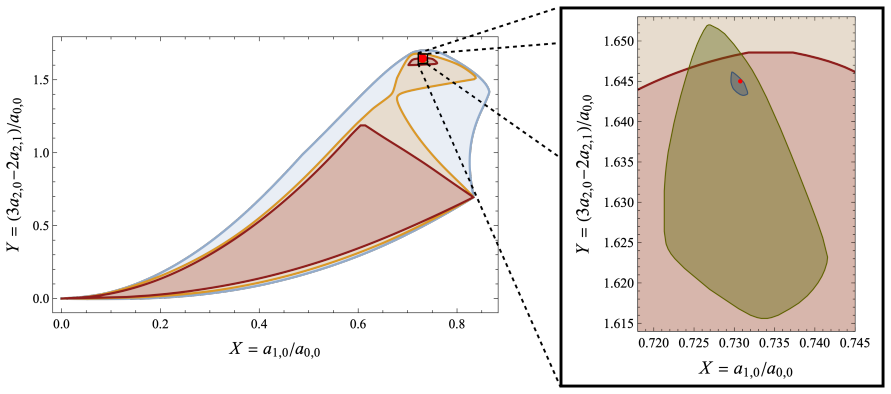
The machinery is the hidden-zero/split structure of tree amplitudes, imported into the numerical bootstrap. A hidden zero is a kinematic locus, like $t=0$ in $A_4$, where the amplitude vanishes without a pole; a split is the factorization of a higher-point amplitude into lower-point amplitudes on that locus, for example $A_5|_{s_{13}=0}=A_4(s_{12},s_{15})A_4(s_{23},s_{34})$. The paper constructs a general 5-point EFT amplitude from pole residues and cyclically invariant contact terms, imposes the splits order by order, and finds nonlinear constraints among the 4-point Wilson coefficients. To feed these into the semidefinite bootstrap, the nonlinear relations are linearized by scanning over the variables $X=a_{1,0}/a_{0,0}$ and $Y=(3a_{2,0}-2a_{2,1})/a_{0,0}$, either singly or in a double scan. The remaining input is a set of once-subtracted dispersion relations for the $c_{k,q}$ coefficients, plus null constraints from crossing; these depend on the assumed improved Regge behavior $A_4(s,u)/s \to 0$ as $|s|\to\infty$. The final result is a non-convex allowed region that, under the finite-spectrum-at-the-gap assumption, bifurcates into a scaled trivial region and a shrinking island around the $\beta$ function.
What would settle it
Exhibit one unitary, weakly coupled scalar EFT whose 4-point amplitude has the hidden zero and 5-point split compatibility, has only finitely many states at the mass gap, and whose $(X,Y,Z)$ lies outside the $k_{\rm max}=10$ island of Table 2; for $d=10$ and cutoff $2$, that means outside roughly $0.730760 < X < 0.730764$, $1.644933 < Y < 1.644937$, and $0.630367 < Z < 0.630384$. Alternatively, show numerically or analytically that the island stops shrinking at nonzero size as $k_{\rm max}$ increases.
Extended reading notes
Core claim
On the paper's own terms, the discovery is that higher-point split factorization is a powerful constraint on $2 \to 2$ amplitudes, not a kinematic curiosity. Working at weak coupling with amplitudes of the $\mathrm{Tr}(\Phi^3)$ hidden-zero/split type, the paper derives nonlinear constraints on the 4-point Wilson coefficients from the 5-point split equations; for example, at order $k=2$, $a_{2,1} = \frac{3}{2} a_{2,0} - \frac{1}{2g^2} a_{0,0}^2$, and in general every $a_{k,q}$ with $q\ge 1$ is fixed in terms of $a_{k,0}$ and lower-order coefficients. The bootstrapped region is non-convex, and with a finite number of states at the mass gap the parameter space separates into a trivial high-energy region and an island containing the string $\beta$ function amplitude $A_4 = \Gamma(-\alpha' s)\Gamma(-\alpha' u)/\Gamma(-\alpha'(s+u))$. The island shrinks with increasing derivative order; in $d=10$ with cutoff $2$, it constrains three Wilson-coefficient ratios to within about $4\cdot 10^{-6}$ of the string values at $k_{\rm max}=10$. The paper therefore claims that, absent single-mass infinite spin towers, the string $\beta$ function is the unique unitary 4-point amplitude compatible with the hidden zero and the 5-point splitting constraints.
Load-bearing premise
The uniqueness conclusion rests on assuming that the 4-point amplitude falls off faster than $1/s$ at large $s$ with fixed momentum transfer; the authors say this is not generic and is stronger than the standard Froissart-Martin bound, and with the standard Regge behavior the bifurcation and shrinking island cannot be cleanly established.
Editorial extensions
If this is right
- Any weakly coupled unitary 4-point amplitude with hidden zero and 5-point split compatibility must, if it has no infinite spin tower at the mass gap, have Wilson coefficients that approach the string values as the derivative order $k_{\rm max}$ is increased.
- The allowed region of the 4-point EFT is no longer convex; sums of individually valid amplitudes are in general invalid once 5-point splits are imposed.
- At each derivative order only one 4-field Wilson coefficient, $a_{k,0}$, remains free; the splits fix all other $a_{k,q}$ in terms of it and lower-order data.
- The split conditions saturate the multipositivity bounds of [77] at low orders, so those bounds add no further constraints in this setup.
- The numerical bounds on $X=a_{1,0}/a_{0,0}$, $Y$, and $Z$ reach within about $4\cdot 10^{-6}$ of the string values in $d=10$ with cutoff $2$ at $k_{\rm max}=10$, with comparable though weaker bounds in $d=4$ with cutoff $1.2$.
Reading between the lines
- If the uniqueness conjecture survives at higher $k_{\rm max}$, it gives a purely field-theoretic characterization of the open-string tree amplitude: no worldsheet input is needed, since the splits already hold for $\mathrm{Tr}(\Phi^3)$.
- The linearization-by-scan trick used here could be adapted to other non-convex higher-point constraints, such as those from soft limits or supersymmetry, where the same nonlinearity would otherwise block semidefinite methods.
- The apparent absence of new constraints from 6-point splits suggests the decisive higher-point information is already contained at 5 points; a testable extension is to check whether 7-point splits fix additional 5-point contact terms corresponding to multiple zeta values.
- One could replace the finite-spectrum assumption with a slope-one Regge trajectory input to see whether the island persists; if it does, the uniqueness statement would be robust to this spectral detail.
Editorial analysis
A structured set of objections, weighed in public.
Referee Report
Summary. This paper studies how hidden-zero and split conditions on higher-point amplitudes constrain the 2-to-2 low-energy Wilson coefficients in weakly coupled adjoint scalar EFTs. The authors derive order-by-order nonlinear relations among the 4-point coefficients from the 5-point split conditions (e.g., Eq. (1.8) and Table 1), eliminate the cubic coupling using the k=2 constraint, and implement linearized versions of these constraints in an SDPB-based bootstrap with once-subtracted dispersion relations under the improved Regge assumption (1.10). The main numerical results are that the allowed region becomes non-convex, that assuming a finite number of states at the mass gap and a cutoff leads to bifurcation of the allowed region, and that an island around the string beta-function amplitude shrinks as more constraints are included. The paper concludes with the conjecture that the beta-function amplitude is the unique 4-point amplitude compatible with hidden zero, split, unitarity, and absence of an infinite spin tower at the mass gap.
Significance. If the uniqueness conjecture is correct, this is a striking demonstration that higher-point factorization properties can identify a specific 4-point amplitude without invoking string-theoretic input. The analytical derivation of the nonlinear constraints is explicit and is checked against the beta-function and infinite-spin-tower amplitudes; the numerical implementation using standard null constraints and SDPB is transparent; and the comparison with the monodromy-based bootstrap island places the result in a useful context. The main caveat is that the numerical evidence for uniqueness is conditional on the non-generic improved Regge behavior (1.10), as the authors themselves acknowledge in Appendix C, so the strength of the claim in the abstract and in Section 4.4 needs to be aligned with that condition.
major comments (3)
- [Sec. 1, Eq. (1.10), App. C] The central uniqueness claim is conditional on the improved Regge behavior (1.10), which the paper explicitly states is stronger than the Froissart-Martin bound. The abstract and Section 4.4 state that, absent an infinite spin tower at the mass gap, the string beta function is unique among amplitudes satisfying hidden zero, the 5-point splits, and unitarity. All numerical evidence for this claim uses (1.10). Appendix C shows that under the standard twice-subtracted behavior (5.2) the k=2 and k=3 constraints must be re-solved via (C.6), the single-variable Y-scan linearization is unavailable, and up to kmax=8 the allowed region does not cleanly bifurcate; the paper notes that a thin island could 'escape between probed points' on the finite grid. Since the uniqueness inference relies on the bifurcation and the shrinking island, the conjecture is not established under standard Regge assumptions. Please either qualify the abstract and Section 4.4 explicitly, for example by stating the conjecture under the improved Regge assumption (1.10), or provide additional evidence for the standard-Regge case, such as a higher-kmax two-variable scan or a boundary-following method.
- [Secs. 4.2-4.4, Table 2, App. B.2] The 'unique' conclusion is an extrapolation from finite truncation. The d=10, cutoff-2 island at kmax=10 has linear size of order 4e-6, and the d=4, cutoff-1.2 island at kmax=8 has linear size of order 3e-3; there is no theorem that these intervals converge to the string point. Moreover, the double-scan feasibility method in Appendix B.2 samples a grid of (X,Y) points and then takes the convex hull of the feasible points, so thin allowed regions could be missed in the improved-Regge analysis as well. The abstract's 'numerics indicate' is appropriately cautious, but the phrasing near the end of Section 4.4, which says that 'the only theory without an infinite spin tower' is the string amplitude, goes beyond what finite-kmax numerics can establish. I request that this be presented strictly as a conjecture and that the finite-truncation extrapolation be explicitly flagged.
- [Sec. 4.4, final paragraph] The recursive argument that a theory with only contributions above the cutoff must, by the same analysis, either have a spin tower at the cutoff or be the string amplitude with cutoff 1/(alpha' M_gap^2) assumes that the bifurcation and island-shrinking behavior persists at all scales and in the kmax-to-infinity limit. The numerical bifurcation is demonstrated only for specific choices of d, cutoff, and finite kmax, and Appendix C shows that the behavior is qualitatively different when the Regge assumption is relaxed. Please mark this recursive step as an extrapolation from the numerical evidence rather than as an established consequence.
minor comments (5)
- [Eq. (B.4), k=3 line] The line 'Y a1,0 = 2a3,0 - a3,1 = 0' appears to contain an erroneous trailing '= 0'; it should be 'Y a1,0 - (2a3,0 - a3,1) = 0' or simply 'Y a1,0 = 2a3,0 - a3,1'.
- [Sec. 1, first paragraph] The phrase 'S-matrix withn-point scattering' has a missing space and should read 'S-matrix with n-point scattering'.
- [Sec. 3.4, Fig. 1] The text says the hidden-zero scalar-vector exchange amplitude is 'shown in blue in Figure 1', but the figure caption identifies it as the 'purple dashed line'; please make the color references consistent.
- [Sec. 4.2, paragraph after Fig. 2] The phrase 'the upper corner is close to the string amplitude with 1/alpha' = 2 M_gap^2' is confusing: from the context it should mean alpha' M_gap^2 = 1/2, i.e., the string's second massive state at the cutoff. Please rephrase.
- [Eq. (3.18)] The definition 'Y = 3a2,0 - 2a2,1 / a0,0' should be parenthesized as 'Y = (3a2,0 - 2a2,1)/a0,0' to avoid ambiguity.
Circularity Check
No circularity: the split constraints are derived from a general EFT ansatz and imposed on the bootstrap; the string amplitude is an external benchmark, not a fitted input.
full rationale
The derivation is self-contained. The nonlinear constraints on the 4-point Wilson coefficients (Table 1) are obtained by imposing the 5-point split conditions (2.4)-(2.5) on a general low-energy ansatz for A5 and solving (2.14) order by order; the 4-point coefficients are not matched to the string, and no string values are used to fix any parameter. In the bootstrap, g^2 is eliminated algebraically via the k=2 constraint (3.16), which is a consistency condition of the split constraints rather than a fit, and the allowed regions are computed from positivity, null constraints, and the stated spectral assumptions. The beta-function amplitude enters only as a point whose exact Wilson coefficients (4.9) are compared with the computed islands, so the shrinking island is not induced by fitting. Self-citations such as [66,84] for the analytic bound on spins at the mass gap are independent mathematical results with stated assumptions that do not include the uniqueness conjecture, and the hidden-zero/split input from [79,80] is used as an axiom of the analysis rather than as a conclusion. The improved Regge assumption (1.10) and the less clean results under the standard Froissart bound in Appendix C weaken the robustness of the numerical uniqueness claim, but this is a matter of assumption-dependence, not circularity.
Assumptions & free parameters
free parameters (3)
- Cutoff scale mu_c =
2 (d=10), 1.2 (d=4)
- Truncation order kmax =
up to 10
- Spacetime dimension d =
10 and 4
assumptions (5)
- domain assumption The 4-point and 5-point amplitudes satisfy the hidden zero and split conditions of [79], e.g. (2.4)-(2.5).
- ad hoc to paper Improved Regge behavior (1.10): A4(s,u)/s -> 0 as |s| -> infinity at fixed u, and similarly for fixed t.
- domain assumption Analyticity of A4 in the complex s-plane away from the real axis and existence of a mass gap Mgap.
- domain assumption Weak coupling: tree-level amplitudes and positive spectral density from unitarity.
- domain assumption With a finite number of states at the mass gap, the maximally allowed spin at the mass gap is j=1 (proven in [66,84]).
Cite this review
Pith. "Pith review of Splitting Regions and Shrinking Islands from Higher Point Constraints." pith.science (2026). https://pith.science/paper/FMN3CMIC
@misc{pith2026250622538,
  author       = {Pith},
  title        = {Pith review of: Splitting Regions and Shrinking Islands from Higher Point Constraints},
  year         = {2026},
  howpublished = {\url{https://pith.science/paper/FMN3CMIC}},
  note         = {Machine review of arXiv:2506.22538}
}
abstract
We study constraints from higher-point amplitudes on $2 \to 2$ scattering in the context of effective field theory (EFT) using the perturbative numerical S-matrix bootstrap. Specifically, we investigate the class of weakly coupled EFTs with amplitudes that obey the hidden zero and split conditions that are known to hold both for Tr($\Phi^3$) theory and for certain string tree amplitudes, including at 4-point the beta function. Requiring the splitting condition for the 5-point amplitude not only fixes nearly all its contact terms, but it also imposes non-linear constraints among the 4-point EFT Wilson coefficients. When included in the bootstrap, the resulting allowed region consistent with positivity is no longer convex but is restricted to a smaller non-convex region - which has a sharp corner near the string beta function! Assuming the absence of an infinite spin tower at the mass gap, the allowed region bifurcates into a trivial region (with states only above a chosen cutoff) and an island that continues to shrink around the string as more constraints are included in the bootstrap. The numerics indicate that in the absence of single-mass infinite spin towers the string beta function is the unique 4-point amplitude compatible with hidden zero and the 5-point splitting constraints. The analysis provides a prototype example for how features of higher-point amplitudes constrain the bootstrap of 4-point amplitudes.
Figures


Figures from the paper (6 more)



Forward citations
Cited by 14 Pith papers
-
String Theory from Maximal Supersymmetry
The open string Veneziano amplitude emerges as the unique tree-level completion of N=4 super Yang-Mills when supersymmetry, factorization, and positivity are imposed.
-
Analytic Boundaries of Infinite-Spin-Tower Amplitudes from Hidden Zero
The exact analytic boundary of unitary infinite-spin-tower amplitudes is derived and shown to be maximal unless energy poles accumulate.
-
Unitary Dual-Resonance S-matrices
Smearing Veneziano blocks over continuous Regge slopes yields local, analytic, crossing-symmetric S-matrices with full partial-wave unitarity and controllable second-sheet resonances.
-
Gravitational Effective Theories with Maximal Supersymmetry and a Peculiar Parity
Peculiar parity plus N=8 SUSY, tree-level factorization, and finitely many states at the mass gap uniquely select the Virasoro–Shapiro amplitude among weakly-coupled UV completions of N=8 supergravity.
-
Bootstrapping Pion Form Factors at Large $N$
Bootstrap analysis of meromorphic observables in large-N QCD yields universal and SVZ-type bounds that constrain chiral Lagrangian parameters and link hadronic data to asymptotic freedom.
-
Analytic Bootstrap of the Veneziano Amplitude
The Veneziano amplitude is the unique outcome of an analytic dual bootstrap from dispersive sum rules, unitarity, and either string monodromy or splitting and hidden-zero conditions.
-
Analytic Bootstrap of the Veneziano Amplitude
The Veneziano amplitude is the unique solution to a dual bootstrap from dispersive sum rules interpreted as moments, unitarity, and string monodromy or splitting conditions.
-
String Theory from Maximal Supersymmetry
Supersymmetry, R-symmetry, and positivity constrain planar 4d EFTs to match the open string Veneziano amplitude at tree level.
-
Positivity with Long-Range Interactions
Defines IR-finite amplitudes M_E that preserve analyticity and unitarity to derive positivity bounds on EFTs including electromagnetism and gravity in D=4.
-
Strings from Almost Nothing
Ultrasoft, minimally structured scattering amplitudes are forced onto the Veneziano and Virasoro-Shapiro amplitudes of string theory.
-
A Dispersive Bootstrap for the Virasoro-Shapiro Amplitude
Dispersive bootstrap with unitarity, crossing and a Virasoro-inspired ansatz isolates the Virasoro-Shapiro amplitude in a small island for the gravity-pole-subtracted four-point amplitude in 10D supersymmetry.
-
Multipositivity Constrains the Chiral Lagrangian
Multipositivity bounds derived from planar tree-level scattering amplitudes constrain Wilson coefficients of the chiral Lagrangian from below by the chiral anomaly.
-
The Equivalence Principle at High Energies Completes the Spectrum
Tree-level gravitational scattering under the equivalence principle mandates single-particle states in all irreducible representations constructible from a single seed charge, with equal interaction strengths.
-
Positivity bounds from thermal field theory entropy
Thermodynamic consistency in thermal scalar EFTs requires the Wilson coefficient of the leading dimension-8 operator to be strictly positive.
Reference graph
Works this paper leans on
-
[1]
Eden, P.V
R.J. Eden, P.V. Landshoff, D.I. Olive and J.C. Polkinghorne, The Analytic S-matrix , Cambridge Univ. Press, Cambridge, UK (1966)
1966
-
[2]
Chew, The Analytic S-matrix: A Basis for Nuclear Democracy , W
G. Chew, The Analytic S-matrix: A Basis for Nuclear Democracy , W. A. Benjamin (1966)
1966
-
[3]
Veneziano, Construction of a crossing - symmetric, Regge behaved amplitude for linearly rising trajectories, Nuovo Cim
G. Veneziano, Construction of a crossing - symmetric, Regge behaved amplitude for linearly rising trajectories, Nuovo Cim. A 57 (1968) 190
1968
-
[4]
Lovelace, A novel application of Regge trajectories , Phys
C. Lovelace, A novel application of Regge trajectories , Phys. Lett. B 28 (1968) 264
1968
-
[5]
Shapiro, Narrow-resonance model with regge behavior for pi pi scattering , Phys
J.A. Shapiro, Narrow-resonance model with regge behavior for pi pi scattering , Phys. Rev. 179 (1969) 1345
1969
-
[6]
Virasoro, Alternative constructions of crossing-symmetric amplitudes with regge behavior, Phys
M.A. Virasoro, Alternative constructions of crossing-symmetric amplitudes with regge behavior, Phys. Rev. 177 (1969) 2309
1969
-
[7]
Shapiro, Electrostatic analog for the virasoro model , Phys
J.A. Shapiro, Electrostatic analog for the virasoro model , Phys. Lett. B 33 (1970) 361
1970
-
[8]
Cappelli, E
A. Cappelli, E. Castellani, F. Colomo and P. Di Vecchia, eds., The birth of string theory , Cambridge Univ. Press, Cambridge, UK (5, 2012)
2012
Show all 105 references
-
[9]
Camanho, J.D
X.O. Camanho, J.D. Edelstein, J. Maldacena and A. Zhiboedov, Causality Constraints on Corrections to the Graviton Three-Point Coupling , JHEP 02 (2016) 020 [ 1407.5597]. – 42 –
2016 arXiv
-
[10]
Caron-Huot, Z
S. Caron-Huot, Z. Komargodski, A. Sever and A. Zhiboedov, Strings from Massive Higher Spins: The Asymptotic Uniqueness of the Veneziano Amplitude , JHEP 10 (2017) 026 [1607.04253]
2017 arXiv
-
[11]
Paulos, J
M.F. Paulos, J. Penedones, J. Toledo, B.C. van Rees and P. Vieira, The S-matrix bootstrap. Part III: higher dimensional amplitudes , JHEP 12 (2019) 040 [ 1708.06765]
2019 arXiv
-
[12]
de Rham, S
C. de Rham, S. Melville, A.J. Tolley and S.-Y. Zhou, Positivity bounds for scalar field theories , Phys. Rev. D 96 (2017) 081702 [ 1702.06134]
2017 arXiv
-
[13]
Caron-Huot and V
S. Caron-Huot and V. Van Duong, Extremal Effective Field Theories , 2011.02957
2011 arXiv
-
[14]
Guerrieri, J
A.L. Guerrieri, J. Penedones and P. Vieira, S-matrix bootstrap for effective field theories: massless pions , JHEP 06 (2021) 088 [ 2011.02802]
2021 arXiv
-
[15]
Hebbar, D
A. Hebbar, D. Karateev and J. Penedones, Spinning S-matrix bootstrap in 4d , JHEP 01 (2022) 060 [ 2011.11708]
2022 arXiv
-
[16]
Huang, J.-Y
Y.-t. Huang, J.-Y. Liu, L. Rodina and Y. Wang, Carving out the Space of Open-String S-matrix, JHEP 04 (2021) 195 [ 2008.02293]
2021 arXiv
-
[17]
Arkani-Hamed, T.-C
N. Arkani-Hamed, T.-C. Huang and Y.-T. Huang, The EFT-Hedron, JHEP 05 (2021) 259 [2012.15849]
2021 arXiv
-
[18]
Tolley, Z.-Y
A.J. Tolley, Z.-Y. Wang and S.-Y. Zhou, New positivity bounds from full crossing symmetry , JHEP 05 (2021) 255 [ 2011.02400]
2021 arXiv
-
[19]
Sinha and A
A. Sinha and A. Zahed, Crossing Symmetric Dispersion Relations in Quantum Field Theories , Phys. Rev. Lett. 126 (2021) 181601 [ 2012.04877]
2021 arXiv
-
[20]
Bellazzini, J
B. Bellazzini, J. Elias Mir´ o, R. Rattazzi, M. Riembau and F. Riva, Positive moments for scattering amplitudes, Phys. Rev. D 104 (2021) 036006 [ 2011.00037]
2021 arXiv
-
[21]
Chiang, Y.-t
L.-Y. Chiang, Y.-t. Huang, W. Li, L. Rodina and H.-C. Weng, Into the EFThedron and UV constraints from IR consistency , JHEP 03 (2022) 063 [ 2105.02862]
2022 arXiv
-
[22]
Guerrieri and A
A. Guerrieri and A. Sever, Rigorous Bounds on the Analytic S Matrix , Phys. Rev. Lett. 127 (2021) 251601 [ 2106.10257]
2021 arXiv
-
[23]
Caron-Huot, D
S. Caron-Huot, D. Mazac, L. Rastelli and D. Simmons-Duffin, Sharp boundaries for the swampland, JHEP 07 (2021) 110 [ 2102.08951]
2021 arXiv
-
[24]
Bellazzini, M
B. Bellazzini, M. Riembau and F. Riva, IR side of positivity bounds , Phys. Rev. D 106 (2022) 105008 [2112.12561]
2022 arXiv
-
[25]
He and M
Y. He and M. Kruczenski, S-matrix bootstrap in 3+1 dimensions: regularization and dual convex problem, JHEP 08 (2021) 125 [ 2103.11484]
2021 arXiv
-
[26]
Alberte, C
L. Alberte, C. de Rham, S. Jaitly and A.J. Tolley, Reverse Bootstrapping: IR Lessons for UV Physics, Phys. Rev. Lett. 128 (2022) 051602 [ 2111.09226]
2022 arXiv
-
[27]
Henriksson, B
J. Henriksson, B. McPeak, F. Russo and A. Vichi, Rigorous bounds on light-by-light scattering , JHEP 06 (2022) 158 [ 2107.13009]
2022 arXiv
-
[28]
de Rham, A.J
C. de Rham, A.J. Tolley and J. Zhang, Causality Constraints on Gravitational Effective Field Theories, Phys. Rev. Lett. 128 (2022) 131102 [ 2112.05054]. – 43 –
2022 arXiv
-
[29]
Guerrieri, J
A. Guerrieri, J. Penedones and P. Vieira, Where Is String Theory in the Space of Scattering Amplitudes?, Phys. Rev. Lett. 127 (2021) 081601 [ 2102.02847]
2021 arXiv
- [30]
-
[31]
Chowdhury, K
S.D. Chowdhury, K. Ghosh, P. Haldar, P. Raman and A. Sinha, Crossing Symmetric Spinning S-matrix Bootstrap: EFT bounds , SciPost Phys. 13 (2022) 051 [ 2112.11755]
2022 arXiv
-
[32]
Carrillo Gonzalez, C
M. Carrillo Gonzalez, C. de Rham, V. Pozsgay and A.J. Tolley, Causal effective field theories , Phys. Rev. D 106 (2022) 105018 [ 2207.03491]
2022 arXiv
-
[33]
Chiang, Y.-t
L.-Y. Chiang, Y.-t. Huang, L. Rodina and H.-C. Weng, De-projecting the EFThedron, 2204.07140
-
[34]
Albert and L
J. Albert and L. Rastelli, Bootstrapping pions at large N , JHEP 08 (2022) 151 [ 2203.11950]
2022 arXiv
-
[35]
Chiang, Y.-t
L.-Y. Chiang, Y.-t. Huang, W. Li, L. Rodina and H.-C. Weng, (Non)-projective bounds on gravitational EFT, 2201.07177
-
[36]
H¨ aring and A
K. H¨ aring and A. Zhiboedov,Gravitational Regge bounds, SciPost Phys. 16 (2024) 034 [2202.08280]
2024 arXiv
-
[37]
Fernandez, A
C. Fernandez, A. Pomarol, F. Riva and F. Sciotti, Cornering Large-Nc QCD with Positivity Bounds, 2211.12488
-
[38]
Elias Miro, A
J. Elias Miro, A. Guerrieri and M.A. Gumus, Bridging positivity and S-matrix bootstrap bounds, JHEP 05 (2023) 001 [ 2210.01502]
2023 arXiv
-
[39]
de Rham, S
C. de Rham, S. Jaitly and A.J. Tolley, Constraints on Regge behavior from IR physics , Phys. Rev. D 108 (2023) 046011 [ 2212.04975]
2023 arXiv
-
[40]
Acanfora, A
F. Acanfora, A. Guerrieri, K. H¨ aring and D. Karateev, Bounds on scattering of neutral Goldstones, JHEP 03 (2024) 028 [ 2310.06027]
2024 arXiv
-
[41]
McPeak, M
B. McPeak, M. Venuti and A. Vichi, Adding subtractions: comparing the impact of different Regge behaviors, 2310.06888
-
[42]
Albert and L
J. Albert and L. Rastelli, Bootstrapping Pions at Large N . Part II: Background Gauge Fields and the Chiral Anomaly , 2307.01246
-
[43]
Albert, J
J. Albert, J. Henriksson, L. Rastelli and A. Vichi, Bootstrapping mesons at large n: Regge trajectory from spin-two maximization , 2312.15013
-
[44]
Li, Effective field theory bootstrap, large-N χPT and holographic QCD , JHEP 01 (2024) 072 [2310.09698]
Y.-Z. Li, Effective field theory bootstrap, large-N χPT and holographic QCD , JHEP 01 (2024) 072 [2310.09698]
2024 arXiv
-
[45]
Tourkine and A
P. Tourkine and A. Zhiboedov, Scattering amplitudes from dispersive iterations of unitarity , JHEP 11 (2023) 005 [ 2303.08839]
2023 arXiv
-
[46]
Elias Miro, A.L
J. Elias Miro, A.L. Guerrieri and M.A. Gumus, Extremal Higgs couplings , Phys. Rev. D 110 (2024) 016007 [ 2311.09283]
2024 arXiv
-
[47]
Berman, H
J. Berman, H. Elvang and A. Herderschee, Flattening of the eft-hedron: Supersymmetric positivity bounds and the search for string theory , 2310.10729
-
[48]
H¨ aring and A
K. H¨ aring and A. Zhiboedov,The Stringy S-matrix Bootstrap: Maximal Spin and Superpolynomial Softness, 2311.13631. – 44 –
-
[49]
Chiang, Y.-t
L.-Y. Chiang, Y.-t. Huang and H.-C. Weng, Bootstrapping string theory EFT , JHEP 05 (2024) 289 [ 2310.10710]
2024 arXiv
-
[50]
Bellazzini, G
B. Bellazzini, G. Isabella, S. Ricossa and F. Riva, Massive gravity is not positive , Phys. Rev. D 109 (2024) 024051 [ 2304.02550]
2024 arXiv
-
[51]
Hong, Z.-H
D.-Y. Hong, Z.-H. Wang and S.-Y. Zhou, Causality bounds on scalar-tensor EFTs , JHEP 10 (2023) 135 [ 2304.01259]
2023 arXiv
-
[52]
He and M
Y. He and M. Kruczenski, Bootstrapping gauge theories, Phys. Rev. Lett. 133 (2024) 191601 [2309.12402]
2024 arXiv
-
[53]
F. Bhat, D. Chowdhury, A. Sinha, S. Tiwari and A. Zahed, Bootstrapping high-energy observables, JHEP 03 (2024) 157 [ 2311.03451]
2024 arXiv
-
[54]
Eckner, F
C. Eckner, F. Figueroa and P. Tourkine, Regge bootstrap: From linear to nonlinear trajectories, Phys. Rev. D 111 (2025) 126005 [ 2401.08736]
2025 arXiv
-
[55]
Wan and S.-Y
S.-L. Wan and S.-Y. Zhou, Matrix moment approach to positivity bounds and UV reconstruction from IR, JHEP 02 (2025) 168 [ 2411.11964]
2025 arXiv
-
[56]
Berman, H
J. Berman, H. Elvang, N. Geiser and L.L. Lin, Bootstrapping Extremal Scalar Amplitudes With and Without Supersymmetry , 2412.13368
-
[57]
Guerrieri, K
A. Guerrieri, K. H¨ aring and N. Su, From data to the analytic S-matrix: A Bootstrap fit of the pion scattering amplitude , 2410.23333
-
[58]
Caron-Huot and Y.-Z
S. Caron-Huot and Y.-Z. Li, Gravity and a universal cutoff for field theory , JHEP 02 (2025) 115 [2408.06440]
2025 arXiv
-
[59]
He and M
Y. He and M. Kruczenski, Gauge Theory Bootstrap: Pion amplitudes and low energy parameters, 2403.10772
-
[60]
Berman and H
J. Berman and H. Elvang, Corners and Islands in the S-matrix Bootstrap of the Open Superstring, 2406.03543
- [61]
-
[62]
Hillman, Y.-t
A. Hillman, Y.-t. Huang, L. Rodina and J. Rumbutis, Spectral Constraints on Theories of Colored Particles and Gravity , 2411.04857
-
[63]
F. Bhat, D. Chowdhury, A.P. Saha and A. Sinha, Bootstrapping string models with entanglement minimization and machine learning , Phys. Rev. D 111 (2025) 066013 [2409.18259]
2025 arXiv
-
[64]
Beadle, G
C. Beadle, G. Isabella, D. Perrone, S. Ricossa, F. Riva and F. Serra, Non-Forward UV/IR Relations, 2407.02346
-
[65]
Caron-Huot and J
S. Caron-Huot and J. Tokuda, String loops and gravitational positivity bounds: imprint of light particles at high energies , JHEP 11 (2024) 055 [ 2406.07606]
2024 arXiv
-
[66]
Berman and N
J. Berman and N. Geiser, Analytic bootstrap bounds on masses and spins in gravitational and non-gravitational scalar theories, 2412.17902
-
[67]
Xu, D.-Y
H. Xu, D.-Y. Hong, Z.-H. Wang and S.-Y. Zhou, Positivity bounds on parity-violating scalar-tensor EFTs, JCAP 01 (2025) 102 [ 2410.09794]. – 45 –
2025 arXiv
-
[68]
Buoninfante, L.-Q
L. Buoninfante, L.-Q. Shao and A. Tokareva, Non-local positivity bounds: islands in Terra Incognita, 2412.08634
-
[69]
Gumus, D
M.A. Gumus, D. Leflot, P. Tourkine and A. Zhiboedov, The S-matrix bootstrap with neural optimizers I: zero double discontinuity , 2412.09610
-
[70]
Bhat, A.P
F. Bhat, A.P. Saha and A. Sinha, A stringy dispersion relation for field theory , 2506.03862
- [71]
-
[72]
Beadle, G
C. Beadle, G. Isabella, D. Perrone, S. Ricossa, F. Riva and F. Serra, The EFT Bootstrap at Finite MP L, 2501.18465
-
[73]
He and M
Y. He and M. Kruczenski, The Gauge Theory Bootstrap: Predicting pion dynamics from QCD , 2505.19332
-
[74]
Pasiecznik, Bootstrapping Gravity with Crossing Symmetric Dispersion Relations , 2506.09884
C. Pasiecznik, Bootstrapping Gravity with Crossing Symmetric Dispersion Relations , 2506.09884
-
[75]
Arkani-Hamed, C
N. Arkani-Hamed, C. Cheung, C. Figueiredo and G.N. Remmen, Multiparticle Factorization and the Rigidity of String Theory , Phys. Rev. Lett. 132 (2024) 091601 [ 2312.07652]
2024 arXiv
-
[76]
Guerrieri, A
A. Guerrieri, A. Homrich and P. Vieira, Multiparticle Flux-Tube S-matrix Bootstrap, Phys. Rev. Lett. 134 (2025) 041601 [ 2404.10812]
2025 arXiv
- [77]
-
[78]
Cachazo, N
F. Cachazo, N. Early and B. Gim´ enez Umbert, Smoothly splitting amplitudes and semi-locality, JHEP 08 (2022) 252 [ 2112.14191]
2022 arXiv
-
[79]
Arkani-Hamed, Q
N. Arkani-Hamed, Q. Cao, J. Dong, C. Figueiredo and S. He, Hidden zeros for particle/string amplitudes and the unity of colored scalars, pions and gluons , 2312.16282
-
[80]
Arkani-Hamed and C
N. Arkani-Hamed and C. Figueiredo, All-order splits and multi-soft limits for particle and string amplitudes , 2405.09608
-
[81]
Arkani-Hamed, Y
N. Arkani-Hamed, Y. Bai, S. He and G. Yan, Scattering Forms and the Positive Geometry of Kinematics, Color and the Worldsheet , JHEP 05 (2018) 096 [ 1711.09102]
2018 arXiv
-
[82]
Huang, O
Y.-t. Huang, O. Schlotterer and C. Wen, Universality in string interactions , JHEP 09 (2016) 155 [1602.01674]
2016 arXiv
-
[83]
Simmons-Duffin, A Semidefinite Program Solver for the Conformal Bootstrap , JHEP 06 (2015) 174 [ 1502.02033]
D. Simmons-Duffin, A Semidefinite Program Solver for the Conformal Bootstrap , JHEP 06 (2015) 174 [ 1502.02033]
2015 arXiv
-
[84]
Berman, Analytic Bounds on the Spectrum of Crossing Symmetric S-Matrices , 2410.01914
J. Berman, Analytic Bounds on the Spectrum of Crossing Symmetric S-Matrices , 2410.01914
-
[85]
Chiang, Y
L.-Y. Chiang, Y. tin Huang and H.-C. Weng, Bootstrapping string theory eft , 2023
2023
-
[86]
Plahte, Symmetry properties of dual tree-graph n-point amplitudes , Nuovo Cim
E. Plahte, Symmetry properties of dual tree-graph n-point amplitudes , Nuovo Cim. A 66 (1970) 713
1970
-
[87]
Stieberger, Open \& Closed vs
S. Stieberger, Open \& Closed vs. Pure Open String Disk Amplitudes , 0907.2211
-
[88]
Bjerrum-Bohr, P.H
N.E.J. Bjerrum-Bohr, P.H. Damgaard and P. Vanhove, Minimal Basis for Gauge Theory Amplitudes, Phys. Rev. Lett. 103 (2009) 161602 [ 0907.1425]
2009 arXiv
-
[89]
Bjerrum-Bohr, P.H
N.E.J. Bjerrum-Bohr, P.H. Damgaard, T. Sondergaard and P. Vanhove, Monodromy and Jacobi-like Relations for Color-Ordered Amplitudes , JHEP 06 (2010) 003 [ 1003.2403]. – 46 –
2010 arXiv
-
[90]
Bjerrum-Bohr, P.H
N.E.J. Bjerrum-Bohr, P.H. Damgaard, T. Sondergaard and P. Vanhove, The Momentum Kernel of Gauge and Gravity Theories , JHEP 01 (2011) 001 [ 1010.3933]
2011 arXiv
-
[91]
Eckner, F
C. Eckner, F. Figueroa and P. Tourkine, On the number of Regge trajectories for dual amplitudes, 2405.21057
-
[92]
A. Liu, D. Simmons-Duffin, N. Su and B.C. van Rees, Skydiving to Bootstrap Islands , 2307.13046
-
[93]
Kleiss and H
R. Kleiss and H. Kuijf, Multi - Gluon Cross-sections and Five Jet Production at Hadron Colliders, Nucl. Phys. B 312 (1989) 616
1989
-
[94]
Bern, J.J.M
Z. Bern, J.J.M. Carrasco and H. Johansson, New Relations for Gauge-Theory Amplitudes , Phys. Rev. D 78 (2008) 085011 [ 0805.3993]
2008 arXiv
-
[95]
A.S.-K. Chen, H. Elvang and A. Herderschee, Emergence of String Monodromy in Effective Field Theory, Phys. Rev. Lett. 133 (2024) 091601 [ 2212.13998]
2024 arXiv
-
[96]
Brown, K
T.V. Brown, K. Kampf, U. Oktem, S. Paranjape and J. Trnka, Scalar Bern-Carrasco-Johansson bootstrap, Phys. Rev. D 108 (2023) 105008 [ 2305.05688]
2023 arXiv
-
[97]
Arkani-Hamed, Q
N. Arkani-Hamed, Q. Cao, J. Dong, C. Figueiredo and S. He, Scalar-scaffolded gluons and the combinatorial origins of Yang-Mills theory , JHEP 04 (2025) 078 [ 2401.00041]
2025 arXiv
-
[98]
Elvang, M
H. Elvang, M. Hadjiantonis, C.R.T. Jones and S. Paranjape, Soft Bootstrap and Supersymmetry, JHEP 01 (2019) 195 [ 1806.06079]
2019 arXiv
-
[99]
Schlotterer and S
O. Schlotterer and S. Stieberger, Motivic Multiple Zeta Values and Superstring Amplitudes , J. Phys. A 46 (2013) 475401 [ 1205.1516]
2013 arXiv
-
[100]
Brown, Single-valued Motivic Periods and Multiple Zeta Values , SIGMA 2 (2014) e25 [1309.5309]
F. Brown, Single-valued Motivic Periods and Multiple Zeta Values , SIGMA 2 (2014) e25 [1309.5309]
2014 arXiv
-
[101]
Broedel, O
J. Broedel, O. Schlotterer, S. Stieberger and T. Terasoma, All order α′-expansion of superstring trees from the Drinfeld associator , Phys. Rev. D 89 (2014) 066014 [ 1304.7304]
2014 arXiv
-
[102]
Blumlein, D.J
J. Blumlein, D.J. Broadhurst and J.A.M. Vermaseren, The Multiple Zeta Value Data Mine , Comput. Phys. Commun. 181 (2010) 582 [ 0907.2557]
2010 arXiv
-
[103]
Mafra and O
C.R. Mafra and O. Schlotterer, Tree-level amplitudes from the pure spinor superstring , Phys. Rept. 1020 (2023) 1 [ 2210.14241]
2023 arXiv
-
[104]
Froissart, Asymptotic behavior and subtractions in the Mandelstam representation , Phys
M. Froissart, Asymptotic behavior and subtractions in the Mandelstam representation , Phys. Rev. 123 (1961) 1053
1961
-
[105]
Martin, Unitarity and high-energy behavior of scattering amplitudes , Phys
A. Martin, Unitarity and high-energy behavior of scattering amplitudes , Phys. Rev. 129 (1963) 1432. – 47 –
1963
Reviewed August 6, 2026 · model on record in the stance chip above.
Discussion (0). Sign in to comment.