REVIEW 4 major objections 5 minor 23 references
Knowledge-Guided Multi-Agent Framework for Automated Requirements Development: A Vision
T0 review · 4 major / 5 minor · reviewed 2026-08-06 · deepseek-v4-flash
Pith's one-line read Six LLM agents turn a brief idea into a full requirements spec.
desk verdict Clear vision for multi-agent requirements engineering; the case study is anecdotal and doesn't yet substantiate the knowledge-guided, adaptive core. read the letter →
The pith
A machine-rendered reading of the paper's core claim, the machinery that carries it, and where it could break.
The reading
What carries the argument
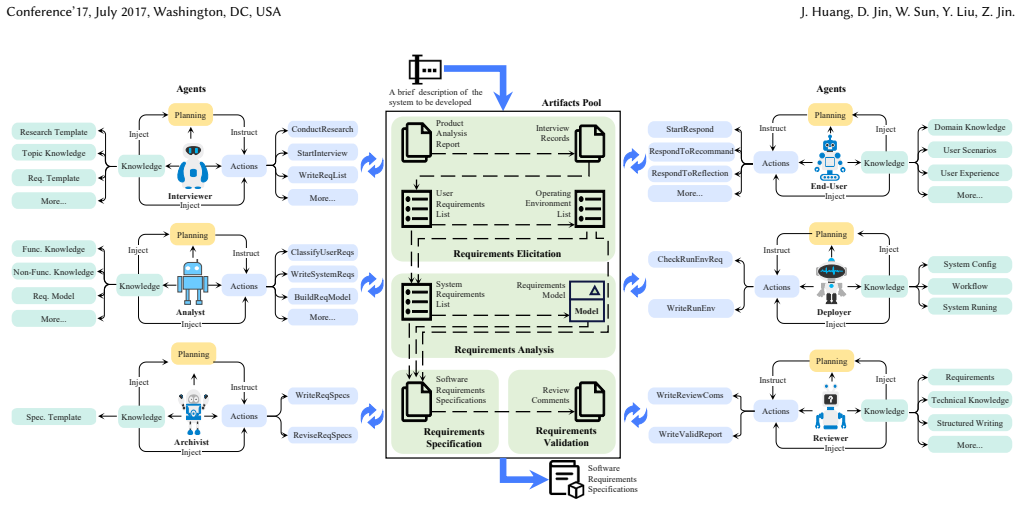
The load-bearing mechanism is the pairing of (1) six agents that each combine a functionality, a set of predefined actions, a planning mechanism, and injected knowledge (domain knowledge, templates, and standards specific to their role), with (2) an artifact pool modeled on the blackboard mechanism, whose state triggers agents to plan and act as artifacts are added or updated. This design turns the requirements workflow from a fixed chat into a state-driven pipeline: the Interviewer produces analysis and interview records, the Deployer drafts the environment list, the Analyst classifies requirements and builds the model, the Archivist writes and revises the SRS, and the Reviewer consolidates feedback. The knowledge injection is what the paper claims separates KGMAF from prior multi-agent systems that simply assign roles to LLMs without defining the software-engineering knowledge they need.
What would settle it
Run KGMAF end-to-end on a diverse set of at least 20 software ideas spanning different domains; if the pipeline frequently stalls, produces internally inconsistent SRSs, or fails a requirements-quality checklist (completeness, consistency, testability) at rates far below human-written specifications, the claim that KGMAF autonomously performs RE would be refuted.
Extended reading notes
Core claim
The central claim is that a knowledge-guided multi-agent framework, KGMAF, can autonomously perform the four requirements-engineering activities — elicitation, analysis, specification, and validation — by orchestrating six specialized LLM-based agents through a shared artifact pool. Given a brief description of the system to be developed, the agents take turns producing intermediate artifacts (product analysis report, interview records, user requirements list, operating environment list, system requirements list, requirements model) and the final SRS; the artifact pool's state drives which agent acts next. The authors position the framework as filling a gap left by code-centric multi-agent systems, and their case study on an insurance management system produces artifacts whose quality they describe as satisfactory, though the evaluation is qualitative and limited to a single project.
Load-bearing premise
The framework assumes that six LLM-based agents, given predefined actions, planning mechanisms, and injected knowledge, can reliably execute and collaborate on requirements tasks across diverse projects, but this is only demonstrated on a single insurance-management case with subjective quality judgment and no quantitative evaluation.
Editorial extensions
If this is right
- If the framework works as claimed, a requirements engineer's job shifts from manually drafting an SRS to reviewing and steering an automated pipeline that produces structured, traceable artifacts from a brief idea.
- The artifact-pool design offers a general pattern for multi-agent software engineering collaboration: shared state, rather than direct conversation, determines which agent acts next, potentially reducing coordination overhead in larger pipelines.
- The explicit role-action-knowledge decomposition provides a template for retrofitting existing LLM-based development agents with the requirements capabilities they currently lack.
- Automated validation and revision loops between the Reviewer and Archivist could make requirement changes propagate quickly through the SRS, supporting iterative development in practice.
Reading between the lines
- The paper's single insurance-management case, judged only by subjective inspection, leaves the core claim of reliability across projects untested; a multi-domain benchmark with quantitative consistency checks would be the natural next evaluation.
- Because the end-user agent is itself an LLM simulation of users, requirements quality may be bounded by the model's ability to imitate real stakeholders; grounding that agent in actual user personas, interview transcripts, or usage data could make the pipeline more credible.
- The framework's design does not specify how agent disagreements (for example, a user request that conflicts with deployment constraints) are arbitrated; an explicit conflict-resolution or negotiation mechanism would be needed before trusting the pipeline with safety-critical requirements.
Editorial analysis
A structured set of objections, weighed in public.
Referee Report
Summary. This paper proposes KGMAF, a multi-agent framework for requirements development, consisting of six LLM-based agents (Interviewer, End-User, Deployer, Analyst, Archivist, Reviewer) and an artifact pool. Each agent is assigned a functionality, predefined actions, a planning mechanism, and requirements-related knowledge, and the framework is intended to take a brief system description and autonomously perform elicitation, analysis, specification, and validation to produce a Software Requirements Specification and intermediate artifacts. The paper illustrates the framework with a case study on an insurance management system using GPT-4-turbo, reports the generated artifacts, and outlines a future-work roadmap.
Significance. KGMAF targets a genuine gap: existing multi-agent software development frameworks such as ChatDev and MetaGPT concentrate on code development and do not provide dedicated agent designs for requirements engineering. The conceptual decomposition into specialist agents with explicit knowledge and artifacts is clearly presented, and the included artifact excerpts give a concrete picture of what the framework aims to produce. The authors also report their model settings and provide a public link to the full artifacts, which is helpful for reproducibility of the demonstration. If the central mechanisms, especially knowledge injection and artifact-state-driven planning, are later substantiated, the framework would be a useful step toward automated requirements development. However, the paper is explicitly a vision paper, and the evidence currently remains anecdotal and does not validate the distinctive mechanisms that the framework claims.
major comments (4)
- [Section 3 (Collaboration Process) vs. Section 2.3] The case narrative says the Interviewer selects WriteProductAnalysisReport and PrepareInterviewList, but Section 2.3 lists the Interviewer's actions as ConductResearch, StartInterview, and WriteReqList. This internal mismatch makes the precise workflow irreproducible and indicates that the action design is not yet stable enough to support the paper's claims.
- [Section 2.3, Interviewer ConductResearch] The description of ConductResearch states that the agent collects URLs, summarizes webpages, and writes the Product Analysis Report, yet no URLs, external references, or retrieval traces appear in the case study artifacts shown in Figure 2 or in the collaboration narrative. The PAR excerpts, such as Product Background and Comparative Analysis, could plausibly have been generated from the LLM's parametric memory alone. Consequently, the evidence does not demonstrate that external knowledge is actually retrieved and injected, which weakens the central 'knowledge-guided' claim.
- [Section 3, Collaboration Process] The reported collaboration process follows a fixed linear sequence: PAR, interview questions, dialogue, User Requirements List, Operating Environment List, System Requirements List, requirements model, SRS, and review. No instance is shown in which the planning mechanism selects an alternative action, reacts to an unexpected artifact state, or recovers from a failure. The claimed adaptive, artifact-state-driven planning is therefore not demonstrated, and the statement that the case study validates KGMAF overstates what a single successful linear trace can show.
- [Section 3, Generated Artifacts] The quality of the generated artifacts is assessed only subjectively, with the statement that 'the quality ... is satisfactory' based on visual inspection. There are no evaluation criteria, baseline comparison, or independent assessment. This is acceptable for illustrating potential in a vision paper, but it does not support the stronger validation phrasing used in the introduction and Section 3.
minor comments (5)
- [Section 1] The phrase 'blackboard mechansim' should be corrected to 'blackboard mechanism'.
- [Figure 1 and Section 2.3] Several action names in Figure 1 and in the case narrative differ from those in Section 2.3, such as WriteProductAnalysisReport and PrepareInterviewList versus ConductResearch and StartInterview. The figure, the conceptual design, and the case study should use one consistent set of action names.
- [Section 3, Collaboration Process] The collaboration narrative mentions an 'interview question list' artifact, but this artifact is not described in Section 2.3 and does not appear in the artifact list in Figure 2. Please clarify whether it is a distinct artifact and how it relates to the Interview Records.
- [Section 2.2] The sentence 'The performance of both modules requires an injection of requirements-related knowledge' is awkward and should be rephrased, for example as 'both modules require the injection of requirements-related knowledge'.
- [Section 1 and Reference [4]] The relationship to the authors' earlier Mare framework [4], which is also a multi-agent framework for requirements engineering, is not discussed. The introduction should state explicitly what KGMAF adds beyond Mare so that the novelty claim is clear.
Circularity Check
No circular derivation: KGMAF is a design vision, and the only same-author citation (Mare [4]) is not load-bearing.
full rationale
KGMAF is a vision paper that proposes an architecture rather than deriving a result; it contains no equations, fitted parameters, uniqueness theorems, or predicted quantities that could reduce to its inputs by construction. The central claim is the design itself, and the Section 3 case study is an illustrative demonstration, not a statistical or mathematical prediction. The only same-author citation identified is reference [4] (Mare), used in Section 1 to support the general statement that requirements engineering is a pivotal phase in the software development life-cycle; this is a standard background claim and does not carry the weight of KGMAF's agent design, so it is not load-bearing. The paper's assertions that knowledge injection and planning mechanisms are effective are not validated by controlled comparison, but that is an evaluation gap rather than circularity. Accordingly, no specific circular step is identified, and the score reflects only the presence of a minor, non-load-bearing self-citation.
Assumptions & free parameters
free parameters (4)
- temperature =
0.3
- top_p =
1.0
- max_tokens =
4096
- specific knowledge content per agent =
unspecified
assumptions (3)
- domain assumption LLM-based agents can perform elicitation, analysis, specification, and validation tasks with sufficient quality when given predefined actions and knowledge.
- domain assumption The artifact pool blackboard mechanism can coordinate agent workflows by state monitoring.
- domain assumption Knowledge can be effectively injected into prompts using the described strategies.
Cite this review
Pith. "Pith review of Knowledge-Guided Multi-Agent Framework for Automated Requirements Development: A Vision." pith.science (2026). https://pith.science/paper/4TYXFDDV
@misc{pith2026250622656,
  author       = {Pith},
  title        = {Pith review of: Knowledge-Guided Multi-Agent Framework for Automated Requirements Development: A Vision},
  year         = {2026},
  howpublished = {\url{https://pith.science/paper/4TYXFDDV}},
  note         = {Machine review of arXiv:2506.22656}
}
read the original abstract
This paper envisions a knowledge-guided multi-agent framework named KGMAF for automated requirements development. KGMAF aims to address gaps in current automation systems for SE, which prioritize code development and overlook the complexities of requirements tasks. KGMAF is composed of six specialized agents and an artifact pool to improve efficiency and accuracy. Specifically, KGMAF outlines the functionality, actions, and knowledge of each agent and provides the conceptual design of the artifact pool. Our case study highlights the potential of KGMAF in real-world scenarios. Finally, we outline several research opportunities for implementing and enhancing automated requirements development using multi-agent systems. We believe that KGMAF will play a pivotal role in shaping the future of automated requirements development in the era of LLMs.
Figures

Reference graph
Works this paper leans on
-
[1]
Research directions in requirements engineering
Betty HC Cheng and Joanne M Atlee. Research directions in requirements engineering. Future of software engineering , pages 285–303, 2007
work page 2007
-
[2]
Requirements engineering: a roadmap
Bashar Nuseibeh and Steve Easterbrook. Requirements engineering: a roadmap. In Proceedings of the Conference on the Future of Software Engineering , pages 35–46, 2000
work page 2000
-
[3]
Software engineering programs are not computer science programs
David Lorge Parnas. Software engineering programs are not computer science programs. IEEE software, 16(6):19–30, 1999
work page 1999
-
[4]
Mare: Multi- agents collaboration framework for requirements engineering
Dongming Jin, Zhi Jin, Xiaohong Chen, and Chunhui Wang. Mare: Multi- agents collaboration framework for requirements engineering. arXiv preprint arXiv:2405.03256, 2024
arXiv 2024
-
[5]
Software Requirements Engineering Methods and Practices
Zhi Jin, Lin Liu, Xiaohong Chen, and Tong Li. Software Requirements Engineering Methods and Practices. Tsinghua University Press, 2023
work page 2023
-
[6]
An evaluation of requirements modeling for cyber- physical systems via llms
Dongming Jin, Shengxin Zhao, Zhi Jin, Xiaohong Chen, Chunhui Wang, Zheng Fang, and Hongbin Xiao. An evaluation of requirements modeling for cyber- physical systems via llms. arXiv preprint arXiv:2408.02450, 2024
arXiv 2024
-
[7]
Source code summarization in the era of large language models
Weisong Sun, Yun Miao, Yuekang Li, Hongyu Zhang, Chunrong Fang, Yi Liu, Gelei Deng, Yang Liu, and Zhenyu Chen. Source code summarization in the era of large language models. In Proceedings of the 47th International Conference on Software Engineering, pages 419–431, Ottawa, Ontario, Canada, 27 April-3 May, 2025 2025. IEEE Computer Society
work page 2025
-
[8]
Webarena: A realistic web environment for building autonomous agents
Shuyan Zhou, Frank F Xu, Hao Zhu, Xuhui Zhou, Robert Lo, Abishek Srid- har, Xianyi Cheng, Tianyue Ou, Yonatan Bisk, Daniel Fried, et al. Webarena: A realistic web environment for building autonomous agents. arXiv preprint arXiv:2307.13854, 2023
arXiv 2023
Show all 23 references
-
[9]
Chatdev: Communicative agents for software development
Chen Qian, Wei Liu, Hongzhang Liu, Nuo Chen, Yufan Dang, Jiahao Li, Cheng Yang, Weize Chen, Yusheng Su, Xin Cong, et al. Chatdev: Communicative agents for software development. In Proceedings of the 62nd Annual Meeting of the Association for Computational Linguistics (Volume 1...
2024
-
[10]
Metagpt: Meta programming for multi-agent collaborative framework
Sirui Hong, Xiawu Zheng, Jonathan Chen, Yuheng Cheng, Jinlin Wang, Ceyao Zhang, Zili Wang, Steven Ka Shing Yau, Zijuan Lin, Liyang Zhou, et al. Metagpt: Meta programming for multi-agent collaborative framework. arXiv preprint arXiv:2308.00352, 2023
2023 arXiv
-
[11]
Gpt-engineer, 2023
Gpt-engineer. Gpt-engineer, 2023. Accessed: 2025-01-10
2023
-
[12]
Autogpt, 2023
AutoGPT. Autogpt, 2023. Accessed: 2025-01-10
2023
-
[13]
Gpt-powered elicitation interview script generator for requirements engineering training
Binnur Görer and Fatma Basak Aydemir. Gpt-powered elicitation interview script generator for requirements engineering training. In 32nd IEEE International Requirements Engineering Conference, pages 372–379. IEEE, 2024
2024
-
[14]
Multi-label requirements classifica- tion with large taxonomies
Waleed Abdeen, Michael Unterkalmsteiner, Krzysztof Wnuk, Alexandros Chir- toglou, Christoph Schimanski, and Heja Goli. Multi-label requirements classifica- tion with large taxonomies. In 32nd IEEE International Requirements Engineering Conference, pages 264–274. IEEE, 2024
2024
-
[15]
Using llms in software requirements specifications: An empirical evaluation
Madhava Krishna, Bhagesh Gaur, Arsh Verma, and Pankaj Jalote. Using llms in software requirements specifications: An empirical evaluation. In 32nd IEEE International Requirements Engineering Conference , pages 475–483. IEEE, 2024
2024
-
[16]
Automated smell detection and recommendation in natural language requirements
Alvaro Veizaga, Seung Yeob Shin, and Lionel C Briand. Automated smell detection and recommendation in natural language requirements. IEEE Transactions on Software Engineering, 2024
2024
-
[17]
Blackboard systems
Iain D Craig. Blackboard systems. Artificial Intelligence Review, 2(2):103–118, 1988
1988
-
[18]
https://github.com/lenve/javadoc, 2020
The source for the selected case study. https://github.com/lenve/javadoc, 2020
2020
-
[19]
Chain-of-thought prompting elicits reasoning in large language models
Jason Wei, Xuezhi Wang, Dale Schuurmans, Maarten Bosma, Fei Xia, Ed Chi, Quoc V Le, Denny Zhou, et al. Chain-of-thought prompting elicits reasoning in large language models. Advances in neural information processing systems , 35:24824–24837, 2022
2022
-
[20]
Tree of thoughts: Deliberate problem solving with large language models
Shunyu Yao, Dian Yu, Jeffrey Zhao, Izhak Shafran, Tom Griffiths, Yuan Cao, and Karthik Narasimhan. Tree of thoughts: Deliberate problem solving with large language models. Advances in Neural Information Processing Systems , 36, 2024
2024
-
[21]
Gpt-4 technical report
R OpenAI et al. Gpt-4 technical report. ArXiv, 2303:08774, 2023
2023
-
[22]
https://openai.com/
Openai. https://openai.com/
-
[23]
https://anonymous.4open
The generated requirements artifacts in our case study. https://anonymous.4open. science/r/KARE-Vision-4C63
Reviewed August 6, 2026 · model on record in the stance chip above.
Discussion (0). Sign in to comment.