REVIEW 4 major objections 5 minor 67 references
Persistence Paradox in Dynamic Science
T0 review · 4 major / 5 minor · reviewed 2026-08-06 · deepseek-v4-flash
Pith's one-line read During a paradigm shift like the deep learning revolution, persistence in one's established research direction measurably lowers citation impact, while partial pivoting that retains some thread to prior work maximizes it.
desk verdict The rigidity penalty is plausible and the study is honest, but the headline magnitude is off by 100x and the attrition channel is not bounded. read the letter →
The pith
A machine-rendered reading of the paper's core claim, the machinery that carries it, and where it could break.
The reading
What carries the argument
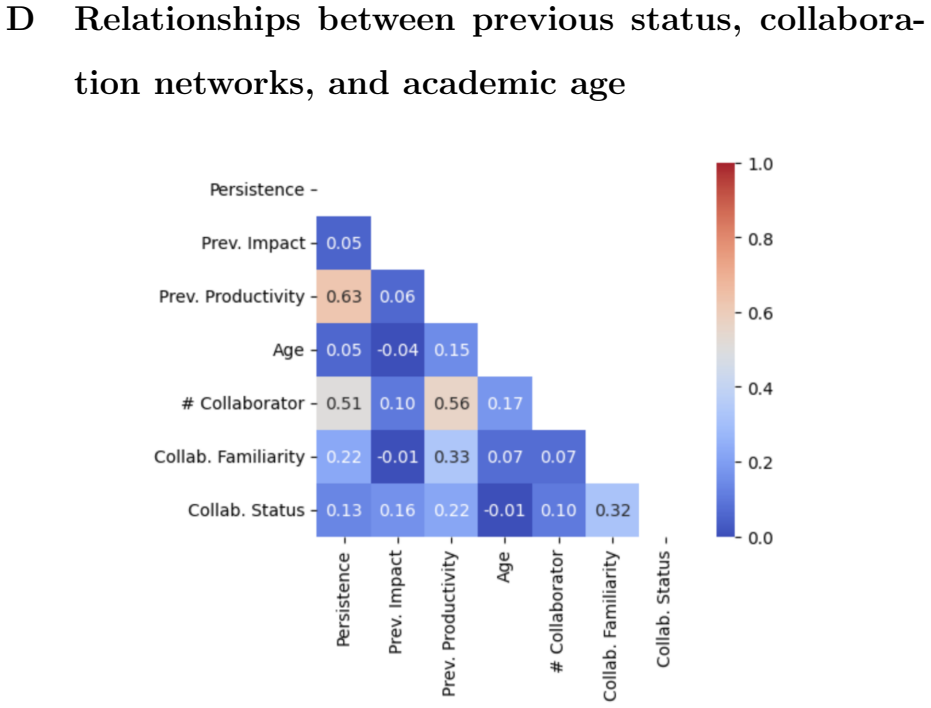
The workhorse is the research persistence index, a bootstrapped text-similarity score per scientist per year: the corpus of a scientist's ICML/NeurIPS papers up to year T is compared with their papers in year T+1, randomly sampling the larger corpus down to the smaller size 1,000 times and averaging the similarities, so a higher score means the scientist's latest work closely resembles their own past work. This index enters a two-way fixed-effects panel regression of impact and productivity on persistence, its interaction with the post-2013 period, prior performance, and coauthor-network features (count, familiarity, status). The persistence-by-post-2013 interaction coefficient is the evidence for the rigidity penalty, and the peak-in-the-middle pattern of impact against persistence identifies the strategic-adaptation zone.
What would settle it
The decisive check is to bring leavers back into the outcome: re-estimate the persistence-by-post-2013 interaction on a panel that adds this cohort's ICLR papers, their publications in other machine-learning and AI venues, and eventually their submitted-but-rejected papers. If the negative coefficient shrinks or vanishes once leavers are included, the rigidity penalty is an artifact of selective retention; if it grows, the conclusion is reinforced. A quicker placebo check on the existing data is to set the fake shift at, say, 2008 and confirm that persistence shows no comparable negative interaction in a period without a paradigm shift.
Extended reading notes
Core claim
The paper's central claim is that in the era following the advent of deep learning, rigidity became costly: holding coauthor networks and prior performance fixed, a 0.1 increase in a scientist's year-over-year similarity to their own prior research explains a 1.77% marginal decrease in impact, measured by citation percentile rank at ICML and NeurIPS. Persistence remained positively associated with productivity, so the penalty is specific to influence rather than output. The paper also documents a redistribution of status: previous impact negatively predicts subsequent impact in this period, and scientists who were prolific or embedded in older, larger teams adapted more slowly. The maximum impact gain sits at moderate persistence - roughly 25-50% overlap with prior work - a zone the authors call strategic adaptation, which selectively adopts the new paradigm while keeping weak ties to old expertise.
Load-bearing premise
The load-bearing premise, which the paper itself flags in Section 6, is that the penalty is estimated only among researchers who kept getting published at ICML and NeurIPS - if the scientists who stopped appearing there (moving to ICLR, journals, or industry, or being rejected) are exactly the ones persistence hurt most, the measured penalty could reflect who stayed in the sample rather than what persistence does to impact.
Editorial extensions
If this is right
- A researcher who keeps their output highly similar to their own prior work after a paradigm shift will see citation percentile rank decline even when productivity and collaboration inputs are held constant.
- Impact is redistributed in a revolution: high prior impact predicts lower subsequent impact in the same venues, so the scientists most established before 2013 are not the ones who benefit most after it.
- The best-impact adaptation is partial: the largest gains occur at a 25-50% overlap with prior work, not at full continuity and not at a complete break.
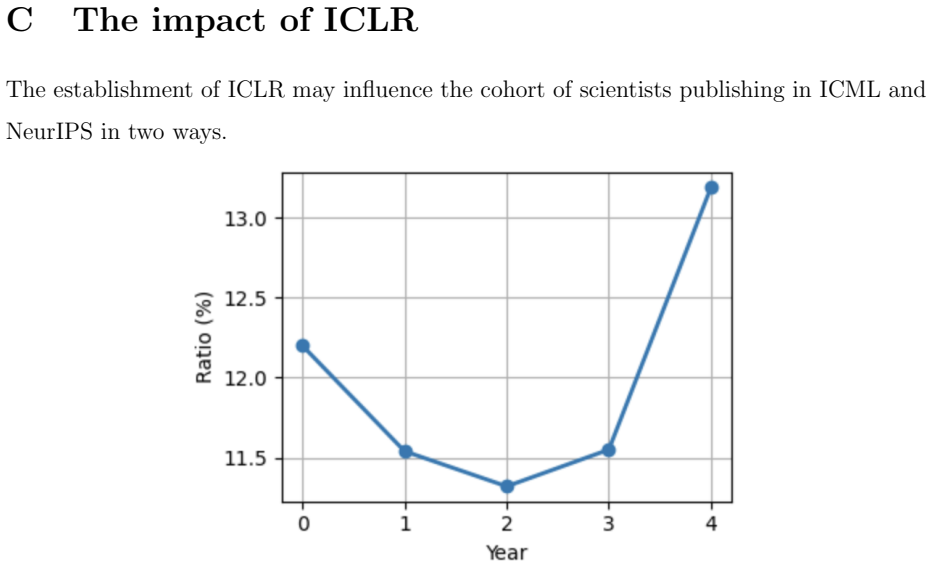
- Elite venues are not neutral: ICML and NeurIPS converged on the new deep-learning topics over time, so publishing in the same venue is not the same as staying in the same paradigm.
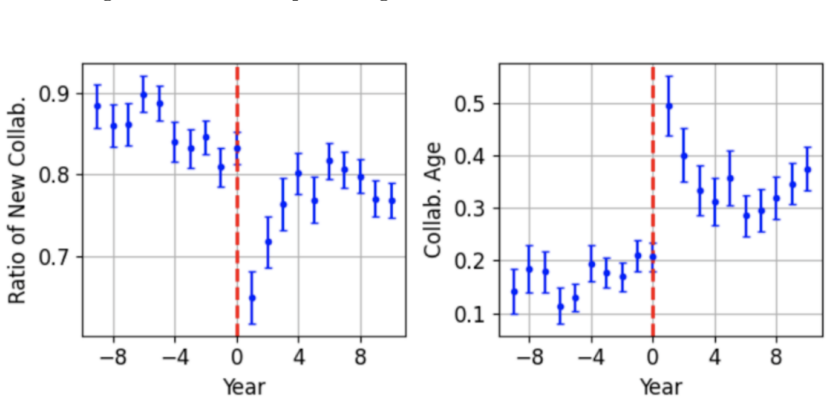
- Older and larger collaboration teams lag in adaptation, and teams that take on new collaborators after the shock sustain their success.
Reading between the lines
- Testable extension: apply the same within-author persistence design to later paradigm shifts - the large-language-model wave after 2018, or the CRISPR revolution in biology - to see whether the rigidity penalty is a general feature of scientific revolutions or specific to the deep-learning transition.
- Implication the authors leave implicit: if rigidity reliably costs impact during revolutions, then evaluation and funding systems that reward uninterrupted productivity are systematically biased toward the strategy that loses influence in exactly those periods, and crediting adaptation during shifts would offset that bias.
- Refinement with the same data: the persistence index is computed from published text, so a scientist who changes vocabulary without changing methods, or switches methods while keeping familiar vocabulary, is misclassified; separating topical similarity from methodological similarity would sharpen the 1.77% estimate.
Editorial analysis
A structured set of objections, weighed in public.
Referee Report
Summary. The paper studies how researchers' persistence -- measured as the bootstrapped text similarity between a scientist's current-year ICML/NeurIPS papers and their prior corpus -- relates to citation impact and productivity during the deep learning paradigm shift after 2013. Using a cohort of 5,359 scientists who published at ICML/NeurIPS between 2003 and 2012, the authors estimate two-way fixed effects panel regressions. They find a statistically significant negative interaction between persistence and the post-2013 period for impact (the 'rigidity penalty'), a positive association between persistence and productivity, and a negative association between prior impact and subsequent impact. They also report that previous productivity and large, older collaboration teams predict higher persistence. The paper concludes that persistence is context-dependent, that strategic partial adaptation is optimal, and that scientific disruptions redistribute influence.
Significance. If the central identification were credible, the paper would provide a valuable empirical contribution to the science-of-science literature: it would show that a clearly measured behavioral trait (textual persistence) has context-dependent returns during a paradigm shift, with implications for career strategy and research evaluation. The paper also offers a novel persistence measure that corrects for corpus-size differences via bootstrapping, and it combines macro-level venue-topic analysis with micro-level scientist panels. However, the main quantitative claim is threatened by sample-selection on the outcome and by a misreported effect size, so the significance as currently established is limited.
major comments (4)
- [Section 5.2.1, Table 1] The interpretation of the interaction coefficient is incorrect. In Model 6, the coefficient on post2013×persistence is -0.177, with persistence measured on a 0-100 scale and impact measured as a 0-100 citation percentile. A 0.1-unit increase in persistence therefore corresponds to a change of -0.0177 percentile-rank points, not a 1.77% decrease. The current wording overstates the magnitude by a factor of 100 relative to the scale of the dependent variable. Please correct this sentence and any related claims in the abstract, main text, or discussion.
- [Section 5.2.1 and Section 6] The panel regression is estimated only on scientist-year observations with at least one ICML/NeurIPS publication in that year, because both the persistence measure and the impact measure require a year-T+1 paper. After 2013, researchers who persisted in pre-deep-learning topics may have been more likely to be rejected at these venues, to move to ICLR, or to stop publishing in them; such years drop out of the sample. The negative interaction coefficient is therefore identified only among the selected group of scientists who continued to publish in ICML/NeurIPS, making the 'rigidity penalty' potentially an artifact of attrition. The paper's statement in Section 6 ('This research only considered published papers') acknowledges the issue but provides no sensitivity analysis. Please provide bounds, a selection correction, or at least a rigorous informal assessment of the direction and plausible magnitude of the resulting bias.
- [Section 5.2.1 and Figure 4] The paper's policy-relevant conclusion that 'strategic adaptation' (moderate persistence, around 25-50% overlap) maximizes impact is not supported by the regression model. Table 1 contains only a linear persistence term and its interaction with the post-2013 indicator; it does not include a quadratic or spline term. Figure 4 is based on bivariate linear fits, not the multivariate specification. Please test for curvature explicitly in the main regression, or tone down the claim that the highest impact is achieved at an intermediate persistence level.
- [Section 5.2.1, persistence measure] The construction of the 'bootstrapped text similarity' measure is not fully specified. The text does not state which text representation is used (e.g., TF-IDF vectors, word embeddings, or SPECTER2 embeddings) or which similarity metric (e.g., cosine, Jaccard, dot product) is applied. Appendix A describes SPECTER2 for the macro-level comparison, but it is not stated whether the same representation underlies the scientist-level persistence measure. Please provide a complete algorithmic definition, including the feature set, similarity function, and any preprocessing steps, so that the central independent variable is reproducible.
minor comments (5)
- [Table 1] The R-squared for the impact model is 0.031, meaning the model explains roughly 3% of the variance in citation impact. While statistical significance is reported, the paper should acknowledge the small explanatory power when interpreting the economic significance of the persistence coefficient.
- [Section 5.2.1, regression equation] The regression equation is not numbered, and the 'Post 2013' dummy is never explicitly defined. Please state whether it equals 1 for calendar years 2013 onward or for transitions into years after 2013, and clarify the timing of the persistence measure (from year T to T+1) relative to the outcome measured in year T+1.
- [Figure 4] The y-axis labels 'Impact Change' and 'Productivity Change' are undefined in the caption. The text mentions 'ratios of productivity and impact relative to the previous year,' but the units and the construction of these ratios should be stated explicitly in the figure caption.
- [Appendix A] The citation for SPECTER2 appears inconsistent: the text cites '[10, 47]' for the SPECTER2 model, but reference [10] is a Web Conference paper by Bao et al., not the Singh et al. SPECTER2 paper. Please verify all citations in Appendix A.
- [Section 6] The limitations paragraph mentions that only published papers were considered, but it does not mention that persistence itself cannot be measured in years without publications. This is directly relevant to the attrition issue and should be stated explicitly.
Circularity Check
No significant circularity: the central rigidity-penalty claim is an empirical regression estimate, not a construct defined in terms of the outcome, and the self-citations are not load-bearing.
full rationale
The paper's central claim (Section 5.2.1) is a two-way fixed-effects regression coefficient: the post-2013 interaction of the bootstrapped text-similarity persistence measure with citation-percentile impact. There is no derivation step in which the predicted quantity is built from the fitted inputs by definition. Persistence is defined as bootstrapped text similarity between a scientist's pre-year-T ICML/NeurIPS corpus and their year-T+1 corpus, while impact is the citation percentile rank of the same year's papers; the two variables share a publication corpus but are not definitionally equivalent, so the shared-corpus mechanical link is a measurement and identification concern rather than circularity. The stated limitation in Section 6 ('This research only considered published papers') is an external-validity and attrition threat, not a circular reduction. The self-citations (e.g., [10] cited alongside [47] for SPECTER2, and [8, 9, 61, 62] in peripheral roles) are not load-bearing: the embedding model is independently benchmarked, and the cited prior work does not supply the rigidity-penalty result or forbid alternative measures. Therefore the paper is self-contained against external benchmarks, and no circular step can be exhibited from the paper's own equations or self-citation chain.
Assumptions & free parameters
free parameters (3)
- TF-IDF keyword count (top-10) =
10
- ICLR-underrepresented topic count (top-50) =
50
- Bootstrap iterations for persistence =
1000
assumptions (5)
- domain assumption ICML and NeurIPS publication is an adequate proxy for remaining at the frontier of machine learning; ICLR is a valid proxy for deep learning purity.
- domain assumption 2013 is the first year of the deep learning paradigm shift.
- domain assumption After author and year fixed effects and collaboration controls, research persistence varies as if randomly within authors (no time-varying confounding).
- domain assumption Bootstrapped TF-IDF text similarity is a valid measure of research persistence.
- domain assumption OpenAlex/DBLP/Google Scholar disambiguation is accurate for the cohort.
Cite this review
Pith. "Pith review of Persistence Paradox in Dynamic Science." pith.science (2026). https://pith.science/paper/BT7BWBLW
@misc{pith2026250622729,
  author       = {Pith},
  title        = {Pith review of: Persistence Paradox in Dynamic Science},
  year         = {2026},
  howpublished = {\url{https://pith.science/paper/BT7BWBLW}},
  note         = {Machine review of arXiv:2506.22729}
}
read the original abstract
Persistence is often regarded as a virtue in science. In this paper, however, we challenge this conventional view by highlighting its contextual nature, particularly how persistence can become a liability during periods of paradigm shift. We focus on the deep learning revolution catalyzed by AlexNet in 2012. Analyzing the 20-year career trajectories of over 5,000 scientists who were active in top machine learning venues during the preceding decade, we examine how their research focus and output evolved. We first uncover a dynamic period in which leading venues increasingly prioritized cutting-edge deep learning developments that displaced relatively traditional statistical learning methods. Scientists responded to these changes in markedly different ways. Those who were previously successful or affiliated with old teams adapted more slowly, experiencing what we term a rigidity penalty - a reluctance to embrace new directions leading to a decline in scientific impact, as measured by citation percentile rank. In contrast, scientists who pursued strategic adaptation - selectively pivoting toward emerging trends while preserving weak connections to prior expertise - reaped the greatest benefits. Taken together, our macro- and micro-level findings show that scientific breakthroughs act as mechanisms that reconfigure power structures within a field.
Figures


Figures from the paper (9 more)



Reference graph
Works this paper leans on
-
[1]
Alom, M. Z., T. M. Taha, C. Yakopcic, S. Westberg, P. Sidike, M. S. Nasrin, B. C. Van Esesn, A. A. S. Awwal, and V. K. Asari (2018). The history began from alexnet: A comprehensive survey on deep learning approaches. arXiv preprint arXiv:1803.01164
arXiv 2018
- [2]
-
[3]
Araj, H., L. Worth Jr, and D. T. Yeung (2024). Elements of successful nih grant applications. Proceedings of the National Academy of Sciences 121 (15), e2315735121
work page 2024
-
[4]
Azoulay, P., C. Fons-Rosen, and J. S. G. Zivin (2019). Does science advance one funeral at a time? American Economic Review 109 (8), 2889–2920
work page 2019
-
[5]
Azoulay, P., J. S. Graff Zivin, and G. Manso (2011). Incentives and creativity: Evidence from the academic life sciences. The RAND Journal of Economics 42 (3), 527–554
work page 2011
-
[6]
Azoulay, P. and W. H. Greenblatt (2025). Does peer review penalize scientific risk tak- ing? evidence from nih grant renewals. Technical report, National Bureau of Economic Research
work page 2025
-
[7]
Azoulay, P., T. Stuart, and Y. Wang (2014). Matthew: Effect or fable? Management Science 60 (1), 92–109
work page 2014
-
[8]
Bao, H. and M. Teplitskiy (2024). A simulation-based analysis of the impact of rhetor- ical citations in science. Nature Communications 15 (1), 431
work page 2024
Show all 67 references
-
[9]
Bao, H., S. Wu, J. Choi, Y. Mao, and J. A. Evans (2025). Language models surface the unwritten code of science and society. arXiv preprint arXiv:2505.18942
2025
-
[10]
Zhang, M
Bao, H., J. Zhang, M. Cao, and J. A. Evans (2025). From division to unity: A large- scale study on the emergence of computational social science, 1990-2021. In Companion Proceedings of the ACM Web Conference 2025 , pp. 859–863. 32
2025
-
[11]
Beaver, D. and R. Rosen (1978). Studies in scientific collaboration: Part i. the profes- sional origins of scientific co-authorship. Scientometrics 1 (1), 65–84
1978
-
[12]
Lo, and A
Beltagy, I., K. Lo, and A. Cohan (2019, November). Scibert: A pretrained language model for scientific text. Proceedings of the 2019 Conference on Empirical Methods in Natural Language Processing and the 9th International Joint Conference on Natural Language Processing (EMNLP-...
2019
-
[13]
Berggren, T
Bergek, A., C. Berggren, T. Magnusson, and M. Hobday (2013). Technological dis- continuities and the challenge for incumbent firms: Destruction, disruption or creative accumulation? Research Policy 42 (6-7), 1210–1224
2013
-
[14]
Bhatt, A. M. (2020). Neither Blank Slate nor Set in Stone: Cultural Behaviors of Organizational Newcomers. Stanford University
2020
-
[15]
Bhatt, A. M., A. Goldberg, and S. B. Srivastava (2022). A language-based method for assessing symbolic boundary maintenance between social groups. Sociological Methods & Research 51 (4), 1681–1720
2022
-
[16]
Brandt, M. and C. Reyna (2012). Social dominance or system justification? - the acceptance of inequality and resistance to social change as unique system-relevant mo- tivations. The Acceptance of Inequality and Resistance to Social Change as Unique System-Relevant Motivations ...
2012
-
[17]
Bush, V. (1945). Science: The endless frontier. a report to the president. US Govern- ment Printing Office, Washington DC , 7
1945
-
[18]
Ferriani, and A
Cattani, G., S. Ferriani, and A. Lanza (2017). Deconstructing the outsider puzzle: The legitimation journey of novelty. Organization Science 28 (6), 965–992
2017
-
[19]
Wu, and J
Cui, H., L. Wu, and J. A. Evans (2022). Aging scientists and slowed advance. arXiv preprint arXiv:2202.04044
2022
-
[20]
Diamond Jr, A. M. (1980). Age and the acceptance of cliometrics. The Journal of Economic History 40 (4), 838–841. 33
1980
-
[21]
Duan, Y., S. A. Memon, B. AlShebli, Q. Guan, P. Holme, and T. Rahwan (2025). Postdoc publications and citations link to academic retention and faculty success. Pro- ceedings of the National Academy of Sciences 122 (4), e2402053122
2025
-
[22]
Field, J. (2016). The unhelpful notion of ”renaissance man”. Interdisciplinary Science Reviews 41 (2-3), 188–201
2016
-
[23]
Foster, J. G., A. Rzhetsky, and J. A. Evans (2015). Tradition and innovation in scientists’ research strategies. American Sociological Review 80 (5), 875–908
2015
-
[24]
Frankenhuis, W. E., K. Panchanathan, and P. E. Smaldino (2023). Strategic ambiguity in the social sciences. Social Psychological Bulletin 18 , 1–25
2023
-
[25]
Goldberg, A., S. B. Srivastava, V. G. Manian, W. Monroe, and C. Potts (2016). Fitting in or standing out? the tradeoffs of structural and cultural embeddedness. American Sociological Review 81 (6), 1190–1222
2016
-
[26]
Harford, T. (2011). Adapt: Why success always starts with failure . Farrar, Straus and Giroux
2011
-
[27]
Hill, R., Y. Yin, C. Stein, X. Wang, D. Wang, and B. F. Jones (2025). The pivot penalty in research. Nature, 1–8
2025
-
[28]
Hull, D. L., P. D. Tessner, and A. M. Diamond (1978). Planck’s principle: Do younger scientists accept new scientific ideas with greater alacrity than older scientists? Sci- ence 202 (4369), 717–723
1978
-
[29]
Jones, B. F. (2009). The burden of knowledge and the ”death of the renaissance man”: Is innovation getting harder? The Review of Economic Studies 76 (1), 283–317
2009
-
[30]
Kim, and J
Kim, J., J. Kim, and J. Kim (2023). Effect of chinese characters on machine learn- ing for chinese author name disambiguation: A counterfactual evaluation. Journal of Information Science 49 (3), 711–725
2023
-
[31]
Schulte, and A
K¨ onig, A., M. Schulte, and A. Enders (2012). Inertia in response to non-paradigmatic change: The case of meta-organizations. Research Policy 41 (8), 1325–1343. 34
2012
-
[32]
Sutskever, and G
Krizhevsky, A., I. Sutskever, and G. E. Hinton (2012). Imagenet classification with deep convolutional neural networks. Advances in Neural Information Processing Sys- tems 25
2012
-
[33]
Kuhn, T. S. (1997). The structure of scientific revolutions , Volume 962. University of Chicago press
1997
-
[34]
Lane, J. N., M. Teplitskiy, G. Gray, H. Ranu, M. Menietti, E. C. Guinan, and K. R. Lakhani (2022). Conservatism gets funded? a field experiment on the role of negative information in novel project evaluation. Management Science 68 (6), 4478–4495
2022
-
[35]
Leahey, E., C. M. Beckman, and T. L. Stanko (2017). Prominent but less produc- tive: The impact of interdisciplinarity on scientists’ research. Administrative Science Quarterly 62 (1), 105–139
2017
-
[36]
Bengio, and G
LeCun, Y., Y. Bengio, and G. Hinton (2015). Deep learning. Nature 521 (7553), 436–444
2015
-
[37]
Lin, and L
Li, L., Y. Lin, and L. Wu (2024). Displacing science. arXiv preprint arXiv:2402.16839
2024 arXiv
-
[38]
Marantz, E. A. and G. Cattani (2024). Changing of the guards: Status dynamics and innovation in american tv shows, 1956–2010. Poetics 102 , 101859
2024
-
[39]
Merton, R. K. (1968). The matthew effect in science: The reward and communication systems of science are considered. Science 159 (3810), 56–63
1968
-
[40]
Messeri, P. (1988). Age differences in the reception of new scientific theories: The case of plate tectonics theory. Social Studies of Science 18 (1), 91–112
1988
-
[41]
Sutskever, K
Mikolov, T., I. Sutskever, K. Chen, G. S. Corrado, and J. Dean (2013). Distributed representations of words and phrases and their compositionality. Advances in Neural Information Processing Systems 26
2013
-
[42]
Omenn, G. S. (2006). Grand challenges and great opportunities in science, technology, and public policy. Science 314 (5806), 1696–1704. 35
2006
-
[43]
Reimers, N. and I. Gurevych (2019, November). Sentence-bert: Sentence embeddings using siamese bert-networks. Proceedings of the 2019 Conference on Empirical Methods in Natural Language Processing and the 9th International Joint Conference on Natural Language Processing (EMNLP...
2019
-
[44]
Rzhetsky, A., J. G. Foster, I. T. Foster, and J. A. Evans (2015). Choosing experi- ments to accelerate collective discovery. Proceedings of the National Academy of Sci- ences 112 (47), 14569–14574
2015
-
[45]
Schilling, M. A. and E. Green (2011). Recombinant search and breakthrough idea gen- eration: An analysis of high impact papers in the social sciences. Research Policy 40 (10), 1321–1331
2011
-
[46]
Siler, K. (2024). Gerontocracy, labor market bottlenecks, and generational crises in modern science. Science and Public Policy 51 (2), 179–191
2024
-
[47]
D’Arcy, A
Singh, A., M. D’Arcy, A. Cohan, D. Downey, and S. Feldman (2023, December). Scirepeval: A multi-format benchmark for scientific document representations. Pro- ceedings of the 2023 Conference on Empirical Methods in Natural Language Processing , 5548–5566
2023
-
[48]
Sonnenwald, D. H. (2007). Scientific collaboration. Annual Review of Information Science and Technology 41 (1), 643–681
2007
-
[49]
Srivastava, S. B., A. Goldberg, V. G. Manian, and C. Potts (2018). Enculturation trajectories: Language, cultural adaptation, and individual outcomes in organizations. Management Science 64 (3), 1348–1364
2018
-
[50]
Strang, D. and K. Siler (2015). Revising as reframing: Original submissions versus published papers in administrative science quarterly, 2005 to 2009. Sociological The- ory 33 (1), 71–96
2015
-
[51]
Teece, D. J., G. Pisano, and A. Shuen (1997). Dynamic capabilities and strategic management. Strategic Management Journal 18 (7), 509–533. 36
1997
-
[52]
Teplitskiy, M., H. Peng, A. Blasco, and K. R. Lakhani (2022). Is novel research worth doing? evidence from peer review at 49 journals. Proceedings of the National Academy of Sciences 119 (47), e2118046119
2022
-
[53]
Mukherjee, M
Uzzi, B., S. Mukherjee, M. Stringer, and B. Jones (2013). Atypical combinations and scientific impact. Science 342 (6157), 468–472
2013
-
[54]
Sikdar, F
Venturini, S., S. Sikdar, F. Rinaldi, F. Tudisco, and S. Fortunato (2024). Collaboration and topic switches in science. Scientific Reports 14 (1), 1258
2024
-
[55]
Wagner, C. S., J. D. Roessner, K. Bobb, J. T. Klein, K. W. Boyack, J. Keyton, I. Rafols, and K. B¨ orner (2011). Approaches to understanding and measuring interdisci- plinary scientific research (idr): A review of the literature. Journal of Informetrics 5 (1), 14–26
2011
-
[56]
Wahid, K. A., M. K. Rooney, J. R. Gunther, A. C. Moreno, C. C. Pinnix, C. R. Thomas Jr, and C. D. Fuller (2024). Empirically derived principles for research fund- ing success: A primer for early career academic investigators. International Journal of Radiation Oncology Biology...
2024
-
[57]
Yan, and H
Wang, C.-J., L. Yan, and H. Cui (2023). Unpacking the essential tension of knowledge recombination: Analyzing the impact of knowledge spanning on citation impact and disruptive innovation. Journal of Informetrics 17 (4), 101451
2023
-
[58]
Whitley, R. (2000). The intellectual and social organization of the sciences . Oxford University Press
2000
-
[59]
Kittur, H
Wu, L., A. Kittur, H. Youn, S. Milojevi´ c, E. Leahey, S. M. Fiore, and Y.-Y. Ahn (2022). Metrics and mechanisms: Measuring the unmeasurable in the science of science. Journal of Informetrics 16 (2), 101290
2022
-
[60]
Wang, and J
Wu, L., D. Wang, and J. A. Evans (2019). Large teams develop and small teams disrupt science and technology. Nature 566 (7744), 378–382
2019
-
[61]
Yan, A. X., H. Bao, T. R. Leppard, and A. P. Davis (2025). Measuring vogue in american sociology (2011-2020). arXiv preprint arXiv:2503.17843 . 37
2025 arXiv
-
[62]
Yan, X., H. Bao, T. Leppard, and A. Davis (2024). Cultural ties in american sociology. Technical report, Center for Open Science
2024
-
[63]
Zeng, A., Y. Fan, Z. Di, Y. Wang, and S. Havlin (2022). Impactful scientists have higher tendency to involve collaborators in new topics. Proceedings of the National Academy of Sciences 119 (33), e2207436119
2022
-
[64]
Zeng, A., Z. Shen, J. Zhou, Y. Fan, Z. Di, Y. Wang, H. E. Stanley, and S. Havlin (2019). Increasing trend of scientists to switch between topics. Nature Communications 10 (1), 3439
2019
-
[65]
Zhang, L. (2021). Shaking things up: Disruptive events and inequality. American Journal of Sociology 127 (2), 376–440
2021
-
[66]
Zhang, Y., Y. Wang, H. Du, and S. Havlin (2024). Delayed citation impact of inter- disciplinary research. Journal of Informetrics 18 (1), 101468
2024
-
[67]
Zhou, H. and M. Sun (2024). Evaluating authorship disambiguation quality through anomaly analysis on researchers’ career transition. arXiv preprint arXiv:2412.18757 . 38 Appendix A Analysis of the dataset of 580 thousand general ma- chine learning papers In this study, we focu...
2024 arXiv
Reviewed August 6, 2026 · model on record in the stance chip above.
Discussion (0). Continue with ORCID to comment.