REVIEW 3 major objections 5 minor 33 references
Hierarchical Characterization of Brain Dynamics via State Space-based Vector Quantization
T0 review · 3 major / 5 minor · reviewed 2026-08-06 · deepseek-v4-flash
Pith's one-line read fMRI tokenized into separate brain-state and transition embeddings reconstructs signals better and classifies ADHD and schizophrenia more accurately than existing VQ-VAE and sequential baselines.
desk verdict Promising architecture for fMRI tokenization, but the reported superiority is not supported by the evaluation because codebook size is chosen on the test set and multisite data are pooled without site handling. read the letter →
The pith
A machine-rendered reading of the paper's core claim, the machinery that carries it, and where it could break.
The reading
What carries the argument
The load-bearing machinery is the HST pipeline: a spatio-temporal transformer encoder first fuses temporal and spatial attention views of the BOLD matrix $X \in \mathbb{R}^{T \times M}$; a state-space sequence model then converts the fused representations $H^f_1,\dots,H^f_T$ into per-time-step state outputs $o_t$ and transition updates $h_t$ (Mamba uses discretized evolution matrices $A,B$); and a hierarchical VQ-VAE quantizes the two streams into separate codebooks $e^S$ (states) and $e^T$ (transitions) by nearest-neighbour lookup. Two refinements carry the efficiency claim: quantization-error feedback quantizes the residuals $o_t - \hat{o}_t$ and $h_t - \hat{h}_t$ through auxiliary codebooks, and a clustering update repositions underused code vectors toward active feature regions using $\alpha_j = \exp(-N_j K 10^{1-\gamma})$. The separation of state and transition tokens is what lets the model capture both metastable configurations and the dependencies between them, and the compact codebook is what lets classification use few, stable tokens.
What would settle it
Run the identical HST pipeline with site labels as the prediction target on the pooled ADHD-200 data; if site-prediction accuracy rivals the reported 66.28% diagnostic accuracy, or if diagnosis accuracy drops to chance under site-stratified cross-validation, the empirical claim collapses.
Extended reading notes
Core claim
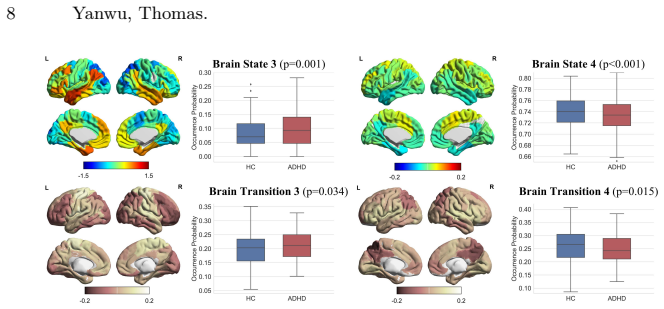
The discovery the authors aim to establish is that separating the quantization of brain states from the quantization of state transitions—rather than clustering whole-brain connectivity or using a single VQ codebook—preserves the information needed to reconstruct BOLD signals and to distinguish patient groups. Concretely, HST with eight state and eight transition embeddings outperforms C-VAE and VQ-VAE at sixteen embeddings on reconstruction, and with Mamba as the state-space backbone it reaches 66.28% accuracy on ADHD-200 and 75.72% on SchizoConnect, beating SVM, MLP, ST-GCN, FBNetGen, BolT, and BrainWaveNet at every point on both datasets. The authors also report that ADHD patients show a higher occurrence probability of an activated brain state (state 3 and transition 3) and a lower probability of a deactivated state (state 4 and transition 4), with prefrontal and parietal differences surviving FDR correction except for transition 3.
Load-bearing premise
The evaluation pools subjects from multiple scanning sites without site harmonization, site covariates, or site-stratified cross-validation, so the reported accuracy and token differences must be caused by diagnosis rather than by scanner or site artifacts.
Editorial extensions
If this is right
- With only 8–16 state and transition embeddings per stream, HST reconstructs fMRI better than VQ-VAE and C-VAE at larger codebook sizes, so a small token vocabulary suffices for brain dynamics.
- Frozen quantized representations transferred to a simple MLP classifier outperform SVM, MLP, ST-GCN, FBNetGen, BolT, and BrainWaveNet on both ADHD-200 and SchizoConnect, implying the tokens are not just reconstructive but discriminative.
- Token occurrence probabilities differ between ADHD and healthy-control groups in prefrontal and parietal states, so the method yields interpretable brain-state maps rather than only a black-box classifier.
- Because Mamba outperforms RNN, LSTM, and GRU under the same quantization, longer-range selective state transitions carry useful information for both reconstruction and diagnosis, and the paper's stated path to a brain-dynamics foundation model is next-token prediction on this token vocabulary.
Reading between the lines
- If the central claim is right, the same hierarchical state/transition quantization could transfer to other high-dimensional time series such as EEG or MEG, where metastable states and transitions are also hypothesized to be diagnostic; the paper does not test this.
- The strongest test not run in the paper is a site-stratified cross-validation or site-harmonization experiment; if site labels can be decoded from the tokens as accurately as diagnosis, the claimed diagnostic interpretation of state 3/4 differences weakens.
- The 8–16 token codebooks imply a natural generative model: treating state and transition tokens as a sequence would allow sampling synthetic BOLD dynamics or scoring anomaly via next-token surprise, which the authors gesture at but do not implement.
- Because the transition codebook quantizes a state-space hidden state, the tokens may depend on TR, scan length, and preprocessing choices; a temporal-downsampling robustness check would show whether 'transitions' reflect neural time scales or acquisition resolution.
Editorial analysis
A structured set of objections, weighed in public.
Referee Report
Summary. The paper proposes HST, a hierarchical state-space-based tokenization network for fMRI that quantizes brain states and transitions through a two-level vector-quantization scheme built on a state-space encoder (RNN, LSTM, GRU, or Mamba), and evaluates it on the ADHD-200 and SchizoConnect datasets for reconstruction quality and diagnostic classification. The central claim is that HST, with hierarchical quantization, achieves superior reconstruction and downstream diagnostic performance compared to VQ-VAE and C-VAE baselines and to several sequential modeling classifiers, while also providing interpretable state/transition tokens for metastability analysis.
Significance. If the claimed results are validated, HST would be a useful contribution to brain-dynamics representation learning, potentially supporting foundation-model-style pretraining and clinical diagnosis. The paper combines state-space modeling with hierarchical vector quantization, which is a reasonable architectural direction, and it evaluates on two public datasets with several baselines. However, the current evidence for 'superior' performance is weakened by a test-set-based model-selection protocol, the absence of statistical significance testing, and the lack of site handling in multisite data. These issues are addressable, and the architectural idea remains interesting; the significance would rise considerably if the experimental protocol were corrected.
major comments (3)
- [Section 3.1 and Section 3.2, Figure 2] The codebook size appears to be selected using the test set. Section 3.1 states that the number of state/transition tokens is 'searched within the range [8, 16, 32, 64, 128]', and Section 3.2, using Figure 2 which is explicitly labeled as evaluated on the 'test set of ADHD-200 dataset', reports that 'using eight embeddings ... yields the best classification performance' and that a 'grid search on SchizoConnect' found 16 embeddings best. The reported accuracies of 66.28% and 75.72% in Tables 1 and 2 are therefore maxima over configurations chosen on the same test set used for evaluation, not the performance of a fixed model. This optimistic selection inflates the headline numbers and undermines the claim of superiority over baselines. The authors should use a separate validation split (or nested cross-validation) for codebook-size selection and then report test performance of the selected configuration, or report results averaged across all searched sizes.
- [Tables 1 and 2] No statistical significance tests are reported, and the best margins are within one standard deviation of the baselines. For example, on ADHD-200 HST achieves 66.28±2.54 vs. BrainWaveNet's 64.95±2.92, and on SchizoConnect 75.72±2.15 vs. BrainWaveNet's 73.75±3.89. The text says Mamba 'consistently outperformed' other approaches and that HST achieves 'performance comparable to or superior to established baselines,' but without paired tests, confidence intervals, or effect sizes, these claims are not supported. The authors should provide per-fold paired comparisons (e.g., Wilcoxon signed-rank tests across folds or subjects) or report bootstrap confidence intervals for the accuracy differences.
- [Section 3.1, Datasets] Both datasets are multisite: ADHD-200 is described as containing '1,260 individuals in multiple data centers,' and SchizoConnect as a 'multisite neuroimaging resource.' The paper reports no site harmonization, no site covariates, and no site-stratified cross-validation. If scanner or site effects correlate with diagnosis, the reported classification accuracy and the group-difference maps in Figure 3 could reflect site artifacts rather than brain dynamics. The authors should either include site as a covariate, apply a harmonization method, or demonstrate that site distribution is balanced across diagnosis groups and folds; at minimum, a site-stratified cross-validation is needed to support the diagnostic conclusions.
minor comments (5)
- [Equations (7) and (8)] The symbol gamma is used in two different roles: in Eq. (7) it is an exponent controlling the codebook update coefficient, while in Eq. (8) it is a weight for the error-feedback loss. The hyperparameter section reports only alpha and beta values (alpha=1.0, beta=0.1) and does not specify the gamma value; this ambiguity should be resolved for reproducibility.
- [Equations (5), (6), and (8)] The notation for the error-feedback codebook entries is inconsistent: Eq. (5) uses e^S_o,k, Eq. (6) uses e^T_h,k, and Eq. (8) uses a bare e_t in the loss terms. Please clarify which codebook each error vector belongs to and align the subscripts and superscripts.
- [Figure 2] Figure 2 shows reconstruction and accuracy curves for different codebook sizes but does not include error bars or significance markers, making it difficult to assess whether the differences among codebook sizes or against baselines are meaningful; error bars or confidence bands would help.
- [Section 3.2, paragraph 1] The sentence 'Similarly, a grid search on the SchizoConnect dataset showed that 16 embeddings provided the best results' does not report the search range or the evaluation criterion; given the test-set selection concern raised above, this should be clarified and, if done on the test set, corrected.
- [Tables 1 and 2] The row 'HST (Ours)' in Table 2 appears to repeat the Mamba results from Table 1; stating this explicitly (e.g., 'HST (Ours) = Mamba') would avoid confusion.
Circularity Check
No circular derivation: HST's architecture is defined by explicit equations and evaluated against external baselines on public datasets; the test-set codebook selection is a protocol limitation, not a circular step.
full rationale
The paper's derivation chain is self-contained. Equations (1)-(8) define the spatio-temporal encoder, state-space model, refined cluster VQ-VAE, and loss; these definitions do not presuppose the reported reconstruction or diagnostic results. The empirical claims are evaluated against external baselines (VQ-VAE, C-VAE, SVM, MLP, ST-GCN, FBNetGen, BolT, BrainWaveNet) on two public datasets, not against quantities derived from the same fitted values. The codebook size search over [8, 16, 32, 64, 128] is reported in Sections 3.1 and 3.2, and Figure 2 is labelled as the test set, so selecting the best codebook size on the test set could inflate the reported accuracy; however, this is a model-selection and evaluation-protocol issue, not a case where a prediction is equivalent by construction to its input. The self-citations (refs. 25-30) are prior method papers used for context and comparison, not load-bearing justifications of HST's architecture. No uniqueness theorem is imported from the authors, and no ansatz is smuggled in via citation. Therefore, no significant circularity is present.
Assumptions & free parameters
free parameters (3)
- Codebook size K =
8 (ADHD-200), 16 (SchizoConnect)
- Loss weights alpha and beta =
alpha=1.0, beta=0.1
- Codebook update coefficient gamma =
not reported
assumptions (5)
- domain assumption BOLD time series can be encoded by separate temporal and spatial transformers and fused by cross attention (Section 2.1).
- domain assumption The hidden state h_t and output o_t of the state-space model can be separately quantized into brain state and transition tokens (Sections 2.2 and 2.3).
- domain assumption Multisite fMRI data can be pooled without site harmonization (Section 3.1).
- standard math Mamba's discretization formulas (Eq. 3) are valid for fMRI sequences.
- standard math Straight-through gradient estimation and codebook losses train the discrete token selection end-to-end (Eq. 8).
Cite this review
Pith. "Pith review of Hierarchical Characterization of Brain Dynamics via State Space-based Vector Quantization." pith.science (2026). https://pith.science/paper/Y2PID432
@misc{pith2026250622952,
  author       = {Pith},
  title        = {Pith review of: Hierarchical Characterization of Brain Dynamics via State Space-based Vector Quantization},
  year         = {2026},
  howpublished = {\url{https://pith.science/paper/Y2PID432}},
  note         = {Machine review of arXiv:2506.22952}
}
read the original abstract
Understanding brain dynamics through functional Magnetic Resonance Imaging (fMRI) remains a fundamental challenge in neuroscience, particularly in capturing how the brain transitions between various functional states. Recently, metastability, which refers to temporarily stable brain states, has offered a promising paradigm to quantify complex brain signals into interpretable, discretized representations. In particular, compared to cluster-based machine learning approaches, tokenization approaches leveraging vector quantization have shown promise in representation learning with powerful reconstruction and predictive capabilities. However, most existing methods ignore brain transition dependencies and lack a quantification of brain dynamics into representative and stable embeddings. In this study, we propose a Hierarchical State space-based Tokenization network, termed HST, which quantizes brain states and transitions in a hierarchical structure based on a state space-based model. We introduce a refined clustered Vector-Quantization Variational AutoEncoder (VQ-VAE) that incorporates quantization error feedback and clustering to improve quantization performance while facilitating metastability with representative and stable token representations. We validate our HST on two public fMRI datasets, demonstrating its effectiveness in quantifying the hierarchical dynamics of the brain and its potential in disease diagnosis and reconstruction performance. Our method offers a promising framework for the characterization of brain dynamics, facilitating the analysis of metastability.
Figures


Reference graph
Works this paper leans on
-
[1]
Advances in neural information processing systems 33, 12449–12460 (2020)
Baevski, A., Zhou, Y., Mohamed, A., Auli, M.: wav2vec 2.0: A framework for self-supervised learning of speech representations. Advances in neural information processing systems 33, 12449–12460 (2020)
work page 2020
-
[2]
arXiv preprint arXiv:2106.08254 (2021)
Bao, H., Dong, L., Piao, S., Wei, F.: Beit: Bert pre-training of image transformers. arXiv preprint arXiv:2106.08254 (2021)
arXiv 2021
-
[3]
Medical image analysis88, 102841 (2023)
Bedel, H.A., Sivgin, I., Dalmaz, O., Dar, S.U., Çukur, T.: Bolt: Fused window transformers for fmri time series analysis. Medical image analysis88, 102841 (2023)
work page 2023
-
[4]
Frontiers in Computational Neuroscience 13, 62 (2019)
Beim Graben, P., Jimenez-Marin, A., Diez, I., Cortes, J.M., Desroches, M., Ro- drigues, S.: Metastable resting state brain dynamics. Frontiers in Computational Neuroscience 13, 62 (2019)
work page 2019
-
[5]
Scientific reports7(1), 5135 (2017)
Cabral, J., Vidaurre, D., Marques, P., Magalhães, R., Silva Moreira, P., Miguel Soares, J., Deco, G., Sousa, N., Kringelbach, M.L.: Cognitive performance in healthy older adults relates to spontaneous switching between states of func- tional connectivity during rest. Scientific reports7(1), 5135 (2017)
work page 2017
-
[6]
Neuroim- age 180, 383–395 (2018)
Cavanna, F., Vilas, M.G., Palmucci, M., Tagliazucchi, E.: Dynamic functional con- nectivity and brain metastability during altered states of consciousness. Neuroim- age 180, 383–395 (2018)
work page 2018
-
[7]
arXiv preprint arXiv:1810.04805 (2018)
Devlin, J.: Bert: Pre-training of deep bidirectional transformers for language un- derstanding. arXiv preprint arXiv:1810.04805 (2018)
arXiv 2018
-
[8]
Journal of affective disorders 289, 7–15 (2021)
Du, M., Zhang, L., Li, L., Ji, E., Han, X., Huang, G., Liang, Z., Shi, L., Yang, H., Zhang, Z.: Abnormal transitions of dynamic functional connectivity states in bipo- lar disorder: A whole-brain resting-state fmri study. Journal of affective disorders 289, 7–15 (2021)
work page 2021
Show all 33 references
-
[9]
In: Medical Image Com- puting and Computer Assisted Intervention–MICCAI 2020: 23rd International Conference, Lima, Peru, October 4–8, 2020, Proceedings, Part VII 23
Gadgil, S., Zhao, Q., Pfefferbaum, A., Sullivan, E.V., Adeli, E., Pohl, K.M.: Spatio- temporal graph convolution for resting-state fmri analysis. In: Medical Image Com- puting and Computer Assisted Intervention–MICCAI 2020: 23rd International Conference, Lima, Peru, October 4–...
2020
-
[10]
arXiv preprint arXiv:2312.00752 (2023)
Gu, A., Dao, T.: Mamba: Linear-time sequence modeling with selective state spaces. arXiv preprint arXiv:2312.00752 (2023)
2023 arXiv
-
[11]
In: International Conference on Medical Image Computing and Computer-Assisted Intervention
Jeong, A.Y., Heo, D.W., Kang, E., Suk, H.I.: Brainwavenet: Wavelet-based transformer for autism spectrum disorder diagnosis. In: International Conference on Medical Image Computing and Computer-Assisted Intervention. pp. 56–66. Springer (2024)
2024
-
[12]
In: International Conference on Medical Imaging with Deep Learning
Kan, X., Cui, H., Lukemire, J., Guo, Y., Yang, C.: Fbnetgen: Task-aware gnn-based fmri analysis via functional brain network generation. In: International Conference on Medical Imaging with Deep Learning. pp. 618–637. PMLR (2022)
2022
-
[13]
NeuroImage 271, 119945 (2023)
Kurtin, D.L., Scott, G., Hebron, H., Skeldon, A.C., Violante, I.R.: Task-based dif- ferences in brain state dynamics and their relation to cognitive ability. NeuroImage 271, 119945 (2023)
2023
-
[14]
In: Proceedings of the IEEE/CVF Conference on Computer Vision and Pattern Recognition
Lee, D., Kim, C., Kim, S., Cho, M., Han, W.S.: Autoregressive image genera- tion using residual quantization. In: Proceedings of the IEEE/CVF Conference on Computer Vision and Pattern Recognition. pp. 11523–11532 (2022)
2022
-
[15]
Computational Intelligence and Neuroscience2019(1), 9027803 (2019)
Liu, C., Xue, J., Cheng, X., Zhan, W., Xiong, X., Wang, B.: Tracking the brain state transition process of dynamic function connectivity based on resting state fmri. Computational Intelligence and Neuroscience2019(1), 9027803 (2019)
2019
-
[16]
PLoS computational biology4(5), e1000072 (2008)
Rabinovich, M.I., Huerta, R., Varona, P., Afraimovich, V.S.: Transient cognitive dynamics, metastability, and decision making. PLoS computational biology4(5), e1000072 (2008)
2008
-
[17]
Advances in neural information processing systems32 (2019)
Razavi, A., Van den Oord, A., Vinyals, O.: Generating diverse high-fidelity images with vq-vae-2. Advances in neural information processing systems32 (2019)
2019
-
[18]
Psychiatry Re- search: Neuroimaging 183(1), 75–84 (2010)
Schneider, M.F., Krick, C.M., Retz, W., Hengesch, G., Retz-Junginger, P., Re- ith, W., Rösler, M.: Impairment of fronto-striatal and parietal cerebral networks correlates with attention deficit hyperactivity disorder (adhd) psychopathology in adults—a functional magnetic reson...
2010
-
[19]
Song, C., Hui, C., Lin, Q., Zhang, W., Li, S., Zhang, S., Zhu, H., Li, Z., Liu, S., Jiang, F., Li, X.: Lvpnet: A latent-variable-based prediction-driven end-to-end framework for lossless compression of medical images (2025),https://arxiv.org/ abs/2506.17983
2025 arXiv
-
[20]
Song, C., Hui, C., Zhang, W., Zhu, H., Liu, S., Huang, H., Jiang, F.: Bpclip: A bottom-up image quality assessment from distortion to semantics based on clip (2025), https://arxiv.org/abs/2506.17969
2025 arXiv
-
[21]
Frontiers in sys- tems neuroscience 6, 62 (2012)
ADHD-200 Consortium : The adhd-200 consortium: a model to advance the translational potential of neuroimaging in clinical neuroscience. Frontiers in sys- tems neuroscience 6, 62 (2012)
2012
-
[22]
Advances in neural information processing systems30 (2017)
Van Den Oord, A., Vinyals, O., et al.: Neural discrete representation learning. Advances in neural information processing systems30 (2017)
2017
-
[23]
Neuroimage 124, 1155–1167 (2016)
Wang, L., Alpert, K.I., Calhoun, V.D., Cobia, D.J., Keator, D.B., King, M.D., Kogan, A., Landis, D., Tallis, M., Turner, M.D., et al.: Schizconnect: Mediating neuroimaging databases on schizophrenia and related disorders for large-scale in- tegration. Neuroimage 124, 1155–1167 (2016)
2016
-
[24]
Developmental neuropsychology 38(4), 211–225 (2013)
Weyandt, L., Swentosky, A., Gudmundsdottir, B.G.: Neuroimaging and adhd: fmri, pet, dti findings, and methodological limitations. Developmental neuropsychology 38(4), 211–225 (2013)
2013
-
[25]
In: International Conference on Medical Image Computing and Computer-Assisted Intervention
Yang,Y.,Chen,H.,Hu,J.,Guo,X.,Ma,T.:Advancingbrainimaginganalysisstep- by-step via progressive self-paced learning. In: International Conference on Medical Image Computing and Computer-Assisted Intervention. pp. 58–68. Springer (2024) Title Suppressed Due to Excessive Length 11
2024
-
[26]
Medical Image Analysis 89, 102916 (2023)
Yang, Y., Guo, X., Ye, C., Xiang, Y., Ma, T.: Creg-kd: Model refinement via confi- dence regularized knowledge distillation for brain imaging. Medical Image Analysis 89, 102916 (2023)
2023
-
[27]
IEEE Journal of Biomedical and Health Informatics (2024)
Yang, Y., Ye, C., Cai, G., Song, K., Zhang, J., Xiang, Y., Ma, T.: Hypercomplex graph neural network: Towards deep intersection of multi-modal brain networks. IEEE Journal of Biomedical and Health Informatics (2024)
2024
-
[28]
Yang, Y., Ye, C., Guo, X., Wu, T., Xiang, Y., Ma, T.: Mapping multi-modal brain connectome for brain disorder diagnosis via cross-modal mutual learning https://ieeexplore.ieee.org/abstract/document/10182318/, publisher: IEEE
-
[29]
Neural Networks164, 91–104 (2023)
Yang, Y., Ye, C., Ma, T.: A deep connectome learning network using graph con- volution for connectome-disease association study. Neural Networks164, 91–104 (2023)
2023
-
[30]
IEEE Transactions on Medical Imaging (2024)
Yang, Y., Ye, C., Su, G., Zhang, Z., Chang, Z., Chen, H., Chan, P., Yu, Y., Ma, T.: Brainmass: Advancing brain network analysis for diagnosis with large-scale self-supervised learning. IEEE Transactions on Medical Imaging (2024)
2024
-
[31]
arXiv preprint arXiv:2411.16550 (2024)
Zhao, W., Zou, Q., Shah, R., Liu, D.: Representation collapsing problems in vector quantization. arXiv preprint arXiv:2411.16550 (2024)
2024 arXiv
-
[32]
In: Proceedings of the IEEE/CVF International Conference on Computer Vision
Zheng, C., Vedaldi, A.: Online clustered codebook. In: Proceedings of the IEEE/CVF International Conference on Computer Vision. pp. 22798–22807 (2023)
2023
-
[538]
Springer (2020) 10 Yanwu, Thomas
2020
Reviewed August 6, 2026 · model on record in the stance chip above.
Discussion (0). Sign in to comment.