REVIEW 5 major objections 6 minor 76 references
Interpretable by Design: MH-AutoML for Transparent and Efficient Android Malware Detection without Compromising Performance
T0 review · 5 major / 6 minor · reviewed 2026-08-06 · deepseek-v4-flash
Pith's one-line read A domain-specific AutoML framework for Android malware out-recalls seven general-purpose tools while keeping the pipeline exposed.
desk verdict Useful benchmark, broken transparency metric: the scoring formula in Section V-C cannot produce the reported percentages, so the paper's main differentiator is unsupported as written. read the letter →
The pith
A machine-rendered reading of the paper's core claim, the machinery that carries it, and where it could break.
The reading
What carries the argument
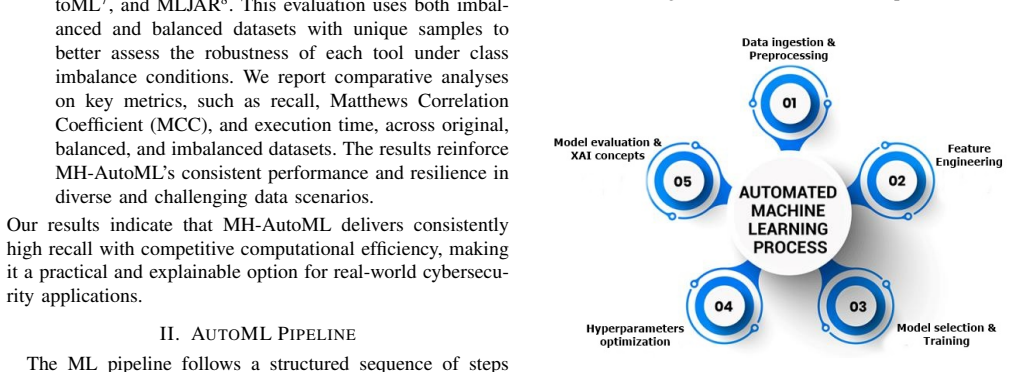
The load-bearing mechanism is the MH-AutoML pipeline itself: an automated sequence that exposes its decisions. It applies PCA, ANOVA, and LASSO for feature selection, combines six classifiers through a voting ensemble, tunes hyperparameters with recall as the prioritized objective, and attaches local explanation and experiment-tracking artifacts at each stage. The supporting evaluative device is a five-dimension questionnaire, normalized to a 0-100 scale, used to compare transparency and interpretability across tools. The pipeline's transparency is what the paper claims as its differentiator, and the questionnaire is what converts that claim into a reported score.
What would settle it
Ask independent analysts to apply a pre-registered transparency questionnaire to all eight tools under blinded conditions, and run all tools on a fresh Android malware dataset with default settings; if MH-AutoML no longer scores highest on transparency or no longer leads in recall, the paper's central claims fail.
Extended reading notes
Core claim
The central claim is that MH-AutoML achieves better recall than seven general-purpose AutoML frameworks on Android malware detection while providing more transparency and control, with computational efficiency comparable to the other tools. The paper supports this by running all eight tools on nine datasets in both original and balanced forms, measuring recall, the Matthews correlation coefficient (MCC), and execution time, and by scoring each tool with a custom questionnaire on functional description, statistical analysis, algorithmic transparency, interpretability, and internal analysis. In the authors' evaluation, MH-AutoML leads the other tools in recall on six of the nine original datasets and receives the highest overall transparency and interpretability score. The intended upshot is that a domain-specific AutoML tool can close the explainability gap that black-box general-purpose tools leave open, without sacrificing detection quality in a security context.
Load-bearing premise
The transparency advantage rests on a five-dimension scoring rubric the authors designed and applied to their own tool; if that rubric is not a valid, impartial measure of interpretability, the main differentiator is not established.
Editorial extensions
If this is right
- Non-specialist security teams could deploy a malware detector that reaches high recall without hand-tuning a pipeline stage by stage.
- Detection models built this way would come with the information needed to audit which features and models drove a prediction, supporting incident review and organizational accountability.
- Because tuning optimizes recall, the framework is positioned for settings where missing a malicious sample is costlier than investigating a false alarm.
- The comparison suggests that domain-specific AutoML does not necessarily trade performance for transparency: a tool built for one problem class can hold its own against general-purpose frameworks.
Reading between the lines
- The five-dimension scoring questionnaire is a reusable checklist, but its real weight depends on independent application; a natural next step is to have third parties score all tools blind.
- The framework's recall-first tuning likely shifts the precision-recall trade-off; a deployment-oriented follow-up would report cost-sensitive thresholds or precision at matched recall levels for each dataset.
- The same evaluation protocol (multiple datasets, balanced and imbalanced versions, plus a transparency rubric) could be transferred to other security domains such as network intrusion detection or phishing URL classification, where explainability also matters.
- If the recall advantage persists across new Android malware families, it would suggest that feature-selection choices grounded in domain data, rather than generic optimization alone, are what close the gap with larger general-purpose systems.
Editorial analysis
A structured set of objections, weighed in public.
Referee Report
Summary. The paper introduces MH-AutoML, a domain-specific AutoML framework for Android malware detection that automates data preprocessing, feature engineering, model selection, and hyperparameter tuning, and integrates MLflow experiment tracking, Optuna hyperparameter optimization, and SHAP/LIME interpretability tools. It reports a comparative evaluation against seven general-purpose AutoML frameworks (Auto-Sklearn, AutoGluon, TPOT, HyperGBM, Auto-PyTorch, LightAutoML, and MLJAR) on nine Android malware datasets, using recall, MCC, and execution time, together with a custom five-dimension transparency/interpretability questionnaire. The central claims are that MH-AutoML achieves better recall rates than the competitors on most datasets while providing more transparency and control.
Significance. If the results are reliable, the paper would offer a useful domain-specific AutoML baseline for security analysts, combining automated pipeline construction with interpretability, experiment tracking, and debugging support. The comparison across nine Android-specific datasets with both original and balanced versions is a valuable contribution, and the authors make the code and datasets publicly available. The choice of recall, MCC, and execution time as evaluation axes is appropriate for malware detection. However, the headline differentiator—'more transparency and control'—rests on a self-designed and self-applied questionnaire whose scoring formula is internally inconsistent, and the recall advantage is potentially confounded by the optimization objective used exclusively for MH-AutoML. These issues currently prevent the evidence from supporting the abstract's claims as stated.
major comments (5)
- [Section V-C, Eq. (2), Table VI] The normalization formula is not a function of the question scores: it defines S as 0, 1, or 2 depending only on the question count N, while the variables P_i and W described in the surrounding text are never used. Consequently, the 0-100% category scores reported in Section VI-A and Figure 4 cannot be recomputed from the stated procedure. In addition, Table VI assigns 100 to every category, including Interpretability and Internal Analysis, while Section VI-A reports MH-AutoML scores of 58.33 and 50 for those same categories. This internal inconsistency makes the quantitative transparency assessment unreproducible and unfalsifiable; the formula must be corrected, and the scoring should be performed by independent raters or at least in a blinded manner.
- [Section V-B, Table II, Section V-E] The paper states in Section V-B that experiments use 'eight carefully selected datasets (Table VII)' but Section V-E and Table VII list nine datasets. Table II's 'This work' row reports 'Holdout + 5-fold CV' as the validation method, while Section V-B explicitly states that 'we employ the Holdout method.' No repeated runs, error bars, or statistical tests are reported, and Section V-D does not specify numerical time limits despite saying that time limits were adjusted. The balancing procedure used to create the 'balanced datasets with unique samples' is never described. These inconsistencies affect every performance claim in the paper and should be resolved with a single clear protocol.
- [Section IV-A and Section V-D] MH-AutoML's tuning stage is described as prioritizing Recall through Optuna, whereas Section V-D states that all competitors were run with 'default configuration.' The observation that MH-AutoML leads in recall on six of nine datasets could therefore reflect the choice of optimization objective rather than a structural advantage of the framework. The paper should either tune all frameworks for recall, use a common objective, or explicitly discuss this confound and its effect on the reported recall comparisons.
- [Section VI-D] The balanced-versus-original analysis contains a direct numerical contradiction: 'the KronoDroid Emulator dataset shows improved recall after balancing, with HyperGBM increasing from 94.03% to 91.69%.' A decrease from 94.03% to 91.69% is described as an increase. Furthermore, the term 'balanced datasets with unique samples' is not defined, so the reader cannot determine whether balancing was performed by undersampling, oversampling, or another method. The entire balanced-versus-original discussion needs to be reworked with correct numbers and a precise description of the balancing protocol.
- [Section V-C and Section VI-A] The transparency questionnaire is designed by the authors, and the scores are assigned by the authors to their own framework, which was explicitly built to include the features the questionnaire rewards. No external validation, inter-rater reliability, or blinded assessment is reported. Even if the scoring formula is repaired, the central claim of 'more transparency and control' is not supported unless the assessment is independently audited or the paper explicitly frames the result as a self-assessment and discusses the associated bias risk.
minor comments (6)
- [Figure 4] Tool names contain typos: 'LinghtAutoML' should be 'LightAutoML', 'AutoGloun' should be 'AutoGluon', and 'MlJar' should be 'MLJar'.
- [Section IV-A] The text contains an odd spacing in 'ANOV A', which should read 'ANOVA'.
- [Section VI-B] The text refers to a dataset named 'MH-100-4k', but Table VII lists 'MH-100K Real'; please align the naming.
- [Section VI-D] The sentence 'Auto-Sklearn achieves 91.41% recall compared to 99.19% in the original data' reports an original-data value that should be tied to a specific figure or table for verification.
- [References] Reference [63] is listed as 'Anonymized for review' and is a placeholder that must be replaced before publication.
- [Section V-B] The phrase 'eight carefully selected datasets' conflicts with the nine datasets listed in Table VII and Section V-E; the count should be corrected.
Circularity Check
The 'more transparency and control' differentiator rests on a self-designed, unreproducible rubric, while the recall comparison itself is not circular.
-
self definitional
[Section V-C (Interpretability and Transparency Criteria), Table VI; Section VI-A; Conclusion]
"To systematically evaluate interpretability and transparency aspects, we developed a structured questionnaire based on established literature [66], [67], [68], [5], [69]... We developed a quantitative scoring model that assigns 0-2 points per question based on implementation quality (Not applicable=0, Partial=1, Total=2). We normalize category scores to a 0-100% scale using the formula: S = {0 if N = 0; 1 if N = 1; 2 if N >= 2} where S is the normalized score, Pi is the question score, N is the question count, and W is the maximum score per question (2)...."
The paper's central differentiator, 'more transparency and control', is measured only with a questionnaire whose five dimensions were defined by the same authors who designed MH-AutoML, and MH-AutoML was explicitly built to include exactly the features the rubric rewards (MLflow tracking, SHAP/LIME, feature importance, Section IV-A). Scoring one's own design on a rubric one wrote is a restatement of design intent, not an independent measurement; no external raters, blinded assessment, or inter-rater reliability is reported.
full rationale
The performance comparison is not circular: recall, MCC, and execution time are standard external metrics computed on nine public Android malware datasets against seven established AutoML frameworks, and no parameter of those competitors is fitted to the reported outcome. The self-citations ([12], [56], [76]) are not load-bearing for the main numerical results: they describe the prior MH-AutoML version, the LASSO feature-selection choice, and the MH-100K dataset, but the paper's empirical benchmarks stand on their own. The circularity burden lies entirely in the transparency evaluation: the 'more transparency' claim is the paper's headline contribution and is supported only by a self-designed questionnaire applied by the authors to their own framework, with a malformed scoring formula that cannot reproduce the reported scores and a table inconsistent with the text. That self-referential validation is partial circularity of the central claim, though the independent recall results keep the overall score below 8.
Assumptions & free parameters
assumptions (4)
- domain assumption The nine selected Android malware datasets are representative of real-world detection scenarios.
- domain assumption Recall is the appropriate primary optimization target for malware detection.
- domain assumption Default configurations of the seven comparison tools provide a fair baseline.
- ad hoc to paper The five-dimension transparency questionnaire is a valid measure of interpretability.
Cite this review
Pith. "Pith review of Interpretable by Design: MH-AutoML for Transparent and Efficient Android Malware Detection without Compromising Performance." pith.science (2026). https://pith.science/paper/FL3YDAY5
@misc{pith2026250623314,
  author       = {Pith},
  title        = {Pith review of: Interpretable by Design: MH-AutoML for Transparent and Efficient Android Malware Detection without Compromising Performance},
  year         = {2026},
  howpublished = {\url{https://pith.science/paper/FL3YDAY5}},
  note         = {Machine review of arXiv:2506.23314}
}
read the original abstract
Malware detection in Android systems requires both cybersecurity expertise and machine learning (ML) techniques. Automated Machine Learning (AutoML) has emerged as an approach to simplify ML development by reducing the need for specialized knowledge. However, current AutoML solutions typically operate as black-box systems with limited transparency, interpretability, and experiment traceability. To address these limitations, we present MH-AutoML, a domain-specific framework for Android malware detection. MH-AutoML automates the entire ML pipeline, including data preprocessing, feature engineering, algorithm selection, and hyperparameter tuning. The framework incorporates capabilities for interpretability, debugging, and experiment tracking that are often missing in general-purpose solutions. In this study, we compare MH-AutoML against seven established AutoML frameworks: Auto-Sklearn, AutoGluon, TPOT, HyperGBM, Auto-PyTorch, LightAutoML, and MLJAR. Results show that MH-AutoML achieves better recall rates while providing more transparency and control. The framework maintains computational efficiency comparable to other solutions, making it suitable for cybersecurity applications where both performance and explainability matter.
Figures


Figures from the paper (7 more)


Reference graph
Works this paper leans on
- [63]
-
[1]
Towards automated machine learning: Evaluation and comparison of automl approaches and tools,
A. Truong, A. Walters, J. Goodsitt, K. Hines, C. B. Bruss, and R. Farivar, “Towards automated machine learning: Evaluation and comparison of automl approaches and tools,” arXiv preprint arXiv:1908.05557 , 2019. [Online]. Available: https://arxiv.org/abs/1908.05557
arXiv 1908
-
[2]
Data pipeline training: Integrating automl to optimize the data flow of machine learning models,
J. Wu, H. Wang, C. Ni, C. Zhang, and W. Lu, “Data pipeline training: Integrating automl to optimize the data flow of machine learning models,” in 2024 7th International Conference on Advanced Algorithms and Control Engineering (ICAACE) . IEEE, 2024, pp. 730–734
work page 2024
-
[3]
Dream: Debugging and repairing automl pipelines,
X. Zhang, J. Zhai, S. Ma, X. Guan, and C. Shen, “Dream: Debugging and repairing automl pipelines,” ACM Transactions on Software Engineering and Methodology, vol. 34, no. 4, pp. 1–29, 2025
work page 2025
-
[4]
Benchmark and survey of automated ma- chine learning frameworks,
M.-A. Z ¨oller and M. F. Huber, “Benchmark and survey of automated ma- chine learning frameworks,” Journal of artificial intelligence research , vol. 70, pp. 409–472, 2021
work page 2021
-
[5]
Machine learning interpretability: A survey on methods and metrics,
D. V . Carvalho, E. M. Pereira, and J. S. Cardoso, “Machine learning interpretability: A survey on methods and metrics,” Electronics, 2019
work page 2019
-
[6]
Explainable artificial intelligence: a systematic review,
G. Vilone and L. Longo, “Explainable artificial intelligence: a systematic review,” arXiv preprint arXiv:2006.00093 , 2020
arXiv 2006
-
[7]
Eight years of automl: categorisation, review and trends,
R. Barbudo, S. Ventura, and J. R. Romero, “Eight years of automl: categorisation, review and trends,” Knowledge and Information Systems, vol. 65, no. 12, pp. 5097–5149, 2023
work page 2023
Show all 76 references
-
[8]
AutoML: A systematic review on automated machine learning with neural architecture search,
I. Salehin, M. S. Islam, P. Saha, S. Noman, A. Tuni, M. M. Hasan, and M. A. Baten, “AutoML: A systematic review on automated machine learning with neural architecture search,” Journal of Information and Intelligence, vol. 2, no. 1, pp. 52–81, 2024
2024
-
[9]
AutoML to date and beyond: Challenges and opportunities,
S. K. K. Santu, M. M. Hassan, M. J. Smith, L. Xu, C. Zhai, and K. Veeramachaneni, “AutoML to date and beyond: Challenges and opportunities,” 2021
2021
-
[10]
Automated machine learning: past, present and future,
M. Baratchi, C. Wang, S. Limmer, J. N. van Rijn, H. Hoos, T. B ¨ack, and M. Olhofer, “Automated machine learning: past, present and future,” Artificial intelligence review, vol. 57, no. 5, p. 122, 2024
2024
-
[11]
Automated machine learning: A survey of tools and techniques,
J. Tian and C. Che, “Automated machine learning: A survey of tools and techniques,” Journal of Industrial Engineering and Applied Science, vol. 2, no. 6, pp. 71–76, 2024
2024
-
[12]
MH-AutoML: Transparˆencia, interpretabilidade e desempenho na detecc ¸ ˜ao de malware android,
J. Assolin, G. Canto, D. Kreutz, and E. Feitosa, “MH-AutoML: Transparˆencia, interpretabilidade e desempenho na detecc ¸ ˜ao de malware android,” in Anais Estendidos do XXIV Simp ´osio Brasileiro de Seguranc ¸a da Informac ¸˜ao e de Sistemas Computacionais . Porto Alegre, RS, ...
2024
-
[13]
Hutter, L
F. Hutter, L. Kotthoff, and J. Vanschoren, Automated machine learning: methods, systems, challenges . Springer Nature, 2019
2019
-
[14]
Survey on automated machine learning (automl) and meta learning,
A. Doke and M. Gaikwad, “Survey on automated machine learning (automl) and meta learning,” in 2021 12th International Conference on Computing Communication and Networking Technologies (ICCCNT). IEEE, 2021, pp. 1–5
2021
-
[15]
Data pre-processing pipeline generation for autoetl,
J. Giovanelli, B. Bilalli, and A. Abell ´o, “Data pre-processing pipeline generation for autoetl,” Information Systems, 2022
2022
-
[16]
Auto-prep: Efficient and automated data preprocessing pipeline,
M. Bilal, G. Ali, M. W. Iqbal, M. Anwar, M. S. A. Malik, and R. A. Kadir, “Auto-prep: Efficient and automated data preprocessing pipeline,” IEEE Access, 2022
2022
-
[17]
Hyperparameter optimization for machine learning models based on bayesian optimization,
J. Wu, X.-Y . Chen, H. Zhang, L.-D. Xiong, H. Lei, and S.-H. Deng, “Hyperparameter optimization for machine learning models based on bayesian optimization,” Journal of Electronic Science and Technology , 2019
2019
-
[18]
On hyperparameter optimization of machine learning algorithms: Theory and practice,
L. Yang and A. Shami, “On hyperparameter optimization of machine learning algorithms: Theory and practice,” Neurocomputing, vol. 415, pp. 295–316, 2020
2020
-
[19]
” why should i trust you?
M. T. Ribeiro, S. Singh, and C. Guestrin, “” why should i trust you?” explaining the predictions of any classifier,” in Proceedings of the 22nd ACM SIGKDD international conference on knowledge discovery and data mining, 2016
2016
-
[20]
A unified approach to interpreting model predictions,
S. M. Lundberg and S.-I. Lee, “A unified approach to interpreting model predictions,” Advances in neural information processing systems , 2017
2017
-
[21]
Towards automated machine learning: Evaluation and comparison of AutoML approaches and tools,
A. Truong, A. Walters, J. Goodsitt, K. Hines, C. B. Bruss, and R. Farivar, “Towards automated machine learning: Evaluation and comparison of AutoML approaches and tools,” in IEEE 31st ICTAI , 2019
2019
-
[22]
An empirical evalu- ation of automated machine learning techniques for malware detection,
P. P. Kundu, L. Anatharaman, and T. Truong-Huu, “An empirical evalu- ation of automated machine learning techniques for malware detection,” in Proceedings of the 2021 ACM Workshop on Security and Privacy Analytics, 2021
2021
-
[23]
A comparison of AutoML tools for machine learning, deep learning and xgboost,
L. Ferreira, A. Pilastri, C. M. Martins, P. M. Pires, and P. Cortez, “A comparison of AutoML tools for machine learning, deep learning and xgboost,” in IJCNN, 2021, pp. 1–8
2021
-
[24]
Amlb: an automl benchmark,
P. Gijsbers, M. L. Bueno, S. Coors, E. LeDell, S. Poirier, J. Thomas, B. Bischl, and J. Vanschoren, “Amlb: an automl benchmark,” Journal of Machine Learning Research , 2024
2024
-
[25]
Machine learning for all! benchmarking automated, explain- able, and coding-free platforms on civil and environmental engineering problems,
M. Naser, “Machine learning for all! benchmarking automated, explain- able, and coding-free platforms on civil and environmental engineering problems,” Journal of Infrastructure Intelligence and Resilience , 2023
2023
-
[26]
Automl for multi-label classification: Overview and empirical evaluation,
M. Wever, A. Tornede, F. Mohr, and E. H ¨ullermeier, “Automl for multi-label classification: Overview and empirical evaluation,” IEEE transactions on pattern analysis and machine intelligence, vol. 43, no. 9, pp. 3037–3054, 2021
2021
-
[27]
Benchmarking automated machine learning (automl) frameworks for object detection,
S. d. Oliveira, O. Topsakal, and O. Toker, “Benchmarking automated machine learning (automl) frameworks for object detection,” Informa- tion, vol. 15, no. 1, p. 63, 2024
2024
-
[28]
Bench- marking automl solutions for concrete strength prediction: Reliability, uncertainty, and dilemma,
M. A. Hariri-Ardebili, P. Mahdavi, and F. Pourkamali-Anaraki, “Bench- marking automl solutions for concrete strength prediction: Reliability, uncertainty, and dilemma,” Construction and Building Materials , vol. 423, p. 135782, 2024
2024
-
[29]
Comprehensive benchmarking analysis for evaluating effectiveness of transfer learning-based feature engineering in automl,
M. Sırt and C. Ey ¨upo˘glu, “Comprehensive benchmarking analysis for evaluating effectiveness of transfer learning-based feature engineering in automl,” The Journal of Cognitive Systems , vol. 9, no. 2, pp. 30–37, 2025
2025
-
[30]
Benchmark- ing automl clustering frameworks,
M. C. da Silva, B. Licari, G. M. Tavares, and S. B. Junior, “Benchmark- ing automl clustering frameworks,” in AutoML Conference 2024 (ABCD Track), 2024
2024
-
[31]
Automl-agent: A multi-agent llm framework for full-pipeline automl,
P. Trirat, W. Jeong, and S. J. Hwang, “Automl-agent: A multi-agent llm framework for full-pipeline automl,” arXiv preprint arXiv:2410.02958 , 2024
2024 arXiv
-
[32]
Auto-pytorch tabular: Multi- fidelity metalearning for efficient and robust autodll. arxiv 2020,
L. Zimmer, M. Lindauer, and F. Hutter, “Auto-pytorch tabular: Multi- fidelity metalearning for efficient and robust autodll. arxiv 2020,” arXiv preprint arXiv:2006.13799, 2020
2020 arXiv
-
[33]
AutoGluon-Tabular: Robust and accurate AutoML for structured data,
N. Erickson, J. Mueller, A. Shirkov, H. Zhang, P. Larroy, M. Li, and A. Smola, “AutoGluon-Tabular: Robust and accurate AutoML for structured data,” https://arxiv.org/abs/2003.06505, 2020
2003 arXiv
-
[34]
H2O AutoML: Scalable automatic machine learning,
E. LeDell and S. Poirier, “H2O AutoML: Scalable automatic machine learning,” in Proceedings of the AutoML Workshop at ICML , vol. 2020, 2020
2020
-
[35]
Ludwig: a type-based declar- ative deep learning toolbox,
P. Molino, Y . Dudin, and S. S. Miryala, “Ludwig: a type-based declar- ative deep learning toolbox,” arXiv preprint arXiv:1909.07930 , 2019
1909 arXiv
-
[36]
Nasirt: Automl based learning with instance-level complexity information,
H. A. Neto, R. C. Alves, and S. V . Campos, “Nasirt: Automl based learning with instance-level complexity information,” arXiv preprint arXiv:2008.11846, 2020
2008 arXiv
-
[37]
Alphaml: A clear, legible, explainable, transparent, and elucidative binary classification platform for tabular data,
Nasimian, A. et. al., “Alphaml: A clear, legible, explainable, transparent, and elucidative binary classification platform for tabular data,” Patterns, vol. 5, no. 1, 2024
2024
-
[38]
Integrated automl-based framework for optimizing shale gas production: A case study of the fuling shale gas field,
T. Ye, J. Meng, Y . Xiao, Y . Lu, A. Zheng, and B. Liang, “Integrated automl-based framework for optimizing shale gas production: A case study of the fuling shale gas field,” Energy Geoscience, vol. 6, no. 1, p. 100365, 2025
2025
-
[39]
Automl framework for physical activities recognition,
V . Kovalevsky, R. Delhibabu, and N. Zhukova, “Automl framework for physical activities recognition,” in 2024 3rd International Conference on Artificial Intelligence For Internet of Things (AIIoT) . IEEE, 2024, pp. 1–5
2024
-
[40]
Automl-gwl: automated machine learning model for the prediction of groundwater level,
A. Singh, S. Patel, V . Bhadani, V . Kumar, and K. Gaurav, “Automl-gwl: automated machine learning model for the prediction of groundwater level,” Engineering Applications of Artificial Intelligence , vol. 127, p. 107405, 2024
2024
-
[41]
Building domain-specific machine learning workflows: A conceptual framework for the state of the practice,
B. J. Oakes, M. Famelis, and H. Sahraoui, “Building domain-specific machine learning workflows: A conceptual framework for the state of the practice,” ACM Transactions on Software Engineering and Methodology, vol. 33, no. 4, pp. 1–50, 2024
2024
-
[42]
AutoML-based predictive framework for predictive analysis in adsorption cooling and desalination systems,
J. Krzywanski, K. Sztekler, D. Skrobek, K. Grabowska, W. M. Ashraf, M. Sosnowski, K. Ishfaq, W. Nowak, and L. Mika, “AutoML-based predictive framework for predictive analysis in adsorption cooling and desalination systems,” Energy Science & Engineering , vol. 12, no. 5, pp. 19...
1969
-
[43]
AutoML for multi-class anomaly compensation of sensor drift,
M. Schaller, M. Kruse, A. Ortega, M. Lindauer, and B. Rosenhahn, “AutoML for multi-class anomaly compensation of sensor drift,” Mea- surement, vol. 250, p. 117097, 2025
2025
-
[44]
Automl for deep recommender systems: A survey,
R. Zheng, L. Qu, B. Cui, Y . Shi, and H. Yin, “Automl for deep recommender systems: A survey,” ACM Transactions on Information Systems, vol. 41, no. 4, pp. 1–38, 2023
2023
-
[45]
Xautoml: a visual analytics tool for understanding and validating automated machine learning,
M.-A. Z ¨oller, W. Titov, T. Schlegel, and M. F. Huber, “Xautoml: a visual analytics tool for understanding and validating automated machine learning,” ACM Transactions on Interactive Intelligent Systems , vol. 13, no. 4, pp. 1–39, 2023
2023
-
[46]
Automated machine learning and explainable ai (automl-xai) for metabolomics: improving cancer diagnostics,
O. O. Bifarin and F. M. Fern ´andez, “Automated machine learning and explainable ai (automl-xai) for metabolomics: improving cancer diagnostics,” Journal of the American Society for Mass Spectrometry , vol. 35, no. 6, pp. 1089–1100, 2024
2024
-
[47]
Unlocking the black box: Towards interactive explainable automated machine learning,
M. Garouani and M. Bouneffa, “Unlocking the black box: Towards interactive explainable automated machine learning,” in International Conference on Intelligent Data Engineering and Automated Learning . Springer, 2023, pp. 458–469
2023
-
[48]
Automated machine learning with interpretation: a systematic review of methodologies and applications in healthcare,
H. Yuan, K. Yu, F. Xie, M. Liu, and S. Sun, “Automated machine learning with interpretation: a systematic review of methodologies and applications in healthcare,” Medicine Advances, vol. 2, no. 3, pp. 205– 237, 2024
2024
-
[49]
Automl to date and beyond: Challenges and opportunities,
Karmaker S. et. al., “Automl to date and beyond: Challenges and opportunities,” ACM Computing Surveys , vol. 54, no. 8, oct 2021. [Online]. Available: https://doi.org/10.1145/3470918
2021 doi
-
[50]
Two to trust: Automl for safe mod- elling and interpretable deep learning for robustness,
M. Amirian, L. Tuggener, R. Chavarriaga, Y . P. Satyawan, F.-P. Schilling, F. Schwenker, and T. Stadelmann, “Two to trust: Automl for safe mod- elling and interpretable deep learning for robustness,” in Trustworthy AI- Integrating Learning, Optimization and Reasoning: First In...
2020
-
[51]
Model lineupper: Supporting interactive model comparison at multiple levels for automl,
S. Narkar, Y . Zhang, Q. V . Liao, D. Wang, and J. D. Weisz, “Model lineupper: Supporting interactive model comparison at multiple levels for automl,” in Proceedings of the 26th International Conference on Intelligent User Interfaces , 2021, pp. 170–174
2021
-
[52]
Embracing diversity: Interpretable zero-shot classification beyond one vector per class,
M. Moayeri, M. Rabbat, M. Ibrahim, and D. Bouchacourt, “Embracing diversity: Interpretable zero-shot classification beyond one vector per class,” in Proceedings of the 2024 ACM Conference on Fairness, Accountability, and Transparency, 2024, pp. 2302–2321
2024
-
[53]
Towards trans- parent diabetes prediction: Combining automl and explainable ai for improved clinical insights,
R. Hasan, V . Dattana, S. Mahmood, and S. Hussain, “Towards trans- parent diabetes prediction: Combining automl and explainable ai for improved clinical insights,” Information, vol. 16, no. 1, p. 7, 2024
2024
-
[54]
An interpretable and generalizable machine learning model for predicting asthma out- comes: Integrating automl and explainable ai techniques,
S. Mahmood, R. Hasan, S. Hussain, and R. Adhikari, “An interpretable and generalizable machine learning model for predicting asthma out- comes: Integrating automl and explainable ai techniques,” World, vol. 6, no. 1, p. 15, 2025
2025
-
[55]
MH-AutoML,
MH-AutoML, “MH-AutoML,” 2024, https://github.com/SBSegSF24/ MH-AutoML
2024
-
[56]
Mh-fsf: um framework para reproduc ¸ ˜ao, experimentac ¸˜ao e avaliac ¸ ˜ao de m´etodos de selec ¸˜ao de caracter ´ısticas,
V . Rocha, H. Braganc ¸a, D. Kreutz, and E. Feitosa, “Mh-fsf: um framework para reproduc ¸ ˜ao, experimentac ¸˜ao e avaliac ¸ ˜ao de m´etodos de selec ¸˜ao de caracter ´ısticas,” in Anais Estendidos do XXIV Simp´osio Brasileiro de Seguranc ¸a da Informac ¸ ˜ao e de Sistemas Co...
2024
-
[57]
Efficient and robust automated machine learning,
M. Feurer, A. Klein, K. Eggensperger, J. Springenberg, M. Blum, and F. Hutter, “Efficient and robust automated machine learning,” Advances in neural information processing systems , vol. 28, 2015
2015
-
[58]
Scaling tree-based automated machine learning to biomedical big data with a feature set selector,
T. T. Le, W. Fu, and J. H. Moore, “Scaling tree-based automated machine learning to biomedical big data with a feature set selector,” Bioinformatics, vol. 36, no. 1, pp. 250–256, 2020
2020
-
[59]
HyperGBM: A Full Pipeline AutoML Tool Integrated With Various GBM Models,
H. W. Jian Yang, Xuefeng Li, “HyperGBM: A Full Pipeline AutoML Tool Integrated With Various GBM Models,” https://github.com/DataCanvasIO/HyperGBM, 2020, version 0.2.x
2020
-
[60]
Auto-pytorch: multi-fidelity metalearning for efficient and robust autodl,
L. Zimmer, M. Lindauer, and F. Hutter, “Auto-pytorch: multi-fidelity metalearning for efficient and robust autodl,” IEEE Trans. on Pattern Analysis and MI , vol. 43, no. 9, pp. 3079–3090, 2021
2021
-
[61]
Lightautoml: Automl solution for a large financial services ecosystem,
A. Vakhrushev, A. Ryzhkov, M. Savchenko, D. Simakov, R. Damdinov, and A. Tuzhilin, “Lightautoml: Automl solution for a large financial services ecosystem,” arXiv preprint arXiv:2109.01528 , 2021
2021 arXiv
-
[62]
Mljar: State-of-the-art automated machine learning framework for tabular data,
A. Pło ´nska and P. Pło ´nski, “Mljar: State-of-the-art automated machine learning framework for tabular data,” Version 0.10, vol. 3, 2021
2021
-
[64]
AutoML: state of the art with a focus on anomaly detection, challenges, and research directions,
M. Bahri, F. Salutari, A. Putina, and M. Sozio, “AutoML: state of the art with a focus on anomaly detection, challenges, and research directions,” International Journal of Data Science and Analytics , 2022
2022
-
[65]
Can fairness be automated? guidelines and opportunities for fairness-aware AutoML,
H. Weerts, F. Pfisterer, M. Feurer, K. Eggensperger, E. Bergman, N. Awad, J. Vanschoren, M. Pechenizkiy, B. Bischl, and F. Hutter, “Can fairness be automated? guidelines and opportunities for fairness-aware AutoML,” 2023
2023
-
[66]
Ex- plainable artificial intelligence (xai): Precepts, models, and opportunities for research in construction,
P. E. Love, W. Fang, J. Matthews, S. Porter, H. Luo, and L. Ding, “Ex- plainable artificial intelligence (xai): Precepts, models, and opportunities for research in construction,” Advanced Engineering Informatics , 2023
2023
-
[67]
Explainable artificial intelligence (xai): Concepts, taxonomies, oppor- tunities and challenges toward responsible ai,
A. B. Arrieta, N. D ´ıaz-Rodr´ıguez, J. Del Ser, A. Bennetot, S. Tabik, A. Barbado, S. Garc ´ıa, S. Gil-L ´opez, D. Molina, R. Benjamins et al. , “Explainable artificial intelligence (xai): Concepts, taxonomies, oppor- tunities and challenges toward responsible ai,” Informatio...
2020
-
[68]
Review study of interpretation methods for future interpretable machine learning,
J.-X. Mi, A.-D. Li, and L.-F. Zhou, “Review study of interpretation methods for future interpretable machine learning,” IEEE Access, 2020
2020
-
[69]
Transparency of complex systems: The semantic transparency framework,
M. Br ¨annstr¨om, “Transparency of complex systems: The semantic transparency framework,” 2023
2023
-
[70]
Adroit: Android malware detection using meta-information,
A. Mart ´ın, A. Calleja, H. D. Men ´endez, J. Tapiador, and D. Camacho, “Adroit: Android malware detection using meta-information,” in 2016 IEEE Symposium Series on Computational Intelligence (SSCI) . IEEE, 2016, pp. 1–8
2016
-
[71]
Androcrawl: studying alternative android marketplaces,
A. SISTO, “Androcrawl: studying alternative android marketplaces,” 2012
2012
-
[72]
Android permission dataset,
A. Mahindru, “Android permission dataset,” Mendeley Data, 2018
2018
-
[73]
DefenseDroid: A Modern Approach to Android Malware Detection,
C. W. Colaco, M. D. Bagwe, S. A. Bose, and K. Jain, “DefenseDroid: A Modern Approach to Android Malware Detection,” Strad Research, vol. 8, no. 5, pp. 271–282, 2021
2021
-
[74]
Droidfusion: A novel multilevel classifier fusion approach for android malware detection,
S. Y . Yerima and S. Sezer, “Droidfusion: A novel multilevel classifier fusion approach for android malware detection,” IEEE transactions on cybernetics, vol. 49, no. 2, pp. 453–466, 2018
2018
-
[75]
KronoDroid: Time-based Hybrid-featured Dataset for Effective Android Malware Detection and Characterization,
A. Guerra-Manzanares, H. Bahsi, and S. N ˜omm, “KronoDroid: Time-based Hybrid-featured Dataset for Effective Android Malware Detection and Characterization,” Computers & Security , vol. 110, p. 102399, 2021. [Online]. Available: https://www.sciencedirect.com/ science/article/p...
2021
-
[76]
Capturing the behavior of android malware with mh-100k: A novel and multidimensional dataset,
H. Braganc ¸a, V . Rocha, L. Barcellos, E. Souto, D. Kreutz, and E. Feitosa, “Capturing the behavior of android malware with mh-100k: A novel and multidimensional dataset,” in Anais do XXIII Simp ´osio Brasileiro de Seguranc ¸a da Informac ¸˜ao e de Sistemas Computacionais . P...
2023
Reviewed August 6, 2026 · model on record in the stance chip above.
Discussion (0). Sign in to comment.