REVIEW 4 major objections 5 minor 2 cited by
From Large-scale Audio Tagging to Real-Time Explainable Emergency Vehicle Sirens Detection
T0 review · 4 major / 5 minor · reviewed 2026-08-06 · deepseek-v4-flash
Pith's one-line read E2PANNs claims that a pruned AudioSet audio tagger, fine-tuned on a curated siren subset, beats published siren detectors while running in real time on a Raspberry Pi 5.
desk verdict Useful dataset and real embedded pipeline, but the SOTA claim needs a controlled baseline and the Stage-6 test numbers need reconciling before this is citable as-is. read the letter →
The pith
A machine-rendered reading of the paper's core claim, the machinery that carries it, and where it could break.
The reading
What carries the argument
E2PANNs is a binary classifier carved out of EPANNs, itself the pruned version of the PANNs CNN-14 audio tagger: it keeps the compact encoder, extracts the AudioSet "Emergency vehicle" logit, applies a sigmoid, and fine-tunes with binary cross-entropy, with options for freezing or updating all layers and for warm-up, cosine, or fixed learning-rate schedules. The second mechanism is data curation: AudioSet-EV, a 32 kHz mono 10-second subset of AudioSet filtered through a taxonomy-aware pipeline, provides semantically consistent positives and negatives that are standardized across benchmarks. The third is a deployment mechanism: a circular-buffer, producer-consumer inference engine whose frame length grows adaptively when siren confidence is high, giving temporal context only when needed.
What would settle it
The claim would be settled by running the released E2PANNs checkpoint on the unmodified AudioSet-Strong test set, with none of the 182 clips dropped or re-labelled, and comparing its frame-wise F1 and event-based error rate to the same metrics computed for a prior baseline retrained under the identical protocol; if a baseline matches or exceeds the reported numbers, the state-of-the-art claim would not survive.
Extended reading notes
Core claim
The paper's central claim is that an efficient CNN derived from a large-scale audio-tagging model can be specialized into a binary emergency-vehicle siren detector that outperforms every previously published system while remaining cheap enough for embedded real-time use. The route is transfer learning: take a pruned PANNs variant, fine-tune it on AudioSet-EV, a curated, balanced subset of AudioSet, then fine-tune once more on a unified corpus of siren benchmarks. After this procedure the model reports per-dataset accuracies of 98.89% on ESC-50, 98.33% on SireNNet, 97.09% on UrbanSound8K, 97.71% on LSSiren, and 98.81% on FSD50K, with interpretability maps identifying siren-specific spectrotemporal patterns. On a Raspberry Pi 5 the implementation sustains 1.35 times frame rate, keeps worst-case latency below 400 ms, and reduces false-positive bursts via adaptive windowing.
Load-bearing premise
The headline accuracy and latency numbers assume that published metrics from different prior datasets and evaluation protocols are directly comparable, and that the manual re-labelling of 182 AudioSet-Strong clips as non-siren is correct.
Editorial extensions
If this is right
- Recurrent layers are not required: a pruned CNN plus adaptive windowing delivers real-time siren detection, so latency-critical sound-event detectors can be built without recurrent-network compute overhead.
- A curated subset of a large general-purpose corpus, AudioSet-EV, is enough to specialize a strong pretrained tagger, pointing to a cheaper path than collecting large task-specific datasets.
- The reported metrics on ESC-50, UrbanSound8K, FSD50K, LSSiren, and SireNNet after unified transfer learning imply the model generalizes across very different recording conditions and taxonomies.
- Real-time operation on a Raspberry Pi 5 with throughput above frame rate and sub-400 ms worst-case latency makes edge deployment of the detector practical for smart-city and vehicle systems.
Reading between the lines
- Beyond the paper: the adaptive windowing rule, extend the analysis window only when confidence is high, is a general recipe for rare-event audio detection and could transfer to gunshot, glass-break, or wake-word spotting on embedded devices.
- Beyond the paper: because the state-of-the-art comparison mixes published numbers from different datasets and protocols, a fixed-protocol rerun of prior baselines on AudioSet-EV would be the cleanest test of the accuracy claim.
- Beyond the paper: the manual re-labelling of 182 AudioSet-Strong clips as non-siren means part of the measured gain may be a test-set correction; an audit of label noise in AudioSet-Strong would separate model quality from annotation quality.
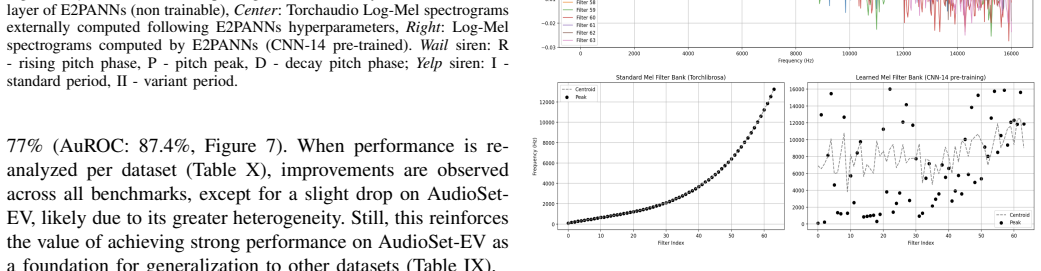
- Beyond the paper: unfreezing the learned mel-filterbank during fine-tuning, listed as future work, would reveal how much accuracy comes from the pretrained front-end versus the fine-tuned classifier.
Editorial analysis
A structured set of objections, weighed in public.
Referee Report
Summary. The paper proposes E2PANNs, a pruned PANNs-based CNN fine-tuned for binary emergency-vehicle siren detection, together with a curated AudioSet subset (AudioSet-EV). The experimental campaign includes a hyperparameter search, a six-stage fine-tuning ablation, cross-dataset evaluation on a merged Unified-EV benchmark, XAI analyses with Guided Backpropagation and Score-CAM, and real-time embedded deployment on a Raspberry Pi 5. The abstract claims a new state of the art in EV siren detection with high computational efficiency and edge suitability.
Significance. If the central claims hold, the paper would offer a useful public dataset (AudioSet-EV), a reproducible fine-tuning pipeline, and a credible demonstration that a pruned AudioSet-pretrained CNN can run in real time on embedded hardware. The explicit release of dataset, code, and checkpoints is a strength, and the XAI analysis goes beyond the usual accuracy reporting. However, the headline "new state of the art" claim is not supported by any controlled comparison under a shared protocol, and the reported Stage 6 metrics are internally inconsistent. The real-time evaluation also relies on a post-hoc relabeling procedure that is applied asymmetrically to model non-detections. These issues are load-bearing because they directly affect the abstract's main performance claims.
major comments (4)
- [Abstract and Section V-C, Table I] The claim of a new state of the art is not supported by a controlled comparison with any baseline under a shared protocol. Table I summarizes prior methods with different datasets, class balances, and evaluation protocols, and the paper does not re-train or re-run any of these systems on AudioSet-EV or Unified-EV partitions. Consequently, the accuracy differences reported in the abstract and conclusions are not commensurable. The authors should add experiments that run at least one existing baseline (e.g., the original PANNs CNN-14 or EPANNs, and ideally one published siren detector implemented from its description) on the same AudioSet-EV and Unified-EV splits, and report paired metrics. Section VI lists limitations but does not acknowledge this missing baseline, which is a central gap given the SOTA statement.
- [Section V-B, Tables VIII and IX] The Stage 6 results are internally inconsistent. Section V-B reports test accuracy 97.6% and F1 97.5% for Stage 6, while Table VIII reports 91.81% accuracy for Stage 6 and Table IX reports 90.5% accuracy and 90.6% F1 for the same stage. Other stages also differ between the text and Table IX (e.g., Stage 1 is reported as 84.2% accuracy in the text but 87.3% in Table IX). Because the Stage 6 checkpoint is the one used for Unified-EV transfer learning and for the Raspberry Pi real-time evaluation, this discrepancy propagates into the downstream claims. The authors must reconcile these numbers, state which table reflects the standardized test protocol, and recompute any dependent results if the corrected values differ.
- [Section V-E] The "False True Positives" procedure is a post-hoc relabeling of test clips based on model non-detections. The paper starts from 287 clips with no confident predictions, manually audits them, and relabels 182 as not containing actual EV sounds. Metrics are then reported on the corrected "True" set, which excludes these clips. Because only model non-detections are subjected to this audit, the evaluation is asymmetrical: positive labels that the model detects are not audited with the same scrutiny. This can inflate precision and event-based scores. The authors should report metrics on the original AudioSet-Strong labels as the primary result, or pre-register an independent label audit of all test clips, and quantify how the FTP filtering changes each metric.
- [Section V-C and Table X] The conclusion that transfer learning "improves generalization and robustness over previous settings" is stated without confidence intervals or repeated-run variability. Several Unified-EV results, such as FSD50K AuPRC of 25.28% and AudioSet-EV Augmented AuPRC of 62.80% in Table X, are well below the corresponding single-dataset numbers in Table IX, and the text acknowledges a drop on AudioSet-EV. Given that the main SOTA claim depends on aggregate comparison, the authors should provide per-dataset significance or variability information and clearly separate the settings in which the unified model is better than the Stage 6 model from those in which it is worse.
minor comments (5)
- [Section II-B] The enumerated list of AudioSet-EV features uses "(1)" three times; it should be a proper sequence (1), (2), (3).
- [Throughout] The dataset name is inconsistently spelled as both "SireNNet" and "SirenNet"; the authors should standardize to the official name used in the reference.
- [Section VI] There are typographical errors such as "E2PANNs XIV" and "real-word computational constraints" that should be corrected.
- [Figure 9 caption] The caption contains a typo, "peak frquencies," that should read "peak frequencies."
- [References [15] and [68]] The paper relies on two manuscripts that are described as under review or in preprint form for the dataset construction and the real-time implementation details. The authors should clarify the availability of those artifacts and, where possible, include the essential details in this manuscript so that the evaluation does not depend on inaccessible sources.
Circularity Check
Partial circularity in the real-time evaluation: the FTP relabeling removes the model's own non-detections from the scoring set, and the 'True' metrics are then computed against that self-corrected ground truth.
-
fitted input called prediction
[Section V-E (Embedded Real-Time Evaluation & False Positive Analysis), Tables XI and XII]
"The preliminary analysis of model outputs revealed that 287 clips yielded no confident predictions (i.e.: no frames exceeded the 0.5 threshold). Manual audition of these clips showed that 182 (63.41%) did not contain actual EV sounds, despite being positively labeled in AudioSet-Strong. This post-validation process exposed a significant presence of mis-annotated positives — referred to here as False True Positives (FTP) — and led to the creation of a corrected metadata file ..."
The 'True' evaluation set is built from the model's own non-detections: the 287 clips with no frame above threshold were auditioned, and 182 were relabeled as FTP and filtered from scoring. Re-scoring the same model against this corrected set removes exactly the clips the model missed, so the True-condition metrics (e.g., recall 60% vs 50%, F1 66% vs 56%, deletion rate 0.88 vs 0.90 in Table XI) improve partly by construction rather than by independent measurement. The ground-truth labels used for validation are thus derived from the model's output distribution, making the 'True' real-time evaluation a fitted input to the metric rather than an external check.
full rationale
The main accuracy and cross-domain results are not circular in the formal sense: the model is fine-tuned on a held-out split of a released dataset and evaluated on several external benchmarks (ESC-50, UrbanSound8K, FSD50K, SireNNet, LSSiren), and the edge deployment is measured on actual Raspberry Pi hardware, so there is substantial independent content. However, one evaluation step is circular: the FTP relabeling in Section V-E starts from clips the model never flagged and then removes those clips from the ground truth before computing the 'True' real-time metrics, so part of the reported improvement is by construction. I also flag two serious non-circular correctness risks that do not raise the circularity score: (i) the 'new state of the art' claim rests on comparing literature numbers in Table I across different datasets, class balances, and evaluation protocols, with no re-run baseline under a shared protocol; and (ii) the Stage 6 checkpoint, used for transfer learning and edge evaluation, has inconsistent reported test accuracy (97.6% in Section V-B, 91.81% in Table VIII, 90.5% in Table IX). These issues undermine the strength of the headline claims but are not definitional circularity.
Assumptions & free parameters
free parameters (5)
- Peak learning rate eta_max =
1e-4 for the final fixed-lr stage; search grid was 1e-5, 1e-4, 1e-3, 1e-2
- Batch size =
32
- Binary decision threshold =
0.5 for classification; 0.6 for false-positive analysis and adaptive frame trigger
- Augmentation probability =
0.7 in Stage 5, 0.5 in Stage 6
- Adaptive frame growth rate =
0.2 s and 0.4 s variants
assumptions (4)
- domain assumption AudioSet labels, after the authors' filtering and manual corrections, are sufficiently accurate for training and evaluating a reliable binary siren classifier.
- domain assumption EPANNs, a pruned version of PANNs, retains enough spectro-temporal information for siren discrimination after fine-tuning.
- ad hoc to paper The output of AudioSet class 322 ('Emergency vehicle') after fine-tuning is a valid proxy for EV siren presence.
- ad hoc to paper Cross-dataset test metrics are comparable to the literature results summarized in Table I.
Cite this review
Pith. "Pith review of From Large-scale Audio Tagging to Real-Time Explainable Emergency Vehicle Sirens Detection." pith.science (2026). https://pith.science/paper/FRBDVTHD
@misc{pith2026250623437,
  author       = {Pith},
  title        = {Pith review of: From Large-scale Audio Tagging to Real-Time Explainable Emergency Vehicle Sirens Detection},
  year         = {2026},
  howpublished = {\url{https://pith.science/paper/FRBDVTHD}},
  note         = {Machine review of arXiv:2506.23437}
}
read the original abstract
Accurate recognition of Emergency Vehicle (EV) sirens is critical for the integration of intelligent transportation systems, smart city monitoring systems, and autonomous driving technologies. Modern automatic solutions are limited by the lack of large scale, curated datasets and by the computational demands of state of the art sound event detection models. This work introduces E2PANNs (Efficient Emergency Pre trained Audio Neural Networks), a lightweight Convolutional Neural Network architecture derived from the PANNs framework, specifically optimized for binary EV siren detection. Leveraging our dedicated subset of AudioSet (AudioSet EV) we fine-tune and evaluate E2PANNs across multiple reference datasets and test its viability on embedded hardware. The experimental campaign includes ablation studies, cross-domain benchmarking, and real-time inference deployment on edge device. Interpretability analyses exploiting Guided Backpropagation and ScoreCAM algorithms provide insights into the model internal representations and validate its ability to capture distinct spectrotemporal patterns associated with different types of EV sirens. Real time performance is assessed through frame wise and event based detection metrics, as well as a detailed analysis of false positive activations. Results demonstrate that E2PANNs establish a new state of the art in this research domain, with high computational efficiency, and suitability for edge-based audio monitoring and safety-critical applications.
Figures


Figures from the paper (8 more)




Forward citations
Cited by 2 Pith papers
-
Real-Time Emergency Vehicle Siren Detection with Efficient CNNs on Embedded Hardware
A fine-tuned CNN (E2PANNs) deployed on a Raspberry Pi 5 detects emergency vehicle sirens in real time with adaptive frame sizing and post-processing, reporting up to 78% framewise F1 on a corrected AudioSet-Strong subset.
-
Explainable Lightweight Compact Deep Models for Speech Emotion Recognition
A 33k-parameter CNN with attentive statistics pooling and Grad-CAM reaches 96.9% accuracy on SAVEE speech emotion recognition, but the evaluation rests on one speaker-independent split.
Reference graph
Works this paper leans on
-
[1]
Emergency services in future intelligent trans- portation systems based on vehicular communication networks,
Martinez F. et al., “Emergency services in future intelligent trans- portation systems based on vehicular communication networks,” IEEE Intelligent Transportation Systems Magazine , vol. 2, no. 2, pp. 6–20, 2010. IEEE/ACM TRANSACTIONS ON AUDIO, SPEECH, AND LANGUAGE PROCESSING, VOL. XX, NO. XX, MONTH 2025 19 TABLE XIV E2PANN S ARCHITECTURE SUMMARY Layer IN...
2010
-
[2]
A survey of the connected ve- hicle landscape—architectures, enabling technologies, applications, and development areas,
J. E. Siegel, D. C. Erb, and S. E. Sarma, “A survey of the connected ve- hicle landscape—architectures, enabling technologies, applications, and development areas,” IEEE Transactions on Intelligent Transportation Systems, vol. 19, no. 8, pp. 2391–2406, 2018
2018
-
[3]
Autonomous traffic system for emergency vehicles,
M. Humayun, M. F. Almufareh, and N. Z. Jhanjhi, “Autonomous traffic system for emergency vehicles,” Electronics, vol. 11, no. 4, 2022. [Online]. Available: https://www.mdpi.com/2079-9292/11/4/510
2022
-
[4]
Implementing intelligent traffic control system for congestion control, ambulance clearance, and stolen vehicle detection,
R. Sundar, S. Hebbar, and V . Golla, “Implementing intelligent traffic control system for congestion control, ambulance clearance, and stolen vehicle detection,” IEEE Sensors Journal, vol. 15, no. 2, pp. 1109–1113, 2015
2015
-
[5]
A survey of sound source localization with deep learning methods,
P.A. Grumiaux et al., “A survey of sound source localization with deep learning methods,” The Journal of the Acoustical Society of America, vol. 152, no. 1, pp. 107–151, Jul. 2022. [Online]. Available: https://doi.org/10.1121/10.0011809
-
[6]
Anomalous sound event detection: A survey of machine learning based methods and applications,
Z. Mnasri, S. Rovetta, and F. Masulli, “Anomalous sound event detection: A survey of machine learning based methods and applications,” Multimedia Tools Appl., vol. 81, no. 4, p. 5537–5586, feb
-
[7]
Review of Emergency Vehicle Detection Techniques by Acoustic Signals,
K. Choudhury and D. Nandi, “Review of Emergency Vehicle Detection Techniques by Acoustic Signals,” Transactions of the Indian National Academy of Engineering, vol. 8, no. 4, pp. 535–550, Dec. 2023. [Online]. Available: https://link.springer.com/10.1007/s41403-023-00424-9
-
[8]
Transformers and audio detection tasks: An overview,
K. Zaman et al., “Transformers and audio detection tasks: An overview,” Digital Signal Processing , vol. 158, p. 104956, Mar
Show all 90 references
-
[9]
Efficient Transformers: A Survey,
Yi Tay et al., “Efficient Transformers: A Survey,” ACM Computing Surveys, vol. 55, no. 6, pp. 1–28, Jun. 2023. [Online]. Available: https://dl.acm.org/doi/10.1145/3530811
2023 doi
-
[10]
A survey of techniques for optimizing transformer inference,
K. Chitty-Venkata et al., “A survey of techniques for optimizing transformer inference,” Journal of Systems Architecture , vol. 144, p. 102990, Nov. 2023. [Online]. Available: https://linkinghub.elsevier.com/ retrieve/pii/S1383762123001698
2023
-
[11]
Optimization and acceleration of convolutional neural networks: A survey,
G. Habib and S. Qureshi, “Optimization and acceleration of convolutional neural networks: A survey,” Journal of King Saud University - Computer and Information Sciences , vol. 34, no. 7, pp. 4244–4268, Jul. 2022. [Online]. Available: https://linkinghub.elsevier. com/retrieve/p...
2022
-
[12]
PANNs: Large-Scale Pretrained Audio Neural Networks for Audio Pattern Recognition,
Q. Kong et al., “PANNs: Large-Scale Pretrained Audio Neural Networks for Audio Pattern Recognition,” IEEE/ACM Transactions on Audio, Speech, and Language Processing , vol. 28, pp. 2880–2894,
-
[13]
Audioset-ev: an audioset-derived distribution of emergency vehicle siren sounds,
S. Giacomelli and C. Rinaldi, “Audioset-ev: an audioset-derived distribution of emergency vehicle siren sounds,” Feb. 2025. [Online]. Available: https://doi.org/10.5281/zenodo.14882314
2025 doi
-
[14]
Audio Set: An ontology and human-labeled dataset for audio events,
J.F. Gemmeke et al., “Audio Set: An ontology and human-labeled dataset for audio events,” in 2017 IEEE International Conference on Acoustics, Speech and Signal Processing (ICASSP) . New Orleans, LA: IEEE, Mar. 2017, pp. 776–780. [Online]. Available: http://ieeexplore.ieee.org/...
2017
-
[15]
Audioset-Tools: A python framework for taxonomy-aware audioset curation and reproducible audio research,
S. Giacomelli et al., “Audioset-Tools: A python framework for taxonomy-aware audioset curation and reproducible audio research,” pre-print on Research Square, under peer-review for EURASIP - Journal on Audio Speech and Music Processing , pp. 1–40, 2025
2025
-
[16]
A safety-oriented framework for sound event detection in driving scenarios,
C. Castorena et al., “A safety-oriented framework for sound event detection in driving scenarios,” Applied Acoustics, vol. 215, p. 109719, Jan. 2024. [Online]. Available: https://linkinghub.elsevier.com/retrieve/ pii/S0003682X23005170
2024
-
[17]
A siren identification system using deep learning to aid hearing-impaired people,
A. E. Ramirez, E. Donati, and C. Chousidis, “A siren identification system using deep learning to aid hearing-impaired people,” Engineering Applications of Artificial Intelligence , vol. 114, p. 105000, Sep
-
[18]
Acoustic data detection in large-scale emergency vehicle sirens and road noise dataset,
M. Y . Shams, T. Abd El-Hafeez, and E. Hassan, “Acoustic data detection in large-scale emergency vehicle sirens and road noise dataset,” Expert Systems with Applications , vol. 249, p. 123608, Sep
-
[19]
Acoustic Based Emergency Vehicle Detection Using Ensemble of deep Learning Models,
U. Mittal and P. Chawla, “Acoustic Based Emergency Vehicle Detection Using Ensemble of deep Learning Models,” Procedia Computer Science , vol. 218, pp. 227–234, 2023. [Online]. Available: https://linkinghub.elsevier.com/retrieve/pii/S1877050923000054
2023
-
[20]
Detection of alarm sounds in noisy environments,
D. Carmel, A. Yeshurun, and Y . Moshe, “Detection of alarm sounds in noisy environments,” in 2017 25th European Signal Processing Conference (EUSIPCO) . Kos, Greece: IEEE, Aug. 2017, pp. 1839–
2017
-
[21]
Available: https://linkinghub.elsevier.com/retrieve/pii/ S0952197622001890
[Online]. Available: https://linkinghub.elsevier.com/retrieve/pii/ S0952197622001890
-
[22]
Audio Classification of Emergency Vehicle Sirens Using Recurrent Neural Network Architectures,
A. Shah, A. Singh, and A. Singh, “Audio Classification of Emergency Vehicle Sirens Using Recurrent Neural Network Architectures,” in Pro- ceedings of International Conference on Paradigms of Communication, Computing and Data Analytics , A. Yadav, S. J. Nanda, and M.-H. Lim, Ed...
2023
-
[23]
Listening for Sirens: Locating and Classifying Acoustic Alarms in City Scenes,
L. Marchegiani and P. Newman, “Listening for Sirens: Locating and Classifying Acoustic Alarms in City Scenes,” IEEE Transactions on Intelligent Transportation Systems , vol. 23, no. 10, pp. 17 087–17 096, Oct. 2022. [Online]. Available: https://ieeexplore.ieee.org/document/ 9737390/
2022
-
[24]
Few-Shot Emergency Siren Detection,
M. Cantarini, L. Gabrielli, and S. Squartini, “Few-Shot Emergency Siren Detection,” Sensors, vol. 22, no. 12, p. 4338, Jun. 2022. [Online]. Available: https://www.mdpi.com/1424-8220/22/12/4338
2022
-
[25]
mixup: Beyond Empirical Risk Minimization,
H. Zhang et al., “mixup: Beyond Empirical Risk Minimization,” Apr
-
[26]
EfficientNet: Rethinking model scaling for convolutional neural networks,
M. Tan and Q. Le, “EfficientNet: Rethinking model scaling for convolutional neural networks,” in Proceedings of the 36th International Conference on Machine Learning , ser. Proceedings of Machine Learning Research, K. Chaudhuri and R. Salakhutdinov, Eds., vol. 97. PMLR, 09–15 ...
2019
-
[27]
Acoustic-Based Emergency Vehicle Detection Using Convolutional Neural Networks,
V .-T. Tran and W.-H. Tsai, “Acoustic-Based Emergency Vehicle Detection Using Convolutional Neural Networks,” IEEE Access, vol. 8, pp. 75 702–75 713, 2020. [Online]. Available: https://ieeexplore.ieee. org/document/9072379/
2020
-
[28]
Data augmentation and deep learning methods in sound classification: A systematic review,
O. Abayomi-Alli et al., “Data augmentation and deep learning methods in sound classification: A systematic review,” Electronics, vol. 11, IEEE/ACM TRANSACTIONS ON AUDIO, SPEECH, AND LANGUAGE PROCESSING, VOL. XX, NO. XX, MONTH 2025 20 no. 22, 2022. [Online]. Available: https://...
2025
-
[29]
Yin, a fundamental frequency estimator for speech and music,
A. de Cheveign ´e and H. Kawahara, “Yin, a fundamental frequency estimator for speech and music,” The Journal of the Acoustical Society of America , vol. 111, no. 4, pp. 1917–1930, 04 2002. [Online]. Available: https://doi.org/10.1121/1.1458024
1917 doi
-
[30]
Theoretical and Empirical Analysis of ReliefF and RReliefF,
M. R. ˇSikonja et al., “Theoretical and Empirical Analysis of ReliefF and RReliefF,” Machine Learning, vol. 53, pp. 23–69, 2003
2003
-
[31]
Prototypical networks for few-shot learning,
J. Snell, K. Swersky, and R. S. Zemel, “Prototypical networks for few-shot learning,” 2017. [Online]. Available: https://arxiv.org/abs/1703. 05175
2017
-
[32]
The spoken wikipedia corpus collection: Harvesting, alignment and an application to hyperlistening,
T. Baumann, A. K ¨ohn, and F. Hennig, “The spoken wikipedia corpus collection: Harvesting, alignment and an application to hyperlistening,” Lang. Resour. Eval. , vol. 53, no. 2, p. 303–329, Jun. 2019. [Online]. Available: https://doi.org/10.1007/s10579-017-9410-y
2019 doi
-
[33]
A Dataset and Taxonomy for Urban Sound Research,
J. Salamon, C. Jacoby, and J. P. Bello, “A Dataset and Taxonomy for Urban Sound Research,” in Proceedings of the 22nd ACM international conference on Multimedia . Orlando Florida USA: ACM, Nov. 2014, pp. 1041–1044. [Online]. Available: https: //dl.acm.org/doi/10.1145/2647868.2655045
2014
-
[34]
Attention is all you need,
A. Vaswani et al., “Attention is all you need,” in Advances in Neural Information Processing Systems , I. Guyon, U. V . Luxburg, S. Bengio, H. Wallach, R. Fergus, S. Vishwanathan, and R. Garnett, Eds., vol. 30. Curran Associates, Inc., 2017. [Online]. Available: https://procee...
2017
-
[35]
Ambulance Siren Detector using FFT on dsPIC,
T. Miyazaki, Y . Kitazono, and M. Shimakawa, “Ambulance Siren Detector using FFT on dsPIC,” in Proceedings of the 1st IEEE/IIAE International Conference on Intelligent Systems and Image Processing
-
[36]
A real-time siren detector to improve safety of guide in traffic environment,
F. Meucci et al., “A real-time siren detector to improve safety of guide in traffic environment,” in 2008 16th European Signal Processing Conference, 2008, pp. 1–5
2008
-
[37]
An Automatic Emergency Signal Recognition System for the Hearing Impaired,
F. Beritelli et al., “An Automatic Emergency Signal Recognition System for the Hearing Impaired,” in 2006 IEEE 12th Digital Signal Processing Workshop & 4th IEEE Signal Processing Education Workshop . Teton National Park, WY , USA: IEEE, Sep. 2006, pp. 179–182. [Online]. A...
2006
-
[38]
Low computational method for siren detection,
R. A. Dobre et al., “Low computational method for siren detection,” in 2015 IEEE 21st International Symposium for Design and Technology in Electronic Packaging (SIITME) . Brasov, Romania: IEEE, Oct. 2015, pp. 291–295. [Online]. Available: http://ieeexplore.ieee.org/document/ 7342342/
2015
-
[39]
Improved low computa- tional method for siren detection,
R. A. Dobre, C. Negrescu, and D. Stanomir, “Improved low computa- tional method for siren detection,” in 2017 IEEE 23rd International Sym- posium for Design and Technology in Electronic Packaging (SIITME) , 2017, pp. 318–323
2017
-
[40]
High-performance, low complexity yelp siren detection system,
R.-A. Dobre and E.-V . Dumitrascu, “High-performance, low complexity yelp siren detection system,” Alexandria Engineering Journal , vol. 109, pp. 669–684, Dec. 2024. [Online]. Available: https://linkinghub. elsevier.com/retrieve/pii/S1110016824010974
2024
-
[41]
Few-Shot-Emergency-Siren-Detection A3-Siren
“Few-Shot-Emergency-Siren-Detection A3-Siren.” [On- line]. Available: https://github.com/michelacantarini/ Few-Shot-Emergency-Siren-Detection
-
[42]
Large-Scale Audio Dataset for Emergency Vehicle Sirens and Road Noises,
M. Usaid et al., “Large-Scale Audio Dataset for Emergency Vehicle Sirens and Road Noises,” 2022. [Online]. Avail- able: https://figshare.com/articles/media/Large-Scale Audio Dataset for Emergency Vehicle Sirens and Road Noises/19291472/2
2022
-
[43]
Large-scale audio dataset for emergency vehicle sirens and road noises,
M. Asif et al., “Large-scale audio dataset for emergency vehicle sirens and road noises,” Scientific Data, vol. 9, no. 1, p. 599, Oct. 2022. [On- line]. Available: https://www.nature.com/articles/s41597-022-01727-2
2022
-
[44]
ESC: Dataset for Environmental Sound Classification,
K. J. Piczak, “ESC: Dataset for Environmental Sound Classification,” in Proceedings of the 23rd ACM international conference on Multimedia, ser. MM ’15. New York, NY , USA: Association for Computing Machinery, Oct. 2015, pp. 1015–1018. [Online]. Available: https://doi.org/10.1...
2015
-
[45]
FSD50K: An Open Dataset of Human-Labeled Sound Events,
E. Fonseca et al., “FSD50K: An Open Dataset of Human-Labeled Sound Events,” Apr. 2022. [Online]. Available: http://arxiv.org/abs/2010.00475
2022 arXiv
-
[46]
SALT: Standardized Audio event Label Taxonomy,
P. Stamatiadis, M. Olvera, and S. Essid, “SALT: Standardized Audio event Label Taxonomy,” Sep. 2024. [Online]. Available: http://arxiv.org/abs/2409.11746
2024 arXiv
-
[47]
py-salt
“py-salt.” [Online]. Available: https://github.com/tpt-adasp/salt/tree/ main/py-salt
-
[48]
PyTorch: An Imperative Style, High-Performance Deep Learning Library,
A. Paszke et al., “PyTorch: An Imperative Style, High-Performance Deep Learning Library,” Dec. 2019. [Online]. Available: http: //arxiv.org/abs/1912.01703
2019 arXiv
-
[49]
PyTorch Lightning,
W. Falcon et al., “PyTorch Lightning,” May 2020. [Online]. Available: https://zenodo.org/records/3828935
2020
-
[50]
sireNNet-Emergency Vehicle Siren Classification Dataset For Urban Applications,
A. Shah and A. Singh, “sireNNet-Emergency Vehicle Siren Classification Dataset For Urban Applications,” Feb. 2023. [Online]. Available: https://data.mendeley.com/datasets/j4ydzzv4kb/1
2023
-
[51]
A Survey on Efficient Convolutional Neural Networks and Hardware Acceleration,
D. Ghimire, D. Kil, and S.-h. Kim, “A Survey on Efficient Convolutional Neural Networks and Hardware Acceleration,” Electronics, vol. 11, no. 6, p. 945, Mar. 2022. [Online]. Available: https://www.mdpi.com/ 2079-9292/11/6/945
2022
-
[52]
A survey of FPGA and ASIC designs for transformer inference acceleration and optimization,
B. J. Kang et al., “A survey of FPGA and ASIC designs for transformer inference acceleration and optimization,” Journal of Systems Architecture, vol. 155, p. 103247, Oct. 2024. [Online]. Available: https://linkinghub.elsevier.com/retrieve/pii/S138376212400184X
2024
-
[53]
SVD-based redundancy removal in 1-D CNNs for acoustic scene classification,
A. Singh, P. Rajan, and A. Bhavsar, “SVD-based redundancy removal in 1-D CNNs for acoustic scene classification,” Pattern Recognition Letters, vol. 131, pp. 383–389, Mar. 2020. [Online]. Available: https://www.sciencedirect.com/science/article/pii/S0167865520300428
2020
-
[54]
Efficient Similarity-Based Passive Filter Pruning for Compressing CNNS,
A. Singh and M. D. Plumbley, “Efficient Similarity-Based Passive Filter Pruning for Compressing CNNS,” in ICASSP 2023 - 2023 IEEE International Conference on Acoustics, Speech and Signal Processing (ICASSP) , Jun. 2023, pp. 1–5. [Online]. Available: https://ieeexplore.ieee.org...
2023
-
[55]
resampy,
B. McFee et al., “resampy,” Mar. 2024. [Online]. Available: https://zenodo.org/doi/10.5281/zenodo.596633
2024 doi
-
[56]
SpecAugment: A Simple Data Augmentation Method for Automatic Speech Recognition,
D.S. Park et al., “SpecAugment: A Simple Data Augmentation Method for Automatic Speech Recognition,” in Interspeech 2019. ISCA, Sep. 2019, pp. 2613–2617. [Online]. Available: https://www.isca-archive. org/interspeech 2019/park19e interspeech.html
2019
-
[57]
mixup: Beyond empirical risk minimization,
H. Zhang et al., “mixup: Beyond empirical risk minimization,” in International Conference on Learning Representations , 2018. [Online]. Available: https://openreview.net/forum?id=r1Ddp1-Rb
2018
-
[58]
Efficient Training of Audio Transformers with Patchout,
K. Koutini et al., “Efficient Training of Audio Transformers with Patchout,” in Interspeech 2022 . ISCA, Sep. 2022, pp. 2753–
2022
-
[59]
E-PANNs: Sound Recognition Using Efficient Pre-trained Audio Neural Networks,
A. Singh, H. Liu, and M. D. Plumbley, “E-PANNs: Sound Recognition Using Efficient Pre-trained Audio Neural Networks,” May 2023. [Online]. Available: http://arxiv.org/abs/2305.18665
2023 arXiv
-
[60]
Adam: A method for stochastic optimization,
D. P. Kingma and J. Ba, “Adam: A method for stochastic optimization,”
-
[61]
There are many consistent explanations of unlabeled data: Why you should average,
B. Athiwaratkun et al., “There are many consistent explanations of unlabeled data: Why you should average,” 2019. [Online]. Available: https://arxiv.org/abs/1806.05594
2019 arXiv
-
[62]
Sgdr: Stochastic gradient descent with warm restarts,
I. Loshchilov and F. Hutter, “Sgdr: Stochastic gradient descent with warm restarts,” 2017. [Online]. Available: https://arxiv.org/abs/1608. 03983
2017
-
[63]
Prechelt et al., Early Stopping — But When? Berlin, Heidelberg: Springer Berlin Heidelberg, 2012, pp
L. Prechelt et al., Early Stopping — But When? Berlin, Heidelberg: Springer Berlin Heidelberg, 2012, pp. 53–67. [Online]. Available: https://doi.org/10.1007/978-3-642-35289-8 5
2012 doi
-
[64]
TorchMetrics - Measuring Reproducibility in PyTorch,
N. Detlefsen et al., “TorchMetrics - Measuring Reproducibility in PyTorch,” Journal of Open Source Software , vol. 7, no. 70, p. 4101, Feb. 2022. [Online]. Available: https://joss.theoj.org/papers/10.21105/ joss.04101
2022
-
[65]
The ocon model: an old but gold solution for distributable supervised classification,
S. Giacomelli, M. Giordano, and C. Rinaldi, “The ocon model: an old but gold solution for distributable supervised classification,” in 2024 IEEE Symposium on Computers and Communications (ISCC) , 2024, pp. 1–7
2024
-
[66]
The ocon model: An old but green solution for distributable supervised classification for acoustic monitoring in smart cities,
——, “The ocon model: An old but green solution for distributable supervised classification for acoustic monitoring in smart cities,” in 2024 IEEE 5th International Symposium on the Internet of Sounds (IS2), 2024, pp. 1–10
2024
-
[67]
Modified binary search algorithm,
A. R. Chadha, R. Misal, and T. Mokashi, “Modified binary search algorithm,” CoRR, vol. abs/1406.1677, 2014. [Online]. Available: http://arxiv.org/abs/1406.1677
2014 arXiv
-
[68]
Real-Time Emergency Vehicle Siren Detection with Efficient CNNs on Embedded Hardware,
M. Giordano et al., “Real-Time Emergency Vehicle Siren Detection with Efficient CNNs on Embedded Hardware,” under peer-review for the IEEE International Symposium of the Internet of Sounds (IS2) , pp. 1–10, 2025
2025
-
[69]
StefanoGiacomelli/epanns inference,
S. Giacomelli, “StefanoGiacomelli/epanns inference,” Jun. 2024. [On- line]. Available: https://github.com/StefanoGiacomelli/epanns inference
2024
-
[70]
Explaining deep neural networks and beyond: A review of methods and applications,
W. Samek et al., “Explaining deep neural networks and beyond: A review of methods and applications,” Proceedings of the IEEE, vol. 109, no. 3, pp. 247–278, 2021
2021
-
[71]
Striving for simplicity: The all convolutional net,
J. T. Springenberg et al., “Striving for simplicity: The all convolutional net,” in 3rd International Conference on Learning Representations, ICLR 2015, San Diego, CA, USA, May 7-9, 2015, Workshop Track Proceedings, Y . Bengio and Y . LeCun, Eds., 2015. [Online]. Available: ht...
2015 arXiv
-
[72]
Score-CAM: Score-Weighted Visual Explanations for Convolutional Neural Networks ,
H. Wang et al., “ Score-CAM: Score-Weighted Visual Explanations for Convolutional Neural Networks ,” in 2020 IEEE/CVF Conference on IEEE/ACM TRANSACTIONS ON AUDIO, SPEECH, AND LANGUAGE PROCESSING, VOL. XX, NO. XX, MONTH 2025 21 Computer Vision and Pattern Recognition Workshops...
2020
-
[73]
TorchAudio 2.1: Advancing speech recognition, self- supervised learning, and audio processing components for PyTorch,
J. Hwang et al., “TorchAudio 2.1: Advancing speech recognition, self- supervised learning, and audio processing components for PyTorch,” Oct. 2023. [Online]. Available: http://arxiv.org/abs/2310.17864
2023 arXiv
-
[74]
The htk book,
S. Y . et al., “The htk book,” Cambridge University Engineering Depart- ment, vol. 3, 2002
2002
-
[75]
The benefit of temporally-strong labels in audio event classification,
S. Hershey et al., “The benefit of temporally-strong labels in audio event classification,” ICASSP 2021 - 2021 IEEE International Conference on Acoustics, Speech and Signal Processing (ICASSP) , pp. 366–370,
2021
-
[76]
Metrics for polyphonic sound event detection,
A. Mesaros, T. Heittola, and T. Virtanen, “Metrics for polyphonic sound event detection,” Applied Sciences, vol. 6, no. 6, 2016. [Online]. Available: https://www.mdpi.com/2076-3417/6/6/162
2016
-
[77]
Acoustic scene classification: An overview of dcase 2017 chal- lenge entries,
——, “Acoustic scene classification: An overview of dcase 2017 chal- lenge entries,” in 2018 16th International Workshop on Acoustic Signal Enhancement (IWAENC), 2018, pp. 411–415
2017
-
[78]
Convolutional recurrent neural networks for polyphonic sound event detection,
E. C ¸ akır et al., “Convolutional recurrent neural networks for polyphonic sound event detection,” IEEE/ACM Transactions on Audio, Speech, and Language Processing, vol. 25, no. 6, pp. 1291–1303, 2017. Stefano Giacomelli (Graduate Student Member, IEEE) was born in Rieti, Italy...
2017
-
[80]
Molnar, Interpretable Machine Learning , 3rd ed., 2025
C. Molnar, Interpretable Machine Learning , 3rd ed., 2025. [Online]. Available: https://christophm.github.io/interpretable-ml-book
2025
-
[269]
Available: https://www2.ia-engineers.org/conference/ index.php/icisip/icisip2013/paper/view/247
[Online]. Available: https://www2.ia-engineers.org/conference/ index.php/icisip/icisip2013/paper/view/247
-
[1843]
Available: http://ieeexplore.ieee.org/document/8081527/
[Online]. Available: http://ieeexplore.ieee.org/document/8081527/
-
[2013]
The Institute of Industrial Applications Engineers, 2013, pp. 266–
2013
-
[2017]
Available: https://arxiv.org/abs/1412.6980
[Online]. Available: https://arxiv.org/abs/1412.6980
-
[2018]
Available: http://arxiv.org/abs/1710.09412
[Online]. Available: http://arxiv.org/abs/1710.09412
-
[2020]
Available: https://ieeexplore.ieee.org/document/9229505
[Online]. Available: https://ieeexplore.ieee.org/document/9229505
-
[2021]
Available: https://api.semanticscholar.org/CorpusID: 234742594
[Online]. Available: https://api.semanticscholar.org/CorpusID: 234742594
-
[2022]
Available: https://doi.org/10.1007/s11042-021-11817-9
[Online]. Available: https://doi.org/10.1007/s11042-021-11817-9
-
[2024]
Available: https://linkinghub.elsevier.com/retrieve/pii/ S0957417424004731
[Online]. Available: https://linkinghub.elsevier.com/retrieve/pii/ S0957417424004731
-
[2025]
Available: https://linkinghub.elsevier.com/retrieve/pii/ S1051200424005803
[Online]. Available: https://linkinghub.elsevier.com/retrieve/pii/ S1051200424005803
-
[2757]
Available: https://www.isca-archive.org/interspeech 2022/koutini22 interspeech.html
[Online]. Available: https://www.isca-archive.org/interspeech 2022/koutini22 interspeech.html
2022
Reviewed August 6, 2026 · model on record in the stance chip above.
Discussion (0). Sign in to comment.