REVIEW 5 major objections 5 minor 32 references
Real-Time Emergency Vehicle Siren Detection with Efficient CNNs on Embedded Hardware
T0 review · 5 major / 5 minor · reviewed 2026-08-06 · deepseek-v4-flash
Pith's one-line read This paper claims that a fine-tuned convolutional network, E2PANNs, can detect emergency vehicle sirens in live audio on a Raspberry Pi 5 in real time, with adaptive frame sizing keeping latency below 400 ms and framewise F1 up to 78% on…
desk verdict A credible embedded real-time siren detection demo whose headline F1 is inflated by an outcome-dependent label correction; the deployment measurements deserve peer review, but the accuracy claims need a cleaner protocol. read the letter →
The pith
A machine-rendered reading of the paper's core claim, the machinery that carries it, and where it could break.
The reading
What carries the argument
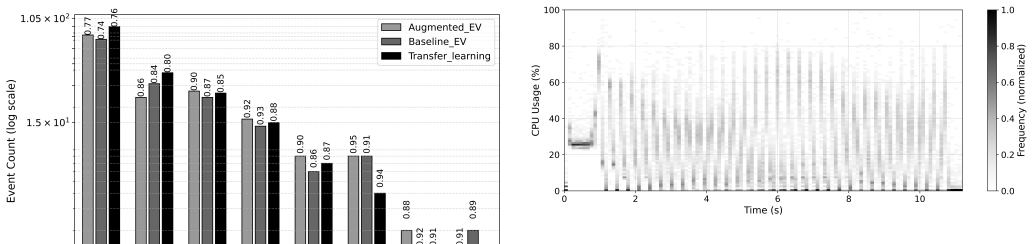
The central mechanism is the adaptive frame-length inference loop built around E2PANNs, a fine-tuned convolutional network derived from EPANNs (Efficient Pruned Audio Neural Networks), itself a pruned variant of the CNN14 model in the PANNs family. The E2PANNs model consumes 64-bin log-Mel spectrograms extracted from 10-second mono audio at 32 kHz and outputs a probability for the 'Emergency Vehicle' class. On the edge side, a producer thread writes audio chunks into a thread-safe circular buffer while a consumer thread pulls frames; the frame length starts at the empirically determined minimum valid input of 9,919 samples and grows only when the recent probability exceeds a threshold, bounded by a configurable maximum. A moving-average smoothing filter and a requirement of several consecutive positive frames feed an event decision state machine that issues final detection flags, and the whole loop is exposed over a WebSocket interface for remote monitoring.
What would settle it
Check the 1,025 AudioSet-Strong clip identifiers against the AudioSet-EV training split to see whether any overlap exists; if even one test clip was used in fine-tuning, the framewise F1 figures stop measuring generalization. Separately, have two independent annotators re-label all 1,025 clips and measure inter-annotator agreement; if agreement on the 'corrected' subset is low, the corrected gold standard is not a stable reference.
Extended reading notes
Core claim
On its own terms, the paper establishes a complete pipeline from training data to deployed detector. It claims to be the first publicly documented CNN-based emergency vehicle siren detector that achieves real-time inference on embedded hardware with live audio input and adaptive detection logic. The load-bearing result is the combination of the E2PANNs model with an adaptive frame-length inference loop: starting from a minimum input size of about 9,919 samples (about 310 ms), the system lengthens the analysis window whenever the predicted probability stays above a threshold, so it spends more computation only when a siren is plausibly present. This mechanism, together with moving-average smoothing and a consecutive-frame validation state machine, yields a real-time factor of 1.35x under active detection, a perfect 1.00x when idle, a maximum latency below 400 ms, and framewise F1 up to 78% on the corrected AudioSet-Strong subset. The paper also documents that 182 of 287 test files that produced zero confident detections contained no siren despite their positive ground-truth labels, a finding used to build a corrected gold standard.
Load-bearing premise
The reported F1 and false-positive rates stand only if the AudioSet-Strong test clips used for evaluation were never used to fine-tune the model, and if manually correcting just the 287 zero-detection files produces an unbiased gold standard; the paper does not demonstrate either condition.
Editorial extensions
If this is right
- Real-time siren detection is achievable on a low-cost embedded platform without quantization, ONNX conversion, or hardware-accelerated inference backends.
- Adaptive frame sizing suppresses false positives: variable-frame configurations produce fewer and shorter false-positive sequences than the constant-frame configuration.
- The manual audit of AudioSet-Strong shows that a substantial share of positive labels in large-scale audio corpora can be wrong, so curated subsets such as AudioSet-EV are needed for trustworthy evaluation.
- A WebSocket-connected fleet of such edge detectors can share detection flags and confidence scores, enabling collaborative emergency vehicle tracking in smart city infrastructures.
- The measured processing headroom (1.35x real-time under load, with average CPU around 30%) leaves room for additional post-processing or for running the detector alongside other tasks on the same device.
Reading between the lines
- If label noise of the scale found in the 287 zero-detection files extends to the rest of AudioSet-Strong's EV class, then any F1 measured against the unmodified labels is systematically distorted; re-auditing all 1,025 clips, not just the zero-detection subset, would give an unbiased estimate of both the model and the dataset.
- The confidence-triggered adaptive frame idea is not siren-specific: any streaming sound-event detector with a cheap confidence estimate could grow its receptive field on demand, trading a little latency for lower false alarms, which suggests a testable transfer to other urban sound classes.
- The 334 detections per hour reported in the live 'multiple detections' session were not validated against ground truth, so a controlled field experiment with known siren passages would be the natural next step to confirm the event-level detection rates.
- Because the system ran without quantization or inference accelerators, applying standard model compression should push the real-time factor higher or move the same detector onto even cheaper hardware such as older Raspberry Pi models.
Editorial analysis
A structured set of objections, weighed in public.
Referee Report
Summary. This paper presents a full-stack emergency vehicle (EV) siren detection system built around E2PANNs, a fine-tuned variant of the EPANNs CNN, deployed on a Raspberry Pi 5 with a multithreaded inference engine, adaptive frame sizing, probability smoothing, and a decision state machine. The authors curate AudioSet-EV and related datasets, evaluate framewise and event-based metrics on 1,025 AudioSet-Strong clips, and report real-time measurements from one-hour live experiments. The headline claims are: (i) a first publicly documented CNN-based EV siren detector with real-time inference on embedded hardware and live audio input, and (ii) improved robustness through adaptive detection logic, with framewise F1 up to 78% and a real-time factor of 1.35x under active detection.
Significance. The real-time feasibility part of the paper is valuable and, on its face, credible: the authors provide concrete measurements of CPU, memory, latency, frame rates, and real-time factors, and they describe a reproducible embedded pipeline. The release of AudioSet-EV and related datasets and the AudioSet-Tools framework is a useful contribution to the community. However, the detection accuracy claims, including the 78% F1 and the claimed robustness improvement from adaptive framing, are undermined by an evaluation protocol in which the ground-truth label set is corrected based on the model's own zero-detection outputs. Until the evaluation is redone with an independent, blinded audit and explicit train/test disjointness, the accuracy numbers cannot be taken at face value. The real-time measurements do not depend on that protocol and appear sound, so the central real-time embedded deployment claim is plausible, but the improved robustness claim needs stronger support.
major comments (5)
- [V (Ground truth correction)] The evaluation protocol is outcome-dependent. The paper states that 287 of 1,025 AudioSet-Strong clips had zero frames above the 0.5 threshold, that these were manually audited, and that 182 were re-labeled as containing no EV; the corrected subset is then used for the headline metrics in Table I (rows labeled 'True'). Because the audit was applied only to files where the model produced no detections, it can only remove false negatives from already-failed cases, converting them into true negatives and inflating recall and F1; it cannot find false negatives in files with partial detections, nor can it correct false positives in the remaining 738 files. The gap between the 'True' and 'False' rows in Table I, for var fr 04 checkpoint 1 with F1 78% versus 66%, is thus at least partly an artifact of relabeling driven by the model's own behavior. Please rerun the evaluation on the original labels, or better, conduct a blinded re-audit of a random stratified sample of all 1,025 files and report metrics on that independently corrected ground truth.
- [III-B and V (Train/test overlap)] The paper never demonstrates that the 1,025 AudioSet-Strong test clips are disjoint from the AudioSet-EV training clips. Both are drawn from AudioSet, and the curation framework in III-B does not state that AudioSet-Strong clips were excluded during fine-tuning. If any test clip appeared in training, the reported F1 and false-positive rates are inflated by direct leakage. Please report the overlap analysis, for example by matching YouTube IDs or clip hashes, and if there is overlap, retrain or re-split with explicit exclusion.
- [Table III (Real-time factor)] The real-time factor definition and the numerical values in Table III are internally inconsistent. The table states 'Real-Time Factor is defined as Frame_Duration / Actual_Processing_Time,' but for the 'Normal' row, 310.0 ms divided by 318.1 ms is 0.975, not the reported 1.00; for the 'Adaptive' row, 848.5 ms divided by 318.1 ms is 2.67, not the reported 2.48. The 'Overall Real-Time Factor' of 1.35x is also unexplained, as the table does not specify which frame duration and processing time are used in that calculation. Please clarify the definition and recompute the reported values, and state explicitly what value of the factor constitutes real-time operation.
- [III-B and III-C (Unified-EV role)] There is a direct contradiction about the role of Unified-EV. Section III-B lists Unified-EV as a merged dataset 'for generalization testing,' while Section III-C says checkpoint 3 (Transfer_learning) was 'trained on the Unified-EV dataset III-B' and also says 'Model evaluation was carried out using stratified training/validation splits of Unified-Ev dataset.' If Unified-EV is used for both training and evaluation, the Transfer_learning checkpoint results in Table I could be optimistically biased. Please clarify which splits were used for training versus testing and how generalization was measured.
- [V (Metric discretization)] The description of how adaptive-frame outputs are converted to fixed-resolution binary sequences is too vague to be reproducible. The paper only says the outputs were produced by 'discretizing the fixed and variable-length inference windows ... into uniform time steps and aligning them with the corresponding ground truth annotations.' It does not state the time-step size, how overlapping adaptive windows are aggregated, how boundary frames are assigned, or whether the conversion is deterministic. Since the adaptive frame logic changes the temporal alignment of predictions, this step can materially affect framewise precision and recall. Please provide the precise discretization algorithm or release the evaluation code.
minor comments (5)
- [V] The term 'False True Positives' is confusing; consider using 'false positive annotations' or 'incorrect positive labels' to avoid the double negation.
- [V (typo)] 'One one side we collected and analyzed CPU and memory load data' should be 'On the one hand, we collected and analyzed CPU and memory load data.'
- [III-C] The checkpoint naming in the Table I footnote uses lowercase for the first two checkpoints ('audioset ev augmented', 'audioset ev'), but Section III-C uses headings 'Baseline_EV', 'Augmented_EV', and 'Transfer_learning'; please align the notation.
- [V] The manual audit of 287 zero-detection files is described in one paragraph, but no information is provided about the auditors, the listening setup, or inter-auditor agreement; a brief protocol description would strengthen the label-correction claim.
- [IV] The sentence 'This approach aims to avoid recurrent layers — common in SoA SED systems — which introduce substantial computational and memory overhead' is a reasonable motivation, but it is not supported by a comparison in the paper; a sentence referencing a complexity table or a direct comparison would help.
Circularity Check
Accuracy evaluation is partly circular: the corrected ground truth is built only from files where the model had zero detections, so the reported F1 partially measures agreement with the model's own outputs.
-
self definitional
[Section V, 'Evaluation of Real Time Sound Events Detection', paragraph following Fig. 4; Table I FTP column]
"A statistical analysis of the number of frames exceeding a 0.5 probability threshold (Figure 4) revealed a subset of 287 audio files with zero confident detections. These files were manually audited, and 182 (63.41%) of them were confirmed to contain no emergency vehicle events despite their positive ground-truth labels."
The set of files re-audited is determined by the model's own output: only files with zero frames above the 0.5 threshold were re-examined. The audit can therefore reclassify missed detections as true negatives, but it cannot correct false negatives in files with any detections, nor false positives in the 738 files that had detections. Table I reports the headline frame-wise F1 (e.g., 78% for True var fr 04 checkpoint 1, versus 66% for the same configuration under FTP=False) computed against this corrected ground truth. Because the 'False True Positives' list is defined by the model's zero-detection outputs, the corrected labels and the reported F1 are partially defined by the very model being evaluated.
full rationale
The paper is an empirical systems paper, not a mathematical derivation, so most of its claims are not circular in the derivation sense. The real-time feasibility measurements (RT factor 1.35x, latency below 400 ms, resource usage) are self-contained and do not depend on the corrected ground truth; likewise the embedded implementation and adaptive inference logic are evaluated directly. The central accuracy claim, however, is partly circular: the corrected AudioSet-Strong test labels were constructed by re-auditing only the 287 clips for which the model produced zero confident detections, and 182 of those were relabeled as non-EV. This outcome-dependent relabeling inflates recall and F1 by converting model misses into true negatives, and the gap between FTP=True and FTP=False in Table I (78% vs 66% for the best configuration) shows the reported number is sensitive to this model-conditioned correction. The paper's self-citations to the authors' prior E2PANNs and AudioSet-Tools work are not load-bearing in a circular way: they supply the model and dataset tooling, but the embedded evaluation is independent external measurement. A blinded, model-independent re-audit of a random stratified sample would resolve the circularity; until then, the accuracy claim should be treated as partly self-consistent with the model rather than independently validated. Score 6 reflects partial circularity confined to the evaluation protocol, while the real-time feasibility contribution retains independent content.
Assumptions & free parameters
free parameters (7)
- decision_threshold =
0.5
- min_consecutive_frames =
3
- adaptive_frame_increment_speeds =
0.2 and 0.4 s/s
- minimum_valid_input_size =
9919 samples (~310 ms)
- mel_bins =
64
- training_hyperparameters =
not reported
- audio_sample_rate =
32 kHz
assumptions (5)
- domain assumption AudioSet-Strong labels are correct except for the 182 files manually identified as false true positives.
- domain assumption The manual audit of 287 zero-detection files is unbiased and the resulting corrected subset improves test reliability.
- domain assumption No overlap exists between AudioSet-EV training clips and AudioSet-Strong evaluation clips.
- domain assumption Log-Mel spectrogram features and EPANNs architecture are a sufficient representation for siren detection.
- domain assumption The two one-hour live experiments are representative of real-world operating conditions.
invented entities (2)
-
E2PANNs
-
AudioSet-EV and variants
Cite this review
Pith. "Pith review of Real-Time Emergency Vehicle Siren Detection with Efficient CNNs on Embedded Hardware." pith.science (2026). https://pith.science/paper/M4JYE647
@misc{pith2026250701563,
  author       = {Pith},
  title        = {Pith review of: Real-Time Emergency Vehicle Siren Detection with Efficient CNNs on Embedded Hardware},
  year         = {2026},
  howpublished = {\url{https://pith.science/paper/M4JYE647}},
  note         = {Machine review of arXiv:2507.01563}
}
read the original abstract
We present a full-stack emergency vehicle (EV) siren detection system designed for real-time deployment on embedded hardware. The proposed approach is based on E2PANNs, a fine-tuned convolutional neural network derived from EPANNs, and optimized for binary sound event detection under urban acoustic conditions. A key contribution is the creation of curated and semantically structured datasets - AudioSet-EV, AudioSet-EV Augmented, and Unified-EV - developed using a custom AudioSet-Tools framework to overcome the low reliability of standard AudioSet annotations. The system is deployed on a Raspberry Pi 5 equipped with a high-fidelity DAC+microphone board, implementing a multithreaded inference engine with adaptive frame sizing, probability smoothing, and a decision-state machine to control false positive activations. A remote WebSocket interface provides real-time monitoring and facilitates live demonstration capabilities. Performance is evaluated using both framewise and event-based metrics across multiple configurations. Results show the system achieves low-latency detection with improved robustness under realistic audio conditions. This work demonstrates the feasibility of deploying IoS-compatible SED solutions that can form distributed acoustic monitoring networks, enabling collaborative emergency vehicle tracking across smart city infrastructures through WebSocket connectivity on low-cost edge devices.
Figures


Figures from the paper (4 more)



Reference graph
Works this paper leans on
-
[1]
A safety- oriented framework for sound event detection in driving scenarios,
C. Castorena, M. Cobos, J. Lopez-Ballester, and F. J. Ferri, “A safety- oriented framework for sound event detection in driving scenarios,” Applied Acoustics, vol. 215, p. 109719, Jan. 2024. [Online]. Available: https://linkinghub.elsevier.com/retrieve/pii/S0003682X23005170
work page 2024
-
[2]
A siren identification system using deep learning to aid hearing-impaired people,
A. E. Ramirez, E. Donati, and C. Chousidis, “A siren identification system using deep learning to aid hearing-impaired people,” Engineering Applications of Artificial Intelligence , vol. 114, p. 105000, Sep
-
[3]
A comprehensive review of smart emergency vehicle detection and response systems,
D. V K, A. P S, P. Jayakumar, and P. S, “A comprehensive review of smart emergency vehicle detection and response systems,” in 2025 3rd International Conference on Advancements in Electrical, Electronics, Communication, Computing and Automation (ICAECA), April 2025, pp. 1–5
work page 2025
-
[4]
Acoustic Based Emergency Vehicle Detection Using Ensemble of deep Learning Models,
U. Mittal and P. Chawla, “Acoustic Based Emergency Vehicle Detection Using Ensemble of deep Learning Models,” Procedia Computer Science , vol. 218, pp. 227–234, 2023. [Online]. Available: https://linkinghub.elsevier.com/retrieve/pii/S1877050923000054
work page 2023
-
[5]
Ambulance Siren Detector using FFT on dsPIC,
T. Miyazaki, Y . Kitazono, and M. Shimakawa, “Ambulance Siren Detector using FFT on dsPIC,” in Proceedings of the 1st IEEE/IIAE International Conference on Intelligent Systems and Image Processing
-
[6]
A real- time siren detector to improve safety of guide in traffic environment,
F. Meucci, L. Pierucci, E. Del Re, L. Lastrucci, and P. Desii, “A real- time siren detector to improve safety of guide in traffic environment,” in 2008 16th European Signal Processing Conference , 2008, pp. 1–5
work page 2008
-
[7]
From Large-scale Audio Tagging to Real-Time Explainable Emergency Vehicle Sirens Detection
S. Giacomelli, M. Giordano, C. Rinaldi, and F. Graziosi, “From large-scale audio tagging to real-time explainable emergency vehicle sirens detection,” version: 1. [Online]. Available: http://arxiv.org/abs/ 2506.23437
-
[8]
E-PANNs: Sound Recognition Using Efficient Pre-trained Audio Neural Networks
A. Singh, H. Liu, and M. D. Plumbley, “E-PANNs: Sound Recognition Using Efficient Pre-trained Audio Neural Networks,” May 2023, arXiv:2305.18665 [cs]. [Online]. Available: http://arxiv.org/abs/2305. 18665
work page Pith review arXiv 2023
Show all 32 references
-
[9]
PANNs: Large-Scale Pretrained Audio Neural Networks for Audio Pattern Recognition,
Q. Kong, Y . Cao, T. Iqbal, Y . Wang, W. Wang, and M. D. Plumbley, “PANNs: Large-Scale Pretrained Audio Neural Networks for Audio Pattern Recognition,” IEEE/ACM Transactions on Audio, Speech, and Language Processing, vol. 28, pp. 2880–2894, 2020, conference Name: IEEE/ACM Tran...
2020
-
[10]
Audio Set: An ontology and human-labeled dataset for audio events,
J. F. Gemmeke, D. P. W. Ellis, D. Freedman, A. Jansen, W. Lawrence, R. C. Moore, M. Plakal, and M. Ritter, “Audio Set: An ontology and human-labeled dataset for audio events,” in 2017 IEEE International Conference on Acoustics, Speech and Signal Processing (ICASSP) . New Orlea...
2017
-
[11]
AudioSet- tools: A python framework for taxonomy-aware AudioSet curation and reproducible audio research,
S. Giacomelli, M. Giordano, C. Rinaldi, and F. Graziosi, “AudioSet- tools: A python framework for taxonomy-aware AudioSet curation and reproducible audio research,” ISSN: 2693-5015. [Online]. Available: https://www.researchsquare.com/article/rs-6957428/v1
-
[12]
Sound Event Detection: A tutorial,
A. Mesaros, T. Heittola, T. Virtanen, and M. D. Plumbley, “Sound Event Detection: A tutorial,” IEEE Signal Processing Magazine, vol. 38, no. 5, pp. 67–83, Sep. 2021. [Online]. Available: https://ieeexplore.ieee.org/document/9524590/
2021
-
[13]
Acoustic data detection in large-scale emergency vehicle sirens and road noise dataset,
M. Y . Shams, T. Abd El-Hafeez, and E. Hassan, “Acoustic data detection in large-scale emergency vehicle sirens and road noise dataset,” Expert Systems with Applications , vol. 249, p. 123608, Sep
-
[14]
An Automatic Emergency Signal Recognition System for the Hearing Impaired,
F. Beritelli, S. Casale, A. Russo, and S. Serrano, “An Automatic Emergency Signal Recognition System for the Hearing Impaired,” in 2006 IEEE 12th Digital Signal Processing Workshop & 4th IEEE Signal Processing Education Workshop . Teton National Park, WY , USA: IEEE, Sep. ...
2006
-
[15]
ESC: Dataset for Environmental Sound Classification,
K. J. Piczak, “ESC: Dataset for Environmental Sound Classification,” in Proceedings of the 23rd ACM international conference on Multimedia, ser. MM ’15. New York, NY , USA: Association for Computing Machinery, Oct. 2015, pp. 1015–1018. [Online]. Available: https://doi.org/10.1...
2015
-
[16]
Urban Sound & Sight: Dataset And Benchmark For Audio-Visual Urban Scene Understanding,
M. Fuentes, B. Steers, P. Zinemanas, M. Rocamora, L. Bondi, J. Wilkins, Q. Shi, Y . Hou, S. Das, X. Serra, and J. P. Bello, “Urban Sound & Sight: Dataset And Benchmark For Audio-Visual Urban Scene Understanding,” in ICASSP 2022 - 2022 IEEE International Conference on Acoustics...
2022
-
[17]
FSD50K: An Open Dataset of Human-Labeled Sound Events,
E. Fonseca, X. Favory, J. Pons, F. Font, and X. Serra, “FSD50K: An Open Dataset of Human-Labeled Sound Events,” Apr. 2022, arXiv:2010.00475 [cs]. [Online]. Available: http://arxiv.org/abs/2010. 00475
2022 arXiv
-
[18]
sireNNet-Emergency Vehicle Siren Classification Dataset For Urban Applications,
A. Shah and A. Singh, “sireNNet-Emergency Vehicle Siren Classification Dataset For Urban Applications,” Feb. 2023, publisher: Mendeley Data. [Online]. Available: https://data.mendeley.com/datasets/ j4ydzzv4kb/1
2023
-
[19]
Large-Scale Audio Dataset for Emergency Vehicle Sirens and Road Noises,
M. Usaid, M. Asif, t. rajab, P. D. E. S. Hussain, P. D. s. M. munaf, and S. Wasi, “Large-Scale Audio Dataset for Emergency Vehicle Sirens and Road Noises,” 2022. [On- line]. Available: https://figshare.com/articles/media/Large-Scale Audio Dataset for Emergency Vehicle Sirens a...
2022
-
[20]
Audio Classification of Emergency Vehicle Sirens Using Recurrent Neural Network Architectures,
A. Shah, A. Singh, and A. Singh, “Audio Classification of Emergency Vehicle Sirens Using Recurrent Neural Network Architectures,” in Proceedings of International Conference on Paradigms of Communication, Computing and Data Analytics , A. Yadav, S. J. Nanda, and M.-H. Lim, Eds....
2023 doi
-
[21]
Large-scale audio dataset for emergency vehicle sirens and road noises,
M. Asif, M. Usaid, M. Rashid, T. Rajab, S. Hussain, and S. Wasi, “Large-scale audio dataset for emergency vehicle sirens and road noises,” Scientific Data , vol. 9, no. 1, p. 599, Oct. 2022. [Online]. Available: https://www.nature.com/articles/s41597-022-01727-2
2022
-
[22]
A Dataset and Taxonomy for Urban Sound Research,
J. Salamon, C. Jacoby, and J. P. Bello, “A Dataset and Taxonomy for Urban Sound Research,” in Proceedings of the 22nd ACM international conference on Multimedia . Orlando Florida USA: ACM, Nov. 2014, pp. 1041–1044. [Online]. Available: https: //dl.acm.org/doi/10.1145/2647868.2655045
2014
-
[23]
Modified binary search algorithm,
A. R. Chadha, R. Misal, and T. Mokashi, “Modified binary search algorithm,” CoRR, vol. abs/1406.1677, 2014. [Online]. Available: http://arxiv.org/abs/1406.1677
2014 arXiv
-
[24]
The benefit of temporally-strong labels in audio event classification,
S. Hershey, D. P. W. Ellis, E. Fonseca, A. Jansen, C. Liu, C. Moore, and M. Plakal, “The benefit of temporally-strong labels in audio event classification,” ICASSP 2021 - 2021 IEEE International Conference on Acoustics, Speech and Signal Processing (ICASSP) , pp. 366–370,
2021
-
[25]
TorchMetrics - Measuring Reproducibility in PyTorch,
N. S. Detlefsen, J. Borovec, J. Schock, A. H. Jha, T. Koker, L. D. Liello, D. Stancl, C. Quan, M. Grechkin, and W. Falcon, “TorchMetrics - Measuring Reproducibility in PyTorch,” Journal of Open Source Software, vol. 7, no. 70, p. 4101, Feb. 2022. [Online]. Available: https://j...
2022 doi
-
[26]
Acoustic scene classification: An overview of dcase 2017 challenge entries,
A. Mesaros, T. Heittola, and T. Virtanen, “Acoustic scene classification: An overview of dcase 2017 challenge entries,” in2018 16th International Workshop on Acoustic Signal Enhancement (IWAENC) , 2018, pp. 411– 415
2017
-
[27]
Convolutional recurrent neural networks for polyphonic sound event detection,
E. C ¸ akır, G. Parascandolo, T. Heittola, H. Huttunen, and T. Virtanen, “Convolutional recurrent neural networks for polyphonic sound event detection,” IEEE/ACM Transactions on Audio, Speech, and Language Processing, vol. 25, no. 6, pp. 1291–1303, 2017
2017
-
[269]
Available: https://www2.ia-engineers.org/conference/ index.php/icisip/icisip2013/paper/view/247
[Online]. Available: https://www2.ia-engineers.org/conference/ index.php/icisip/icisip2013/paper/view/247
-
[2013]
The Institute of Industrial Applications Engineers, 2013, pp. 266–
2013
-
[2021]
Available: https://api.semanticscholar.org/CorpusID: 234742594
[Online]. Available: https://api.semanticscholar.org/CorpusID: 234742594
-
[2022]
Available: https://linkinghub.elsevier.com/retrieve/pii/ S0952197622001890
[Online]. Available: https://linkinghub.elsevier.com/retrieve/pii/ S0952197622001890
-
[2024]
Available: https://linkinghub.elsevier.com/retrieve/pii/ S0957417424004731
[Online]. Available: https://linkinghub.elsevier.com/retrieve/pii/ S0957417424004731
Reviewed August 6, 2026 · model on record in the stance chip above.
Discussion (0). Sign in to comment.