REVIEW 3 major objections 4 minor 48 references
Time-variant Image Inpainting via Interactive Distribution Transition Estimation
T0 review · 3 major / 4 minor · reviewed 2026-08-06 · deepseek-v4-flash
Pith's one-line read The paper introduces TAMP, a reference-guided inpainting setting where the reference image is time-shifted and possibly damaged, and proposes InDiTE-Diff, which treats complementation as a distribution transition and reports consistent…
desk verdict New task and dataset worth a look; the InDiTE-Diff 'consistent superiority' claim does not survive its own tvRefInpaint table. read the letter →
The pith
A machine-rendered reading of the paper's core claim, the machinery that carries it, and where it could break.
The reading
What carries the argument
The load-bearing object is the Interactive Distribution Transition Estimation (InDiTE) module, a parameter-shared Siamese U-Net with two heads. It treats the two time-variant images as draws from distributions that share geometry, and learns the transition between them by merging latent features, applying semantic predictive filtering (SPF) to keep only semantically consistent neighbors, and outputting both a complemented image and a confidence mask. The confidence mask is what converts the problem into a standard masked inpainting task: low-confidence regions are handed to a diffusion model, and the low-pass cross-reference term in the sampling loop enforces mutual consistency. The named identity doing the work is the distribution-transition framing: instead of aligning pixels, the module estimates what content can be trusted across temporal change.
What would settle it
Evaluate InDiTE-Diff on time-variant pairs that include strong viewpoint shifts or structural scene changes, such as a building added or removed, where the 'near-identical geometry' premise breaks; if its PSNR advantage over LeftRefill disappears or reverses on those pairs, the central assumption is refuted.
Extended reading notes
Core claim
The central claim is that time-variant image pairs share near-identical overall geometry, so their complementation can be learned as a distribution transition rather than as explicit copy-and-paste. InDiTE learns this transition with a Siamese U-Net backbone that merges features and applies semantic predictive filtering to keep only consistent contents, while a confidence head learns where the complementation is unreliable. InDiTE-Diff then feeds the complemented, confidence-masked images into a diffusion sampler whose null-space constraint preserves known pixels and whose low-pass cross-reference term forces the two outputs to agree on low frequencies at every step. The paper reports that this consistently outperforms state-of-the-art reference-guided methods on the new TAMP-Street benchmark when both images are damaged, with PSNR gains over LeftRefill of roughly 3.1 to 5.2 dB depending on mask ratio, and remains competitive when the reference is intact.
Load-bearing premise
The whole pipeline assumes the two images of the same scene remain near-identical in overall geometry despite the time gap, so that feature merging, semantic filtering, and low-pass alignment can find genuinely corresponding content.
Editorial extensions
If this is right
- In tvDuoInpaint, where the reference is also damaged, InDiTE-Diff reports PSNR gains of roughly 3.1 to 5.2 dB over LeftRefill across mask ratios 20% to 60%.
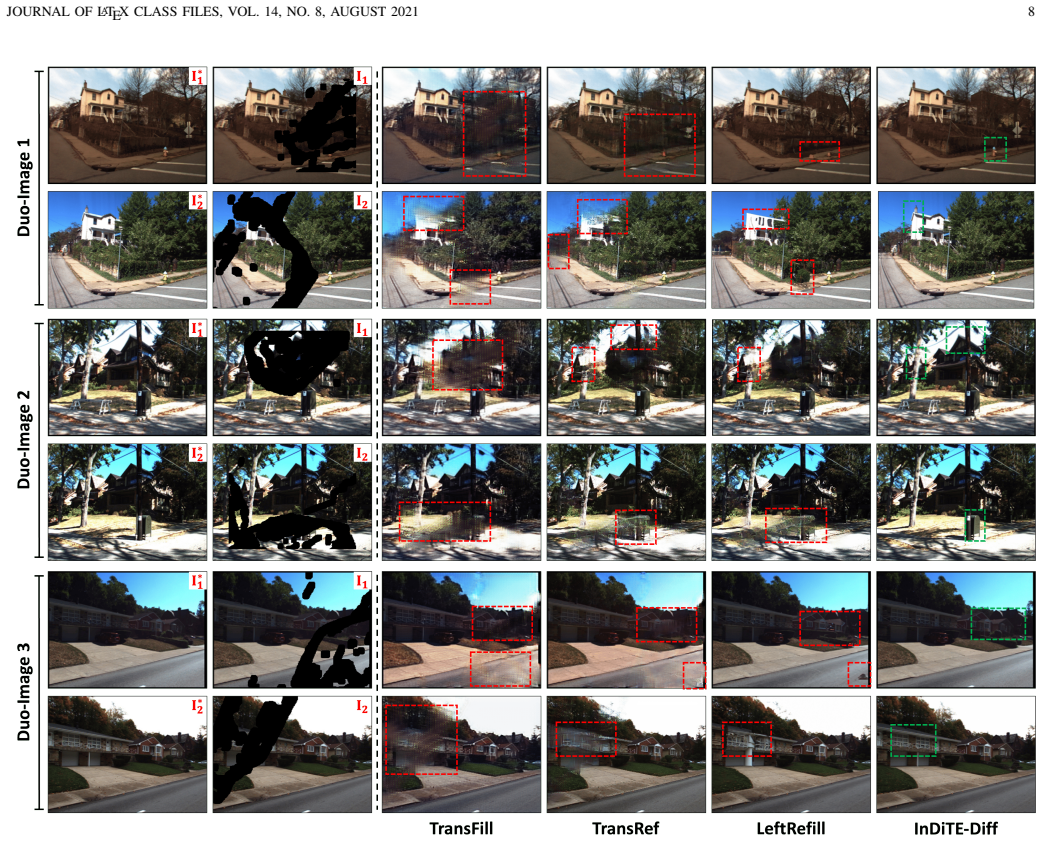
- InDiTE's complement output can be plugged into existing inpainting models; the paper shows it generally boosts TransFill, TransRef, and LeftRefill for duo-image inpainting.
- In tvRefInpaint, InDiTE-Diff is competitive with LeftRefill and improves most at higher mask ratios, suggesting the approach extracts more reference value when damage is severe.
- Ablation shows both InDiTE and the diffusion cross-reference step contribute, with InDiTE providing the majority of the gain.
Reading between the lines
- The confidence mask learned by InDiTE could serve as a general reliability signal for fusing multiple temporally shifted views, beyond the specific inpainting head used here.
- Because the method weakens the requirement that a reference be clean and contemporaneous, it opens a direct path to restoring scans of archived or historical imagery, though the paper does not test that scenario.
- The geometric-alignment assumption suggests a natural stress test: applying the method to pairs with camera viewpoint changes would reveal how far the distribution-transition framing can be pushed.
- If the low-pass cross-reference term is doing most of the consistency work, the method could generalize to video restoration by aligning successive frames in the same latent space; the paper does not explore this.
Editorial analysis
A structured set of objections, weighed in public.
Referee Report
Summary. The paper introduces Time-vAriant iMage inPainting (TAMP), a reference-guided inpainting setting in which the reference image is captured with a large time gap and may itself be damaged. The authors propose InDiTE, a Siamese U-Net with semantic predictive filtering and a confidence head that produces complemented images and confidence masks, and InDiTE-Diff, which combines InDiTE with the DDNM diffusion model and adds a low-pass cross-reference constraint during sampling. They assemble a TAMP-Street benchmark from VL-CMU-CD images and irregular masks, and report experiments for two settings: tvRefInpaint (intact reference) and tvDuoInpaint (both images damaged). The tvDuoInpaint results show large PSNR gains over LeftRefill, while the tvRefInpaint results are mixed, with LeftRefill winning several low-mask-ratio cells.
Significance. If the reported tvDuoInpaint gains are statistically robust, the paper makes a useful contribution by defining a practical task, providing a plug-and-play complementation module that improves several baselines, and assembling a publicly released benchmark from existing sources. The ablation study in Table V gives some evidence that both the InDiTE complementation and the diffusion cross-reference contribute to the final performance. However, the central advertised claim of consistent superiority over state-of-the-art methods is not supported by the tvRefInpaint results, and the absence of error bars or significance tests leaves the magnitude of even the large tvDuoInpaint gains unquantified. The method also rests on a near-identical-geometry assumption that is not validated on the benchmark.
major comments (3)
- [Abstract and Section VI-B, Table II] The abstract's claim that InDiTE-Diff 'consistently outperform SOTA reference-guided image inpainting methods for solving TAMP' is contradicted by the only quantitative tvRefInpaint evidence. In Table II, LeftRefill outperforms InDiTE-Diff on all four metrics at mask ratios 20%-30% (PSNR 30.9928 vs 30.9782; SSIM 0.9438 vs 0.9338) and 30%-40% (PSNR 30.3511 vs 29.9718; SSIM 0.9229 vs 0.9071). The text in Section VI-B, first item, that InDiTE-Diff 'demonstrates a consistent advantage over the baselines' is therefore inaccurate. Please narrow the claim to tvDuoInpaint, or provide paired statistical evidence that the high-mask-ratio tvRefInpaint gains are real and outweigh the low-mask-ratio losses.
- [Tables II-V] No standard deviations, confidence intervals, or paired significance tests are reported for any quantitative result. Several comparisons in Table II differ by less than 0.05 dB (e.g., 20%-30%: 30.9928 vs 30.9782), and even the larger tvDuoInpaint gains in Table III cannot be distinguished from run-to-run noise without variance estimates. Please report error bars and, where relevant, paired tests, or explicitly phrase the conclusions as observed point estimates rather than consistent improvements.
- [Section IV-A and Eq. (8)] The method is justified by the assumption that time-variant images share 'near-identical overall geometry,' and the semantic predictive filtering in Eq. (3) and the low-pass cross-reference alignment in Eq. (8) both depend on this correspondence. However, TAMP-Street is described in Table I as including Geometric Misalignment as a challenge, and the paper provides no quantitative characterization of alignment in the dataset and no experiment testing robustness to misalignment. This is a correctness-risk concern for the general TAMP claim: if geometric misalignment is substantial, the feature matching and low-pass alignment could enforce wrong correspondences and mislead the diffusion output. Please either restrict the claim to approximately aligned time-variant images or add an experiment that varies or measures misalignment.
minor comments (4)
- [Section III-B and Fig. 4 caption] There are typos: 'tuDuoInpaint' should be 'tvDuoInpaint', and the method name is inconsistently written as 'InTiDE-Diff', 'InDiTE-DDNM', and 'ITDiff' in Section VI-E; please standardize.
- [Section VI-B and VI-C] PSNR differences are reported as percentages (e.g., '1.3693%', '3.095%/3.4442%'), but PSNR is measured in decibels; the reported quantities are dB differences, not percentage improvements. Please correct the units throughout.
- [Section VI-A] TransFill is evaluated by sending data to the authors' server, whereas TransRef and LeftRefill are retrained on TAMP-Street; this asymmetry should be explicitly stated as a potential source of unfair comparison, especially in Table IV where TransFill is used in boosting experiments.
- [Section IV-C and Eq. (10)] Several free parameters are not specified: the binarization threshold tau in Eq. (6), the low-pass scale factor D and step size omega in Eq. (8), and the diffusion sampling steps. In addition, the confidence mask is trained against the ground-truth residual C*_i = I*_i - \tilde I_i, so Section VI-E's description of it as an independent indicator should be softened to reflect that this is a supervised regressor fitted to training data.
Circularity Check
No significant circularity: InDiTE-Diff's components are supervised or externally sourced, and the central claim is tested against independent baselines; the 'consistently outperform' wording is a correctness concern, not a circular reduction.
full rationale
Walking the claimed derivation chain: TAMP is a task definition (Eq. 1); an empirical study motivates learned complementation; InDiTE learns complementation outputs and confidence masks through supervised losses against ground truth (Eqs. 9-10); InDiTE-Diff wraps DDNM with a low-pass cross-reference term (Eqs. 7-8); and the full system is evaluated on the assembled TAMP-Street benchmark against external baselines TransFill, TransRef, and LeftRefill. No step equates an output to an input by construction. The complementation output ~I_i and confidence map ~C_i are trained with L1/GAN/style/perceptual losses; the confidence target ~C*_i = I*_i - ~I_i is a supervised label, not a fitted parameter renamed as a prediction, and the final PSNR/SSIM/LPIPS values are computed against held-out ground truth. The SPF technique and loss hyperparameters are inherited from MISF [6], a same-group prior paper, but MISF is a peer-reviewed, code-released CVPR method used as a component rather than as a self-citation chain that forces the TAMP result; no uniqueness theorem is imported from the authors' prior work, and DDNM [13] and the low-pass interaction [41] are external. The abstract's 'consistently outperform' wording is in tension with Table II, where LeftRefill wins some tvRefInpaint cells at 20%-40% mask ratios, and no significance tests are reported; that is an evidence/claim mismatch belonging to correctness risk, not circularity. The geometric-similarity assumption in Sec. IV-A is an explicit modeling assumption, not a derived or self-cited fact. I therefore find no significant circularity.
Assumptions & free parameters
free parameters (3)
- Confidence binarization threshold tau
- Low-pass filter scale factor D
- Loss weights lambda1..lambda4 =
1, 0.1, 0.1, 250
assumptions (4)
- domain assumption Time-variant images share near-identical overall geometry
- domain assumption Semantic predictive filtering learned from MISF transfers to time-variant pairs
- standard math DDNM null-space diffusion is a valid generative prior for the masked complementation inputs
- domain assumption TAMP-Street masks and image pairs represent the real TAMP distribution
invented entities (1)
-
InDiTE (Interactive Distribution Transition Estimation module)
Cite this review
Pith. "Pith review of Time-variant Image Inpainting via Interactive Distribution Transition Estimation." pith.science (2026). https://pith.science/paper/PFVUZ4YO
@misc{pith2026250623461,
  author       = {Pith},
  title        = {Pith review of: Time-variant Image Inpainting via Interactive Distribution Transition Estimation},
  year         = {2026},
  howpublished = {\url{https://pith.science/paper/PFVUZ4YO}},
  note         = {Machine review of arXiv:2506.23461}
}
read the original abstract
In this work, we focus on a novel and practical task, i.e., Time-vAriant iMage inPainting (TAMP). The aim of TAMP is to restore a damaged target image by leveraging the complementary information from a reference image, where both images captured the same scene but with a significant time gap in between, i.e., time-variant images. Different from conventional reference-guided image inpainting, the reference image under TAMP setup presents significant content distinction to the target image and potentially also suffers from damages. Such an application frequently happens in our daily lives to restore a damaged image by referring to another reference image, where there is no guarantee of the reference image's source and quality. In particular, our study finds that even state-of-the-art (SOTA) reference-guided image inpainting methods fail to achieve plausible results due to the chaotic image complementation. To address such an ill-posed problem, we propose a novel Interactive Distribution Transition Estimation (InDiTE) module which interactively complements the time-variant images with adaptive semantics thus facilitate the restoration of damaged regions. To further boost the performance, we propose our TAMP solution, namely Interactive Distribution Transition Estimation-driven Diffusion (InDiTE-Diff), which integrates InDiTE with SOTA diffusion model and conducts latent cross-reference during sampling. Moreover, considering the lack of benchmarks for TAMP task, we newly assembled a dataset, i.e., TAMP-Street, based on existing image and mask datasets. We conduct experiments on the TAMP-Street datasets under two different time-variant image inpainting settings, which show our method consistently outperform SOTA reference-guided image inpainting methods for solving TAMP.
Figures


Figures from the paper (11 more)




Reference graph
Works this paper leans on
-
[1]
Repaint: Inpainting using denoising diffusion probabilistic models,
A. Lugmayr, M. Danelljan, A. Romero, F. Yu, R. Timofte, and L. Van Gool, “Repaint: Inpainting using denoising diffusion probabilistic models,” inProceedings of the IEEE/CVF Conference on Computer Vision and Pattern Recognition, 2022, pp. 11 461–11 471. 1, 3
work page 2022
-
[2]
Towards coherent image inpainting using denoising diffusion implicit models,
G. Zhang, J. Ji, Y . Zhang, M. Yu, T. Jaakkola, and S. Chang, “Towards coherent image inpainting using denoising diffusion implicit models,” inInternational Conference on Machine Learning. PMLR, 2023, pp. 41 164–41 193. 1, 3, 7
work page 2023
-
[3]
Reference-based multi-stage progressive restoration for multi-degraded images,
Y . Zhang, Q. Yang, D. M. Chandler, and X. Mou, “Reference-based multi-stage progressive restoration for multi-degraded images,”IEEE Transactions on Image Processing, 2024. 1
work page 2024
-
[4]
Dynamic selection network for image inpainting,
N. Wang, Y . Zhang, and L. Zhang, “Dynamic selection network for image inpainting,”IEEE Transactions on Image Processing, vol. 30, pp. 1784–1798, 2021. 1, 3
work page 2021
-
[5]
Jpgnet: Joint predictive filtering and generative network for image inpainting,
Q. Guo, X. Li, F. Juefei-Xu, H. Yu, Y . Liu, and S. Wang, “Jpgnet: Joint predictive filtering and generative network for image inpainting,” in Proceedings of the 29th ACM International Conference on Multimedia, 2021, pp. 386–394. 1
work page 2021
-
[6]
Misf: Multi- level interactive siamese filtering for high-fidelity image inpainting,
X. Li, Q. Guo, D. Lin, P. Li, W. Feng, and S. Wang, “Misf: Multi- level interactive siamese filtering for high-fidelity image inpainting,” inProceedings of the IEEE/CVF Conference on Computer Vision and Pattern Recognition, 2022, pp. 1869–1878. 1, 2, 5, 7, 8
work page 2022
-
[7]
Coarse-and fine-grained fusion hierarchical network for hole filling in view synthesis,
G. Wang, K. Jiang, K. Gu, H. Liu, H. Liu, and W. Zhang, “Coarse-and fine-grained fusion hierarchical network for hole filling in view synthesis,” IEEE Transactions on Image Processing, vol. 33, pp. 322–337, 2023. 1
work page 2023
-
[8]
Onion-peel networks for deep video completion,
S. W. Oh, S. Lee, J.-Y . Lee, and S. J. Kim, “Onion-peel networks for deep video completion,” inProceedings of the IEEE/CVF international conference on computer vision, 2019, pp. 4403–4412. 1
work page 2019
Show all 48 references
-
[9]
Transfill: Reference-guided image inpainting by merging multiple color and spatial transformations,
Y . Zhou, C. Barnes, E. Shechtman, and S. Amirghodsi, “Transfill: Reference-guided image inpainting by merging multiple color and spatial transformations,” inProceedings of the IEEE/CVF CVPR, 2021, pp. 2266–2276. 1, 3, 6, 7, 8
2021
-
[10]
Rego: Reference-guided outpainting for scenery image,
Y . Wang, Y . Wei, X. Qian, L. Zhu, and Y . Yang, “Rego: Reference-guided outpainting for scenery image,”IEEE Transactions on Image Processing, vol. 33, pp. 1375–1388, 2024. 1
2024
-
[11]
Transref: Multi-scale reference embedding transformer for reference- guided image inpainting,
L. Liao, T. Liu, D. Chen, J. Xiao, Z. Wang, C.-W. Lin, and S. Satoh, “Transref: Multi-scale reference embedding transformer for reference- guided image inpainting,”arXiv:2306.11528, 2023. 1, 3, 6, 7
2023 arXiv
-
[12]
Leftrefill: Filling right canvas based on left reference through generalized text-to-image diffusion model,
C. Cao, Y . Cai, Q. Dong, Y . Wang, and Y . Fu, “Leftrefill: Filling right canvas based on left reference through generalized text-to-image diffusion model,” inProceedings of the IEEE/CVF Conference on Computer Vision and Pattern Recognition, 2024, pp. 7705–7715. 1, 2, 3, 4, 6, 7
2024
-
[13]
Zero-shot image restoration using denoising diffusion null-space model,
Y . Wang, J. Yu, and J. Zhang, “Zero-shot image restoration using denoising diffusion null-space model,”arXiv preprint arXiv:2212.00490,
-
[14]
Deep learning- based image and video inpainting: A survey,
W. Quan, J. Chen, Y . Liu, D.-M. Yan, and P. Wonka, “Deep learning- based image and video inpainting: A survey,”International Journal of Computer Vision, pp. 1–34, 2024. 2
2024
-
[15]
Image inpainting by end-to-end cascaded refinement with mask awareness,
M. Zhu, D. He, X. Li, C. Li, F. Li, X. Liu, E. Ding, and Z. Zhang, “Image inpainting by end-to-end cascaded refinement with mask awareness,” IEEE Transactions on Image Processing, vol. 30, pp. 4855–4866, 2021. 3
2021
-
[16]
Parallel multi-resolution fusion network for image inpainting,
W. Wang, J. Zhang, L. Niu, H. Ling, X. Yang, and L. Zhang, “Parallel multi-resolution fusion network for image inpainting,” inProceedings of the IEEE/CVF international conference on computer vision, 2021, pp. 14 559–14 568. 3
2021
-
[17]
W-net: Structure and texture interaction for image inpainting,
R. Zhang, W. Quan, Y . Zhang, J. Wang, and D.-M. Yan, “W-net: Structure and texture interaction for image inpainting,”IEEE Transactions on Multimedia, 2022. 3
2022
-
[18]
Masked autoencoders are scalable vision learners,
K. He, X. Chen, S. Xie, Y . Li, P. Dollár, and R. Girshick, “Masked autoencoders are scalable vision learners,” inProceedings of the IEEE/CVF conference on computer vision and pattern recognition, 2022, pp. 16 000–16 009. 3 JOURNAL OF LATEX CLASS FILES, VOL. 14, NO. 8, AUGUST 2021 12
2022
-
[19]
Bridging global context interactions for high-fidelity image completion,
C. Zheng, T.-J. Cham, J. Cai, and D. Phung, “Bridging global context interactions for high-fidelity image completion,” inProceedings of the IEEE/CVF Conference on Computer Vision and Pattern Recognition, 2022, pp. 11 512–11 522. 3
2022
-
[20]
Aggregated contextual transfor- mations for high-resolution image inpainting,
Y . Zeng, J. Fu, H. Chao, and B. Guo, “Aggregated contextual transfor- mations for high-resolution image inpainting,”IEEE Transactions on Visualization and Computer Graphics, 2022. 3
2022
-
[21]
Glama: Joint spatial and frequency loss for general image inpainting,
Z. Lu, J. Jiang, J. Huang, G. Wu, and X. Liu, “Glama: Joint spatial and frequency loss for general image inpainting,” inProceedings of the IEEE/CVF conference on computer vision and pattern recognition, 2022, pp. 1301–1310. 3
2022
-
[22]
Generative memory-guided semantic reasoning model for image inpainting,
X. Feng, W. Pei, F. Li, F. Chen, D. Zhang, and G. Lu, “Generative memory-guided semantic reasoning model for image inpainting,”IEEE Transactions on Circuits and Systems for Video Technology, vol. 32, no. 11, pp. 7432–7447, 2022. 3
2022
-
[23]
Dual-path image inpainting with auxiliary gan inversion,
W. Wang, L. Niu, J. Zhang, X. Yang, and L. Zhang, “Dual-path image inpainting with auxiliary gan inversion,” inProceedings of the IEEE/CVF conference on computer vision and pattern recognition, 2022, pp. 11 421– 11 430. 3
2022
-
[24]
Zoom-to-inpaint: Image inpainting with high-frequency details,
S. Y . Kim, K. Aberman, N. Kanazawa, R. Garg, N. Wadhwa, H. Chang, N. Karnad, M. Kim, and O. Liba, “Zoom-to-inpaint: Image inpainting with high-frequency details,” inProceedings of the IEEE/CVF conference on computer vision and pattern recognition, 2022, pp. 477–487. 3
2022
-
[25]
Image inpainting using frequency-domain priors,
H. Roy, S. Chaudhury, T. Yamasaki, and T. Hashimoto, “Image inpainting using frequency-domain priors,”Journal of Electronic Imaging, vol. 30, no. 2, pp. 023 016–023 016, 2021. 3
2021
-
[26]
Boundary-aware image inpainting with multiple auxiliary cues,
Y . Yamashita, K. Shimosato, and N. Ukita, “Boundary-aware image inpainting with multiple auxiliary cues,” inProceedings of the IEEE/CVF Conference on Computer Vision and Pattern Recognition, 2022, pp. 619–
2022
-
[27]
Deep generative model for image inpainting with local binary pattern learning and spatial attention,
H. Wu, J. Zhou, and Y . Li, “Deep generative model for image inpainting with local binary pattern learning and spatial attention,”IEEE Transactions on Multimedia, vol. 24, pp. 4016–4027, 2021. 3
2021
-
[28]
High- resolution image inpainting with iterative confidence feedback and guided upsampling,
Y . Zeng, Z. Lin, J. Yang, J. Zhang, E. Shechtman, and H. Lu, “High- resolution image inpainting with iterative confidence feedback and guided upsampling,” inComputer Vision–ECCV 2020: 16th European Conference, Glasgow, UK, August 23–28, 2020, Proceedings, Part XIX
2020
-
[29]
Springer, 2020, pp. 1–17. 3
2020
-
[30]
Srinpaintor: When super-resolution meets transformer for image inpainting,
F. Li, A. Li, J. Qin, H. Bai, W. Lin, R. Cong, and Y . Zhao, “Srinpaintor: When super-resolution meets transformer for image inpainting,”IEEE Transactions on Computational Imaging, vol. 8, pp. 743–758, 2022. 3
2022
-
[31]
Auto-encoding variational bayes,
D. P. Kingma and M. Welling, “Auto-encoding variational bayes,”arXiv preprint arXiv:1312.6114, 2013. 3
2013 arXiv
-
[32]
Generative adversarial nets,
I. Goodfellow, J. Pouget-Abadie, M. Mirza, B. Xu, D. Warde-Farley, S. Ozair, A. Courville, and Y . Bengio, “Generative adversarial nets,” Advances in neural information processing systems, vol. 27, 2014. 3
2014
-
[33]
Pluralistic free-form image completion,
C. Zheng, T.-J. Cham, and J. Cai, “Pluralistic free-form image completion,” International Journal of Computer Vision, vol. 129, no. 10, pp. 2786– 2805, 2021. 3
2021
-
[34]
Image inpainting with cascaded modulation gan and object-aware training,
H. Zheng, Z. Lin, J. Lu, S. Cohen, E. Shechtman, C. Barnes, J. Zhang, N. Xu, S. Amirghodsi, and J. Luo, “Image inpainting with cascaded modulation gan and object-aware training,” inEuropean Conference on Computer Vision. Springer, 2022, pp. 277–296. 3
2022
-
[35]
Diverse image inpainting with normalizing flow,
C. Wang, Y . Zhu, and C. Yuan, “Diverse image inpainting with normalizing flow,” inEuropean conference on computer vision. Springer, 2022, pp. 53–69. 3
2022
-
[36]
High-fidelity pluralistic image completion with transformers,
Z. Wan, J. Zhang, D. Chen, and J. Liao, “High-fidelity pluralistic image completion with transformers,” inProceedings of the IEEE/CVF International Conference on Computer Vision, 2021, pp. 4692–4701. 3
2021
-
[37]
Denoising diffusion probabilistic models,
J. Ho, A. Jain, and P. Abbeel, “Denoising diffusion probabilistic models,” Advances in neural information processing systems, vol. 33, pp. 6840– 6851, 2020. 3
2020
-
[38]
Reference-guided texture and structure inference for image inpainting,
T. Liu, L. Liao, Z. Wang, and S. Satoh, “Reference-guided texture and structure inference for image inpainting,” in2022 IEEE international conference on image processing (ICIP). IEEE, 2022, pp. 1996–2000. 3
2022
-
[39]
Reference-guided landmark image inpainting with deep feature matching,
J. Li, Z. Xiong, and D. Liu, “Reference-guided landmark image inpainting with deep feature matching,”IEEE Transactions on Circuits and Systems for Video Technology, vol. 32, no. 12, pp. 8422–8435, 2022. 3
2022
-
[40]
Learning dynamic siamese network for visual object tracking,
Q. Guo, W. Feng, C. Zhou, R. Huang, L. Wan, and S. Wang, “Learning dynamic siamese network for visual object tracking,” inProceedings of the IEEE international conference on computer vision, 2017, pp. 1763–1771. 5
2017
-
[41]
U-net: Convolutional networks for biomedical image segmentation,
O. Ronneberger, P. Fischer, and T. Brox, “U-net: Convolutional networks for biomedical image segmentation,” inMedical image computing and computer-assisted intervention–MICCAI 2015: 18th international conference, Munich, Germany, October 5-9, 2015, proceedings, part III
2015
-
[42]
Springer, 2015, pp. 234–241. 5
2015
-
[43]
Back to the source: Diffusion-driven test-time adaptation,
J. Gao, J. Zhang, X. Liu, T. Darrell, E. Shelhamer, and D. Wang, “Back to the source: Diffusion-driven test-time adaptation,”arXiv preprint arXiv:2207.03442, 2022. 6
2022 arXiv
-
[44]
Edgeconnect: Structure guided image inpainting using edge prediction,
K. Nazeri, E. Ng, T. Joseph, F. Qureshi, and M. Ebrahimi, “Edgeconnect: Structure guided image inpainting using edge prediction,” inProceedings of the IEEE/CVF international conference on computer vision workshops, 2019, pp. 0–0. 6, 8
2019
-
[45]
Ilvr: Conditioning method for denoising diffusion probabilistic models,
J. Choi, S. Kim, Y . Jeong, Y . Gwon, and S. Yoon, “Ilvr: Conditioning method for denoising diffusion probabilistic models,”arXiv preprint arXiv:2108.02938, 2021. 6
2021 arXiv
-
[46]
Street- view change detection with deconvolutional networks,
P. F. Alcantarilla, S. Stent, G. Ros, R. Arroyo, and R. Gherardi, “Street- view change detection with deconvolutional networks,”Autonomous Robots, vol. 42, pp. 1301–1322, 2018. 7
2018
-
[47]
Image inpainting for irregular holes using partial convolutions,
G. Liu, F. A. Reda, K. J. Shih, T.-C. Wang, A. Tao, and B. Catanzaro, “Image inpainting for irregular holes using partial convolutions,” in Proceedings of the European conference on computer vision (ECCV), 2018, pp. 85–100. 7
2018
-
[48]
Benchmarking neural network ro- bustness to common corruptions and perturbations,
D. Hendrycks and T. Dietterich, “Benchmarking neural network ro- bustness to common corruptions and perturbations,”arXiv preprint arXiv:1903.12261, 2019. 13 JOURNAL OF LATEX CLASS FILES, VOL. 14, NO. 8, AUGUST 2021 13 Fig. 13:Visualization of another two more LeftRefill inpain...
1903 arXiv
Reviewed August 6, 2026 · model on record in the stance chip above.
Discussion (0). Sign in to comment.