REVIEW 4 major objections 4 minor 33 references
Beyond Statistical Learning: Exact Learning Is Essential for General Intelligence
T0 review · 4 major / 4 minor · reviewed 2026-08-06 · deepseek-v4-flash
Pith's one-line read The paper argues that sound deductive reasoning in AI requires exact learning—correctness on every well-formed input—and that the statistical objective of minimizing average loss is fundamentally misaligned with that goal.
desk verdict A sound, honestly argued position paper whose formal lower bounds are clean, but whose 'must shift' conclusion is a normative leap beyond what the theorems prove. read the letter →
The pith
A machine-rendered reading of the paper's core claim, the machinery that carries it, and where it could break.
The reading
What carries the argument
The argument runs on the disagreement-region bound: with fewer than $1/(2 \inf_{h \neq h'} P(h(X) \neq h'(X)))$ samples, no learner can distinguish two hypotheses that agree on the sampled inputs, so exact identification fails with probability at least $1/4$. Applied to a group-symmetric learner, the same bound becomes distribution- and hypothesis-specific: the critical sample size is set by the smallest disagreement probability between a hypothesis and its nontrivial symmetries. This formalizes why generalist, symmetric learners such as gradient-trained networks and transformers pay an exponential price for exactness, while a task-specific non-symmetric learner would not. A supporting mechanism is the maximum-margin teaching set: for any linear classifier on a finite domain there is a dataset of at most $2d+2$ carefully chosen examples on which the maximum-margin classifier exactly recovers it, showing that exactness is attainable in principle when the learner's inductive bias cooperates.
What would settle it
Train a symmetric neural classifier on the binary comparison task $h_\geq$ versus $h_>$ with $n = 2^{m/4}$ uniformly sampled pairs, where $m = d/2$, and then test on all $2^d$ inputs. The paper's Theorem 3.3 predicts failure with probability at least $1/4$ for any symmetric learner; observing near-perfect exact correctness on the full hypercube with such a small sample would refute the lower bound's applicability to gradient-trained networks.
Extended reading notes
Core claim
The central claim is that reliable deductive reasoning cannot be secured by minimizing expected loss over a distribution; it requires the exact learning criterion, defined as worst-case correctness over all well-formed inputs. The paper establishes a formal separation between the two criteria: for linear classifiers over the binary hypercube, statistical learning succeeds with $O(d \log(d/\delta))$ examples, while exact identification of the same rule requires $\Omega(2^d)$ examples in the worst case, and for symmetric learners, including gradient-trained neural networks, even distinguishing the simple hypotheses $h_\geq$ and $h_>$ takes at least $2^{d/2}$ examples. Consequently, statistical shortcuts are not an accident of particular architectures; they are forced by the interaction of distributional objectives with learner symmetries.
Load-bearing premise
The load-bearing premise is that natural-language reasoning problems explode combinatorially like the Boolean hypercube, so the exponential lower bounds apply; if language inputs factorize compositionally, exact learning could be much easier in practice, and the claim that the statistical objective is the cause of LLM failures would need separate evidence.
Editorial extensions
If this is right
- Average-accuracy benchmarks become insufficient evidence of reasoning ability; exactness requires evaluation over exhaustive or adversarially generated input spaces.
- Training with next-token prediction and cross-entropy is not enough and can even destroy a correct solution, so training should incorporate teaching sets, reasoning traces, verifiers, and exactness-friendly losses.
- Reducing learner symmetries becomes a primary lever for making exact learning sample-efficient, because symmetries force the learner to pay for all alternatives simultaneously.
- Hybrid systems that delegate search to symbolic engines and restrict learned components to verifiable subproblems become a natural route to universal correctness.
- The measured gap between statistical and exact learning quantifies the danger of deploying distribution-optimized models in safety-critical deductive settings, where rare inputs are where failures concentrate.
Reading between the lines
- The exponential lower bounds are proved on a Boolean hypercube; transferring them to natural language presumes linguistic reasoning inputs have the same combinatorial structure. If compositional factorization supports better generalization, exact learning in language may be much easier than the bounds suggest.
- A testable extension: train the same transformer family on a reasoning task under two objectives—next-token prediction versus exactness-oriented training with teaching sets and verifiers—and compare full-input-space error rates. This would isolate whether the statistical objective is the causal driver of observed failures.
- Identifying exact learning with worst-case out-of-distribution generalization suggests that progress on robust and invariant learning could be reframed as partial exact learning, and that exactness may be achievable in practice only by restricting inputs to well-formed, canonicalized prompts.
- If exactness becomes the goal, verification becomes the bottleneck: automatically proving that a learned system is correct on all inputs would be a core research object, not an optional add-on.
Editorial analysis
A structured set of objections, weighed in public.
Referee Report
Summary. The paper argues that the statistical learning paradigm, which optimizes average performance over an unknown distribution, is fundamentally misaligned with the demand for reliable deductive reasoning in AI systems. It formalizes an exact learning criterion as worst-case loss over all inputs, proves lower bounds showing that passive statistical learners require exponentially many samples to identify simple Boolean functions exactly, and analyzes how learner symmetries make this worse. It then discusses alternative directions (teaching sets, changing the task, active learning, verification) and presents an experiment on propositional logic problems showing that training with reasoning traces substantially improves out-of-distribution accuracy. The paper concludes that researchers must shift to exact learning as the organizing goal for general intelligence.
Significance. The formal contributions are clean and useful: the equivalence between exact learning and worst-case out-of-distribution generalization (Section 2), the sample-complexity lower bounds for exact identification (Theorems 3.2 and 3.3), and the teaching-set result for maximum-margin classifiers (Proposition B.1) are all mathematically sound and clearly presented. The paper also gives an honest account of limitations, including the concession in Section 5 that current benchmark hill-climbing may suffice for many practical purposes. If the claims are read as 'naive statistical learners cannot guarantee exact identification without many samples,' the paper is a valuable conceptual contribution with a crisp formal core. However, the paper's headline normative claim—that researchers 'must' abandon statistical objectives—is not established by the theorems and is partially contradicted by its own experiments.
major comments (4)
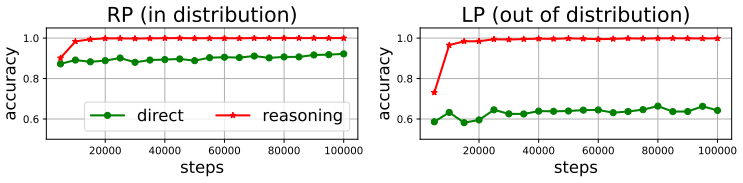
- [Section 1 (boxed position) and Section 3 (Theorems 3.2-3.3)] The boxed claim that researchers 'must fundamentally shift' from statistical performance to exact learning is a necessity claim, but Theorems 3.2 and 3.3 establish only an insufficiency: for any passive i.i.d. learner and small sample, there exists a target hypothesis on which the learner fails with probability at least 1/4. These lower bounds vanish as the sample size grows and do not apply to the active, task-modified, or teaching-based protocols discussed in Section 4. The paper's own Figure 3 shows near-perfect out-of-distribution accuracy on a logic benchmark under a purely statistical next-token objective. The necessity step therefore requires additional premises that are not proved.
- [Section 3, paragraph following Proposition 3.1 and footnote 7] The transfer of the hypercube lower bounds to natural-language reasoning rests on the assertion that 'in the applications we can think of, the input space has a similar combinatorial structure and is subject to the same explosion as what we see here.' This is an analogy, not a demonstrated fact. Natural-language reasoning domains can have compositional factorization—the definite-clause problems of Section 4 are one example—that may make generalization tractable despite a combinatorially large input space. Without a formal or empirical argument for the claimed structural similarity, the exponential lower bounds do not by themselves apply to the settings that motivate the paper.
- [Section 5, 'Existing statistical methods are working'] The paper concedes that the current path of training on ever-expanding benchmarks 'may... lead to systems that appear logically coherent for all or most practical purposes, with no paradigm shift needed.' This concession directly contradicts the boxed 'must' claim. The counter-argument that even unlikely mistakes are unacceptable in high-stakes applications is a normative preference about risk tolerance, not evidence that statistical objectives are incapable of yielding reliable reasoning or exactness. The paper should either weaken the conclusion to a conditional recommendation or supply evidence that the conceded path is closed.
- [Section 1 and Section 4 (Figure 3)] The Introduction asserts that the unsound behavior of current AI systems is 'a consequence of the statistical learning approach,' but this causal claim is asserted rather than demonstrated. The cited failure literature is consistent with many alternative explanations, including optimization, data coverage, decoding, and architecture. Moreover, the Section 4 experiment shows that reformulating the task (training with reasoning traces) yields 0.999 out-of-distribution accuracy while keeping a statistical objective; this is counter-evidence to the claimed fundamental misalignment and is addressed only by noting that exact learning is not achieved. The paper should treat this experiment as evidence bearing on the central claim, not merely as an illustration of task change.
minor comments (4)
- [Theorem 3.2 statement] The sentence 'all learners fail to identify the function used to label the sample for at least one of the labeling functions h* ∈ H' is ambiguous; it should state the quantifier explicitly: for every learner and every input distribution, there exists some h* ∈ H such that the learner fails with probability at least 1/4.
- [Section 2, equation for L*] The identity sup_ρ L_{ρ⊗μ_{Y|X}}(θ) = L*_{μ_{Y|X}}(θ) would be clearer if the domain of ρ were spelled out, since ρ is used both as a generic input distribution and as the marginal in the supremum.
- [Appendix C, Figure 3 caption] The caption 'but is not exact (1.0 on RP data and 0.999 on LP data' is missing a colon or em dash; it should read 'but is not exact: 1.0 on RP data and 0.999 on LP data.'
- [Proposition B.1 proof] The proof characterizes the optimal weight vector w but does not explicitly explain how the bias term b is recovered from the pairwise constraints D_δ; adding a sentence about choosing b between max_n(w·n+1) and min_p(w·p−1) would improve readability.
Circularity Check
No circularity found: the exact-learning lower bounds are self-contained mathematical results, and the paper's own experiments honestly report that exact learning is not achieved.
full rationale
The paper's central derivation chain is not circular. The formal results in Section 3 (Proposition 3.1, Theorem 3.2, and Theorem 3.3) are proved from elementary indistinguishability arguments in Appendix B, with no fitted constants, no trained parameters, and no data-dependent quantities relabeled as predictions. The exact-learning objective L* is defined externally via a supremum over inputs, following Angluin's classical notion, and the paper's observation that this equals the worst-case out-of-distribution loss is a direct mathematical identity, not a conclusion imported from a prior work. The transformer experiments in Section 4 and Figures 1-3 are demonstrations rather than predictions; the paper explicitly reports that the reasoning-trace model reaches 0.999 accuracy on LP data, not 1.0, and states that 'exact learning is still not achieved,' so the empirical claim is not dressed up as a success it did not obtain. The self-citations that appear (e.g., Lattimore et al. 2020, Uesato et al. 2019) are used only as examples of related methods or as pointers to existing work, and they are not load-bearing for the exact-learning thesis. The main weaknesses of the paper are not circularity but unsupported premises: the transfer from the binary hypercube to natural-language reasoning is carried by the assertion that 'in the applications we can think of, the input space has a similar combinatorial structure,' and the causal claim that unsound behavior is 'a consequence of the statistical learning approach' is asserted rather than demonstrated. These are correctness and evidence concerns, not cases where a result reduces to its own inputs by construction.
Assumptions & free parameters
assumptions (5)
- standard math Standard VC dimension and uniform-convergence results for linear classifiers over X subset of R^d.
- standard math Caratheodory's theorem and first-order optimality conditions for maximum-margin convex optimization.
- domain assumption Reasoning input spaces have a combinatorial structure similar to the binary hypercube, causing the same exponential explosion.
- domain assumption Well-formed reasoning tasks in natural language have a well-defined set of correct responses, so exact learning is well-defined.
- domain assumption The unsound behavior of frontier LLMs is caused by the statistical learning objective rather than by other factors such as data, architecture, or optimization choices.
Cite this review
Pith. "Pith review of Beyond Statistical Learning: Exact Learning Is Essential for General Intelligence." pith.science (2026). https://pith.science/paper/2S3LIS6J
@misc{pith2026250623908,
  author       = {Pith},
  title        = {Pith review of: Beyond Statistical Learning: Exact Learning Is Essential for General Intelligence},
  year         = {2026},
  howpublished = {\url{https://pith.science/paper/2S3LIS6J}},
  note         = {Machine review of arXiv:2506.23908}
}
read the original abstract
Sound deductive reasoning -- the ability to derive new knowledge from existing facts and rules -- is an indisputably desirable aspect of general intelligence. Despite the major advances of AI systems in areas such as math and science, especially since the introduction of transformer architectures, it is well-documented that even the most advanced frontier systems regularly and consistently falter on easily-solvable deductive reasoning tasks. Hence, these systems are unfit to fulfill the dream of achieving artificial general intelligence capable of sound deductive reasoning. We argue that their unsound behavior is a consequence of the statistical learning approach powering their development. To overcome this, we contend that to achieve reliable deductive reasoning in learning-based AI systems, researchers must fundamentally shift from optimizing for statistical performance against distributions on reasoning problems and algorithmic tasks to embracing the more ambitious exact learning paradigm, which demands correctness on all inputs. We argue that exact learning is both essential and possible, and that this ambitious objective should guide algorithm design.
Figures


Figures from the paper (1 more)

Reference graph
Works this paper leans on
-
[1]
There can be an enormous number of support vectors and the setD is a carefully chosen subset. On the other hand, whenX = Rd, Liu and Zhu (2016) show that a teaching set of a single element always exist (due to the homogenity of the separating hyperplane, although the example in the teaching set may not be a genuine data point). While interesting, this is ...
work page 2016
-
[4]
Mostafa Dehghani, Stephan Gouws, Oriol Vinyals, Jakob Uszkoreit, and Lukasz Kaiser
URLhttps://arxiv.org/abs/2401.02954. Mostafa Dehghani, Stephan Gouws, Oriol Vinyals, Jakob Uszkoreit, and Lukasz Kaiser. Universal transformers. In International Conference on Learning Representations,
-
[6]
Gemma 3 technical report.arXiv preprint arXiv:2503.19786,
Gemma Team, Aishwarya Kamath, Johan Ferret, Shreya Pathak, Nino Vieillard, Ramona Merhej, Sarah Perrin, Tatiana Matejovicova, Alexandre Ramé, Morgane Rivière, et al. Gemma 3 technical report.arXiv preprint arXiv:2503.19786,
-
[10]
Easy problems that LLMs get wrong
James Huckle and Sean Williams. Easy problems that LLMs get wrong. InProceedings of the 2025 Future of Information and Communication Conference (FICC), pages 313–332
work page 2025
-
[11]
Mathew Huerta-Enochian and Seung Ko. Instruction fine-tuning: Does prompt loss matter? InProceedings of the 2024 Conference on Empirical Methods in Natural Language Processing, pages 22771–22795,
work page 2024
-
[12]
Bowen Jiang, Yangxinyu Xie, Zhuoqun Hao, Xiaomeng Wang, Tanwi Mallick, Weijie J Su, Camillo J Taylor, and Dan Roth. A peek into token bias: Large language models are not yet genuine reasoners.arXiv preprint arXiv:2406.11050,
-
[13]
16 Ryo Kamoi, Yusen Zhang, Nan Zhang, Sarkar Snigdha Sarathi Das, and Rui Zhang. Training step-level reasoning verifiers with formal verification tools.arXiv preprint arXiv:2505.15960,
-
[16]
Goedel-Prover: A frontier model for open-source automated theorem proving
Yong Lin, Shange Tang, Bohan Lyu, Jiayun Wu, Hongzhou Lin, Kaiyu Yang, Jia Li, Mengzhou Xia, Danqi Chen, Sanjeev Arora, et al. Goedel-Prover: A frontier model for open-source automated theorem proving. arXiv preprint arXiv:2502.07640,
Show all 33 references
-
[17]
Po-Ling Loh
URL https://arxiv.org/abs/2407.21783. Po-Ling Loh. A theoretical review of modern robust statistics.Annual Review of Statistics and Its Application, 12,
-
[19]
Embers of autoregression show how large language models are shaped by the problem they are trained to solve
R Thomas McCoy, Shunyu Yao, Dan Friedman, Mathew D Hardy, and Thomas L Griffiths. Embers of autoregression show how large language models are shaped by the problem they are trained to solve. Proceedings of the National Academy of Sciences, 121(41):e2322420121, 2024a. R Thomas ...
-
[20]
Andrew Y Ng
URL https://arxiv.org/abs/2406.02061. Andrew Y Ng. Feature selection, l 1 vs. l 2 regularization, and rotational invariance. InProceedings of the twenty-first international conference on Machine learning, page 78,
-
[22]
Inbar Oren, Jonathan Herzig, Nitish Gupta, Matt Gardner, and Jonathan Berant
URLhttps://arxiv.org/abs/2303.08774. Inbar Oren, Jonathan Herzig, Nitish Gupta, Matt Gardner, and Jonathan Berant. Improving compositional generalization in semantic parsing. In Trevor Cohn, Yulan He, and Yang Liu, editors,Findings of the Association for Computational Linguist...
2020 arXiv
-
[23]
Fixedencoderself-attentionpatternsintransformer- based machine translation
AlessandroRaganato, YvesScherrer, andJörgTiedemann. Fixedencoderself-attentionpatternsintransformer- based machine translation. InFindings of the Association for Computational Linguistics: EMNLP 2020, pages 556–568,
2020
-
[24]
19 Zhengxiang Shi, Adam Yang, Bin Wu, Laurence Aitchison, Emine Yilmaz, and Aldo Lipani
URL https://arxiv.org/abs/2501.16496. 19 Zhengxiang Shi, Adam Yang, Bin Wu, Laurence Aitchison, Emine Yilmaz, and Aldo Lipani. Instruction tuning with loss over instructions.Advances in Neural Information Processing Systems, 37:69176–69205,
-
[25]
Behrooz Tahmasebi and Stefanie Jegelka
URLhttps://arxiv.org/abs/2409.02257. Behrooz Tahmasebi and Stefanie Jegelka. The exact sample complexity gain from invariances for kernel regression. Advances in Neural Information Processing Systems, 36,
-
[26]
Learn- ing compositional functions with transformers from easy-to-hard data.arXiv preprint arXiv:2505.23683,
Zixuan Wang, Eshaan Nichani, Alberto Bietti, Alex Damian, Daniel Hsu, Jason D Lee, and Denny Wu. Learn- ing compositional functions with transformers from easy-to-hard data.arXiv preprint arXiv:2505.23683,
-
[27]
URLhttps://www.aclweb.org/anthology/ 2020.acl-main.687
Association for Computational Linguistics. URLhttps://www.aclweb.org/anthology/ 2020.acl-main.687. Manzil Zaheer, Satwik Kottur, Siamak Ravanbakhsh, Barnabas Poczos, Ruslan R Salakhutdinov, and Alexander J Smola. Deep sets. InAdvances in neural information processing systems, ...
2020
-
[28]
Unveiling transformers with LEGO: a synthetic reasoning task, 2023b
Yi Zhang, Arturs Backurs, Sébastien Bubeck, Ronen Eldan, Suriya Gunasekar, and Tal Wagner. Unveiling transformers with LEGO: a synthetic reasoning task, 2023b. URLhttps://arxiv.org/abs/2206.04301. Andy Zhou, Kai Yan, Michal Shlapentokh-Rothman, Haohan Wang, and Yu-Xiong Wang. ...
-
[29]
unsatisfactory glitches
21 A Further Related Works This paper touches upon several areas of related work, including statistical learning theory, neuro-symbolic AI, systematic generalization in neural networks, classical exact learning, adversarial examples, and out-of- distribution generalization. To...
2018
-
[31]
Equivalently, −w⋆(D0) is in the normal cone ofP (D0) at w⋆(D0)
By the first-order optimality conditions, for allw ∈ P (D0), ⟨w⋆(D0), w− w⋆(D0)⟩ ≥0 . Equivalently, −w⋆(D0) is in the normal cone ofP (D0) at w⋆(D0). Since X is finite the normal cone atw⋆(D0) is cone(N ) with N = {−δ : δ ∈ Dδ 0, ⟨δ, w⋆(D0)⟩ = 2} . Hence there exists a functio...
1970
-
[33]
We generated reasoning traces of the form in Figure 4 by running forward-chaining until the query was proven true, or until no further predicates could be proven true
Rather than using a fixed dataset, we continuously generated data on-the-fly. We generated reasoning traces of the form in Figure 4 by running forward-chaining until the query was proven true, or until no further predicates could be proven true. Rather than predicting all toke...
-
[1966]
Decoupled weight decay regularization.arXiv preprint arXiv:1711.05101,
I Loshchilov. Decoupled weight decay regularization.arXiv preprint arXiv:1711.05101,
-
[1993]
Explaining and harnessing adversarial examples
Ian J Goodfellow, Jonathon Shlens, and Christian Szegedy. Explaining and harnessing adversarial examples. arXiv preprint arXiv:1412.6572,
-
[2003]
Bronstein, Joan Bruna, Taco Cohen, and Petar Veli?kovi? Geometric deep learning: Grids, groups, graphs, geodesics, and gauges.arXiv preprint arXiv:2104.13478,
Michael M. Bronstein, Joan Bruna, Taco Cohen, and Petar Veli?kovi? Geometric deep learning: Grids, groups, graphs, geodesics, and gauges.arXiv preprint arXiv:2104.13478,
-
[2004]
Optimal teaching for online perceptrons
18 Xuezhou Zhang Hrag Gorune Ohannessian, Ayon Sen, Scott Alfeld, and Xiaojin Zhu. Optimal teaching for online perceptrons. InNIPS 2016 workshop on Constructive Machine Learning,
2016
-
[2017]
We clip gradients by global norm
with batch size 256, peak learning rate 0.0001, warmup and final rate of 0.00001, and 2000 warmup steps. We clip gradients by global norm
2000
-
[2018]
Universal length generalization with Turing programs.arXiv preprint arXiv:2407.03310,
Kaiying Hou, David Brandfonbrener, Sham Kakade, Samy Jelassi, and Eran Malach. Universal length generalization with Turing programs.arXiv preprint arXiv:2407.03310,
-
[2020]
Gemini: a family of highly capable multimodal models
Gemini Team, Rohan Anil, Sebastian Borgeaud, Jean-Baptiste Alayrac, Jiahui Yu, Radu Soricut, Johan Schalkwyk, Andrew M Dai, Anja Hauth, Katie Millican, et al. Gemini: a family of highly capable multimodal models. arXiv preprint arXiv:2312.11805,
-
[2021]
LLMs can easily learn to reason from demonstrations
DachengLi, ShiyiCao, TylerGriggs, ShuLiu, XiangxiMo, EricTang, SumanthHegde, KouroshHakhamaneshi, Shishir G Patil, Matei Zaharia, et al. LLMs can easily learn to reason from demonstrations. structure, not content, is what matters!arXiv preprint arXiv:2502.07374,
-
[2022]
The CoT collection: Improving zero-shot and few-shot learning of language models via chain-of-thought fine-tuning
Seungone Kim, Se Joo, Doyoung Kim, Joel Jang, Seonghyeon Ye, Jamin Shin, and Minjoon Seo. The CoT collection: Improving zero-shot and few-shot learning of language models via chain-of-thought fine-tuning. In Proceedings of the 2023 Conference on Empirical Methods in Natural La...
2023
-
[2023]
Achieving the tightest relaxation of sigmoids for formal verification.arXiv preprint arXiv:2408.10491,
Samuel Chevalier, Duncan Starkenburg, and Krishnamurthy Dvijotham. Achieving the tightest relaxation of sigmoids for formal verification.arXiv preprint arXiv:2408.10491,
-
[2024]
Relational inductive biases, deep learning, and graph networks.arXiv preprint arXiv:1806.01261,
Peter W Battaglia, Jessica B Hamrick, Victor Bapst, Alvaro Sanchez-Gonzalez, Vinicius Zambaldi, Mateusz Malinowski, Andrea Tacchetti, David Raposo, Adam Santoro, Ryan Faulkner, et al. Relational inductive biases, deep learning, and graph networks.arXiv preprint arXiv:1806.01261,
-
[2025]
Gaussian error linear units (gelus).arXiv preprint arXiv:1606.08415,
Dan Hendrycks and Kevin Gimpel. Gaussian error linear units (gelus).arXiv preprint arXiv:1606.08415,
Reviewed August 6, 2026 · model on record in the stance chip above.
Discussion (0). Sign in to comment.