REVIEW 2 major objections 6 minor 1 cited by
Constraining self-interacting ultrahigh-energy muon neutrinos by cosmic microwave background spectral distortion
T0 review · 2 major / 6 minor · reviewed 2026-08-06 · deepseek-v4-flash
Pith's one-line read The paper derives upper bounds on muon-neutrino self-interactions from CMB spectral distortions, reaching about 3.1e-5 with PIXIE-projected sensitivities and arguing future measurements would improve on FIRAS by one to three orders of…
desk verdict A clean but fragile application of known machinery: the PIXIE bounds are interesting, but they hinge on an unjustified maximal neutrino abundance and a dimensional typo in the central cross-section. read the letter →
The pith
A machine-rendered reading of the paper's core claim, the machinery that carries it, and where it could break.
The reading
What carries the argument
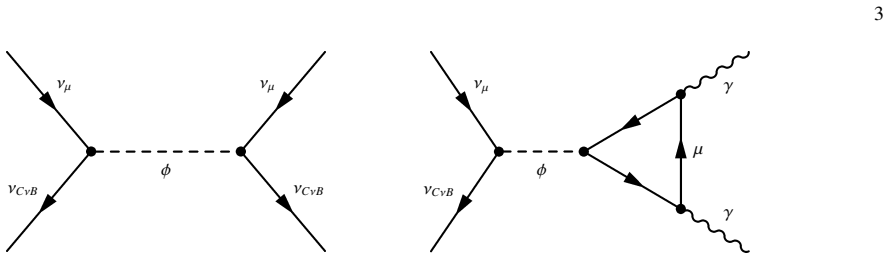
The load-bearing object is the energy-injection rate $$\frac{dE}{dVdt}=f_\chi\Omega_\chi\rho_c n_{\nu_\mu,0}\,\$\sigma$(2m_{\nu_\mu}E_\nu)(1+z)^6,$$ which combines the assumed density of ultrahigh-energy muon neutrinos from dark-matter decay with the one-loop radiative-scattering cross-section $\sigma$ of a UHE neutrino off a nonrelativistic cosmic-background neutrino, mediated by a scalar $\phi$ and producing a photon pair through a muon loop. The cross-section depends on the scalar Passarino-Veltman integral $C_0(s,m_\mu)$, a standard one-loop function, and the rate is inserted into the standard evolution equations for the chemical-potential distortion $\mu$ and the Compton $y$ parameter. Because the rate scales as $(g_\mu g_{\nu_\mu})^2$, the observed or projected distortion limits become statements about the fourth power of the couplings. The resonance structure of the cross-section gives the bounds their characteristic shape: flat below $m_\phi\ll\sqrt{s}$, a kink at $m_\phi\approx\sqrt{s}$ where the mediator's width dominates, and a relaxation proportional to $m_\phi$ at higher masses.
What would settle it
A concrete check: normalize the present-day UHE neutrino density to the diffuse flux actually observed by IceCube and KM3NeT, and include a finite dark-matter lifetime so that only the fraction of parents decayed by redshift $z$ contributes, then recompute the $\mu$- and $y$-distortion integrals. If the resulting distortions fall below the FIRAS and PIXIE limits across the parameter space, the claimed bounds disappear; if they survive, the bounds are robust to the normalization worry.
Extended reading notes
Core claim
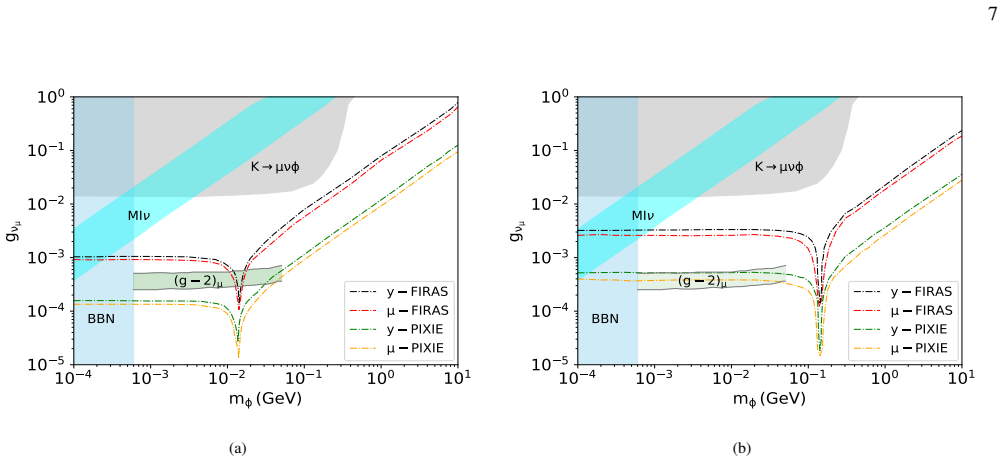
The paper's central claim is that radiative scattering of ultrahigh-energy muon neutrinos on the cosmic neutrino background, mediated by a sub-GeV scalar that couples to both muons and muon neutrinos, injects enough energy into the early intergalactic medium to produce observable $\mu$- and $y$-type CMB spectral distortions, and that the measured or projected limits on those distortions translate into the strongest cosmology-based upper bounds on the flavor-specific self-coupling $g_{\nu_\mu}$ in the sub-GeV mediator-mass range. Concretely, at $E_\nu=1$ PeV with the projected PIXIE $\mu$-distortion sensitivity of $5\times10^{-8}$, the bound is $g_{\nu_\mu}\lesssim3.1\times10^{-5}$ in the scenario $g_\mu=5\times10^{-4}$ that addresses the muon $g-2$ anomaly; in the equal-coupling case $g_{\nu_\mu}=g_\mu$, the PIXIE $\mu$- and $y$-distortion bounds are $1.3\times10^{-4}$ and $1.5\times10^{-4}$. The bounds stay flat for mediator masses below the center-of-mass energy $\sqrt{s}\approx\sqrt{2m_{\nu_\mu}E_\nu}$, show a resonance kink near $m_\phi\approx\sqrt{s}$, and then relax in proportion to $m_\phi$ at higher masses. The paper concludes that CMB spectral distortion is a strong and complementary probe, with PIXIE improving on FIRAS by one to three orders of magnitude.
Load-bearing premise
The results assume that the entire dark-matter density is converted, with unit efficiency and no delay, into ultrahigh-energy muon neutrinos whose density scales as $(1+z)^3$ at every redshift, and that the one-loop cross-section formula is used at face value; if the parent lifetime is finite, the conversion fraction is lower, or the cross-section normalization is corrected, all quoted bounds shift.
Editorial extensions
If this is right
- At $E_\nu=1$ PeV and with $g_\mu=5\times10^{-4}$, the PIXIE $\mu$-distortion sensitivity of $5\times10^{-8}$ gives $g_{\nu_\mu}\lesssim3.1\times10^{-5}$, roughly two orders of magnitude tighter than the FIRAS-based limit.
- The limits are flat for $m_\phi\ll\sqrt{s}$, show a resonance kink at $m_\phi\approx\sqrt{s}$, and relax in proportion to $m_\phi$ above resonance, so the probe is strongest for sub-GeV mediators.
- Raising the UHE neutrino energy from 1 PeV to 100 PeV shifts the resonance to heavier mediators and relaxes the coupling bounds by roughly an order of magnitude, e.g. the PIXIE $\mu$-distortion bound becomes $3.6\times10^{-4}$ at 100 PeV in the $g_\mu=5\times10^{-4}$ scenario.
- Because the energy injection scales as $(g_\mu g_{\nu_\mu})^2$, a null PIXIE measurement constrains the product of the muon and neutrino couplings, not just the neutrino coupling alone.
- The resulting constraints occupy parameter space complementary to BBN, rare kaon decay, and the Hubble-tension and muon $g-2$ explanations, so PIXIE could discriminate among those scenarios.
Reading between the lines
- Read properly, the bounds constrain $f_\chi(g_\mu g_{\nu_\mu})^2$ rather than $g_{\nu_\mu}$ alone: if the UHE neutrino density is normalized to the observed IceCube or KM3NeT diffuse flux instead of $f_\chi=1$, the early-universe injection rate drops and all quoted bounds weaken by a factor $(f_\chi)^{1/4}$.
- The same machinery should apply to electron- or tau-flavored self-interactions; replacing the muon mass and couplings in the loop would give a parallel set of PIXIE-era bounds, though the charged-lepton mass changes the loop function and the resonance position.
- A dedicated computation of the distortion in the intermediate epoch $z\sim10^5$, where neither the pure $\mu$ nor the pure $y$ approximation holds, could add independent leverage and resolve how the two bound regimes connect.
Editorial analysis
A structured set of objections, weighed in public.
Referee Report
Summary. The paper computes the CMB spectral distortions (μ- and y-type) generated by radiative scattering of ultra-high-energy muon neutrinos with the cosmic neutrino background, mediated by a light scalar boson. The UHE neutrinos are assumed to originate from super-heavy dark matter decay. Using COBE/FIRAS limits and PIXIE projected sensitivities, the authors derive upper bounds on the scalar-neutrino coupling g_νμ as a function of mediator mass for the cases g_νμ=g_μ and g_νμ≠g_μ. The headline results are bounds of order 10^-4 for 1 PeV neutrinos with PIXIE, improving on FIRAS by one to two orders of magnitude, with the strongest quoted bound g_νμ ~ 3×10^-5 for the g_μ=5×10^-4 benchmark.
Significance. The mechanism is plausible and the spectral-distortion framework is standard; if the normalization were robust, the derived constraints would make CMB spectral distortion a competitive probe of muon-philic neutrino self-interactions. The paper is transparent about its assumptions, explicitly setting f_χ=1, and the constraints are genuine inequality inversions of the forward calculation rather than fits, so there is no circularity. However, the central numbers depend on an unphysical normalization of the UHE neutrino abundance in a decaying-DM model, and the quoted bounds are likely to shift when the decay lifetime is included. The qualitative conclusion that spectral distortions can probe these couplings is defensible, but the specific headline values need revision.
major comments (2)
- [Sec. III, Eq. (8)] The energy injection rate is computed with f_χ=1 and a UHE neutrino density that scales as (1+z)^3 at all redshifts. This is inconsistent with the stated origin of the neutrinos as decay products of super-heavy dark matter. For a two-body decay with lifetime τ, the daughter-neutrino density at redshift z is proportional to [1−exp(−t(z)/τ)], not to the assumed (1+z)^3 factor. At the μ-distortion epoch z∼10^5, t(z)∼10^2 yr, so for τ∼10^10 yr (typical in decaying-DM interpretations of IceCube) the density is suppressed by ∼10^-8 relative to Eq. (8). Because σ∝g_νμ^4, the μ-type bounds weaken by roughly two orders of magnitude and the y-type bounds by one order. The headline bound in the abstract (3.1×10^-5) is therefore not a robust prediction of the decaying-DM scenario. The authors should either include the decay factor in Eq. (8) or explicitly qualify the results as bounds on a hypothetical, maximally abundant UHE neutrino population that is not produced by the decaying DM described in Sec. II.
- [Sec. III, Eq. (8)] The assumed present-day UHE neutrino density with f_χ=1 and m_χ≳PeV corresponds to an isotropic local flux many orders of magnitude above the IceCube-observed diffuse flux, and the relativistic decay products cannot act as cold dark matter. The manuscript does not check consistency with IceCube or with structure-formation requirements. Without this check, the bounds in Figs. 4–6 are best interpreted as constraints on the product f_χ σ rather than on g_νμ alone. Please add a discussion of how the assumed abundance relates to current neutrino-flux measurements, or fold the allowed f_χ into the reported limits.
minor comments (6)
- [Sec. II, Eq. (2)] The decay width definition Γ_ϕ=m_ϕ g_μ g_νμ/(4π) is unusual; for a scalar with Yukawa couplings to muons and neutrinos, the total width should be the sum of quadratic partial widths for each open channel. Please clarify whether this is an effective width or a typo, as it affects the on-resonance cross-section.
- [Sec. II, Eq. (2)] The cross-section formula in Eq. (2) has a factor s in the numerator, giving the correct mass dimension GeV^-2 as used in Fig. 2; if the typesetting in the published version masks this, please make the division explicit.
- [Abstract] The abstract quotes g_νμ ∼ 3.1×10^-5 without specifying the benchmark g_μ = 5×10^-4; since the bounds vary by orders of magnitude with g_μ (e.g., g_νμ ≲ 1.7×10^-7 for g_μ=0.1), the abstract should state the assumed value of g_μ.
- [Sec. IV, Eq. (11)] The sentence 'The evolution of µ with redshift z can be written as [75]' appears twice in the vicinity of Eqs. (11)-(12); the duplicate should be removed.
- [Sec. IV, Eq. (14)] The y-type distortion is plotted only down to z=10^3 in Fig. 2b, while the integral in Eq. (14) formally extends to low redshift; please specify the lower integration limit used in the numerical calculation.
- [Sec. II] The choice m_νμ ≈ 0.1 eV for the cosmic neutrino background mass should be justified with an explicit reference, since current mass limits allow a lighter heaviest mass eigenstate.
Circularity Check
No circularity: the bounds are forward-model inversions against external FIRAS/PIXIE limits; the sole self-citation supplies standard mu/y kernels also attributed to external references.
full rationale
The derivation chain is self-contained in the relevant sense: no parameter is fitted to the distortion data. The cross-section (Eq. 2) is imported from external references [29,48,64,65]; the interaction rate (Eq. 5) follows from n_nu_mu sigma; the energy injection (Eq. 8) multiplies by the assumed UHE neutrino density n_nu,0 = f_chi Omega_chi rho_c / m_chi, with f_chi = 1 stated explicitly as an assumption; and the mu- and y-type distortions are computed with the standard kernels (Eqs. 9-14), attributed to external Refs. [51,52] as well as to the authors' own Ref. [70]. The comparison against COBE/FIRAS and PIXIE is a genuine inequality inversion, not a definitional identity. Ref. [70] is by three of the present authors, but it is cited alongside external Refs. [51,52] for conventional mu/y evolution equations; it supplies no uniqueness theorem, does not forbid alternatives, and its content is not the target neutrino-coupling bound, so it is not load-bearing. The f_chi = 1 normalization and the mass dimension of Eq. (2) are physical assumptions or possible correctness issues, not circular reductions; correcting them would shift the quoted bounds, but no output is equivalent to an input by construction.
Assumptions & free parameters
free parameters (4)
- f_chi (fraction of dark matter converted into UHE neutrinos) =
1 (set to its maximum, not inferred)
- m_nu_mu (mass of the background muon neutrino) =
0.1 eV
- E_nu (UHE neutrino energy) =
1 PeV and 100 PeV
- g_mu (muon-scalar coupling) =
g_nu_mu (equal case), 0.1, or 5x10^-4
assumptions (5)
- domain assumption The radiative neutrino-neutrino to gamma-gamma cross-section of Eq. (2), imported from Refs [29,48,64,65], is correct as printed with dimensionless couplings g_nu_mu and g_mu.
- ad hoc to paper The UHE neutrino population tracks (1+z)^3 at all epochs with f_chi = 1 and no parent decay-width factor.
- domain assumption The cosmic neutrino background is non-relativistic with s = 2 m_nu_mu E_nu and Moller velocity v_M = 1.
- domain assumption All energy injected as photons distorts the CMB spectrum with unit efficiency, and the standard mu-type and y-type Green's functions of Sec. IV apply with no intermediate-redshift interpolation.
- standard math Standard cosmological parameters (Omega_b h^2 = 0.0224, z_dc = 1.11x10^7, the critical density, and the Hubble rate) enter the distortion integrals.
invented entities (1)
-
Light scalar mediator phi with flavor-specific couplings to muon neutrinos (g_nu_mu) and to muons (g_mu)
independent evidence
Cite this review
Pith. "Pith review of Constraining self-interacting ultrahigh-energy muon neutrinos by cosmic microwave background spectral distortion." pith.science (2026). https://pith.science/paper/62HCHKA4
@misc{pith2026250624110,
  author       = {Pith},
  title        = {Pith review of: Constraining self-interacting ultrahigh-energy muon neutrinos by cosmic microwave background spectral distortion},
  year         = {2026},
  howpublished = {\url{https://pith.science/paper/62HCHKA4}},
  note         = {Machine review of arXiv:2506.24110}
}
abstract
The neutrino telescopes have firmly established the existence of ultrahigh-energy neutrinos. Observations of these neutrinos offer a unique probe of neutrino self-interactions. This work investigates how the self-interacting neutrinos, mediated by scalar bosons, inject energy into the medium through radiative scattering with the cosmic neutrino background, leaving an imprint on the cosmic microwave background (CMB) spectrum. The energy injection into plasma in redshift ranges, $5\times10^4\lesssim z\lesssim2\times10^6$ and $ z\lesssim5\times10^4$, leads to $\mu$-type and $y$-type CMB spectral distortions, respectively. Using observational constraints from Cosmic Background Explorer/Far Infrared Absolute Spectrophotometer (COBE/FIRAS) and projected sensitivities from Primordial Inflation Explorer (PIXIE) experiments for $\mu$-type and $y$-type CMB distortions, we derive the stringent upper bounds on the self-interaction coupling strength as a function of mediator mass for neutrino interactions. We focus on flavor-specific self-interaction related to muon neutrinos and sub-GeV mass mediators ($m_{\phi}$). We find the upper bound on the self-interaction coupling strength to be $\sim 2.8\times 10^{-4}$ for the muon neutrino, considering ultrahigh-energy muon neutrino energy to be 1 PeV and PIXIE projected upper bounds on $y$-type CMB spectral distortion. The bound remains constant till the mediator mass reaches the center-of-mass energy, and after that, it gets relaxed and becomes proportional to the mediator mass. We have also compared our results with existing bounds in the literature. Our findings indicate that CMB spectral distortion could play a decisive role in exploring neutrino physics beyond the standard model of particle physics, and future missions like PIXIE can provide valuable insights.
Figures


Figures from the paper (3 more)


Forward citations
Cited by 1 Pith paper
-
Probing Scalar Non-Standard Neutrino Interactions using High-Energy Astrophysical Neutrinos
IceCube astrophysical neutrino data is analyzed for flavor ratios and spectral shapes to constrain scalar non-standard neutrino interactions via induced pseudo-Dirac behavior.
Reference graph
Works this paper leans on
-
[1]
For UHE neutrinos at 1 PeV , the PIXIE-projected bounds yield gνµ ≲ 1.3× 10⁻⁴ (µ-distortion) and gνµ ≲ 1.5× 10⁻⁴ (y-distortion), improving upon FIRAS con- straints by an order of magnitude
-
[2]
For mϕ≫√s, the constraints relax pro- portionally to mϕ
The bounds remain constant for mϕ ≪ √s (where s ≈ 2mνµEν is the center-of-mass energy) but exhibit a characteristic kink near mϕ ∼ √s, where the cross- 10 section peaks. For mϕ≫√s, the constraints relax pro- portionally to mϕ
-
[3]
Increasing the UHE neutrino energy (e.g., to 100 PeV) shifts the kink to higher mϕ and relaxes the bounds
-
[4]
We also present a scenarios with unequal couplings gνµ , gµ, where gµ = 5× 10⁻⁴ [28], which explains the excess in the anomalous magnetic moment of the muon [81]. In this case, the upper bounds on the coupling pa- rameter found to be 3.1× 10⁻⁵ (µ-type) and 5.2× 10⁻⁵ (y-type) using the PIXIE-projected bounds, which is an improvement on FIRAS bounds by two ...
-
[5]
M ´esz´aros, D
P. M ´esz´aros, D. B. Fox, C. Hanna, and K. Murase, Multi- messenger astrophysics, Nature Reviews Physics 1, 585–599 (2019)
2019
-
[6]
Salesa Greus and A
F. Salesa Greus and A. S ´anchez Losa, Multimessenger astron- omy with neutrinos, Universe 7, 397 (2021)
2021
-
[7]
Gu ´epin, K
C. Gu ´epin, K. Kotera, and F. Oikonomou, High-energy neutrino transients and the future of multi-messenger astronomy, Nature Reviews Physics 4, 697 (2022)
2022
-
[8]
Sharma, Multi-messenger connection in high-energy neu- trino astronomy, Universe 10, 326 (2024)
A. Sharma, Multi-messenger connection in high-energy neu- trino astronomy, Universe 10, 326 (2024)
2024
Show all 88 references
-
[9]
Pontecorvo, Mesonium and Antimesonium, Soviet Journal of Experimental and Theoretical Physics 6, 429 (1958)
B. Pontecorvo, Mesonium and Antimesonium, Soviet Journal of Experimental and Theoretical Physics 6, 429 (1958)
1958
-
[10]
Z. Maki, M. Nakagawa, and S. Sakata, Remarks on the Uni- fied Model of Elementary Particles, Progress of Theoretical Physics 28, 870 (1962), https: //academic.oup.com/ptp/article- pdf/28/5/870/5258750/28-5-870.pdf
1962
-
[11]
Pontecorvo, Neutrino Experiments and the Problem of Con- servation of Leptonic Charge, Soviet Journal of Experimental and Theoretical Physics 26, 984 (1968)
B. Pontecorvo, Neutrino Experiments and the Problem of Con- servation of Leptonic Charge, Soviet Journal of Experimental and Theoretical Physics 26, 984 (1968)
1968
-
[12]
J. N. Bahcall and R. Davis, Solar neutrinos: A scientific puzzle, Science 191, 264 (1976), https://www.science.org/doi/pdf/10.1126/science.191.4224.264
1976 doi
-
[13]
A. Y . Smirnov, Neutrino mass and new physics, Journal of Physics: Conference Series 53, 44–82 (2006)
2006
-
[14]
Lesgourgues and S
J. Lesgourgues and S. Pastor, Massive neutrinos and cosmol- ogy, Physics Reports 429, 307 (2006)
2006
-
[15]
Ashie et al
Y . Ashie et al. (The Super-Kamiokande Collaboration), Evi- dence for an oscillatory signature in atmospheric neutrino os- cillations, Phys. Rev. Lett. 93, 101801 (2004)
2004
-
[16]
Ashie et al
Y . Ashie et al. (Super-Kamiokande Collaboration), Measure- ment of atmospheric neutrino oscillation parameters by super- kamiokande i, Phys. Rev. D 71, 112005 (2005)
2005
-
[17]
Aharmim et al
B. Aharmim et al. (SNO Collaboration), Electron energy spec- tra, fluxes, and day-night asymmetries of 8b solar neutrinos from measurements with nacl dissolved in the heavy-water de- tector at the sudbury neutrino observatory, Phys. Rev. C 72, 055502 (2005)
2005
-
[18]
Aharmim et al
B. Aharmim et al. (SNO Collaboration), Search for periodici- ties in the 8b solar neutrino flux measured by the sudbury neu- trino observatory, Phys. Rev. D72, 052010 (2005)
2005
-
[19]
Abbasi et al
R. Abbasi et al. (IceCube), The IceCube high-energy start- ing event sample: Description and flux characterization with 7.5 years of data, Phys. Rev. D 104, 022002 (2021), arXiv:2011.03545 [astro-ph.HE]
2021
-
[20]
Abbasi et al
R. Abbasi et al. (IceCube), Observation of high-energy neu- trinos from the Galactic plane, Science 380, adc9818 (2023), arXiv:2307.04427 [astro-ph.HE]
2023
-
[21]
Sclafani et al
S. Sclafani et al. (IceCube), Observation of High-Energy Neu- trinos from the Galactic Plane, PoS ICRC2023, 1108 (2023), arXiv:2307.14842 [astro-ph.HE]
2023 arXiv
-
[22]
, Observation of an ultra- high-energy cosmic neutrino with KM3NeT, Nature 638, 376 (2025)
The KM3NeT Collaboration et al. , Observation of an ultra- high-energy cosmic neutrino with KM3NeT, Nature 638, 376 (2025)
2025
-
[23]
Esteban, S
I. Esteban, S. Pandey, V . Brdar, and J. F. Beacom, Probing secret interactions of astrophysical neutrinos in the high-statistics era, Phys. Rev. D 104, 123014 (2021), arXiv:2107.13568 [hep-ph]
2021 arXiv
-
[24]
J. A. Carpio, K. Murase, I. M. Shoemaker, and Z. Tabrizi, High- energy cosmic neutrinos as a probe of the vector mediator sce- nario in light of the muon g-2 anomaly and Hubble tension, Phys. Rev. D 107, 103057 (2023), arXiv:2104.15136 [hep-ph]
2023 arXiv
-
[25]
Bustamante, C
M. Bustamante, C. Rosenstrøm, S. Shalgar, and I. Tam- borra, Bounds on secret neutrino interactions from high-energy astrophysical neutrinos, Phys. Rev. D 101, 123024 (2020), arXiv:2001.04994 [astro-ph.HE]
2020 arXiv
-
[26]
Mazumdar, S
A. Mazumdar, S. Mohanty, and P. Parashari, Flavour specific neutrino self-interaction: H 0 tension and IceCube, JCAP 10, 011, arXiv:2011.13685 [hep-ph]
2011 arXiv
-
[27]
De Gouv ˆea, M
A. De Gouv ˆea, M. Sen, W. Tangarife, and Y . Zhang, Dodelson- Widrow Mechanism in the Presence of Self-Interacting Neu- trinos, Phys. Rev. Lett. 124, 081802 (2020), arXiv:1910.04901 [hep-ph]
2020 arXiv
-
[28]
K. J. Kelly, M. Sen, W. Tangarife, and Y . Zhang, Origin of sterile neutrino dark matter via secret neutrino interac- tions with vector bosons, Phys. Rev. D 101, 115031 (2020), arXiv:2005.03681 [hep-ph]
2020 arXiv
-
[29]
Benso, W
C. Benso, W. Rodejohann, M. Sen, and A. U. Ramachandran, Sterile neutrino dark matter production in presence of nonstan- dard neutrino self-interactions: An EFT approach, Phys. Rev. D 105, 055016 (2022), arXiv:2112.00758 [hep-ph]
2022 arXiv
-
[30]
Dhuria and A
M. Dhuria and A. Pradhan, Synergy between Hubble ten- sion motivated self-interacting neutrinos and KeV-sterile neutrino dark matter, Phys. Rev. D 107, 123030 (2023), arXiv:2301.09552 [hep-ph]
2023 arXiv
-
[31]
C. D. Kreisch, F.-Y . Cyr-Racine, and O. Dor´e, Neutrino puzzle: Anomalies, interactions, and cosmological tensions, Phys. Rev. D 101, 123505 (2020), arXiv:1902.00534 [astro-ph.CO]. 11
2020 arXiv
-
[32]
J. Liu, N. McGinnis, C. E. M. Wagner, and X.-P. Wang,ν scalar in the early universe and ( g− 2)µ, Phys. Rev. D 105, L051702 (2022)
2022
-
[33]
Dhuria, Grb221009a gamma-ray events from nonstandard neutrino self-interactions, Phys
M. Dhuria, Grb221009a gamma-ray events from nonstandard neutrino self-interactions, Phys. Rev. D 109, 063007 (2024)
2024
-
[34]
Gu ´epin, R
C. Gu ´epin, R. Aloisio, L. A. Anchordoqui, A. Cummings, J. F. Krizmanic, A. V . Olinto, M. H. Reno, and T. M. Venters, Prob- ing the properties of superheavy dark matter annihilating or de- caying into neutrinos with ultra-high energy neutrino experi- ments, PoS ICRC2021, 551...
2021 arXiv
-
[35]
K. V . Berghaus, D. Hooper, and E. R. Simon, Searching For Su- perheavy Decaying Particles With Ultra-High-Energy Neutrino Observatories, (2025), arXiv:2502.12238 [hep-ph]
2025 arXiv
-
[36]
Kachelriess, O
M. Kachelriess, O. E. Kalashev, and M. Y . Kuznetsov, Heavy decaying dark matter and IceCube high energy neutrinos, Phys. Rev. D 98, 083016 (2018), arXiv:1805.04500 [astro-ph.HE]
2018 arXiv
-
[37]
M. G. Aartsen et al. (IceCube), Constraints on Ultrahigh- Energy Cosmic-Ray Sources from a Search for Neutrinos above 10 PeV with IceCube, Phys. Rev. Lett.117, 241101 (2016), [Er- ratum: Phys.Rev.Lett. 119, 259902 (2017)], arXiv:1607.05886 [astro-ph.HE]
2016 arXiv
-
[38]
M. G. Aartsen et al. (IceCube), The IceCube Neutrino Ob- servatory - Contributions to ICRC 2017 Part II: Properties of the Atmospheric and Astrophysical Neutrino Flux, (2017), arXiv:1710.01191 [astro-ph.HE]
2017 arXiv
-
[39]
Bhattacharya, A
A. Bhattacharya, A. Esmaili, S. Palomares-Ruiz, and I. Sarce- vic, Probing decaying heavy dark matter with the 4-year Ice- Cube HESE data, JCAP 07, 027, arXiv:1706.05746 [hep-ph]
-
[40]
M. G. Aartsen et al. (IceCube), Search for neutrinos from decaying dark matter with IceCube, Eur. Phys. J. C 78, 831 (2018), arXiv:1804.03848 [astro-ph.HE]
2018 arXiv
-
[41]
Sui and P
Y . Sui and P. S. Bhupal Dev, A Combined Astrophysical and Dark Matter Interpretation of the IceCube HESE and Through- going Muon Events, JCAP 07, 020, arXiv:1804.04919 [hep- ph]
-
[42]
M. G. Aartsen et al. (IceCube-Gen2), IceCube-Gen2: the win- dow to the extreme Universe, J. Phys. G 48, 060501 (2021), arXiv:2008.04323 [astro-ph.HE]
2021
-
[43]
D. F. G. Fiorillo, V . B. Valera, M. Bustamante, and W. Win- ter, Searches for dark matter decay with ultrahigh-energy neu- trinos endure backgrounds, Phys. Rev. D 108, 103012 (2023), arXiv:2307.02538 [astro-ph.HE]
2023 arXiv
-
[44]
´Alvarez-Mu˜niz et al
J. ´Alvarez-Mu˜niz et al. (GRAND), The Giant Radio Array for Neutrino Detection (GRAND): Science and Design, Sci. China Phys. Mech. Astron. 63, 219501 (2020), arXiv:1810.09994 [astro-ph.HE]
2020 arXiv
-
[45]
A. V . Olinto et al. (POEMMA), The POEMMA (Probe of Ex- treme Multi-Messenger Astrophysics) observatory, JCAP 06, 007, arXiv:2012.07945 [astro-ph.IM]
2012 arXiv
-
[46]
J. A. Aguilar et al. (RNO-G), Design and Sensitivity of the Radio Neutrino Observatory in Greenland (RNO-G), JINST 16 (03), P03025, [Erratum: JINST 18, E03001 (2023)], arXiv:2010.12279 [astro-ph.IM]
2023 arXiv
-
[47]
A. N. Otte, Studies of an air-shower imaging system for the de- tection of ultrahigh-energy neutrinos, Phys. Rev. D 99, 083012 (2019), arXiv:1811.09287 [astro-ph.IM]
2019 arXiv
-
[48]
Neronov, Sensitivity of top-of-the-mountain fluorescence telescope system for astrophysical neutrino flux above 10 PeV, Astropart
A. Neronov, Sensitivity of top-of-the-mountain fluorescence telescope system for astrophysical neutrino flux above 10 PeV, Astropart. Phys. 128, 102549 (2021), arXiv:1905.10606 [astro- ph.HE]
2021 arXiv
-
[49]
Ioka and K
K. Ioka and K. Murase, IceCube PeV–EeV neutrinos and se- cret interactions of neutrinos, PTEP 2014, 061E01 (2014), arXiv:1404.2279 [astro-ph.HE]
2014 arXiv
-
[50]
I. M. Oldengott, T. Tram, C. Rampf, and Y . Y . Y . Wong, In- teracting neutrinos in cosmology: exact description and con- straints, JCAP 11, 027, arXiv:1706.02123 [astro-ph.CO]
-
[51]
Blinov, K
N. Blinov, K. J. Kelly, G. Z. Krnjaic, and S. D. McDer- mott, Constraining the Self-Interacting Neutrino Interpretation of the Hubble Tension, Phys. Rev. Lett. 123, 191102 (2019), arXiv:1905.02727 [astro-ph.CO]
2019 arXiv
-
[52]
Dhuria and B
M. Dhuria and B. Gupta Teli, Probing self-interacting ultrahigh- energy neutrinos with the cosmic 21-cm signal, Phys. Rev. D 110, 123033 (2024)
2024
-
[53]
D. J. Fixsen, E. S. Cheng, J. M. Gales, J. C. Mather, R. A. Shafer, and E. L. Wright, The Cosmic Microwave Background spectrum from the full COBE FIRAS data set, Astrophys. J. 473, 576 (1996), arXiv:astro-ph/9605054
1996 arXiv
-
[54]
J. C. Mather et al. , Measurement of the Cosmic Microwave Background spectrum by the COBE FIRAS instrument, Astro- phys. J. 420, 439 (1994)
1994
-
[55]
Khatri and R
R. Khatri and R. A. Sunyaev, Beyond y and µ: the shape of the cmb spectral distortions in the intermediate epoch, 1.5× 10⁴≤ z≤ 2× 10⁵, Journal of Cosmology and Astroparticle Physics 2012 (09), 016
2012
-
[56]
K. E. Kunze and E. Komatsu, Constraining primordial magnetic fields with distortions of the black-body spectrum of the cos- mic microwave background: pre- and post-decoupling contri- butions, J. Cosmol. Astropart. Phys. 2014 (01), 009
2014
-
[57]
Kogut et al., The Primordial Inflation Explorer (PIXIE): A Nulling Polarimeter for Cosmic Microwave Background Obser- vations, JCAP 07, 025, arXiv:1105.2044 [astro-ph.CO]
A. Kogut et al., The Primordial Inflation Explorer (PIXIE): A Nulling Polarimeter for Cosmic Microwave Background Obser- vations, JCAP 07, 025, arXiv:1105.2044 [astro-ph.CO]
-
[58]
Blinov, K
N. Blinov, K. J. Kelly, G. Krnjaic, and S. D. McDermott, Con- straining the self-interacting neutrino interpretation of the hub- ble tension, Phys. Rev. Lett. 123, 191102 (2019)
2019
-
[59]
Lindner, M
M. Lindner, M. Platscher, and F. S. Queiroz, A Call for New Physics : The Muon Anomalous Magnetic Moment and Lepton Flavor Violation, Phys. Rept. 731, 1 (2018), arXiv:1610.06587 [hep-ph]
2018 arXiv
-
[60]
Capdevilla, D
R. Capdevilla, D. Curtin, Y . Kahn, and G. Krnjaic, System- atically testing singlet models for ( g− 2)µ, JHEP 04, 129, arXiv:2112.08377 [hep-ph]
-
[61]
Krnjaic, G
G. Krnjaic, G. Marques-Tavares, D. Redigolo, and K. Tobioka, Probing muonphilic force carriers and dark matter at kaon fac- tories, Phys. Rev. Lett. 124, 041802 (2020)
2020
-
[62]
Blinov, S
N. Blinov, S. Gori, and N. Hamer, Diphoton signals of muon- philic scalars at DarkQuest, Phys. Rev. D 110, 075006 (2024), arXiv:2405.17651 [hep-ph]
2024 arXiv
-
[63]
Caputo, G
A. Caputo, G. Ra ffelt, and E. Vitagliano, Muonic boson lim- its: Supernova redux, Phys. Rev. D 105, 035022 (2022), arXiv:2109.03244 [hep-ph]
2022 arXiv
-
[64]
Forbes, C
D. Forbes, C. Herwig, Y . Kahn, G. Krnjaic, C. Mantilla Suarez, N. Tran, and A. Whitbeck, New searches for muonphilic par- ticles at proton beam dump spectrometers, Phys. Rev. D 107, 116026 (2023), arXiv:2212.00033 [hep-ph]
2023 arXiv
-
[65]
Y . Jho, Y . Kwon, S. C. Park, and P.-Y . Tseng, Search for muon-philic new light gauge boson at Belle II, JHEP 10, 168, arXiv:1904.13053 [hep-ph]
1904 arXiv
-
[66]
Zhu and X
B. Zhu and X. Liu, Probing the flavor-specific scalar mediator for the muon (g — 2) deviation, the proton radius puzzle and the light dark matter production, Sci. China Phys. Mech. Astron. 65, 231011 (2022), arXiv:2104.03238 [hep-ph]
2022 arXiv
-
[67]
Cesarotti, Y
C. Cesarotti, Y . Kahn, G. Krnjaic, D. Rocha, and J. Spitz, New µ forces from νµ sources, Phys. Rev. D 110, 055032 (2024), arXiv:2311.10829 [hep-ph]
2024 arXiv
-
[68]
Fileviez P ´erez and C
P. Fileviez P ´erez and C. Murgui, Gamma lines from the hidden sector, Phys. Rev. D 100, 123007 (2019). 12
2019
-
[69]
Duerr, P
M. Duerr, P. Fileviez P´erez, and J. Smirnov, Gamma lines from majorana dark matter, Phys. Rev. D 93, 023509 (2016)
2016
-
[70]
I. J. Araya and N. D. Padilla, Dark matter annihila- tion energy output and its e ffects on the high-z igm, Monthly Notices of the Royal Astronomical Society 445, 850 (2014), https: //academic.oup.com/mnras/article- pdf/445/1/850/18468848/stu1780.pdf
2014
-
[71]
D ¨oring and S
C. D ¨oring and S. V ogl, Testing secret interaction with astro- physical neutrino point sources, Journal of Cosmology and As- troparticle Physics 2024 (07), 015
2024
-
[72]
D ¨oring and S
C. D ¨oring and S. V ogl, Testing secret interaction with astrophysical neutrino point sources, JCAP 07, 015, arXiv:2304.08533 [hep-ph]
-
[73]
Sarkar, Cosmological implications of neutrinos, Nuclear Physics B - Proceedings Supplements 66, 168 (1998), proceed- ings of the XVI Workshop on Weak Interactions and Neutrinos
S. Sarkar, Cosmological implications of neutrinos, Nuclear Physics B - Proceedings Supplements 66, 168 (1998), proceed- ings of the XVI Workshop on Weak Interactions and Neutrinos
1998
-
[74]
S. Si, A. C. Nayak, and P. K. Natwariya, Constraining viscous dark matter in light of cmb spectral distortion, Phys. Rev. D 111, 043002 (2025)
2025
-
[75]
Tashiro, E
H. Tashiro, E. Sabancilar, and T. Vachaspati, Cmb distortions from superconducting cosmic strings, Phys. Rev. D 85, 103522 (2012)
2012
-
[76]
Chluba, R
J. Chluba, R. Khatri, and R. A. Sunyaev, CMB at 2x2 order: The dissipation of primordial acoustic waves and the observable part of the associated energy release, Mon. Not. Roy. Astron. Soc. 425, 1129 (2012), arXiv:1202.0057 [astro-ph.CO]
2012 arXiv
-
[77]
S. Si, V . Mohapatra, P. k. Natwariya, and A. C. Nayak, Re- visiting constraints on superconducting cosmic strings in light of Dark Ages global 21-cm signal, (2025), arXiv:2504.02947 [astro-ph.CO]
2025
-
[78]
Pajer and M
E. Pajer and M. Zaldarriaga, A hydrodynamical approach to CMB µ-distortion from primordial perturbations, JCAP 02, 036, arXiv:1206.4479 [astro-ph.CO]
-
[79]
K. E. Kunze and E. Komatsu, Constraining primordial magnetic fields with distortions of the black-body spectrum of the cos- mic microwave background: pre- and post-decoupling contri- butions, JCAP 01, 009, arXiv:1309.7994 [astro-ph.CO]
-
[80]
R. A. Sunyaev and Y . B. Zeldovich, The Interaction of matter and radiation in the hot model of the universe, Astrophys. Space Sci. 7, 20 (1970)
1970
-
[81]
S. K. Acharya and R. Khatri, CMB spectral distortions con- straints on primordial black holes, cosmic strings and long lived unstable particles revisited, JCAP 02, 010, arXiv:1912.10995 [astro-ph.CO]
1912 arXiv
-
[82]
J. M. Wagstaff and R. Banerjee, CMB spectral distortions from the decay of causally generated magnetic fields, Phys. Rev. D 92, 123004 (2015), arXiv:1508.01683 [astro-ph.CO]
2015 arXiv
-
[83]
Uchida, K
F. Uchida, K. Kamada, and H. Tashiro, Revisiting constraints on primordial magnetic fields from spectral distortions of cos- mic microwave background, Phys. Lett. B 865, 139456 (2025), arXiv:2411.03183 [astro-ph.CO]
2025 arXiv
-
[84]
Lancaster, F.-Y
L. Lancaster, F.-Y . Cyr-Racine, L. Knox, and Z. Pan, A tale of two modes: neutrino free-streaming in the early universe, Jour- nal of Cosmology and Astroparticle Physics 2017 (07), 033
2017
-
[85]
Abi et al
B. Abi et al. (Muon g− 2 Collaboration), Measurement of the positive muon anomalous magnetic moment to 0.46 ppm, Phys. Rev. Lett. 126, 141801 (2021)
2021
-
[86]
Jana and S
S. Jana and S. Klett, Muonic force and nonstandard neutrino in- teractions at muon colliders, Phys. Rev. D 110, 095011 (2024), arXiv:2308.07375 [hep-ph]
2024 arXiv
-
[87]
J. M. Berryman et al., Neutrino self-interactions: A white pa- per, Phys. Dark Univ. 42, 101267 (2023), arXiv:2203.01955 [hep-ph]
2023 arXiv
-
[88]
J. Liu, N. McGinnis, C. E. M. Wagner, and X.-P. Wang,ν scalar in the early Universe and (g-2) µ, Phys. Rev. D 105, L051702 (2022), arXiv:2110.14665 [hep-ph]
2022 arXiv
Reviewed August 6, 2026 · model on record in the stance chip above.
Discussion (0). Sign in to comment.