REVIEW 4 major objections 6 minor 2 cited by
TextMesh4D: Zero-shot Text-to-4D Mesh Generation
T0 review · 4 major / 6 minor · reviewed 2026-08-06 · deepseek-v4-flash
Pith's one-line read TextMesh4D claims the first zero-shot method to generate dynamic, CG-ready meshes directly from text prompts, bypassing NeRF and Gaussian conversions.
desk verdict Real idea (per-face Jacobian deformation for text-to-4D), but Eq. (4) fights the static stage, the 'first' claim is false by their own citation list, and the quantitative support is thin. read the letter →
The pith
A machine-rendered reading of the paper's core claim, the machinery that carries it, and where it could break.
The reading
What carries the argument
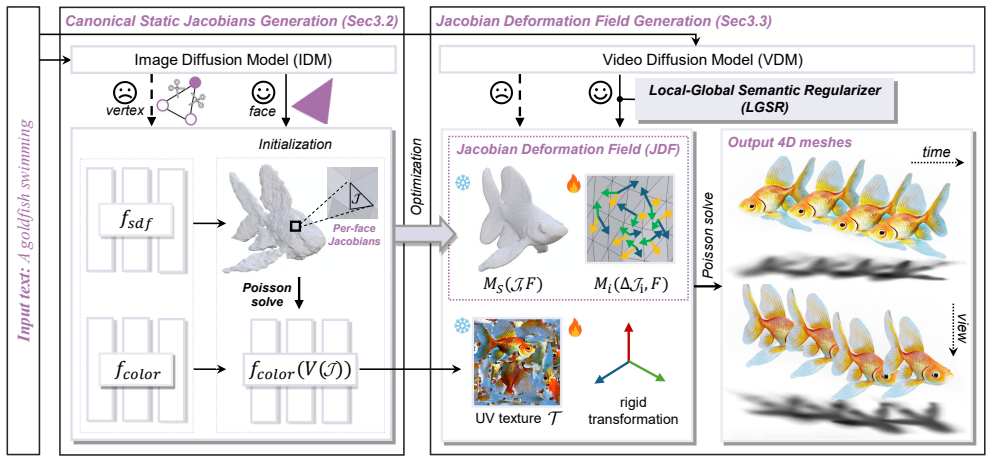
The core object is the Jacobian Deformation Field (JDF), a mesh representation in which each triangular face carries a 3x3 Jacobian matrix as its deformation parameter instead of the usual vertex positions. A differentiable Poisson solver reconstructs the vertex deformation map that best matches the target Jacobians, so optimization operates on per-face transformations and the surface is rebuilt as a whole, which the paper claims yields smooth, topology-consistent motion. The companion Local-Global Semantic Regularizer (LGSR) adds an ARAP local rigidity term and a global Jacobian drift penalty to keep identity stable across frames.
What would settle it
Run the method on prompts that require severe topology change, such as “an explosion of a ball” where the object fragments into many pieces, and check whether the fixed-topology mesh can represent the motion without tearing or collapsing; if the surface always breaks, the claim of topology-free deformation is bounded to moderate deformations. A second test would deliberately degrade the static stage, for instance by cutting its optimization iterations, and verify whether the dynamic stage amplifies the error as the limitations section states.
Extended reading notes
Core claim
On the paper's own terms, the central discovery is that a fixed-topology mesh can express complex, temporally consistent motion if deformation is parameterized by per-face Jacobians rather than vertex displacements, and if the resulting surface is rebuilt through an integrability-enforcing Poisson solve. The paper pairs this Jacobian Deformation Field with a Local-Global Semantic Regularizer that combines an as-rigid-as-possible local term with a global Jacobian drift penalty, arguing that this joint constraint counteracts the semantic inconsistency that plagues distilled video priors. The authors report state-of-the-art temporal consistency, structural fidelity, and visual quality in comparisons with NeRF- and 3DGS-based text-to-4D baselines, and show that the full pipeline fits within 24GB of GPU memory.
Load-bearing premise
The whole pipeline assumes the static NeuS-initialized mesh is a faithful, clean base asset; if the static composition is unsatisfactory, the dynamic stage propagates and amplifies that error, and no amount of deformation regularization can rescue it.
Editorial extensions
If this is right
- If the claim holds, artists can obtain animated, UV-textured meshes directly from text prompts, with no lossy conversion from implicit representations.
- A single 24GB GPU suffices for the full text-to-4D mesh pipeline, lowering the hardware barrier for 4D content creation.
- The two-stage design means improvements in text-to-3D generation could directly translate into better text-to-4D results.
- The per-face Jacobian parameterization is a reusable deformation primitive that could extend to controllable animation and mesh editing beyond generation.
- The framework provides a benchmark for future mesh-centric 4D methods to compare against in structure fidelity, temporal coherence, and memory cost.
Reading between the lines
- The claim that JDF surpasses vertex-based and rigging-based deformation is demonstrated on a flag-fluttering ablation; a broader evaluation with prompts involving liquid, cloth, and articulated limbs would better bound the types of motion the representation can express.
- The paper's own limitation statement implies that fixing the static stage will improve the whole pipeline more than refining the deformation regularizers, which suggests a concrete research direction for follow-up work.
- The fixed-topology mesh may still fail on prompts requiring severe topological change, such as explosions or objects shattering, and testing on those prompts would clarify whether the method's 'topology-free' claim holds beyond moderate deformations.
Editorial analysis
A structured set of objections, weighed in public.
Referee Report
Summary. TextMesh4D proposes a two-stage zero-shot text-to-4D mesh generation framework. Stage 1 (Sec. 3.2) initializes a mesh from a NeuS SDF field and then refines geometry and texture by optimizing a per-face Jacobian field under SDS guidance from multi-view and 2D image diffusion models. Stage 2 (Sec. 3.3) fixes the static mesh and optimizes per-frame delta Jacobians and rigid transformations under VDS guidance from a video diffusion model, adding a Local-Global Semantic Regularizer (LGSR) consisting of an ARAP-style local rigidity term (Eq. 5) and a global Jacobian-preservation term (Eq. 4). The output is a sequence of textured meshes. The method is evaluated with CLIP score, GPT-4V selection, and a 31-participant user study against a mix of NeRF-based, Gaussian-based, and mesh-based baselines, and it claims state-of-the-art temporal consistency, structural fidelity, and visual quality.
Significance. If the proposed representation and optimization work as intended, the paper addresses a genuine gap: direct zero-shot text-to-4D mesh generation, avoiding the lossy conversion from NeRF or 3DGS and enabling CG-ready animated meshes. The Jacobian Deformation Field (JDF) is a principled response to the topological constraints of vertex-based deformation, and the two-stage pipeline on a single 24GB GPU is an attractive practical contribution. The paper also credits the important limitation that dynamic-stage errors depend on static-stage success (Limitations section). However, the central global regularizer in Eq. (4) appears internally inconsistent with the two-stage design, and the quantitative evidence is substantially weaker than the abstract's state-of-the-art claim. As the manuscript stands, the core claim is defensible in principle but requires correction and far stronger empirical support.
major comments (4)
- [Sec. 3.3, Eq. (4)] The global regularizer L_G-SR penalizes ||hat{J}_j - I||^2 with an exponential weight, where hat{J}_j is the combined dynamic Jacobian and I is the identity matrix. In Stage 1 (Sec. 3.2), the static Jacobians J_j are initialized as identity and then optimized to refine the NeuS initialization; hence J_j is generally not the identity after the static stage. At the start of Stage 2 (Delta J = 0), the gradient of L_G-SR with respect to Delta J is therefore nonzero whenever J_j != I, and the term drives the combined Jacobian back toward the identity. In the limit of large lambda_1, the dynamic sequence collapses toward a rigid repetition of the NeuS-initialized mesh, undoing the static refinement that Sec. 3.2 and Fig. 2 claim to provide. This contradicts the stated purpose of preserving the static object's geometry. Please correct Eq. (4) to penalize hat{J}_j against the static Jacobian J_j (or another clearly defined reference), define hat{J}_j unambiguously, and address the exponential term's instability when J_j deviates from I.
- [Sec. 4.4, Table 1] The central claim of state-of-the-art temporal consistency and visual quality rests on a CLIP-score margin of about 0.4 points (32.32 vs 31.93 for STAG4D and 31.83 for TC4D). No error bars, confidence intervals, per-prompt breakdown, or statistical significance tests are reported, so this difference is within the typical noise range for CLIP-based text-to-4D evaluation. The GPT-4V selection and user-study columns are extremely lopsided (e.g., AQ 56.82% vs 6.23%; overall 43.19% vs 11.65%), but the user study has only 31 participants and no variance or inter-rater statistics. The abstract's 'state-of-the-art' claim is not supported by the quantitative evidence as presented; please add uncertainty measures, significance tests, and a precise description of the prompt set and response aggregation.
- [Sec. 4.2 and Table 1] Table 1 mixes methods with different input modalities and representations: text-only (4D-fy, TC4D, AYG), text/image (Dream-in-4D), image-to-4D (DG4D, L4GM), video-to-4D (L4GM), 3D-to-4D (Puppeteer, 3-to-4D), and text+3D (3-to-4D). CLIP scores, GPT-4V selections, and user preferences across such heterogeneous conditions are not directly comparable. The text-to-4D claim should be evaluated on a condition-matched text-only subset, or the table should clearly separate condition-matched comparisons from broader-context comparisons; otherwise the state-of-the-art conclusion is confounded by input modality and representation.
- [Sec. 4.5 and Table 2] The ablation study validating the two core contributions (JDF and LGSR) is supported only by qualitative figures and a single GPT-4V preference evaluation, with no multiple runs, no standard deviations, and no human rating. The claim that JDF and each LGSR component are indispensable would be much stronger with quantitative metrics such as temporal consistency or geometric error, plus variance estimates. As presented, the ablation evidence is illustrative rather than conclusive.
minor comments (6)
- [Sec. 3.3] The symbol hat{J}_j in Eq. (4) is used without definition; please state explicitly whether it is J_j + Delta J_{i,j} for frame i and face j, or some other quantity.
- [Sec. 3.2] The notation 'M_s = {V0 + J, F, T}' is formally confusing because V0 is a vertex set and J is a per-face Jacobian; please clarify that the Poisson integration reconstructs vertex displacements from the Jacobian field.
- [Algorithm 1 and Sec. 3.3] The losses L_smooth and L_dof appear in Algorithm 1 with weights lambda_3 and lambda_4, but they are not defined in the main text; please add a one-line definition or an explicit pointer to the supplementary material where these terms are specified.
- [Sec. 4.1 and Table 1] Section 4.1 states that optimization runs on an NVIDIA RTX 6000 GPU, while Table 1 lists 'Ours' as '1 * A5000 24GB'; these hardware descriptions should be made consistent.
- [Sec. 4.3] The qualitative comparison with DreamGaussian4D uses images generated from the text prompt by a separate text-to-image model as input; this protocol should be stated as a limitation or a condition mismatch, since it adds an extra generation step that is not part of the text-to-4D setting.
- [Sec. 1 and Sec. 4.2] The claim that TextMesh4D is the 'first zero-shot framework for text-to-4D that directly generates dynamic meshes' should be reconciled with CT4D [9], which the paper itself cites as consistent text-to-4D generation with animatable meshes; at minimum, the novelty claim should be circumscribed given CT4D's existence even if its code is unavailable.
Circularity Check
No significant circularity: the evaluation is external to the optimization, and the only self-citation is a non-load-bearing GPT-4V protocol reference.
full rationale
The derivation chain is self-contained. In the static stage, a NeuS-initialized mesh is optimized under SDS/VSD guidance from external image and multi-view diffusion priors, producing canonical per-face Jacobians. In the dynamic stage, delta Jacobians and rigid transformations are optimized under video score distillation with local and global regularizers. No claimed prediction reduces by construction to a fitted input: CLIP score, GPT-4V selection, and user studies are all external measurements of the final rendered outputs, and the regularizer ablations demonstrate engineering choices rather than circular derivation. The only self-citation is InterFusion [14] for the GPT-4V evaluation protocol; since GPT-4V is an independent external model and the protocol is stated to be zero-shot with no in-context examples, this citation is not load-bearing for the core method. The Limitations paragraph correctly acknowledges that errors in the static stage propagate into the dynamic stage; this is a dependency, not circularity. One internal-consistency concern is noted but is not a circularity finding: Eq. (4) writes LG-SR as penalizing ||J_hat_j - I|| while the surrounding text says the term prevents divergence from the static object's geometry. If J_hat_j denotes the dynamic Jacobian J_j + delta_J_ij, the term penalizes deviation from identity rather than from the static Jacobian J_j, which could bias the sequence back toward the NeuS initialization. This is a potential bug or notation ambiguity, not a reduction of the method's output to its inputs. Therefore no step meets the threshold for a circularity finding.
Assumptions & free parameters
free parameters (3)
- Static-stage loss weights lambda_3D, lambda_2D =
0.7/0.3 during initialization, 0.5/0.5 after refinement
- Dynamic-stage regularizer weights lambda_1, lambda_2, lambda_3, lambda_4 =
0.1, 0.0001, 0.1, 0.1
- Static-stage Ldof weight lambda_0 =
not reported
assumptions (4)
- standard math Per-face Jacobians determine a unique least-squares deformation map via the Poisson equation, and the differentiable Poisson solver layer from Neural Jacobian Fields is reliable.
- domain assumption Video diffusion priors (ZeroScope) provide text-aligned motion semantics that can be distilled into mesh deformations.
- ad hoc to paper The global regularizer's assumption that identity is best preserved by keeping Jacobians near the identity matrix.
- domain assumption The static-stage mesh extraction from NeuS yields a manifold mesh suitable for Jacobian optimization.
Cite this review
Pith. "Pith review of TextMesh4D: Zero-shot Text-to-4D Mesh Generation." pith.science (2026). https://pith.science/paper/3QKHEEIS
@misc{pith2026250624121,
  author       = {Pith},
  title        = {Pith review of: TextMesh4D: Zero-shot Text-to-4D Mesh Generation},
  year         = {2026},
  howpublished = {\url{https://pith.science/paper/3QKHEEIS}},
  note         = {Machine review of arXiv:2506.24121}
}
read the original abstract
Large-scale, high-quality dynamic 3D (4D) assets are essential for learning physically grounded representations, but remain costly to capture and annotate at scale. This limits the viability of supervised 4D learning and motivates zero-shot text-to-4D generation leveraging pretrained diffusion priors. To model complex dynamics, prior methods typically adopt implicit 3D representations (e.g., NeRFs or 3DGS) for their deformation capacity. However, their implicit nature provides limited control over surface topology, which hinders high-fidelity geometry and makes temporally coherent surface reconstruction challenging. To address these limitations, we explore zero-shot text-to-4D mesh generation. However, a structural mismatch arises when combining diffusion-based guidance with topology-constrained meshes: the guidance is noisy and spatially inconsistent, while meshes impose severe topological constraints, making direct vertex-level deformation unstable. In this paper, we introduce TextMesh4D, the first zero-shot framework for text-to-4D that directly generates dynamic meshes by addressing the above challenge at two complementary levels. Geometrically, we shift deformation modeling from vertices to faces via a Jacobian Deformation Field (JDF), enabling topology-aware surface reconstruction through an integrability-enforcing integration formulation. Semantically, we propose a Local-Global Semantic Regularizer (LGSR) that preserves identity over time by jointly constraining local deformation plausibility and global shape consistency. Extensive experiments demonstrate state-of-the-art temporal consistency, structural fidelity, and visual quality, while remaining efficient on a single 24GB GPU.
Figures


Figures from the paper (3 more)


Forward citations
Cited by 2 Pith papers
-
Follow Your Track: Precise Skeleton Animation Controlled by 3D Trajectories
ACT is a trajectory-conditioned framework for topology-general skeletal animation that injects 3D point trajectories from monocular video into skeletons via a Routed Trajectory Injector for improved fidelity and tempo...
-
Advances in 4D Representation: Geometry, Motion, and Interaction
A representation-centric survey of 4D generation and reconstruction, organized by geometry, motion, and interaction, with qualitative trade-off comparisons across seven representation families.
Reference graph
Works this paper leans on
-
[9]
Ce Chen, Shaoli Huang, Xuelin Chen, Guangyi Chen, Xi- aoguang Han, Kun Zhang, and Mingming Gong. Ct4d: Con- sistent text-to-4d generation with animatable meshes.arXiv preprint arXiv:2408.08342, 2024. 6
arXiv 2024
-
[1]
co / cerspense / zeroscope _ v2_576w, 2023
Zeroscope text-to-video model.https : / / huggingface . co / cerspense / zeroscope _ v2_576w, 2023. Accessed: 2023-10-31. 2, 4
work page 2023
-
[2]
Neural jaco- bian fields: Learning intrinsic mappings of arbitrary meshes
Noam Aigerman, Kunal Gupta, Vladimir G Kim, Siddhartha Chaudhuri, Jun Saito, and Thibault Groueix. Neural jaco- bian fields: Learning intrinsic mappings of arbitrary meshes. arXiv preprint arXiv:2205.02904, 2022. 3
arXiv 2022
-
[3]
4d-fy: Text-to-4d generation using hybrid score dis- tillation sampling
Sherwin Bahmani, Ivan Skorokhodov, Victor Rong, Gordon Wetzstein, Leonidas Guibas, Peter Wonka, Sergey Tulyakov, Jeong Joon Park, Andrea Tagliasacchi, and David B Lin- dell. 4d-fy: Text-to-4d generation using hybrid score dis- tillation sampling. InProceedings of the IEEE/CVF Con- ference on Computer Vision and Pattern Recognition, pages 7996–8006, 2024. ...
work page 2024
-
[4]
Tc4d: Trajectory-conditioned text-to-4d generation
Sherwin Bahmani, Xian Liu, Wang Yifan, Ivan Sko- rokhodov, Victor Rong, Ziwei Liu, Xihui Liu, Jeong Joon Park, Sergey Tulyakov, Gordon Wetzstein, et al. Tc4d: Trajectory-conditioned text-to-4d generation. InEuropean Conference on Computer Vision, pages 53–72. Springer,
-
[5]
Frozen in time: A joint video and image encoder for end-to-end retrieval
Max Bain, Arsha Nagrani, G ¨ul Varol, and Andrew Zisser- man. Frozen in time: A joint video and image encoder for end-to-end retrieval. InProc. ICCV, 2021. 2
work page 2021
-
[6]
Andreas Blattmann, Tim Dockhorn, Sumith Kulal, Daniel Mendelevitch, Maciej Kilian, Dominik Lorenz, Yam Levi, Zion English, Vikram V oleti, Adam Letts, et al. Stable video diffusion: Scaling latent video diffusion models to large datasets.arXiv preprint arXiv:2311.15127, 2023. 1
arXiv 2023
-
[7]
Hexplane: A fast representa- tion for dynamic scenes
Ang Cao and Justin Johnson. Hexplane: A fast representa- tion for dynamic scenes. InProceedings of the IEEE/CVF Conference on Computer Vision and Pattern Recognition, pages 130–141, 2023. 2
2023
Show all 69 references
-
[8]
Dreamavatar: Text-and-shape guided 3d hu- man avatar generation via diffusion models
Yukang Cao, Yan-Pei Cao, Kai Han, Ying Shan, and Kwan- Yee K Wong. Dreamavatar: Text-and-shape guided 3d hu- man avatar generation via diffusion models. InProceedings of the IEEE/CVF Conference on Computer Vision and Pat- tern Recognition, pages 958–968, 2024. 2
2024
-
[10]
Videocrafter1: Open diffusion models for high-quality video generation.arXiv preprint arXiv:2310.19512, 2023
Haoxin Chen, Menghan Xia, Yingqing He, Yong Zhang, Xiaodong Cun, Shaoshu Yang, Jinbo Xing, Yaofang Liu, Qifeng Chen, Xintao Wang, et al. Videocrafter1: Open diffusion models for high-quality video generation.arXiv preprint arXiv:2310.19512, 2023. 2
-
[11]
Text2shape: Generating shapes from natural language by learning joint embeddings
Kevin Chen, Christopher B Choy, Manolis Savva, An- gel X Chang, Thomas Funkhouser, and Silvio Savarese. Text2shape: Generating shapes from natural language by learning joint embeddings. InComputer Vision–ACCV 2018: 14th Asian Conference on Computer Vision, Perth, Australia, De...
2018
-
[12]
Fan- tasia3d: Disentangling geometry and appearance for high- quality text-to-3d content creation
Rui Chen, Yongwei Chen, Ningxin Jiao, and Kui Jia. Fan- tasia3d: Disentangling geometry and appearance for high- quality text-to-3d content creation. InProceedings of the IEEE/CVF international conference on computer vision, pages 22246–22256, 2023. 2
2023
-
[13]
I2vgen-xl
I2VGen-XL contributors. I2vgen-xl. Accessed October 15, 2023 [Online]https://modelscope.cn/models/ damo/Image-to-Video/summary, 2023. 2
2023
-
[14]
In- terfusion: Text-driven generation of 3d human-object inter- action.arXiv preprint arXiv:2403.15612, 2024
Sisi Dai, Wenhao Li, Haowen Sun, Haibin Huang, Chongyang Ma, Hui Huang, Kai Xu, and Ruizhen Hu. In- terfusion: Text-driven generation of 3d human-object inter- action.arXiv preprint arXiv:2403.15612, 2024. 2, 7
2024 arXiv
-
[15]
Textdeformer: Geometry manipu- lation using text guidance
William Gao, Noam Aigerman, Thibault Groueix, V ova Kim, and Rana Hanocka. Textdeformer: Geometry manipu- lation using text guidance. InACM SIGGRAPH 2023 Con- ference Proceedings, pages 1–11, 2023. 5
2023
-
[16]
Seer: Language instructed video prediction with latent diffusion models.arXiv preprint arXiv:2303.14897, 2023
Xianfan Gu, Chuan Wen, Weirui Ye, Jiaming Song, and Yang Gao. Seer: Language instructed video prediction with latent diffusion models.arXiv preprint arXiv:2303.14897, 2023. 2
2023 arXiv
-
[17]
Instruct-nerf2nerf: Edit- ing 3d scenes with instructions
Ayaan Haque, Matthew Tancik, Alexei A Efros, Aleksander Holynski, and Angjoo Kanazawa. Instruct-nerf2nerf: Edit- ing 3d scenes with instructions. InProceedings of the IEEE/CVF International Conference on Computer Vision, pages 19740–19750, 2023. 2
2023
-
[18]
Imagen video: High definition video generation with diffusion mod- els.arXiv preprint arXiv:2210.02303, 2022
Jonathan Ho, William Chan, Chitwan Saharia, Jay Whang, Ruiqi Gao, Alexey Gritsenko, Diederik P Kingma, Ben Poole, Mohammad Norouzi, David J Fleet, et al. Imagen video: High definition video generation with diffusion mod- els.arXiv preprint arXiv:2210.02303, 2022. 1
-
[19]
Avatarclip: Zero-shot text- driven generation and animation of 3d avatars.arXiv preprint arXiv:2205.08535, 2022
Fangzhou Hong, Mingyuan Zhang, Liang Pan, Zhongang Cai, Lei Yang, and Ziwei Liu. Avatarclip: Zero-shot text- driven generation and animation of 3d avatars.arXiv preprint arXiv:2205.08535, 2022. 2
2022 arXiv
-
[20]
Dreamtime: An improved optimiza- tion strategy for text-to-3d content creation.arXiv preprint arXiv:2306.12422, 2023
Yukun Huang, Jianan Wang, Yukai Shi, Xianbiao Qi, Zheng- Jun Zha, and Lei Zhang. Dreamtime: An improved optimiza- tion strategy for text-to-3d content creation.arXiv preprint arXiv:2306.12422, 2023. 2
2023 arXiv
-
[21]
Dreamwaltz: Make a scene with complex 3d animatable avatars.Advances in Neural Information Processing Systems, 36, 2024
Yukun Huang, Jianan Wang, Ailing Zeng, He Cao, Xianbiao Qi, Yukai Shi, Zheng-Jun Zha, and Lei Zhang. Dreamwaltz: Make a scene with complex 3d animatable avatars.Advances in Neural Information Processing Systems, 36, 2024. 2
2024
-
[22]
As- rigid-as-possible shape manipulation.ACM transactions on Graphics (TOG), 24(3):1134–1141, 2005
Takeo Igarashi, Tomer Moscovich, and John F Hughes. As- rigid-as-possible shape manipulation.ACM transactions on Graphics (TOG), 24(3):1134–1141, 2005. 5
2005
-
[23]
Semantics-guided latent space exploration for shape gener- ation
Tansin Jahan, Yanran Guan, and Oliver Van Kaick. Semantics-guided latent space exploration for shape gener- ation. InComputer Graphics Forum, pages 115–126. Wiley Online Library, 2021. 2
2021
-
[24]
Zero-shot text-guided object genera- tion with dream fields
Ajay Jain, Ben Mildenhall, Jonathan T Barron, Pieter Abbeel, and Ben Poole. Zero-shot text-guided object genera- tion with dream fields. InProceedings of the IEEE/CVF Con- ference on Computer Vision and Pattern Recognition, pages 867–876, 2022. 2
2022
-
[25]
Adam: A method for stochastic optimization
Diederik P Kingma and Jimmy Ba. Adam: A method for stochastic optimization. InInternational Conference on Learning Representations, 2015. 5
2015
-
[26]
Modular primitives for high-performance differentiable rendering.ACM Transac- tions on Graphics (ToG), 39(6):1–14, 2020
Samuli Laine, Janne Hellsten, Tero Karras, Yeongho Seol, Jaakko Lehtinen, and Timo Aila. Modular primitives for high-performance differentiable rendering.ACM Transac- tions on Graphics (ToG), 39(6):1–14, 2020. 4
2020
-
[27]
Understanding pure clip guidance for voxel grid nerf models.arXiv preprint arXiv:2209.15172, 2022
Han-Hung Lee and Angel X Chang. Understanding pure clip guidance for voxel grid nerf models.arXiv preprint arXiv:2209.15172, 2022. 2
2022 arXiv
-
[28]
Focaldreamer: Text- driven 3d editing via focal-fusion assembly
Yuhan Li, Yishun Dou, Yue Shi, Yu Lei, Xuanhong Chen, Yi Zhang, Peng Zhou, and Bingbing Ni. Focaldreamer: Text- driven 3d editing via focal-fusion assembly. InProceed- ings of the AAAI Conference on Artificial Intelligence, pages 3279–3287, 2024. 2
2024
-
[29]
Magic3d: High- resolution text-to-3d content creation.arXiv preprint arXiv:2211.10440, 2022
Chen-Hsuan Lin, Jun Gao, Luming Tang, Towaki Takikawa, Xiaohui Zeng, Xun Huang, Karsten Kreis, Sanja Fi- dler, Ming-Yu Liu, and Tsung-Yi Lin. Magic3d: High- resolution text-to-3d content creation.arXiv preprint arXiv:2211.10440, 2022. 2
2022 arXiv
-
[30]
Align your gaussians: Text-to-4d with dynamic 3d gaussians and composed diffusion models
Huan Ling, Seung Wook Kim, Antonio Torralba, Sanja Fi- dler, and Karsten Kreis. Align your gaussians: Text-to-4d with dynamic 3d gaussians and composed diffusion models. InProceedings of the IEEE/CVF Conference on Computer Vision and Pattern Recognition, pages 8576–8588, 2024. 2, 7
2024
-
[31]
To- wards implicit text-guided 3d shape generation
Zhengzhe Liu, Yi Wang, Xiaojuan Qi, and Chi-Wing Fu. To- wards implicit text-guided 3d shape generation. InProceed- ings of the IEEE/CVF Conference on Computer Vision and Pattern Recognition, pages 17896–17906, 2022. 2
2022
-
[32]
Marching cubes: A high resolution 3d surface construction algorithm.ACM siggraph computer graphics, 21(4):163–169, 1987
William E Lorensen and Harvey E Cline. Marching cubes: A high resolution 3d surface construction algorithm.ACM siggraph computer graphics, 21(4):163–169, 1987. 4
1987
-
[33]
Realfusion: 360deg reconstruction of any object from a single image
Luke Melas-Kyriazi, Iro Laina, Christian Rupprecht, and Andrea Vedaldi. Realfusion: 360deg reconstruction of any object from a single image. InProceedings of the IEEE/CVF conference on computer vision and pattern recognition, pages 8446–8455, 2023. 2
2023
-
[34]
Latent-nerf for shape-guided generation of 3d shapes and textures.arXiv preprint arXiv:2211.07600,
Gal Metzer, Elad Richardson, Or Patashnik, Raja Giryes, and Daniel Cohen-Or. Latent-nerf for shape-guided generation of 3d shapes and textures.arXiv preprint arXiv:2211.07600,
-
[35]
Nerf: Representing scenes as neural radiance fields for view syn- thesis.Communications of the ACM, 65(1):99–106, 2021
Ben Mildenhall, Pratul P Srinivasan, Matthew Tancik, Jonathan T Barron, Ravi Ramamoorthi, and Ren Ng. Nerf: Representing scenes as neural radiance fields for view syn- thesis.Communications of the ACM, 65(1):99–106, 2021. 4
2021
-
[36]
Clip-mesh: Generating textured meshes from text using pretrained image-text models
Nasir Mohammad Khalid, Tianhao Xie, Eugene Belilovsky, and Tiberiu Popa. Clip-mesh: Generating textured meshes from text using pretrained image-text models. InSIGGRAPH Asia 2022 Conference Papers, pages 1–8, 2022. 2
2022
-
[37]
Compositional 3d scene generation using locally conditioned diffusion
Ryan Po and Gordon Wetzstein. Compositional 3d scene generation using locally conditioned diffusion. In2024 In- ternational Conference on 3D Vision (3DV), pages 651–663. IEEE, 2024. 2
2024
-
[38]
Dreamfusion: Text-to-3d using 2d diffusion.arXiv preprint arXiv:2209.14988, 2022
Ben Poole, Ajay Jain, Jonathan T Barron, and Ben Milden- hall. Dreamfusion: Text-to-3d using 2d diffusion.arXiv preprint arXiv:2209.14988, 2022. 1, 2
2022 arXiv
-
[39]
Magic123: One image to high-quality 3d object generation using both 2d and 3d diffusion priors.arXiv preprint arXiv:2306.17843,
Guocheng Qian, Jinjie Mai, Abdullah Hamdi, Jian Ren, Aliaksandr Siarohin, Bing Li, Hsin-Ying Lee, Ivan Sko- rokhodov, Peter Wonka, Sergey Tulyakov, et al. Magic123: One image to high-quality 3d object generation using both 2d and 3d diffusion priors.arXiv preprint arXiv:2306.17843,
-
[40]
Learning transferable visual models from natural language supervi- sion
Alec Radford, Jong Wook Kim, Chris Hallacy, Aditya Ramesh, Gabriel Goh, Sandhini Agarwal, Girish Sastry, Amanda Askell, Pamela Mishkin, Jack Clark, et al. Learning transferable visual models from natural language supervi- sion. InInternational conference on machine learning, p...
2021
-
[41]
Bringing objects to life: 4d generation from 3d objects.arXiv e-prints, pages arXiv–2412, 2024
Ohad Rahamim, Ori Malca, Dvir Samuel, and Gal Chechik. Bringing objects to life: 4d generation from 3d objects.arXiv e-prints, pages arXiv–2412, 2024. 7
2024
-
[42]
Zero-shot text-to-image generation
Aditya Ramesh, Mikhail Pavlov, Gabriel Goh, Scott Gray, Chelsea V oss, Alec Radford, Mark Chen, and Ilya Sutskever. Zero-shot text-to-image generation. InInternational confer- ence on machine learning, pages 8821–8831. Pmlr, 2021. 2
2021
-
[43]
Dreamgaussian4d: Genera- tive 4d gaussian splatting.arXiv preprint arXiv:2312.17142,
Jiawei Ren, Liang Pan, Jiaxiang Tang, Chi Zhang, Ang Cao, Gang Zeng, and Ziwei Liu. Dreamgaussian4d: Genera- tive 4d gaussian splatting.arXiv preprint arXiv:2312.17142,
-
[44]
L4gm: Large 4d gaussian reconstruction model.Advances in Neural Information Processing Systems, 37:56828–56858, 2024
Jiawei Ren, Cheng Xie, Ashkan Mirzaei, Karsten Kreis, Zi- wei Liu, Antonio Torralba, Sanja Fidler, Seung Wook Kim, Huan Ling, et al. L4gm: Large 4d gaussian reconstruction model.Advances in Neural Information Processing Systems, 37:56828–56858, 2024. 7
2024
-
[45]
High-resolution image syn- thesis with latent diffusion models
Robin Rombach, Andreas Blattmann, Dominik Lorenz, Patrick Esser, and Bjorn Ommer. High-resolution image syn- thesis with latent diffusion models. InProc. CVPR, 2022. 1, 2
2022
-
[46]
Photorealistic text-to-image diffusion models with deep language understanding.Advances in neural information processing systems, 35:36479–36494, 2022
Chitwan Saharia, William Chan, Saurabh Saxena, Lala Li, Jay Whang, Emily L Denton, Kamyar Ghasemipour, Raphael Gontijo Lopes, Burcu Karagol Ayan, Tim Salimans, et al. Photorealistic text-to-image diffusion models with deep language understanding.Advances in neural information ...
2022
-
[47]
Laion-5b: An open large-scale dataset for training next generation image-text models.Proc
Christoph Schuhmann, Romain Beaumont, Richard Vencu, Cade Gordon, Ross Wightman, Mehdi Cherti, Theo Coombes, Aarush Katta, Clayton Mullis, Mitchell Worts- man, et al. Laion-5b: An open large-scale dataset for training next generation image-text models.Proc. NeurIPS, 2022. 2
2022
-
[48]
V ox-e: Text-guided voxel editing of 3d ob- jects
Etai Sella, Gal Fiebelman, Peter Hedman, and Hadar Averbuch-Elor. V ox-e: Text-guided voxel editing of 3d ob- jects. InProceedings of the IEEE/CVF International Con- ference on Computer Vision, pages 430–440, 2023. 2
2023
-
[49]
Mvdream: Multi-view diffusion for 3d gen- eration.arXiv preprint arXiv:2308.16512, 2023
Yichun Shi, Peng Wang, Jianglong Ye, Mai Long, Kejie Li, and Xiao Yang. Mvdream: Multi-view diffusion for 3d gen- eration.arXiv preprint arXiv:2308.16512, 2023. 2, 4
2023 arXiv
-
[50]
Make-a-video: Text-to-video generation without text-video data.arXiv preprint arXiv:2209.14792,
Uriel Singer, Adam Polyak, Thomas Hayes, Xi Yin, Jie An, Songyang Zhang, Qiyuan Hu, Harry Yang, Oron Ashual, Oran Gafni, et al. Make-a-video: Text-to-video generation without text-video data.arXiv preprint arXiv:2209.14792,
-
[51]
Text-to-4d dy- namic scene generation.arXiv preprint arXiv:2301.11280,
Uriel Singer, Shelly Sheynin, Adam Polyak, Oron Ashual, Iurii Makarov, Filippos Kokkinos, Naman Goyal, Andrea Vedaldi, Devi Parikh, Justin Johnson, et al. Text-to-4d dy- namic scene generation.arXiv preprint arXiv:2301.11280,
-
[52]
Deep unsupervised learning using nonequilibrium thermodynamics
Jascha Sohl-Dickstein, Eric Weiss, Niru Maheswaranathan, and Surya Ganguli. Deep unsupervised learning using nonequilibrium thermodynamics. InInternational confer- ence on machine learning, pages 2256–2265. PMLR, 2015. 1
2015
-
[53]
Puppeteer: Rig and animate your 3d models.arXiv preprint arXiv:2508.10898, 2025
Chaoyue Song, Xiu Li, Fan Yang, Zhongcong Xu, Jiacheng Wei, Fayao Liu, Jiashi Feng, Guosheng Lin, and Jianfeng Zhang. Puppeteer: Rig and animate your 3d models.arXiv preprint arXiv:2508.10898, 2025. 7
2025 arXiv
-
[54]
Denoising diffusion implicit models.arXiv preprint arXiv:2010.02502, 2020
Jiaming Song, Chenlin Meng, and Stefano Ermon. Denoising diffusion implicit models.arXiv preprint arXiv:2010.02502, 2020. 1
2010 arXiv
-
[55]
Dreamgaussian: Generative gaussian splatting for effi- cient 3d content creation.arXiv preprint arXiv:2309.16653,
Jiaxiang Tang, Jiawei Ren, Hang Zhou, Ziwei Liu, and Gang Zeng. Dreamgaussian: Generative gaussian splatting for effi- cient 3d content creation.arXiv preprint arXiv:2309.16653,
-
[56]
Make-it-3d: High-fidelity 3d creation from a single image with diffusion prior
Junshu Tang, Tengfei Wang, Bo Zhang, Ting Zhang, Ran Yi, Lizhuang Ma, and Dong Chen. Make-it-3d: High-fidelity 3d creation from a single image with diffusion prior. InPro- ceedings of the IEEE/CVF international conference on com- puter vision, pages 22819–22829, 2023. 2
2023
-
[57]
Textmesh: Gen- eration of realistic 3d meshes from text prompts
Christina Tsalicoglou, Fabian Manhardt, Alessio Tonioni, Michael Niemeyer, and Federico Tombari. Textmesh: Gen- eration of realistic 3d meshes from text prompts. In2024 International Conference on 3D Vision (3DV), pages 1554–
-
[58]
Score jacobian chaining: Lifting pretrained 2d diffusion models for 3d generation
Haochen Wang, Xiaodan Du, Jiahao Li, Raymond A Yeh, and Greg Shakhnarovich. Score jacobian chaining: Lifting pretrained 2d diffusion models for 3d generation. InPro- ceedings of the IEEE/CVF Conference on Computer Vision and Pattern Recognition, pages 12619–12629, 2023. 2
2023
-
[59]
Modelscope text-to-video technical report.arXiv preprint arXiv:2308.06571, 2023
Jiuniu Wang, Hangjie Yuan, Dayou Chen, Yingya Zhang, Xiang Wang, and Shiwei Zhang. Modelscope text-to-video technical report.arXiv preprint arXiv:2308.06571, 2023. 1, 2
2023 arXiv
-
[60]
Neus: Learning neural implicit surfaces by volume rendering for multi-view reconstruction
Peng Wang, Lingjie Liu, Yuan Liu, Christian Theobalt, Taku Komura, and Wenping Wang. Neus: Learning neural implicit surfaces by volume rendering for multi-view reconstruction. arXiv preprint arXiv:2106.10689, 2021. 4
2021 arXiv
-
[61]
Videofactory: Swap at- tention in spatiotemporal diffusions for text-to-video gener- ation.arXiv preprint arXiv:2305.10874, 2023
Wenjing Wang, Huan Yang, Zixi Tuo, Huiguo He, Junchen Zhu, Jianlong Fu, and Jiaying Liu. Videofactory: Swap at- tention in spatiotemporal diffusions for text-to-video gener- ation.arXiv preprint arXiv:2305.10874, 2023. 2
2023 arXiv
-
[62]
Videocomposer: Compositional video synthesis with motion controllability.arXiv preprint arXiv:2306.02018, 2023
Xiang Wang, Hangjie Yuan, Shiwei Zhang, Dayou Chen, Jiuniu Wang, Yingya Zhang, Yujun Shen, Deli Zhao, and Jingren Zhou. Videocomposer: Compositional video synthesis with motion controllability.arXiv preprint arXiv:2306.02018, 2023. 2
2023 arXiv
-
[63]
Prolificdreamer: High-fidelity and diverse text-to-3d generation with variational score distilla- tion.Advances in Neural Information Processing Systems, 36, 2024
Zhengyi Wang, Cheng Lu, Yikai Wang, Fan Bao, Chongxuan Li, Hang Su, and Jun Zhu. Prolificdreamer: High-fidelity and diverse text-to-3d generation with variational score distilla- tion.Advances in Neural Information Processing Systems, 36, 2024. 2
2024
-
[64]
Dynamicrafter: Animating open-domain images with video diffusion priors
Jinbo Xing, Menghan Xia, Yong Zhang, Haoxin Chen, Wangbo Yu, Hanyuan Liu, Gongye Liu, Xintao Wang, Ying Shan, and Tien-Tsin Wong. Dynamicrafter: Animating open-domain images with video diffusion priors. InEu- ropean Conference on Computer Vision, pages 399–417. Springer, 2025. 2
2025
-
[65]
Comp4d: Llm-guided compositional 4d scene generation
Dejia Xu, Hanwen Liang, Neel P Bhatt, Hezhen Hu, Hanxue Liang, Konstantinos N Plataniotis, and Zhangyang Wang. Comp4d: Llm-guided compositional 4d scene generation. arXiv preprint arXiv:2403.16993, 2024. 2
2024 arXiv
-
[66]
Dream3d: Zero-shot text-to-3d synthesis using 3d shape prior and text-to-image diffusion models
Jiale Xu, Xintao Wang, Weihao Cheng, Yan-Pei Cao, Ying Shan, Xiaohu Qie, and Shenghua Gao. Dream3d: Zero-shot text-to-3d synthesis using 3d shape prior and text-to-image diffusion models. InProceedings of the IEEE/CVF Con- ference on Computer Vision and Pattern Recognition, pa...
2023
-
[67]
Stag4d: Spatial-temporal anchored generative 4d gaussians.arXiv preprint arXiv:2403.14939, 2024
Yifei Zeng, Yanqin Jiang, Siyu Zhu, Yuanxun Lu, Youtian Lin, Hao Zhu, Weiming Hu, Xun Cao, and Yao Yao. Stag4d: Spatial-temporal anchored generative 4d gaussians.arXiv preprint arXiv:2403.14939, 2024. 7
2024 arXiv
-
[68]
A unified approach for text- and image-guided 4d scene generation
Yufeng Zheng, Xueting Li, Koki Nagano, Sifei Liu, Otmar Hilliges, and Shalini De Mello. A unified approach for text- and image-guided 4d scene generation. InProceedings of the IEEE/CVF Conference on Computer Vision and Pattern Recognition, pages 7300–7309, 2024. 4, 7
2024
-
[69]
Dreameditor: Text-driven 3d scene editing with neural fields
Jingyu Zhuang, Chen Wang, Liang Lin, Lingjie Liu, and Guanbin Li. Dreameditor: Text-driven 3d scene editing with neural fields. InSIGGRAPH Asia 2023 Conference Papers, pages 1–10, 2023. 2
2023
Reviewed August 6, 2026 · model on record in the stance chip above.
Discussion (0). Sign in to comment.