REVIEW 3 major objections 6 minor 46 references
SEZ-HARN: Self-Explainable Zero-shot Human Activity Recognition Network
T0 review · 3 major / 6 minor · reviewed 2026-08-06 · deepseek-v4-flash
Pith's one-line read SEZ-HARN recognizes activities never seen in training and, for each prediction, renders a skeleton video that explains what it thinks it saw.
desk verdict Skeleton-video explanations are class renderings, not faithful explanations; the recognition part is a plausible TEZARNet extension. read the letter →
The pith
A machine-rendered reading of the paper's core claim, the machinery that carries it, and where it could break.
The reading
What carries the argument
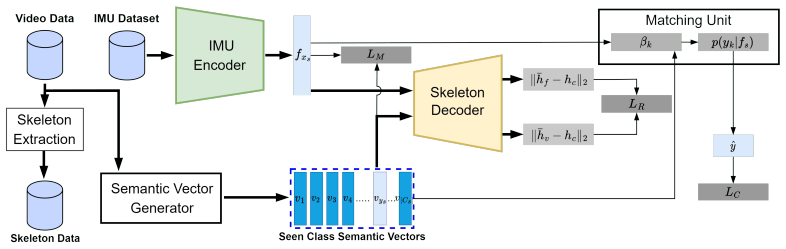
The mechanism that carries the argument is the three-term objective $L = L_M + \lambda L_C + \alpha L_R$. Matching loss $L_M = \|f_{x_s} - v_{y_s}\|^2$ pulls the Bi-LSTM's IMU embedding toward the semantic vector of the true class; classification loss $L_C$ is a softmax negative log-likelihood over seen classes; and reconstruction loss $L_R = \|\bar{h}_f - h_c\|^2 + \|\bar{h}_v - h_c\|^2$ forces the skeleton decoder to regenerate the class skeleton $h_c$ from both the IMU features and the class vector. Since $h_c$ is derived from video of the class through BlazePose (25 keypoints reduced to 12), this final term is what lets the decoder later turn the semantic vector of a never-seen class into a skeleton video at inference. Supporting components are the Bi-LSTM IMU encoder, the I3D video encoder that averages per-video features into class semantic vectors, and the decoder of a bidirectional recurrent skeleton autoencoder; on the evaluation side, Dynamic Time Warping with Mahalanobis distance defines the super-class alignment metrics TSA (Target Super-class Alignment), PSA (Predicted Super-class Alignment), and OA (Overall Alignment), while Discrete Fréchet Distance scores the realism of the rendered skeletons.
What would settle it
Scramble the time order of an unseen-class IMU window that SEZ-HARN classified correctly, regenerate the explanation, and compare it with the skeleton produced from the intact window; if the skeleton is nearly unchanged whenever the predicted class is unchanged, the video renders the class rather than the sensor evidence, and the self-explainability claim fails. The paper's TSA, PSA, and OA metrics would not catch this, because the seen-class skeletons they match against are the same class-typical skeletons the decoder was trained to reproduce, so high alignment partly measures self-consistency.
Extended reading notes
Core claim
The central claim, stated on the authors' terms, is that self-explainability can be built into an IMU-based zero-shot activity recognizer instead of bolted on afterwards. SEZ-HARN embeds a window of inertial readings with a Bi-LSTM encoder, aligns that embedding with class semantic vectors built by a pre-trained video encoder (I3D) from example videos of each activity, and classifies an unseen sample by whichever class vector its embedding is closest to. The same network, through a skeleton decoder, then renders the predicted class as a moving skeleton video, and the decoder is not an add-on: the reconstruction loss in Eq. (5) trains it to regenerate a class's skeleton from both the IMU features and the class semantic vector, so the explanation is produced by the same representation that drove the classification. The empirical claim is that this does not cost accuracy—55.20 percent average per-class accuracy on PAMAP2 versus 58.27 percent for TEZARNet, the strongest black-box baseline, and parity or better on DaLiAc, UTD-MHAD, and MHEALTH—while the generated videos meet the paper's new alignment and realism criteria and were identified correctly by participants in a user study.
Load-bearing premise
The explanation claim rests on one assumption: the skeleton video regenerated from the predicted class's description reflects the sensor readings that produced the prediction, rather than being a generic illustration of that activity label.
Editorial extensions
If this is right
- A caregiver-facing monitor could name a never-seen activity and simultaneously show a skeleton animation of it, so a human can compare the model's claim against the patient's actual movement instead of trusting an opaque score.
- Because the explanation comes from the same semantic space used for classification, zero-shot systems no longer need a separate post-hoc explanation step, removing the possibility that the explanation describes a different model than the one that predicted.
- Video-derived semantic vectors would do double duty in any deployment: they carry the knowledge transfer to unseen classes and anchor the skeleton renderer, so recognition and explanation rise and fall together.
- The new evaluation tools (TSA, PSA, and OA based on Dynamic Time Warping, plus Discrete Fréchet Distance) give subsequent self-explaining recognizers a way to measure whether a generated explanation is aligned with the prediction and realistic, rather than merely plausible.
- The PAMAP2 gap of about three percentage points below TEZARNet, together with parity or better on the other three datasets, suggests that on current benchmarks self-explainability does not exact a systematic accuracy toll.
Reading between the lines
- A stricter test than the paper's own alignment metrics would fix the predicted class and vary the IMU signal, checking whether the decoded skeleton changes with the sensor evidence; near-unchanged skeletons would mean the videos illustrate classes rather than explain decisions.
- The user study and realism scores would keep passing even if the skeleton were a pure class rendering, which is exactly why the invariance test described above is the decisive experiment for the self-explainability claim.
- The same recipe—align a non-visual sensor embedding with video-derived class vectors, then decode the winning vector into a class exemplar—could carry self-explanatory zero-shot recognition into other modalities such as radar, audio, or ambient sensors.
- The paper's own DTW alignment score could be repurposed as a per-instance confidence estimate: a prediction whose explanation fails to match any seen class in its super-class is likely a misclassification, giving deployments a cheap way to flag outputs that need human review.
Editorial analysis
A structured set of objections, weighed in public.
Referee Report
Summary. The manuscript proposes SEZ-HARN, a zero-shot human activity recognition model that takes IMU time series as input, builds a semantic space from auxiliary activity videos, and generates skeleton videos as explanations for its predictions. The training loss combines alignment, classification, and skeleton reconstruction terms, and the paper reports unseen-class accuracy on PAMAP2, DaLiAc, UTD-MHAD, and MHEALTH, together with DTW- and DFD-based explanation metrics and a user study. The authors claim that this is the first IMU-based ZS-HAR framework with self-explainability through skeleton-based activity videos.
Significance. If the explanation faithfulness claim were supported, SEZ-HARN would be a useful contribution to zero-shot HAR and to XAI for wearable sensing: the skeleton-video output is an intuitive interface for lay users, and the authors state that code and collected video data are publicly available, which is a reproducibility strength. The user study is a reasonable complement to automatic metrics. However, the current evidence only supports that the model can render class-typical, human-recognizable skeletons; it does not support the claim that these skeletons explain the model's decision. The central novelty of the paper is therefore not yet demonstrated.
major comments (3)
- [Sec. 3, Eq. (5); Sec. 4.4; Sec. 5] The self-explainability claim is not established. The reconstruction loss in Eq. (5) trains the decoder to reproduce the seen-class skeleton h_c using both the IMU feature f_xs and the class semantic vector v_ys, and the TSA/PSA/OA metrics in Sec. 4.4 only test whether the nearest seen-class skeleton lies in the same super-class as the target or predicted class. A decoder that ignores f_xs and renders a class template for the predicted class would pass all reported explanation metrics, including the DFD and user-study evaluations. This concern is reinforced by Sec. 5, which lists 'improving the explanation mechanism to highlight salient motion patterns that influence model decisions' as future work. Please add a counterfactual test that fixes the class conditioning and perturbs or replaces f_xs and measures the resulting change in the generated skeleton, or reframe the contribution as class-conditional skeleton visualization rather than self-explainability.
- [Sec. 4.3, Table 3] The accuracy comparison is weakened by mixing numbers borrowed from prior papers for MLCLM and TEZARNet with a self-implemented VbZSL, and by omitting error bars or significance tests. The abstract's claim of accuracy 'within 3%' of the best black-box model on PAMAP2 is also contradicted by the table, where the gap to TEZARNet is 58.27 - 55.20 = 3.07 percentage points. Please re-evaluate all baselines under identical fold splits and report mean and standard deviation across folds, or soften the accuracy claims accordingly.
- [Sec. 4.5 and Sec. 4.6] The realism (DFD) and user-study metrics measure whether the generated videos look like natural skeletons and can be recognized by human viewers, not whether they are faithful to the model's decision-making process. Because the decoder is trained to output class-typical skeletons, high DFD quality and high user accuracy in identifying super-classes are expected from a class-conditional renderer. To support the 'self-explainable' label, the paper needs an evaluation that ties the generated skeleton to the specific IMU input, or a carefully stated weaker claim.
minor comments (6)
- [Abstract and Sec. 6] The dataset name is written as 'HTD-MHAD' in the abstract and as 'DiLiAc' in the conclusion; both should be 'UTD-MHAD' and 'DaLiAc', respectively.
- [Sec. 4.4] The phrase 'Dynamic Time Wrapping' should be 'Dynamic Time Warping'.
- [Eq. (10)] The Discrete Fréchet Distance formula appears garbled; please rewrite it with explicit norms and quantifiers so that the computation is unambiguous.
- [Table 1 and Table 3] The column header 'F olds' and the dataset label 'MHEAL TH' contain typos; also, the dashes for MLCLM on three datasets in Table 3 should be explained (e.g., not reported in the original paper) rather than left as dashes.
- [Sec. 4.2] The text refers to 'Kinetic-400' (should be Kinetics-400) and to an 'NVIDIA GeForce RTX 2040', which is not a standard GPU model.
- [Sec. 3 and Fig. 2] The inference procedure does not state explicitly whether the decoder is conditioned on f_xs, on the predicted class semantic vector, or on both; please specify this in the text and figure.
Circularity Check
Explanation evaluation is self-referential: Eq. (5) trains the decoder against the class skeleton, and TSA/PSA/OA score alignment with that same predicted class, so a class-template generator passes; recognition accuracy remains externally benchmarked.
-
self definitional
[Eq. (5), Sec. 4.4, Table 4]
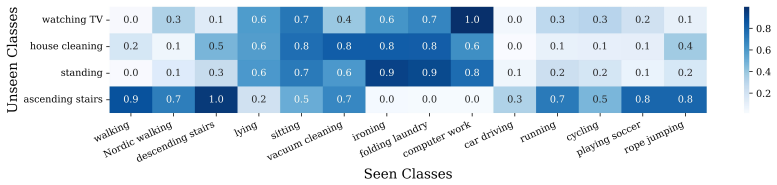
"SEZ-HARN is trained to reconstruct hc using the skeleton decoder, guided by the IMU feature vector fxs and the class semantic vector vys. ... LR = ∥¯hf − hc∥2 + ∥¯hv − hc∥2 ... Target Super-class Alignment(TSA): TSA is calculated when the unseen prediction is correct. It is the percentage of matching seen class belonging to the super-class of the target class of the given unseen instance."
The decoder is trained via LR to output hc, the skeleton of the class whose semantic vector vys is supplied. TSA/PSA/OA then score the explanation by whether the nearest seen-class skeleton falls in the predicted (or target) super-class. Since the predicted class is the class whose semantic vector is most similar to fxs, and the decoder was trained to render that class's skeleton, a decoder that ignores fxs and emits a class-typical skeleton for the predicted class passes all three metrics. The evaluation therefore checks self-consistency with the predicted label, not whether the IMU evidence caused the generated motion; the explanation and the metric are coupled by construction.
-
self citation load bearing
[Sec. 4.3, Table 3; Ref [23]]
"For MLCLM and TEZARNet models, we refer to the accuracy values reported in the respective papers."
TEZARNet is the same research group's earlier model (Deelaka, De Silva, Wickramanayake, Meedeniya, Rasnayaka). The abstract's headline that SEZ-HARN is 'within 3% of the best-performing black-box model on PAMAP2' uses TEZARNet's 58.27 as that best-performing model. That number is taken from a prior self-authored paper rather than re-evaluated in this work, so the relative accuracy claim rests on an unverified self-citation. This is not the main circularity, but it makes a headline comparison load-bearing on the authors' own prior report.
full rationale
The recognition component of SEZ-HARN is evaluated against external IMU benchmarks and compared with independently reported numbers for MLCLM and VbZSL, so the zero-shot accuracy claim is not itself derived from the model's own outputs. However, the paper's central novelty—self-explainability—is not validated as a faithful explanation of the decision. The skeleton decoder is trained with Eq. (5) to reconstruct hc, the skeleton of the class whose semantic vector is supplied, and the TSA/PSA/OA metrics in Sec. 4.4 merely check whether the generated skeleton's nearest seen class lies in the predicted or target super-class. Such a metric is satisfied by a decoder that ignores the IMU input and emits a class-typical skeleton for the predicted class; it does not establish that the generated video reflects the IMU evidence that drove the prediction. The DFD realism metric and the user study only measure motion quality and super-class legibility, not faithfulness. Because the explanation generation and its evaluation are coupled through the predicted class, the self-explainability claim partially reduces by construction, while the recognition-performance claims remain externally grounded.
Assumptions & free parameters
free parameters (8)
- classification loss weight lambda =
0.01
- reconstruction loss weight alpha =
0.6
- number of auxiliary videos per activity class =
10
- number of skeleton keypoints retained =
12
- Bi-LSTM hidden size =
128
- Bi-LSTM layers =
2
- learning rate =
1e-3
- dropout rate =
0.1
assumptions (4)
- domain assumption Video embeddings from I3D pretrained on Kinetics-400 capture motion semantics that transfer to IMU-based activity recognition.
- domain assumption Collected YouTube videos for each activity are representative of that activity and provide a reliable semantic anchor.
- domain assumption The super-class split of activities (static, walking, house chores, sports, sitting) keeps seen and unseen classes semantically comparable.
- domain assumption The pretrained skeleton autoencoder decoder can generate realistic skeleton sequences when conditioned on IMU features and semantic vectors.
Cite this review
Pith. "Pith review of SEZ-HARN: Self-Explainable Zero-shot Human Activity Recognition Network." pith.science (2026). https://pith.science/paper/QKZK45KG
@misc{pith2026250700050,
  author       = {Pith},
  title        = {Pith review of: SEZ-HARN: Self-Explainable Zero-shot Human Activity Recognition Network},
  year         = {2026},
  howpublished = {\url{https://pith.science/paper/QKZK45KG}},
  note         = {Machine review of arXiv:2507.00050}
}
read the original abstract
Human Activity Recognition (HAR), which uses data from Inertial Measurement Unit (IMU) sensors, has many practical applications in healthcare and assisted living environments. However, its use in real-world scenarios has been limited by the lack of comprehensive IMU-based HAR datasets that cover a wide range of activities and the lack of transparency in existing HAR models. Zero-shot HAR (ZS-HAR) overcomes the data limitations, but current models struggle to explain their decisions, making them less transparent. This paper introduces a novel IMU-based ZS-HAR model called the Self-Explainable Zero-shot Human Activity Recognition Network (SEZ-HARN). It can recognize activities not encountered during training and provide skeleton videos to explain its decision-making process. We evaluate the effectiveness of the proposed SEZ-HARN on four benchmark datasets PAMAP2, DaLiAc, HTD-MHAD and MHealth and compare its performance against three state-of-the-art black-box ZS-HAR models. The experiment results demonstrate that SEZ-HARN produces realistic and understandable explanations while achieving competitive Zero-shot recognition accuracy. SEZ-HARN achieves a Zero-shot prediction accuracy within 3\% of the best-performing black-box model on PAMAP2 while maintaining comparable performance on the other three datasets.
Figures


Figures from the paper (3 more)


Reference graph
Works this paper leans on
-
[1]
S. B. Khojasteh, J. R. Villar, C. Chira, V. M. Gonz´ alez, E. De la Cal, Improving fall detection using an on-wrist wearable accelerometer, Sen- sors 18 (2018). doi: 10.3390/s18051350
-
[2]
W. Wang, V. W. Zheng, H. Yu, C. Miao, A survey of zero-shot learning: Settings, methods, and applications, ACM Transactions on Intelligent Systems and Technology (TIST) 10 (2019) 1–37
work page 2019
- [3]
-
[4]
H. Leutheuser, D. Schuldhaus, B. M. Eskofier, Hierarchical, multi-sensor based classification of daily life activities: comparison with state-of-the- art algorithms using a benchmark dataset, PloS one 8 (2013) e75196
work page 2013
-
[5]
C. Chen, R. Jafari, N. Kehtarnavaz, UTD-MHAD: A multimodal dataset for human action recognition utilizing a depth camera and a wearable inertial sensor, in: IEEE International conference on image processing (ICIP), IEEE, Qu´ ebec city, Canada, 2015, pp. 168–172
work page 2015
- [6]
-
[7]
I. Dirgov´ a Lupt´ akov´ a, M. Kubovˇ c ´ ık, J. Posp ´ ıchal, Wearable sensor- based human activity recognition with transformer model, Sensors 22 (2022) 1911
work page 2022
-
[8]
Meedeniya, Deep Learning: A Beginners’ Guide, CRC Press LLC, 2023
D. Meedeniya, Deep Learning: A Beginners’ Guide, CRC Press LLC, 2023
work page 2023
Show all 46 references
-
[9]
Matsuki, P
M. Matsuki, P. Lago, S. Inoue, Characterizing word embeddings for zero-shot sensor-based human activity recognition, Sensors 19 (2019) 5043. 21
2019
-
[10]
T. Wu, Y. Chen, Y. Gu, J. Wang, S. Zhang, Z. Zhechen, Multi-layer cross loss model for zero-shot human activity recognition, in: Pacific- Asia Conference on Knowledge Discovery and Data Mining, Springer, Singapore, Singapore, 2020, pp. 210–221
2020
-
[11]
C. Tong, J. Ge, N. D. Lane, Zero-shot learning for imu-based activity recognition using video embeddings, Proceedings of the ACM on Inter- active, Mobile, Wearable and Ubiquitous Technologies 5 (2021) 1–23
2021
-
[12]
N. A. Capela, E. D. Lemaire, N. Baddour, Feature selection for wearable smartphone-based human activity recognition with able bodied, elderly, and stroke patients, PloS one 10 (2015) e0124414
2015
-
[13]
Zdravevski, P
E. Zdravevski, P. Lameski, V. Trajkovik, A. Kulakov, I. Chorbev, R. Goleva, N. Pombo, N. Garcia, Improving activity recognition ac- curacy in ambient-assisted living systems by automated feature engi- neering, Ieee Access 5 (2017) 5262–5280
2017
-
[14]
S. M. Lundberg, S.-I. Lee, A unified approach to interpreting model pre- dictions, in: I. Guyon, U. V. Luxburg, S. Bengio, H. Wallach, R. Fergus, S. Vishwanathan, R. Garnett (Eds.), Advances in Neural Information Processing Systems 30, 2017, pp. 4765–4774
2017
-
[15]
R. R. Selvaraju, M. Cogswell, A. Das, R. Vedantam, D. Parikh, D. Batra, Grad-cam: Visual explanations from deep networks via gradient-based localization, in: Proceedings of the IEEE international conference on computer vision, Venice, Italy, 2017, pp. 618–626
2017
-
[16]
M. Zeng, H. Gao, T. Yu, O. J. Mengshoel, H. Langseth, I. Lane, X. Liu, Understanding and improving recurrent networks for human activity recognition by continuous attention, in: Proceedings of the ACM in- ternational symposium on wearable computers, Singapore, Singapore, 2018,...
2018
-
[17]
H. Kaur, H. Nori, S. Jenkins, R. Caruana, H. Wallach, J. Wort- man Vaughan, Interpreting interpretability: understanding data scien- tists’ use of interpretability tools for machine learning, in: Proceedings of the CHI conference on human factors in computing systems, 2020, pp...
2020
-
[18]
Banos, R
O. Banos, R. Garcia, J. A. Holgado-Terriza, M. Damas, H. Pomares, I. Rojas, A. Saez, C. Villalonga, mHealthDroid: a novel framework for agile development of mobile health applications, in: Ambient As- sisted Living and Daily Activities: 6th International Work-Conference, IW AA...
2014
-
[19]
Q. Wang, K. Chen, Alternative semantic representations for zero-shot human action recognition, in: Joint European Conference on Machine Learning and Knowledge Discovery in Databases, Springer, Skopje, Macedonia, 2017, pp. 87–102
2017
-
[20]
Cheng, M
H.-T. Cheng, M. Griss, P. Davis, J. Li, D. You, Towards zero-shot learn- ing for human activity recognition using semantic attribute sequence model, UbiComp ’13, ACM, New York, NY, USA, 2013, p. 355–358
2013
-
[21]
Cheng, F.-T
H.-T. Cheng, F.-T. Sun, M. Griss, P. Davis, J. Li, D. You, Nuactiv: Rec- ognizing unseen new activities using semantic attribute-based learning, in: Proceeding of the 11th annual international conference on Mobile systems, applications, and services, Taipei, Taiwan, 2013, pp. 361–374
2013
-
[22]
R. R. Chowdhury, R. Kapila, A. Panse, X. Zhang, D. Teng, R. Kulka- rni, D. Hong, R. K. Gupta, J. Shang, Zerohar: Sensor context augments zero-shot wearable action recognition, Proceedings of the AAAI Conference on Artificial Intelligence 39 (2025) 16046–16054. doi:10.1609/aaai...
2025 doi
-
[23]
P. N. Deelaka, D. Y. De Silva, S. Wickramanayake, D. Meedeniya, S. Rasnayaka, Tezarnet: Temporal zero-shot activity recognition net- work, in: International Conference on Neural Information Processing, Springer, Changsha, China, 2023, pp. 444–455. doi: https://doi.org/ 10.1007...
2023 doi
-
[24]
M. T. Ribeiro, S. Singh, C. Guestrin, ” why should i trust you?” ex- plaining the predictions of any classifier, in: Proceedings of the 22nd ACM SIGKDD international conference on knowledge discovery and data mining, New York, NY, United States, 2016, pp. 1135–1144
2016
-
[25]
Wickramanayake, W
S. Wickramanayake, W. Hsu, M. L. Lee, Comprehensible convolutional neural networks via guided concept learning, in: International Joint 23 Conference on Neural Networks (IJCNN), IEEE, Shenzhen, China, 2021, pp. 1–8
2021
-
[26]
B. Kim, M. Wattenberg, J. Gilmer, C. Cai, J. Wexler, F. Viegas, et al., Interpretability beyond feature attribution: Quantitative testing with concept activation vectors (tcav), in: International conference on ma- chine learning, PMLR, Stockholm, Sweden, 2018, pp. 2668–2677
2018
-
[27]
Wickramanayake, W
S. Wickramanayake, W. Hsu, M. L. Lee, Flex: Faithful linguistic ex- planations for neural net based model decisions, in: Proceedings of the AAAI Conference on Artificial Intelligence, volume 33, Honolulu, Hawaii, USA, 2019, pp. 2539–2546
2019
-
[28]
D. Das, Y. Nishimura, R. P. Vivek, N. Takeda, S. T. Fish, T. Pl¨ otz, S. Chernova, Explainable activity recognition for smart home systems, ACM Trans. Interact. Intell. Syst. 13 (2023)
2023
-
[29]
M. T. Ribeiro, S. Singh, C. Guestrin, Anchors: High-precision model- agnostic explanations, in: AAAI Conference on Artificial Intelligence, New Orleans Riverside, New Orleans, 2018
2018
-
[30]
Arrotta, G
L. Arrotta, G. Civitarese, C. Bettini, DeXAR: Deep explainable sensor- based activity recognition in smart-home environments, Proceedings of the ACM on Interactive, Mobile, Wearable and Ubiquitous Technologies 6 (2022) 1–30
2022
-
[31]
Hamidi, A
M. Hamidi, A. Osmani, Data generation process modeling for activity recognition, in: ECML/PKDD, W¨ urzburg, Germany, 2020
2020
-
[32]
Theissler, F
A. Theissler, F. Spinnato, U. Schlegel, R. Guidotti, Explainable ai for time series classification: a review, taxonomy and research directions, IEEE Access (2022)
2022
-
[33]
Wickramanayake, S
S. Wickramanayake, S. Rasnayaka, M. Gamage, D. Meedeniya, I. Per- era, Explainable artificial intelligence for enhanced living environ- ments: A study on user perspective, in: G. Marques (Ed.), Internet of Things: Architectures for Enhanced Living Environments, volume 133 of A...
2024 doi
-
[34]
Y. Li, L. Wang, Human activity recognition based on residual network and BiLSTM, Sensors 22 (2022) 635
2022
-
[35]
S. Li, Y. Zhou, H. Zhu, W. Xie, Y. Zhao, X. Liu, Bidirectional recurrent autoencoder for 3D skeleton motion data refinement, Computers & Graphics 81 (2019) 92–103
2019
-
[36]
Bazarevsky, I
V. Bazarevsky, I. Grishchenko, K. Raveendran, T. Zhu, F. Zhang, M. Grundmann, Blazepose: On-device real-time body pose tracking, arXiv preprint arXiv:2006.10204 (2020)
2020 arXiv
-
[37]
W. Kay, J. Carreira, K. Simonyan, B. Zhang, C. Hillier, S. Vijaya- narasimhan, F. Viola, T. Green, T. Back, P. Natsev, et al., The kinetics human action video dataset, arXiv preprint arXiv:1705.06950 (2017)
2017 arXiv
-
[38]
Carreira, A
J. Carreira, A. Zisserman, Quo vadis, action recognition? a new model and the kinetics dataset, in: proceedings of the IEEE Conference on Computer Vision and Pattern Recognition, Honolulu, HI, USA, 2017, pp. 6299–6308
2017
-
[39]
J. Liu, A. Shahroudy, M. Perez, G. Wang, L.-Y. Duan, A. C. Kot, Ntu rgb+ d 120: A large-scale benchmark for 3d human activity understand- ing, IEEE transactions on pattern analysis and machine intelligence 42 (2019) 2684–2701
2019
-
[40]
Paszke, S
A. Paszke, S. Gross, F. Massa, A. Lerer, J. Bradbury, G. Chanan, T. Killeen, Z. Lin, N. Gimelshein, L. Antiga, A. Desmaison, A. Kopf, E. Yang, Z. DeVito, M. Raison, A. Tejani, S. Chilamkurthy, B. Steiner, L. Fang, J. Bai, S. Chintala, Pytorch: An imperative style, high- perfor...
2019
-
[41]
D. P. K. andJimmy Ba, Adam: A method for stochastic optimization, in: Y. B. andYann LeCun (Ed.), 3rd International Conference on Learning Representations, ICLR, San Diego, CA, USA, May 7-9, 2015. URL: http://arxiv.org/abs/1412.6980
2015 arXiv
-
[42]
Y. Geng, J. Chen, Z. Ye, Z. Yuan, W. Zhang, H. Chen, Explainable zero- shot learning via attentive graph convolutional network and knowledge graphs, Semantic Web 12 (2021) 741–765. 25
2021
-
[43]
Switonski, H
A. Switonski, H. Josinski, K. Wojciechowski, Dynamic time warping in classification and selection of motion capture data, Multidimensional Systems and Signal Processing 30 (2019) 1437–1468
2019
-
[44]
Zhang, B
Y. Zhang, B. Du, L. Zhang, S. Wang, A low-rank and sparse ma- trix decomposition-based mahalanobis distance method for hyperspec- tral anomaly detection, IEEE Transactions on Geoscience and Remote Sensing 54 (2015) 1376–1389
2015
-
[45]
Devogele, L
T. Devogele, L. Etienne, M. Esnault, F. Lardy, Optimized discrete fr´ echet distance between trajectories, in: Proceedings of the 6th ACM SIGSPATIAL Workshop on Analytics for Big Geospatial Data, Redondo Beach, CA, USA, 2017, pp. 11–19
2017
-
[46]
Dubey, N
A. Dubey, N. Lyons, A. Santra, A. Pandey, XAI-BayesHAR: A novel framework for human activity recognition with integrated uncertainty and shapely values, in: 21st IEEE International Conference on Machine Learning and Applications (ICMLA), IEEE, Atlantis Hotel, Bahamas, 2022, pp...
2022
Reviewed August 6, 2026 · model on record in the stance chip above.
Discussion (0). Continue with ORCID to comment.