REVIEW 4 major objections 6 minor 1 cited by
Studying few cluster resonances with quantum neural network driven iterative Harrow-Hassidim-Lloyd algorithm
T0 review · 4 major / 6 minor · reviewed 2026-08-06 · deepseek-v4-flash
Pith's one-line read A fully quantum workflow combining a quantum neural network with an iterative HHL solver extracts the 4+ resonance of the hypernucleus 9ΛBe.
desk verdict A real but narrow IHHL demonstration is overclaimed as a fully quantum resonance workflow; the missing full-space benchmark is the load-bearing gap. read the letter →
The pith
A machine-rendered reading of the paper's core claim, the machinery that carries it, and where it could break.
The reading
What carries the argument
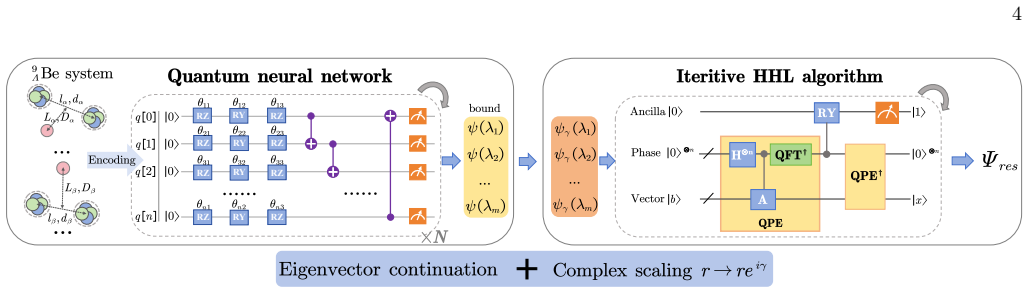
The mechanism is a three-stage pipeline. First, a parameterized strongly entangled circuit (the QNN) is trained by energy minimization to prepare approximate ground states of the three-cluster Hamiltonian, with the Hamiltonian encoded into qubit operators by a fermion-to-qubit mapping or a direct Pauli decomposition. Second, complex scaling (rotating coordinates by $r \to r e^{i\gamma}$) converts the resonance into a square-integrable solution, and eigenvector continuation builds a small basis from QNN wave functions at several parameter sets $\{\lambda_{\Lambda N}, M\}$, whose non-orthogonality is handled through a generalized eigenvalue problem with an overlap matrix $N$. Third, the iterative HHL algorithm recasts the complex-scaled Schr\"odinger equation as the fixed point $C(E,\beta)\varphi = \varphi$, embeds the non-Hermitian $C$ into a Hermitian block matrix $A = \begin{pmatrix}0 & C \\ C^\dagger & 0\end{pmatrix}$, and uses HHL to invert it repeatedly, updating the complex energy from the c-product (the inner product without complex conjugation) until convergence. The EC step is what lets the pipeline tolerate the QNN's approximate wave functions, and the IHHL step is what keeps the final solve quantum.
What would settle it
Enlarge the eigenvector-continuation basis from four training states to eight, sixteen, or the full sixty-four, or deepen the QNN until it reaches the exact ground-state energy of $-59.47$ MeV for the test parameter set, and check whether the IHHL-converged complex energy remains at the quoted resonance value; the present paper only shows convergence to diagonalization of the $4\times4$ EC matrix, not to the full-basis complex-scaling result.
Extended reading notes
Core claim
The paper's central claim is that the QNN-IHHL algorithm—quantum neural network state preparation feeding an eigenvector-continuation (EC) basis, with the complex-scaled generalized eigenvalue problem solved by an iterative HHL procedure—is a working fully-quantum route to few-cluster resonance parameters. The authors validate this on the single-channel $4^+$ resonance of $^{9}_{\Lambda}\mathrm{Be}$. Four bound-state wave functions produced by the QNN at different $\Lambda N$ interaction strengths and Majorana parameters are used as EC training vectors; the $4\times4$ complex-scaled Hamiltonian and overlap matrices built from them are fed into IHHL, which iterates the fixed-point equation $C(E,\beta)\varphi = \varphi$ and converges, within about ten iterations, to the eigenvalue obtained by directly diagonalizing that $4\times4$ matrix. On this basis the authors state that the resonant energy is consistent with the conventional complex-scaling result, and that the workflow extends to other single-$\Lambda$ and double-$\Lambda$ hypernuclei and to coupled-channel problems.
Load-bearing premise
The four approximate QNN ground states, each with an energy error of roughly 6 percent, are assumed to span the subspace containing the true $4^+$ resonance of $^{9}_{\Lambda}\mathrm{Be}$; if they do not, the IHHL result can match the $4\times4$ matrix yet miss the real resonance.
Editorial extensions
If this is right
- The same QNN-IHHL pipeline can be applied to other few-cluster systems—single-$\Lambda$ and double-$\Lambda$ hypernuclei and multi-cluster nuclear structures—to extract resonance energies and widths.
- Because eigenvector continuation relaxes the precision demand on the QNN, near-term quantum devices may be able to prepare useful EC basis states without full ground-state convergence.
- IHHL converges in roughly ten iterations for this problem, so the iterative overhead is modest and the routine handles generalized eigenvalue problems with non-orthogonal bases.
- The algorithm extends to coupled-channel calculations and to bound-state techniques such as the trap method for scattering phase shifts, broadening its reach beyond the single-channel validation.
- The workflow is a step toward ab initio quantum calculations of exotic nuclear states, replacing classical diagonalization of the large Hamiltonian with a quantum linear-system solve.
Reading between the lines
- The demonstrated validation is a consistency check: IHHL reproduces the diagonalization of the $4\times4$ EC matrix. The paper does not show that this four-state subspace already converges to the full 64-dimensional complex-scaled problem; a stronger test would enlarge the EC basis and compare the IHHL result against the full-basis value of $4.08-0.051i$ MeV.
- Because the QNN energies sit roughly 6 percent above the exact values at the chosen circuit depth, the method's practical accuracy hinges on how forgiving eigenvector continuation really is; a systematic scan varying QNN fidelity and EC basis size would map that tolerance.
- A natural next step is to run the pipeline on hardware or a noisy simulator, since the current demonstration is a quantum simulation; with only six qubits for the 64 basis states, the workflow is a plausible near-term candidate.
Editorial analysis
A structured set of objections, weighed in public.
Referee Report
Summary. The paper proposes a hybrid quantum-classical pipeline, QNN-IHHL, that combines quantum neural network (QNN) ground-state preparation, complex-scaled eigenvector continuation (EC), and an iterative Harrow-Hassidim-Lloyd (IHHL) algorithm to solve few-cluster resonance problems in hypernuclei. The method is applied to the 4+ resonant state of 9ΛBe. Four QNN-generated bound-state wave functions (with energies around -55.89 MeV vs. -59.47 MeV exact) are used to build 4x4 complex-scaled Hamiltonian and overlap matrices, and the IHHL algorithm is shown to converge to the eigenvalue obtained by direct diagonalization of these same 4x4 matrices. The paper claims a 'fully quantum workflow' and that the obtained resonant energy is 'consistent with the conventional method.'
Significance. If the claimed external consistency were established, the paper would be a useful demonstration that a quantum algorithm pipeline can, in principle, handle non-Hermitian few-body resonance problems: QNN state preparation, EC subspace construction, and iterative HHL are combined for a nuclear cluster system. Strengths include the explicit presentation of QNN circuit parameters and the EC matrices in Appendix A, the transparent reporting of the QNN energy error (~6%), and the demonstration that IHHL converges within a few iterations to the direct diagonalization result of the same 4x4 matrix. The algorithmic convergence of IHHL on a small non-Hermitian generalized eigenvalue problem is a sound and reproducible numerical result. However, the physics claim—that this procedure yields the actual 4+ resonance of 9ΛBe—is not supported by an independent comparison to a full-space complex-scaling calculation or to larger EC subspaces, and the reported numerical values are not reconciled with the stated target resonance energy.
major comments (4)
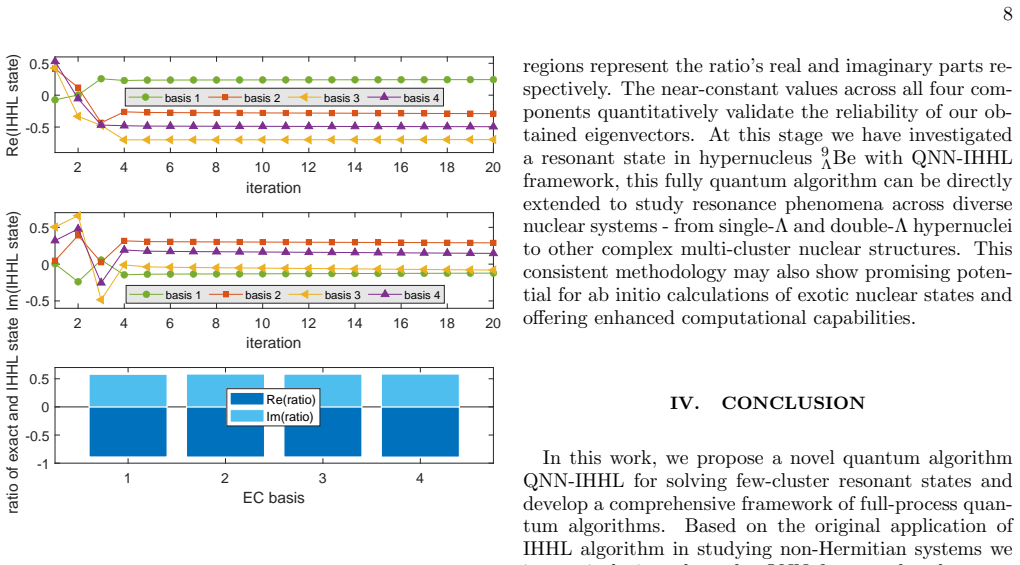
- [Sec. III, Fig. 7] The central validation is circular: the IHHL result is compared only with the direct diagonalization of the same 4x4 EC matrices whose construction is described in the same section. The abstract and conclusion claim the resonant energy is 'consistent with the conventional method,' but no full-space complex-scaled Hill-Wheeler result at γ = -2° (or at any angle) is shown. The authors should compare the IHHL-converged eigenvalue with the 64-dimensional complex-scaled result for the same target parameters (λΛN = 1, M = 0.573), or with a systematically enlarged EC basis (8, 16, 64 training vectors). Without this, the EC subspace itself might miss the relevant resonance/continuum admixture, and IHHL could converge to an eigenvalue of an inaccurate 4x4 model while matching that model exactly.
- [Sec. III, Figs. 4-5 and Eq. (34)] The four QNN training states have energies -55.89 MeV versus exact -59.47 MeV, a relative error of about 6%. The paper explicitly relaxes the precision demand on the wave function and uses these approximate states as the EC basis, but it provides no overlap analysis, residual norm, or fidelity measure showing that the QNN states retain sufficient overlap with the true ground states (and with the resonance of interest) for the EC subspace to be reliable. A convergence check of the resonance pole as the EC basis is enlarged is essential to justify the relaxed-convergence assumption; otherwise the 4-state subspace is an uncontrolled approximation.
- [Sec. III and Fig. 6 vs. Sec. III text] The numerical values are not reconciled. The text states that the target parameters support a resonant 4+ state with complex energy 4.08 - 0.051i MeV, determined by the complex scaling method. The converged IHHL result in Fig. 7 appears to be approximately -49.02 - 0.016i MeV (the exact diagonalization value shown as a green square is near -49.02 - 0.018i MeV). These differ substantially in both real and imaginary parts. If the 4.08 MeV value is relative to a different threshold or uses a different energy convention, this must be stated explicitly and the corresponding full-space value in the same convention must be quoted. As written, the abstract's 'consistent with the conventional method' is not quantitatively substantiated.
- [Sec. III, paragraph on EC basis size] The statement 'Increasing the basis size in eigenvector continuation (EC) can improve the accuracy of resonant energy calculations. However, our focus here is not on this aspect... Therefore we will only utilize 4 basis functions' explicitly declines to test convergence. Given that the central claim is identification of a resonance in a real nuclear system, a convergence study with respect to EC basis size is a load-bearing missing element, not an optional improvement. The stabilization plot in Fig. 6 is built from these same four approximate basis vectors, so it cannot establish convergence to the full-space resonance.
minor comments (6)
- [Sec. II D, Eq. (32)] The c-product (ϕ|ψ) is used without a formal definition; please define (ϕ|ψ) = ∫ ϕ(r) ψ(r) dr (no complex conjugation) and specify which convention is used for the complex-scaled basis. This is particularly important because the overlap matrix Nres in Appendix A has negative diagonal entries, which is surprising and should be explained.
- [Fig. 6 caption] The caption says 'The parameters generating the eight basis vectors are also listed in the figure,' but the text and Eq. (34) list four basis vectors (four parameter sets). Please correct the caption.
- [Sec. III, text after Eq. (35)] The symbol λλN appears where λΛN is meant. Also, the notation in Eq. (35) is ambiguous: it is unclear whether N^{-1} acts before the c-product and how the generalized eigenvalue problem is reduced to the C-matrix form; please write out the definition of matrix elements explicitly.
- [References [46] and [47]] References [46] and [47] are duplicate entries for the same paper (Peruzzo et al., Nature Communications 5, 2014). Please merge them.
- [Abstract and conclusion] The phrase 'fully quantum workflow' is used although all QNN and IHHL components are executed on classical simulators (pyqpanda). Please qualify this as a simulated quantum workflow or describe which stages would run on quantum hardware in an actual implementation.
- [Abstract] The abstract states that properties of 5ΛHe, 6ΛΛHe, and 9ΛBe can be investigated, but only 9ΛBe is numerically studied in this work. Please adjust the abstract to reflect the actual scope, or add the promised results for the other two hypernuclei.
Circularity Check
No significant circularity: the IHHL solver is checked against direct diagonalization of the same small EC matrix, which is an internal consistency test, and the paper's self-citations are not load-bearing.
full rationale
The paper's derivation chain is self-contained with respect to circularity. The QNN provides approximate bound-state vectors, EC constructs the 4x4 complex-scaled Hamiltonian and overlap matrices from those vectors, and IHHL iteratively solves the resulting generalized eigenvalue problem. The validation in Fig. 7 compares the IHHL result with direct diagonalization of the same H_res and N_res matrices, which is an appropriate check of the solver's correctness rather than a circular reduction: the matrix elements are fixed by the QNN states and the Hamiltonian, and the IHHL output does not feed back into those matrix elements. The paper explicitly narrows its claim, stating "our focus here is not on this aspect" of EC basis-size accuracy and that "we do not strictly require the QNN to converge exactly to the lowest energy," which is an acknowledged approximation and a correctness risk (the four-state subspace may not faithfully represent the full-space resonance), not a circularity. The known conventional resonance energy is used only to select a demonstration case and the complex-scaling angle; no parameter is fitted to force agreement with that known value. Self-citations to the authors' prior IHHL paper ([98]) and cluster-model paper ([108]) are used for algorithmic and model details, but the IHHL iteration is re-derived and numerically demonstrated here, so those citations are not load-bearing. No equations reduce to each other by construction, no fitted input is renamed as a prediction, and no uniqueness theorem from the authors is invoked. Therefore the paper does not exhibit circular reasoning under the specified criteria.
Assumptions & free parameters
free parameters (6)
- EC training parameter pairs (lambda_LambdaN, M) =
Four hand-picked pairs: (1.2, 0.50), (1.2, 0.45), (1.4, 0.50), (1.4, 0.45)
- Target Hamiltonian parameters (lambda_LambdaN = 1, M = 0.573) =
Supports the 4+ resonance at 4.08 - 0.051i MeV
- Complex scaling angle gamma =
-2 degrees
- IHHL iteration parameter beta =
1
- QNN architecture and stopping condition =
3 layers, 6 qubits, 200 iterations, final energy -55.89 MeV vs exact -59.47 MeV
- Initial IHHL wavefunction =
[1, 2, 3, 4]
assumptions (5)
- standard math Complex scaling (ABC theorem) transforms the resonance problem into a complex-scaled Hamiltonian with L2 solutions.
- domain assumption Eigenvector continuation from bound-state eigenvectors can reproduce the complex-scaled resonance.
- ad hoc to paper The QNN ansatz and relaxed convergence still produce wavefunctions that span the relevant subspace.
- domain assumption The microscopic cluster Hamiltonian with Volkov, YNG, and OBE interactions describes the 9ΛBe 4+ resonance.
- standard math The Hermitian block embedding of the non-Hermitian C operator preserves the fixed-point eigenvalue problem solvable by HHL.
Cite this review
Pith. "Pith review of Studying few cluster resonances with quantum neural network driven iterative Harrow-Hassidim-Lloyd algorithm." pith.science (2026). https://pith.science/paper/QE6HTJAA
@misc{pith2026250700074,
  author       = {Pith},
  title        = {Pith review of: Studying few cluster resonances with quantum neural network driven iterative Harrow-Hassidim-Lloyd algorithm},
  year         = {2026},
  howpublished = {\url{https://pith.science/paper/QE6HTJAA}},
  note         = {Machine review of arXiv:2507.00074}
}
abstract
By using the quantum computing the properties of hypernuclei ${}^5_{\Lambda}$He, ${}^{\ 6}_{{\Lambda\Lambda}}$He and ${}^9_{\Lambda}$Be can be investigated within microscopic cluster model. Our approach combines quantum neural network (QNN) with iterative Harrow-Hassidim-Lloyd (IHHL) algorithm (abbreviated as QNN-IHHL) to solve the quantum many-body problem. To efficiently describe resonance phenomena, we employ complex scaling and eigenvector continuation techniques, providing a robust framework for identifying few-cluster resonance parameters within quantum computing. To validate our quantum algorithm, the resonant $4^{+}$ state of ${}^9_{\Lambda}$Be is chosen as a core example. With QNN-IHHL algorithm we realize a fully quantum workflow, which provides a novel framework and some ground work for exploring resonance properties in complex nuclear many-body systems.
Figures


Figures from the paper (5 more)


Forward citations
Cited by 1 Pith paper
-
Data-driven trap theory for nuclear scattering
A data-calibrated quantization condition is proposed to extract nuclear scattering phase shifts from harmonic-trap spectra for neutral and charged particles.
Reference graph
Works this paper leans on
-
[1]
M. J. Savage, EPJ Web Conf. 296, 01025 (2024), arXiv:2312.07617 [nucl-th]
arXiv 2024
-
[2]
N. Klco, A. Roggero, and M. J. Savage, Reports on Progress in Physics 85, 064301 (2022). 10
2022
-
[3]
C. M. Ho and S. D. H. Hsu, Modern Physics Letters A 31, 1650110 (2016)
2016
-
[4]
D. E. Kharzeev and E. M. Levin, Phys. Rev. D 95, 114008 (2017)
2017
-
[5]
O. K. Baker and D. E. Kharzeev, Phys. Rev. D 98, 054007 (2018)
2018
-
[6]
S. R. Beane, D. B. Kaplan, N. Klco, and M. J. Savage, Phys. Rev. Lett. 122, 102001 (2019)
2019
-
[7]
Z. Tu, D. E. Kharzeev, and T. Ullrich, Physical Review Letters 124, 10.1103/physrevlett.124.062001 (2020)
-
[8]
S. R. Beane and R. C. Farrell, Annals of Physics 433, 168581 (2021)
2021
Show all 117 references
-
[9]
Iskander, J
G. Iskander, J. Pan, M. Tyler, C. Weber, and O. Baker, Physics Letters B 811, 135948 (2020)
2020
-
[10]
A. T. Kruppa, J. Kov´ acs, P. Salamon, and ¨O. Legeza, Journal of Physics G: Nuclear and Particle Physics 48, 025107 (2021)
2021
-
[11]
S. R. Beane, R. C. Farrell, and M. Varma, Interna- tional Journal of Modern Physics A 36, 2150205 (2021), https://doi.org/10.1142/S0217751X21502055
2021 doi
-
[12]
D. E. Kharzeev and E. Levin, Phys. Rev. D 104, L031503 (2021)
2021
-
[13]
A. T. Kruppa, J. Kov´ acs, P. Salamon, ¨O. Legeza, and G. Zar´ and, Phys. Rev. C106, 024303 (2022)
2022
-
[14]
Robin, M
C. Robin, M. J. Savage, and N. Pillet, Phys. Rev. C 103, 034325 (2021)
2021
-
[15]
Low and T
I. Low and T. Mehen, Phys. Rev. D 104, 074014 (2021)
2021
-
[16]
W. Gong, G. Parida, Z. Tu, and R. Venugopalan, Phys. Rev. D 106, L031501 (2022)
2022
-
[17]
Bai and Z
D. Bai and Z. Ren, Phys. Rev. C 106, 064005 (2022)
2022
-
[18]
C. W. Johnson and O. C. Gorton, Journal of Physics G: Nuclear and Particle Physics 50, 045110 (2023)
2023
-
[19]
P. J. Ehlers, Annals of Physics 452, 169290 (2023)
2023
-
[20]
Tichai, S
A. Tichai, S. Knecht, A. Kruppa, ¨O. Legeza, C. Moca, A. Schwenk, M. Werner, and G. Zarand, Physics Letters B 845, 138139 (2023)
2023
-
[23]
J. Faba, V. Mart ´ ın, and L. Robledo, Phys. Rev. A105, 062449 (2022)
2022
-
[24]
Bulgac, M
A. Bulgac, M. Kafker, and I. Abdurrahman, Phys. Rev. C 107, 044318 (2023)
2023
-
[25]
M. A. Jafarizadeh, M. Ghapanvari, and N. Amiri, Phys. Rev. C 105, 014307 (2022)
2022
-
[26]
Bai, Phys
D. Bai, Phys. Rev. C 107, 044005 (2023)
2023
-
[27]
C. E. P. Robin and M. J. Savage, Physical Review C 108, 10.1103/physrevc.108.024313 (2023)
2023 doi
-
[28]
C. Gu, Z. H. Sun, G. Hagen, and T. Papenbrock, Physi- cal Review C 108, 10.1103/physrevc.108.054309 (2023)
2023 doi
-
[29]
Z. H. Sun, G. Hagen, and T. Papenbrock, Physical Re- view C 108, 10.1103/physrevc.108.014307 (2023)
2023 doi
-
[30]
Bai, Phys
D. Bai, Phys. Lett. B 845, 138162 (2023)
2023
-
[31]
Bai, Phys
D. Bai, Phys. Rev. C 109, 034001 (2024)
2024
- [32]
-
[33]
G. A. Miller, Entanglement maximization in low-energy neutron-proton scattering (2023), arXiv:2306.03239 [nucl-th]
2023 arXiv
-
[34]
S. M. Hengstenberg, C. E. P. Robin, and M. J. Savage, The European Physical Journal A 59, 10.1140/epja/s10050-023-01145-x (2023)
2023 doi
-
[35]
P´ erez-Obiol, S
A. P´ erez-Obiol, S. Masot-Llima, A. M. Romero, J. Men´ endez, A. Rios, A. Garc ´ ıa-S´ aez, and B. Juli´ a- D ´ ıaz, The European Physical Journal A 59, 10.1140/epja/s10050-023-01151-z (2023)
2023 doi
-
[36]
O. C. Gorton and C. W. Johnson, Physical Review C 110, 10.1103/physrevc.110.034305 (2024)
2024 doi
-
[37]
Roggero and J
A. Roggero and J. Carlson, Physical Review C 100, 10.1103/physrevc.100.034610 (2019)
2019 doi
-
[38]
Mueller, A
N. Mueller, A. Tarasov, and R. Venugopalan, Physical Review D 102, 10.1103/physrevd.102.016007 (2020)
2020 doi
-
[39]
Turro, T
F. Turro, T. Chistolini, A. Hashim, Y. Kim, W. Liv- ingston, J. M. Kreikebaum, K. A. Wendt, J. L. Dubois, F. Pederiva, S. Quaglioni, D. I. Santiago, and I. Siddiqi, Physical Review A 108, 10.1103/physreva.108.032417 (2023)
2023 doi
-
[40]
Baroni, J
A. Baroni, J. Carlson, R. Gupta, A. C. Li, G. Perdue, and A. Roggero, Physical Review D 105, 10.1103/phys- revd.105.074503 (2022)
2022 doi
-
[41]
P. F. Bedaque, R. Khadka, G. Rupak, and M. Yusf, Radiative processes on a quantum computer (2022), arXiv:2209.09962 [nucl-th]
2022 arXiv
-
[42]
Turro, K
F. Turro, K. A. Wendt, S. Quaglioni, F. Pederiva, and A. Roggero, Evaluation of phase shifts for non- relativistic elastic scattering using quantum computers (2024), arXiv:2407.04155 [quant-ph]
2024 arXiv
-
[43]
W. Du, J. P. Vary, X. Zhao, and W. Zuo, Physical Re- view A 104, 10.1103/physreva.104.012611 (2021)
2021 doi
-
[44]
Du and J
W. Du and J. P. Vary, Phys. Lett. B866, 139548 (2025), arXiv:2402.08969 [quant-ph]
2025 arXiv
-
[45]
Parnes, N
E. Parnes, N. Barnea, G. Carleo, A. Lovato, N. Rocco, and X. Zhang, arxiv (2025), arXiv:2504.20195 [nucl-th]
2025 arXiv
-
[47]
Peruzzo, J
A. Peruzzo, J. McClean, P. Shadbolt, M.-H. Yung, X.-Q. Zhou, P. J. Love, A. Aspuru-Guzik, and J. L. O’Brien, Nature Communications 5, 10.1038/ncomms5213 (2014)
2014 doi
-
[48]
J. R. McClean, J. Romero, R. Babbush, and A. Aspuru- Guzik, New Journal of Physics 18, 023023 (2016)
2016
-
[49]
E. F. Dumitrescu, A. J. McCaskey, G. Hagen, G. R. Jansen, T. D. Morris, T. Papenbrock, R. C. Pooser, D. J. Dean, and P. Lougovski, Phys. Rev. Lett. 120, 210501 (2018)
2018
-
[50]
Bharti, A
K. Bharti, A. Cervera-Lierta, T. H. Kyaw, T. Haug, S. Alperin-Lea, A. Anand, M. Degroote, H. Heimonen, J. S. Kottmann, T. Menke, W.-K. Mok, S. Sim, L.- C. Kwek, and A. Aspuru-Guzik, Rev. Mod. Phys. 94, 015004 (2022)
2022
-
[51]
M. J. Cervia, A. B. Balantekin, S. N. Coppersmith, C. W. Johnson, P. J. Love, C. Poole, K. Robbins, and M. Saffman, Phys. Rev. C 104, 024305 (2021)
2021
-
[52]
Higgott, D
O. Higgott, D. Wang, and S. Brierley, Quantum 3, 156 (2019)
2019
-
[53]
McArdle, T
S. McArdle, T. Jones, S. Endo, Y. Li, S. C. Ben- jamin, and X. Yuan, npj Quantum Information 5, 10.1038/s41534-019-0187-2 (2019)
2019 doi
-
[54]
X. Yuan, S. Endo, Q. Zhao, Y. Li, and S. C. Benjamin, Quantum 3, 191 (2019)
2019
-
[56]
P. J. Ollitrault, A. Kandala, C.-F. Chen, P. K. Barkout- 11 sos, A. Mezzacapo, M. Pistoia, S. Sheldon, S. Woerner, J. M. Gambetta, and I. Tavernelli, Phys. Rev. Res. 2, 043140 (2020)
2020
-
[57]
Stokes, J
J. Stokes, J. Izaac, N. Killoran, and G. Carleo, Quantum 4, 269 (2020)
2020
-
[58]
Gomes, A
N. Gomes, A. Mukherjee, F. Zhang, T. Iadecola, C. Wang, K. Ho, P. P. Orth, and Y. Yao, Advanced Quantum Technologies 4, 10.1002/qute.202100114 (2021)
2021 doi
-
[59]
H. L. Tang, V. Shkolnikov, G. S. Barron, H. R. Grimsley, N. J. Mayhall, E. Barnes, and S. E. Economou, PRX Quantum 2, 020310 (2021)
2021
-
[60]
A. M. Romero, J. Engel, H. L. Tang, and S. E. Economou, Phys. Rev. C 105, 064317 (2022)
2022
-
[61]
Koczor and S
B. Koczor and S. C. Benjamin, Physical Review A 106, 10.1103/physreva.106.062416 (2022)
2022 doi
-
[62]
A. Y. Kitaev, arxiv (1995), arXiv:quant-ph/9511026 [quant-ph]
1995 arXiv
-
[63]
M. A. Nielsen and I. L. Chuang, Quantum Computation and Quantum Information: 10th Anniversary Edition (Cambridge University Press, 2010)
2010
-
[64]
I. Cong, S. Choi, and M. D. Lukin, Nature Physics 15, 1273–1278 (2019)
2019
-
[65]
K. Beer, D. Bondarenko, T. Farrelly, T. J. Osborne, R. Salzmann, D. Scheiermann, and R. Wolf, Na- ture Communications 11, 10.1038/s41467-020-14454-2 (2020)
2020 doi
-
[66]
Abbas, D
A. Abbas, D. Sutter, C. Zoufal, A. Lucchi, A. Fi- galli, and S. Woerner, Nature Computational Science 1, 403–409 (2021)
2021
-
[67]
X. Pan, Z. Lu, W. Wang, Z. Hua, Y. Xu, W. Li, W. Cai, X. Li, H. Wang, Y.-P. Song, C.-L. Zou, D.-L. Deng, and L. Sun, Nature Communications 14, 10.1038/s41467- 023-39785-8 (2023)
2023 doi
-
[68]
Jin, H.-Z
Y.-X. Jin, H.-Z. Xu, Z.-A. Wang, W.-F. Zhuang, K.- X. Huang, Y.-H. Shi, W.-G. Ma, T.-M. Li, C.-T. Chen, K. Xu, Y.-L. Feng, P. Liu, M. Chen, S.-S. Li, Z.-P. Yang, C. Qian, Y.-H. Ma, X. Xiao, P. Qian, Y. Gu, X.-D. Chai, Y.-N. Pu, Y.-P. Zhang, S.-J. Wei, J.-F. Zeng, H. Li, G.- L....
2024
-
[69]
Zhang, D
H. Zhang, D. Bai, and Z. Ren, Phys. Lett. B860, 139187 (2025), arXiv:2409.06340 [nucl-th]
2025 arXiv
-
[70]
A. W. Harrow, A. Hassidim, and S. Lloyd, Phys. Rev. Lett. 103, 150502 (2009)
2009
-
[71]
Aguilar and J
J. Aguilar and J. M. Combes, Commun. Math. Phys. 22, 269 (1971)
1971
-
[72]
Balslev and J
E. Balslev and J. M. Combes, Commun. Math. Phys. 22, 280 (1971)
1971
-
[73]
Aoyama, T
S. Aoyama, T. Myo, K. Kat¯ o, and K. Ikeda, Prog. Theor. Phys. 116, 1 (2006)
2006
-
[74]
T. Myo, Y. Kikuchi, H. Masui, and K. Kat¯ o, Prog. Part. Nucl. Phys. 79, 1 (2014)
2014
-
[75]
Odsuren, K
M. Odsuren, K. Kat¯ o, M. Aikawa, and T. Myo, Phys. Rev. C 89, 034322 (2014)
2014
-
[76]
Zhang, D
H. Zhang, D. Bai, Z. Wang, and Z. Ren, Phys. Rev. C 105, 054317 (2022)
2022
-
[77]
Zhang, D
H. Zhang, D. Bai, Z. Wang, and Z. Ren, Phys. Rev. C 107, 064304 (2023)
2023
-
[78]
Myo and H
T. Myo and H. Takemoto, Phys. Rev. C 107, 064308 (2023)
2023
-
[79]
Zhang, arxiv (2024), arXiv:2408.03309 [nucl-th]
X. Zhang, arxiv (2024), arXiv:2408.03309 [nucl-th]
2024
-
[80]
Zhang, arxiv (2024), arXiv:2411.06712 [nucl-th]
X. Zhang, arxiv (2024), arXiv:2411.06712 [nucl-th]
2024
-
[81]
Zhang, D
H. Zhang, D. Bai, and Z.-Z. Ren, Chinese Physics C (2024)
2024
-
[82]
Zhang, C
H. Zhang, C. Chen, Z.-Z. Ren, and X.-R. Zhou, Chinese Physics C (2024)
2024
-
[83]
Frame, R
D. Frame, R. He, I. Ipsen, D. Lee, D. Lee, and E. Rrapaj, Phys. Rev. Lett. 121, 032501 (2018)
2018
-
[84]
N. Yapa, K. Fossez, and S. K¨ onig, Phys. Rev. C 107, 064316 (2023)
2023
-
[85]
Demol, T
P. Demol, T. Duguet, A. Ekstr¨ om, M. Frosini, K. Hebeler, S. K¨ onig, D. Lee, A. Schwenk, V. Som` a, and A. Tichai, Phys. Rev. C 101, 041302 (2020)
2020
-
[86]
K¨ onig, A
S. K¨ onig, A. Ekstr¨ om, K. Hebeler, D. Lee, and A. Schwenk, Physics Letters B 810, 135814 (2020)
2020
-
[87]
Companys Franzke, A
M. Companys Franzke, A. Tichai, K. Hebeler, and A. Schwenk, Physics Letters B 830, 137101 (2022)
2022
-
[88]
Yoshida and N
S. Yoshida and N. Shimizu, Progress of Theo- retical and Experimental Physics 2022, 053D02 (2022), https://academic.oup.com/ptep/article- pdf/2022/5/053D02/43860928/ptac057.pdf
2022
-
[89]
Sarkar and D
A. Sarkar and D. Lee, Phys. Rev. Lett. 126, 032501 (2021)
2021
-
[90]
J. A. Melendez, C. Drischler, R. J. Furnstahl, A. J. Gar- cia, and X. Zhang, Journal of Physics G: Nuclear and Particle Physics 49, 102001 (2022)
2022
-
[91]
Bonilla, P
E. Bonilla, P. Giuliani, K. Godbey, and D. Lee, Phys. Rev. C 106, 054322 (2022)
2022
-
[92]
Drischler, J
C. Drischler, J. A. Melendez, R. J. Furnstahl, A. J. Garcia, and X. Zhang, Frontiers in Physics 10, 10.3389/fphy.2022.1092931 (2023)
2023
-
[93]
Furnstahl, A
R. Furnstahl, A. Garcia, P. Millican, and X. Zhang, Physics Letters B 809, 135719 (2020)
2020
-
[94]
Drischler, M
C. Drischler, M. Quinonez, P. Giuliani, A. Lovell, and F. Nunes, Physics Letters B 823, 136777 (2021)
2021
-
[95]
Bai and Z
D. Bai and Z. Ren, Phys. Rev. C 103, 014612 (2021)
2021
-
[96]
Bai, Phys
D. Bai, Phys. Rev. C 106, 024611 (2022)
2022
-
[97]
A. J. Garcia, C. Drischler, R. J. Furnstahl, J. A. Melen- dez, and X. Zhang, Phys. Rev. C 107, 054001 (2023)
2023
-
[98]
Zhang, D
H. Zhang, D. Bai, and Z. Ren, Iterative harrow- hassidim-lloyd quantum algorithm for solving resonances with eigenvector continuation (2025), arXiv:2506.20929 [quant-ph]
2025 arXiv
- [99]
-
[100]
Zhang, S
X. Zhang, S. R. Stroberg, P. Navr´ atil, C. Gwak, J. A. Melendez, R. J. Furnstahl, and J. D. Holt, Phys. Rev. Lett. 125, 112503 (2020), arXiv:2004.13575 [nucl-th]
2020 arXiv
- [101]
- [102]
-
[103]
Zhang, D
H. Zhang, D. Bai, Z. Wang, and Z. Ren, Phys. Rev. C 109, 034307 (2024)
2024
-
[104]
Zhang, D
H. Zhang, D. Bai, Z. Wang, and Z. Ren, Phys. Lett. B 850, 138490 (2024)
2024
-
[105]
Zhang, D
H. Zhang, D. Bai, and Z. Ren, Phys. Rev. C110, 034308 (2024)
2024
-
[106]
Zhang, D
H. Zhang, D. Bai, and Z. Ren, Phys. Lett. B855, 138861 (2024)
2024
- [107]
-
[108]
Zhang, D
H. Zhang, D. Bai, and Z. Ren, Chin. Phys. C 49, 014108 (2025)
2025
-
[109]
Motoba, H
T. Motoba, H. Band¯ o, K. Ikeda, and T. Yamada, Prog. Theor. Phys. Suppl. 81, 42 (1985)
1985
-
[110]
A. Gal, E. V. Hungerford, and D. J. Millener, Rev. Mod. 12 Phys. 88, 035004 (2016)
2016
-
[111]
Hiyama, M
E. Hiyama, M. Kamimura, T. Motoba, T. Yamada, and Y. Yamamoto, Prog. Theor. Phys. 97, 881 (1997)
1997
-
[112]
J. K. Ahn, H. Akikawa, S. Aoki, K. Arai, S. Y. Bahk, K. M. Baik, B. Bassalleck, J. H. Chung, M. S. Chung, D. H. Davis, T. Fukuda, K. Hoshino, A. Ichikawa, M. Ieiri, K. Imai, K. Itonaga, Y. H. Iwata, Y. S. Iwata, H. Kanda, M. Kaneko, T. Kawai, M. Kawasaki, C. O. Kim, J. Y. Kim,...
2013
-
[113]
Bertini, O
R. Bertini, O. Bing, P. Birien, K. Braune, W. Br¨ uckner, A. Chaumeaux, M. Faessler, R. Frey, D. Garreta, T. Ke- tel, K. Kilian, B. Mayer, J. Niewisch, B. Pietrzyk, B. Povh, H. Ritter, and M. Uhrmacher, Nucl. Phys. A 368, 365 (1981)
1981
-
[114]
M. May, S. Bart, S. Chen, R. E. Chrien, D. Maur- izio, P. Pile, Y. Xu, R. Hackenburg, E. Hungerford, H. Piekarz, Y. Xue, M. Deutsch, J. Piekarz, P. D. Barnes, G. Franklin, R. Grace, C. Maher, R. Rieder, J. Szymanski, W. Wharton, R. L. Stearns, B. Bassal- leck, and B. Budick, P...
1983
-
[115]
Br¨ uckner, B
W. Br¨ uckner, B. Granz, D. Ingham, K. Kilian, U. Ly- nen, J. Niewisch, B. Pietrzyk, B. Povh, H. Ritter, and H. Schr¨ oder, Phys. Lett. B62, 481 (1976)
1976
-
[116]
Jordan and E
P. Jordan and E. Wigner, Zeitschrift f¨ ur Physik47, 631 (1928)
1928
-
[117]
Wierichs, J
D. Wierichs, J. Izaac, C. Wang, and C. Y.-Y. Lin, Quan- tum 6, 677 (2022)
2022
-
[118]
https://en.wikipedia.org/wiki/Stochastic_ gradient_descent (2024)
2024
-
[119]
may also be implemented. For our current calcula- tions in this work the basic version of SGD is adopted: θt+1 = θt − η · ∇θL(θt), (25) of course we can also consider other variant of SGD with such as momentum, Nesterov approach [118] and so on. Here, t and t + 1 denote the cu...
-
[120]
J. V. Pankkonen, L. Ylinen, M. Raasakka, and I. Tit- tonen, Improving variational quantum circuit optimiza- tion via hybrid algorithms and random axis initializa- tion (2025), arXiv:2503.20728 [quant-ph]
2025
-
[121]
https://qcloud.originqc.com.cn/zh (2024)
2024
Reviewed August 6, 2026 · model on record in the stance chip above.
Discussion (0). Sign in to comment.