REVIEW 2 major objections 5 minor 36 references
Diffusion-Based Image Augmentation for Semantic Segmentation in Outdoor Robotics
T0 review · 2 major / 5 minor · reviewed 2026-08-06 · deepseek-v4-flash
Pith's one-line read A diffusion-based augmentation pipeline can increase rare snow coverage in semantic segmentation training data by inpainting ground surfaces and filtering hallucinations with an open-vocabulary segmentation model.
desk verdict A clear, honest idea paper whose central claim is explicitly untested; the pipeline description is useful but there is no evidence it improves segmentation. read the letter →
The pith
A machine-rendered reading of the paper's core claim, the machinery that carries it, and where it could break.
The reading
What carries the argument
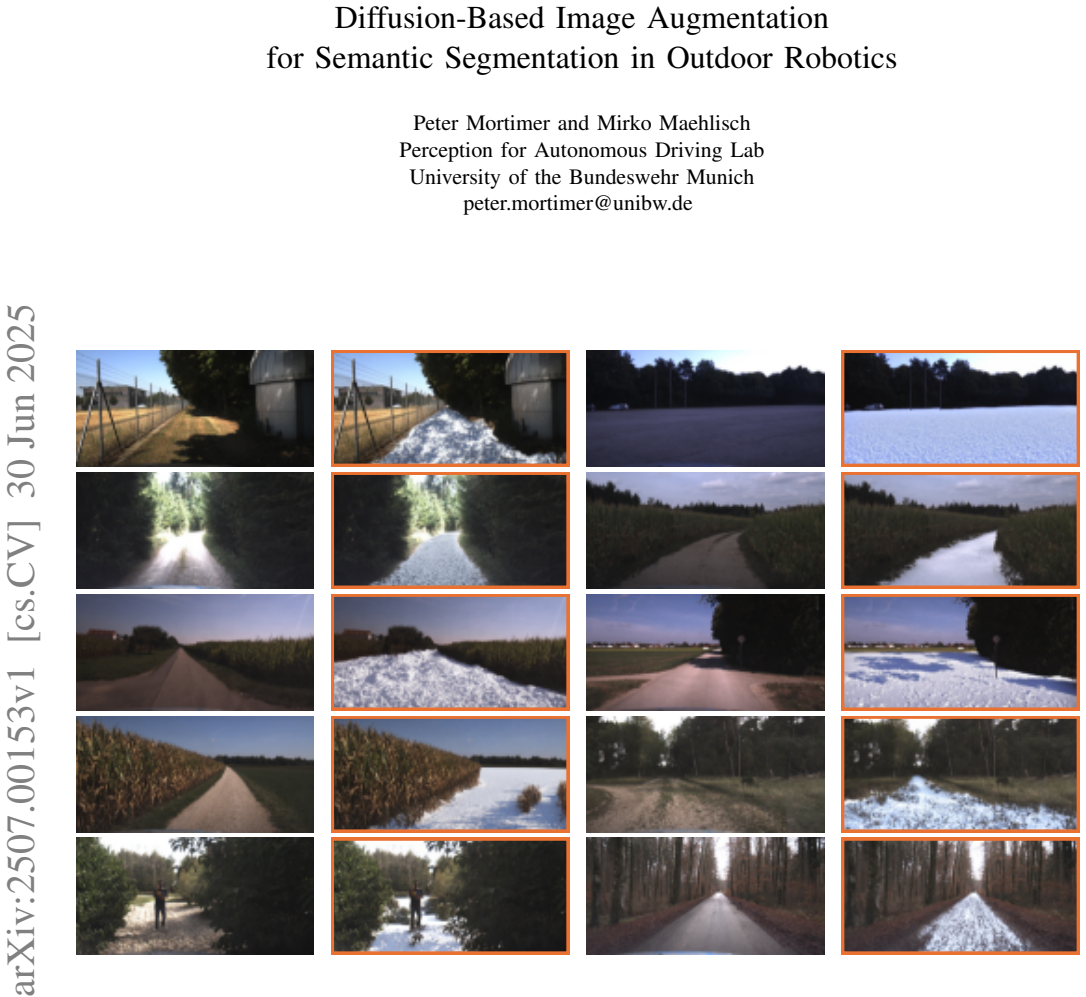
The load-bearing mechanism is mask-conditioned inpainting followed by hallucination filtering. The inpainting mask is derived from the ground-truth mask by choosing a random subset of existing ground-surface classes, so the regions to be changed are known exactly; a latent diffusion model fills those regions with snow under positive and negative text prompts. Because the diffusion process can hallucinate objects on the snow, an open-vocabulary segmentation model (X-Decoder) partitions each candidate, and the expected mask—the original ground-truth mask with the inpainted pixels relabeled as snow—serves as the selection criterion: candidates containing hallucinated obstacle classes are dropped, and the remaining candidate with maximum overlap to the expected mask is chosen.
What would settle it
Train a semantic segmentation model on the GOOSE training set augmented by this method and compare per-class IoU for snow on a held-out winter validation split against a baseline trained on original GOOSE; if snow IoU does not improve while other classes remain stable, the central claim fails. A complementary check is to manually audit a sample of selected augmentation candidates to see how often the X-Decoder segmentation diverges from the expected mask in ways the overlap criterion misses.
Extended reading notes
Core claim
The central claim is that diffusion-based image synthesis constrained by a segmentation mask can serve as a controllable data augmentation for rare surface classes in outdoor robotics. Given any annotated training image, the method selects a random subset of ground-surface pixels, inpaints them with a snow appearance using a latent diffusion model trained with a LaMa-style mask-inpainting strategy, and drives synthesis with fixed text prompts: a positive prompt, "A high quality photo; Covered in white snow," and a negative prompt listing obstacles, people, and other artifacts to avoid. Multiple random seeds produce multiple augmentation candidates, and an open-vocabulary segmentation model (X-Decoder) with the GOOSE labels as vocabulary detects hallucinations such as pedestrians, dogs, or rocks placed on the snow; candidates containing such objects are discarded, and the remaining candidate with the highest overlap to the expected ground-truth mask (the original mask with the inpainted region relabeled as snow) is selected. The authors claim this gives them control over the semantic distribution of ground surfaces in the training data, allowing a perception model to be fine-tuned for a snow deployment environment, with the same scheme applicable to other rare environments.
Load-bearing premise
The method assumes that the diffusion model's inpainted snow, once filtered by overlap with an expected mask, is visually and semantically consistent enough with real snow that a segmentation network trained on it learns correct snow cues rather than synthetic artifacts.
Editorial extensions
If this is right
- Augmenting the GOOSE training set this way increases the pixel share of snow from 2.3%, changing the dataset's class distribution without modifying the segmentation network or its loss function.
- Because the expected mask is derived automatically from the original ground-truth labels, the augmented images come with ready-made training labels for the changed regions.
- The same pipeline should transfer to other rare surface types—sand, volcanic terrain, wintry landscape—wherever the diffusion model has seen such scenes in its pretraining data.
- The method is designed for offline preparation before deployment: the robot needs time to fine-tune on augmented data, rather than adapting during operation.
Reading between the lines
- An unstated testable consequence is that training a segmentation network on the augmented data should raise snow IoU on a held-out winter validation split, and that this gain should transfer to unmodified real winter images rather than only to synthetic-looking ones.
- Because selection relies on X-Decoder's vocabulary, classes outside that vocabulary cannot be protected from hallucination; applying the method to unusual terrains such as volcanic rock may require extending the open-vocabulary label set or adding another filter.
- The overlap-based selection favors candidates that change little beyond the inpainted mask, which could bias toward simpler snow textures and away from complex snow-covered scenery, potentially limiting the diversity of the augmented distribution.
- A direct comparison with class-name-based prompt generation, as used in prior diffusion augmentation work, would clarify whether the fixed snow prompt is sufficient or whether semantic-context prompting helps in other environments.
Editorial analysis
A structured set of objections, weighed in public.
Referee Report
Summary. The paper proposes a diffusion-based image augmentation pipeline to increase the presence of snow in semantic segmentation training data for outdoor robotics. The method uses the GOOSE dataset, selects a random subset of ground surfaces via the semantic mask, inpaints those regions with Stable Diffusion conditioned on fixed positive and negative text prompts, and then filters the resulting candidates with the open-vocabulary segmenter X-Decoder. The filtering step discards candidates containing hallucinations and selects the candidate whose X-Decoder segmentation has the highest overlap with an expected ground-truth mask in which all inpainted pixels are labeled snow. The manuscript presents qualitative examples of augmented images and states in Section IV that a quantitative analysis of transfer learning for snow segmentation is future work.
Significance. If validated, the proposed method would address a real practical problem: rare surface classes such as snow are strongly underrepresented in multi-season outdoor datasets, and diffusion-based augmentation is a timely approach. The idea of using an open-vocabulary segmentation model to filter inpainted candidates is also sensible and worth exploring. However, the paper currently provides no quantitative evidence that the augmented images have correct labels or that training on them improves a downstream segmentation model. The central contribution is therefore only a plausible proposal, not a demonstrated augmentation method. The manuscript's explicit acknowledgment of the missing analysis is honest, but it does not substitute for the evaluation itself.
major comments (2)
- [Section IV (Outlook)] The central claim of the paper—that the proposed augmentation improves semantic segmentation in snow—is not evaluated anywhere. Section IV states that “this initial concept lacks a quantitative analysis on the best transfer learning scheme to improve the semantic segmentation of snow from a model originally trained on a multi-season dataset.” Consequently, the paper does not establish either (i) that the labels transferred from the original GOOSE mask to the inpainted image are correct, or (ii) that training a segmentation model on these augmented images improves performance on snow in a held-out deployment setting. Figures 3–6 are qualitative only. Because the stated contribution is an augmentation method, this missing validation is load-bearing, not a cosmetic gap.
- [Section III-A (Hallucination Filtering)] The filter is not sufficient to ensure label correctness. X-Decoder is queried with only the GOOSE vocabulary, so any hallucinated object whose class is not in that vocabulary is invisible to the filter; the expected ground-truth mask then labels every inpainted pixel as snow, so such a hallucination would be carried into the training set with a snow label. Additionally, selecting the candidate with maximum overlap to the expected mask measures agreement with the assumption that the inpainted area is snow, not correctness against external ground truth. A concrete test would be to evaluate the filter on a held-out set of inpainted images with manually verified snow/no-snow labels and to report the filter's precision and recall against that set.
minor comments (5)
- [Abstract] The abstract contains a typo: “leaning-based perception algorithms” should be “learning-based perception algorithms.”
- [Section III-A (Image Synthesis)] The description of the diffusion process is underspecified: “we observed sufficient change in the in-painted area and a convergence between subsequent denoising step after roughly 20 diffusion and denoising steps” does not say what metric was used for convergence or whether these are DDIM or DDPM steps.
- [Section III-A (Image Synthesis)] The choices of the text prompts Φ+ and Φ−, the number of diffusion steps, and the random subset of ground surfaces are all free parameters, but no ablations or quantitative sensitivity analysis is reported; this limits reproducibility.
- [Figure 4 caption] The caption states that “X-Decoder can reliably detect the objects,” but no detection accuracy is reported; consider rephrasing to “is used to detect” or providing quantitative support.
- [References] Reference [13] has a formatting issue: the author list runs directly into the title with a missing comma or space (“V . Vapnik,Learning algorithms”).
Circularity Check
No significant circularity: the paper is a conceptual proposal whose downstream claim is explicitly untested; the filter's self-consistency is a design choice, not a derived prediction.
full rationale
The paper does not claim to derive an empirical result from its inputs. The central assertion—that diffusion-based augmentation can increase snow occurrence in a training set—is presented as a method proposal, and Section IV explicitly states that 'this initial concept lacks a quantitative analysis on the best transfer learning scheme to improve the semantic segmentation of snow,' deferring experiments to future work. The hallucination filter in Section III-A selects 'the candidate with the highest area of overlap to the expected groundtruth mask,' where the expected mask is constructed by changing the inpainted pixels to snow; this is a self-consistency criterion by design, but the paper never presents it as evidence that downstream segmentation will improve, so no prediction reduces to an input by construction. Self-citations to GOOSE [1] and GOOSE-Ex [6] are citations to public datasets used as training data, not load-bearing theoretical authorities, and no uniqueness theorem or ansatz is imported from the authors' prior work. No equation or fitted parameter is renamed as a prediction, so no circular step is identified.
Assumptions & free parameters
free parameters (3)
- Text prompts Phi+ and Phi-
- Number of diffusion steps =
20 (ground surfaces), 15 (landscape)
- Random subset of ground surfaces for inpainting mask
assumptions (3)
- domain assumption Diffusion models pretrained on internet datasets can generate realistic snow surfaces in outdoor scenes.
- domain assumption X-Decoder with GOOSE labels can reliably detect hallucinated obstacles in inpainted images.
- domain assumption Increasing the proportion of snow pixels in training data improves semantic segmentation of snow at deployment.
Cite this review
Pith. "Pith review of Diffusion-Based Image Augmentation for Semantic Segmentation in Outdoor Robotics." pith.science (2026). https://pith.science/paper/DTXOZ75K
@misc{pith2026250700153,
  author       = {Pith},
  title        = {Pith review of: Diffusion-Based Image Augmentation for Semantic Segmentation in Outdoor Robotics},
  year         = {2026},
  howpublished = {\url{https://pith.science/paper/DTXOZ75K}},
  note         = {Machine review of arXiv:2507.00153}
}
read the original abstract
The performance of leaning-based perception algorithms suffer when deployed in out-of-distribution and underrepresented environments. Outdoor robots are particularly susceptible to rapid changes in visual scene appearance due to dynamic lighting, seasonality and weather effects that lead to scenes underrepresented in the training data of the learning-based perception system. In this conceptual paper, we focus on preparing our autonomous vehicle for deployment in snow-filled environments. We propose a novel method for diffusion-based image augmentation to more closely represent the deployment environment in our training data. Diffusion-based image augmentations rely on the public availability of vision foundation models learned on internet-scale datasets. The diffusion-based image augmentations allow us to take control over the semantic distribution of the ground surfaces in the training data and to fine-tune our model for its deployment environment. We employ open vocabulary semantic segmentation models to filter out augmentation candidates that contain hallucinations. We believe that diffusion-based image augmentations can be extended to many other environments apart from snow surfaces, like sandy environments and volcanic terrains.
Figures


Figures from the paper (3 more)


Reference graph
Works this paper leans on
-
[1]
The GOOSE Dataset for Perception in Unstructured Environments,
P. Mortimer, R. Hagmanns, M. Granero, T. Luettel, J. Petereit, and H.-J. Wuensche, “The GOOSE Dataset for Perception in Unstructured Environments,” in Proceedings of IEEE International Conference on Robotics and Automation (ICRA) , 2024. 1, 2
work page 2024
-
[2]
Survey on Datasets for Perception in Unstructured Outdoor Environments,
P. Mortimer and M. Maehlisch, “Survey on Datasets for Perception in Unstructured Outdoor Environments,” in Proceedings of IEEE International Conference on Robotics and Automation Workshops (ICRAW), 2024. 2
work page 2024
-
[4]
Selective memory: Re- calling relevant experience for long-term visual localization,
K. MacTavish, M. Paton, and T. D. Barfoot, “Selective memory: Re- calling relevant experience for long-term visual localization,” Journal of Field Robotics , vol. 35, no. 8, 2018. 2
work page 2018
-
[5]
FoMo: A Proposal for a Multi-Season Dataset for Robot Navigation in Forêt Montmorency,
M. Boxan, A. Krawciw, E. Daum, X. Qiao, S. Lilge, T. D. Barfoot, and F. Pomerleau, “FoMo: A Proposal for a Multi-Season Dataset for Robot Navigation in Forêt Montmorency,” 2024. 2
work page 2024
-
[6]
Excavating in the Wild: The GOOSE-Ex Dataset for Semantic Segmentation,
R. Hagmanns, P. Mortimer, M. Granero, T. Luettel, and J. Petereit, “Excavating in the Wild: The GOOSE-Ex Dataset for Semantic Segmentation,” in Proceedings of IEEE International Conference on Robotics and Automation (ICRA) , 2025. 2
work page 2025
-
[7]
Denoising Diffusion Probabilistic Models,
J. Ho, A. Jain, and P. Abbeel, “Denoising Diffusion Probabilistic Models,” in Advances in Neural Information Processing Systems (NeurIPS), 2020. 2
work page 2020
-
[8]
Deep Unsupervised Learning using Nonequilibrium Thermodynam- ics,
J. Sohl-Dickstein, E. Weiss, N. Maheswaranathan, and S. Ganguli, “Deep Unsupervised Learning using Nonequilibrium Thermodynam- ics,” in Proceedings of International Conference on Machine Learning (ICML), 2015. 2
work page 2015
-
[9]
Diffusion Models Beat GANs on Image Synthesis,
P. Dhariwal and A. Nichol, “Diffusion Models Beat GANs on Image Synthesis,” in Advances in Neural Information Processing Systems (NeurIPS), 2021. 2
work page 2021
Show all 36 references
-
[10]
High-Resolution Image Synthesis With Latent Diffusion Models,
R. Rombach, A. Blattmann, D. Lorenz, P. Esser, and B. Ommer, “High-Resolution Image Synthesis With Latent Diffusion Models,” in Proceedings of IEEE Conference on Computer Vision and Pattern Recognition (CVPR), 2022. 2, 3
2022
-
[11]
Adding Conditional Control to Text-to-Image Diffusion Models,
L. Zhang, A. Rao, and M. Agrawala, “Adding Conditional Control to Text-to-Image Diffusion Models,” in Proceedings of IEEE Interna- tional Conference on Computer Vision (ICCV) , 2023. 2
2023
-
[12]
LAION-5B: an open large-scale dataset for training next generation image-text models,
C. Schuhmann, R. Beaumont, R. Vencu, C. Gordon, R. Wight- man, M. Cherti, T. Coombes, A. Katta, C. Mullis, M. Wortsman, P. Schramowski, S. Kundurthy, K. Crowson, L. Schmidt, R. Kacz- marczyk, and J. Jitsev, “LAION-5B: an open large-scale dataset for training next generation im...
2022
-
[13]
Lecun, L
Y . Lecun, L. Jackel, L. Bottou, C. Cortes, J. Denker, H. Drucker, I. Guyon, U. Muller, E. Sackinger, P. Simard, and V . Vapnik,Learning algorithms for classification: A comparison on handwritten digit recognition. World Scientific, 1995. 2
1995
-
[14]
Learning Hier- archical Features for Scene Labeling,
C. Farabet, C. Couprie, L. Najman, and Y . LeCun, “Learning Hier- archical Features for Scene Labeling,” IEEE Transactions on Pattern Analysis and Machine Intelligence , 2013. 2
2013
-
[15]
Fully convolutional networks for semantic segmentation,
J. Long, E. Shelhamer, and T. Darrell, “Fully convolutional networks for semantic segmentation,” in Proceedings of IEEE Conference on Computer Vision and Pattern Recognition (CVPR) , 2015. 2
2015
-
[16]
mixup: Beyond Empirical Risk Minimization,
H. Zhang, M. Cisse, Y . N. Dauphin, and D. Lopez-Paz, “mixup: Beyond Empirical Risk Minimization,” in International Conference on Learning Representations (ICLR) , 2018. 2
2018
-
[17]
Improved Regularization of Convolutional Neural Networks with Cutout,
T. DeVries and G. W. Taylor, “Improved Regularization of Convolutional Neural Networks with Cutout,” arXiv preprint arXiv:1708.04552, 2017. 2
2017 arXiv
-
[18]
CutMix: Regularization Strategy to Train Strong Classifiers With Localizable Features,
S. Yun, D. Han, S. J. Oh, S. Chun, J. Choe, and Y . Yoo, “CutMix: Regularization Strategy to Train Strong Classifiers With Localizable Features,” in Proceedings of IEEE International Conference on Com- puter Vision (ICCV) , 2019. 2
2019
-
[19]
Simple Copy-Paste Is a Strong Data Augmentation Method for Instance Segmentation,
G. Ghiasi, Y . Cui, A. Srinivas, R. Qian, T.-Y . Lin, E. D. Cubuk, Q. V . Le, and B. Zoph, “Simple Copy-Paste Is a Strong Data Augmentation Method for Instance Segmentation,” in Proceedings of IEEE Confer- ence on Computer Vision and Pattern Recognition (CVPR) , 2021. 2
2021
-
[20]
On Fea- ture Normalization and Data Augmentation,
B. Li, F. Wu, S.-N. Lim, S. Belongie, and K. Q. Weinberger, “On Fea- ture Normalization and Data Augmentation,” in Proceedings of IEEE Conference on Computer Vision and Pattern Recognition (CVPR) ,
-
[21]
Unpaired Image-to- Image Translation using Cycle-Consistent Adversarial Networks,
J.-Y . Zhu, T. Park, P. Isola, and A. A. Efros, “Unpaired Image-to- Image Translation using Cycle-Consistent Adversarial Networks,” in Proceedings of IEEE International Conference on Computer Vision (ICCV), 2017. 2
2017
-
[22]
Parameterizable Lidar- Assisted Traffic Sign Placement for the Augmentation of Driving Situations with CycleGAN,
P. Rigoll, P. Petersen, J. Langner, and E. Sax, “Parameterizable Lidar- Assisted Traffic Sign Placement for the Augmentation of Driving Situations with CycleGAN,” in Advances in Systems Engineering . Springer International Publishing, 2022. 2
2022
-
[23]
DAFormer: Improving Network Architectures and Training Strategies for Domain-Adaptive Semantic Segmentation,
L. Hoyer, D. Dai, and L. Van Gool, “DAFormer: Improving Network Architectures and Training Strategies for Domain-Adaptive Semantic Segmentation,” in Proceedings of IEEE Conference on Computer Vision and Pattern Recognition (CVPR) , 2022. 2
2022
-
[24]
Learning to Adapt Structured Output Space for Semantic Segmentation,
Y .-H. Tsai, W.-C. Hung, S. Schulter, K. Sohn, M.-H. Yang, and M. Chandraker, “Learning to Adapt Structured Output Space for Semantic Segmentation,” in Proceedings of IEEE Conference on Computer Vision and Pattern Recognition (CVPR) , 2018. 2
2018
-
[25]
Continual Test-Time Domain Adaptation,
Q. Wang, O. Fink, L. Van Gool, and D. Dai, “Continual Test-Time Domain Adaptation,” in Proceedings of IEEE Conference on Computer Vision and Pattern Recognition (CVPR) , 2022. 2
2022
-
[26]
Generalization by Adaptation: Diffusion-Based Do- main Extension for Domain-Generalized Semantic Segmentation,
J. Niemeijer, M. Schwonberg, J.-A. Termöhlen, N. M. Schmidt, and T. Fingscheidt, “Generalization by Adaptation: Diffusion-Based Do- main Extension for Domain-Generalized Semantic Segmentation,” in Proceedings of IEEE Winter Conference on Applications of Computer Vision (WACV),...
2024
-
[27]
Canadian Adverse Driving Conditions Dataset,
M. Pitropov, D. E. Garcia, J. Rebello, M. Smart, C. Wang, K. Czar- necki, and S. Waslander, “Canadian Adverse Driving Conditions Dataset,” The International Journal of Robotics Research , vol. 40,
-
[28]
Boreas: A Multi-Season Autonomous Driving Dataset,
K. Burnett, D. J. Yoon, Y . Wu, A. Z. Li, H. Zhang, S. Lu, J. Qian, W.-K. Tseng, A. Lambert, K. Y . Leung, A. P. Schoellig, and T. D. Barfoot, “Boreas: A Multi-Season Autonomous Driving Dataset,” The International Journal of Robotics Research , 2023. 2
2023
-
[29]
The Winter Adverse Driving dataSet (W ADS),
A. Kurup and J. Bos, “The Winter Adverse Driving dataSet (W ADS),”
-
[30]
SemanticKITTI: A Dataset for Semantic Scene Understanding of LiDAR Sequences,
J. Behley, M. Garbade, A. Milioto, J. Quenzel, S. Behnke, C. Stach- niss, and J. Gall, “SemanticKITTI: A Dataset for Semantic Scene Understanding of LiDAR Sequences,” inProceedings of IEEE Interna- tional Conference on Computer Vision (ICCV) , Seoul, Korea (South),
-
[31]
FinnWoodlands Dataset,
J. Lagos, U. Lempiö, and E. Rahtu, “FinnWoodlands Dataset,” in Image Analysis. Springer Nature Switzerland, 2023. 2
2023
-
[32]
Resolution-Robust Large Mask Inpainting With Fourier Convolu- tions,
R. Suvorov, E. Logacheva, A. Mashikhin, A. Remizova, A. Ashukha, A. Silvestrov, N. Kong, H. Goka, K. Park, and V . Lempitsky, “Resolution-Robust Large Mask Inpainting With Fourier Convolu- tions,” in Proceedings of IEEE Winter Conference on Applications of Computer Vision (WAC...
2022
-
[33]
Gen- eralized Decoding for Pixel, Image, and Language,
X. Zou, Z.-Y . Dou, J. Yang, Z. Gan, L. Li, C. Li, X. Dai, H. Behl, J. Wang, L. Yuan, N. Peng, L. Wang, Y . J. Lee, and J. Gao, “Gen- eralized Decoding for Pixel, Image, and Language,” in Proceedings of IEEE Conference on Computer Vision and Pattern Recognition (CVPR), 2023. 3, 4
2023
-
[34]
LVIS: A Dataset for Large V o- cabulary Instance Segmentation,
A. Gupta, P. Dollar, and R. Girshick, “LVIS: A Dataset for Large V o- cabulary Instance Segmentation,” in Proceedings of IEEE Conference on Computer Vision and Pattern Recognition (CVPR) , 2019. 3
2019
-
[35]
Region rebalance for long-tailed semantic segmentation,
J. Cui, Y . Yuan, Z. Zhong, Z. Tian, H. Hu, S. Lin, and J. Jia, “Region rebalance for long-tailed semantic segmentation,” 2022. [Online]. Available: https://arxiv.org/abs/2204.01969 3 Presented at the 2025 IEEE ICRA Workshop on Field Robotics
2022 arXiv
-
[2021]
Available: https://digitalcommons.mtu.edu/wads/ 2
[Online]. Available: https://digitalcommons.mtu.edu/wads/ 2
-
[2024]
Available: https://arxiv.org/abs/2412.02506 2
[Online]. Available: https://arxiv.org/abs/2412.02506 2
Reviewed August 6, 2026 · model on record in the stance chip above.
Discussion (0). Sign in to comment.