Structural Order Drives Diffusion in a Granular Packing
Pith reviewed 2026-05-19 06:50 UTC · model grok-4.3
The pith
Crystallization enhances the diffusion length that governs velocity profiles in granular silo flows.
A machine-rendered reading of the paper's core claim, the machinery that carries it, and where it could break.
Core claim
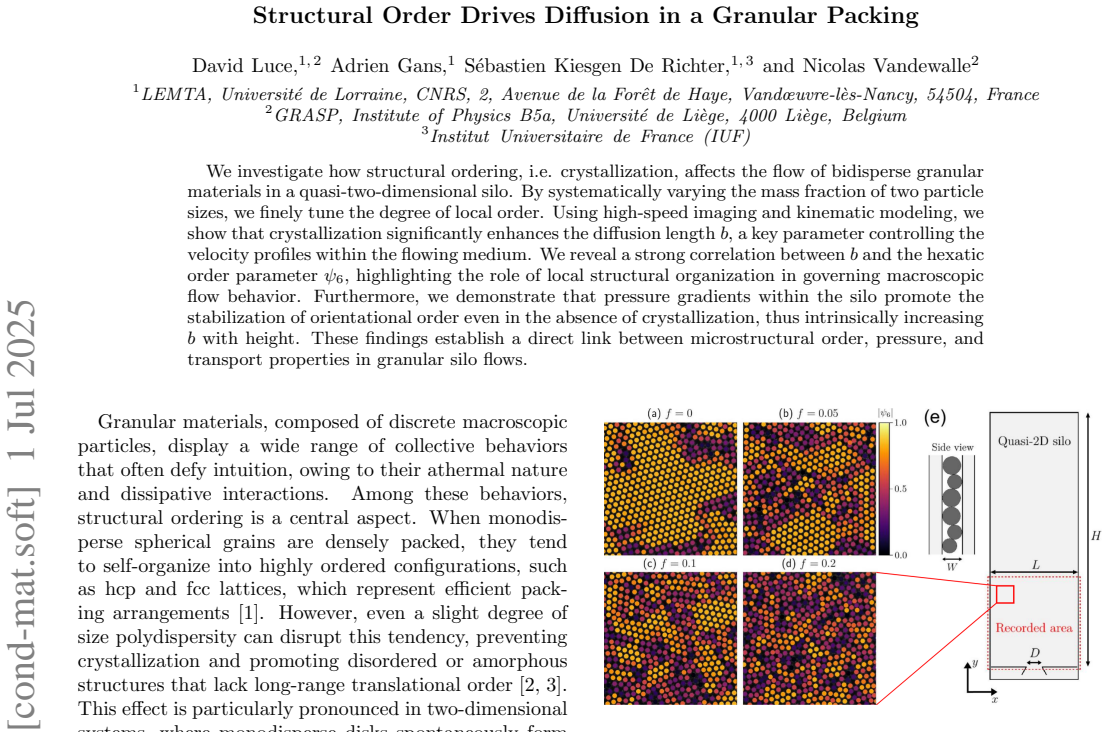
Crystallization significantly enhances the diffusion length b, a key parameter controlling the velocity profiles within the flowing medium. A strong correlation exists between b and the hexatic order parameter <|ψ6|>t. Pressure gradients within the silo promote the stabilization of orientational order even in the absence of crystallization, intrinsically increasing b with height. These findings establish a direct link between microstructural order, pressure, and transport properties in granular silo flows.
What carries the argument
The diffusion length b extracted via kinematic modeling of high-speed images, which scales the velocity profiles and correlates with the time-averaged hexatic order parameter.
If this is right
- Velocity profiles broaden as the degree of crystalline order rises.
- Local structural organization directly controls macroscopic flow behavior.
- b increases with height because pressure stabilizes orientational order without requiring full crystallization.
- Particle size distribution can tune flow properties through its effect on ordering.
Where Pith is reading between the lines
- Adjusting grain size ratios could provide a practical way to modify discharge rates in industrial silos.
- The same structure-transport link may appear in other confined granular systems such as hoppers or shear bands.
- Experiments that hold order fixed while varying pressure independently could separate the two contributions to b.
Load-bearing premise
Kinematic modeling from high-speed imaging extracts the diffusion length b without significant bias from resolution limits or particle tracking errors.
What would settle it
Direct measurement of velocity fields in packings with controlled order but constant b, or inconsistent b values when the same flows are reanalyzed with different tracking algorithms, would break the reported correlation.
Figures


read the original abstract
We investigate how structural ordering, i.e. crystallization, affects the flow of bidisperse granular materials in a quasi-two-dimensional silo. By systematically varying the mass fraction of two particle sizes, we finely tune the degree of local order. Using high-speed imaging and kinematic modeling, we show that crystallization significantly enhances the diffusion length $b$, a key parameter controlling the velocity profiles within the flowing medium. We reveal a strong correlation between $b$ and the hexatic order parameter $\left<|\psi_6|\right>_t$, highlighting the role of local structural organization in governing macroscopic flow behavior. Furthermore, we demonstrate that pressure gradients within the silo promote the stabilization of orientational order even in the absence of crystallization, thus intrinsically increasing $b$ with height. These findings establish a direct link between microstructural order, pressure, and transport properties in granular silo flows.
Editorial analysis
A structured set of objections, weighed in public.
Referee Report
Summary. The paper investigates the effect of structural ordering (crystallization) on the flow behavior of bidisperse granular materials in a quasi-two-dimensional silo. By systematically varying the mass fraction of two particle sizes to tune the degree of local order, and employing high-speed imaging combined with kinematic modeling, the authors report that crystallization enhances the diffusion length b that controls velocity profiles. They demonstrate a strong correlation between b and the time-averaged hexatic order parameter <|ψ6|>t, and further show that pressure gradients can stabilize orientational order even without full crystallization, causing b to increase with height.
Significance. If the central correlation holds after addressing potential methodological biases, the work would establish a direct connection between local microstructural order and a key macroscopic transport parameter in granular silo flows. This has potential implications for granular rheology and silo discharge modeling. The systematic composition variation and use of an independently measured order parameter (rather than a derived one) are positive features supporting the claim.
major comments (1)
- [Kinematic modeling and results on b extraction] Kinematic modeling section: The diffusion length b is extracted by fitting a standard exponential form (v(x) ~ exp(-x/b)) to particle velocity data from high-speed imaging. The manuscript does not report stratified goodness-of-fit statistics (e.g., R² or residual distributions) separated by regions of high vs. low <|ψ6|>t, nor any cross-validation against model-free particle image velocimetry. Because coherent motions in crystalline regions can stabilize fits while noisier trajectories in disordered regions can bias b downward, this differential sensitivity is load-bearing for the reported correlation strength and must be quantified to rule out artifact.
minor comments (2)
- [Abstract] Abstract: The phrase 'significantly enhances' is used without accompanying quantitative measure (e.g., factor by which b increases or correlation coefficient value); adding the actual correlation strength or effect size would improve clarity.
- [Results on pressure and order] The description of pressure-gradient effects on order stabilization is intriguing but would benefit from an explicit statement of how height-dependent pressure is measured or estimated in the silo geometry.
Simulated Author's Rebuttal
We thank the referee for their constructive comments and positive assessment of the significance of our work. We address the major comment below and will incorporate the requested analysis into the revised manuscript.
read point-by-point responses
-
Referee: [Kinematic modeling and results on b extraction] Kinematic modeling section: The diffusion length b is extracted by fitting a standard exponential form (v(x) ~ exp(-x/b)) to particle velocity data from high-speed imaging. The manuscript does not report stratified goodness-of-fit statistics (e.g., R² or residual distributions) separated by regions of high vs. low <|ψ6|>t, nor any cross-validation against model-free particle image velocimetry. Because coherent motions in crystalline regions can stabilize fits while noisier trajectories in disordered regions can bias b downward, this differential sensitivity is load-bearing for the reported correlation strength and must be quantified to rule out artifact.
Authors: We agree that providing stratified goodness-of-fit statistics and cross-validation is important to confirm that the extracted diffusion length b is not biased by differences in trajectory coherence between crystalline and disordered regions. In the revised manuscript we will report R² values together with residual distributions for velocity-profile fits, stratified explicitly by regions of high versus low time-averaged hexatic order parameter. We will also add a direct comparison of the kinematic-model results against model-free particle-image-velocimetry fields to demonstrate that the reported correlation between b and <|ψ6|>t remains robust under these checks. revision: yes
Circularity Check
No circularity: empirical correlation between independently extracted b and hexatic order
full rationale
The paper extracts the diffusion length b via kinematic fits to high-speed imaging velocity data and computes the hexatic order parameter <|ψ6|>t directly from particle position configurations. The reported correlation is between these two separately measured quantities. No equation or step defines b in terms of the order parameter (or vice versa), no fitted parameter is relabeled as a prediction, and no self-citation chain or uniqueness theorem is invoked to force the central claim. The derivation chain remains self-contained against external data benchmarks.
Axiom & Free-Parameter Ledger
free parameters (1)
- diffusion length b
axioms (1)
- domain assumption The hexatic order parameter accurately quantifies local structural ordering in bidisperse granular packings.
Reference graph
Works this paper leans on
-
[1]
S. Torquato and F. H. Stillinger, Jammed hard-particle packings: From kepler to bernal and beyond, Reviews of modern physics 82, 2633 (2010)
work page 2010
-
[2]
K. Watanabe and H. Tanaka, Direct observation of medium-range crystalline order in granular liquids near the glass transition, Physical review letters 100, 158002 (2008)
work page 2008
- [3]
-
[4]
P. M. Reis, R. A. Ingale, and M. D. Shattuck, Crystalliza- tion of a quasi-two-dimensional granular fluid, Physical review letters 96, 258001 (2006)
work page 2006
-
[5]
M. Benyamine, M. Djermane, B. Dalloz-Dubrujeaud, and P. Aussillous, Discharge flow of a bidisperse granular me- dia from a silo, Physical Review E 90, 032201 (2014). 5
work page 2014
- [6]
-
[7]
J. Bai, J. Li, G. Hong, J. Pan, and H. Fei, Mesoscopic evolution and kinetic properties of dense granular flow crystallization under continuous shear induction, Powder Technology 426, 118615 (2023)
work page 2023
-
[8]
C. M. Carlevaro, R. Kozlowski, and L. A. Pugnaloni, Flow rate in 2d silo discharge of binary granular mixtures: the role of ordering in monosized systems, Frontiers in Soft Matter 4, 1340744 (2024)
work page 2024
-
[9]
G. Hagen, ¨Uber den Druck und die Bewegung des trocknen Sandes, Bericht ¨ uber die zur Bekanntmachung geeigneten Verhandlungen der K¨ oniglich Preussischen Akademie der Wissenschaften zu Berlin , 35 (1852)
-
[10]
W. A. Beverloo, H. A. Leniger, and J. Van de Velde, The flow of granular solids through orifices, Chemical engineering science 15, 260 (1961)
work page 1961
- [11]
-
[12]
J. Litwiniszyn, An application of the random walk argu- ment to the mechanics of granular media, Rheology and Soil Mechanics: Symposium Grenoble, April 1–8, 1964 , 82 (1964)
work page 1964
-
[13]
W. Mullins, Experimental evidence for the stochastic the- ory of particle flow under gravity, Powder Technology 9, 29 (1974)
work page 1974
-
[14]
R. Nedderman and U. T¨ uz¨ un, A kinematic model for the flow of granular materials, Powder Technology 22, 243 (1979)
work page 1979
- [15]
-
[16]
J. Choi, A. Kudrolli, and M. Z. Bazant, Velocity pro- file of granular flows inside silos and hoppers, Journal of Physics: Condensed Matter 17, S2533 (2005)
work page 2005
-
[17]
M. Benyamine, P. Aussillous, and B. Dalloz-Dubrujeaud, Discharge flow of a granular media from a silo: effect of the packing fraction and of the hopper angle, EPJ Web of Conferences 140, 03043 (2017)
work page 2017
- [18]
-
[19]
A. Samadani, A. Pradhan, and A. Kudrolli, Size segre- gation of granular matter in silo discharges, Physical Re- view E 60, 7203 (1999)
work page 1999
-
[20]
Q. Chen, R. Li, W. Xiu, V. Zivkovic, and H. Yang, Mea- surement of granular temperature and velocity profile of granular flow in silos, Powder Technology 392, 123 (2021)
work page 2021
-
[21]
I. Zuriguel, D. Maza, A. Janda, R. C. Hidalgo, and A. Garcimart´ ın, Velocity fluctuations inside two and three dimensional silos, Granular Matter 21, 1 (2019)
work page 2019
-
[22]
D. Walker, An approximate theory for pressures and arching in hoppers, Chemical Engineering Science 21, 975 (1966)
work page 1966
discussion (0)
Sign in with ORCID, Apple, or X to comment. Anyone can read and Pith papers without signing in.