Template-Fitting Meets Deep Learning: Redshift Estimation Using Physics-Guided Neural Networks
Pith reviewed 2026-05-19 06:32 UTC · model grok-4.3
The pith
Embedding spectral energy distribution templates into neural networks yields photometric redshifts with an RMS error of 0.0507 and meets two of three LSST requirements below redshift 3.
A machine-rendered reading of the paper's core claim, the machinery that carries it, and where it could break.
Core claim
By embedding spectral energy distribution templates directly into the network architecture, the physics-guided neural network encodes physical priors that improve generalization, yielding an RMS error of 0.0507, a 3-sigma catastrophic outlier rate of 0.13 percent, and a bias of 0.0028 on the PREML dataset while satisfying two of the three LSST photometric redshift requirements for redshifts below 3.
What carries the argument
The multimodal physics-guided neural network architecture that embeds spectral energy distribution templates to encode physical priors, fused via cross-attention mechanisms between photometric and image data together with Bayesian layers for uncertainty estimation.
If this is right
- Redshift estimates become reliable enough for cosmology without needing spectroscopy on every galaxy.
- The rate of catastrophic outliers drops sharply compared with conventional template or machine-learning methods.
- Bayesian uncertainty outputs allow downstream analyses to weight or exclude uncertain predictions.
- The approach meets the accuracy thresholds required by LSST for galaxies at redshifts below 3.
Where Pith is reading between the lines
- Similar template-embedding strategies could improve machine-learning models for other astrophysical parameters such as stellar mass or star-formation rate.
- Strong physical priors might reduce the volume of spectroscopic training data needed for new surveys.
- Applying the same architecture to higher-redshift samples or different filter sets would test how far the priors generalize.
Load-bearing premise
Embedding spectral energy distribution templates directly into the network architecture successfully encodes useful physical priors that improve generalization and reduce outliers beyond what standard multimodal networks achieve on the same data.
What would settle it
Re-training an identical multimodal network on the PREML dataset but without the spectral energy distribution template embedding and checking whether the RMS error exceeds 0.0507 or the 3-sigma outlier rate exceeds 0.13 percent.
Figures



read the original abstract
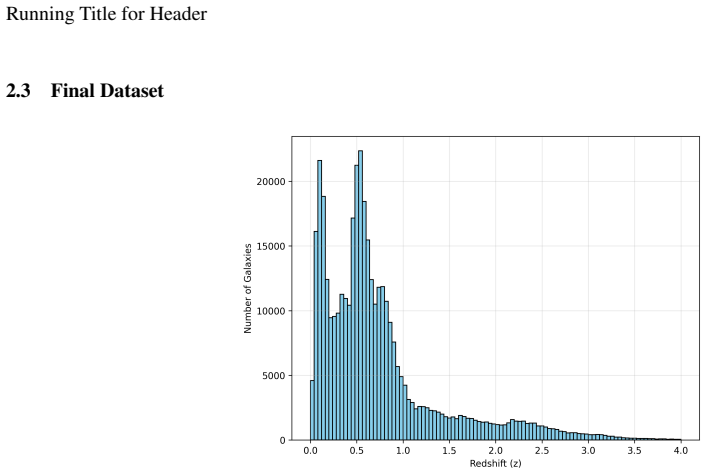
Accurate photometric redshift estimation is critical for observational cosmology, especially in large-scale surveys where spectroscopic measurements are impractical. Traditional approaches include template fitting and machine learning, each with distinct strengths and limitations. We present a hybrid method that integrates template fitting with deep learning using physics-guided neural networks. By embedding spectral energy distribution templates into the network architecture, our model encodes physical priors into the training process. The system employs a multimodal design, incorporating cross-attention mechanisms to fuse photometric and image data, along with Bayesian layers for uncertainty estimation. We evaluate our model on the publicly available PREML dataset, which includes approximately 400,000 galaxies from the Hyper Suprime-Cam PDR3 release, with 5-band photometry, multi-band imaging, and spectroscopic redshifts. Our approach achieves an RMS error of 0.0507, a 3-sigma catastrophic outlier rate of 0.13%, and a bias of 0.0028. The model satisfies two of the three LSST photometric redshift requirements for redshifts below 3. These results highlight the potential of combining physically motivated templates with data-driven models for robust redshift estimation in upcoming cosmological surveys.
Editorial analysis
A structured set of objections, weighed in public.
Referee Report
Summary. The manuscript proposes a hybrid photometric redshift estimator that embeds spectral energy distribution (SED) templates directly into a multimodal neural network architecture. The model fuses 5-band photometry and multi-band imaging via cross-attention, incorporates Bayesian layers for uncertainty estimation, and is trained on the public PREML catalog of ~400,000 HSC PDR3 galaxies with spectroscopic redshifts. It reports an RMS error of 0.0507, 3-sigma catastrophic outlier fraction of 0.13%, bias of 0.0028, and compliance with two of the three LSST requirements for z < 3.
Significance. Should the performance gains prove attributable to the physics-guided template embedding rather than the multimodal architecture alone, the work would provide a concrete route toward meeting LSST photo-z specifications while retaining interpretability from template priors. The use of a public dataset and explicit numerical targets are positive features that support direct comparison with existing template-fitting and machine-learning baselines.
major comments (1)
- [Methods / Results] The central claim that embedding SED templates encodes useful physical priors that improve generalization and reduce outliers (RMS = 0.0507, 0.13% outliers) is load-bearing for the paper's contribution. However, no ablation is presented that removes only the template-embedding component while retaining the identical multimodal cross-attention, Bayesian layers, and PREML train/test split. Without this controlled comparison it remains unclear whether the reported metrics arise from the physics priors or from the data-fusion architecture itself.
minor comments (2)
- [Abstract] The abstract states 'approximately 400,000 galaxies'; the methods section should give the exact sample size after any quality cuts and confirm that the spectroscopic redshift distribution is representative of the target LSST-like population.
- [Figures] Figure captions and axis labels for the redshift comparison plots should explicitly state whether the plotted points are from the held-out test set and whether error bars reflect the Bayesian uncertainty estimates.
Simulated Author's Rebuttal
We thank the referee for their thoughtful and constructive review of our manuscript. We address the major comment below and have revised the manuscript to incorporate the requested analysis.
read point-by-point responses
-
Referee: [Methods / Results] The central claim that embedding SED templates encodes useful physical priors that improve generalization and reduce outliers (RMS = 0.0507, 0.13% outliers) is load-bearing for the paper's contribution. However, no ablation is presented that removes only the template-embedding component while retaining the identical multimodal cross-attention, Bayesian layers, and PREML train/test split. Without this controlled comparison it remains unclear whether the reported metrics arise from the physics priors or from the data-fusion architecture itself.
Authors: We agree that a controlled ablation isolating the SED template embedding is necessary to strengthen attribution of the reported performance gains. In the revised manuscript we have added this experiment: an otherwise identical model was trained without the template-embedding module while preserving the multimodal cross-attention, Bayesian layers, and the exact PREML train/test split. The results of this ablation are now presented in a new subsection of the Methods and Results sections, showing that removal of the template component increases both the RMS error and the outlier fraction relative to the full physics-guided model. These additional numbers are discussed in the context of the original claims. revision: yes
Circularity Check
Empirical performance metrics on held-out public data exhibit no circularity
full rationale
The paper presents a hybrid neural network that embeds SED templates as physical priors within a multimodal architecture with cross-attention and Bayesian layers, then reports direct empirical results (RMS error 0.0507, 0.13% 3-sigma outliers, bias 0.0028) evaluated on the independent held-out split of the public PREML catalog containing ~400k galaxies with spectroscopic redshifts. No equations, derivations, or self-citations reduce these measured quantities to the model inputs or fitted parameters by construction; the performance figures are obtained via standard supervised training and testing rather than tautological re-expression of the architecture or priors. The central claims rest on observable outcomes from external data and do not invoke load-bearing self-referential definitions or uniqueness theorems.
Axiom & Free-Parameter Ledger
axioms (1)
- domain assumption Spectral energy distribution templates provide sufficient physical priors for redshift estimation when embedded in neural networks.
Lean theorems connected to this paper
-
IndisputableMonolith/Cost/FunctionalEquation.leanwashburn_uniqueness_aczel unclear?
unclearRelation between the paper passage and the cited Recognition theorem.
Template Combination: The network predicts probabilities for a set of spectral templates... SEDloss ← MSE(mmodel, mobs)
-
IndisputableMonolith/Foundation/RealityFromDistinction.leanreality_from_one_distinction unclear?
unclearRelation between the paper passage and the cited Recognition theorem.
Total Loss = RMSE + Gaussian NLL + SED Loss · 0.1
What do these tags mean?
- matches
- The paper's claim is directly supported by a theorem in the formal canon.
- supports
- The theorem supports part of the paper's argument, but the paper may add assumptions or extra steps.
- extends
- The paper goes beyond the formal theorem; the theorem is a base layer rather than the whole result.
- uses
- The paper appears to rely on the theorem as machinery.
- contradicts
- The paper's claim conflicts with a theorem or certificate in the canon.
- unclear
- Pith found a possible connection, but the passage is too broad, indirect, or ambiguous to say the theorem truly supports the claim.
Reference graph
Works this paper leans on
-
[1]
T. M. C. Abbott, M. Aguena, S. Allam, A. Amon, F. Andrade-Oliveira, J. Asorey, S. Avila, G. M. Bernstein, E. Bertin, A. Brandao-Souza, D. Brooks, D. L. Burke, J. Calcino, H. Camacho, A. Carnero Rosell, D. Carollo, M. Carrasco Kind, J. Carretero, F. J. Castander, R. Cawthon, K. C. Chan, A. Choi, C. Conselice, M. Costanzi, M. Crocce, L. N. da Costa, M. E. S...
work page 2022
-
[2]
Steven L Finkelstein, Russell E Ryan, Casey Papovich, Mark Dickinson, Mimi Song, Rachel S Somerville, Henry C Ferguson, Brett Salmon, Mauro Giavalisco, Anton M Koekemoer, et al. The evolution of the galaxy rest-frame ultraviolet luminosity function over the first two billion years. The Astrophysical Journal, 810(1):71, 2015
work page 2015
-
[3]
Lsst: from science drivers to reference design and anticipated data products
Željko Ivezi ´c, Steven M Kahn, J Anthony Tyson, Bob Abel, Emily Acosta, Robyn Allsman, David Alonso, Yusra AlSayyad, Scott F Anderson, John Andrew, et al. Lsst: from science drivers to reference design and anticipated data products. The Astrophysical Journal, 873(2):111, 2019
work page 2019
-
[4]
Euclid Collaboration, Ili´c, S., Aghanim, N., Baccigalupi, C., Bermejo-Climent, J. R., Fabbian, G., Legrand, L., Paoletti, D., Ballardini, M., Archidiacono, M., Douspis, M., Finelli, F., Ganga, K., Hernández-Monteagudo, C., Lattanzi, M., Marinucci, D., Migliaccio, M., Carbone, C., Casas, S., Martinelli, M., Tutusaus, I., Natoli, P., Ntelis, P., Pagano, L....
work page 2022
-
[5]
Lsst science requirements document lpm-17, 2018
Željko Ivezi ´c and The LSST Science Collaboration. Lsst science requirements document lpm-17, 2018. Accessed: 2025-05-04
work page 2018
-
[6]
J. Pasquet, E. Bertin, M. Treyer, S. Arnouts, and D. Fouchez. Photometric redshifts from sdss images using a convolutional neural network. Astronomy and Astrophysics, 2019
work page 2019
-
[7]
S. Schuldt et al. Photometric redshift estimation with a convolutional neural network: Netz. Astronomy and Astrophysics, 2021
work page 2021
- [8]
-
[9]
R. Ait Ouahmed, S. Arnouts, J. Pasquet, M. Treyer, and E. Bertin. Multimodality for improved cnn photometric redshifts. Astronomy & Astrophysics, 2023
work page 2023
-
[10]
E. L. Jones et al. Improving photometric redshift estimation for cosmology with lsst using bayesian neural networks. The Astrophysical Journal, 2024
work page 2024
-
[11]
E. Jones et al. Redshift prediction with images for cosmology using a bayesian convolutional neural network with conformal predictions. The Astrophysical Journal, 974:159, 2024
work page 2024
-
[12]
X. Zhou et al. Photometric redshift estimates using bayesian neural networks in the csst survey. Research in Astronomy and Astrophysics, 2022
work page 2022
- [13]
- [14]
-
[15]
S. Hong et al. Photoredshift-mml: a multimodal machine learning method for estimating photometric redshifts of quasars. Monthly Notices of the Royal Astronomical Society , 2022
work page 2022
-
[16]
Investigating deep learning methods for obtaining photometric redshift estimations from images
Henghes et al. Investigating deep learning methods for obtaining photometric redshift estimations from images. Monthly Notices of the Royal Astronomical Society , 2022
work page 2022
-
[17]
B. Hoyle. Measuring photometric redshifts using galaxy images and deep st neural networks. Astronomy and Computing, 2016
work page 2016
-
[18]
A. D’Isanto and K. Polsterer. Photometric redshift estimation via deep learning. Astronomy and Astrophysics, 2017
work page 2017
-
[19]
Third data release of the hyper suprime- cam subaru strategic program
Hiroaki Aihara, Yusra AlSayyad, Makoto Ando, Robert Armstrong, James Bosch, Eiichi Egami, Hisanori Furusawa, Junko Furusawa, Sumiko Harasawa, Yuichi Harikane, et al. Third data release of the hyper suprime- cam subaru strategic program. Publications of the Astronomical Society of Japan , 74(2):247–272, 2022
work page 2022
-
[20]
Tuan Do, Bernie Boscoe, Evan Jones, Yun Qi Li, and Kevin Alfaro. Galaxiesml: a dataset of galaxy images, photometry, redshifts, and structural parameters for machine learning, 2024. 14
work page 2024
discussion (0)
Sign in with ORCID, Apple, or X to comment. Anyone can read and Pith papers without signing in.