A Stochastic Schr\"odinger Equation for the Generalized Rate Operator Unravelings
Pith reviewed 2026-05-22 00:03 UTC · model grok-4.3
The pith
A stochastic Schrödinger equation is derived for generalized rate operator unravelings of open quantum system dynamics.
A machine-rendered reading of the paper's core claim, the machinery that carries it, and where it could break.
Core claim
The central claim of the paper is the derivation of a stochastic Schrödinger equation that realizes the generalized rate operator unraveling for open quantum systems. This holds for both unravelings that include reverse jumps and those that avoid them. The authors further establish that a breakdown in this method can serve as evidence for master equations producing unphysical evolutions, and this evidence is independent of the specific non-linear transformation employed in the unraveling.
What carries the argument
The generalized rate operator unraveling, which relies on an arbitrary non-linear transformation to incorporate memory effects.
If this is right
- Simulations of open quantum dynamics can avoid reverse jumps for certain non-P-divisible processes.
- The stochastic method provides a tool to witness unphysical time evolutions in master equations independently of the transformation.
- Flexibility in choosing the non-linear transformation allows engineering of different stochastic realizations.
Where Pith is reading between the lines
- This derivation may enable new numerical algorithms for simulating memory effects in quantum systems.
- It could connect to studies of divisibility in quantum channels and their physical realizability.
- Extensions might include applying the equation to specific models like spin-boson systems to check efficiency.
Load-bearing premise
The unraveling depends on an arbitrary non-linear transformation which can incorporate the memory effects and allow avoidance of reverse jumps for some dynamics that violate P-divisibility.
What would settle it
A concrete falsifier would be to take a master equation known to generate unphysical states and check if the stochastic Schrödinger equation fails to produce valid probability distributions or positive operators for any choice of the non-linear transformation.
Figures
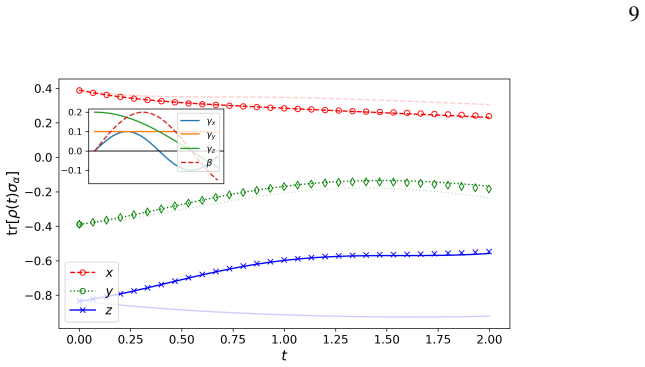
read the original abstract
Stochastic unravelings are a widely used tool to solve open quantum system dynamics, in which the exact solution is obtained via an average over a stochastic process on the set of pure quantum states. Recently, the generalized rate operator unraveling formalism was derived, allowing not only for an engineering of the stochastic realizations, but also to unravel without reverse jumps even for some dynamics in which P-divisibility is violated, thus hugely improving the simulation efficiency. This is possible because the unraveling depend on an arbitrary non-linear transformation which can incorporate the memory effects. In this work, a stochastic Schr\"odinger equation for this formalism is derived, both for cases with and without reverse jumps. It is also shown that a failure of this method can be used to witness master equations leading unphysical time evolutions, independently on the particular non-linear transformation considered.
Editorial analysis
A structured set of objections, weighed in public.
Referee Report
Summary. The paper derives a stochastic Schrödinger equation for the generalized rate operator unraveling formalism, covering both cases with and without reverse jumps. This is achieved by incorporating an arbitrary non-linear transformation into the rate operators, which can encode memory effects. The work also shows that failure of the unraveling can witness master equations producing unphysical time evolutions (e.g., negative eigenvalues in the dynamical map), and that this diagnostic holds independently of the specific non-linear transformation chosen. The derivation proceeds via direct substitution into the standard stochastic jump process followed by an averaging argument.
Significance. If the derivation is correct, the result extends the practical toolkit for efficient simulation of open quantum systems, especially non-Markovian dynamics that violate P-divisibility, by enabling reverse-jump-free unravelings. The transformation-independent witnessing property provides a general diagnostic for unphysical master equations without requiring a specific choice of nonlinearity. The construction builds on standard quantum mechanics and prior generalized rate operator work, with no free parameters or ad-hoc entities introduced.
minor comments (2)
- The abstract and introduction would benefit from a brief explicit statement of the precise form of the stochastic Schrödinger equation (e.g., the Itô or Stratonovich convention used) to aid readers unfamiliar with the generalized rate operator formalism.
- Notation for the non-linear transformation and the transformed rate operators should be introduced with a dedicated equation or definition box in §2 or §3 to improve readability when the witnessing argument is presented later.
Simulated Author's Rebuttal
We thank the referee for their positive assessment of our manuscript and for recommending minor revision. The referee's summary accurately captures the main contributions, including the derivation of the stochastic Schrödinger equation for generalized rate operator unravelings (with and without reverse jumps) and the transformation-independent diagnostic for unphysical master equations. We appreciate the recognition of the work's potential to improve simulation efficiency for non-Markovian dynamics.
Circularity Check
No significant circularity; derivation is self-contained via direct substitution.
full rationale
The central derivation substitutes the arbitrary non-linear transformation into the generalized rate operators and inserts the result into the standard stochastic jump process, followed by an averaging argument to obtain the stochastic Schrödinger equation. The witnessing claim follows directly from the observation that unphysical dynamical maps (negative eigenvalues) preclude any valid positive rate operator, independent of the specific transformation. This relies on standard quantum mechanics and the prior generalized rate operator formalism without reducing any claimed result to a fitted parameter, self-definition, or load-bearing self-citation chain. The construction is externally falsifiable against known stochastic unraveling benchmarks and does not rename or smuggle in prior results by construction.
Axiom & Free-Parameter Ledger
Forward citations
Cited by 1 Pith paper
-
Stochastic unravelings for Heisenberg picture and trace-nonpreserving dynamics
The paper introduces a general framework extending piecewise-deterministic unravelings to arbitrary trace-nonpreserving master equations requiring only positivity and Hermiticity of the dynamics.
Reference graph
Works this paper leans on
-
[1]
1H.-P. Breuer and F. Petruccione, The Theory of Open Quantum Systems (Oxford University PressOxford, Jan. 2007). 2B. Vacchini,Open Quantum Systems, Graduate Texts in Physics (Springer Nature
work page 2007
-
[2]
Completely positive dynam- ical semigroups of N -level systems
Switzerland, Cham, 2024). 3V . Gorini, A. Kossakowski, and E. C. G. Sudarshan, “Completely positive dynam- ical semigroups of N -level systems”, Journal of Mathematical Physics 17, 821– 825 (1976). 4G. Lindblad, “On the generators of quantum dynamical semigroups”, Communi- cations in Mathematical Physics 48, 119–130 (1976). 5D. Chru´sci´nski and A. Kossak...
work page 2024
-
[3]
The quantum-state di ffusion model applied to open systems
Berlin, Heidelberg, 2009). 17N. Gisin and I. C. Percival, “The quantum-state di ffusion model applied to open systems”, Journal of Physics A: General Physics 25, 5677–5691 (1992). 18L. Di´osi, N. Gisin, and W. T. Strunz, “Non-Markovian quantum state di ffusion”, Physical Review A - Atomic, Molecular, and Optical Physics 58, 1699–1712 (1998). 19T. Yu, L. D...
discussion (0)
Sign in with ORCID, Apple, or X to comment. Anyone can read and Pith papers without signing in.