REVIEW 3 major objections 6 minor 3 cited by
47 Tuc in Rubin Data Preview 1: Exploring Early LSST Data and Science Potential
T0 review · 3 major / 6 minor · reviewed 2026-08-06 · deepseek-v4-flash
Pith's one-line read With four nights of commissioning data, a 3,576-star 47 Tuc catalog and 62 recovered variables show the survey can handle crowded fields.
desk verdict A useful early-look paper showing DP1 can support crowded-field stellar photometry, but the 62/72 variable-recovery headline needs false-positive control before it can be quoted. read the letter →
The pith
A machine-rendered reading of the paper's core claim, the machinery that carries it, and where it could break.
The reading
What carries the argument
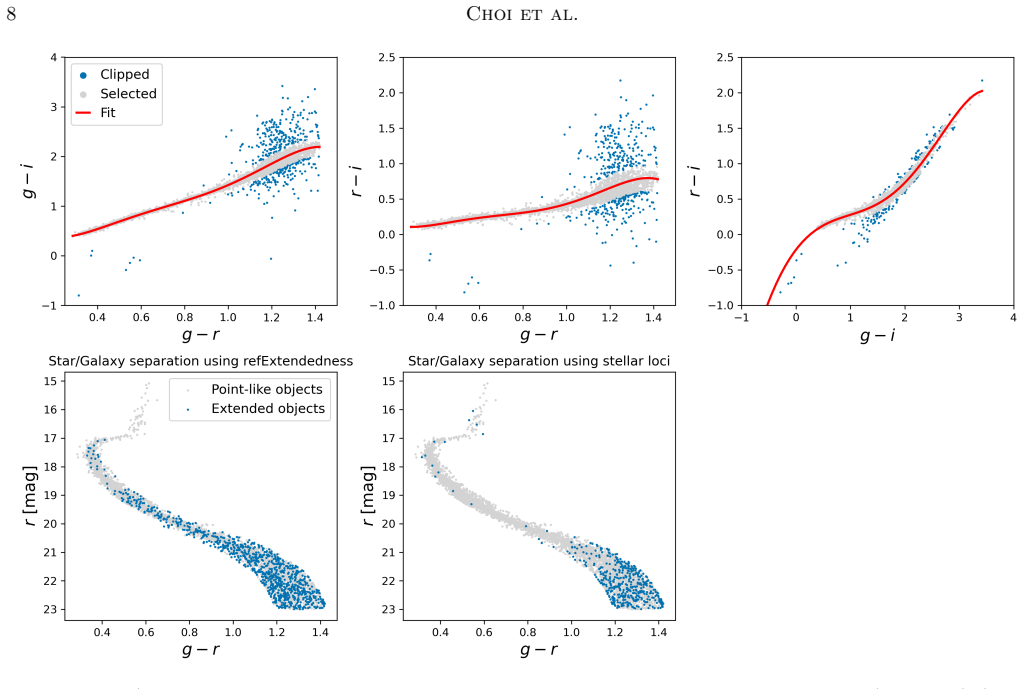
The load-bearing mechanism is a sequential matched filter: proximity to a PARSEC isochrone (a set of theoretical stellar-evolution tracks) in color-magnitude space, a three-component Gaussian mixture model over Gaia proper motions to flag Small Magellanic Cloud and Milky Way contaminants, and fifth-degree polynomial fits to the stellar locus in $(g-r, g-i)$, $(g-r, r-i)$, and $(g-i, r-i)$ color-color space with iterative sigma-clipping. The polynomial loci serve double duty: they define which points are 'star-like' for star-galaxy separation, and in the scatter analysis a linear fit to the $g-i$ versus $g-r$ relation measures the residual that measurement noise, crowding, and reddening models must explain. The variable-star recovery uses difference-image forced photometry, which retains flux in subtracted images and reaches closer to the cluster core than coadd photometry.
What would settle it
A direct, high-resolution reddening map of 47 Tuc, or a repeat of the scatter analysis on a non-crowded control field imaged with the same camera to the same depth, would settle whether the excess color scatter is really differential extinction; if independent reddening measurements gave $\sigma_{A_V}$ well below 0.03 mag, the paper's interpretation would fail.
Extended reading notes
Core claim
The paper's central claim is that the commissioning-era Rubin data, despite being taken with a prototype camera over four nights and processed with pipelines not optimized for dense fields, already enable meaningful stellar-population work in a difficult globular cluster field. Applying a three-stage selection—isochrone proximity in the $(g-r, r)$ color-magnitude diagram, a Gaussian mixture model over Gaia DR3 proper motions, and multi-dimensional $\sigma$-clipping around fifth-degree polynomial fits to the stellar locus in three color-color diagrams—yields 3,576 high-confidence 47 Tuc members. The same polynomial locus fits provide a star-galaxy separation that avoids the bright-star misclassification of the pipeline's extendedness parameter. Crossmatching to a catalog of 72 well-characterized known variables recovers five in the coadd-based object table and 62 in the difference-image object table, and forced photometry at fixed positions reproduces the shapes of densely sampled RR Lyrae light curves. In the color-color plane of bright members, scatter from reported errors and crowding is insufficient; adding differential extinction with $\sigma_{A_V} = 0.03$ mag reproduces the observed scatter, leading the authors to conclude that differential extinction across the surveyed area cannot be as large as a previous $\sigma_{A_V} = 0.06$ mag estimate.
Load-bearing premise
Everything rests on the assumption that a single model stellar population with age 12.4 billion years, metallicity $[\mathrm{M/H}] = -0.5$, distance 4.66 kiloparsecs, and visual extinction $A_V = 0.1$ mag reproduces the true 47 Tuc population; both the membership selection and the photometric-scatter interpretation are calibrated against that model.
Editorial extensions
If this is right
- If the analysis holds, the same three-stage member-selection filter can be applied to future LSST data releases to map 47 Tuc's main sequence to fainter magnitudes than Gaia can reach.
- Difference-image forced photometry becomes the preferred variability channel in dense fields, since it recovered 62 of 72 known variables versus five in coadd catalogs.
- The polynomial stellar-locus method offers a cheap, effective star-galaxy separator that should improve catalog purity in crowded fields before the first official data release.
- The inferred upper limit on differential extinction ($\sigma_{A_V} \lesssim 0.03$ mag) in the surveyed area would constrain internal reddening models of the cluster.
- Sparse multi-night light curves matching dense literature light curves supports Rubin's planned variability science in dense stellar environments.
Reading between the lines
- Editorial inference: the gap between the coadd-object recovery (5 of 72) and the difference-image recovery (62 of 72) suggests future survey analyses should treat difference-image catalogs as the primary variability sample, a choice the paper hints at but does not elevate to a general recommendation.
- Editorial inference: the same color-color locus fitting could be packaged as a generic outlier-rejection step for any crowded stellar field, extending beyond cluster membership work.
- Editorial inference: the spatially coherent roughly 0.1-degree scatter without obvious patch-boundary correlation points to a calibration term in the Data Preview 1 processing that could be isolated by comparing repeated visits of the same sky area; the paper leaves this as future work.
- Editorial inference: if the differential-extinction interpretation survives deeper data, it would imply that 47 Tuc's internal reddening spread is smaller than recently claimed, with consequences for interpreting the cluster's multiple stellar populations.
Editorial analysis
A structured set of objections, weighed in public.
Referee Report
Summary. This paper analyzes Rubin Observatory Data Preview 1 (DP1) LSSTComCam observations of the 47 Tuc field. It characterizes depth, coverage, and the effects of crowding on deblending; fits fifth-degree polynomials to stellar loci in three color-color diagrams to separate stars from galaxies; constructs a catalog of 3,576 probable cluster members by combining isochrone filtering, Gaia DR3 proper-motion filtering, and color-color filtering; models the scatter in the g-i versus g-r sequence using simulated PARSEC populations, photometric errors, crowding, and differential extinction; and crossmatches 72 known variables in the field to the DP1 Object and DiaObject tables, reporting 5 matches in the coadd-based catalog and 62 in the difference-image catalog. The paper concludes that DP1 is promising for crowded-field stellar population and variability work despite recognized limitations.
Significance. The paper is a useful early, honest assessment of Rubin DP1 data in a challenging crowded-field regime, and the public member catalog plus the detailed ADQL query improve reproducibility. If the claimed improvements and recovery rates hold up, the results indicate that even four nights of ComCam data can support member selection and some variability characterization in dense fields, which is valuable for community readiness. Strengths include explicit acknowledgment of limitations (e.g., no claimed differential-extinction measurement, crowding-driven deblending failures) and the use of external benchmarks (PARSEC isochrones, Gaia DR3, the Weldrake catalog). The main caveats are that the star-galaxy separation improvement is not quantitatively validated and that the headline 62/72 variable-recovery count lacks false-positive control.
major comments (3)
- [Section 3.3 / Abstract] The abstract's headline claim that the authors 'identify 62 of 72 known variables in the difference image-based object catalog' is not yet supported because the crossmatch to the DiaObject table is presented without a matching radius, without the total number of DiaObjects in the field, and without any estimate of chance coincidences. The paper itself notes that some DiaSources are incomplete subtractions of bright stars and that at least one detection lies on a diffraction spike (Figure 14 and surrounding text), so the 62 matches could include artifacts or random alignments. Please add the crossmatch parameters, a false-positive estimate, and, if possible, validation of the matches with forced photometry or periodicity/amplitude checks; otherwise the abstract should be reworded to say 'positionally matched' rather than 'identify.'
- [Section 2.2.3 / Figure 6] The claimed improvement in star-galaxy separation relative to refExtendedness is supported only by visual comparison of color-magnitude diagrams. Because the stellar-locus polynomials are fitted to stars preselected by isochrone proximity and moderate color cuts and the same locus is then used to classify all objects by residual, the apparent rejection of faint contaminants may be partly by construction. Please quantify completeness and contamination as a function of magnitude relative to refExtendedness, ideally using an independent sample such as Gaia-confirmed stars or spectroscopically confirmed galaxies/AGN, and state the adopted sigma thresholds and the number of objects rejected at each step.
- [Section 3.2.3 / Figures 11-12] The conclusion that differential extinction in the covered area cannot be as large as the sigma_AV about 0.06 mag reported by Pancino et al. (2024) rests on the assumed PARSEC isochrone parameters (age 12.4 Gyr, [M/H] = -0.5, distance 4.66 kpc, AV = 0.1), the Olsen et al. (2003) crowding-error prescription, and the assumption that the three modeled scatter sources are the only contributors. Since the authors explicitly say they cannot rule out camera-specific systematics in DP1, the upper-limit statement should be framed as conditional on those assumptions, or a sensitivity test varying the isochrone parameters or crowding-error normalization should be added.
minor comments (6)
- [Equation (2)] The term '-5.793 v5' is a typographical error and should read '-5.793 (g - r)^5'.
- [Section 3.3] The sentence 'The two objects not found in the DiaObject table correspond to one EcB and one detached EcB' is ambiguous; clarify that these are the two Object-table matches that are absent from the DiaObject table.
- [Section 3.1.1] The 'likelihood-like score' used for isochrone matching is not defined; please give the formula and the units of the 0.2 threshold so the selection is reproducible.
- [Section 3.3 / Figure 15] The statement that DP1 lightcurves 'appear to follow the patterns of densely-sampled literature lightcurves well' is demonstrated for only one RR Lyrae; consider showing at least one additional example or softening the wording.
- [Table 1] The u-band row lists '6 (0)' visits but no observing nights or CCD statistics; a footnote explaining that all u-band visits failed quality cuts would improve readability.
- [Section 2.2.3] The text says objects are excluded if they lie off the stellar locus 'in all three spaces,' but the preceding sentence describes 5-sigma rejection in each space; please clarify whether the rejection is applied independently per space or jointly across all three color-color spaces.
Circularity Check
No significant circularity: all central claims are benchmarked against external isochrone, Gaia, and Weldrake variable catalogs; the color-color classifier is a practical application, not a derived prediction.
full rationale
The paper is an empirical demonstration of DP1 data products, not a derivation chain. Its three headline results are all anchored to external benchmarks: the 3,576-member catalog is selected using PARSEC isochrones (Bressan et al. 2012; Simunovic et al. 2023), Gaia DR3 proper motions (Gaia Collaboration et al. 2023), and color-color filters whose seed locus is itself isochrone-based; the variable recovery (5 in Object, 62 in DiaObject) is a positional crossmatch to the independent Weldrake et al. (2004) catalog; and the photometric scatter analysis is a forward model that adds PARSEC-simulated populations, Olsen et al. (2003) crowding errors, and Cardelli et al. (1989) extinction, rather than fitting the observed scatter as a free parameter. The only potentially self-referential element is the star-galaxy separation: a fifth-degree polynomial is fit to an isochrone-preselected stellar locus, and objects with residuals exceeding 5 sigma are classified as likely background galaxies. That classification is partly definitional, since 'off the fitted stellar locus' is the rule used to define the galaxy class. However, the locus is anchored to an external isochrone, the method is presented as a practical classifier rather than a first-principles prediction, and the paper does not use the resulting labels to validate the isochrone itself. The variable-recovery claim lacks a false-positive control, and the paper itself notes that 'some of the DiaSources may be incomplete subtractions of the brightest stars' and that at least one detection lies on a diffraction spike; this is a data-quality and validation caveat, not circularity. Citations to DP1 technical notes and the Monster reference catalog are documentation and data products, not load-bearing self-citations. Overall, the paper's claims do not reduce to their inputs by construction.
Assumptions & free parameters
free parameters (6)
- Polynomial coefficients for stellar locus fits =
Equations (1)-(3) in the paper
- Isochrone proximity threshold =
0.2
- Color-color sigma-clipping threshold =
5 sigma
- Differential extinction width sigma_AV =
0.03 mag
- GMM component parameters for proper motion =
Not stated in paper (means/variances)
- Color tolerance for isochrone matching =
0.05 mag (bright), 0.1 mag (faint)
assumptions (4)
- domain assumption PARSEC isochrones with age 12.4 Gyr, [M/H]=-0.5, distance 4.66 kpc, AV=0.1 accurately represent 47 Tuc.
- domain assumption Gaia DR3 proper motions are reliable for separating 47 Tuc from SMC and Milky Way field stars.
- domain assumption The Weldrake et al. (2004) catalog contains the known variables in the field with correct periods and amplitudes.
- domain assumption LSST Science Pipelines produce accurate photometry and astrometry for the processed DP1 images.
Cite this review
Pith. "Pith review of 47 Tuc in Rubin Data Preview 1: Exploring Early LSST Data and Science Potential." pith.science (2026). https://pith.science/paper/TV5MOQ3N
@misc{pith2026250701343,
  author       = {Pith},
  title        = {Pith review of: 47 Tuc in Rubin Data Preview 1: Exploring Early LSST Data and Science Potential},
  year         = {2026},
  howpublished = {\url{https://pith.science/paper/TV5MOQ3N}},
  note         = {Machine review of arXiv:2507.01343}
}
abstract
We present analyses of the early data from Rubin Observatory's Data Preview 1 (DP1) for the globular cluster 47 Tuc field. The DP1 dataset for 47 Tuc includes four nights of observations from the Rubin Commissioning Camera (LSSTComCam), covering multiple bands ($ugriy$). We address challenges of crowding in the inner region of the cluster and toward the SMC in DP1, and demonstrate improved star-galaxy separation by fitting fifth-degree polynomials to the stellar loci in color-color diagrams and applying multi-dimensional sigma clipping. We compile a catalog of 3,576 probable 47 Tuc member stars selected via a combination of isochrone, Gaia proper-motion, and color-color space matched filtering. We explore the sources of photometric scatter in the 47 Tuc color-color sequence, evaluating contributions from various potential sources, including differential extinction within the cluster. Finally, of the 72 well-characterized variables in the field, we recover five known variable stars, including three RR Lyrae and two eclipsing binaries, in the coadd-based object catalog, and identify 62 in the difference image-based object catalog. Although the DP1 lightcurves have sparse temporal sampling, they appear to follow the patterns of densely-sampled literature lightcurves well. Despite some data limitations for crowded-field stellar analysis, DP1 demonstrates the promising scientific potential for future LSST data releases.
Figures


Figures from the paper (10 more)




Forward citations
Cited by 3 Pith papers
-
Optical Counterparts to X-ray sources in LSST DP1
A multi-catalog X-ray to LSST DP1 crossmatch finds 2314 optical counterparts, most reliable in the E-CDF-S field, with no strong accreting compact object candidates found.
-
What ZTF Saw Where Rubin Looked: Anomaly Hunting in DR23
Applying the SNAD PineForest anomaly detector to ZTF DR23 light curves in LSSTComCam fields uncovered six uncatalogued variable stars and improved parameters for six known variables.
-
Crowded Field Photometry with Rubin: Exploring 47 Tucanae with Data Preview 1
Difference-imaging forced photometry recovers stars twice as close to the center of 47 Tuc (about 14 pc) than Rubin's standard coadd catalog (about 28 pc), yielding 14744 candidate members within acknowledged systematics.
Reference graph
Works this paper leans on
-
[1]
Abazajian, K., Adelman-McCarthy, J. K., Ag¨ ueros, M. A., et al. 2004, AJ, 128, 502, doi: 10.1086/421365 Astropy Collaboration, Robitaille, T. P., Tollerud, E. J., et al. 2013, A&A, 558, A33, doi: 10.1051/0004-6361/201322068 Astropy Collaboration, Price-Whelan, A. M., Sip˝ ocz, B. M., et al. 2018, AJ, 156, 123, doi: 10.3847/1538-3881/aabc4f Astropy Collab...
doi:10.1086/421365 2004
-
[2]
Bellazzini, M., Pancino, E., & Ferraro, F. R. 2005, A&A, 435, 871, doi: 10.1051/0004-6361:20042538
-
[3]
Bellazzini, M., Pancino, E., Ferraro, F. R., & Stetson, P. B. 2019, Research Notes of the AAS, 3, 47, doi: 10.3847/2515-5172/ab0c0d
-
[4]
Bernstein, G. M. 2022, gbdes: DECam instrumental signature fitting and processing programs, Astrophysics Source Code Library, record ascl:2210.011
work page 2022
-
[5]
Bernstein, G. M., Armstrong, R., Plazas, A. A., et al. 2017, PASP, 129, 074503, doi: 10.1088/1538-3873/aa6c55
-
[6]
2011, in Astronomical Society of the Pacific Conference Series, Vol
Bertin, E. 2011, in Astronomical Society of the Pacific Conference Series, Vol. 442, Astronomical Data Analysis Software and Systems XX, ed. I. N. Evans, A. Accomazzi, D. J. Mink, & A. H. Rots, 435
2011
-
[7]
2018, PASJ, 70, S5, doi: 10.1093/pasj/psx080
Bosch, J., Armstrong, R., Bickerton, S., et al. 2018, PASJ, 70, S5, doi: 10.1093/pasj/psx080
-
[8]
2019, in Astronomical Society of the Pacific Conference Series, Vol
Bosch, J., AlSayyad, Y., Armstrong, R., et al. 2019, in Astronomical Society of the Pacific Conference Series, Vol. 523, Astronomical Data Analysis Software and Systems XXVII, ed. P. J. Teuben, M. W. Pound, B. A. Thomas, & E. M. Warner, 521, doi: 10.48550/arXiv.1812.03248
Show all 56 references
-
[9]
2012, MNRAS, 427, 127, doi: 10.1111/j.1365-2966.2012.21948.x
Bressan, A., Marigo, P., Girardi, L., et al. 2012, MNRAS, 427, 127, doi: 10.1111/j.1365-2966.2012.21948.x
2012
-
[10]
A., Bedin, L
Brogaard, K., VandenBerg, D. A., Bedin, L. R., et al. 2017, Monthly Notices of the Royal Astronomical Society, 468, 645, doi: 10.1093/mnras/stx378
2017 doi
-
[11]
A., et al
Broughton, A., Utsumi, Y., Plazas Malag´ on, A. A., et al. 2024, PASP, 136, 045003, doi: 10.1088/1538-3873/ad3aa2 16 Choi et al
2024 doi
-
[12]
L., Rykoff, E
Burke, D. L., Rykoff, E. S., Allam, S., et al. 2018, AJ, 155, 41, doi: 10.3847/1538-3881/aa9f22
2018 doi
-
[13]
2025, arXiv e-prints, arXiv:2501.02103, doi: 10.48550/arXiv.2501.02103
Caplar, N., Beebe, W., Branton, D., et al. 2025, arXiv e-prints, arXiv:2501.02103, doi: 10.48550/arXiv.2501.02103
2025 doi
-
[14]
A., Clayton, G
Cardelli, J. A., Clayton, G. C., & Mathis, J. S. 1989, ApJ, 345, 245, doi: 10.1086/167900
1989 doi
-
[15]
2005, A&A, 433, 597, doi: 10.1051/0004-6361:20041892
Bonifacio, P. 2005, A&A, 433, 597, doi: 10.1051/0004-6361:20041892
2005 doi
-
[16]
2018, The Astrophysical Journal, 867, 132, doi: 10.3847/1538-4357/aae089
Chen, S., Richer, H., Caiazzo, I., & Heyl, J. 2018, The Astrophysical Journal, 867, 132, doi: 10.3847/1538-4357/aae089
2018 doi
-
[17]
2015, MNRAS, 452, 1068, doi: 10.1093/mnras/stv1281
Chen, Y., Bressan, A., Girardi, L., et al. 2015, MNRAS, 452, 1068, doi: 10.1093/mnras/stv1281
2015 doi
-
[18]
2014, MNRAS, 444, 2525, doi: 10.1093/mnras/stu1605
Chen, Y., Girardi, L., Bressan, A., et al. 2014, MNRAS, 444, 2525, doi: 10.1093/mnras/stu1605
2014 doi
-
[19]
2023, A&A, 674, A18, doi: 10.1051/0004-6361/202243964 Della Croce, A., Pascale, R., Giunchi, E., et al
Clementini, G., Ripepi, V., Garofalo, A., et al. 2023, A&A, 674, A18, doi: 10.1051/0004-6361/202243964 Della Croce, A., Pascale, R., Giunchi, E., et al. 2024, A&A, 682, A22, doi: 10.1051/0004-6361/202347569
2023 doi
-
[20]
Developers, R. O. S. P. 2025, The LSST Science Pipelines Software: Optical Survey Pipeline Reduction and Analysis Environment, Project Science Technical Note PSTN-019, Vera C. Rubin Observatory. https://pstn-019.lsst.io/
2025
-
[21]
2023, The Rubin Science Platform, Data Management Technical Note DMTN-212, NSF-DOE Vera C
Economou, F. 2023, The Rubin Science Platform, Data Management Technical Note DMTN-212, NSF-DOE Vera C. Rubin Observatory. https://dmtn-212.lsst.io/
2023
-
[22]
2025, Rubin Baseline Calibration Plan, Commissioning Technical Note SITCOMTN-086, Vera C
Fagrelius, P., & Rykoff, E. 2025, Rubin Baseline Calibration Plan, Commissioning Technical Note SITCOMTN-086, Vera C. Rubin Observatory. https://sitcomtn-086.lsst.io/
2025
-
[23]
2025, The Monster: A reference catalog with synthetic ugrizy-band fluxes for the Vera C
Parejko, J. 2025, The Monster: A reference catalog with synthetic ugrizy-band fluxes for the Vera C. Rubin observatory, Data Management Technical Note DMTN-277, Vera C. Rubin Observatory. https://dmtn-277.lsst.io/ Gaia Collaboration, Vallenari, A., Brown, A. G. A., et al. 2023...
2025 doi
-
[24]
P., Bechtol, K., Bellm, E., et al
Guy, L. P., Bechtol, K., Bellm, E., et al. 2025, Rubin Observatory Plans for an Early Science Program, Technical Note RTN-011, Vera C. Rubin Observatory. https://rtn-011.lsst.io/
2025
-
[25]
R., Millman, K
Harris, C. R., Millman, K. J., van der Walt, S. J., et al. 2020, Nature, 585, 357, doi: 10.1038/s41586-020-2649-2
2020 doi
-
[26]
E., & Philip, A
Hesser, J. E., & Philip, A. G. D. 1976, Publications of the Astronomical Society of the Pacific, 88, 89, doi: 10.1086/129904
1976 doi
-
[27]
Hunter, J. D. 2007, Computing in Science and Engineering, 9, 90, doi: 10.1109/MCSE.2007.55 Ivezi´ c,ˇZ., Kahn, S. M., Tyson, J. A., et al. 2019, ApJ, 873, 111, doi: 10.3847/1538-4357/ab042c
2007 doi
-
[28]
M., Amon, A., et al
Jarvis, M., Bernstein, G. M., Amon, A., et al. 2021b, MNRAS, 501, 1282, doi: 10.1093/mnras/staa3679
-
[29]
F., Salnikov, A., et al
Jenness, T., Bosch, J. F., Salnikov, A., et al. 2022, in Society of Photo-Optical Instrumentation Engineers (SPIE) Conference Series, Vol. 12189, Software and Cyberinfrastructure for Astronomy VII, 1218911, doi: 10.1117/12.2629569 Juri´ c, M., Ciardi, D., Dubois-Felsmann, G., ...
2022 doi
-
[30]
2023, A&A, 674, A5, doi: 10.1051/0004-6361/202244220
Katz, D., Sartoretti, P., Guerrier, A., et al. 2023, A&A, 674, A5, doi: 10.1051/0004-6361/202244220
2023 doi
-
[31]
2024, in Ground-based and Airborne Instrumentation for Astronomy X, ed
Lange, T., Nordby, M., Pollek, H., et al. 2024, in Ground-based and Airborne Instrumentation for Astronomy X, ed. J. R. Vernet, J. J. Bryant, & K. Motohara (SPIE), 60, doi: 10.1117/12.3019302
2024 doi
-
[32]
2014, The Astrophysical Journal, 790, 35, doi: 10.1088/0004-637X/790/1/35
Li, C., de Grijs, R., Deng, L., et al. 2014, The Astrophysical Journal, 790, 35, doi: 10.1088/0004-637X/790/1/35
2014 doi
-
[33]
2017, ApJ, 835, 77, doi: 10.3847/1538-4357/835/1/77
Marigo, P., Girardi, L., Bressan, A., et al. 2017, ApJ, 835, 77, doi: 10.3847/1538-4357/835/1/77
2017 doi
-
[34]
F., Milone, A
Marino, A. F., Milone, A. P., Dondoglio, E., et al. 2023, The Astrophysical Journal, 958, 31, doi: 10.3847/1538-4357/acfca3
2023 doi
-
[35]
2018, scarlet: Source separation in multi-band images by Constrained Matrix Factorization, Astrophysics Source Code Library, record ascl:1803.003
Melchior, P., Moolekamp, F., Jerdee, M., et al. 2018, scarlet: Source separation in multi-band images by Constrained Matrix Factorization, Astrophysics Source Code Library, record ascl:1803.003
2018
-
[36]
P., Piotto, G., Bedin, L
Milone, A. P., Piotto, G., Bedin, L. R., et al. 2012, ApJ, 744, 58, doi: 10.1088/0004-637X/744/1/5810.1086/141918
2012
-
[37]
2022, Qserv: A Distributed Petascale Database for the LSST Catalogs, Data Management Technical Note DMTN-243, Vera C
Mueller, F., Gaponenko, I., Gates, J., et al. 2022, Qserv: A Distributed Petascale Database for the LSST Catalogs, Data Management Technical Note DMTN-243, Vera C. Rubin Observatory. https://dmtn-243.lsst.io/ NSF-DOE Vera C. Rubin Observatory. 2025a, The Vera C. Rubin Observat...
2022
-
[38]
Olsen, K. A. G., Blum, R. D., & Rigaut, F. 2003, AJ, 126, 452, doi: 10.1086/375648
2003 doi
-
[39]
W., Saha, A., Knezek, P., et al
Olszewski, E. W., Saha, A., Knezek, P., et al. 2009, The Astronomical Journal, 138, 1570, doi: 10.1088/0004-6256/138/6/1570 On behalf of Rubin Observatory Project. 2025, An Interim Report on the ComCam On-Sky Campaign, Commissioning Technical Note SITCOMTN-149, Vera C. Rubin O...
2009 doi
-
[40]
2024, A&A, 686, A283, doi: 10.1051/0004-6361/202449462
Pancino, E., Zocchi, A., Rainer, M., et al. 2024, A&A, 686, A283, doi: 10.1051/0004-6361/202449462
2024 doi
-
[41]
2019, MNRAS, 485, 5666, doi: 10.1093/mnras/stz725 —
Pastorelli, G., Marigo, P., Girardi, L., et al. 2019, MNRAS, 485, 5666, doi: 10.1093/mnras/stz725 —. 2020, MNRAS, 498, 3283, doi: 10.1093/mnras/staa2565
2019 doi
- [42]
-
[43]
Piatti, A. E. 2017, The Astrophysical Journal Letters, 846, L10, doi: 10.3847/2041-8213/aa8773 Plazas Malag´ on, A. A., Waters, C., Broughton, A., et al. 2025, Journal of Astronomical Telescopes, Instruments, and Systems, 11, 011209, doi: 10.1117/1.JATIS.11.1.011209 Renn´ o, C...
2017 doi
-
[44]
J., Rasmussen, A., Bradshaw, A
Roodman, A. J., Rasmussen, A., Bradshaw, A. K., et al. 2024, in Ground-based and Airborne Instrumentation for Astronomy X, ed. J. R. Vernet, J. J. Bryant, & K. Motohara (SPIE), 90, doi: 10.1117/12.3019698
2024 doi
-
[45]
2016, ApJ, 822, 73, doi: 10.3847/0004-637X/822/2/73
Rosenfield, P., Marigo, P., Girardi, L., et al. 2016, ApJ, 822, 73, doi: 10.3847/0004-637X/822/2/73
2016 doi
-
[46]
H., Miller, B., et al
Simunovic, M., Puzia, T. H., Miller, B., et al. 2023, ApJ, 950, 135, doi: 10.3847/1538-4357/acce3d SLAC National Accelerator Laboratory, & NSF-DOE Vera C. Rubin Observatory. 2024, LSST Commissioning
2023 doi
-
[47]
Camera, SLAC National Accelerator Laboratory (SLAC), Menlo Park, CA (United States), doi: 10.71929/RUBIN/2561361
-
[48]
2014, MNRAS, 445, 4287, doi: 10.1093/mnras/stu2029
Tang, J., Bressan, A., Rosenfield, P., et al. 2014, MNRAS, 445, 4287, doi: 10.1093/mnras/stu2029
2014 doi
-
[49]
B., Udalski, A., Dotter, A., et al
Thompson, I. B., Udalski, A., Dotter, A., et al. 2020, Monthly Notices of the Royal Astronomical Society, 492, 4254, doi: 10.1093/mnras/staa032
2020 doi
-
[50]
Tucker, D. L. 2025, Photometric Transformation Relations for the LSST Data Preview 1, Technical Note RTN-099, Vera C. Rubin Observatory. https://rtn-099.lsst.io/ van der Walt, S., Colbert, S. C., & Varoquaux, G. 2011, Computing in Science and Engineering, 13, 22, doi: 10.1109/...
2025 doi
-
[51]
E., et al
Virtanen, P., Gommers, R., Oliphant, T. E., et al. 2020, Nature Methods, 17, 261, doi: 10.1038/s41592-019-0686-2
2020 doi
-
[52]
L., Monkewitz, S
Wang, D. L., Monkewitz, S. M., Lim, K.-T., & Becla, J. 2011, in State of the Practice Reports, SC ’11 (New
2011
-
[53]
York, NY, USA: Association for Computing Machinery), doi: 10.1145/2063348.2063364
-
[54]
2015, ApJ, 803, 29, doi: 10.1088/0004-637X/803/1/29
Anderson, J. 2015, ApJ, 803, 29, doi: 10.1088/0004-637X/803/1/29
2015 doi
-
[55]
Freeman, K. C. 2004, The Astronomical Journal, 128, 736, doi: 10.1086/422433
2004 doi
-
[56]
Neilsen, J., et al
Yoachim, P., Jones, L., Eric H. Neilsen, J., et al. 2025, lsst/rubin sim: v2.2.4, Zenodo, doi: 10.5281/ZENODO.15368965
2025 doi
Reviewed August 6, 2026 · model on record in the stance chip above.
Discussion (0). Continue with ORCID to comment.