REVIEW 4 major objections 6 minor 1 cited by
AMD: Adaptive Momentum and Decoupled Contrastive Learning Framework for Robust Long-Tail Trajectory Prediction
T0 review · 4 major / 6 minor · reviewed 2026-08-06 · deepseek-v4-flash
Pith's one-line read AMD claims state-of-the-art long-tail trajectory prediction by combining adaptive momentum contrastive learning with decoupled contrastive learning, cutting error on the hardest 1% of nuScenes samples by 14.9% in minADE and 33.6% in…
desk verdict The long-tail comparison in Table 1 is undefined and the claimed gains don't match the table, so the headline result isn't supported as written. read the letter →
The pith
A machine-rendered reading of the paper's core claim, the machinery that carries it, and where it could break.
The reading
What carries the argument
The machinery is a pair of contrastive losses operating on trajectory features. MoCo-DT is an improved momentum contrastive learning module: it uses three stage-dependent momentum coefficients over training (0.95, 0.99, and 0.999) and a Top-K hard negative mining step that selects the negatives most similar to the query, concentrating learning on difficult tail features. DCL is decoupled contrastive learning, a supervised contrastive loss that weights within-class and inter-class positives separately to avoid head-class domination. These losses are wrapped around an encoder-decoder trajectory predictor, fed with four trajectory augmentations (Simplify, Shift, Mask, and Subset), and an online iterative K-means clustering step that continuously re-assigns pseudo-labels.
What would settle it
Re-run the Table 1 comparison defining Top 1% to 5% subsets once, using a fixed reference model's final displacement error rankings, then evaluate every competing method on those exact subsets; if AMD's minADE and minFDE are not consistently the best, its long-tail advantage is an artifact of self-selected subsets. A second check is to compute the overlap between the samples AMD finds hardest and the samples baselines find hardest: high overlap supports comparability, while low overlap indicates the subsets are model-specific.
Extended reading notes
Core claim
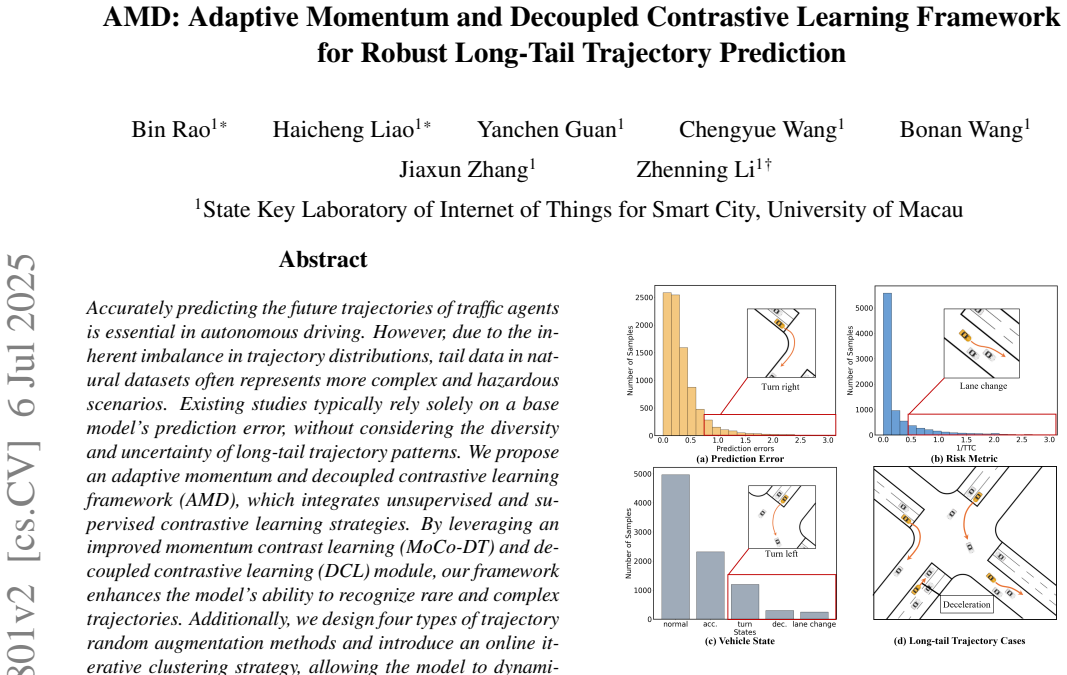
On its own terms, the paper's central claim is that the long-tail problem in trajectory prediction can be addressed at the representation level: pushing the encoder to form compact, well-separated clusters for rare trajectory patterns — via hard-negative mining with a momentum-updated memory bank and decoupled contrastive loss reweighting — lets a standard multimodal decoder predict tail maneuvers more accurately, and overall accuracy improves rather than degrades. The reported evidence is Top 1% minADE/minFDE of 1.08/1.66 on nuScenes versus 1.21/2.50 for the best prior long-tail method, consistent gains across Top 1% to 5% subsets and across risk-based and vehicle-state subsets, and an ablation showing every added module contributes to the Top 1% result.
Load-bearing premise
The comparison assumes the Top 1% to 5% hardest samples are defined by the same reference errors for every model; the paper does not state whether the split uses a fixed reference model or each model's own prediction errors, and if each model is scored on its own hardest cases the reported gains are not apples-to-apples.
Editorial extensions
If this is right
- If AMD's reported numbers hold, autonomous systems can improve performance on high-risk maneuvers such as sharp turns and abrupt braking without a separate model or hand-crafted rules for tail scenarios.
- The multi-criteria evaluation using prediction error, inverse time-to-collision, and vehicle state offers three lenses for auditing predictors; a model that is strong on all three is safer than one optimized for a single head-only benchmark.
- The contrastive representation learning recipe transfers from vehicle prediction on nuScenes to pedestrian prediction on ETH/UCY with consistent gains, suggesting the framework could generalize to other motion forecasting settings.
- The 14 ms inference time indicates that the training-time complexity of contrastive learning does not carry over to deployment latency.
- Improvements on hard samples do not come at the cost of the head: the Rest and All rows in the main tables also improve or match prior methods.
Reading between the lines
- Extension: the proposed three-criteria definition of long-tail trajectories could be adopted as a standard evaluation protocol, but only if the prediction-error split uses a fixed reference model; otherwise comparisons between models with different error profiles are ill-posed.
- Extension: the decoupled contrastive loss is borrowed from long-tail image classification; the paper's transfer suggests representation-level long-tail methods may be broadly applicable across sequence-prediction tasks, but the specific contribution of the four trajectory augmentations versus generic augmentations remains untested in isolation.
- Extension: a testable follow-up is to ablate the four augmentations individually and to study the sensitivity of Top-1% gains to the number of K-means clusters and the pseudo-label update interval; the current hyperparameter table only varies loss weights and momentum coefficients.
- Extension: the risk-metric subsets suggest a possible coupling between contrastive feature clustering and risk estimation; one could train a risk-predictor head on the pseudo-labels and check whether clusters align with actual collision proximity.
Editorial analysis
A structured set of objections, weighed in public.
Referee Report
Summary. The paper proposes AMD, a trajectory prediction framework combining adaptive momentum contrastive learning (MoCo-DT), decoupled contrastive learning (DCL), four trajectory augmentation strategies, and an online iterative clustering mechanism to improve performance on long-tail trajectory samples. The authors define long-tail trajectories by prediction error, risk metric (TTC), and vehicle state, and report experiments on nuScenes and ETH/UCY. The central claim is that AMD achieves state-of-the-art accuracy on the hardest long-tail samples while maintaining or improving overall prediction quality. The long-tail evaluation in Table 1 is based on partitioning samples by prediction error (FDE), and the paper reports large gains on the Top 1% subset, e.g., minADE 1.08 and minFDE 1.66 on nuScenes.
Significance. If the claimed long-tail improvements were verified, the paper would be a useful contribution to trajectory prediction: it proposes a multi-criteria definition of long-tail trajectories, combines several mechanisms that are individually plausible, and includes ablation, hyperparameter sensitivity, inference time, and feature-space visualization experiments. The paper also explicitly criticizes model-specific error definitions in Q2, which shows awareness of an important methodological issue. However, the evaluation protocol has a load-bearing ambiguity and the headline numbers are not internally consistent, so the current evidence does not support the central SOTA claim. The paper does not provide code, machine-checked proofs, or multi-seed error bars, so the assessment rests entirely on the reported tables and the clarity of their protocol.
major comments (4)
- [Section 4.1, Table 1] The long-tail subset definition is ambiguous and potentially invalid. The text states that the dataset is divided into Top 1% to Top 5% based on 'the largest prediction errors' (FDE), but it does not specify whether the partition uses a fixed reference model or each model's own prediction errors. If each model is evaluated on its own hardest samples, then AMD and the baselines are compared on different test distributions, and the claimed gains are not meaningful. This concern is internal to the paper: Q2 criticizes existing methods for relying on 'model-specific prediction errors,' yet the evaluation adopts exactly such a criterion without resolving the ambiguity. Please state explicitly which model's errors define the subsets, and if per-model splits are used, recompute all comparisons on a fixed partition defined by a reference model or by a non-error criterion.
- [Section 4.2(i), Table 1] The reported improvement percentages do not match Table 1. The text says AMD reduces Top-1% error by 14.9% and 33.6% compared to the closest competing model, but AMD's minADE of 1.08 versus FEND's 1.21 is a 10.7% reduction (versus TrACT's 1.23 it is 12.2%); only the minFDE reduction from 2.50 to 1.66 gives 33.6%, and that is against FEND, not the same closest baseline for minADE. This arithmetic inconsistency suggests the table and the text may have been computed under different partitions or baselines. Please report the exact reference values and reconcile the percentages, or remove the inconsistent claim.
- [Tables 2 and 3] The risk-metric and vehicle-state results are reported only for AMD, with no comparison to any baseline. Since the paper's contribution includes a multi-criteria evaluation of long-tail trajectories, these tables are presented as evidence of the model's behavior under alternative definitions. Without baseline numbers, the reader cannot assess whether AMD improves over existing methods on these subsets. Please include the same baseline models used in Table 1 for the risk and vehicle-state partitions, or explicitly state that no comparison is available and weaken the corresponding claims.
- [Section 4.7, Table 8; Table 1] All experimental results are single-run and are reported without error bars or significance tests. Moreover, Table 8 selects hyperparameters based on performance on the same test benchmark (Top-1% and All columns), which adds a selection-bias component to the reported improvements. The central claim of long-tail superiority would be much more credible with mean and standard deviation over multiple seeds, and with a statement of whether the Top-1% gains exceed the run-to-run variability. Please add this information or clearly discuss the limitation.
minor comments (6)
- [Table 1 caption, Table 3 caption] The captions refer to 'seven test samples' and 'six test samples,' but the rows/columns are subsets or categories (Top 1% through All; RA, RD, SLC, ST, Normal, All). Please reword to 'seven subsets' and 'six categories' for clarity.
- [Section 3.1] The four augmentation methods are described only qualitatively, and the exact operation ranges (e.g., magnitudes for Shift, fraction dropped for Mask, subsequence length for Subset) are deferred to an appendix that is not included in the submitted text. These details are needed for reproducibility.
- [Section 3.4] The online iterative clustering strategy does not specify the number of clusters for K-means, the interval at which clustering is run, or the size of the stored feature set. Without these parameters, the pseudo-label update mechanism is not fully specified.
- [Eq. (7), Section 3.5] The notation in the DCL loss is ambiguous: qi and q_i^+ are both described as 'features of positive samples in the same category,' and the relationship between Pi, Ui, and the pseudo-labels from clustering is not defined precisely. Please clarify which samples are positives for a given anchor and how the sets are constructed.
- [Section 4.5, Table 7] The inference-time comparison is not hardware-controlled: VisionTrap is tested on an RTX 3090 Ti while all other models, including AMD, are tested on an RTX 3090. Please state this clearly in the table or use the same GPU for all models.
- [Section 4.2(iii), Table 4] The overall comparison table mixes models with possibly different prediction settings (e.g., different numbers of modes, different map inputs). The paper should state the exact evaluation protocol, including the number of predicted modes used for minADE5, minADE10, and minFDE1, so that the comparisons are meaningful.
Circularity Check
No significant circularity: AMD's SOTA claim is an empirical benchmark result, not a derivation from its definitions; the only concern is an underspecified long-tail subset protocol.
full rationale
The paper does not derive its headline numbers from its own definitions. The long-tail criteria (prediction error, TTC risk, vehicle state) are evaluation partitions, not training targets, and the reported minADE/minFDE values come from trained models compared against external baselines on nuScenes and ETH/UCY. The contrastive losses are adapted from published methods [16, 58] with equations supplied, and no load-bearing claim rests on a self-citation or a uniqueness theorem. The only notable issue is that Section 4.1 and Table 1 do not state which model's prediction error ranks the Top 1%-5% subsets; if each model were ranked on its own errors, the comparison would be invalid, but the paper is ambiguous rather than explicit, and no equation shows the reported gain reducing to the subset definition. The claimed 14.9% minADE improvement also does not match Table 1 (FEND 1.21 to AMD 1.08 is 10.7%), which is a numerical inconsistency to clarify, not circularity. Overall, the central claim is self-contained empirical evidence, so circularity is minimal.
Assumptions & free parameters
free parameters (6)
- MoCo momentum coefficients me, mm, ml =
0.95, 0.99, 0.999
- Loss weights gamma1, gamma2, lambda1, lambda2 =
1.0, 0.5, 1.0, 0.1
- DCL weight alpha =
not reported
- Contrastive temperature tau =
not reported
- Top-K for hard negative mining =
not reported
- Number of clusters for online K-means =
not reported
assumptions (3)
- domain assumption Long-tail trajectories are adequately characterized by prediction error, low TTC, and vehicle-state categories.
- domain assumption The four trajectory augmentations preserve semantic validity of trajectories.
- domain assumption K-means pseudo-labels over trajectory features are meaningful and stable enough for supervised contrastive learning.
Cite this review
Pith. "Pith review of AMD: Adaptive Momentum and Decoupled Contrastive Learning Framework for Robust Long-Tail Trajectory Prediction." pith.science (2026). https://pith.science/paper/JSUVWHDW
@misc{pith2026250701801,
  author       = {Pith},
  title        = {Pith review of: AMD: Adaptive Momentum and Decoupled Contrastive Learning Framework for Robust Long-Tail Trajectory Prediction},
  year         = {2026},
  howpublished = {\url{https://pith.science/paper/JSUVWHDW}},
  note         = {Machine review of arXiv:2507.01801}
}
abstract
Accurately predicting the future trajectories of traffic agents is essential in autonomous driving. However, due to the inherent imbalance in trajectory distributions, tail data in natural datasets often represents more complex and hazardous scenarios. Existing studies typically rely solely on a base model's prediction error, without considering the diversity and uncertainty of long-tail trajectory patterns. We propose an adaptive momentum and decoupled contrastive learning framework (AMD), which integrates unsupervised and supervised contrastive learning strategies. By leveraging an improved momentum contrast learning (MoCo-DT) and decoupled contrastive learning (DCL) module, our framework enhances the model's ability to recognize rare and complex trajectories. Additionally, we design four types of trajectory random augmentation methods and introduce an online iterative clustering strategy, allowing the model to dynamically update pseudo-labels and better adapt to the distributional shifts in long-tail data. We propose three different criteria to define long-tail trajectories and conduct extensive comparative experiments on the nuScenes and ETH$/$UCY datasets. The results show that AMD not only achieves optimal performance in long-tail trajectory prediction but also demonstrates outstanding overall prediction accuracy.
Figures


Figures from the paper (1 more)

Forward citations
Cited by 1 Pith paper
-
JACoP: Joint Alignment for Compliant Multi-Agent Prediction
JACoP is a new framework using an anchor-based profiler and MRF aligner to produce multi-agent trajectory predictions with optimal scene-level compliance by minimizing joint social and environmental costs.
Reference graph
Works this paper leans on
-
[1]
So- cial lstm: Human trajectory prediction in crowded spaces
Alexandre Alahi, Kratarth Goel, Vignesh Ramanathan, Alexandre Robicquet, Li Fei-Fei, and Silvio Savarese. So- cial lstm: Human trajectory prediction in crowded spaces. In CVPR, pages 961–971, 2016. 2
work page 2016
-
[2]
Non- probability sampling network for stochastic human trajectory prediction
Inhwan Bae, Jin-Hwi Park, and Hae-Gon Jeon. Non- probability sampling network for stochastic human trajectory prediction. In CVPR, pages 6477–6487, 2022. 7
work page 2022
-
[3]
nuscenes: A mul- timodal dataset for autonomous driving
Holger Caesar, Varun Bankiti, Alex H Lang, Sourabh V ora, Venice Erin Liong, Qiang Xu, Anush Krishnan, Yu Pan, Giancarlo Baldan, and Oscar Beijbom. nuscenes: A mul- timodal dataset for autonomous driving. In CVPR, pages 11621–11631, 2020. 5
work page 2020
-
[4]
Learning imbalanced datasets with label- distribution-aware margin loss
Kaidi Cao, Colin Wei, Adrien Gaidon, Nikos Arechiga, and Tengyu Ma. Learning imbalanced datasets with label- distribution-aware margin loss. Advances in neural informa- tion processing systems, 32, 2019. 6
work page 2019
-
[5]
Contrastive trajectory similarity learning with dual- feature attention
Yanchuan Chang, Jianzhong Qi, Yuxuan Liang, and Egemen Tanin. Contrastive trajectory similarity learning with dual- feature attention. In 2023 IEEE 39th International confer- ence on data engineering (ICDE) , pages 2933–2945. IEEE,
work page 2023
-
[6]
Q- eanet: Implicit social modeling for trajectory prediction via experience-anchored queries
Jiuyu Chen, Zhongli Wang, Jian Wang, and Baigen Cai. Q- eanet: Implicit social modeling for trajectory prediction via experience-anchored queries. IET Intelligent Transport Sys- tems, 18(6):1004–1015, 2024. 7
work page 2024
-
[7]
A simple framework for contrastive learning of visual representations
Ting Chen, Simon Kornblith, Mohammad Norouzi, and Ge- offrey Hinton. A simple framework for contrastive learning of visual representations. In International conference on ma- chine learning, pages 1597–1607. PMLR, 2020. 3
work page 2020
-
[8]
Class-balanced loss based on effective number of samples
Yin Cui, Menglin Jia, Tsung-Yi Lin, Yang Song, and Serge Belongie. Class-balanced loss based on effective number of samples. In CVPR, pages 9268–9277, 2019. 6
work page 2019
Show all 62 references
-
[9]
Trajectory forecasts in unknown environments conditioned on grid-based plans
Nachiket Deo and Mohan M Trivedi. Trajectory forecasts in unknown environments conditioned on grid-based plans. arXiv preprint arXiv:2001.00735, 2020. 6
2001 arXiv
-
[10]
Multimodal trajectory prediction conditioned on lane-graph traversals
Nachiket Deo, Eric Wolff, and Oscar Beijbom. Multimodal trajectory prediction conditioned on lane-graph traversals. In Conference on Robot Learning , pages 203–212. PMLR,
-
[11]
Vectornet: Encoding hd maps and agent dynamics from vectorized rep- resentation
Jiyang Gao, Chen Sun, Hang Zhao, Yi Shen, Dragomir Anguelov, Congcong Li, and Cordelia Schmid. Vectornet: Encoding hd maps and agent dynamics from vectorized rep- resentation. In CVPR, pages 11525–11533, 2020. 2, 4
2020
-
[12]
Gohome: Graph- oriented heatmap output for future motion estimation
Thomas Gilles, Stefano Sabatini, Dzmitry Tsishkou, Bog- dan Stanciulescu, and Fabien Moutarde. Gohome: Graph- oriented heatmap output for future motion estimation. In 2022 international conference on robotics and automation (ICRA), pages 9107–9114. IEEE, 2022. 6
2022
-
[13]
Stochastic trajectory pre- diction via motion indeterminacy diffusion
Tianpei Gu, Guangyi Chen, Junlong Li, Chunze Lin, Yong- ming Rao, Jie Zhou, and Jiwen Lu. Stochastic trajectory pre- diction via motion indeterminacy diffusion. In CVPR, pages 17113–17122, 2022. 7
2022
-
[14]
Borderline-smote: a new over-sampling method in im- balanced data sets learning
Hui Han, Wen-Yuan Wang, and Bing-Huan Mao. Borderline-smote: a new over-sampling method in im- balanced data sets learning. In International conference on intelligent computing, pages 878–887. Springer, 2005. 2
2005
-
[15]
Algorithm as 136: A k-means clustering algorithm
John A Hartigan and Manchek A Wong. Algorithm as 136: A k-means clustering algorithm. Journal of the royal sta- tistical society. series c (applied statistics) , 28(1):100–108,
-
[16]
Momentum contrast for unsupervised visual rep- resentation learning
Kaiming He, Haoqi Fan, Yuxin Wu, Saining Xie, and Ross Girshick. Momentum contrast for unsupervised visual rep- resentation learning. In CVPR, pages 9729–9738, 2020. 3, 4
2020
-
[17]
Bayonet-corpus: a trajectory prediction method based on bayonet context and bidirectional gru.Digital Com- munications and Networks, 7(1):72–81, 2021
Mengyang Huang, Menggang Zhu, Yunpeng Xiao, and Yan- bing Liu. Bayonet-corpus: a trajectory prediction method based on bayonet context and bidirectional gru.Digital Com- munications and Networks, 7(1):72–81, 2021. 2
2021
-
[18]
Supervised contrastive learning
Prannay Khosla, Piotr Teterwak, Chen Wang, Aaron Sarna, Yonglong Tian, Phillip Isola, Aaron Maschinot, Ce Liu, and Dilip Krishnan. Supervised contrastive learning. Advances in neural information processing systems, 33:18661–18673,
-
[19]
Lapred: Lane-aware prediction of multi- modal future trajectories of dynamic agents
ByeoungDo Kim, Seong Hyeon Park, Seokhwan Lee, Elbek Khoshimjonov, Dongsuk Kum, Junsoo Kim, Jeong Soo Kim, and Jun Won Choi. Lapred: Lane-aware prediction of multi- modal future trajectories of dynamic agents. In CVPR, pages 14636–14645, 2021. 6
2021
-
[20]
Hi-scl: Fight- ing long-tailed challenges in trajectory prediction with hi- erarchical wave-semantic contrastive learning
Zhengxing Lan, Yilong Ren, Haiyang Yu, Lingshan Liu, Zhenning Li, Yinhai Wang, and Zhiyong Cui. Hi-scl: Fight- ing long-tailed challenges in trajectory prediction with hi- erarchical wave-semantic contrastive learning. Transporta- tion Research Part C: Emerging Technologies, 1...
-
[21]
Learning an image-based motion context for multiple people tracking
Laura Leal-Taix ´e, Michele Fenzi, Alina Kuznetsova, Bodo Rosenhahn, and Silvio Savarese. Learning an image-based motion context for multiple people tracking. InCVPR, pages 3542–3549, 2014. 5
2014
-
[22]
Trustworthy long-tailed classification
Bolian Li, Zongbo Han, Haining Li, Huazhu Fu, and Changqing Zhang. Trustworthy long-tailed classification. In CVPR, pages 6970–6979, 2022. 2
2022
-
[23]
Graph structure-based implicit risk reasoning for long-tail scenarios of automated driving
Xueke Li, Jiaxin Liu, Jun Li, Wenhao Yu, Zhong Cao, Shaobo Qiu, Jia Hu, Hong Wang, and Xiaohong Jiao. Graph structure-based implicit risk reasoning for long-tail scenarios of automated driving. In 2023 4th International Conference on Big Data, Artificial Intelligence and Inter...
2023
-
[24]
Cdstraj: Characterized diffusion and spatial- temporal interaction network for trajectory prediction in au- tonomous driving
Haicheng Liao, Xuelin Li, Yongkang Li, Hanlin Kong, Chengyue Wang, Bonan Wang, Yanchen Guan, K Tam, and Zhenning Li. Cdstraj: Characterized diffusion and spatial- temporal interaction network for trajectory prediction in au- tonomous driving. In IJCAI, pages 7331–7339, 2024. 2
2024
-
[25]
Bat: Behavior-aware human-like trajectory prediction for au- tonomous driving
Haicheng Liao, Zhenning Li, Huanming Shen, Wenxuan Zeng, Dongping Liao, Guofa Li, and Chengzhong Xu. Bat: Behavior-aware human-like trajectory prediction for au- tonomous driving. In AAAI, pages 10332–10340, 2024. 2
2024
-
[26]
Mftraj: Map-free, behavior-driven trajec- tory prediction for autonomous driving
Haicheng Liao, Zhenning Li, Chengyue Wang, Huan- ming Shen, Dongping Liao, Bonan Wang, Guofa Li, and Chengzhong Xu. Mftraj: Map-free, behavior-driven trajec- tory prediction for autonomous driving. In IJCAI, 2024. 2
2024
-
[27]
A cognitive-driven trajectory prediction model for autonomous driving in mixed autonomy environments
Haicheng Liao, Zhenning Li, Chengyue Wang, Bonan Wang, Hanlin Kong, Yanchen Guan, Guofa Li, and Zhiyong Cui. A cognitive-driven trajectory prediction model for autonomous driving in mixed autonomy environments. In IJCAI, 2024. 2
2024
-
[28]
Physics- informed trajectory prediction for autonomous driving under missing observation
Haicheng Liao, Chengyue Wang, Zhenning Li, Yongkang Li, Bonan Wang, Guofa Li, and Chengzhong Xu. Physics- informed trajectory prediction for autonomous driving under missing observation. In IJCAI, 2024. 2
2024
-
[29]
Cot-drive: Efficient motion forecasting for au- tonomous driving with llms and chain-of-thought prompting
Haicheng Liao, Hanlin Kong, Bonan Wang, Chengyue Wang, Wang Ye, Zhengbing He, Chengzhong Xu, and Zhen- ning Li. Cot-drive: Efficient motion forecasting for au- tonomous driving with llms and chain-of-thought prompting. IEEE Transactions on Artificial Intelligence, 2025. 1
2025
-
[30]
Toward human-like trajectory predic- tion for autonomous driving: A behavior-centric approach
Haicheng Liao, Zhenning Li, Guohui Zhang, Keqiang Li, and Chengzhong Xu. Toward human-like trajectory predic- tion for autonomous driving: A behavior-centric approach. Transportation Science, 2025. 2
2025
-
[31]
Minds on the move: Decoding trajectory prediction in autonomous driving with cognitive insights
Haicheng Liao, Chengyue Wang, Kaiqun Zhu, Yilong Ren, Bolin Gao, Shengbo Eben Li, Chengzhong Xu, and Zhen- ning Li. Minds on the move: Decoding trajectory prediction in autonomous driving with cognitive insights. IEEE Trans- actions on Intelligent Transportation Systems, 2025. 2
2025
-
[32]
Ve- hicle dynamics and external disturbance estimation for vehi- cle path prediction
Chiu-Feng Lin, A Galip Ulsoy, and David J LeBlanc. Ve- hicle dynamics and external disturbance estimation for vehi- cle path prediction. IEEE Transactions on Control Systems Technology, 8(3):508–518, 2000. 2
2000
-
[33]
Progressive pretext task learning for human trajec- tory prediction
Xiaotong Lin, Tianming Liang, Jianhuang Lai, and Jian- Fang Hu. Progressive pretext task learning for human trajec- tory prediction. In ECCV, pages 197–214. Springer, 2024. 7
2024
-
[34]
Laformer: Trajectory prediction for autonomous driving with lane-aware scene constraints
Mengmeng Liu, Hao Cheng, Lin Chen, Hellward Broszio, Jiangtao Li, Runjiang Zhao, Monika Sester, and Michael Ying Yang. Laformer: Trajectory prediction for autonomous driving with lane-aware scene constraints. In CVPR, pages 2039–2049, 2024. 7
2024
-
[35]
Large-scale long-tailed recognition in an open world
Ziwei Liu, Zhongqi Miao, Xiaohang Zhan, Jiayun Wang, Boqing Gong, and Stella X Yu. Large-scale long-tailed recognition in an open world. In CVPR, pages 2537–2546,
-
[36]
Open long-tailed recogni- tion in a dynamic world
Ziwei Liu, Zhongqi Miao, Xiaohang Zhan, Jiayun Wang, Boqing Gong, and X Yu Stella. Open long-tailed recogni- tion in a dynamic world. IEEE TPAMI, 46(3):1836–1851,
-
[37]
On exposing the challenging long tail in future prediction of traffic actors
Osama Makansi, ¨Ozg¨un Cicek, Yassine Marrakchi, and Thomas Brox. On exposing the challenging long tail in future prediction of traffic actors. In ICCV, pages 13147– 13157, 2021. 6
2021
-
[38]
It is not the journey but the destination: Endpoint conditioned trajectory prediction
Karttikeya Mangalam, Harshayu Girase, Shreyas Agarwal, Kuan-Hui Lee, Ehsan Adeli, Jitendra Malik, and Adrien Gaidon. It is not the journey but the destination: Endpoint conditioned trajectory prediction. In ECCV, pages 759–776. Springer, 2020. 7
2020
-
[39]
Social-stgcnn: A social spatio-temporal graph convolutional neural network for human trajectory prediction
Abduallah Mohamed, Kun Qian, Mohamed Elhoseiny, and Christian Claudel. Social-stgcnn: A social spatio-temporal graph convolutional neural network for human trajectory prediction. In CVPR, pages 14424–14432, 2020. 2
2020
-
[40]
Visiontrap: Vision-augmented trajectory pre- diction guided by textual descriptions
Seokha Moon, Hyun Woo, Hongbeen Park, Haeji Jung, Reza Mahjourian, Hyung-gun Chi, Hyerin Lim, Sangpil Kim, and Jinkyu Kim. Visiontrap: Vision-augmented trajectory pre- diction guided by textual descriptions. In ECCV, pages 361–
-
[41]
You’ll never walk alone: Modeling social behav- ior for multi-target tracking
Stefano Pellegrini, Andreas Ess, Konrad Schindler, and Luc Van Gool. You’ll never walk alone: Modeling social behav- ior for multi-target tracking. In ICCV, pages 261–268. IEEE,
-
[42]
The pareto, zipf and other power laws
William J Reed. The pareto, zipf and other power laws. Eco- nomics letters, 74(1):15–19, 2001. 2
2001
-
[43]
Focal loss for dense object detection
T-YLPG Ross and GKHP Doll ´ar. Focal loss for dense object detection. In CVPR, pages 2980–2988, 2017. 2
2017
-
[44]
Trajectron++: Dynamically-feasible trajec- tory forecasting with heterogeneous data
Tim Salzmann, Boris Ivanovic, Punarjay Chakravarty, and Marco Pavone. Trajectron++: Dynamically-feasible trajec- tory forecasting with heterogeneous data. In ECCV, pages 683–700. Springer, 2020. 2, 6, 7
2020
-
[45]
Relay back- propagation for effective learning of deep convolutional neu- ral networks
Li Shen, Zhouchen Lin, and Qingming Huang. Relay back- propagation for effective learning of deep convolutional neu- ral networks. In ECCV, pages 467–482. Springer, 2016. 6
2016
-
[46]
Tra- jectory unified transformer for pedestrian trajectory predic- tion
Liushuai Shi, Le Wang, Sanping Zhou, and Gang Hua. Tra- jectory unified transformer for pedestrian trajectory predic- tion. In ICCV, pages 9675–9684, 2023. 7
2023
-
[47]
Risk-aware trajectory prediction by incorporating spatio-temporal traffic interaction analysis
Divya Thuremella, Lewis Ince, and Lars Kunze. Risk-aware trajectory prediction by incorporating spatio-temporal traffic interaction analysis. In 2024 IEEE International Conference on Robotics and Automation (ICRA) , pages 14421–14427. IEEE, 2024. 2
2024
-
[48]
Beyond patterns: Har- nessing causal logic for autonomous driving trajectory pre- diction
Bonan Wang, Haicheng Liao, Chengyue Wang, Bin Rao, Yanchen Guan, Guyang Yu, Jiaxun Zhang, Songning Lai, Chengzhong Xu, and Zhenning Li. Beyond patterns: Har- nessing causal logic for autonomous driving trajectory pre- diction. arXiv preprint arXiv:2505.06856, 2025. 2
2025 arXiv
-
[49]
Wake: Towards robust and physically feasible trajectory prediction for autonomous vehicles with wavelet and kinematics synergy
Chengyue Wang, Haicheng Liao, Zhenning Li, and Chengzhong Xu. Wake: Towards robust and physically feasible trajectory prediction for autonomous vehicles with wavelet and kinematics synergy. PAMI, 2025. 2
2025
-
[50]
Nest: A neuromodulated small-world hy- pergraph trajectory prediction model for autonomous driv- ing
Chengyue Wang, Haicheng Liao, Bonan Wang, Yanchen Guan, Bin Rao, Ziyuan Pu, Zhiyong Cui, Cheng-Zhong Xu, and Zhenning Li. Nest: A neuromodulated small-world hy- pergraph trajectory prediction model for autonomous driv- ing. In AAAI, pages 808–816, 2025. 2
2025
-
[51]
A dynamics-enhanced learning model for multi-horizon trajectory prediction in autonomous vehicles
Chengyue Wang, Haicheng Liao, Kaiqun Zhu, Guohui Zhang, and Zhenning Li. A dynamics-enhanced learning model for multi-horizon trajectory prediction in autonomous vehicles. Information Fusion, 118:102924, 2025. 1
2025
-
[52]
Trajectory distribution aware graph convolutional network for trajectory prediction considering spatio-temporal inter- actions and scene information
Ruiping Wang, Zhijian Hu, Xiao Song, and Wenxin Li. Trajectory distribution aware graph convolutional network for trajectory prediction considering spatio-temporal inter- actions and scene information. IEEE TRANSACTIONS ON KNOWLEDGE AND DATA ENGINEERING , 36(8):4304– 4316, 2024. 1
2024
-
[53]
Fend: A future enhanced distribution-aware contrastive learning framework for long-tail trajectory prediction
Yuning Wang, Pu Zhang, Lei Bai, and Jianru Xue. Fend: A future enhanced distribution-aware contrastive learning framework for long-tail trajectory prediction. In CVPR, pages 1400–1409, 2023. 2, 3, 6
2023
-
[54]
View vertically: A hierarchical network for trajectory prediction via fourier spectrums
Conghao Wong, Beihao Xia, Ziming Hong, Qinmu Peng, Wei Yuan, Qiong Cao, Yibo Yang, and Xinge You. View vertically: A hierarchical network for trajectory prediction via fourier spectrums. In ECCV, pages 682–700. Springer,
-
[55]
Context-aware timewise vaes for real-time vehicle trajectory prediction
Pei Xu, Jean-Bernard Hayet, and Ioannis Karamouzas. Context-aware timewise vaes for real-time vehicle trajectory prediction. IEEE Robotics and Automation Letters, 2023. 6
2023
-
[56]
Adapting to length shift: Flexilength network for trajectory prediction
Yi Xu and Yun Fu. Adapting to length shift: Flexilength network for trajectory prediction. In CVPR, pages 15226– 15237, 2024. 6
2024
-
[57]
Adaptive trajectory prediction via transferable gnn
Yi Xu, Lichen Wang, Yizhou Wang, and Yun Fu. Adaptive trajectory prediction via transferable gnn. In CVPR, pages 6520–6531, 2022. 2
2022
-
[58]
Decoupled contrastive learning for long-tailed recognition
Shiyu Xuan and Shiliang Zhang. Decoupled contrastive learning for long-tailed recognition. In AAAI, pages 6396– 6403, 2024. 3, 5
2024
-
[59]
Agentformer: Agent-aware transformers for socio-temporal multi-agent forecasting
Ye Yuan, Xinshuo Weng, Yanglan Ou, and Kris M Kitani. Agentformer: Agent-aware transformers for socio-temporal multi-agent forecasting. In ICCV, pages 9813–9823, 2021. 7
2021
-
[60]
Tract: A training dynamics aware contrastive learning frame- work for long-tail trajectory prediction
Junrui Zhang, Mozhgan Pourkeshavarz, and Amir Rasouli. Tract: A training dynamics aware contrastive learning frame- work for long-tail trajectory prediction. arXiv preprint arXiv:2404.12538, 2024. 2, 6
2024 arXiv
-
[61]
Seflow: A self-supervised scene flow method in autonomous driving
Qingwen Zhang, Yi Yang, Peizheng Li, Olov Andersson, and Patric Jensfelt. Seflow: A self-supervised scene flow method in autonomous driving. In ECCV, pages 353–369. Springer,
-
[62]
Long-tail prediction uncertainty aware trajectory planning for self-driving vehi- cles
Weitao Zhou, Zhong Cao, Yunkang Xu, Nanshan Deng, Xi- aoyu Liu, Kun Jiang, and Diange Yang. Long-tail prediction uncertainty aware trajectory planning for self-driving vehi- cles. In 2022 IEEE 25th International Conference on In- telligent Transportation Systems (ITSC) , pages...
2022
Reviewed August 6, 2026 · model on record in the stance chip above.
Discussion (0). Sign in to comment.