REVIEW 5 major objections 6 minor 62 references
Pentaquarks made of light quarks and their admixture to baryons
T0 review · 5 major / 6 minor · reviewed 2026-08-06 · deepseek-v4-flash
Pith's one-line read The nucleon's five-quark Fock component is large, with probability $P_{5q}\simeq 0.4$, and this paper derives the explicit pentaquark wavefunctions that realize it.
desk verdict Real wavefunction construction, but the headline 5q probability is mislabeled due to a normalization slip that also breaks Eq. (38). read the letter →
The pith
A machine-rendered reading of the paper's core claim, the machinery that carries it, and where it could break.
The reading
What carries the argument
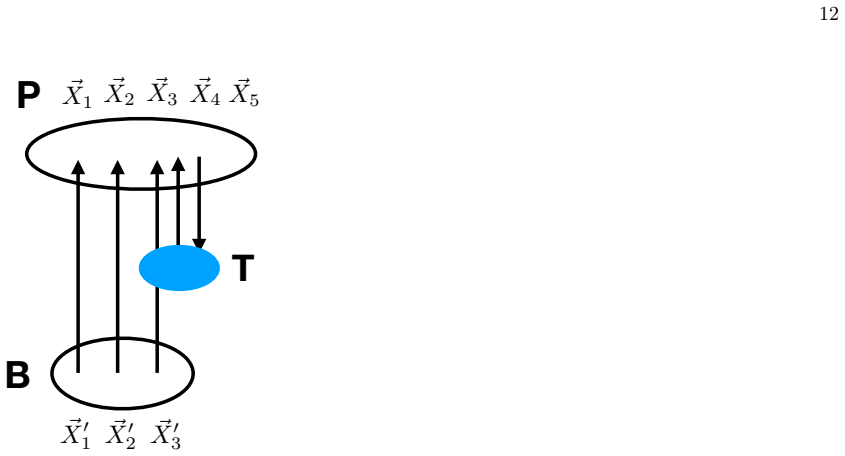
The central object is the fully antisymmetric pentaquark wavefunction, built by tensor-producting the permutation-group ($S_4$) generators in color, spin, flavor, and orbital spaces and selecting common eigenvectors with eigenvalue $-1$; in the monomial basis the $L=0$ space has dimension $3^6\times 2^5\times 2^5=746496$, and the $L=1$ shell multiplies this by the four Jacobi-coordinate directions. The dynamics uses the hyperdistance $Y^2=\vec\alpha^2+\vec\beta^2+\vec\gamma^2+\vec\delta^2$ in 12 dimensions, with the kinetic Laplacian reduced to a radial equation and the Cornell potential replaced by its angular average (with a cutoff $\epsilon=0.02$ on the Coulomb singularity). The mixing is carried by pair-creation operators: a $\sigma$ term with $\vec S\cdot\vec L$ and vacuum quantum numbers, plus a pion term with $\vec S\cdot\vec P$; both add a $\bar q q$ pair to the baryon, and the nucleon wavefunction is shifted by $\sum_n C_n|P_n\rangle$ over the 24 P-shell pentaquark states.
What would settle it
Recompute the radial overlaps (28)-(29) with the full angle-dependent Cornell potential instead of its hyperdistance average, and compare the resulting $P_{5q}$ to the fitted value near 0.4; if the shift exceeds the experimental uncertainty in $\int dx(\bar d-\bar u)$, the averaging assumption controls the central result.
Extended reading notes
Core claim
The central claim is that the probability of the five-quark Fock component in the nucleon is large, $P_{5q}\simeq 0.4$, and that this component is not a generic "pion cloud" but a definite pentaquark wavefunction obtained from Fermi statistics alone. The paper derives explicit antisymmetric wavefunctions for $qqqq\bar q$ pentaquarks with $L=0$ and $L=1$ by diagonalizing the two generators of $S_4$ in color-spin-flavor-orbital space, checks them against analytic Young-tableau constructions where possible, and computes radial wavefunctions from an angle-averaged Cornell potential in the hyperdistance $Y$. The mixing amplitudes with the nucleon are computed for both the $\sigma$-type pair operator (vacuum quantum numbers, $\vec S\cdot\vec L$) and the pion-type operator ($\vec S\cdot\vec P$). The weighted admixture yields $\langle\bar d-\bar u\rangle = 0.335 P_{5q}/(1+P_{5q})$, matching the measured 0.118 with $P_{5q}\sim 0.5$; the axial charge formula $g_A = 5/3 + 0.249 P_{5q}/(1+P_{5q})$ gives $P_{5q}\sim 0.4$; and the spin-sum-rule requirement of orbital motion also points to $P_{5q}\sim 0.4$. The paper concludes that one large five-quark admixture accounts for the antiquark flavor asymmetry, the axial charge, and quark orbital angular momentum simultaneously.
Load-bearing premise
The load-bearing premise is that the five-quark system can be treated as approximately spherically symmetric in 12-dimensional Jacobi space, so that the angle-dependent Cornell interaction is replaced by its angular average with a hand-chosen cutoff at the Coulomb singularity; all radial wavefunctions, energy gaps, and mixing overlaps depend on that replacement.
Editorial extensions
If this is right
- If $P_{5q}\simeq 0.4$ is correct, the hadron-scale nucleon must be described as a $qqq$ core plus an explicit five-quark sector; a pure valence description is ruled out at resolution near 1 GeV.
- The same mixing that reproduces the measured $\bar d-\bar u$ asymmetry fixes the nucleon axial charge and the orbital angular momentum, so those three observables are no longer independent inputs.
- The predicted pentaquark spectrum places a maximal-spin $5/2^+$ state near 2 GeV, with the other $I=1/2$ states below it; this gives a concrete search target for resonances such as $N^*(2000)$.
- The P-shell admixture is dominated by roughly four pentaquark states even though the individual P-shell pentaquarks look quasi-random, so few-state truncations of the "unquenched" nucleon are justified.
- Sigma-like and pion-like $\bar q q$ admixtures must be treated together, as chiral symmetry requires; neglecting the sigma channel would miss a substantial part of the five-quark sector.
Reading between the lines
- Because the central calculation replaces the angle-dependent binary potential by its hyperdistance average, the most direct test is to recompute the overlaps (28)-(29) with the full angular dependence; if $P_{5q}$ moves outside roughly 0.3-0.5, the large-admixture claim would need qualification.
- The same $S_4$ machinery should apply to unequal-mass pentaquarks, but the hyperdistance Laplacian assumes equal quark masses; a mass-split version would let the framework be checked against charmed pentaquarks observed in high-energy experiments.
- The paper defers magnetic moments and form factors; a natural extension is to compute them from the derived admixture and check whether cancellations preserve the classic three-quark results, as earlier unquenching studies assumed.
- Because the mixing operator is linear in the fourth Jacobi coordinate $\vec\delta$, only P-shell pentaquarks contribute; if a similar analysis of mesons finds a tetraquark Fock component of comparable size, the unquenching pattern would be universal.
Editorial analysis
A structured set of objections, weighed in public.
Referee Report
Summary. The paper constructs fully antisymmetric pentaquark wavefunctions for light quarks (qqqq\bar q) in the S- and P-shells using permutation-group methods in a large "monom" basis, and cross-checks the S=5/2, L=0 state against an explicit Young-tableaux construction. It then uses these states to study nucleon-pentaquark mixing induced by sigma-like and pion-like \bar qq pair-creation operators, and claims that the five-quark Fock component has probability P5q ~ 0.4, based on the measured antiquark flavor asymmetry, the axial charge gA, and the quark orbital angular momentum. The paper also presents evidence for quantum-chaos-like statistics in the L=1 pentaquark coefficients.
Significance. If the wavefunction construction is correct, this is a valuable technical contribution: it provides explicit Fermi-statistics-compliant pentaquark states, with nontrivial sum rules verified (e.g., Eqs. (6), (12), (14)-(15)) and an analytic check for the maximal-spin state. The use of the permutation-group "good basis" to tame a monom space of dimension 746496 is an interesting and potentially reusable method. However, the central phenomenological claim about P5q is not supported as written: the printed equations for the two main observables are mutually inconsistent and one of them has no solution. The paper therefore needs substantial revision before the headline result can be accepted.
major comments (5)
- [Section V, Eq. (38)] Eq. (38) as printed, gA = 5/3 + 0.249 P5q/(1+P5q) = 1.267, has no positive solution for P5q, because 5/3 > 1.267 and the second term is positive. This is not a typo-level issue: it means the normalization of the admixture is inconsistent. If P5q is the unnormalized weight ratio \langle\Delta\psi|\Delta\psi\rangle (as Eq. (37) implies), the correctly normalized expression should be gA = (5/3 + 0.249 P5q)/(1+P5q), which yields P5q ~ 0.39. The manuscript must correct this equation and re-derive the subsequent conclusions.
- [Section V, Eqs. (37) and (38) vs. Summary] The two observables do not agree on P5q even after correcting Eq. (38). Eq. (37) with the measured value 0.118\pm0.012 gives P5q = \langle\Delta\psi|\Delta\psi\rangle ~ 0.54 (physical probability p=P5q/(1+P5q) ~ 0.35), while the corrected Eq. (38) gives P5q ~ 0.39 (p ~ 0.28). The Summary's statement that "the probability of 5q Fock component is large, P5q ~ 0.4" is therefore an overstatement that is not supported by the paper's own equations. The manuscript needs to decide whether P5q denotes a probability or a weight ratio, and then either reconcile the two extractions or present them as a tension, not as a single consistent number.
- [Section IV.D] The sigma-induced admixture, which the text describes as central to the orbital-motion argument, is never given a complete set of matrix elements. After Eq. (29) only radial overlaps are listed; the color-spin-flavor overlaps A_n^mix for the sigma channel that would enter Eqs. (27)-(28) are not tabulated, unlike the pion-channel coefficients in Table VII. Without these numbers, the claim that the combined sigma+pi admixture reproduces the flavor asymmetry, gA, and orbital angular momentum cannot be checked.
- [Section II.C and Appendix A, Eqs. (A9)-(A10)] The hyperdistance approximation replaces the binary Cornell potential by its angular average in 12 dimensions, with the Coulomb singularity regularized by a hand-chosen cutoff epsilon=0.02, giving \langle 1/r_{12}\rangle \approx 3.3/Y. All radial wavefunctions, energy splittings (Eq. (5)), and mixing overlaps (Eqs. (28)-(29)) inherit this choice, but no sensitivity study is presented. Since the extracted P5q depends on these radial inputs, the paper should quantify how much the final result changes under reasonable variations of epsilon and of the potential parameters.
- [Section V, last paragraph] The statement "The spin sum rule requirement yields also P5q \approx 0.4" is asserted without any equation, derivation, or reference to a specific relation. This is one of the three observables used to support the headline number, so it must either be derived explicitly or removed as an independent constraint.
minor comments (6)
- [Abstract] The abstract contains a typo: "nontivial" should be "nontrivial".
- [Appendix C, pentaquark S-shell subsection] The text refers to "derivation in Appendix ??, see (??)", which is an unresolved placeholder; the promised derivation and equation numbers are missing.
- [Table VI] The row for N*(1675) 5/2- appears twice; one duplicate row should be removed.
- [Figure 5 caption] The caption contains a typo: "defnition" should be "definition".
- [Section IV.C, Eq. (26)] The notation for the pair-creation radius is inconsistent: Eq. (26) uses r_sigma in the exponent while the text below refers to r_T; the relation between these symbols should be clarified.
- [Section III] The quantum-chaos claim is based on visual inspection of two histograms with no quantitative test (e.g., Brody distribution or spectral statistics); this section is suggestive but should be framed as qualitative.
Circularity Check
The wavefunction construction is independent, but the headline P5q~0.4 is a fitted normalization relabeled as a probability, and the gA 'confirmation' reuses the same one-parameter family; the printed gA equation has no positive solution.
-
self definitional
[Section V, Eq. (37); Section VI Summary]
"If the probability of the 5q configuration in the nucleon is P5q, then the weighted isospin asymmetry is ⟨dbar−ubar⟩=0.335 P5q/(1+P5q). Comparing this to the experimental value (34), we find P5q∼0.5. ... all indicate that the probability of 5q Fock component is large, P5q∼0.4."
With the state normalized as ψ(B)=N[|B⟩+Δψ] in Eq. (25), the true 5q probability is p=⟨Δψ|Δψ⟩/(1+⟨Δψ|Δψ⟩). Eq. (37) has the form b w/(1+w) with w=⟨Δψ|Δψ⟩, so the P5q solved there is the unnormalized weight, not the probability. The Summary then renames this weight as 'the probability of 5q Fock component', making the headline number not what its own equations define. The companion Eq. (38) as printed has no positive solution for P5q, so the claimed 'P5q≈0.4' is not a derived probability but a relabeled quantity.
-
fitted input called prediction
[Section IV.D and Section V, Eqs. (37)-(38)]
"Finally, the actual magnitude of the pentaquarks admixture is proportional to the overall parameter γ0 in the vacuum production operator T. ... below we choose to fit empirically to the observed nucleon 'sea'. ... A comparison to the accurately known experimental value gA = 1.267 = 5/3 + 0.249∗P5q/(1+P5q) yields P5q≈0.4."
The one free strength γ0, equivalently P5q, is explicitly fitted to the flavor-asymmetry data in Eq. (37). The subsequent gA comparison uses the same fitted parameter and the same Δψ whose matrix element 0.249 was already computed; it is therefore a consistency check inside a one-parameter family, not a parameter-free prediction. The Summary's statement that gA and orbital angular momentum independently 'indicate' P5q≈0.4 converts this fitted input into corroborating evidence. Moreover, the printed Eq. (38) cannot be satisfied by any positive P5q, so the claimed concordance is not actually produced by the equations as written.
full rationale
The pentaquark wavefunction construction itself is largely independent: the permutation-group algebra, the monom-basis computation, and the Young-tableaux cross-checks in Appendices B and C do not reduce to the fitted γ0, and the matrix-element ratios 0.335 and 0.249 are parameter-free outputs of those states. The paper is therefore not circular in its wavefunction technology. The circularity is concentrated in the interpretation of the mixing strength: γ0 (or P5q) is explicitly fitted to the E866 flavor asymmetry via Eq. (37), and Eq. (38) plus the Summary then present the same one-parameter family as independent evidence that P5q∼0.4. Eq. (38) as printed is mathematically inconsistent with gA=1.267, and Eq. (37) actually defines P5q as the unnormalized weight w=⟨Δψ|Δψ⟩ rather than the probability p=w/(1+w), so the headline 'probability of 5q Fock component is large, P5q∼0.4' is a relabeled fit, not a derived prediction. No load-bearing self-citation chain is needed for this finding; citations to [24] are backed by the explicit algorithms and cross-checks in the appendices.
Assumptions & free parameters
free parameters (7)
- gamma0 (overall qbar-q pair-creation strength) =
not quoted; effectively sets P5q ~ 0.4-0.5
- Constituent quark mass M =
0.35 GeV
- Pair-creation radius r_sigma =
0.3 fm
- Sigma-pair mass M(qbar q) =
0.5 GeV
- Baryon mass M(B) =
1 GeV (spin-averaged N-Delta)
- Coulomb regularization cutoff epsilon =
0.02
- Cornell potential parameters =
not stated in this paper
assumptions (6)
- domain assumption All five quarks have equal mass (u,d only), so the kinetic energy is a single 12-dimensional Laplacian with hypercentral symmetry.
- ad hoc to paper The pentaquark ground state is approximately spherically symmetric, and the binary Cornell potential is replaced by its angular average in 12 dimensions.
- domain assumption The qbar-q pair-creation operator T in eq (26), with a Gaussian size r_sigma and the specified color-flavor-spin structure, describes the sigma and pion admixture to the nucleon.
- ad hoc to paper First-order perturbation theory (eq 25) with a complete pentaquark basis and the chosen energy denominators is adequate for the mixing.
- ad hoc to paper The spin sum rule used to relate orbital motion to P5q ~ 0.4 is valid and is not derived in the paper.
- standard math Standard representation theory of the symmetric group S4, Young tableaux, and SU(2) recoupling are used without proof.
Cite this review
Pith. "Pith review of Pentaquarks made of light quarks and their admixture to baryons." pith.science (2026). https://pith.science/paper/QZZMUSSN
@misc{pith2026250701861,
  author       = {Pith},
  title        = {Pith review of: Pentaquarks made of light quarks and their admixture to baryons},
  year         = {2026},
  howpublished = {\url{https://pith.science/paper/QZZMUSSN}},
  note         = {Machine review of arXiv:2507.01861}
}
abstract
This paper is a continuation of our studies of multiquark hadrons. The anti-symmetrization of their wavefunctions required by Fermi statistics is nontivial, as it mixes orbital, color, spin and flavor structures. In our previous papers we developed a method to find them based on the representations of the permutation group, and derived the explicit wave functions for baryons excited to the first and second shells $(L=1,2)$, tetraquarks $qq\bar q\bar q$ and hexaquarks ($6q$). Now we apply it to light pentaquarks ($qqqq\bar q$), in the S- and P-shells ($L=0,1$). Using Jacobi coordinates, one can use the hyperdistance approximation in 12-dimensional space. We further address the issue of ``unquenching" of baryons, by considering their mixing with pentaquarks, via two channels, through the addition of $\sigma$-like or $\pi$-like $\bar q q$ pairs. This mixing is central for understanding of the observed flavor asymmetry of the antiquark sea, the amount of orbital motion issue as well as other nucleon properties.
Figures


Figures from the paper (4 more)



Reference graph
Works this paper leans on
-
[1]
Color and flavor representations The color singlet wavefunction ofq4 ¯qfollows from the combination of the color triplet ofq4 with the color anti-triplet of¯q. Since the total wavefunction is antisymmetric in color, the corresponding Young tableau follows from the product 1C = ≡C[222] = ≡C[211] ⊗ ≡C[11] (C1) with the quark-antiquark color identifications ...
-
[2]
have introduced hypothetical a 4-fermion La- grangian, and have shown that for a large enough coupling, it can break spontaneously theSU(N f ) chiral symmetry. The discovery of fermion zero modes of instantons by t’ Hooft [39], had shown that QCD does generate non-perturbative multi-fermion 2Nf interactions. For two flavors (Nf = 2) the re- sulting 4-ferm...
work page 1970
-
[3]
Color representations The first 2 Young tableaux in (C2) are readily identified with the two irreducible Jacobi-likeρ= α, λ=βrepresentations ofS 3 which are parts of the cycles inS4, and which we have previously used [24]. More specifically, C[211] α = 1 3 2 4 (C7) C[211] β = 1 2 3 4 (C8) C[211] γ = 1 4 2 3 (C9) Note that the removal of box 4 in the first...
-
[4]
Jacobi-like representations ofS 4 Before proceeding to the representations ofS4 we first recall the Jacobi coordinates for 5 particles, which will be used to generalize the Isgur-Karl repre- sentations of the 3 particles wavefunctions to 5 par- ticles. Another form of Jacobi coordinates we use is ⃗ α= 1√ 2⃗ r12 ⃗β= 1√ 6 (⃗ r13 +⃗ r23) ⃗ γ= 1√ 12 (⃗ r14 +⃗...
-
[5]
1 2 1 2 , 5 2 5 2 #† I 3 i φS P
S-state pentaquarks To proceed to theLSFrepresentations, we will first focus on the ground pentaquark or S-states with L= 0, and then proceed to detail the extension of the construction to the P-states which is more involved. a. Spin-flavor mixed representations:SF[31] For the ground state wavefunction withL= 0, the 4-quarks spin-flavor mixed representati...
-
[6]
Spin, flavor:[q 4]S,F The spin flavor configurations of[q4]follow from the standardSU(2)Young tableaux, [q4]S = ⊕ ⊕ ≡S[4]⊕S[31]⊕S[22](C15) and similarly for[q4]F withS→F, a. Maximum weight representations for[q 4]S,F We now construct explicitly the 4 quark states with maximum spin that appear in (C15) by using the standard procedures forSU(2) S Young tabl...
- [7]
-
[8]
We now consider them sequentially
Spin-color-flavor operators and Hamiltonians In the S-state the spin-orbit and tensor interac- tions vanish, with only the spin-color exchange from the perturbative gluon exchange, and the emergent ’t Hooft flavor induced interactions adding to the central kinetic and confining interactions. We now consider them sequentially. a. Color interaction The simp...
Show all 62 references
-
[9]
The 45-spin contribution (C59) forξ=α, β, γamounts to SF5[31]ξσ4 ·σ 5SF5[31]ξ = S[4]σ4 ·σ 5S[4] F[31] ξF[31] ξ = 1(C62) and similarly for4→1,2,3thanks to the symmetry of the spin combinationS[4]. The combination of (C60) and (C62) in (C59), yields ⟨ΨS P 1 2 5 2 |V1g|ΨS P 1 2 5...
-
[10]
baryon plus a meson
have described the admixed 5-q states as a “baryon plus a meson" state. These states were de- scribed as theN+πor∆ +πstates, with rather large pion momenta. While the search for baryon resonances are done this way, and while a loop di- agram with a virtual pion does lead to so...
2020
-
[11]
Gell-Mann and M
M. Gell-Mann and M. Levy, Nuovo Cim.16, 705 (1960)
1960
-
[12]
Nambu and G
Y. Nambu and G. Jona-Lasinio, Phys. Rev.124, 246 (1961)
1961
-
[13]
Chodos, R
A. Chodos, R. L. Jaffe, K. Johnson, C. B. Thorn, and V. F. Weisskopf, Phys. Rev. D9, 3471 (1974)
1974
-
[14]
Friedberg and T
R. Friedberg and T. D. Lee, Phys. Rev. D16, 1096 (1977)
1977
-
[15]
G. E. Brown and M. Rho, Phys. Lett. B82, 177 (1979)
1979
-
[16]
Kokoski and N
R. Kokoski and N. Isgur, Phys. Rev. D35, 907 (1987)
1987
-
[17]
Le Yaouanc, L
A. Le Yaouanc, L. Oliver, O. Pene, and J. C. Ray- nal, Phys. Rev. D8, 2223 (1973)
1973
-
[18]
Santopinto and R
E. Santopinto and R. Bijker, in11th Conference on Problems in Theoretical Nuclear Physics(2007) pp. 323–330, arXiv:hep-ph/0701227
2007 arXiv
-
[19]
Bijker, E
R. Bijker, E. Santopinto, and E. Santopinto, Phys. Rev. C80, 065210 (2009), arXiv:0912.4494 [nucl- th]
2009 arXiv
-
[20]
M. A. Nowak, M. Rho, and I. Zahed,Chiral nuclear dynamics(1996)
1996
-
[21]
G. A. Miller, (2022), arXiv:2208.12873 [nucl-th]
2022 arXiv
- [22]
-
[23]
Shuryak and I
E. Shuryak and I. Zahed, Phys. Rev. D107, 034027 (2023), arXiv:2208.04428 [hep-ph]
2023 arXiv
- [24]
-
[25]
C. S. An and B. Saghai, Phys. Rev. D99, 094039 (2019), arXiv:1905.05330 [hep-ph]
2019 arXiv
-
[26]
Nakanoet al.(LEPS), Phys
T. Nakanoet al.(LEPS), Phys. Rev. Lett.91, 012002 (2003), arXiv:hep-ex/0301020
2003 arXiv
- [27]
-
[28]
Diakonov, V
D. Diakonov, V. Petrov, and M. V. Polyakov, Z. Phys. A359, 305 (1997), arXiv:hep-ph/9703373
1997 arXiv
-
[29]
Praszalowicz, (2024), arXiv:2411.08429 [hep- ph]
M. Praszalowicz, (2024), arXiv:2411.08429 [hep- ph]. 33
2024 arXiv
- [30]
-
[31]
A. V. Anisovich, R. Beck, E. Klempt, V. A. Nikonov, A. V. Sarantsev, and U. Thoma, Eur. Phys. J. A48, 15 (2012), arXiv:1112.4937 [hep-ph]
2012 arXiv
-
[32]
Miesch, E
N. Miesch, E. Shuryak, and I. Zahed, Phys. Rev. D 111, 034006 (2025), arXiv:2403.18700 [hep-ph]
2025 arXiv
- [33]
-
[34]
H. Kim, K. S. Kim, and M. Oka, Phys. Rev. D102, 074023 (2020), arXiv:2009.11983 [hep-ph]
2020 arXiv
-
[35]
Adlarsonet al.(WASA-at-COSY), Phys
P. Adlarsonet al.(WASA-at-COSY), Phys. Rev. Lett.106, 242302 (2011), arXiv:1104.0123 [nucl-ex]
2011 arXiv
-
[36]
Note that whileSparseArrayformat for large vec- tors and matrices may speed things up, in this form some general commands like Expand, Conjugate, ComplexExpand etc do not work (in version 14.1), thus it is safer to useN aturalformat for such ma- nipulations
-
[37]
We also disagree with the way their energies are derived from their Hamiltonian
Note that in [16] the number ofL= 1compatible states is 17, and they are not organized into Fermi- statistics-compliant combinations. We also disagree with the way their energies are derived from their Hamiltonian
-
[38]
Zelevinsky, Ann
V. Zelevinsky, Ann. Rev. Nucl. Part. Sci.46, 237 (1996)
1996
-
[39]
Can we apply statistical laws to small systems? the cerium atom,
V. V. Flambaum, A. A. Gribakina, G. F. Gribakin, and I. V. Ponomarev, “Can we apply statistical laws to small systems? the cerium atom,” (1997), arXiv:cond-mat/9710172 [cond-mat.stat-mech]
1997 arXiv
-
[40]
E. V. Shuryak and J. J. M. Verbaarschot, Nucl. Phys. A560, 306 (1993), arXiv:hep-th/9212088
1993 arXiv
-
[41]
J. J. M. Verbaarschot and I. Zahed, Phys. Rev. Lett. 70, 3852 (1993), arXiv:hep-th/9303012
1993 arXiv
-
[42]
Ferretti, G
J. Ferretti, G. Galatà, and E. Santopinto, Phys. Rev.C88,015207(2013),arXiv:1302.6857[hep-ph]
2013 arXiv
-
[43]
M. A. Nowak, M. Rho, and I. Zahed, Phys. Rev. D 48, 4370 (1993), arXiv:hep-ph/9209272
1993 arXiv
-
[44]
W. A. Bardeen and C. T. Hill, Phys. Rev. D49, 409 (1994), arXiv:hep-ph/9304265
1994 arXiv
-
[45]
M. A. Nowak, M. Rho, and I. Zahed, Acta Phys. Polon. B35, 2377 (2004), arXiv:hep-ph/0307102
2004 arXiv
-
[46]
Aubertet al.(BaBar), Phys
B. Aubertet al.(BaBar), Phys. Rev. Lett.90, 242001 (2003), arXiv:hep-ex/0304021
2003 arXiv
-
[47]
Bessonet al.(CLEO), Phys
D. Bessonet al.(CLEO), Phys. Rev. D68, 032002 (2003), [Erratum: Phys.Rev.D 75, 119908 (2007)], arXiv:hep-ex/0305100
2003 arXiv
-
[48]
G.’tHooft,Phys.Rev.D14,3432(1976),[Erratum: Phys.Rev.D 18, 2199 (1978)]
1976
-
[49]
E. V. Shuryak, Nucl. Phys. B203, 93 (1982)
1982
-
[50]
E. V. Shuryak, Rev. Mod. Phys.65, 1 (1993)
1993
-
[51]
Schäfer and E
T. Schäfer and E. V. Shuryak, Rev. Mod. Phys.70, 323 (1998), arXiv:hep-ph/9610451
1998 arXiv
-
[52]
Geiger and N
P. Geiger and N. Isgur, Phys. Rev. Lett.67, 1066 (1991)
1991
-
[53]
G. T. Garvey, Phys. Rev. C81, 055212 (2010), arXiv:1001.4547 [nucl-th]
2010 arXiv
-
[54]
Accardi, C
A. Accardi, C. E. Keppel, S. Li, W. Melnitchouk, G.Niculescu, I.Niculescu, andJ.F.Owens(CTEQ- Jefferson Lab (CJ)), Phys. Lett. B801, 135143 (2020), arXiv:1910.02931 [hep-ph]
2020 arXiv
-
[55]
R. S. Towellet al.(NuSea), Phys. Rev. D64, 052002 (2001), arXiv:hep-ex/0103030
2001 arXiv
-
[56]
Isgur and G
N. Isgur and G. Karl, Phys. Rev. D18, 4187 (1978)
1978
-
[57]
Isgur and G
N. Isgur and G. Karl, Phys. Rev. D19, 2653 (1979), [Erratum: Phys.Rev.D 23, 817 (1981)]
1979
-
[58]
C. S. An, D. O. Riska, and B. S. Zou, Phys. Rev. C73, 035207 (2006), arXiv:hep-ph/0511223
2006 arXiv
-
[59]
C. S. an, Q. B. Li, D. O. Riska, and B. S. Zou, Phys. Rev. C74, 055205 (2006), [Erratum: Phys.Rev.C 75, 069901 (2007)], arXiv:nucl-th/0610009
2006 arXiv
-
[60]
K. Xu, N. Ritjoho, S. Srisuphaphon, and Y. Yan, Int. J. Mod. Phys. Conf. Ser.29, 1460251 (2014)
2014
-
[61]
S. Duan, C. S. An, and B. Saghai, Phys. Rev. D 93, 114006 (2016), arXiv:1606.02000 [hep-ph]
2016 arXiv
-
[62]
Yan and S
Y. Yan and S. Srisuphaphon, Prog. Part. Nucl. Phys.67, 496 (2012)
2012
Reviewed August 6, 2026 · model on record in the stance chip above.
Discussion (0). Sign in to comment.