REVIEW 3 major objections 5 minor 53 references
3D Reconstruction and Information Fusion between Dormant and Canopy Seasons in Commercial Orchards Using Deep Learning and Fast GICP
T0 review · 3 major / 5 minor · reviewed 2026-08-06 · deepseek-v4-flash
Pith's one-line read Fusing winter and summer 3D reconstructions of orchard trees can give canopy-season robots branch and trunk information that dense leaves hide, with diameter errors around 5 mm.
desk verdict A decent applied pipeline for fusing dormant and canopy orchard scans, but the central claim that fusion recovers occluded branches is not actually measured. read the letter →
The pith
A machine-rendered reading of the paper's core claim, the machinery that carries it, and where it could break.
The reading
What carries the argument
The load-bearing mechanism is Fast Generalized Iterative Closest Point (Fast GICP), a registration algorithm that voxelizes each point cloud and iteratively minimizes a covariance-weighted displacement between corresponding voxels, producing a transformation that places dormant and canopy reconstructions in the same coordinates. The assumption that carries the argument is that after this transformation, winter branches that were never visible in summer remain in the fused coordinate frame and are usable by downstream robotic planners. The supporting pipeline is YOLOv9-Seg, whose masks select depth pixels to feed into KinectFusion for volumetric reconstruction, and CloudCompare, which extracts trunk diameter, branch diameter, and branch-spacing measurements from the resulting point clouds for validation.
What would settle it
Count, in the fused point cloud, how many of the 102 branches absent from the canopy-season reconstruction appear at their field-measured positions after Fast GICP alignment. If the fused model does not recover those branches as usable geometry, the paper's central claim that obscured branch structure is transferred to the canopy season fails.
Extended reading notes
Core claim
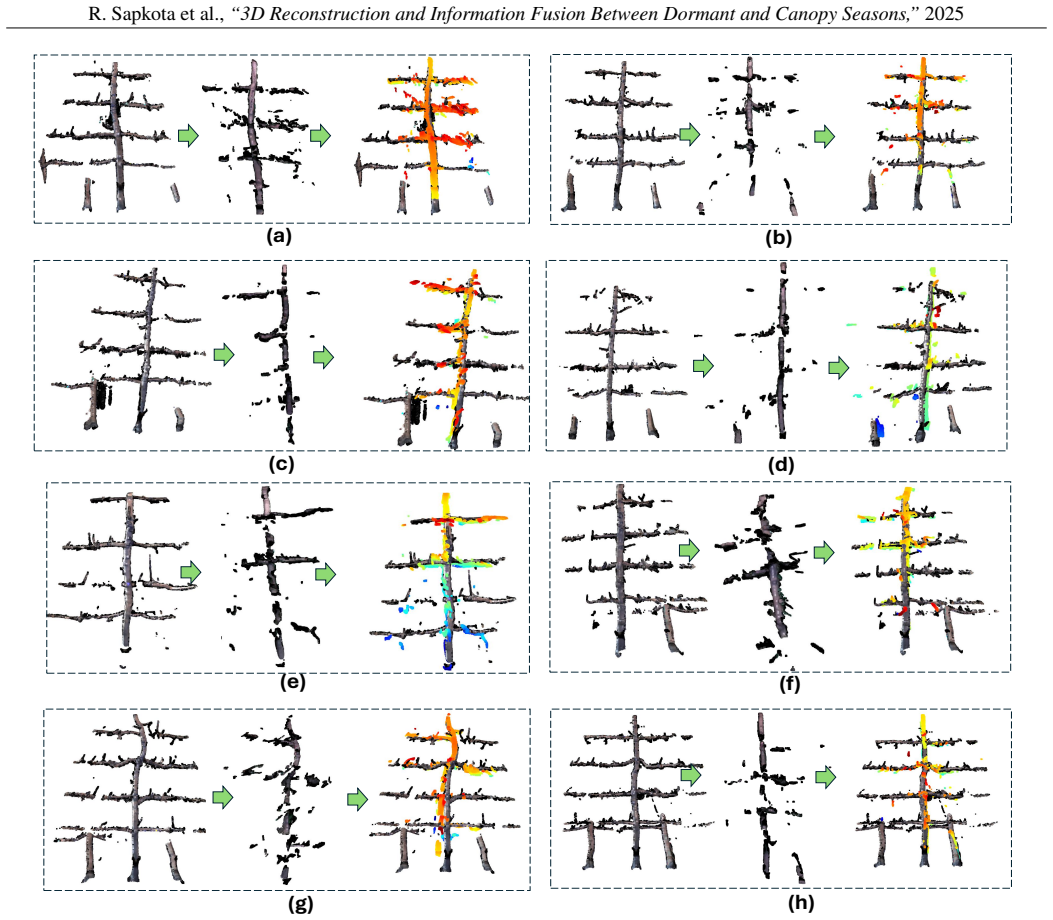
The central claim, stated on the paper's own terms, is that structural information from the defoliated winter tree can be carried into the leafy summer model by registering the two seasonal 3D reconstructions. Dormant-season reconstructions captured most of the visible trunk and branch structure, while canopy-season reconstructions recovered only 7 of 109 ground-truthed branches, leaving 102 branches missing. The paper contends that Fast GICP alignment of the dormant and canopy point clouds produces a single fused representation in which the winter branch geometry is available for summer tasks such as pruning, thinning, and crop-load management. Validation is reported at the component level: RMSE of 5.23 mm for trunk diameter, 4.50 mm for branch diameter, and 13.72 mm for branch spacing, together with registration fitness scores as low as 0.00197.
Load-bearing premise
The load-bearing premise is that aligning the winter and summer 3D scans well is enough to transfer the winter model's full branch information into the summer model, so branches hidden by leaves become available to the robot; the validations check alignment and reconstruction separately, not whether the fused model actually recovers the 102 branches missing from the canopy-season model.
Editorial extensions
If this is right
- Canopy-season robots get access to winter branch geometry after registration, enabling pruning and thinning decisions based on structure that is invisible in summer imagery.
- Trunk diameter errors near 5 mm and branch diameter errors near 4.5 mm make the reconstructed models precise enough for field-level structural measurements used in crop-load management.
- YOLOv9-Seg trunk segmentation at mAP@50 up to 0.78 is sufficient to drive the reconstruction pipeline during the defoliated season.
- Fast GICP fitness scores below 0.006 for most trees indicate that cross-season alignment is achievable from RGB-D data alone, without LiDAR.
- A single sensing platform can provide year-round orchard perception, since winter structure is carried forward into the summer model instead of being re-measured through foliage.
Reading between the lines
- A direct testable extension is to measure branch-level recall in the fused point cloud: count how many of the 102 canopy-missed branches appear at their field-measured locations after registration; the paper validates alignment and reconstruction separately, so this count is the missing experiment.
- If the transfer holds, the same winter-to-summer alignment could apply to other trellised fruit crops such as pears, cherries, or peaches, where pruning decisions also depend on branch architecture hidden by foliage.
- Replacing RGB-D with LiDAR for the dormant scan could raise reconstruction accuracy and registration stability in larger commercial blocks, at higher sensor cost.
- Because both seasons share one coordinate frame after fusion, the framework enables longitudinal growth measurements, such as branch extension and trunk thickening between December and June.
Editorial analysis
A structured set of objections, weighed in public.
Referee Report
Summary. The paper presents an information-fusion pipeline for apple orchards: YOLOv9-Seg instance segmentation of trunks and branches, KinectFusion 3D reconstruction, and Fast GICP alignment of dormant-season and canopy-season point clouds. The authors report segmentation metrics (mAP@50 up to 0.78 for trunks), reconstruction accuracy validated against field caliper measurements (RMSE 5.23 mm for trunk diameter, 4.50 mm for branch diameter), and Fast GICP fitness scores (minimum 0.00197, average 0.0047). The central claim is that fusing dormant and canopy reconstructions gives robotic systems access to branch architecture that is occluded during the canopy season, thereby improving automated pruning and thinning.
Significance. If the fusion claim were validated, the work would be a useful step for orchard robotics: dormant-season scans are unobstructed, and mapping them into the canopy-season frame could supply branch information that RGB-D sensors cannot directly capture. The use of independent field measurements as ground truth for diameter and spacing validation is a definite strength, and the field deployment in a commercial orchard adds practical credibility. The segmentation and reconstruction numbers are plausible and the registration fitness scores are reported rather than fitted. However, the paper's central fusion benefit—that the aligned dormant model actually supplies the missing branch structure—is not directly measured, so the significance of the contribution currently rests on an extrapolation rather than a demonstrated result.
major comments (3)
- [§4.2 and §4.3] The central fusion claim is not directly validated. Section 4.2 states that only 7 of 109 canopy-season branches were reconstructed, with 102 missing. Section 4.3 then reports only global Fast GICP fitness scores (Eq. 9), which average over all matched points and are dominated by trunk and large-branch surfaces. No experiment counts how many of the 102 missing branches are actually recovered in the fused model, and no branch-level correspondence error is reported. Add a branch-level evaluation: after applying the Fast GICP transform, measure how many dormant-model branches land within a specified tolerance of the canopy-season trunk/branch frame, or compute per-branch nearest-neighbor alignment errors against field-measured branch locations. Without this, the abstract's statement that the fused representation 'enables robotic systems to access otherwise obscured architectural information' is unsupported.
- [§3.6, §3.7, and §4.3] The six-month gap between the dormant (December 2023) and canopy (June 2024) scans means that tree growth, fruit load, and canopy weight can shift branch positions non-rigidly. A single rigid-body transform optimized on all points (Eq. 8) need not preserve branch-level accuracy even if the global fitness score is low. The paper should either restrict the fusion claim to global trunk alignment or demonstrate that branch positions are preserved, for example by evaluating on a subset of branches visible in both seasons or by using ground-truth markers. This is a load-bearing issue because the stated application depends on branch-level accuracy for pruning and thinning.
- [Abstract and §4.3] The abstract attributes a 'mean squared error (MSE) of 0.0047' to the YOLOv9-Seg model, but no such segmentation MSE appears in the results; the only 0.0047 value in the paper is the average Fast GICP fitness score, and Eq. (9) defines fitness as a mean distance, not a mean squared error. This misattribution conflates the segmentation and registration stages and should be corrected in the abstract and in the text around Eq. (9).
minor comments (5)
- [Table 4 and §4.2] Units are inconsistent: trunk and branch diameters are given in mm, while branch spacing is reported as 0.54 inches in the text and as an unlabeled 0.54 in Table 4. Use a single unit for the table and state the unit explicitly in both the table header and the text.
- [§4.1.1 and Table 2] The text first states that YOLOv9-gelan-c-dseg trunk recall dropped to 0.52, then later states that 'both gelan-c-seg and gelan-c-dseg variants achieved the highest recall for the trunk category at 0.71.' Table 2 lists gelan-c-seg trunk recall as 0.71 and gelan-c-dseg trunk recall as 0.52; the contradictory sentence should be revised.
- [Figure 10 and §4.3] The Figure 10 caption says the leftmost panels show dormant-season trees and the middle panels show canopy-season counterparts, while the §4.3 text says the leftmost image is the canopy-season point cloud and the middle image is the dormant-season data. Align the caption with the text.
- [Throughout] The YOLOv9 variant names are used inconsistently: for example, 'YOLOv9-seg-dseg' is sometimes written as 'YOLOv9-c-dseg.' Standardize the variant names to match Table 2 and the training description in §3.3.
- [§4.2] The branch diameter RMSE of 4.50 mm is based on only the 7 branches that were partially reconstructed in the canopy season, a very small sample. State this sample size explicitly in the results and consider reporting a confidence interval or noting the limited statistical power.
Circularity Check
No load-bearing circularity: reconstruction accuracy is anchored to independent field measurements; the only self-referential element is the in-sample Fast GICP fitness score used as registration validation.
-
fitted input called prediction
[Section 3.6-3.7, Eq. (8)-(9); Section 4.3]
"T = argminT X i dT i CBi + T CAi T T −1 di (8) ... Fitness Score = 1 N X N i=1 kpi − T(qi)k (9) ... The fitness score provides a mean displacement value between aligned points, where lower values signify more precise registration."
T is estimated in Eq. (8) by minimizing the GICP alignment residual on the same dormant/canopy point clouds, and Eq. (9) reports the mean Euclidean residual of those same matched point pairs after applying the optimized T. A low fitness score is therefore partly forced by the minimization itself rather than by independent evidence that branch-level geometry is correctly transferred to the canopy frame. The paper's own Section 4.2 states that 102 of 109 branches were not reconstructed in the canopy season, so the global fitness score cannot substantiate the abstract's claim that the fused model gives robots access to otherwise obscured branch information.
full rationale
The paper's derivation chain is largely self-contained against external ground truth. YOLOv9 segmentation is scored on annotated images, KinectFusion reconstructions are compared with independent field caliper measurements (RMSE 5.23 mm trunk diameter, 4.50 mm branch diameter), and the Fast GICP registration is a standard algorithm. The only step that partly reduces to its input is the use of the in-sample fitness score (Eq. 9) as evidence of 'precise' registration: because Eq. (8) minimizes essentially the same residual on the same point pairs, low fitness values are expected after optimization and do not, by themselves, confirm that the 102 canopy-occluded branches from the dormant model are correctly localized in the fused frame. Section 4.2 explicitly concedes that only 7 of 109 branches were partially reconstructed in the canopy season, which is a limitation of the central fusion claim rather than a circular derivation. There are no load-bearing self-citations, no imported uniqueness theorems, and no fitted parameter renamed as a prediction at the core of the method.
Assumptions & free parameters
assumptions (4)
- domain assumption Azure Kinect DK provides accurate depth and color data for mm-level reconstruction.
- domain assumption KinectFusion produces accurate 3D models from segmented depth streams in outdoor orchard conditions.
- domain assumption Fast GICP converges to the correct alignment between dormant and canopy point clouds given the initial poses.
- domain assumption The YOLOv9 model trained on the authors' annotations generalizes to the validation and deployment scenes.
Cite this review
Pith. "Pith review of 3D Reconstruction and Information Fusion between Dormant and Canopy Seasons in Commercial Orchards Using Deep Learning and Fast GICP." pith.science (2026). https://pith.science/paper/BZ6NT543
@misc{pith2026250701912,
  author       = {Pith},
  title        = {Pith review of: 3D Reconstruction and Information Fusion between Dormant and Canopy Seasons in Commercial Orchards Using Deep Learning and Fast GICP},
  year         = {2026},
  howpublished = {\url{https://pith.science/paper/BZ6NT543}},
  note         = {Machine review of arXiv:2507.01912}
}
read the original abstract
In orchard automation, dense foliage during the canopy season severely occludes tree structures, minimizing visibility to various canopy parts such as trunks and branches, which limits the ability of a machine vision system. However, canopy structure is more open and visible during the dormant season when trees are defoliated. In this work, we present an information fusion framework that integrates multi-seasonal structural data to support robotic and automated crop load management during the entire growing season. The framework combines high-resolution RGB-D imagery from both dormant and canopy periods using YOLOv9-Seg for instance segmentation, Kinect Fusion for 3D reconstruction, and Fast Generalized Iterative Closest Point (Fast GICP) for model alignment. Segmentation outputs from YOLOv9-Seg were used to extract depth-informed masks, which enabled accurate 3D point cloud reconstruction via Kinect Fusion; these reconstructed models from each season were subsequently aligned using Fast GICP to achieve spatially coherent multi-season fusion. The YOLOv9-Seg model, trained on manually annotated images, achieved a mean squared error (MSE) of 0.0047 and segmentation mAP@50 scores up to 0.78 for trunks in dormant season dataset. Kinect Fusion enabled accurate reconstruction of tree geometry, validated with field measurements resulting in root mean square errors (RMSE) of 5.23 mm for trunk diameter, 4.50 mm for branch diameter, and 13.72 mm for branch spacing. Fast GICP achieved precise cross-seasonal registration with a minimum fitness score of 0.00197, allowing integrated, comprehensive tree structure modeling despite heavy occlusions during the growing season. This fused structural representation enables robotic systems to access otherwise obscured architectural information, improving the precision of pruning, thinning, and other automated orchard operations.
Figures


Figures from the paper (8 more)



Reference graph
Works this paper leans on
-
[1]
write newline
" write newline "" before.all 'output.state := FUNCTION n.dashify 't := "" t empty not t #1 #1 substring "-" = t #1 #2 substring "--" = not "--" * t #2 global.max substring 't := t #1 #1 substring "-" = "-" * t #2 global.max substring 't := while if t #1 #1 substring * t #2 global.max substring 't := if while FUNCTION word.in bbl.in ":" * " " * FUNCTION f...
-
[2]
write newline
" write newline "" before.all 'output.state := FUNCTION n.dashify 't := "" t empty not t #1 #1 substring "-" = t #1 #2 substring "--" = not "--" * t #2 global.max substring 't := t #1 #1 substring "-" = "-" * t #2 global.max substring 't := while if t #1 #1 substring * t #2 global.max substring 't := if while FUNCTION word.in bbl.in ":" * " " * FUNCTION f...
-
[3]
write newline
" write newline "" before.all 'output.state := FUNCTION n.dashify 't := "" t empty not t #1 #1 substring "-" = t #1 #2 substring "--" = not "--" * t #2 global.max substring 't := t #1 #1 substring "-" = "-" * t #2 global.max substring 't := while if t #1 #1 substring * t #2 global.max substring 't := if while FUNCTION word.in bbl.in ":" * " " * FUNCTION f...
-
[4]
author Akbar, S.A. , author Elfiky, N.M. , author Kak, A. , year 2016 . title A novel framework for modeling dormant apple trees using single depth image for robotic pruning application , in: booktitle 2016 IEEE International Conference on Robotics and Automation (ICRA) , publisher IEEE . pp. pages 5136--5142
work page 2016
-
[5]
author Besl, P.J. , author McKay, N.D. , year 1992 . title Method for registration of 3-d shapes , in: booktitle Sensor Fusion IV: Control Paradigms and Data Structures , publisher SPIE . pp. pages 586--606
work page 1992
-
[6]
author Boudon, F. , author Prusinkiewicz, P. , author Federl, P. , author Godin, C. , author Karwowski, R. , year 2003 . title Interactive design of bonsai tree models , in: booktitle Computer Graphics Forum , publisher Wiley Online Library . pp. pages 591--599
work page 2003
-
[7]
author Bucksch, A. , author Lindenbergh, R. , author Menenti, M. , year 2010 . title Skeltre . journal The Visual Computer volume 26 , pages 1283--1300
work page 2010
-
[8]
author Christiaensen, L. , author Rutledge, Z. , author Taylor, J.E. , year 2021 . title The future of work in agri-food . journal Food Policy volume 99 , pages 101963
work page 2021
Show all 53 references
-
[9]
, author He, M
author Cui, Z. , author He, M. , author Chen, B. , author Hu, B. , year 2023 . title In-situ elemental quantitative imaging in plant leaves by la-icp-ms with matrix-matching external calibration . journal Analytica Chimica Acta volume 1275 , pages 341588
2023
-
[10]
, author Nieto, J
author Digumarti, S.T. , author Nieto, J. , author Cadena, C. , author Siegwart, R. , author Beardsley, P. , year 2018 . title Automatic segmentation of tree structure from point cloud data . journal IEEE Robotics and Automation Letters volume 3 , pages 3043--3050
2018
-
[11]
, author Sharir, M
author Ezra, E. , author Sharir, M. , author Efrat, A. , year 2008 . title On the performance of the icp algorithm . journal Computational Geometry volume 41 , pages 77--93
2008
-
[12]
, year 2010
author Fathallah, F.A. , year 2010 . title Musculoskeletal disorders in labor-intensive agriculture . journal Applied Ergonomics volume 41 , pages 738--743
2010
-
[13]
, author Tauer, L.W
author Fried, H.O. , author Tauer, L.W. , year 2016 . title The aging us farmer: should we worry? , in: booktitle Advances in Efficiency and Productivity . publisher Springer , pp. pages 391--407
2016
-
[14]
, author Klein, R
author Ganster, B. , author Klein, R. , year 2008 . title 1-2-tree: Semantic modeling and editing of trees , in: booktitle VMV , pp. pages 51--60
2008
-
[15]
, author Yan, H
author Gao, R. , author Yan, H. , author Duan, J. , author Gao, Y. , author Cao, C. , author Li, L. , author Guo, L. , year 2022 . title Study on the nonfatigue and fatigue states of orchard workers based on electrocardiogram signal analysis . journal Scientific Reports volume...
2022
-
[16]
, author Ikemoto, L
author Gelfand, N. , author Ikemoto, L. , author Rusinkiewicz, S. , author Levoy, M. , year 2003 . title Geometrically stable sampling for the icp algorithm , in: booktitle Fourth International Conference on 3-D Digital Imaging and Modeling, 2003. 3DIM 2003. Proceedings , publ...
2003
-
[17]
, year 1971
author Honda, H. , year 1971 . title Description of the form of trees by the parameters of the tree-like body: Effects of the branching angle and the branch length on the shape of the tree-like body . journal Journal of Theoretical Biology volume 31 , pages 331--338
1971
-
[18]
, author Noguchi, R
author Jiang, A. , author Noguchi, R. , author Ahamed, T. , year 2022 . title Tree trunk recognition in orchard autonomous operations under different light conditions using a thermal camera and faster r-cnn . journal Sensors volume 22 , pages 2065
2022
-
[19]
, author Qi, P
author Jiang, S. , author Qi, P. , author Han, L. , author Liu, L. , author Li, Y. , author Huang, Z. , author Liu, Y. , author He, X. , year 2024 . title Navigation system for orchard spraying robot based on 3d lidar slam with ndt\_icp point cloud registration . journal Compu...
2024
-
[20]
, author Hügli, H
author Jost, T. , author Hügli, H. , year 2002 . title Fast icp algorithms for shape registration , in: booktitle Pattern Recognition: 24th DAGM Symposium, Zurich, Switzerland, September 16--18, 2002, Proceedings 24 , publisher Springer . pp. pages 91--99
2002
-
[21]
, author Adhikari, B
author Karkee, M. , author Adhikari, B. , year 2015 . title A method for three-dimensional reconstruction of apple trees for automated pruning . journal Transactions of the ASABE volume 58 , pages 565--574
2015
-
[22]
, author Dun, O
author Klocker, N. , author Dun, O. , author Head, L. , author Gopal, A. , year 2020 . title Exploring migrants’ knowledge and skill in seasonal farm work: more than labouring bodies . journal Agriculture and Human Values volume 37 , pages 463--478
2020
-
[23]
, author Wang, X
author Kok, E. , author Wang, X. , author Chen, C. , year 2023 . title Obscured tree branches segmentation and 3d reconstruction using deep learning and geometrical constraints . journal Computers and Electronics in Agriculture volume 210 , pages 107884
2023
-
[24]
, author Martin, W
author Laborde, D. , author Martin, W. , author Swinnen, J. , author Vos, R. , year 2020 . title Covid-19 risks to global food security . journal Science volume 369 , pages 500--502
2020
-
[25]
, author Oh, J.H
author Lee, H.J. , author Oh, J.H. , author Yoo, J.R. , author Ko, S.Y. , author Kang, J.H. , author Lee, S.K. , author Jeong, W. , author Seong, G.M. , author Kang, C.H. , author Song, S.W. , year 2021 . title Prevalence of low back pain and associated risk factors among farm...
2021
-
[26]
, author Ma, W
author Liu, Q. , author Ma, W. , author Zhang, J. , author Liu, Y. , author Xu, D. , author Wang, J. , year 2021 . title Point-cloud segmentation of individual trees in complex natural forest scenes based on a trunk-growth method . journal Journal of Forestry Research volume 3...
2021
-
[27]
, author Zhang, J
author Majeed, Y. , author Zhang, J. , author Zhang, X. , author Fu, L. , author Karkee, M. , author Zhang, Q. , author Whiting, M.D. , year 2018 . title Apple tree trunk and branch segmentation for automatic trellis training using convolutional neural network based semantic s...
2018
-
[28]
, author Kim, D
author Medeiros, H. , author Kim, D. , author Sun, J. , author Seshadri, H. , author Akbar, S.A. , author Elfiky, N.M. , author Park, J. , year 2017 . title Modeling dormant fruit trees for agricultural automation . journal Journal of Field Robotics volume 34 , pages 1203--1224
2017
-
[29]
, author Zhang, Z
author Mhamed, M. , author Zhang, Z. , author Yu, J. , author Li, Y. , author Zhang, M. , year 2024 . title Advances in apple’s automated orchard equipment: A comprehensive research . journal Computers and Electronics in Agriculture volume 221 , pages 108926
2024
-
[30]
, author Schupp, J.R
author Miller, S.S. , author Schupp, J.R. , author Baugher, T.A. , author Wolford, S.D. , year 2011 . title Performance of mechanical thinners for bloom or green fruit thinning in peaches . journal HortScience volume 46 , pages 43--51
2011
-
[31]
, year 2022
author Polat, A.A. , year 2022 . title Orchard management , in: booktitle Loquat: Botany, Production and Uses . publisher CABI GB , pp. pages 167--187
2022
-
[32]
, author Ruminar, H
author Prasetyaningrum, D. , author Ruminar, H. , author Irwandi, P. , year 2022 . title The perception and interest of career choices in agriculture: Case of agroecotechnology and agribusiness students . journal Habitat volume 33 , pages 186--200
2022
-
[33]
, author Lane, B
author Runions, A. , author Lane, B. , author Prusinkiewicz, P. , year 2007 . title Modeling trees with a space colonization algorithm . journal NPH volume 7 , pages 6
2007
-
[34]
, author Levoy, M
author Rusinkiewicz, S. , author Levoy, M. , year 2001 . title Efficient variants of the icp algorithm , in: booktitle Proceedings Third International Conference on 3-D Digital Imaging and Modeling , publisher IEEE . pp. pages 145--152
2001
-
[35]
, author Borgefors, G
author Saha, P.K. , author Borgefors, G. , author di Baja, G.S. , year 2016 . title A survey on skeletonization algorithms and their applications . journal Pattern Recognition Letters volume 76 , pages 3--12
2016
-
[36]
, author Wood, R.M
author Schut, D.E. , author Wood, R.M. , author Trull, A.K. , author Schouten, R. , author van Liere, R. , author van Leeuwen, T. , author Batenburg, K.J. , year 2024 . title Joint 2d to 3d image registration workflow for comparing multiple slice photographs and ct scans of ap...
2024
-
[37]
, author Medeiros, H
author Tabb, A. , author Medeiros, H. , year 2017 . title A robotic vision system to measure tree traits , in: booktitle 2017 IEEE/RSJ International Conference on Intelligent Robots and Systems (IROS) , publisher IEEE . pp. pages 6005--6012
2017
-
[38]
, author Zeng, G
author Tan, P. , author Zeng, G. , author Wang, J. , author Kang, S.B. , author Quan, L. , year 2007 . title Image-based tree modeling , in: booktitle ACM SIGGRAPH 2007 papers , pp. pages 87--es
2007
-
[39]
, author Zhang, J
author Tong, S. , author Zhang, J. , author Li, W. , author Wang, Y. , author Kang, F. , year 2023 . title An image-based system for locating pruning points in apple trees using instance segmentation and rgb-d images . journal Biosystems Engineering volume 236 , pages 277--286
2023
-
[40]
, author Hance, T
author Tougeron, K. , author Hance, T. , year 2021 . title Impact of the covid-19 pandemic on apple orchards in europe . journal Agricultural Systems volume 190 , pages 103097
2021
-
[41]
, author Sawaya, A
author Usman, M. , author Sawaya, A. , author Igarashi, M. , author Gayman, J.J. , author Dixit, R. , year 2021 . title Strained agricultural farming under the stress of youths’ career selection tendencies: A case study from hokkaido (japan) . journal Humanities and Social Sci...
2021
-
[42]
, author Fan, Z
author Wan, H. , author Fan, Z. , author Yu, X. , author Kang, M. , author Wang, P. , author Zeng, X. , year 2022 . title A real-time branch detection and reconstruction mechanism for harvesting robot via convolutional neural network and image segmentation . journal Computers ...
2022
-
[43]
, author Yeh, I.H
author Wang, C.Y. , author Yeh, I.H. , author Liao, H.Y.M. , year 2024 . title Yolov9: Learning what you want to learn using programmable gradient information . journal arXiv preprint arXiv:2402.13616
2024 arXiv
-
[44]
, year 2022
author Weiler, A.M. , year 2022 . title Seeing the workers for the trees: Exalted and devalued manual labour in the pacific northwest craft cider industry . journal Agriculture and Human Values volume 39 , pages 65--78
2022
-
[45]
, author Choi, D
author Yuan, W. , author Choi, D. , author Bolkas, D. , year 2022 . title Gnss-imu-assisted colored icp for uav-lidar point cloud registration of peach trees . journal Computers and Electronics in Agriculture volume 197 , pages 106966
2022
-
[46]
, author Xie, N
author Zhang, D. , author Xie, N. , author Liang, S. , author Jia, J. , year 2016 a. title 3d tree skeletonization from multiple images based on pyrlk optical flow . journal Pattern Recognition Letters volume 76 , pages 49--58
2016
-
[47]
, author Gu, J
author Zhang, J. , author Gu, J. , author Hu, T. , author Wang, B. , author Xia, Z. , year 2024 . title An image segmentation and point cloud registration combined scheme for sensing of obscured tree branches . journal Computers and Electronics in Agriculture volume 221 , pages 108960
2024
-
[48]
, author Chen, H
author Zhang, K. , author Chen, H. , author Wu, H. , author Zhao, X. , author Zhou, C. , year 2022 . title Point cloud registration method for maize plants based on conical surface fitting icp . journal Scientific Reports volume 12 , pages 6852
2022
-
[49]
, author Karkee, M
author Zhang, Q. , author Karkee, M. , year 2021 . title Agricultural and field robotics: An introduction , in: booktitle Fundamentals of Agricultural and Field Robotics . publisher Springer , pp. pages 1--10
2021
-
[50]
, author Elnashef, B
author Zhang, T. , author Elnashef, B. , author Filin, S. , year 2023 . title Spatio-temporal registration of plants non-rigid 3-d structure . journal ISPRS Journal of Photogrammetry and Remote Sensing volume 205 , pages 263--283
2023
-
[51]
, author Karkee, M
author Zhang, X. , author Karkee, M. , author Zhang, Q. , author Whiting, M.D. , year 2021 . title Computer vision-based tree trunk and branch identification and shaking points detection in dense-foliage canopy for automated harvesting of apples . journal Journal of Field Robo...
2021
-
[52]
, author Heinemann, P.H
author Zhang, Z. , author Heinemann, P.H. , author Liu, J. , author Baugher, T.A. , author Schupp, J.R. , year 2016 b. title The development of mechanical apple harvesting technology: A review . journal Transactions of the ASABE volume 59 , pages 1165--1180
2016
-
[53]
, author Kang, F
author Zhou, S. , author Kang, F. , author Li, W. , author Kan, J. , author Zheng, Y. , year 2020 . title Point cloud registration for agriculture and forestry crops based on calibration balls using kinect v2 . journal International Journal of Agricultural and Biological Engin...
2020
Reviewed August 6, 2026 · model on record in the stance chip above.
Discussion (0). Sign in to comment.