REVIEW 4 major objections 5 minor 47 references
FMOcc: TPV-Driven Flow Matching for 3D Occupancy Prediction with Selective State Space Model
T0 review · 4 major / 5 minor · reviewed 2026-08-06 · deepseek-v4-flash
Pith's one-line read FMOcc claims two-frame camera input can outperform eight- and sixteen-frame 3D occupancy predictors by generating missing features with flow matching.
desk verdict The efficiency and accuracy claims are attractive, but the paper's key ablation is ambiguous: the 'w/o FMSSM' row appears to be the 8-frame BEVDetOcc baseline, so the +32.2% gain attributed to FMSSM is not actually established. read the letter →
The pith
A machine-rendered reading of the paper's core claim, the machinery that carries it, and where it could break.
The reading
What carries the argument
The central machinery is the Flow Matching SSM module (FMSSM), a rectified-flow generative model that refines 3D voxel features by learning the velocity field between masked input features and encoded occupancy labels. To keep the generative steps cheap, it flattens voxel features into tri-perspective view (TPV) planes — the top, side, and front views — via axis-wise mean pooling, then processes all three planes with parallel Plane Selective SSM blocks. Each block unfolds a plane along four directions and applies the S6 selective state space update with input-dependent matrices B, C, and Δ, which the paper argues filters out air-voxel redundancy and captures global context in linear time. Euler integration over the predicted velocity TPV features produces the enhanced voxel features fed to the occupancy head. Mask Training corrupts voxel features with a Bernoulli mask whose dropout rate grows with training epoch, so the model learns to predict with missing camera data.
What would settle it
Run the complete FMOcc pipeline with two-frame input and remove only the FMSSM module, keeping TPV-SSM layers, Mask Training, and the same training schedule; then measure RayIoU on Occ3D-nuScenes validation. If the result lands near 29.6, the two-frame BEVDetOcc number, rather than 32.6, then the flow-matching module is responsible for a smaller gain than the paper reports, and the comparison against eight-frame baselines would need to be redone on equal terms.
Extended reading notes
Core claim
On the paper's own terms, the discovery is that a generative flow-matching model can synthesize missing voxel features from a two-frame camera input, so that occlusion reasoning and distant-scene prediction no longer require historical frame fusion. The Flow Matching SSM module (FMSSM) builds an optimal-transport straight path between masked input voxel features and encoded label targets, processes the intermediate features as three orthographic planes (top, side, front) through selective state space layers, and integrates the predicted velocity field back into voxel space. The authors report that this pipeline consistently outperforms state-of-the-art algorithms on Occ3D-nuScenes and OpenOcc, including methods consuming eight or sixteen frames, while using roughly 5.4 G inference memory.
Load-bearing premise
The paper's central claim rests on the assumption that the 'w/o FMSSM' row in its ablation is the same two-frame pipeline with only the flow-matching module removed; if that row is instead the eight-frame BEVDetOcc baseline, the attributed improvement from FMSSM is inflated and the state-of-the-art claim is not established.
Editorial extensions
If this is right
- Two-frame input can replace eight- and sixteen-frame temporal fusion, cutting sensor history requirements and memory use.
- The reported 5.4 G inference memory and 330 ms latency make the approach usable for onboard deployment.
- Mask Training keeps prediction accurate under up to 50% camera feature corruption, improving robustness to sensor failure.
- Distant-scene occupancy improves: RayIoU at 100 m rises from 32.6 for BEVDetOcc to 39.6 for FMOcc in the paper's comparison.
- Exchanging the flow-matching generator for a diffusion generator lowers RayIoU from 43.1 to 38.6 and raises latency from 333 ms to 691 ms, supporting flow matching over diffusion in this setting.
Reading between the lines
- The FMSSM ablation compares its 'w/o FMSSM' row at 32.6 RayIoU, the same value as the eight-frame BEVDetOcc baseline in Table 1; if that row is not the two-frame FMOcc without FMSSM, the paper's claimed +32.2% gain from flow matching is not actually isolated. A two-frame ablation without FMSSM would settle this.
- The TPV-planes-plus-selective-SSM recipe is not specific to occupancy; it could be applied to other dense 3D perception tasks such as BEV segmentation or detection, where air-voxel redundancy and long-range context are similar bottlenecks.
- The conclusion hints at generating future occupancy scenes as a world model; FMSSM's velocity-field formulation could naturally extend from refining the current frame to forecasting the next one, a testable next step the paper does not pursue.
- Because the paper reports only 24 epochs and a ResNet50 backbone, its state-of-the-art comparison may partly reflect training budget differences; a fair test would train competing methods under identical epochs, resolution, and augmentation.
Editorial analysis
A structured set of objections, weighed in public.
Referee Report
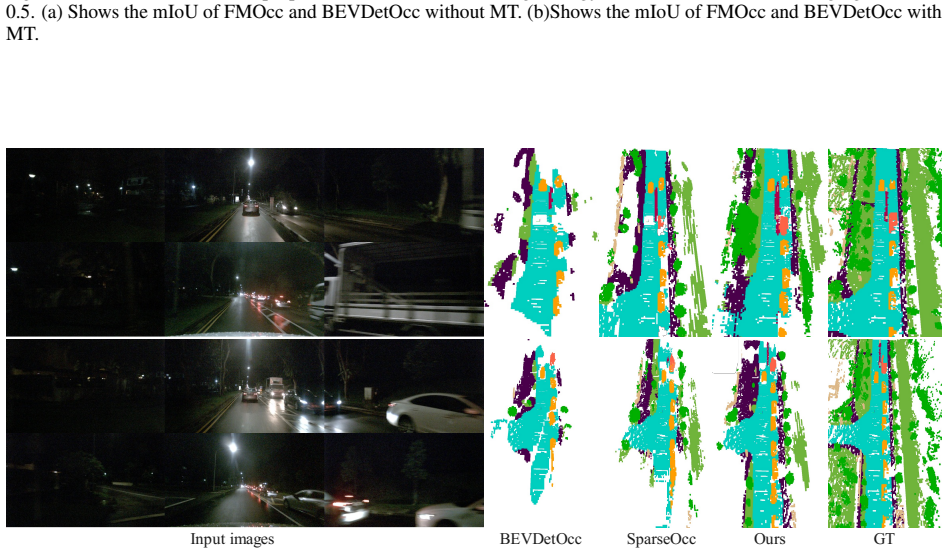
Summary. The paper proposes FMOcc, a camera-only 3D semantic occupancy prediction network that uses a flow-matching module (FMSSM) built on tri-perspective-view (TPV) features and selective state space models, together with a mask-training strategy. The central claim is that with only two input frames, FMOcc achieves 43.1% RayIoU and 39.8% mIoU on Occ3D-nuScenes validation and 42.6% RayIoU on OpenOcc, outperforming existing methods that use more frames, while using less inference memory and time. The paper includes quantitative comparisons, ablations of FMSSM, the TPV-SSM layer, mask training, distance-based performance, and different backbones, plus qualitative results for occlusion, low-light, and missing-label scenes.
Significance. If the empirical claims hold, the paper would demonstrate a practical few-frame occupancy prediction method that avoids the cost of historical-frame fusion while matching or exceeding multi-frame baselines, and it would introduce a novel combination of flow matching and selective SSMs for 3D perception. The efficiency numbers are attractive and the OpenOcc evaluation adds diversity. However, the central attribution of the gains to FMSSM is currently undermined by an unmatched ablation baseline, and the method description is incomplete about inference-time handling of labels and key hyperparameters. The paper also contains several internal inconsistencies about visible-mask training. These issues are fixable but currently prevent the main SOTA claim from being considered established.
major comments (4)
- [§4.2, Tables 1 and 3] The 'w/o FMSSM' row in Table 3 reports RayIoU 32.6 and RayIoU1m/2m/4m values 26.6/33.1/38.2, which exactly match the BEVDetOcc (8f) row in Table 1, not the two-frame BEVDetOcc (2f) baseline at 29.6. If this row is the 8-frame model, the claimed +32.2% RayIoU improvement from FMSSM in the two-frame setting is inflated, and the central narrative that FMSSM closes the gap to 8-frame methods is not established. Please rerun the 'w/o FMSSM' configuration with two frame inputs, matched backbone, input resolution, and training epochs, and report explicitly whether that baseline already contains the TPV-SSM layer and mask training.
- [§4.1, §4.2.1, Table 1] The manuscript is internally inconsistent about visible masks. Section 4.1 states that 'we have deliberately omitted the use of camera masks throughout the training phase,' and Section 4.2 states that the model is trained without visible masks, yet Table 1 lists FMOcc (2f) with a checkmark under Vis. Mask at 46.5 RayIoU and 47.9 mIoU in addition to the no-mask row at 43.1/39.8. The sentence in §4.2.1 that 'when adopting the visible mask during training' the model improves 11.7% and 3.3% over STCOcc is also inconsistent with Table 1, because STCOcc has no visible mask and those percentages match the no-mask FMOcc comparison instead. Please clarify which configuration is the proposed method and correct the text accordingly.
- [§3.3, Eqs. (5) and (6)] The training target V1 is constructed from ground-truth labels Y via Eq. (5), and Vt is defined as the interpolation tV1 + (1−t)V0. At inference, ground-truth labels are not available, but the paper does not state how V1 is initialized or how the learned velocity field is integrated to produce the enhanced voxel features. Please provide the full inference-time algorithm, including the initialization of V1 and the Euler integration schedule; as written, the method could be inadvertently using labels at inference, which would invalidate the evaluation.
- [§3.3, Eqs. (5), (10); §3.5, Eq. (14)] Key hyperparameters are not reported: the value of `scale` in Eq. (5), the value of `∆t` in Eq. (10), the number of flow-matching integration steps at inference, and the mask-cap parameter β in Eq. (14). These are load-bearing free parameters for the proposed method. For example, β is described as a preset cap of 25, but Figure 5 evaluates mask ratios up to 0.5, and it is unclear whether β denotes 25% or a different quantity. Please report the exact values used in the experiments and clarify the units of the mask schedule.
minor comments (5)
- [Throughout] The manuscript contains numerous typos and grammatical errors, including 'this paper propose', 'momory', 'state space modeks', 'occupanct head', 'rediction', and 'framework pf'; a careful proofread is needed.
- [§4.2.2] The text refers to the baseline as 'BEVDet4D', while Table 1 and the figure captions refer to 'BEVDetOcc'; please use a consistent name.
- [§5 Conclusion] The conclusion states that the feature refinement module is 'based on diffusion model', but the paper proposes a flow-matching module; please correct this inconsistency.
- [§3.3, Eq. (11)] Equation (11) uses VV_t and (x1 − x0) without defining these quantities in the voxel feature space; please clarify how x0 and x1 relate to V0 and V1, and correct the notation.
- [Figure 5] The caption says the mask ratio ranges from 0 to 0.5, while Eq. (14) sets a cap β=25; please reconcile the fraction/percent notation and describe the schedule precisely.
Circularity Check
No significant circularity: the FMOcc claim rests on external benchmarks and supervised flow-matching training, not on a self-referential derivation.
full rationale
The central claim is an empirical benchmark result evaluated on external Occ3D-nuScenes and OpenOcc datasets. The flow-matching target V1 in Eq. (5) is built from ground-truth labels Y only during training, as indicated by the 'Labels only Training' annotation in Fig. 1; at inference the labels are not inputs, so the prediction is not defined in terms of its target. The loss in Eq. (11) compares the predicted velocity field with x1 - x0 using standard supervised regression, not a fitted parameter renamed as a prediction. The method does not rely on a uniqueness theorem or on the authors' prior work as load-bearing evidence: the only co-author citation is Ref. [35] (LocalMamba), mentioned as related work on visual SSMs in Section 2.3 and not used to justify any derivation. One non-circular soundness concern is that the 'w/o FMSSM' row in Table 3 exactly matches the BEVDetOcc (8f) numbers in Table 1 (RayIoU 32.6, RayIoU1m/2m/4m 26.6/33.1/38.2), so the ablation baseline may not match the two-frame setting; this affects attribution of the reported gain but is an experimental-control issue, not circularity.
Assumptions & free parameters
free parameters (4)
- scale =
not reported
- Delta t (Euler step) =
not reported
- number of flow matching steps at inference =
not reported
- mask cap beta =
25 (i.e., 25%)
assumptions (5)
- standard math Rectified flow optimal transport family defined by linear interpolation V_t = t V_1 + (1-t) V_0 (Eq. 6)
- standard math Equation 12 discretized S6 state-space recurrences with input-dependent B, C, Delta
- domain assumption Mean pooling along x, y, z into tri-perspective views (Eq. 7) and summation back to voxels (Eq. 9) preserves enough information for refinement
- ad hoc to paper Label-derived V1 via sigmoid(embedding(Y))^2 - 1 is a valid target for enhancing image-derived features
- domain assumption Bernoulli feature masking at training (Eq. 14) transfers to real camera dropout and occlusion
Cite this review
Pith. "Pith review of FMOcc: TPV-Driven Flow Matching for 3D Occupancy Prediction with Selective State Space Model." pith.science (2026). https://pith.science/paper/XH2HB3BZ
@misc{pith2026250702250,
  author       = {Pith},
  title        = {Pith review of: FMOcc: TPV-Driven Flow Matching for 3D Occupancy Prediction with Selective State Space Model},
  year         = {2026},
  howpublished = {\url{https://pith.science/paper/XH2HB3BZ}},
  note         = {Machine review of arXiv:2507.02250}
}
read the original abstract
3D semantic occupancy prediction plays a pivotal role in autonomous driving. However, inherent limitations of fewframe images and redundancy in 3D space compromise prediction accuracy for occluded and distant scenes. Existing methods enhance performance by fusing historical frame data, which need additional data and significant computational resources. To address these issues, this paper propose FMOcc, a Tri-perspective View (TPV) refinement occupancy network with flow matching selective state space model for few-frame 3D occupancy prediction. Firstly, to generate missing features, we designed a feature refinement module based on a flow matching model, which is called Flow Matching SSM module (FMSSM). Furthermore, by designing the TPV SSM layer and Plane Selective SSM (PS3M), we selectively filter TPV features to reduce the impact of air voxels on non-air voxels, thereby enhancing the overall efficiency of the model and prediction capability for distant scenes. Finally, we design the Mask Training (MT) method to enhance the robustness of FMOcc and address the issue of sensor data loss. Experimental results on the Occ3D-nuScenes and OpenOcc datasets show that our FMOcc outperforms existing state-of-theart methods. Our FMOcc with two frame input achieves notable scores of 43.1% RayIoU and 39.8% mIoU on Occ3D-nuScenes validation, 42.6% RayIoU on OpenOcc with 5.4 G inference memory and 330ms inference time.
Figures


Figures from the paper (4 more)



Reference graph
Works this paper leans on
-
[1]
Parallel driving os: A ubiquitous operating system for autonomous driving in cpss,
L. Chen, Y . Zhang, B. Tian, Y . Ai, D. Cao, and F.-Y . Wang, “Parallel driving os: A ubiquitous operating system for autonomous driving in cpss,” IEEE Transactions on Intelligent Vehicles, vol. 7, no. 4, pp. 886–895, 2022
work page 2022
-
[2]
Road-model-based road boundary extraction for high definition map via lidar,
H. Xiong, T. Zhu, Y . Liu, Y . Pan, S. Wu, and L. Chen, “Road-model-based road boundary extraction for high definition map via lidar,” IEEE Transactions on Intelligent Transportation Systems, vol. 23, no. 10, pp. 18 456– 18 465, 2022
work page 2022
-
[3]
Suprnet: Super proxy for 4d occupancy forecasting,
A. Liang, W. Chen, J. Fang, and H. Zhao, “Suprnet: Super proxy for 4d occupancy forecasting,” Knowledge-Based Systems, vol. 301, p. 112332, 2024
work page 2024
-
[4]
High-precision positioning, perception and safe navigation for automated heavy-duty mining trucks,
L. Chen, Y . Li, L. Li, S. Qi, J. Zhou, Y . Tang, J. Yang, and J. Xin, “High-precision positioning, perception and safe navigation for automated heavy-duty mining trucks,”IEEE Transactions on Intelligent Vehicles, vol. 9, no. 4, pp. 4644–4656, 2024
work page 2024
-
[5]
Opus: occupancy prediction using a sparse set,
J. Wang, Z. Liu, Q. Meng, L. Yan, K. Wang, J. Yang, W. Liu, Q. Hou, and M.-M. Cheng, “Opus: occupancy prediction using a sparse set,” arXiv preprint arXiv:2409.09350, 2024
arXiv 2024
-
[6]
Stcocc: Sparse spatial-temporal cascade renovation for 3d occupancy and scene flow prediction,
Z. Liao, P. Wei, S. Chen, H. Wang, and Z. Ren, “Stcocc: Sparse spatial-temporal cascade renovation for 3d occupancy and scene flow prediction,” in Proceedings of the Computer Vision and Pattern Recognition Conference, 2025, pp. 1516–1526
work page 2025
-
[7]
Adaptiveocc: Adaptive octree-based network for multi-camera 3d semantic occupancy prediction in autonomous driving,
T. Yang, Y . Qian, W. Yan, C. Wang, and M. Yang, “Adaptiveocc: Adaptive octree-based network for multi-camera 3d semantic occupancy prediction in autonomous driving,”IEEE Transactions on Circuits and Systems for Video Technology, 2024
2024
-
[8]
Linkocc: 3d semantic occupancy prediction with temporal association,
W. Ouyang, Z. Xu, B. Shen, J. Wang, and Y . Xu, “Linkocc: 3d semantic occupancy prediction with temporal association,” IEEE Transactions on Circuits and Systems for Video Technology, 2024
work page 2024
Show all 47 references
-
[9]
Drop sparse convolution for 3d object detection,
T. Zhu, J. Shen, C. Wang, and H. Xiong, “Drop sparse convolution for 3d object detection,” in ICASSP 2024- 2024 IEEE International Conference on Acoustics, Speech and Signal Processing (ICASSP). IEEE, 2024, pp. 3185–3189
2024
-
[10]
Panoocc: Unified occupancy representation for camera-based 3d panoptic segmentation,
Y . Wang, Y . Chen, X. Liao, L. Fan, and Z. Zhang, “Panoocc: Unified occupancy representation for camera-based 3d panoptic segmentation,” inProceedings of the IEEE/CVF conference on computer vision and pattern recognition, 2024, pp. 17 158–17 168
2024
-
[11]
Autonomous mining through cooperative driving and operations enabled by parallel intelligence,
L. Chen, Y . Xie, Y . He, Y . Ai, B. Tian, L. Li, S. Ge, and F.-Y . Wang, “Autonomous mining through cooperative driving and operations enabled by parallel intelligence,” Communications Engineering, vol. 3, no. 75, 2024
2024
-
[12]
Co-occ: Coupling explicit feature fusion with volume rendering regularization for multi-modal 3d semantic occupancy prediction,
J. Pan, Z. Wang, and L. Wang, “Co-occ: Coupling explicit feature fusion with volume rendering regularization for multi-modal 3d semantic occupancy prediction,” IEEE Robotics and Automation Letters, 2024
2024
-
[13]
Denoising diffusion implicit models,
J. Song, C. Meng, and S. Ermon, “Denoising diffusion implicit models,” arXiv preprint arXiv:2010.02502, 2020
2010 arXiv
-
[14]
Denoising diffusion probabilistic models,
J. Ho, A. Jain, and P. Abbeel, “Denoising diffusion probabilistic models,” vol. 33, 2020, pp. 6840–6851
2020
-
[15]
Diffusiondet: Diffusion model for object detection,
S. Chen, P. Sun, Y . Song, and P. Luo, “Diffusiondet: Diffusion model for object detection,” inProceedings of the IEEE/CVF international conference on computer vision, 2023, pp. 19 830–19 843
2023
-
[16]
Diffusion models for implicit image segmentation ensembles,
J. Wolleb, R. Sandkühler, F. Bieder, P. Valmaggia, and P. C. Cattin, “Diffusion models for implicit image segmentation ensembles,” in International Conference on Medical Imaging with Deep Learning. PMLR, 2022, pp. 1336–1348
2022
-
[17]
Monocular depth estimation using diffusion models,
S. Saxena, A. Kar, M. Norouzi, and D. J. Fleet, “Monocular depth estimation using diffusion models,” arXiv preprint arXiv:2302.14816, 2023. 14 A PREPRINT - S EPTEMBER 25, 2025
2023 arXiv
-
[18]
Occgen: Generative multi-modal 3d occupancy prediction for autonomous driving,
G. Wang, Z. Wang, P. Tang, J. Zheng, X. Ren, B. Feng, and C. Ma, “Occgen: Generative multi-modal 3d occupancy prediction for autonomous driving,” 2024
2024
-
[19]
Mamba: Linear-time sequence modeling with selective state spaces,
A. Gu and T. Dao, “Mamba: Linear-time sequence modeling with selective state spaces,” arXiv preprint arXiv:2312.00752, 2023
2023 arXiv
-
[20]
Vision mamba: Efficient visual representation learning with bidirectional state space model,
L. Zhu, B. Liao, Q. Zhang, X. Wang, W. Liu, and X. Wang, “Vision mamba: Efficient visual representation learning with bidirectional state space model,” arXiv preprint arXiv:2401.09417, 2024
2024 arXiv
-
[21]
Tri-perspective view for vision-based 3d semantic occupancy prediction,
Y . Huang, W. Zheng, Y . Zhang, J. Zhou, and J. Lu, “Tri-perspective view for vision-based 3d semantic occupancy prediction,” in Proceedings of the IEEE/CVF conference on computer vision and pattern recognition, 2023, pp. 9223–9232
2023
-
[22]
Monoscene: Monocular 3d semantic scene completion,
A.-Q. Cao and R. De Charette, “Monoscene: Monocular 3d semantic scene completion,” in Proceedings of the IEEE/CVF Conference on Computer Vision and Pattern Recognition, 2022, pp. 3991–4001
2022
-
[23]
V oxformer: Sparse voxel transformer for camera-based 3d semantic scene completion,
Y . Li, Z. Yu, C. Choy, C. Xiao, J. M. Alvarez, S. Fidler, C. Feng, and A. Anandkumar, “V oxformer: Sparse voxel transformer for camera-based 3d semantic scene completion,” in Proceedings of the IEEE/CVF conference on computer vision and pattern recognition, 2023, pp. 9087–9098
2023
-
[24]
Occformer: Dual-path transformer for vision-based 3d semantic occupancy prediction,
Y . Zhang, Z. Zhu, and D. Du, “Occformer: Dual-path transformer for vision-based 3d semantic occupancy prediction,” in Proceedings of the IEEE/CVF International Conference on Computer Vision, 2023, pp. 9433–9443
2023
-
[25]
Cotr: Compact occupancy transformer for vision-based 3d occupancy prediction,
Q. Ma, X. Tan, Y . Qu, L. Ma, Z. Zhang, and Y . Xie, “Cotr: Compact occupancy transformer for vision-based 3d occupancy prediction,” in Proceedings of the IEEE/CVF Conference on Computer Vision and Pattern Recognition, 2024, pp. 19 936–19 945
2024
-
[26]
Geocc: Geometrically enhanced 3d occu- pancy network with implicit-explicit depth fusion and contextual self-supervision,
X. Tan, W. Wu, Z. Zhang, C. Fan, Y . Peng, Z. Zhang, Y . Xie, and L. Ma, “Geocc: Geometrically enhanced 3d occu- pancy network with implicit-explicit depth fusion and contextual self-supervision,”arXiv preprint arXiv:2405.10591, 2024
2024 arXiv
-
[27]
Magic3d: High-resolution text-to-3d content creation,
C.-H. Lin, J. Gao, L. Tang, T. Takikawa, X. Zeng, X. Huang, K. Kreis, S. Fidler, M.-Y . Liu, and T.-Y . Lin, “Magic3d: High-resolution text-to-3d content creation,” in Proceedings of the IEEE/CVF Conference on Computer Vision and Pattern Recognition, 2023, pp. 300–309
2023
-
[28]
Dreamfusion: Text-to-3d using 2d diffusion,
B. Poole, A. Jain, J. T. Barron, and B. Mildenhall, “Dreamfusion: Text-to-3d using 2d diffusion,”arXiv preprint arXiv:2209.14988, 2022
2022 arXiv
-
[29]
Zero-1-to-3: Zero-shot one image to 3d object,
R. Liu, R. Wu, B. Van Hoorick, P. Tokmakov, S. Zakharov, and C. V ondrick, “Zero-1-to-3: Zero-shot one image to 3d object,” in Proceedings of the IEEE/CVF international conference on computer vision, 2023, pp. 9298–9309
2023
-
[30]
Diffuser: Diffusion model for robust multi-sensor fusion in 3d object detection and bev segmentation,
D.-T. Le, H. Shi, J. Cai, and H. Rezatofighi, “Diffuser: Diffusion model for robust multi-sensor fusion in 3d object detection and bev segmentation,” arXiv preprint arXiv:2404.04629, 2024
2024 arXiv
-
[31]
Diffbev: Conditional diffusion model for bird’s eye view perception,
J. Zou, K. Tian, Z. Zhu, Y . Ye, and X. Wang, “Diffbev: Conditional diffusion model for bird’s eye view perception,” in Proceedings of the AAAI Conference on Artificial Intelligence, vol. 38, no. 7, 2024, pp. 7846–7854
2024
-
[32]
Ddp: Diffusion model for dense visual prediction,
Y . Ji, Z. Chen, E. Xie, L. Hong, X. Liu, Z. Liu, T. Lu, Z. Li, and P. Luo, “Ddp: Diffusion model for dense visual prediction,” in Proceedings of the IEEE/CVF International Conference on Computer Vision , 2023, pp. 21 741–21 752
2023
-
[33]
Bevdet: High-performance multi-camera 3d object detection in bird-eye-view,
J. Huang, G. Huang, Z. Zhu, Y . Ye, and D. Du, “Bevdet: High-performance multi-camera 3d object detection in bird-eye-view,”arXiv preprint arXiv:2112.11790, 2021
2021 arXiv
-
[34]
Attention is all you need,
A. Vaswani, “Attention is all you need,” Advances in Neural Information Processing Systems, 2017
2017
-
[35]
Localmamba: Visual state space model with windowed selective scan,
T. Huang, X. Pei, S. You, F. Wang, C. Qian, and C. Xu, “Localmamba: Visual state space model with windowed selective scan,” arXiv preprint arXiv:2403.09338, 2024
2024 arXiv
-
[36]
V oxel mamba: Group-free state space models for point cloud based 3d object detection,
G. Zhang, L. Fan, C. He, Z. Lei, Z. Zhang, and L. Zhang, “V oxel mamba: Group-free state space models for point cloud based 3d object detection,” arXiv preprint arXiv:2406.10700, 2024
2024 arXiv
-
[37]
Occmamba: Semantic occupancy prediction with state space models,
H. Li, Y . Hou, X. Xing, X. Sun, and Y . Zhang, “Occmamba: Semantic occupancy prediction with state space models,” arXiv preprint arXiv:2408.09859, 2024
2024 arXiv
-
[38]
Flow matching for generative modeling,
Y . Lipman, R. T. Chen, H. Ben-Hamu, M. Nickel, and M. Le, “Flow matching for generative modeling,”arXiv preprint arXiv:2210.02747, 2022
2022 arXiv
-
[39]
Flow straight and fast: Learning to generate and transfer data with rectified flow,
X. Liu, C. Gong, and Q. Liu, “Flow straight and fast: Learning to generate and transfer data with rectified flow,” arXiv preprint arXiv:2209.03003, 2022
2022 arXiv
-
[40]
A convexity principle for interacting gases,
R. J. McCann, “A convexity principle for interacting gases,”Advances in mathematics, vol. 128, no. 1, pp. 153–179, 1997. 15 A PREPRINT - S EPTEMBER 25, 2025
1997
-
[41]
Efficiently modeling long sequences with structured state spaces,
A. Gu, K. Goel, and C. Ré, “Efficiently modeling long sequences with structured state spaces,” arXiv preprint arXiv:2111.00396, 2021
2021 arXiv
-
[42]
Deep residual learning for image recognition,
K. He, X. Zhang, S. Ren, and J. Sun, “Deep residual learning for image recognition,” in Proceedings of the IEEE conference on computer vision and pattern recognition, 2016, pp. 770–778
2016
-
[43]
Occ3d: A large-scale 3d occupancy prediction benchmark for autonomous driving,
X. Tian, T. Jiang, L. Yun, Y . Mao, H. Yang, Y . Wang, Y . Wang, and H. Zhao, “Occ3d: A large-scale 3d occupancy prediction benchmark for autonomous driving,” Advances in Neural Information Processing Systems, vol. 36, 2024
2024
-
[44]
Scene as occupancy,
W. Tong, C. Sima, T. Wang, L. Chen, S. Wu, H. Deng, Y . Gu, L. Lu, P. Luo, D. Linet al., “Scene as occupancy,” in Proceedings of the IEEE/CVF International Conference on Computer Vision, 2023, pp. 8406–8415
2023
-
[45]
Fully sparse 3d occupancy prediction,
H. Liu, H. Wang, Y . Chen, Z. Yang, J. Zeng, L. Chen, and L. Wang, “Fully sparse 3d occupancy prediction,”arXiv preprint arXiv:2312.17118, 2024
2024 arXiv
-
[46]
Decoupled weight decay regularization,
I. Loshchilov, “Decoupled weight decay regularization,” arXiv preprint arXiv:1711.05101, 2017
2017 arXiv
-
[47]
Uniocc: Unifying vision-centric 3d occupancy prediction with geometric and semantic rendering,
M. Pan, L. Liu, J. Liu, P. Huang, L. Wang, S. Zhang, S. Xu, Z. Lai, and K. Yang, “Uniocc: Unifying vision-centric 3d occupancy prediction with geometric and semantic rendering,” arXiv preprint arXiv:2306.09117, 2023. 16
2023 arXiv
Reviewed August 6, 2026 · model on record in the stance chip above.
Discussion (0). Sign in to comment.