REVIEW 3 major objections 6 minor 18 references
Content filtering methods for music recommendation: A review
T0 review · 3 major / 6 minor · reviewed 2026-08-06 · deepseek-v4-flash
Pith's one-line read The paper argues that content filtering—audio analysis, lyrics, emotion, and context—can mitigate the sparsity and popularity bias that break collaborative filtering in music recommendation.
desk verdict A well-organized survey of content-based music recommendation whose quantitative progress narrative needs a commensurability caveat before it can be trusted as a reference. read the letter →
The pith
A machine-rendered reading of the paper's core claim, the machinery that carries it, and where it could break.
The reading
What carries the argument
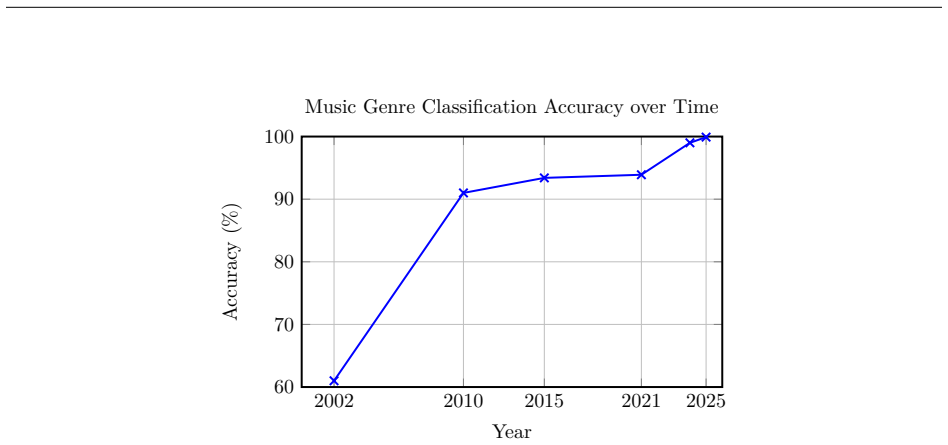
The organizing device is a taxonomy of content-filtering signals for music, covering audio signal analysis, which includes emotion recognition, perceptual features, genre classification, and instrument detection; lyrics analysis; and context awareness, including environmental factors and user demographics. The quantitative spine is a genre classification accuracy progression—61% in 2002, 91% in 2010, 93.4% in 2015, 93.9% in 2021, 99.0% in 2024, and 99.9% in 2025—presented as evidence that content analysis has matured enough to be practical.
What would settle it
Re-run the cited genre classifiers on one shared benchmark, such as GTZAN with identical train/test splits, and compare accuracies; if the spread across years collapses or inverts, the claimed improvement curve is an artifact of protocol differences rather than genuine progress.
Extended reading notes
Core claim
The paper's central claim is that content-based filtering is the practical remedy for the two main failures of collaborative filtering in music: data sparsity and popularity bias. It surveys five content-analysis families—music emotion recognition, perceptual features, genre classification, instrument detection, and lyrics analysis—and argues that each supplies information that interaction data lacks. The review also asserts that these methods increasingly complement each other, and it flags conflicts between them, such as audio and lyrics signals pointing to different moods or genres, as a research problem to be resolved.
Load-bearing premise
The quantitative story of progress in genre classification assumes that accuracy figures from different papers, datasets, class sets, and evaluation protocols can be read as a single improvement curve; if those numbers are not commensurable, the accuracy-over-time evidence is unsupported.
Editorial extensions
If this is right
- Hybrid systems that combine audio and lyrics features should outperform either modality alone, because each captures information the other misses.
- LLM-generated lyrics summaries offer a computationally cheap and copyright-friendly route to adding semantic content to recommenders.
- Context-aware signals such as time, place, mood, and demographics could let recommenders adapt in real time, going beyond static user profiles.
- Better genre and emotion classification should improve cold-start recommendations for new and unpopular tracks.
- Resolving conflicts between audio and lyrical analysis is a precondition for reliable multimodal recommendation.
Reading between the lines
- If the reported accuracy progression is real and transferable, content-only recommenders could largely replace collaborative filtering for new items, shrinking the cold-start problem to a feature-extraction problem.
- A fair test of the review's thesis would be an apples-to-apples benchmark: running the cited classifiers on one dataset under one protocol; the accuracy curve may flatten, which would weaken the improvement-over-time claim without destroying the qualitative survey.
- The review implicitly bets that semantic features such as lyrics and emotion will matter more as LLMs improve; a testable extension is whether LLM-based lyrics summaries beat full-lyrics analysis at equal compute.
- The paper hints that personalization may eventually make genre itself fluid, suggesting recommenders may need per-user genre taxonomies rather than fixed labels.
Editorial analysis
A structured set of objections, weighed in public.
Referee Report
Summary. This paper is a narrative literature review of content-based filtering for music recommendation. It organizes the field into audio signal analysis (music emotion recognition, perceptual features, genre classification, instrument detection), lyrics analysis (including LLM-based approaches), and context awareness (environmental factors and user demographics). The abstract and introduction argue that content filtering can mitigate the sparsity and popularity bias of collaborative filtering, and the conclusion discusses open challenges. No new algorithms or derivations are presented; the body is a survey of cited prior work.
Significance. If accepted, the paper would provide a broad, accessible map of content-based music recommendation, with useful coverage of recent LLM-based lyrics analysis and a sensible hierarchical taxonomy. The authors assemble a large set of relevant references and connect several research strands. However, the quantitative progression in genre classification (Figure 7) is based on non-commensurable benchmarks, and the acousticness-arousal claim in Section 2.2 is not supported by the cited figure. In addition, the central claim that content filtering mitigates collaborative-filtering biases is not directly demonstrated by the surveyed studies, which mostly report classification accuracy rather than recommender-system metrics. These issues are fixable and do not undermine the qualitative survey, but they need attention before publication.
major comments (3)
- [Section 2.3, Figure 7] The accuracy-over-time plot mixes results from heterogeneous benchmarks: Tzanetakis & Cook (2002) reports 10-class GTZAN accuracy, while Panagakis et al. (2010), Dai et al. (2015), Liu et al. (2021), Duan (2024), and Ba et al. (2025) are not stated with respect to the same dataset, class count, or split. Without this information, the monotonic progression from 61% to 99.9% cannot be interpreted as improvement on a common task; near-100% figures may reflect easier benchmarks or different evaluation protocols. The text should either remove Figure 7, restrict the comparison to results on the same evaluation setup, or explicitly report dataset, class count, and split for each milestone and add a commensurability caveat.
- [Section 2.2, Section 2.4] The claim that 'acousticness has a strong negative correlation with arousal' (Section 2.2) and its reuse in Section 2.4 to motivate instrument detection are not supported by Figure 6, which displays only feature weights from Panda et al. (2021) on the arousal-valence discrimination task. No correlation analysis or arousal-axis mapping is shown. Please cite the specific analysis from Panda et al. that supports this correlation, or remove or qualify the claim.
- [Abstract, Sections 1 and 5] The abstract and introduction assert that content filtering mitigates the sparsity and popularity bias of collaborative filtering, but the body reviews classification methods rather than recommendation-system evaluations that compare content-based, collaborative, and hybrid approaches on sparsity or long-tail metrics. Section 5 itself states that cold-start scenarios remain a challenge. The authors should either add evidence from studies that directly measure recommendation quality with content filtering or reframe the claim as a potential benefit rather than an established finding.
minor comments (6)
- [Throughout] There are numerous typos and formatting errors, including 'T erence Zeng', 'audio extracts' in Section 1, missing spaces in the abstract, and 'mainstream users' in Section 4.2 (which should likely be 'mainstream music'). Please copyedit carefully.
- [Figure 7] The y-axis starts at 60 rather than 0, which visually exaggerates the differences among accuracy values. Either start the axis at 0 or add an explicit axis break.
- [Section 2.3] Each accuracy number should be accompanied by the dataset and the number of classes; currently only GTZAN is identified for Tzanetakis & Cook (2002). Without this, readers cannot assess the reported improvements.
- [Figure 2] The taxonomy uses 'misc' as an entry for the citations Xu et al. (2021) and Napier & Shamir (2018). Expand this label to something informative, such as 'lyrics sentiment analysis', or remove the 'misc' label and place the citations under a more specific category.
- [Section 4.1] The caption for Figure 8 should clarify that this is a patent illustration and that citing a patent does not imply the system is deployed. The current wording may mislead readers into thinking this is a commercial feature.
- [References] Pastukhov (2022) is a non-peer-reviewed blog post; if possible, replace it with a peer-reviewed source describing Spotify's perceptual features, or clearly mark it as an industry source.
Circularity Check
No circularity: this is a literature review with no fitted parameters, no derivation chain, and no load-bearing self-citations.
full rationale
This paper is a review of content-filtering methods for music recommendation. It does not present a derivation, fit parameters, or make predictions from a model. The central claim that content filtering can help mitigate collaborative filtering's sparsity and popularity bias is supported by surveying external studies, not by any internal calculation that reduces to its inputs. There are no self-citations to the authors' own prior work, and the few citations to commercial or patent sources are descriptive rather than load-bearing. The only quantitative synthesis is Figure 7, which plots genre-classification accuracy milestones from different papers (Tzanetakis & Cook 2002, Panagakis 2010, Dai 2015, Liu 2021, Duan 2024, Ba 2025). Those accuracies come from different datasets, class sets, and evaluation protocols, so the apparent monotonic improvement may be an artifact of benchmark choice rather than a true trend. However, that is a question of commensurability and evidentiary quality, not circularity: the review does not define its conclusion in terms of these numbers, nor does it fit a parameter and then rename the fit as a prediction. The figure's own caption limits it to 'milestones mentioned in the text above' and disclaims completeness, and the qualitative survey would stand even if the accuracy curve were removed. Therefore no circular step is exhibited, and the appropriate score is 0.
Assumptions & free parameters
assumptions (2)
- domain assumption The cited genre classification accuracies are comparable across papers and can be plotted as one progression.
- domain assumption Feature weights from the Spotify API can support a claim about acousticness and arousal correlation.
Cite this review
Pith. "Pith review of Content filtering methods for music recommendation: A review." pith.science (2026). https://pith.science/paper/RU3ZA5FC
@misc{pith2026250702282,
  author       = {Pith},
  title        = {Pith review of: Content filtering methods for music recommendation: A review},
  year         = {2026},
  howpublished = {\url{https://pith.science/paper/RU3ZA5FC}},
  note         = {Machine review of arXiv:2507.02282}
}
read the original abstract
Recommendation systems have become essential in modern music streaming platforms, shaping how users discover and engage with songs. One common approach in recommendation systems is collaborative filtering, which suggests content based on the preferences of users with similar listening patterns to the target user. However, this method is less effective on media where interactions are sparse. Music is one such medium, since the average user of a music streaming service will never listen to the vast majority of tracks. Due to this sparsity, there are several challenges that have to be addressed with other methods. This review examines the current state of research in addressing these challenges, with an emphasis on the role of content filtering in mitigating biases inherent in collaborative filtering approaches. We explore various methods of song classification for content filtering, including lyrical analysis using Large Language Models (LLMs) and audio signal processing techniques. Additionally, we discuss the potential conflicts between these different analysis methods and propose avenues for resolving such discrepancies.
Figures
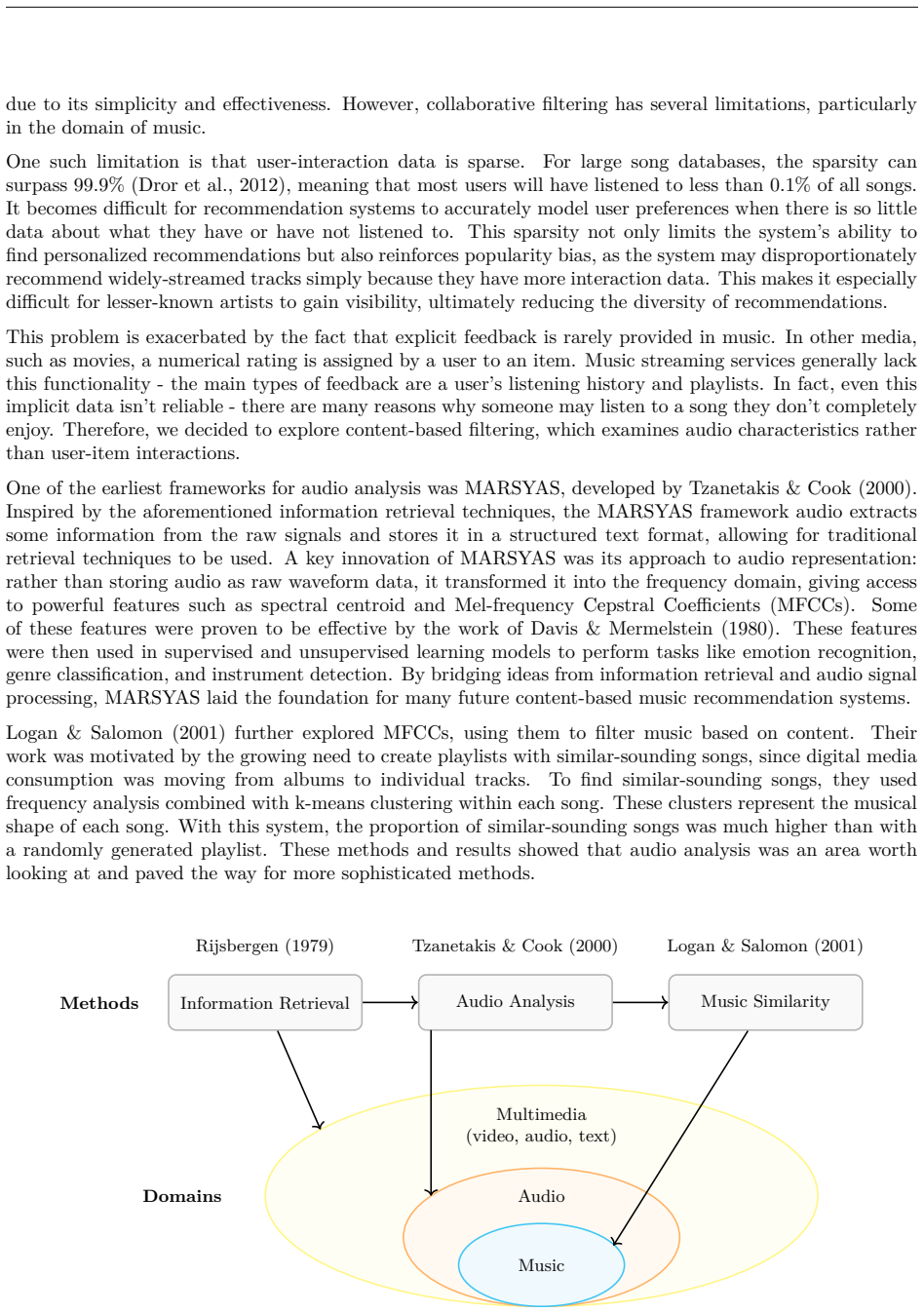


Figures from the paper (5 more)




Reference graph
Works this paper leans on
-
[3]
Comparison of features for musical instrument recognition
Antti Eronen. Comparison of features for musical instrument recognition. InProceedings of the 2001 IEEE Workshop on the Applications of Signal Processing to Audio and Acoustics (Cat. No. 01TH8575), pp. 19–22. IEEE,
work page 2001
-
[5]
doi: 10.1016/j.ipm.2020.102409. Stéphane Hulaud. Identification of taste attributes from an audio signal.https://patents.google.com/ patent/US10891948B2/en,
-
[6]
Ja-Young Kim and Nicholas J Belkin
URLhttps://arxiv.org/abs/2502.03979. Ja-Young Kim and Nicholas J Belkin. Categories of music description and search terms and phrases used by non-music experts. InISMIR, volume 2, pp. 209–214,
-
[12]
Insidespotify’srecommender system: Acomplete guideto spotify recommendation algorithms
D Pastukhov. Insidespotify’srecommender system: Acomplete guideto spotify recommendation algorithms. Music Tomorrow. Preuzeto, 9:2024,
work page 2024
-
[17]
Chatmusician: Understanding and generating music intrinsically with llm
Ruibin Yuan, Hanfeng Lin, Yi Wang, Zeyue Tian, Shangda Wu, Tianhao Shen, Ge Zhang, Yuhang Wu, Cong Liu, Ziya Zhou, et al. Chatmusician: Understanding and generating music intrinsically with llm. arXiv preprint arXiv:2402.16153,
-
[18]
Interpreting Song Lyrics with an Audio-Informed Pre-trained Language Model
Yixiao Zhang, Junyan Jiang, Gus Xia, and Simon Dixon. Interpreting song lyrics with an audio-informed pre-trained language model.arXiv preprint arXiv:2208.11671,
-
[1980]
Joint sentiment analysis of lyrics and audio in music
Lea Schaab and Anna Kruspe. Joint sentiment analysis of lyrics and audio in music. arXiv preprint arXiv:2405.01988,
-
[2000]
George Tzanetakis and Perry Cook
doi: 10.1017/S1355771800003071. George Tzanetakis and Perry Cook. Musical genre classification of audio signals.IEEE Transactions on speech and audio processing, 10(5):293–302,
Show all 18 references
-
[2001]
Beth Logan, Andrew Kositsky, and Pedro Moreno
doi: 10.1109/ICME.2001.1237829. Beth Logan, Andrew Kositsky, and Pedro Moreno. Semantic analysis of song lyrics. In2004 IEEE Interna- tional Conference on Multimedia and Expo (ICME)(IEEE Cat. No. 04TH8763), volume 2, pp. 827–830. IEEE,
2001
-
[2003]
Caifeng Liu, Lin Feng, Guochao Liu, Huibing Wang, and Shenglan Liu
doi: 10.1109/MIC.2003.1167344. Caifeng Liu, Lin Feng, Guochao Liu, Huibing Wang, and Shenglan Liu. Bottom-up broadcast neural network for music genre classification.Multimedia Tools and Applications, 80:7313–7331,
2003 arXiv
-
[2010]
12 Renato Panda, Hugo Redinho, Carolina Gonçalves, Ricardo Malheiro, and Rui Pedro Paiva
doi: 10.1109/TASL.2009.2036813. 12 Renato Panda, Hugo Redinho, Carolina Gonçalves, Ricardo Malheiro, and Rui Pedro Paiva. How does the spotify api compare to the music emotion recognition state-of-the-art?, 07
2009
-
[2014]
James A Russell
doi: 10.1109/TAFFC.2014.2343222. James A Russell. A circumplex model of affect.Journal of personality and social psychology, 39(6):1161,
2014
-
[2019]
URL https://doi.org/10.1080/15213269.2018.1507827
doi: 10.1080/15213269.2018.1507827. URL https://doi.org/10.1080/15213269.2018.1507827. Thomas Krismayer, Markus Schedl, Peter Knees, and Rick Rabiser. Predicting user demographics from music listening information.Multimedia Tools and Applications, 78(3):2897–2920,
2018
-
[2020]
Giving voice to silent data: Designing with per- sonal music listening history
Jordan Wirfs-Brock, Sarah Mennicken, and Jennifer Thom. Giving voice to silent data: Designing with per- sonal music listening history. InProceedings of the 2020 CHI Conference on Human Factors in Computing Systems, pp. 1–11,
2020
-
[2021]
doi: 10.1109/MSP.2021. 3106232. Xingye Hao, Honghe Li, and Yonggang Wen. Real-time music emotion recognition based on multimodal fusion. Alexandria Engineering Journal, 116:586–600,
2021 doi
-
[2022]
Kathleen Napier and Lior Shamir
URLhttps://arxiv.org/abs/2212.04782. Kathleen Napier and Lior Shamir. Quantitative sentiment analysis of lyrics in popular music.Journal of Popular Music Studies, 30(4):161–176,
-
[2024]
Gideon Dror, Noam Koenigstein, Yehuda Koren, and Markus Weimer
URL https://arxiv.org/abs/2402.17645. Gideon Dror, Noam Koenigstein, Yehuda Koren, and Markus Weimer. The yahoo! music dataset and kdd-cup’11. In Gideon Dror, Yehuda Koren, and Markus Weimer (eds.),Proceedings of KDD Cup 2011, volume 18 ofProceedings of Machine Learning Resear...
2011 arXiv
-
[2025]
doi: https:// doi.org/10.1016/j.entcom.2025.100929
ISSN 1875-9521. doi: https:// doi.org/10.1016/j.entcom.2025.100929. URL https://www.sciencedirect.com/science/article/pii/ S1875952125000096. R Bhagyalakshmi and MB Anandaraju. Machine learning approaches for musical instrument recognition us- ing distinctive audio features. I...
2025
Reviewed August 6, 2026 · model on record in the stance chip above.
Discussion (0). Sign in to comment.