REVIEW 2 major objections 6 minor 2 cited by
Quantum Mpemba Effects from Symmetry Perspectives
T0 review · 2 major / 6 minor · reviewed 2026-08-06 · deepseek-v4-flash
Pith's one-line read The quantum Mpemba effect in closed systems is governed by unequal thermalization rates of symmetry sectors, with the entanglement-asymmetry version appearing under symmetric evolution and the charge-variance version only under…
desk verdict A solid review of the QME organized around symmetry sectors, but the paper's only new analytic claim—the small-time charge-variance expansion—is unproven and needs to be nailed down. read the letter →
The pith
A machine-rendered reading of the paper's core claim, the machinery that carries it, and where it could break.
The reading
What carries the argument
The central objects are the entanglement asymmetry, defined as the difference between the Rényi entropy of the symmetry-projected reduced density matrix and that of the original reduced density matrix, and the charge variance, defined as the spread of charge over symmetry sectors. The argument is carried by the unequal thermalization rates of different charge sectors: a subsystem sector with larger Hilbert-space dimension equilibrates faster, so the initial overlap with slow sectors controls how quickly symmetry is restored. For the charge-variance version, the load-bearing identity is the second-order small-time expansion with coefficient obtained from the equation of motion, whose sign changes with tilt angle and produces the concave-versus-convex behavior behind the early-time crossing.
What would settle it
Compute the exact charge-variance dynamics of a tilted ferromagnetic state under the anisotropic Hamiltonian at gamma=0.7 without truncating at second order, and check whether the curves for theta=0.2 pi and theta=0.5 pi cross near t=2 exactly as the expansion predicts; if the crossing disappears, shifts in time, or higher-order terms dominate before the crossing, the concave-versus-convex mechanism is refuted. A second check is to run the same initial states under the symmetric Hamiltonian gamma=1, where the review predicts no charge-variance QME, so observing a crossing there would falsify the claimed separation between the two versions.
Extended reading notes
Core claim
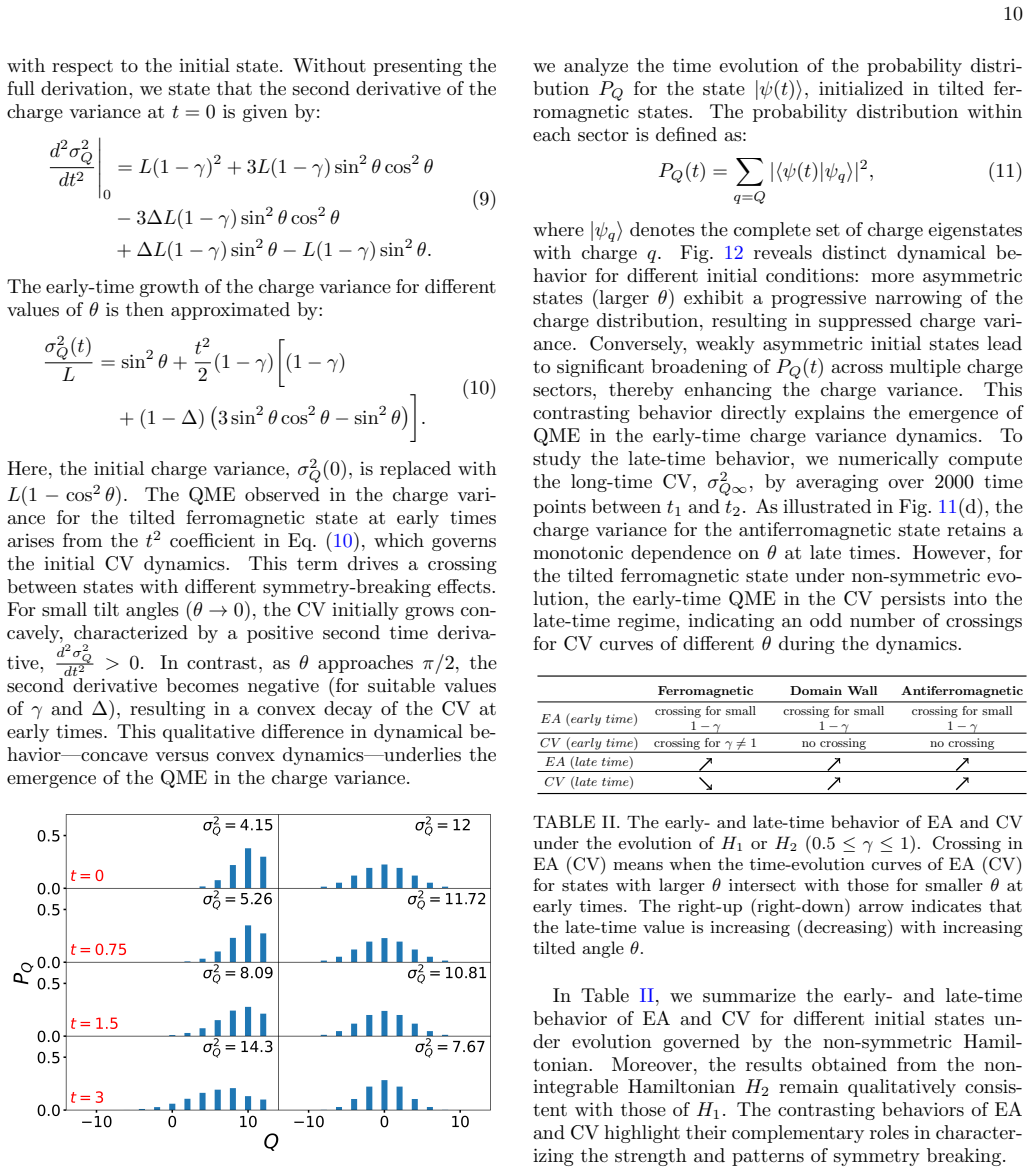
For closed quantum systems quenched from U(1)-asymmetric initial states, the question that decides whether the quantum Mpemba effect occurs is which symmetry sectors the initial state populates and how fast each sector thermalizes. Under U(1)-symmetric random circuits or Hamiltonians, the entanglement asymmetry decays faster for more asymmetric states because those states have larger overlap with high-dimensional sectors that thermalize quickly, while mildly tilted states remain pinned by slow sectors such as the Q_A=0 sector. Under Hamiltonians with anisotropy that breaks U(1), symmetry breaking persists in the steady state, and the charge variance instead develops early-time crossings: weakly tilted ferromagnetic states show concave growth while strongly tilted states show convex decay, an effect traced through the second-order time expansion of the variance. The two probes, entanglement asymmetry and charge variance, thus capture different manifestations of the same underlying symmetry-sector dynamics.
Load-bearing premise
The explanation of the charge-variance QME assumes that the second-order Taylor expansion of the charge variance remains valid up to the crossing time around t=2, and the review does not establish the expansion's radius of convergence or verify it against the full dynamics at the crossing.
Editorial extensions
If this is right
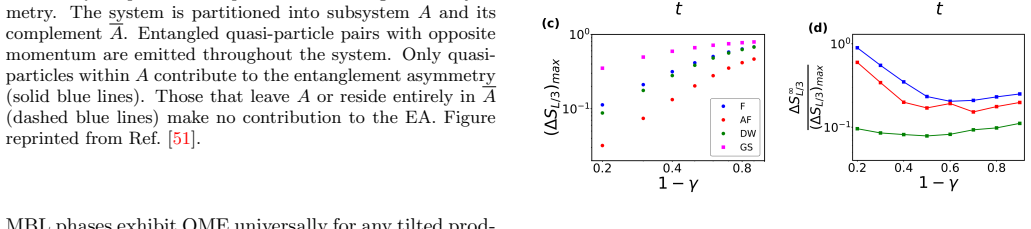
- Under U(1)-symmetric random circuits, early-time entanglement-asymmetry dynamics produce crossings for tilted ferromagnetic and tilted domain-wall states but not for tilted antiferromagnetic states.
- The entanglement-asymmetry version of the quantum Mpemba effect persists under weak symmetry-breaking perturbations, with a threshold that depends on the initial state: about gamma>=0.8 for ferromagnetic states and gamma>=0.4 for antiferromagnetic states in the studied Hamiltonian.
- The charge-variance version appears only under non-symmetric Hamiltonian dynamics, and for tilted ferromagnetic states the early-time crossing persists to late times, implying an odd number of crossings over the full time evolution.
- Late-time entanglement asymmetry vanishes under symmetric evolution in chaotic systems and in random circuits, but remains nonzero for integrable systems described by a generalized Gibbs ensemble and for symmetry-breaking Hamiltonians.
- In many-body-localized systems the quantum Mpemba effect occurs universally for tilted product states, with the QME timescale growing exponentially with subsystem size and full subsystem symmetry restoration occurring without thermalization.
Reading between the lines
- This reader's inference: because which probe shows a crossing depends on whether the dynamics preserves the symmetry, reports of the quantum Mpemba effect should always specify the observable and the symmetry-sector structure; apparent contradictions between experiments or numerics may simply reflect different probes.
- This reader's inference: the sector-thermalization-rate mechanism suggests a practical tuning knob, namely preparing initial states with controlled overlap onto slow sectors to engineer or suppress crossings, which could be tested directly in the small 12-site Hamiltonian used here.
- This reader's inference: the second-order coefficient criterion for charge variance should be testable for other symmetry groups, such as Z2 or SU(2), and other drive protocols such as Floquet evolution, by checking whether the sign of the t^2 coefficient consistently predicts the presence of an early-time crossing.
Editorial analysis
A structured set of objections, weighed in public.
Referee Report
Summary. This manuscript reviews the quantum Mpemba effect (QME) in closed quantum many-body systems from the perspective of symmetry breaking and restoration. It introduces entanglement asymmetry (EA) and charge variance (CV) as diagnostics, summarizes their early- and late-time dynamics under random unitary circuits and Hamiltonian evolution, and covers integrable, chaotic, and many-body-localized regimes. The paper's central synthetic claim, stated in Section V, is that the EA version of the QME arises under symmetric evolution and remains robust against weak symmetry-breaking perturbations, whereas the CV version emerges only in non-symmetric Hamiltonian dynamics. To support the CV half of this claim, the paper presents a small-time expansion of the charge variance, Eq. (10), whose t^2 coefficient is argued to control the early-time crossing in Fig. 11(a).
Significance. If the classification in Section V is correct, the paper offers a useful organizing principle: the QME is not a single anomaly but a family of observable-dependent effects tied to the sector structure and the symmetry properties of the dynamics. The review is comprehensive, and the tabular summaries in Tables I and II are helpful for navigating the literature. The paper consolidates several peer-reviewed results and clearly separates the EA and CV diagnostics. However, the only new analytic content, Eqs. (9)-(10), is presented without derivation or numerical validation, and it is load-bearing for the CV half of the central claim. The paper also lacks error estimates on power-law fits and leaves part of Table II unreadable. These issues are fixable and do not undermine the review portions that summarize prior work.
major comments (2)
- [Section IV.B, Eqs. (9)-(10)] Equation (9) is introduced with the phrase "Without presenting the full derivation," and no citation or numerical verification is provided. This equation is the only analytic support for the claim that the CV-QME is controlled by the sign of the t^2 coefficient in Eq. (10), so it is load-bearing. Please give the full derivation, explicitly stating the boundary conditions used for H1 at L=12 (Eq. (6) distinguishes open and periodic boundary conditions), and validate Eq. (10) against exact dynamics. The crossing in Fig. 11(a) occurs near t=2, and for the displayed parameters the t^2 term changes sigma_Q^2/L by approximately +0.3 for theta=0.2*pi and -0.18 for theta=0.5*pi at t=2, so the O(t^2) truncation must be justified up to the crossing time, e.g., by a radius-of-convergence estimate or by comparing with higher-order terms and the full evolution.
- [Section V, first paragraph; Section III.C] The central dichotomy states that the charge-variance version of the QME "emerges only in non-symmetric Hamiltonian dynamics." However, CV dynamics are not reported for U(1)-symmetric Hamiltonian evolution: Section III.C studies EA only, and the circuit results of Section III.B are not Hamiltonian dynamics. Because Eq. (10) contains a factor (1-gamma), its t^2 term vanishes at gamma=1, but that does not exclude a crossing generated by higher-order terms or by other initial states. Please add explicit exact CV dynamics for a symmetric Hamiltonian (e.g., H1 with gamma=1), or qualify the claim to the specific models and parameter ranges studied.
minor comments (6)
- [Table II] The rows "EA(late time)" and "CV(late time)" in Table II appear empty in the rendered text, and the arrows mentioned in the caption are missing; please complete the table so the late-time summary is readable.
- [Section III.B, Fig. 4(b)] The power-law fits y = a x^b are reported without error bars, fit ranges, or goodness-of-fit measures, and the text immediately notes that the scaling holds only for P_Haar < 0.1; please specify the fitting range and report uncertainties on a and b.
- [Section III.A, Fig. 3] Panels (a) and (b) use different system sizes (N=16 and N=8), so the comparison of QME presence and absence couples the symmetry-sector structure with the system size; please state whether the conclusions are robust at matched sizes.
- [Section II, Eq. (3)] The sentence explaining the ordering of the two layers in Eq. (3) is confusing ("the second (first) bracket represents the operations applied in the first (second) layer"); please rephrase so the time-ordering of the brick-wall layers is unambiguous.
- [Section IV.B] The parameters t1 and t2 used for long-time averaging (e.g., t1=2000 and t2=40000 in Fig. 9) are not defined; please specify their meaning and whether they use the same time units as the plotted axes.
- [Throughout] There are several typographical issues, including "F erromagnetic" in Table II and inconsistent rendering of accented characters such as "R'enyi"; a careful proofread is needed.
Circularity Check
No definitional circularity: the Eq. (10) expansion is an analytic, falsifiable short-time expansion independent of the CV-QME crossing it explains; remaining caveats are a review-typical self-citation burden and an asserted, unverified O(t^2) truncation at t≈2.
full rationale
No load-bearing circular step is present. The CV-QME mechanism is not circular: Eqs. (7)-(10) are presented as a Heisenberg-equation expansion, and the t^2 coefficient in Eq. (10) changes sign between θ=0.2π and θ=0.5π for the stated parameters (γ=0.7, Δ=0.4), predicting a crossing near t≈2.3 consistent with the observed crossing at t≈2 in Fig. 11(a); the expansion is therefore independent of, and falsifiable against, the numerics, not a fit renamed as an explanation. The explicit admission 'Without presenting the full derivation' (Section IV.B, between Eqs. (8) and (9)) is an omitted-proof transparency gap rather than a circular step, and the unverified validity of the O(t^2) truncation at the crossing time is a correctness risk, not a circularity, per the rule that unverified expansions are not definitional reductions. The heavy self-citation (Refs [53, 70, 76], plus [71, 72, 97, 125]) is genre-appropriate for a review: Figs. 3, 5, and 9-12 reproduce the key data in-text, so the Section V dichotomy (EA-QME under symmetric evolution, CV-QME only under non-symmetric Hamiltonian dynamics) does not reduce to 'trust the authors' earlier papers'; the EA branch is independently corroborated by Refs [52, 67, 80], and the CV branch rests on an independent commutator evaluation rather than on the same crossing data. The QME definition in Section II is a standard crossing criterion and EA and CV are independent observables, so no quantity is defined in terms of the claim it supports, and no uniqueness theorem or ansatz is imported from the authors' prior work. A minor wording slip ('grows concavely, characterized by a positive second time derivative' is convex growth) does not affect the sign-based argument. Overall, the score of 2 reflects only the self-citation burden and the asserted, underived form of Eq. (9), not any circular reduction.
Assumptions & free parameters
free parameters (1)
- Power-law exponents a, b for EA-peak scaling =
F: a=1.4, b=0.4; DW: a=2.7, b=0.8; AF: a=1.9, b=0.9
assumptions (4)
- domain assumption For chaotic Hamiltonians, small subsystems thermalize to a thermal state rho_A proportional to exp(-beta H_A), so symmetry restoration requires [Q_A, H_A] = 0.
- domain assumption Integrable systems relax to a generalized Gibbs ensemble, and quasiparticle pairs emitted from the quench carry the symmetry-breaking correlations.
- domain assumption In random circuits with subsystem size at most half the system size, the circuit-averaged reduced state of any subsystem becomes fully mixed at late times.
- ad hoc to paper The small-time expansion of sigma_Q^2(t) truncated at O(t^2), Eq. (10), is valid at the crossing times where the charge-variance QME is observed.
Cite this review
Pith. "Pith review of Quantum Mpemba Effects from Symmetry Perspectives." pith.science (2026). https://pith.science/paper/2QILCQ55
@misc{pith2026250702301,
  author       = {Pith},
  title        = {Pith review of: Quantum Mpemba Effects from Symmetry Perspectives},
  year         = {2026},
  howpublished = {\url{https://pith.science/paper/2QILCQ55}},
  note         = {Machine review of arXiv:2507.02301}
}
read the original abstract
Non-equilibrium dynamics have become a central research focus, exemplified by the counterintuitive Mpemba effect where initially hotter systems can cool faster than colder ones. Studied extensively in both classical and quantum regimes, this phenomenon reveals diverse and complex behaviors across different systems. This review provides a concise overview of the quantum Mpemba effect (QME), specifically emphasizing its connection to symmetry breaking and restoration in closed quantum many-body systems. We begin by outlining the classical Mpemba effect and its quantum counterparts, summarizing key findings. Subsequently, we introduce entanglement asymmetry and charge variance as key metrics for probing the QME from symmetry perspectives. Leveraging these tools, we analyze the early- and late-time dynamics of these quantities under Hamiltonian evolution and random unitary circuits. We conclude by discussing significant challenges and promising avenues for future research.
Figures


Figures from the paper (7 more)



Forward citations
Cited by 2 Pith papers
-
Anomalous Decay of Quantum Resources: The Entanglement Sudden Death Mpemba Effect
More strongly entangled two-qubit states can reach separability faster than weakly entangled ones under local amplitude damping, forming an ESD Mpemba effect with an exact analytical derivation of crossover time.
-
Anomalous Decay of Quantum Resources: The Entanglement Sudden Death Mpemba Effect
More strongly entangled two-qubit states can lose entanglement faster than weaker ones under local amplitude damping due to excited-state population catalyzing sudden death.
Reference graph
Works this paper leans on
-
[1]
E. B. Mpemba and D. G. Osborne, Cool?, Physics Ed- ucation 4, 172 (1969)
1969
-
[2]
Bacon, Opus majus [great work](rb burke, trans.), New York: Russell & Russell.(Original work written in
R. Bacon, Opus majus [great work](rb burke, trans.), New York: Russell & Russell.(Original work written in
-
[3]
Descartes and L
R. Descartes and L. Liard, Discours de la m´ ethode pour bien conduire sa raison et chercher la v´ erit´ e dans les sciences (Continental-Verlag, 1948)
1948
-
[4]
L. M. Groves, Now it can be told: The story of the Man- hattan Project (Hachette+ ORM, 2009)
2009
-
[5]
H. C. Burridge and P. F. Linden, Questioning the mpemba effect: hot water does not cool more quickly than cold, Scientific Reports 6, 37665 (2016)
2016
-
[6]
H. C. Burridge and O. Hallstadius, Observing the mpemba effect with minimal bias and the value of the mpemba effect to scientific outreach and engage- ment, Proceedings of the Royal Society A476, 20190829 (2020)
2020
-
[7]
Auerbach, Supercooling and the mpemba effect: When hot water freezes quicker than cold, American Journal of Physics 63, 882 (1995)
D. Auerbach, Supercooling and the mpemba effect: When hot water freezes quicker than cold, American Journal of Physics 63, 882 (1995)
1995
-
[8]
Esposito, R
S. Esposito, R. De Risi, and L. Somma, Mpemba effect and phase transitions in the adiabatic cooling of water before freezing, Physica A: Statistical Mechanics and its Applications 387, 757 (2008)
2008
Show all 136 references
-
[9]
Lasanta, F
A. Lasanta, F. Vega Reyes, A. Prados, and A. Santos, When the hotter cools more quickly: Mpemba effect in granular fluids, Physical review letters 119, 148001 (2017)
2017
-
[10]
Y.-H. Ahn, H. Kang, D.-Y. Koh, and H. Lee, Ex- perimental verifications of mpemba-like behaviors of clathrate hydrates, Korean Journal of Chemical Engi- neering 33, 1903 (2016)
2016
-
[11]
P. A. Greaney, G. Lani, G. Cicero, and J. C. Grossman, Mpemba-like behavior in carbon nanotube resonators, Metallurgical and Materials Transactions A 42, 3907 (2011)
2011
-
[12]
Kumar and J
A. Kumar and J. Bechhoefer, Exponentially faster cool- ing in a colloidal system, Nature 584, 64 (2020)
2020
-
[13]
Bechhoefer, A
J. Bechhoefer, A. Kumar, and R. Ch´ etrite, A fresh understanding of the mpemba effect, Nature Reviews Physics 3, 534 (2021)
2021
-
[14]
Lu and O
Z. Lu and O. Raz, Nonequilibrium thermodynamics of the markovian mpemba effect and its inverse, Proceed- ings of the National Academy of Sciences 114, 5083 (2017)
2017
-
[15]
Klich, O
I. Klich, O. Raz, O. Hirschberg, and M. Vucelja, Mpemba index and anomalous relaxation, Physical Re- view X 9, 021060 (2019)
2019
-
[16]
C. Hu, J. Li, S. Huang, H. Li, C. Luo, J. Chen, S. Jiang, and L. An, Conformation directed mpemba effect on polylactide crystallization, Crystal Growth & Design 18, 5757 (2018)
2018
-
[17]
Keller, V
T. Keller, V. Torggler, S. B. J¨ ager, S. Sch¨ utz, H. Ritsch, and G. Morigi, Quenches across the self-organization transition in multimode cavities, New Journal of Physics 20, 025004 (2018)
2018
-
[18]
Holtzman and O
R. Holtzman and O. Raz, Landau theory for the mpemba effect through phase transitions, Communica- tions physics 5, 280 (2022)
2022
-
[19]
Baity-Jesi, E
M. Baity-Jesi, E. Calore, A. Cruz, L. A. Fernandez, J. M. Gil-Narvi´ on, A. Gordillo-Guerrero, D. I˜ niguez, A. Lasanta, A. Maiorano, E. Marinari, et al. , The mpemba effect in spin glasses is a persistent memory effect, Proceedings of the National Academy of Sciences 116, 153...
2019
-
[20]
Kumar, R
A. Kumar, R. Ch´ etrite, and J. Bechhoefer, Anomalous heating in a colloidal system, Proceedings of the Na- tional Academy of Sciences 119, e2118484119 (2022)
2022
-
[21]
Santos, Mpemba meets newton: Exploring the mpemba and kovacs effects in the time-delayed cooling law, Physical Review E 109, 044149 (2024)
A. Santos, Mpemba meets newton: Exploring the mpemba and kovacs effects in the time-delayed cooling law, Physical Review E 109, 044149 (2024)
2024
-
[22]
F. J. Schwarzendahl and H. L¨ owen, Anomalous cooling and overcooling of active colloids, Physical review letters 129, 138002 (2022)
2022
-
[23]
G. Teza, R. Yaacoby, and O. Raz, Relaxation shortcuts through boundary coupling, Physical review letters131, 017101 (2023)
2023
-
[24]
I. G.-A. Pemart ´ ın, E. Momp´ o, A. Lasanta, V. Mart ´ ın- Mayor, and J. Salas, Shortcuts of freely relaxing systems using equilibrium physical observables, Physical Review Letters 132, 117102 (2024)
2024
-
[25]
Gal and O
A. Gal and O. Raz, Precooling strategy allows exponen- tially faster heating, Physical review letters 124, 060602 (2020)
2020
-
[26]
M. R. Walker and M. Vucelja, Mpemba effect in terms of mean first passage time, arXiv preprint arXiv:2212.07496 (2022)
2022 arXiv
-
[27]
M. R. Walker, S. Bera, and M. Vucelja, Optimal trans- port and anomalous thermal relaxations, arXiv preprint arXiv:2307.16103 (2023)
2023 arXiv
-
[28]
S. Bera, M. R. Walker, and M. Vucelja, Effect of dynam- ics on anomalous thermal relaxations and information exchange, arXiv preprint arXiv:2308.04557 (2023)
2023 arXiv
-
[29]
G. Teza, J. Bechhoefer, A. Lasanta, O. Raz, and M. Vucelja, Speedups in nonequilibrium thermal re- laxation: Mpemba and related effects, arXiv preprint arXiv:2502.01758 (2025)
2025
-
[30]
Nava and M
A. Nava and M. Fabrizio, Lindblad dissipative dynamics in the presence of phase coexistence, Physical Review B 100, 125102 (2019)
2019
-
[31]
Carollo, A
F. Carollo, A. Lasanta, and I. Lesanovsky, Exponen- tially accelerated approach to stationarity in marko- vian open quantum systems through the mpemba effect, Physical Review Letters 127, 060401 (2021)
2021
-
[32]
Zhang, G
J. Zhang, G. Xia, C.-W. Wu, T. Chen, Q. Zhang, Y. Xie, W.-B. Su, W. Wu, C.-W. Qiu, P.-X. Chen,et al., Obser- vation of quantum strong mpemba effect, Nature Com- munications 16, 301 (2025)
2025
-
[33]
Moroder, O
M. Moroder, O. Culhane, K. Zawadzki, and J. Goold, Thermodynamics of the quantum mpemba effect, Phys- ical Review Letters 133, 140404 (2024)
2024
-
[34]
Aharony Shapira, Y
S. Aharony Shapira, Y. Shapira, J. Markov, G. Teza, N. Akerman, O. Raz, and R. Ozeri, Inverse mpemba ef- fect demonstrated on a single trapped ion qubit, Phys- ical Review Letters 133, 010403 (2024)
2024
-
[35]
A. K. Chatterjee, S. Takada, and H. Hayakawa, Quan- tum mpemba effect in a quantum dot with reservoirs, Physical Review Letters 131, 080402 (2023)
2023
-
[36]
A. K. Chatterjee, S. Takada, and H. Hayakawa, Mul- tiple quantum mpemba effect: Exceptional points and oscillations, Physical Review A 110, 022213 (2024)
2024
-
[37]
Kochsiek, F
S. Kochsiek, F. Carollo, and I. Lesanovsky, Accelerating the approach of dissipative quantum spin systems to- wards stationarity through global spin rotations, Phys- ical Review A 106, 012207 (2022)
2022
-
[38]
Ivander, N
F. Ivander, N. Anto-Sztrikacs, and D. Segal, Hyperac- celeration of quantum thermalization dynamics by by- passing long-lived coherences: An analytical treatment, Physical Review E 108, 014130 (2023)
2023
-
[39]
Wang and J
X. Wang and J. Wang, Mpemba effects in nonequilib- rium open quantum systems, Physical Review Research 6, 033330 (2024). 13
2024
-
[40]
Longhi, Photonic mpemba effect, Optics Letters 49, 5188 (2024)
S. Longhi, Photonic mpemba effect, Optics Letters 49, 5188 (2024)
2024
-
[41]
Longhi, Bosonic mpemba effect with non-classical states of light, APL Quantum 1 (2024)
S. Longhi, Bosonic mpemba effect with non-classical states of light, APL Quantum 1 (2024)
2024
-
[42]
D. Liu, J. Yuan, H. Ruan, Y. Xu, S. Luo, J. He, X. He, Y. Ma, and J. Wang, Speeding up quantum heat engines by the mpemba effect, Physical Review A 110, 042218 (2024)
2024
-
[43]
Boubakour, S
M. Boubakour, S. Endo, T. Fogarty, and T. Busch, Dynamical invariant based shortcut to equilibration in open quantum systems, Quantum Science and Technol- ogy 10, 025036 (2025)
2025
-
[44]
Furtado and A
J. Furtado and A. C. Santos, Strong quantum mpemba effect with squeezed thermal reservoirs, arXiv preprint arXiv:2411.04545 (2024)
2024 arXiv
-
[45]
D. Qian, H. Wang, and J. Wang, Intrinsic quantum mpemba effect in markovian systems and quantum cir- cuits, arXiv preprint arXiv:2411.18417 (2024)
2024
-
[46]
J. Dong, H. Mu, M. Qin, and H. Cui, Quantum mpemba effect of localization in the dissipative mosaic model, Physical Review A 111, 022215 (2025)
2025
-
[47]
X. Wang, J. Su, and J. Wang, Mpemba meets quantum chaos: Anomalous relaxation and mpemba crossings in dissipative sachdev-ye-kitaev models, arXiv preprint arXiv:2410.06669 (2024)
2024
-
[48]
Kheirandish, N
F. Kheirandish, N. Cheraghpour, and A. Moradian, The mpemba effect in quantum oscillating and two-level sys- tems, arXiv preprint arXiv:2412.03943 (2024)
2024 arXiv
-
[49]
D. J. Strachan, A. Purkayastha, and S. R. Clark, Non-markovian quantum mpemba effect, arXiv preprint arXiv:2402.05756 (2024)
2024
-
[50]
Z.-M. Wang, S. Wu, M. S. Byrd, and L.-A. Wu, Go- ing beyond quantum markovianity and back to real- ity: An exact master equation study, arXiv preprint arXiv:2411.17197 (2024)
2024 arXiv
-
[51]
F. Ares, P. Calabrese, and S. Murciano, The quan- tum mpemba effects, arXiv preprint arXiv:2502.08087 (2025)
2025 arXiv
-
[52]
F. Ares, S. Murciano, and P. Calabrese, Entanglement asymmetry as a probe of symmetry breaking, Nature Communications 14, 2036 (2023)
2023
-
[53]
Liu, H.-K
S. Liu, H.-K. Zhang, S. Yin, and S.-X. Zhang, Symmetry restoration and quantum mpemba effect in symmetric random circuits, Physical Review Letters 133, 140405 (2024)
2024
-
[54]
Turkeshi, P
X. Turkeshi, P. Calabrese, and A. De Luca, Quan- tum mpemba effect in random circuits, arXiv preprint arXiv:2405.14514 (2024)
2024 arXiv
-
[55]
Fagotti, M
M. Fagotti, M. Collura, F. H. Essler, and P. Calabrese, Relaxation after quantum quenches in the spin-1 2 heisenberg xxz chain, Physical Review B 89, 125101 (2014)
2014
-
[56]
F. H. Essler and M. Fagotti, Quench dynamics and relaxation in isolated integrable quantum spin chains, Journal of Statistical Mechanics: Theory and Experi- ment 2016, 064002 (2016)
2016
-
[57]
Doyon, Lecture notes on generalised hydrodynamics, SciPost Physics Lecture Notes , 018 (2020)
B. Doyon, Lecture notes on generalised hydrodynamics, SciPost Physics Lecture Notes , 018 (2020)
2020
-
[58]
Fagotti, On conservation laws, relaxation and pre- relaxation after a quantum quench, Journal of Statisti- cal Mechanics: Theory and Experiment 2014, P03016 (2014)
M. Fagotti, On conservation laws, relaxation and pre- relaxation after a quantum quench, Journal of Statisti- cal Mechanics: Theory and Experiment 2014, P03016 (2014)
2014
-
[59]
Bertini and M
B. Bertini and M. Fagotti, Pre-relaxation in weakly in- teracting models, Journal of Statistical Mechanics: The- ory and Experiment 2015, P07012 (2015)
2015
-
[60]
Vidmar and M
L. Vidmar and M. Rigol, Generalized gibbs ensemble in integrable lattice models, Journal of Statistical Mechan- ics: Theory and Experiment 2016, 064007 (2016)
2016
-
[61]
V. Alba, B. Bertini, M. Fagotti, L. Piroli, and P. Rug- giero, Generalized-hydrodynamic approach to inho- mogeneous quenches: correlations, entanglement and quantum effects, Journal of Statistical Mechanics: The- ory and Experiment 2021, 114004 (2021)
2021
-
[62]
Calabrese, F
P. Calabrese, F. Essler, and G. Mussardo, Quantum in- tegrability in out-of-equilibrium systems, special issue, J. Stat. Mech 2016, 064001 (2016)
2016
-
[63]
Polkovnikov, K
A. Polkovnikov, K. Sengupta, A. Silva, and M. Ven- galatorre, Nonequilibrium dynamics of closed interact- ing quantum systems, 2011 rev, Mod. Phys 83, 5
2011
-
[64]
Bastianello, B
A. Bastianello, B. Bertini, B. Doyon, and R. Vasseur, Introduction to the special issue on emergent hydro- dynamics in integrable many-body systems, Journal of Statistical Mechanics: Theory and Experiment 2022, 014001 (2022)
2022
-
[65]
F. Ares, S. Murciano, E. Vernier, and P. Calabrese, Lack of symmetry restoration after a quantum quench: an entanglement asymmetry study, SciPost Physics15, 089 (2023)
2023
-
[66]
B. J. Khor, D. K¨ urk¸ c¨ uoglu, T. Hobbs, G. Perdue, and I. Klich, Confinement and kink entanglement asymme- try on a quantum ising chain, Quantum 8, 1462 (2024)
2024
-
[67]
Rylands, E
C. Rylands, E. Vernier, and P. Calabrese, Dynamical symmetry restoration in the heisenberg spin chain, Jour- nal of Statistical Mechanics: Theory and Experiment 2024, 123102 (2024)
2024
-
[68]
Murciano, F
S. Murciano, F. Ares, I. Klich, and P. Calabrese, Entan- glement asymmetry and quantum mpemba effect in the xy spin chain, Journal of Statistical Mechanics: Theory and Experiment 2024, 013103 (2024)
2024
-
[69]
Ferro, F
F. Ferro, F. Ares, and P. Calabrese, Non-equilibrium en- tanglement asymmetry for discrete groups: the example of the xy spin chain, Journal of Statistical Mechanics: Theory and Experiment 2024, 023101 (2024)
2024
-
[70]
Liu, H.-K
S. Liu, H.-K. Zhang, S. Yin, S.-X. Zhang, and H. Yao, Quantum mpemba effects in many-body localization systems, arXiv preprint arXiv:2408.07750 (2024)
2024
-
[71]
Chang, S
W.-X. Chang, S. Yin, S.-X. Zhang, and Z.-X. Li, Imaginary-time mpemba effect in quantum many-body systems, arXiv preprint arXiv:2409.06547 (2024)
2024
-
[72]
S. Guo, S. Yin, S.-X. Zhang, and Z.-X. Li, Skin effect in- duced anomalous dynamics from charge-fluctuating ini- tial states, arXiv preprint arXiv:2504.21631 (2025)
2025
-
[73]
F. Ares, S. Murciano, P. Calabrese, and L. Piroli, En- tanglement asymmetry dynamics in random quantum circuits, arXiv preprint arXiv:2501.12459 (2025)
2025 arXiv
-
[74]
Klobas, C
K. Klobas, C. Rylands, and B. Bertini, Translation symmetry restoration under random unitary dynamics, arXiv preprint arXiv:2406.04296 (2024)
2024 arXiv
-
[75]
Di Giulio, X
G. Di Giulio, X. Turkeshi, and S. Murciano, Measurement-induced symmetry restoration and quan- tum mpemba effect, Entropy 27, 407 (2025)
2025
-
[76]
Yu, Z.-X
H. Yu, Z.-X. Li, and S.-X. Zhang, Symmetry break- ing dynamics in quantum many-body systems, arXiv preprint arXiv:2501.13459 (2025)
2025
-
[77]
Y. Yu, T. Jin, K. Xu, and H. Fan, Tuning the quan- tum mpemba effect in isolated system by initial state engineering, arXiv preprint arXiv:2505.02040 (2025). 14
2025
-
[78]
Yamashika, F
S. Yamashika, F. Ares, and P. Calabrese, Entangle- ment asymmetry and quantum mpemba effect in two- dimensional free-fermion systems, Physical Review B 110, 085126 (2024)
2024
-
[79]
Yamashika, P
S. Yamashika, P. Calabrese, and F. Ares, Quenching from superfluid to free bosons in two dimensions: En- tanglement, symmetries, and the quantum mpemba ef- fect, Physical Review A 111, 043304 (2025)
2025
-
[80]
Rylands, K
C. Rylands, K. Klobas, F. Ares, P. Calabrese, S. Mur- ciano, and B. Bertini, Microscopic origin of the quantum mpemba effect in integrable systems, Physical Review Letters 133, 010401 (2024)
2024
-
[81]
L. K. Joshi, J. Franke, A. Rath, F. Ares, S. Murciano, F. Kranzl, R. Blatt, P. Zoller, B. Vermersch, P. Cal- abrese, et al. , Observing the quantum mpemba effect in quantum simulations, Physical Review Letters 133, 010402 (2024)
2024
-
[82]
Capizzi and V
L. Capizzi and V. Vitale, A universal formula for the en- tanglement asymmetry of matrix product states, Jour- nal of Physics A: Mathematical and Theoretical 57, 45LT01 (2024)
2024
-
[83]
Chen and H.-H
M. Chen and H.-H. Chen, R´ enyi entanglement asym- metry in (1+ 1)-dimensional conformal field theories, Physical Review D 109, 065009 (2024)
2024
-
[84]
Capizzi and M
L. Capizzi and M. Mazzoni, Entanglement asymmetry in the ordered phase of many-body systems: the ising field theory, Journal of High Energy Physics 2023, 1 (2023)
2023
-
[85]
L. A. Lessa, R. Ma, J.-H. Zhang, Z. Bi, M. Cheng, and C. Wang, Strong-to-weak spontaneous symmetry break- ing in mixed quantum states, PRX Quantum 6, 010344 (2025)
2025
-
[86]
P. Sala, S. Gopalakrishnan, M. Oshikawa, and Y. You, Spontaneous strong symmetry breaking in open sys- tems: Purification perspective, Physical Review B 110, 155150 (2024)
2024
-
[87]
Huang, R
H.-Y. Huang, R. Kueng, and J. Preskill, Predicting many properties of a quantum system from very few measurements, Nature Physics 16, 1050 (2020)
2020
-
[88]
Brydges, A
T. Brydges, A. Elben, P. Jurcevic, B. Vermersch, C. Maier, B. P. Lanyon, P. Zoller, R. Blatt, and C. F. Roos, Probing r´ enyi entanglement entropy via random- ized measurements, Science 364, 260 (2019)
2019
-
[89]
M. P. Fisher, V. Khemani, A. Nahum, and S. Vi- jay, Random quantum circuits, Annual Review of Con- densed Matter Physics 14, 335 (2023)
2023
-
[90]
Y. Li, X. Chen, and M. P. Fisher, Measurement-driven entanglement transition in hybrid quantum circuits, Physical Review B 100, 134306 (2019)
2019
-
[91]
Y. Bao, S. Choi, and E. Altman, Theory of the phase transition in random unitary circuits with measure- ments, Physical Review B 101, 104301 (2020)
2020
-
[92]
Zabalo, M
A. Zabalo, M. J. Gullans, J. H. Wilson, S. Gopalakr- ishnan, D. A. Huse, and J. Pixley, Critical properties of the measurement-induced transition in random quan- tum circuits, Physical Review B 101, 060301 (2020)
2020
-
[93]
Jian, Y.-Z
C.-M. Jian, Y.-Z. You, R. Vasseur, and A. W. Lud- wig, Measurement-induced criticality in random quan- tum circuits, Physical Review B 101, 104302 (2020)
2020
-
[94]
Z. Li, H. Zheng, Y. Wang, L. Jiang, Z.-W. Liu, and J. Liu, Su (d)-symmetric random unitaries: Quan- tum scrambling, error correction, and machine learning, arXiv preprint arXiv:2309.16556 (2023)
2023
-
[95]
S. N. Hearth, M. O. Flynn, A. Chandran, and C. R. Laumann, Unitary k-designs from random number-conserving quantum circuits, arXiv preprint arXiv:2306.01035 (2023)
2023 arXiv
-
[96]
Z. Li, H. Zheng, J. Liu, L. Jiang, and Z.-W. Liu, De- signs from local random quantum circuits with su (d) symmetry, arXiv preprint arXiv:2309.08155 (2023)
2023 arXiv
-
[97]
Y.-Q. Chen, S. Liu, and S.-X. Zhang, Subsystem in- formation capacity in random circuits and hamiltonian dynamics, arXiv preprint arXiv:2405.05076 (2024)
2024 arXiv
-
[98]
Hayden and J
P. Hayden and J. Preskill, Black holes as mirrors: quan- tum information in random subsystems, Journal of high energy physics 2007, 120 (2007)
2007
-
[99]
Sekino and L
Y. Sekino and L. Susskind, Fast scramblers, Journal of High Energy Physics 2008, 065 (2008)
2008
-
[100]
Lashkari, D
N. Lashkari, D. Stanford, M. Hastings, T. Osborne, and P. Hayden, Towards the fast scrambling conjecture, Journal of High Energy Physics 2013, 1 (2013)
2013
-
[101]
Calabrese and J
P. Calabrese and J. Cardy, Evolution of entanglement entropy in one-dimensional systems, Journal of Statisti- cal Mechanics: Theory and Experiment 2005, P04010 (2005)
2005
-
[102]
Alba and P
V. Alba and P. Calabrese, Entanglement and thermody- namics after a quantum quench in integrable systems, Proceedings of the National Academy of Sciences 114, 7947 (2017)
2017
-
[103]
Alba and P
V. Alba and P. Calabrese, Entanglement dynamics after quantum quenches in generic integrable systems, Sci- Post Physics 4, 017 (2018)
2018
-
[104]
J. M. Deutsch, Quantum statistical mechanics in a closed system, Physical review a 43, 2046 (1991)
1991
-
[105]
Srednicki, Chaos and quantum thermalization, Phys- ical review e 50, 888 (1994)
M. Srednicki, Chaos and quantum thermalization, Phys- ical review e 50, 888 (1994)
1994
-
[106]
Rigol, V
M. Rigol, V. Dunjko, and M. Olshanii, Thermalization and its mechanism for generic isolated quantum sys- tems, Nature 452, 854 (2008)
2008
-
[107]
Rigol, V
M. Rigol, V. Dunjko, V. Yurovsky, and M. Olshanii, Re- laxation in a completely integrable many-body quantum system: an ab initio study of the dynamics of the highly excited states of 1d lattice hard-core bosons, Physical review letters 98, 050405 (2007)
2007
-
[108]
Caux and F
J.-S. Caux and F. H. Essler, Time evolution of local ob- servables after quenching to an integrable model, Phys- ical review letters 110, 257203 (2013)
2013
-
[109]
Ilievski, J
E. Ilievski, J. De Nardis, B. Wouters, J.-S. Caux, F. H. Essler, and T. Prosen, Complete generalized gibbs en- sembles in an interacting theory, Physical review letters 115, 157201 (2015)
2015
-
[110]
D. A. Abanin, E. Altman, I. Bloch, and M. Serbyn, Col- loquium: Many-body localization, thermalization, and entanglement, Reviews of Modern Physics 91, 021001 (2019)
2019
-
[111]
Pal and D
A. Pal and D. A. Huse, Many-body localization phase transition, Physical Review B 82, 174411 (2010)
2010
-
[112]
Nandkishore and D
R. Nandkishore and D. A. Huse, Many-body localiza- tion and thermalization in quantum statistical mechan- ics, Annu. Rev. Condens. Matter Phys. 6, 15 (2015)
2015
-
[113]
J. Z. Imbrie, V. Ros, and A. Scardicchio, Local integrals of motion in many-body localized systems, Annalen der Physik 529, 1600278 (2017)
2017
-
[114]
Altman and R
E. Altman and R. Vosk, Universal dynamics and renor- malization in many-body-localized systems, Annu. Rev. Condens. Matter Phys. 6, 383 (2015). 15
2015
-
[115]
Lukin, M
A. Lukin, M. Rispoli, R. Schittko, M. E. Tai, A. M. Kaufman, S. Choi, V. Khemani, J. L´ eonard, and M. Greiner, Probing entanglement in a many-body– localized system, Science 364, 256 (2019)
2019
-
[116]
J. H. Bardarson, F. Pollmann, and J. E. Moore, Un- bounded growth of entanglement in models of many- body localization, Physical review letters 109, 017202 (2012)
2012
-
[117]
D.-L. Deng, X. Li, J. Pixley, Y.-L. Wu, and S. Das Sarma, Logarithmic entanglement lightcone in many-body localized systems, Physical Review B 95, 024202 (2017)
2017
-
[118]
Huang, Y.-L
Y. Huang, Y.-L. Zhang, and X. Chen, Out-of-time- ordered correlators in many-body localized systems, An- nalen der Physik 529, 1600318 (2017)
2017
-
[119]
R. Fan, P. Zhang, H. Shen, and H. Zhai, Out-of-time- order correlation for many-body localization, Science bulletin 62, 707 (2017)
2017
-
[120]
X. Chen, T. Zhou, D. A. Huse, and E. Fradkin, Out-of-time-order correlations in many-body localized and thermal phases, Annalen der Physik 529, 1600332 (2017)
2017
-
[121]
M. C. Ba˜ nuls, N. Yao, S. Choi, M. D. Lukin, and J. I. Cirac, Dynamics of quantum information in many-body localized systems, Physical Review B 96, 174201 (2017)
2017
-
[122]
D. A. Huse, R. Nandkishore, and V. Oganesyan, Phenomenology of fully many-body-localized systems, Physical Review B 90, 174202 (2014)
2014
-
[123]
S. Iyer, V. Oganesyan, G. Refael, and D. A. Huse, Many- body localization in a quasiperiodic system, Physical Review B—Condensed Matter and Materials Physics 87, 134202 (2013)
2013
-
[124]
Khemani, D
V. Khemani, D. Sheng, and D. A. Huse, Two univer- sality classes for the many-body localization transition, Physical review letters 119, 075702 (2017)
2017
-
[125]
Zhang and H
S.-X. Zhang and H. Yao, Universal properties of many- body localization transitions in quasiperiodic systems, Physical review letters 121, 206601 (2018)
2018
-
[126]
Gao and X
Q. Gao and X. Chen, Boundary perturbation effects in quantum systems with conserved energy and continuous symmetry, arXiv preprint arXiv:2502.16252 (2025)
2025
-
[127]
M. Heyl, A. Polkovnikov, and S. Kehrein, Dynamical quantum phase transitions in the transverse-field ising model, Physical review letters 110, 135704 (2013)
2013
-
[128]
Heyl, Dynamical quantum phase transitions: a re- view, Reports on Progress in Physics 81, 054001 (2018)
M. Heyl, Dynamical quantum phase transitions: a re- view, Reports on Progress in Physics 81, 054001 (2018)
2018
-
[129]
Berges, S
J. Berges, S. Bors´ anyi, and C. Wetterich, Prethermal- ization, Physical review letters 93, 142002 (2004)
2004
-
[130]
Gring, M
M. Gring, M. Kuhnert, T. Langen, T. Kitagawa, B. Rauer, M. Schreitl, I. Mazets, D. A. Smith, E. Dem- ler, and J. Schmiedmayer, Relaxation and prethermal- ization in an isolated quantum system, Science 337, 1318 (2012)
2012
-
[131]
W. H. Zurek, Cosmological experiments in superfluid helium?, Nature 317, 505 (1985)
1985
-
[132]
Hendry, N
P. Hendry, N. S. Lawson, R. Lee, P. V. McClintock, and C. Williams, Generation of defects in superfluid 4he as an analogue of the formation of cosmic strings, Nature 368, 315 (1994)
1994
-
[133]
T. W. Kibble, Topology of cosmic domains and strings, Journal of Physics A: Mathematical and General9, 1387 (1976)
1976
-
[134]
S. Yin, P. Mai, and F. Zhong, Nonequilibrium quantum criticality in open systems: The dissipation rate as an additional indispensable scaling variable, Physical Re- view B 89, 094108 (2014)
2014
-
[135]
Zhang, P
J. Zhang, P. W. Hess, A. Kyprianidis, P. Becker, A. Lee, J. Smith, G. Pagano, I.-D. Potirniche, A. C. Potter, A. Vishwanath, et al. , Observation of a discrete time crystal, Nature 543, 217 (2017)
2017
-
[136]
D. V. Else, C. Monroe, C. Nayak, and N. Y. Yao, Dis- crete time crystals, Annual Review of Condensed Matter Physics 11, 467 (2020)
2020
Reviewed August 6, 2026 · model on record in the stance chip above.
Discussion (0). Sign in to comment.