REVIEW 5 major objections 5 minor 37 references
QFFN-BERT: An Empirical Study of Depth, Performance, and Data Efficiency in Hybrid Quantum-Classical Transformers
T0 review · 5 major / 5 minor · reviewed 2026-08-06 · deepseek-v4-flash
Pith's one-line read QFFN-BERT replaces the feedforward networks of a compact BERT with small parameterized quantum circuits and reports that the 4-layer variant reaches 81.19% accuracy on SST-2, surpassing the classical bert-tiny baseline at 79.59% while…
desk verdict A confounded comparison sinks the central quantum-advantage claim, but the paper's negative control and depth ablation make it a useful case study. read the letter →
The pith
A machine-rendered reading of the paper's core claim, the machinery that carries it, and where it could break.
The reading
What carries the argument
The central object is the Quantum Feedforward Network (QFFN), a block that linearly projects the hidden state down to four dimensions, passes it through a 4-qubit parameterized quantum circuit, and projects back to the hidden size, with the block's input added back through a residual connection. Each PQC layer embeds the classical input once at the first layer, alternates CNOT and CZ entanglement across layers, and applies trainable $R_Z$ then $R_Y$ rotations on every qubit. Two QFFN blocks replace the two classical FFNs in bert-tiny, and the circuit is simulated with Qiskit's EstimatorQNN and trained with the parameter-shift rule. This design gives each trainable angle a non-local influence over the whole 4-qubit state, which the paper calls the power of a quantum parameter.
What would settle it
Train a classical control with the same bert-tiny backbone but with a classical single-token MLP applied only to the [CLS] representation, matched to the QFFN's parameter budget. If that control reaches or exceeds 81.19% on full SST-2, the reported gain is not specific to quantum computation; if it falls short, the quantum circuit's contribution is supported.
Extended reading notes
Core claim
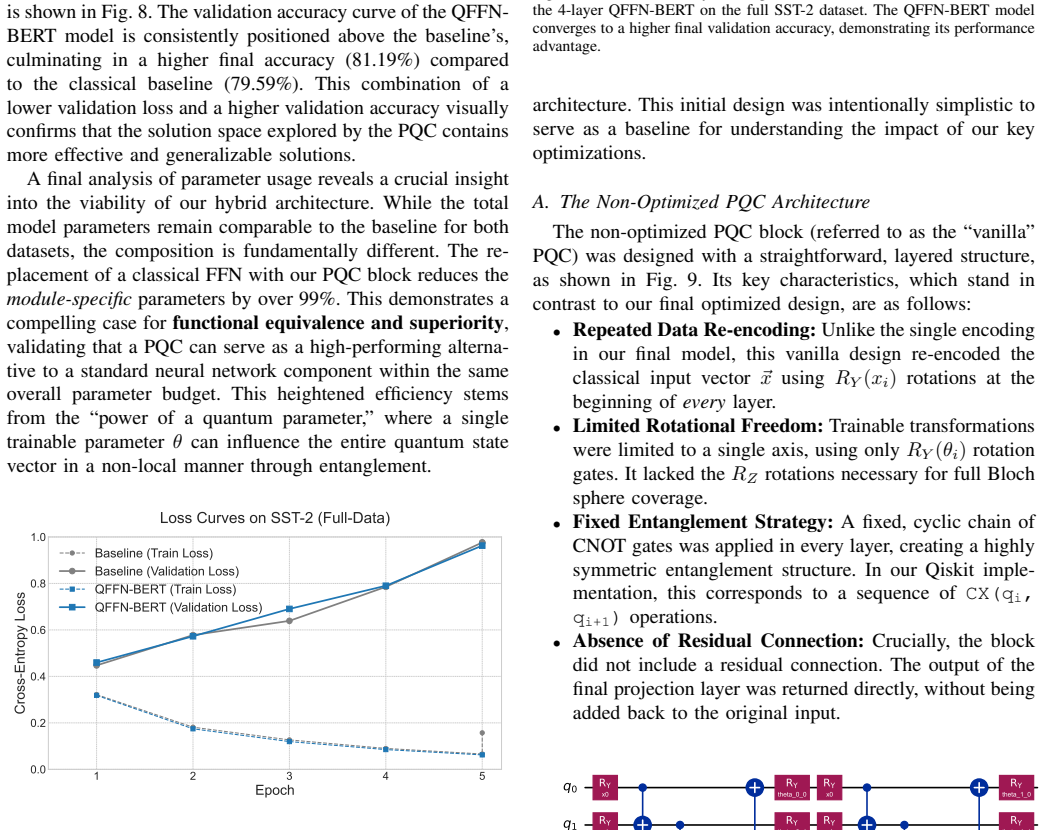
The central claim is that a PQC-based block can serve as a parameter-efficient replacement for the FFN modules of a Transformer without sacrificing task performance, and in one configuration improves it. QFFN-BERT applies the PQC only to the [CLS] token representation, uses a residual connection, $R_Y$ and $R_Z$ rotations, and alternating CNOT/CZ entanglement. In the full-data SST-2 setting, the 4-layer model achieves 81.19% accuracy versus 79.59% for bert-tiny, while the FFN-specific parameter count drops by over 99%; on DBpedia, the 4-layer model reaches 99.03% versus 99.02%. The depth study shows non-monotonic performance with a sweet spot at 4 layers, and the vanilla ablation fails to learn on both datasets, which the authors interpret as evidence that co-design with residual connections and expressive rotation strategies is essential.
Load-bearing premise
The reported advantage rests on the assumption that applying the PQC only to the [CLS] token, while leaving all other token representations untouched, isolates the effect of the quantum circuit; no classical model with the same CLS-only FFN structure was evaluated.
Editorial extensions
If this is right
- On full SST-2, the 4-layer QFFN-BERT reaches 81.19% accuracy, above the 79.59% classical baseline, so a PQC-based FFN can be a performance-neutral or positive substitute within the same model.
- The FFN module parameter count drops by more than 99%, so the accuracy-per-parameter ratio of the quantum module is dramatically higher than the classical FFN it replaces.
- Depth scaling is non-monotonic: 1-, 2-, 4-, and 8-layer variants show 4 layers as the empirical sweet spot, with 8 layers slightly worse, consistent with an expressibility-trainability trade-off.
- In few-shot settings QFFN-BERT is competitive with the fine-tuned baseline on SST-2 (8L beats baseline at 10% data, 76.95 vs 76.83) and slightly ahead on DBpedia at 20% data (98.71 vs 98.68), indicating better data efficiency.
- The vanilla PQC variant fails to learn on both datasets (near 51% on SST-2, below 34% on DBpedia), showing that residual connections and rotation/entanglement design are necessary for trainability.
Reading between the lines
- Because the PQC is applied only to the [CLS] token, the comparison is really between a quantum-transformed single token and an untransformed baseline; a classical CLS-only FFN control would tell whether the gain is due to added nonlinear capacity rather than quantum entanglement.
- If the few-shot edge reproduces across tasks, PQCs may be most valuable in data-limited NLP regimes rather than as replacements for large pretrained models.
- The 'power of a quantum parameter' claim suggests a concrete test: fix the parameter budget and compare a PQC against an MLP with the same number of parameters but entangled feature structure; if accuracy tracks entanglement pattern, the quantum-specific hypothesis gains support.
- The ablation's two confounded changes (residual connection plus richer rotations/entanglement) mean the vanilla failure cannot by itself pinpoint barren plateaus; a follow-up could add a residual connection to the vanilla PQC and measure gradient variance.
Editorial analysis
A structured set of objections, weighed in public.
Referee Report
Summary. The paper proposes QFFN-BERT, a hybrid quantum-classical transformer in which the feedforward network (FFN) modules of a compact BERT variant (bert-tiny) are replaced by parameterized quantum circuit (PQC) blocks. The authors evaluate several PQC depths on the SST-2 and DBpedia benchmarks, reporting that a 4-layer QFFN-BERT reaches 81.19% validation accuracy on SST-2 versus 79.59% for the classical baseline, while reducing FFN-specific parameters by over 99%, and they argue for a data-efficiency advantage in few-shot settings. An ablation study shows that a simpler "vanilla" PQC fails to learn, which the authors attribute to the absence of residual connections and insufficiently expressive circuit design. The central claim is that an optimized PQC can match or exceed a classical FFN at much lower module-level parameter cost.
Significance. If the reported results were supported by a controlled comparison, the paper would be a useful empirical contribution to hybrid quantum-classical NLP, demonstrating that a small PQC could plausibly replace a classical FFN in a transformer with competitive accuracy and drastically fewer parameters. The manuscript explicitly describes the PQC architecture, the training protocol, and the hardware/software environment, which aids reproducibility. However, the central empirical claim is currently not established: the comparison is confounded by a simultaneous change in both the transformation (quantum vs classical) and the token scope (CLS-only vs all tokens), and the reported accuracy differences are within the noise level of a single-seed run. The ablation study is informative about co-design but does not isolate a quantum-specific benefit.
major comments (5)
- [§III-C] The paper states that 'the PQC is applied only to the [CLS] token representation,' while the bert-tiny baseline applies its classical FFN to every token. This changes two factors at once: the nature of the block (quantum vs classical) and its scope (single token vs all tokens). No classical control with the same CLS-only structure—same input/output projections, same residual connection, and comparable parameter count—is reported. Consequently, the observed accuracy advantage on SST-2 (Table IV) and the claimed 'over 99% FFN-parameter reduction' cannot be attributed to quantum computation; they could stem from the simplified token-wise structure, the reduced capacity, the residual connection, or the CLS-only placement. This is the central confound and the main reason why the paper's core claim is not supported.
- [§IV-A, Table IV] The full-data SST-2 improvement of the 4-layer QFFN-BERT (81.19% vs 79.59%) is based on a single run with a fixed random seed (Table III). With a validation set of 872 examples, the standard error of a binary accuracy near 0.8 is about 1.35 percentage points, so the 1.6-point gap is within approximately one standard error. No confidence intervals, multiple seeds, or significance tests are reported. The claim that QFFN-BERT 'surpasses its classical counterpart in a full-data setting' is therefore not statistically justified by the presented results.
- [§IV-A and §IV-B] The few-shot results do not support the claimed 'superior data efficiency.' On SST-2 with 10% of the data, the best QFFN-BERT (8L) is 76.95% versus the baseline's 76.83%, a difference of 0.12 percentage points; with 20% of the data, the classical baseline outperforms all QFFN-BERT variants. On DBpedia few-shot, differences are at most 0.04 percentage points. These margins are far smaller than the variability expected from a single seed with these validation sizes, so the conclusion of a 'consistent and competitive edge' is not empirically grounded.
- [§III-C and §IV-C] The parameter-reduction claim is misleading. The QFFN block does not replace the FFN at every token position; it replaces it only for the [CLS] token. The classical FFN in bert-tiny processes all 128 tokens, whereas the QFFN processes one, so the 'over 99% FFN-specific parameter reduction' conflates a reduction in per-token operations with a reduction in module capacity. A fair parameter-efficiency comparison should control for the total number of FFN-like transformations applied to the sequence, or should report the per-token parameter cost under matched conditions.
- [§V] The ablation study compares only the optimized PQC against a 'vanilla' PQC, both applied in the same CLS-only placement. Because the vanilla variant lacks a residual connection and uses only RY rotations, its failure to learn may reflect standard deep learning issues (e.g., vanishing gradients due to missing skip connections) rather than quantum-specific limitations. The ablation does not include a classical CLS-only FFN baseline with comparable capacity, so it cannot isolate what, if anything, quantum computation contributes to the improved performance.
minor comments (5)
- [Table II] For SST-2, the table lists both validation (872) and test (1,821) sizes, but Table IV reports 'Validation Accuracy' without clarifying whether the SST-2 numbers are computed on the validation or test split; for DBpedia, only a test size is given. The same convention should be used consistently for both datasets.
- [§III-D] There is a typographical error in 'engtangling gates' (should be 'entangling gates').
- [§VI] The statement that training the 8-layer model on the full DBpedia dataset had not completed after more than 30 days suggests that some reported DBpedia results may come from incomplete runs; please clarify whether all reported numbers correspond to fully converged training.
- [Abstract and Contributions] The abstract and the contribution list present the model as replacing FFN modules without noting that the replacement is applied only to the [CLS] token; this architectural detail is central to interpreting the results and should be stated prominently in the abstract.
- [§II] The related-work section focuses on QNLP and quantum attention but omits other hybrid quantum-classical transformer works, such as recent quantum self-attention or quantum vision transformer variants; a brief comparison would strengthen the positioning of the contribution.
Circularity Check
No circularity found: the central results are empirical accuracy comparisons on external benchmarks, and the CLS-only design issue is an experimental confound rather than a reduction of the claim to its inputs.
full rationale
The paper is an empirical benchmarking study, not a derivation. The central claims (QFFN-BERT reaching 81.19% vs 79.59% on SST-2, 99.03% vs 99.02% on DBpedia, and competitive few-shot numbers) are measured accuracies on external datasets against an external baseline model, so they do not reduce to definitions or fitted constants. The 'over 99% FFN-parameter reduction' follows arithmetically from the chosen 4-qubit PQC and 128->4->128 projections, but it is a construction property, not a prediction used to prove performance. No parameter is fitted to the target metric and then reported as a forecast; the 4-layer 'sweet spot' is selected post hoc after evaluating depths, which is model selection rather than circular reasoning. There are no self-citations by the author, no imported uniqueness theorem, and no ansatz smuggled in via citation. The most serious methodological issue is a confound: Section III-C states 'the PQC is applied only to the [CLS] token representation,' while the bert-tiny baseline applies its classical FFN position-wise to all tokens, and no classical control with the same CLS-only bottleneck structure is reported. That missing control weakens attribution of the accuracy gap to the quantum circuit, but it is an experimental-design gap, not an equivalence-by-construction or a fitted-input-called-prediction. Accordingly, no circular step is identified.
Assumptions & free parameters
free parameters (3)
- PQC depth =
4 layers
- Number of qubits =
4
- Input projection dimension =
4
assumptions (4)
- domain assumption Qiskit's statevector simulation of the PQC exactly represents ideal quantum dynamics
- standard math The parameter-shift rule provides exact gradients for the PQC parameters
- ad hoc to paper In the baseline bert-tiny, the FFN is applied to every token, while QFFN-BERT applies its quantum block only to the [CLS] token
- domain assumption Validation accuracy on the HuggingFace splits is an unbiased estimate of model quality
Cite this review
Pith. "Pith review of QFFN-BERT: An Empirical Study of Depth, Performance, and Data Efficiency in Hybrid Quantum-Classical Transformers." pith.science (2026). https://pith.science/paper/RYKJN4XX
@misc{pith2026250702364,
  author       = {Pith},
  title        = {Pith review of: QFFN-BERT: An Empirical Study of Depth, Performance, and Data Efficiency in Hybrid Quantum-Classical Transformers},
  year         = {2026},
  howpublished = {\url{https://pith.science/paper/RYKJN4XX}},
  note         = {Machine review of arXiv:2507.02364}
}
abstract
Parameterized quantum circuits (PQCs) have recently emerged as promising components for enhancing the expressibility of neural architectures. In this work, we introduce QFFN-BERT, a hybrid quantum-classical transformer where the feedforward network (FFN) modules of a compact BERT variant are replaced by PQC-based layers. This design is motivated by the dominant parameter contribution of FFNs, which account for approximately two-thirds of the parameters within standard Transformer encoder blocks. While prior studies have primarily integrated PQCs into self-attention modules, our work focuses on the FFN and systematically investigates the trade-offs between PQC depth, expressibility, and trainability. Our final PQC architecture incorporates a residual connection, both $R_Y$ and $R_Z$ rotations, and an alternating entanglement strategy to ensure stable training and high expressibility. Our experiments, conducted on a classical simulator, on the SST-2 and DBpedia benchmarks demonstrate two key findings. First, a carefully configured QFFN-BERT achieves up to 102.0% of the baseline accuracy, surpassing its classical counterpart in a full-data setting while reducing FFN-specific parameters by over 99%. Second, our model exhibits a consistent and competitive edge in few-shot learning scenarios, confirming its potential for superior data efficiency. These results, supported by an ablation study on a non-optimized PQC that failed to learn, confirm that PQCs can serve as powerful and parameter-efficient alternatives to classical FFNs when co-designed with foundational deep learning principles.
Figures


Figures from the paper (5 more)


Reference graph
Works this paper leans on
-
[1]
BERT: Pre-training of Deep Bidirectional Transformers for Language Understanding,
J. Devlin, M.-W. Chang, K. Lee, and K. Toutanova, “BERT: Pre-training of Deep Bidirectional Transformers for Language Understanding,” in Proceedings of the 2019 Conference of the North American Chapter of the Association for Computational Linguistics: Human Language Technologies, Volume 1 (Long and Short Papers) . Minneapolis, Minnesota: Association for C...
work page 2019
-
[2]
Improving Language Understanding by Generative Pre-Training,
A. Radford, K. Narasimhan, T. Salimans, and I. Sutskever, “Improving Language Understanding by Generative Pre-Training,” OpenAI, 2018
work page 2018
-
[3]
A. Vaswani, N. Shazeer, N. Parmar, J. Uszkoreit, L. Jones, A. N. Gomez, L. Kaiser, and I. Polosukhin, “Attention is All You Need,” inProceedings of the 31st International Conference on Neural Information Processing Systems, ser. NIPS’17. Red Hook, NY , USA: Curran Associates Inc., 2017, pp. 6000–6010
work page 2017
-
[4]
ALBERT: A Lite BERT for Self-supervised Learning of Language Representations,
Z. Lan, M. Chen, S. Goodman, K. Gimpel, P. Sharma, and R. Soricut, “ALBERT: A Lite BERT for Self-supervised Learning of Language Representations,” in International Conference on Learning Representations, 2020. [Online]. Available: https://openreview.net/ forum?id=H1eA7AEtvS
work page 2020
-
[5]
Q-BERT: Hessian Based Ultra Low Precision Quan- tization of BERT,
S. Shen, Z. Dong, J. Ye, L. Ma, Z. Yao, A. Gholami, M. W. Mahoney, and K. Keutzer, “Q-BERT: Hessian Based Ultra Low Precision Quan- tization of BERT,” Proceedings of the AAAI Conference on Artificial Intelligence, vol. 34, no. 05, pp. 8815–8821, Apr. 2020
work page 2020
-
[6]
DistilBERT, a Distilled Version of BERT: Smaller, Faster, Cheaper and Lighter,
V . Sanh, L. Debut, J. Chaumond, and T. Wolf, “DistilBERT, a Distilled Version of BERT: Smaller, Faster, Cheaper and Lighter,”
-
[7]
Patient Knowledge Distillation for BERT Model Compression,
S. Sun, Y . Cheng, Z. Gan, and J. Liu, “Patient Knowledge Distillation for BERT Model Compression,” in Proceedings of the 2019 Conference on Empirical Methods in Natural Language Processing and the 9th In- ternational Joint Conference on Natural Language Processing (EMNLP- IJCNLP), K. Inui, J. Jiang, V . Ng, and X. Wan, Eds. Hong Kong, China: Association ...
work page 2019
-
[8]
MiniLM: Deep Self-Attention Distillation for Task-Agnostic Compression of Pre-Trained Transformers,
W. Wang, F. Wei, L. Dong, H. Bao, N. Yang, and M. Zhou, “MiniLM: Deep Self-Attention Distillation for Task-Agnostic Compression of Pre-Trained Transformers,” in Proceedings of the 34th International Conference on Neural Information Processing Systems , ser. NIPS ’20. Red Hook, NY , USA: Curran Associates Inc., 2020
work page 2020
Show all 37 references
-
[9]
LoRA: Low-Rank Adaptation of Large Language Models,
E. J. Hu, Y . Shen, P. Wallis, Z. Allen-Zhu, Y . Li, S. Wang, L. Wang, and W. Chen, “LoRA: Low-Rank Adaptation of Large Language Models,” 2021. [Online]. Available: https://arxiv.org/abs/2106.09685
2021 arXiv
-
[10]
Parameter-Efficient Transfer Learning for NLP,
N. Houlsby, A. Giurgiu, S. Jastrzebski, B. Morrone, Q. De Laroussilhe, A. Gesmundo, M. Attariyan, and S. Gelly, “Parameter-Efficient Transfer Learning for NLP,” in Proceedings of the 36th International Conference on Machine Learning , ser. Proceedings of Machine Learning Resea...
2019
-
[11]
A Variational Eigenvalue Solver on a Photonic Quantum Processor,
A. Peruzzo, J. McClean, P. Shadbolt, M.-H. Yung, X.-Q. Zhou, P. J. Love, A. Aspuru-Guzik, and J. L. O’Brien, “A Variational Eigenvalue Solver on a Photonic Quantum Processor,” Nature Communications , vol. 5, no. 1, p. 4213, Jul 2014
2014
-
[12]
Quantum Self-Attention Neural Networks for Text Classification,
G. Li, X. Zhao, and X. Wang, “Quantum Self-Attention Neural Networks for Text Classification,” Science China Information Sciences , vol. 67, no. 4, p. 142501, Mar 2024
2024
-
[13]
Quantum Vision Transformers,
E. A. Cherrat, I. Kerenidis, N. Mathur, J. Landman, M. Strahm, and Y . Y . Li, “Quantum Vision Transformers,” Quantum, vol. 8, p. 1265, Feb. 2024
2024
-
[14]
Quantum Computing with Qiskit,
A. Javadi-Abhari, M. Treinish, K. Krsulich, C. J. Wood, J. Lishman, J. Gacon, S. Martiel, P. D. Nation, L. S. Bishop, A. W. Cross, B. R. Johnson, and J. M. Gambetta, “Quantum Computing with Qiskit,”
-
[15]
PyTorch: An Imperative Style, High- Performance Deep Learning Library,
A. Paszke, S. Gross, F. Massa, A. Lerer, J. Bradbury, G. Chanan, T. Killeen, Z. Lin, N. Gimelshein, L. Antiga, A. Desmaison, A. Kopf, E. Yang, Z. DeVito, M. Raison, A. Tejani, S. Chilamkurthy, B. Steiner, L. Fang, J. Bai, and S. Chintala, “PyTorch: An Imperative Style, High- P...
2019
-
[16]
Quantum Computing in the NISQ Era and Beyond,
J. Preskill, “Quantum Computing in the NISQ Era and Beyond,” Quantum, vol. 2, p. 79, Aug. 2018
2018
-
[17]
MobileBERT: a Compact Task-Agnostic BERT for Resource-Limited Devices,
Z. Sun, H. Yu, X. Song, R. Liu, Y . Yang, and D. Zhou, “MobileBERT: a Compact Task-Agnostic BERT for Resource-Limited Devices,” in Proceedings of the 58th Annual Meeting of the Association for Compu- tational Linguistics , D. Jurafsky, J. Chai, N. Schluter, and J. Tetreault, E...
2020
-
[18]
TinyBERT: Distilling BERT for Natural Language Understanding,
X. Jiao, Y . Yin, L. Shang, X. Jiang, X. Chen, L. Li, F. Wang, and Q. Liu, “TinyBERT: Distilling BERT for Natural Language Understanding,” in Findings of the Association for Computational Linguistics: EMNLP 2020, T. Cohn, Y . He, and Y . Liu, Eds. Online: Association for Compu...
2020
-
[19]
Supervised Learning with Quantum- enhanced Feature Spaces,
V . Havl ´ıˇcek, A. D. C ´orcoles, K. Temme, A. W. Harrow, A. Kandala, J. M. Chow, and J. M. Gambetta, “Supervised Learning with Quantum- enhanced Feature Spaces,” Nature, vol. 567, no. 7747, pp. 209–212, Mar. 2019
2019
-
[20]
Classification with Quantum Neural Networks on Near Term Processors,
E. Farhi and H. Neven, “Classification with Quantum Neural Networks on Near Term Processors,” 2018. [Online]. Available: https://arxiv.org/abs/1802.06002
2018 arXiv
-
[21]
Quanvolutional Neural Networks: Powering Image Recognition with Quantum Circuits,
M. Henderson, S. Shakya, S. Pradhan, and T. Cook, “Quanvolutional Neural Networks: Powering Image Recognition with Quantum Circuits,” Quantum Machine Intelligence , vol. 2, no. 1, p. 2, Feb 2020
2020
-
[22]
Foundations for Near-Term Quantum Natural Language Processing,
B. Coecke, G. de Felice, K. Meichanetzidis, and A. Toumi, “Foundations for Near-Term Quantum Natural Language Processing,” 2020. [Online]. Available: https://arxiv.org/abs/2012.03755
2020 arXiv
-
[23]
The Dawn of Quantum Natural Language Processing,
R. Di Sipio, J.-H. Huang, S. Y .-C. Chen, S. Mangini, and M. Worring, “The Dawn of Quantum Natural Language Processing,” in ICASSP 2022 - 2022 IEEE International Conference on Acoustics, Speech and Signal Processing (ICASSP), 2022, pp. 8612–8616
2022
-
[24]
Cost Function Dependent Barren Plateaus in Shallow Parametrized Quantum Circuits,
M. Cerezo, A. Sone, T. V olkoff, L. Cincio, and P. J. Coles, “Cost Function Dependent Barren Plateaus in Shallow Parametrized Quantum Circuits,” Nature Communications, vol. 12, no. 1, p. 1791, Mar. 2021
2021
-
[25]
Absence of Barren Plateaus in Quantum Convolutional Neural Networks,
A. Pesah, M. Cerezo, S. Wang, T. V olkoff, A. T. Sornborger, and P. J. Coles, “Absence of Barren Plateaus in Quantum Convolutional Neural Networks,” Phys. Rev. X, vol. 11, p. 041011, Oct 2021
2021
-
[26]
Recursive Deep Models for Semantic Compositionality Over a Sentiment Treebank,
R. Socher, A. Perelygin, J. Wu, J. Chuang, C. D. Manning, A. Ng, and C. Potts, “Recursive Deep Models for Semantic Compositionality Over a Sentiment Treebank,” in Proceedings of the 2013 Conference on Empirical Methods in Natural Language Processing . Seattle, Washington, USA:...
2013
-
[27]
DBpedia-Entity V2: A Test Collection for Entity Search,
F. Hasibi, F. Nikolaev, C. Xiong, K. Balog, S. E. Bratsberg, A. Kotov, and J. Callan, “DBpedia-Entity V2: A Test Collection for Entity Search,” in Proceedings of the 40th International ACM SIGIR Conference on Research and Development in Information Retrieval , ser. SIGIR ’17. ...
2017
-
[28]
MTEB: Massive Text Embedding Benchmark,
N. Muennighoff, N. Tazi, L. Magne, and N. Reimers, “MTEB: Massive Text Embedding Benchmark,” arXiv preprint arXiv:2210.07316 , 2022
2022 arXiv
-
[29]
Well-Read Students Learn Better: The Impact of Student Initialization on Knowledge Distillation,
I. Turc, M. Chang, K. Lee, and K. Toutanova, “Well-Read Students Learn Better: The Impact of Student Initialization on Knowledge Distillation,” CoRR, vol. abs/1908.08962, 2019. [Online]. Available: http://arxiv.org/abs/1908.08962
1908 arXiv
-
[30]
Generalization in NLI: Ways (Not) To Go Beyond Simple Heuristics,
P. Bhargava, A. Drozd, and A. Rogers, “Generalization in NLI: Ways (Not) To Go Beyond Simple Heuristics,” 2021
2021
-
[31]
Transformers: State- of-the-Art Natural Language Processing,
T. Wolf, L. Debut, V . Sanh, J. Chaumond, C. Delangue, A. Moi, P. Cistac, T. Rault, R. Louf, M. Funtowicz, J. Davison, S. Shleifer, P. von Platen, C. Ma, Y . Jernite, J. Plu, C. Xu, T. Le Scao, S. Gugger, M. Drame, Q. Lhoest, and A. Rush, “Transformers: State- of-the-Art Natur...
2020
-
[32]
Expressibility and Entangling Capability of Parameterized Quantum Circuits for Hy- brid Quantum-Classical Algorithms,
S. Sim, P. D. Johnson, and A. Aspuru-Guzik, “Expressibility and Entangling Capability of Parameterized Quantum Circuits for Hy- brid Quantum-Classical Algorithms,” Advanced Quantum Technologies, vol. 2, no. 12, p. 1900070, 2019
2019
-
[33]
Barren Plateaus in Quantum Neural Network Training Landscapes,
J. R. McClean, S. Boixo, V . N. Smelyanskiy, R. Babbush, and H. Neven, “Barren Plateaus in Quantum Neural Network Training Landscapes,” Nature Communications, vol. 9, no. 1, p. 4812, 2018
2018
-
[34]
An Initializa- tion Strategy for Addressing Barren Plateaus in Parametrized Quantum Circuits,
E. Grant, L. Wossnig, M. Ostaszewski, and M. Benedetti, “An Initializa- tion Strategy for Addressing Barren Plateaus in Parametrized Quantum Circuits,” Quantum, vol. 3, p. 214, Dec. 2019
2019
-
[35]
cuQuantum SDK: A High-Performance Library for Accelerating Quantum Science,
H. Bayraktar, A. Charara, D. Clark, S. Cohen, T. Costa, Y .-L. L. Fang, Y . Gao, J. Guan, J. Gunnels, A. Haidar, A. Hehn, M. Hohnerbach, M. Jones, T. Lubowe, D. Lyakh, S. Morino, P. Springer, S. Stanwyck, I. Terentyev, S. Varadhan, J. Wong, and T. Yamaguchi, “cuQuantum SDK: A ...
2023
-
[2020]
Available: https://arxiv.org/abs/1910.01108
[Online]. Available: https://arxiv.org/abs/1910.01108
1910 arXiv
-
[2024]
Available: https://arxiv.org/abs/2405.08810
[Online]. Available: https://arxiv.org/abs/2405.08810
Reviewed August 6, 2026 · model on record in the stance chip above.
Discussion (0). Sign in to comment.