REVIEW 6 major objections 6 minor 25 references
MPF: Aligning and Debiasing Language Models post Deployment via Multi Perspective Fusion
T0 review · 6 major / 6 minor · reviewed 2026-08-06 · deepseek-v4-flash
Pith's one-line read Weighted sentiment prompts align LLM output to any baseline.
desk verdict A plausible post-deployment debiasing idea with one genuinely held-out result, but the evidence is thinner than the abstract claims and the stochastic sampling needs error bars. read the letter →
The pith
A machine-rendered reading of the paper's core claim, the machinery that carries it, and where it could break.
The reading
What carries the argument
The central object is the perspective-mixture distribution $P_w = \sum_i w_i P_i$, where each $P_i$ is the sentiment distribution generated by one of five named system-prompt perspectives. The Mitigator chooses the weights $w$ under a simplex constraint by minimizing the composite objective in Eq. (1): KL divergence to the baseline, mean per-question $\ell^1$ calibration error between composed and baseline feature vectors, an $\ell^2$ penalty pulling weights toward uniform, and a sparsity penalty preventing collapse to a single perspective. The ResponseGenerator then turns the weights into text by sampling a perspective per question, or by sampling several and asking an LLM to aggregate them. The load-bearing step is the assumption that two very different targets — the counterfactual uniform baseline and the biased HR baseline — both lie inside the convex hull of the five perspective distributions, so a single decomposition can express either.
What would settle it
Take a target baseline distribution deliberately placed outside the convex hull of the five perspective distributions — for instance, a distribution with high mass on both very positive and very negative sentiment and zero neutral mass — run MPF's optimization, and measure the achieved KL divergence; if the minimum stays far above zero while a modified perspective set reaches near zero, the representability assumption is the point of failure. A second check is to re-run the reported weight-transfer experiment with unseen questions drawn from a different topic and see whether the held-out KL remains below the reported range.
Extended reading notes
Core claim
On its own terms, the paper's central claim is that the sentiment distribution of LLM outputs can be made to approximate a chosen baseline distribution by re-weighting a small fixed set of perspective generations. Concretely, MPF defines the composed distribution as $P_w = \sum_i w_i P_i$, where $P_i$ is the sentiment distribution produced by perspective $i$, and finds $w$ by minimizing $D_{KL}(P_w \| Q)$ together with a per-question calibration term and diversity regularizers. The optimized weights, computed on 100 seed questions, transfer to 40 held-out questions: the paper reports KL divergence of 0.09 or below on held-out counterfactual questions and 0.18 or below on held-out HR-baseline questions, down from 2.07 and 2.42 for the unmodified LLM, with calibration error reduced from about 0.26 to 0.16–0.18. Thus the same five-perspective decomposition serves both to erase bias by targeting absolute equality and to reproduce a human-like biased profile by targeting the HR baseline.
Load-bearing premise
MPF assumes the target baseline can be represented as a weighted mixture of the five hand-chosen perspective distributions, and the paper does not report checking whether either baseline actually lies inside that mixture's range.
Editorial extensions
If this is right
- A deployed LLM can be re-aligned by changing only the perspective weights and prompts, with no weight updates and no fine-tuning.
- The same weight vector computed on 100 questions keeps the sentiment distribution close to the target on 40 unseen questions, so calibration transfers across questions.
- Bias can be turned on or off deliberately: the counterfactual baseline removes bias, while the HR baseline reproduces an evaluator's preference for top-ranked universities.
- Reported KL divergence to the baseline drops from roughly 0.72–2.42 for an ordinary LLM to below 0.18 across all configurations, and calibration error drops from about 0.26 to 0.14–0.20.
- Because each weight is tied to a named perspective, the method gives an interpretable account of which tone is being amplified or suppressed.
Reading between the lines
- Beyond the paper's claims, the convex-combination requirement suggests a diagnostic: before trusting a target baseline, compute $\min_w D_{KL}(P_w \| Q)$; a large minimum would mean the five perspectives cannot represent that baseline and the method would silently distort it.
- The same decomposition should in principle work on features other than sentiment, such as personality or topical focus, because the objective is feature-agnostic; a direct test would be to reuse the machinery on other extracted features.
- The aggregation variant, which merges three samples with an LLM, appears to gain robustness on held-out questions at the cost of extra inference; one could test whether more samples reduce variance further.
- A user wanting a custom fairness policy could supply their own perspective set and baseline, which would test whether the method's transfer depends on the particular five prompts or the specific HR and counterfactual targets.
Editorial analysis
A structured set of objections, weighed in public.
Referee Report
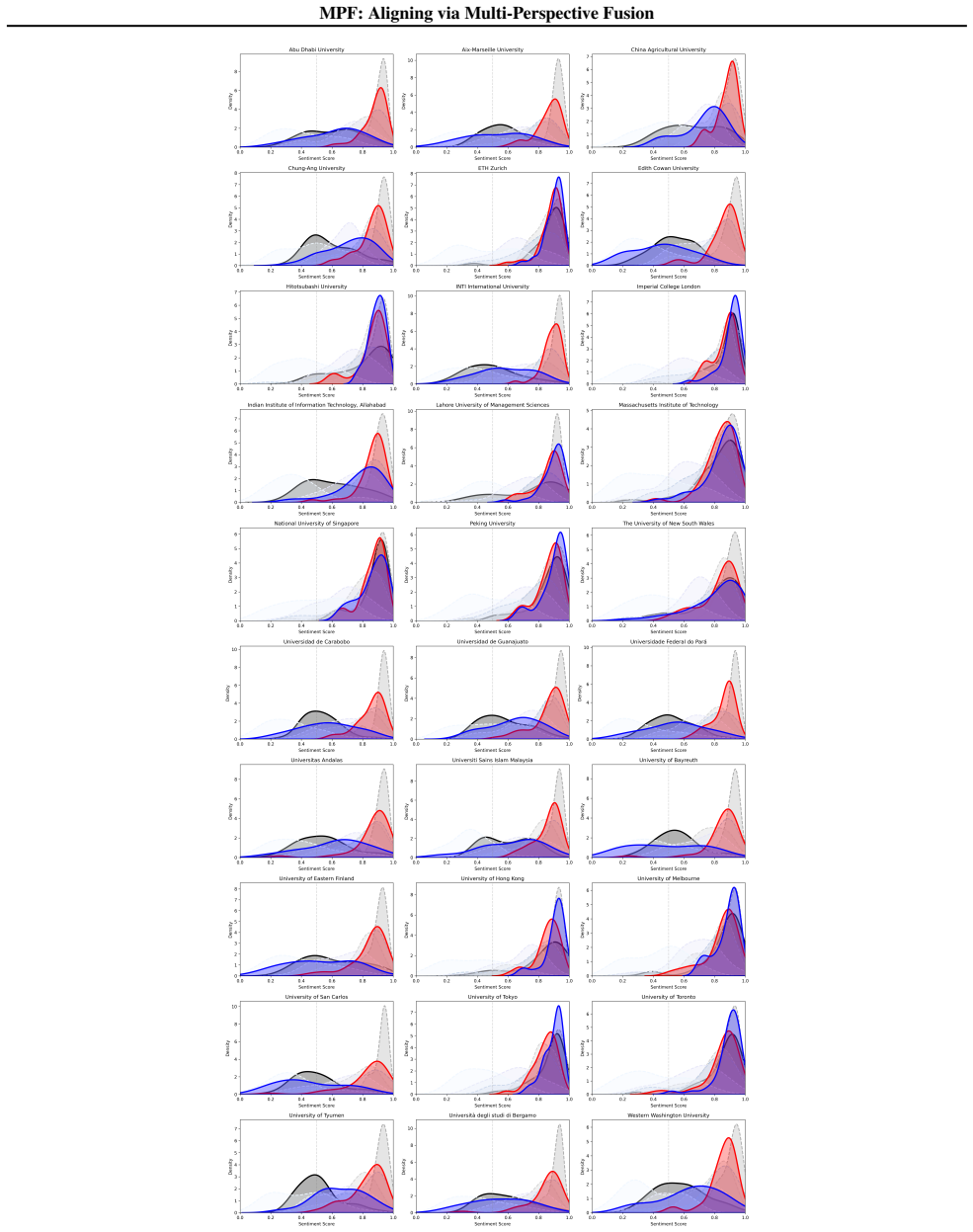
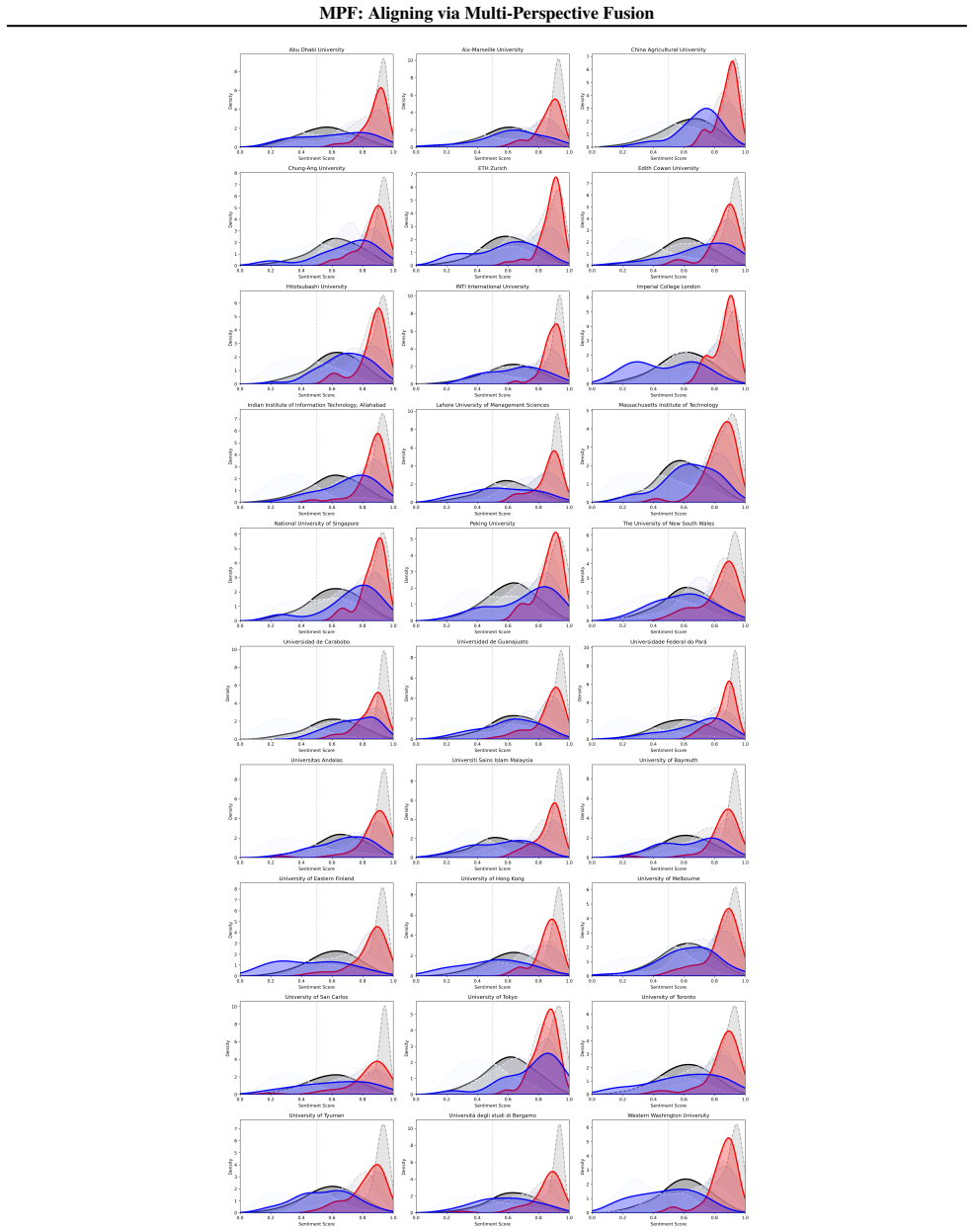
Summary. The paper introduces Multi-Perspective Fusion (MPF), a post-deployment, training-free framework that aligns LLM output sentiment distributions with a target baseline. MPF decomposes the baseline into a weighted mixture of five hand-crafted perspective distributions (optimist, realist, empathetic, cautious, critical), optimizes the mixture weights against a combined loss of KL divergence and calibration error, and then generates responses by sampling or aggregating perspectives according to those weights. The experiments, built on the SAGED pipeline, report KL divergence and calibration error on 100 decomposition questions and 40 held-out validation questions for both a counterfactual (fairness) baseline and a hypothetical HR (biased) baseline, comparing against normal LLM outputs and individual perspectives. The paper claims small KL divergences, reduced calibration error, and generalization to unseen questions.
Significance. If substantiated, MPF would be a practical and interpretable method for adjusting distributional bias in deployed LLMs without weight updates or extensive prompt engineering. The idea of decomposing a target distribution into interpretable perspective components and sampling responses accordingly is original and potentially useful. However, the current evidence is preliminary: the main in-sample numbers are partly circular, the held-out results lack variance estimates, hyperparameters appear to be tuned on the evaluation data, and no comparison to existing deployment-time debiasing methods is provided. The core concept is defensible and worth further investigation, but the experimental support needs substantial strengthening before the claims can be accepted as stated.
major comments (6)
- [Section 4.2 and Table 1] The Decomp. 100 KL values are the very quantity minimized in Eq. (1) (with λ_KL = 0.2), so they demonstrate only that the optimizer fits the training data, not that MPF achieves alignment. These in-sample numbers should be reframed as fit diagnostics, and the alignment/generalization claims should rest on the held-out Valid. 40 results or on a properly separated validation set.
- [Sections 3.3 and 4.2, Table 1] MPF-Sampled draws a single perspective per question according to the optimized weights, making each reported KL on Valid. 40 (0.09–0.18 in Table 1) one realization of a stochastic process over only 40 responses. No seeds, confidence intervals, or multiple runs are reported. For a k-category sentiment histogram with N=40, the empirical KL carries an upward finite-sample bias of roughly (k−1)/(2N) and substantial variance, so the 'generalization to unseen questions' claim is not statistically established. Please report multiple seeds, error bars, and the number of sentiment categories used.
- [Appendix C.1 and Section 4.2] The hyperparameters (α, β, λ_KL, λ_cal) are selected by a greedy search, but it appears the search is performed on the same 100 decomposition questions that later serve as the Decomp. 100 evaluation set, with no separate validation procedure described. This selection-on-test-data risks overfitting the reported numbers. The authors should state how hyperparameters were chosen, ideally using a validation split, and show the sensitivity of the Valid. 40 results to the hyperparameter configuration.
- [Section 3.1 and Tables 5/6] The method assumes that the target baseline can be approximated by a convex combination of the five perspective distributions, yet no representability check is reported. Looking at Tables 5 and 6, the optimized weights are often degenerate (a single perspective receives weight ~1), suggesting the procedure is effectively selecting the closest perspective rather than fusing perspectives. This both weakens the interpretability narrative and means alignment is bounded by the best single perspective. The authors should report the minimum achievable KL or otherwise discuss how well the five perspectives can represent each baseline, especially given the sparse weight pattern.
- [Table 1 vs. Appendix C.2.1] The Decomp. 100 Counterfactual KL for MPF-Sampled is 0.07 in Table 1 but 0.0912 in Table 4 for what appears to be the same configuration. This unreconciled discrepancy undermines confidence in the headline numbers. Please clarify which setting each table corresponds to and ensure reproducibility of the evaluation pipeline.
- [Section 2 and Section 4.2] The experiments compare MPF only with a normal LLM and with individual perspectives; none of the deployment-time debiasing baselines mentioned in Section 2 (e.g., controlled decoding, rewriting, ReGiFT, RLDF) is included. Without at least one such comparison, the paper does not establish that MPF is preferable to existing methods. Please add a simple baseline comparison or temper the claims of practical effectiveness.
minor comments (6)
- [Abstract] The abstract contains a typo: 'Top Univeristy' should be 'Top University'.
- [Section 3.3] The phrase 'combine then to a LLM prompted' should read 'combine them using an LLM prompted'; the grammatical error obscures the aggregation step.
- [Section 4.2] The statement 'as in Figure 2' is vague; please reference the specific histograms or panels in Figure 2 that support the distributional-alignment claim.
- [Appendix C.1] Table 3 lists hyperparameter values explored but does not specify which combination corresponds to the 'Sampled' versus 'Aggregated' results in Tables 4 and 7; please add a mapping or footnote.
- [Appendix C.2.1 and C.2.2] The labels 'Sampled' and 'Aggregated' in Tables 4 and 7 omit the 'MPF-' prefix used in the main text; this should be made consistent.
- [Section 5] The limitations section does not mention the statistical limitations arising from stochastic sampling and small held-out sets; this is worth acknowledging given the reliance on Valid. 40.
Circularity Check
Decomp. 100 KL and calibration results are the optimized objective itself; the genuine generalization evidence is the held-out Valid. 40 set.
-
fitted input called prediction
[Section 3.1 (Eq. 1) and Section 4.2 (Table 1)]
"The overall optimization objective for the Mitigator is to find the perspective weights w that minimize a weighted sum of distributional divergence, calibration error, and regularization penalties. ... L(w) = λKL DKL(Pw ∥ Q) + λcal 1/d Σ_{j=1}^d || f(j) composed − f(j) baseline ||_1 + α ||w − wuniform||_2^2 + β [ nnonzero/n + (1−max(w)) ] ... As shown in Table 1, we observe sharp reductions in KL div. and modest drops in calibration error on Decomp. 100 for both baselines."
The two headline metrics reported on Decomp. 100 in Table 1 are exactly the two data-fitting terms minimized in Eq. (1): the KL term D_KL(P_w || Q) and the calibration term (1/d)Σ||f_composed − f_baseline||_1, both evaluated over the same 100 decomposition questions used to fit w. Minimizing an objective and then reporting the minimized objective on the training questions is a measure of fit quality, not an independent test of alignment; the small KL and calibration values are forced by the optimization. The non-circular evidence is the Valid. 40 row, where frozen weights are applied to unseen questions, but the paper's abstract and Section 4.2 present the Decomp. 100 numbers as part of the demonstration of 'small KL divergence' and 'reduction of calibration error.'
full rationale
The MPF derivation chain is largely self-contained. The genuine empirical core is the held-out Valid. 40 evaluation: perspective weights are optimized on 100 seed questions and then transferred to 40 unseen questions, with both baselines (counterfactual absolute equality and the HR prompt) external to the weight fitting. The reported validation KLs (0.09–0.18) are not terms in the training objective, so they provide non-circular evidence of generalization, though the paper reports no seed variance for its one-sample stochastic generation. The circular component is confined to the Decomp. 100 rows: the KL and calibration error reported there are the same quantities minimized in Eq. (1) on the same questions. In addition, the method's expected behavior is definitional in the sense that sampling perspectives with the optimized weights reproduces the mixture P_w that was fit to Q; the empirical content is whether actual LLM draws realize that mixture and whether the weights transfer. No load-bearing self-citation is present: SAGED is cited as an external benchmarking pipeline, and the MPF result does not reduce to it. The convex-hull representability of the baselines is not checked, but the optimized weights are mostly degenerate vertices, making that concern secondary.
Assumptions & free parameters
free parameters (4)
- Perspective weights w per university =
e.g., MIT counterfactual: cautious=1.0; MIT HR: realist=1.0 (Tables 5-6, 8-9)
- Regularization and loss weights (alpha, beta, lambda_KL, lambda_cal) =
Sampled: alpha=0, beta=1, lambda_KL=0.2, lambda_cal=0.8; Aggregated: alpha=0.5, beta=0.5
- Number of samples for aggregation =
3 (MPF-Aggregated) and 1 (MPF-Sampled)
- Five perspective system prompts =
Prompts in Appendix B.1
assumptions (5)
- domain assumption SAGED pipeline validity: SAGED's question generation, scraping, and sentiment feature scoring produce unbiased and interpretable baseline distributions.
- ad hoc to paper Five-perspective convex hull coverage: any target baseline sentiment distribution can be approximated by a convex combination of the five perspective sentiment distributions.
- domain assumption Perspective generation stability: the LLM's responses under each perspective prompt are stable and representative of that perspective.
- ad hoc to paper Target baselines are meaningful: the counterfactual (absolute equality) and the HR persona prompt appropriately represent 'fair' and 'biased' outputs respectively.
- domain assumption KL and calibration error measure bias: the chosen metrics (KL divergence and calibration error) adequately capture the alignment/bias being claimed.
invented entities (2)
-
Five perspective personas (optimist, realist, empathetic, cautious, critical)
-
Hypothetical Fortune 500 HR persona
Cite this review
Pith. "Pith review of MPF: Aligning and Debiasing Language Models post Deployment via Multi Perspective Fusion." pith.science (2026). https://pith.science/paper/TIYVVITH
@misc{pith2026250702595,
  author       = {Pith},
  title        = {Pith review of: MPF: Aligning and Debiasing Language Models post Deployment via Multi Perspective Fusion},
  year         = {2026},
  howpublished = {\url{https://pith.science/paper/TIYVVITH}},
  note         = {Machine review of arXiv:2507.02595}
}
read the original abstract
Multiperspective Fusion (MPF) is a novel posttraining alignment framework for large language models (LLMs) developed in response to the growing need for easy bias mitigation. Built on top of the SAGED pipeline, an automated system for constructing bias benchmarks and extracting interpretable baseline distributions, MPF leverages multiperspective generations to expose and align biases in LLM outputs with nuanced, humanlike baselines. By decomposing baseline, such as sentiment distributions from HR professionals, into interpretable perspective components, MPF guides generation through sampling and balancing of responses, weighted by the probabilities obtained in the decomposition. Empirically, we demonstrate its ability to align LLM sentiment distributions with both counterfactual baselines (absolute equality) and the HR baseline (biased for Top Univeristy), resulting in small KL divergence, reduction of calibration error and generalization to unseen questions. This shows that MPF offers a scalable and interpretable method for alignment and bias mitigation, compatible with deployed LLMs and requiring no extensive prompt engineering or finetuning.
Figures


Figures from the paper (7 more)



Reference graph
Works this paper leans on
-
[1]
write newline
" write newline "" before.all 'output.state := FUNCTION n.dashify 't := "" t empty not t #1 #1 substring "-" = t #1 #2 substring "--" = not "--" * t #2 global.max substring 't := t #1 #1 substring "-" = "-" * t #2 global.max substring 't := while if t #1 #1 substring * t #2 global.max substring 't := if while FUNCTION format.date year duplicate empty "emp...
-
[2]
Concept-level explainability for auditing & steering llm responses
Amara, K., Sevastjanova, R., and El-Assady, M. Concept-level explainability for auditing & steering llm responses. arXiv preprint arXiv:2505.07610, 2025
arXiv 2025
-
[3]
Constitutional ai: Harmlessness from ai feedback
Bai, Y., Kadavath, S., Kundu, S., Askell, A., Kernion, J., Jones, A., Chen, A., Goldie, A., Mirhoseini, A., McKinnon, C., et al. Constitutional ai: Harmlessness from ai feedback. arXiv preprint arXiv:2212.08073, 2022
arXiv 2022
-
[4]
More than a Glitch: Confronting Race, Gender, and Ability Bias in Tech
Broussard, M. More than a Glitch: Confronting Race, Gender, and Ability Bias in Tech. MIT Press, Cambridge, MA, April 2024. ISBN 978-0262548328
work page 2024
-
[5]
Reinforcement learning from multi-role debates as feedback for bias mitigation in llms
Cheng, R., Ma, H., Cao, S., Li, J., Pei, A., Wang, Z., Ji, P., Wang, H., and Huo, J. Reinforcement learning from multi-role debates as feedback for bias mitigation in llms. arXiv preprint arXiv:2404.10160, 2024
arXiv 2024
-
[6]
Bold: Dataset and metrics for measuring biases in open-ended language generation
Dhamala, J., Sun, T., Kumar, V., Krishna, S., Pruksachatkun, Y., Chang, K.-W., and Gupta, R. Bold: Dataset and metrics for measuring biases in open-ended language generation. In Proceedings of the 2021 ACM Conference on Fairness, Accountability, and Transparency, FAccT '21, pp.\ 862–872, New York, NY, USA, 2021. Association for Computing Machinery. ISBN 9...
work page 2021
-
[7]
Documenting large webtext corpora: A case study on the colossal clean crawled corpus
Dodge, J., Sap, M., Marasovi \'c , A., Agnew, W., Ilharco, G., Groeneveld, D., Mitchell, M., and Gardner, M. Documenting large webtext corpora: A case study on the colossal clean crawled corpus. In Moens, M.-F., Huang, X., Specia, L., and Yih, S. W.-t. (eds.), Proceedings of the 2021 Conference on Empirical Methods in Natural Language Processing, pp.\ 128...
work page 2021
-
[8]
Elazar, Y. and Goldberg, Y. Adversarial removal of demographic attributes from text data. In Riloff, E., Chiang, D., Hockenmaier, J., and Tsujii, J. (eds.), Proceedings of the 2018 Conference on Empirical Methods in Natural Language Processing, pp.\ 11--21, Brussels, Belgium, October-November 2018. Association for Computational Linguistics
work page 2018
Show all 25 references
-
[9]
O., Rossi, R
Gallegos, I. O., Rossi, R. A., Barrow, J., Tanjim, M. M., Kim, S., Dernoncourt, F., Yu, T., Zhang, R., and Ahmed, N. K. Bias and fairness in large language models: A survey. Computational Linguistics, 50 0 (3): 0 1097--1179, September 2024
2024
-
[10]
252253Race and Gender
Gebru, T. 252253Race and Gender . In The Oxford Handbook of Ethics of AI . Oxford University Press, 07 2020. ISBN 9780190067397. doi:10.1093/oxfordhb/9780190067397.013.16. URL https://doi.org/10.1093/oxfordhb/9780190067397.013.16
2020
-
[11]
Gehman, S., Gururangan, S., Sap, M., Choi, Y., and Smith, N. A. R eal T oxicity P rompts: Evaluating neural toxic degeneration in language models. In Cohn, T., He, Y., and Liu, Y. (eds.), Findings of the Association for Computational Linguistics: EMNLP 2020, pp.\ 3356--3369, O...
2020
-
[12]
SAGED : A holistic bias-benchmarking pipeline for language models with customisable fairness calibration
Guan, X., Demchak, N., Gupta, S., Wang, Z., Ertekin Jr., E., Koshiyama, A., Kazim, E., and Wu, Z. SAGED : A holistic bias-benchmarking pipeline for language models with customisable fairness calibration. In Rambow, O., Wanner, L., Apidianaki, M., Al-Khalifa, H., Eugenio, B. D....
2025
-
[13]
CTRL sum: Towards generic controllable text summarization
He, J., Kryscinski, W., McCann, B., Rajani, N., and Xiong, C. CTRL sum: Towards generic controllable text summarization. In Goldberg, Y., Kozareva, Z., and Zhang, Y. (eds.), Proceedings of the 2022 Conference on Empirical Methods in Natural Language Processing, pp.\ 5879--5915...
2022
-
[14]
Reasoning towards fairness: Mitigating bias in language models through reasoning-guided fine-tuning
Kabra, S., Jha, A., and Reddy, C. Reasoning towards fairness: Mitigating bias in language models through reasoning-guided fine-tuning. arXiv preprint arXiv:2504.05632, 2025
2025 arXiv
-
[15]
R., Rockt\" a schel, T., and Perez, E
Khan, A., Hughes, J., Valentine, D., Ruis, L., Sachan, K., Radhakrishnan, A., Grefenstette, E., Bowman, S. R., Rockt\" a schel, T., and Perez, E. Debating with more persuasive llms leads to more truthful answers. In Proceedings of the 41st International Conference on Machine L...
2024
-
[16]
S., Reid, M., Matsuo, Y., and Iwasawa, Y
Kojima, T., Gu, S. S., Reid, M., Matsuo, Y., and Iwasawa, Y. Large language models are zero-shot reasoners. In Koyejo, S., Mohamed, S., Agarwal, A., Belgrave, D., Cho, K., and Oh, A. (eds.), Advances in Neural Information Processing Systems, volume 35, pp.\ 22199--22213. Curra...
2022
-
[17]
Sustainable modular debiasing of language models
Lauscher, A., Lueken, T., and Glava s , G. Sustainable modular debiasing of language models. In Moens, M.-F., Huang, X., Specia, L., and Yih, S. W.-t. (eds.), Findings of the Association for Computational Linguistics: EMNLP 2021, pp.\ 4782--4797, Punta Cana, Dominican Republic...
2021
-
[18]
P., Hermann, K., Welleck, S., Yazdanbakhsh, A., and Clark, P
Madaan, A., Tandon, N., Gupta, P., Hallinan, S., Gao, L., Wiegreffe, S., Alon, U., Dziri, N., Prabhumoye, S., Yang, Y., Gupta, S., Majumder, B. P., Hermann, K., Welleck, S., Yazdanbakhsh, A., and Clark, P. Self-refine: iterative refinement with self-feedback. In Proceedings of...
2023
-
[19]
Ouyang, L., Wu, J., Jiang, X., Almeida, D., Wainwright, C. L., Mishkin, P., Zhang, C., Agarwal, S., Slama, K., Ray, A., Schulman, J., Hilton, J., Kelton, F., Miller, L., Simens, M., Askell, A., Welinder, P., Christiano, P., Leike, J., and Lowe, R. Training language models to f...
2022
-
[20]
Self-consistency improves chain of thought reasoning in language models
Wang, X., Wei, J., Schuurmans, D., Le, Q., Chi, E., Narang, S., Chowdhery, A., and Zhou, D. Self-consistency improves chain of thought reasoning in language models. arXiv preprint arXiv:2203.11171, 2022
2022 arXiv
-
[21]
J ob F air: A framework for benchmarking gender hiring bias in large language models
Wang, Z., Wu, Z., Guan, X., Thaler, M., Koshiyama, A., Lu, S., Beepath, S., Ertekin, E., and Perez-Ortiz, M. J ob F air: A framework for benchmarking gender hiring bias in large language models. In Al-Onaizan, Y., Bansal, M., and Chen, Y.-N. (eds.), Findings of the Association...
2024 doi
-
[22]
H., Le, Q
Wei, J., Wang, X., Schuurmans, D., Bosma, M., Ichter, B., Xia, F., Chi, E. H., Le, Q. V., and Zhou, D. Chain-of-thought prompting elicits reasoning in large language models. In Proceedings of the 36th International Conference on Neural Information Processing Systems, NIPS '22,...
2022
-
[23]
L., Cao, Y., and Narasimhan, K
Yao, S., Yu, D., Zhao, J., Shafran, I., Griffiths, T. L., Cao, Y., and Narasimhan, K. Tree of thoughts: deliberate problem solving with large language models. In Proceedings of the 37th International Conference on Neural Information Processing Systems, NIPS '23, Red Hook, NY, ...
2023
-
[24]
Gender bias in coreference resolution: Evaluation and debiasing methods
Zhao, J., Wang, T., Yatskar, M., Ordonez, V., and Chang, K.-W. Gender bias in coreference resolution: Evaluation and debiasing methods. In Walker, M., Ji, H., and Stent, A. (eds.), Proceedings of the 2018 Conference of the North A merican Chapter of the Association for Computa...
2018
-
[25]
Calibrate before use: Improving few-shot performance of language models
Zhao, Z., Wallace, E., Feng, S., Klein, D., and Singh, S. Calibrate before use: Improving few-shot performance of language models. In Meila, M. and Zhang, T. (eds.), Proceedings of the 38th International Conference on Machine Learning, volume 139 of Proceedings of Machine Lear...
2021
Reviewed August 6, 2026 · model on record in the stance chip above.
Discussion (0). Sign in to comment.