Ultracold Mechanical Quantum Sensor for Tests of New Physics
Pith reviewed 2026-05-19 06:21 UTC · model grok-4.3
The pith
A mechanical resonator achieves an excited-state population as low as 1.2 times 10 to the minus five, enabling new bounds on high-frequency gravitational waves and dark matter.
A machine-rendered reading of the paper's core claim, the machinery that carries it, and where it could break.
Core claim
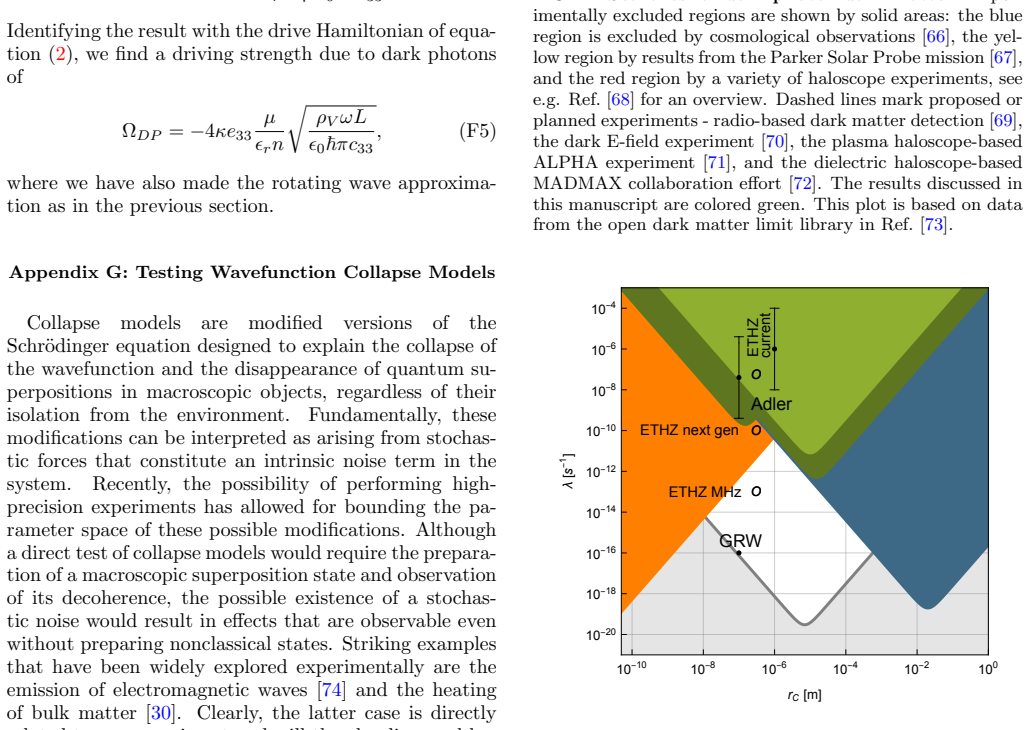
We measure the excited-state populations of GHz-frequency modes in a high-overtone bulk acoustic wave resonator and find that the population of the first excited state can be as low as P_p equals (1.2 plus or minus 5.5) times 10 to the minus five, corresponding to an effective temperature of 25.2 mK. These upper bounds, limited by imperfections in the measurement process, are used to constrain the amplitude of high-frequency gravitational waves, the kinetic mixing strength of ultra-light dark matter, and non-linear modifications of the Schrödinger equation describing wavefunction collapse mechanisms.
What carries the argument
The high-overtone bulk acoustic wave resonator whose first-excited-state population is measured through coupling to a superconducting circuit, providing both quantum initialization and a sensor for rare energy depositions.
If this is right
- Low mechanical populations reduce thermal noise in quantum sensing protocols that rely on the resonator.
- The absence of excess excitations directly limits the possible amplitude of high-frequency gravitational waves.
- The same data constrains the kinetic mixing strength between ultra-light dark matter and ordinary matter.
- Nonlinear modifications to the Schrödinger equation that could induce spontaneous wavefunction collapse are bounded.
Where Pith is reading between the lines
- Improving readout fidelity alone would tighten the new-physics limits without redesigning the resonator.
- Arrays of such HBARs could increase sensitivity to rare events by averaging independent measurements.
- The same population bounds could be applied to other mechanical systems such as optomechanical cavities for similar fundamental tests.
Load-bearing premise
The reported populations are true upper bounds set by measurement imperfections rather than by additional unaccounted systematic effects in the resonator or readout chain.
What would settle it
An independent calibration experiment that isolates readout errors and directly measures a thermal occupation significantly higher than the reported upper bound would show that the new-physics constraints do not yet apply.
Figures


read the original abstract
Initialization of mechanical modes in the quantum ground state is crucial for their use in quantum information and quantum sensing protocols. In quantum processors, impurity of the modes' initial state affects the infidelity of subsequent quantum algorithms. In quantum sensors, excitations out of the ground state contribute to the noise of the detector, and their prevalence puts a bound on rare events that deposit energy into the mechanical modes. In this work, we measure the excited-state populations of GHz-frequency modes in a high-overtone bulk acoustic wave resonator (HBAR). We find that the population of the first excited state can be as low as $P_p$=(1.2$\pm$5.5)$\times10^{-5}$, corresponding to an effective temperature of 25.2 mK, which are upper bounds limited by imperfections in the measurement process. These results compare favorably to the lowest populations measured in superconducting circuits. Finally, we use the measured populations to constrain the amplitude of high-frequency gravitational waves, the kinetic mixing strength of ultra-light dark matter, and non-linear modifications of the Schr\"{o}dinger equation describing wavefunction collapse mechanisms. Our work establishes HBARs as a versatile resource for quantum state initialization and studies of fundamental physics.
Editorial analysis
A structured set of objections, weighed in public.
Referee Report
Summary. The manuscript reports measurements of the excited-state population of GHz-frequency modes in a high-overtone bulk acoustic wave resonator (HBAR). The authors find that the population of the first excited state can be as low as P_p = (1.2 ± 5.5) × 10^{-5}, corresponding to an effective temperature of 25.2 mK; these values are presented as upper bounds limited by imperfections in the measurement process. The results are compared to those in superconducting circuits and are used to constrain the amplitude of high-frequency gravitational waves, the kinetic mixing strength of ultra-light dark matter, and non-linear modifications of the Schrödinger equation.
Significance. If the reported upper bounds on mechanical-mode population are robust, the work establishes HBARs as a competitive platform for quantum state initialization and for using low thermal populations to bound rare energy-deposition events. The experimental achievement of sub-30 mK effective temperatures in a mechanical resonator at GHz frequencies, together with the direct application to new-physics constraints, would be a notable contribution to quantum sensing and fundamental-physics searches.
major comments (2)
- [Results (population extraction) and abstract] The headline result treats P_p = (1.2 ± 5.5) × 10^{-5} as a measurement-limited upper bound on the true thermal population. For the new-physics constraints to follow, every other contribution (residual heating from the piezoelectric transducer, frequency drifts, or non-thermal excitations) must be demonstrably smaller than the quoted uncertainty. The abstract asserts this is the case, but without explicit quantitative bounds on these systematics the translation to GW amplitude, dark-matter mixing, and nonlinear Schrödinger limits inherits the same assumption; any unmodeled excess population would directly loosen those limits.
- [New-physics constraints section] The conversion from measured population to the quoted new-physics limits assumes standard thermal-state relations without additional model dependence. Any deviation from this assumption (e.g., non-thermal excitation spectra or readout-induced heating) should be quantified, as it directly affects the numerical constraints reported for gravitational-wave amplitude, dark-matter kinetic mixing, and collapse-model parameters.
minor comments (2)
- [Abstract] The abstract states clear numerical results but does not specify the precise fitting procedure or data cuts used to obtain the quoted uncertainty on P_p; a brief sentence clarifying this would improve readability.
- [Throughout manuscript] Notation for the excited-state population is introduced as P_p; ensure the symbol is used consistently in all figures, tables, and equations that report the same quantity.
Simulated Author's Rebuttal
We thank the referee for the positive overall assessment and for the detailed major comments, which help clarify the requirements for robustly linking our experimental upper bounds to new-physics constraints. We address each point below and commit to revisions that strengthen the manuscript without altering its core claims.
read point-by-point responses
-
Referee: [Results (population extraction) and abstract] The headline result treats P_p = (1.2 ± 5.5) × 10^{-5} as a measurement-limited upper bound on the true thermal population. For the new-physics constraints to follow, every other contribution (residual heating from the piezoelectric transducer, frequency drifts, or non-thermal excitations) must be demonstrably smaller than the quoted uncertainty. The abstract asserts this is the case, but without explicit quantitative bounds on these systematics the translation to GW amplitude, dark-matter mixing, and nonlinear Schrödinger limits inherits the same assumption; any unmodeled excess population would directly loosen those limits.
Authors: We agree that explicit quantitative bounds on the listed systematics would make the upper-bound claim and its implications for new-physics searches more transparent. Although the manuscript already states that the reported values are limited by measurement imperfections, we will add a concise analysis in the revised results section that uses our calibration and stability data to bound residual transducer heating, frequency drifts, and non-thermal excitations, showing each lies below the quoted uncertainty. These bounds will be referenced in the abstract and the constraints section. revision: yes
-
Referee: [New-physics constraints section] The conversion from measured population to the quoted new-physics limits assumes standard thermal-state relations without additional model dependence. Any deviation from this assumption (e.g., non-thermal excitation spectra or readout-induced heating) should be quantified, as it directly affects the numerical constraints reported for gravitational-wave amplitude, dark-matter kinetic mixing, and collapse-model parameters.
Authors: The reported limits are derived from the measured population as a conservative upper bound on any excitation rate, which directly constrains the new-physics models even if the underlying distribution is not purely thermal. To address the referee's point, the revised manuscript will include an expanded discussion in the constraints section that quantifies the possible impact of non-thermal spectra and readout heating on the numerical values, thereby making the model assumptions and their robustness explicit. revision: yes
Circularity Check
No circularity: experimental upper bounds derived from data, not self-referential fits or citations
full rationale
The paper's central chain is an experimental measurement of excited-state population P_p in an HBAR device, reported as an upper bound set by measurement imperfections rather than any fitted model of the target new-physics signals. This measured value is then inserted into standard thermal-state formulas to produce limits on GW amplitude, dark-matter mixing, and nonlinear Schrödinger terms. No equation equates a derived quantity back to a parameter defined from the same dataset, no prediction is statistically forced by a prior fit to the same observable, and no load-bearing premise rests on a self-citation whose validity is presupposed. The work is therefore self-contained against external benchmarks; the quoted P_p=(1.2±5.5)×10^{-5} is obtained directly from data and does not reduce to its own inputs by construction.
Axiom & Free-Parameter Ledger
axioms (1)
- standard math Excited-state population maps to effective temperature via the standard Bose-Einstein distribution for a quantum harmonic oscillator.
Lean theorems connected to this paper
-
IndisputableMonolith/Foundation/RealityFromDistinction.leanreality_from_one_distinction unclear?
unclearRelation between the paper passage and the cited Recognition theorem.
⟨Pp⟩ = 4Ω_d²/Γ² ... h0 = sqrt(⟨Pp⟩) * scaling factors derived from device geometry
What do these tags mean?
- matches
- The paper's claim is directly supported by a theorem in the formal canon.
- supports
- The theorem supports part of the paper's argument, but the paper may add assumptions or extra steps.
- extends
- The paper goes beyond the formal theorem; the theorem is a base layer rather than the whole result.
- uses
- The paper appears to rely on the theorem as machinery.
- contradicts
- The paper's claim conflicts with a theorem or certificate in the canon.
- unclear
- Pith found a possible connection, but the passage is too broad, indirect, or ambiguous to say the theorem truly supports the claim.
Forward citations
Cited by 1 Pith paper
-
High-Fidelity Transmon Reset with a Multimode Acoustic Resonator
Coupling a transmon to a multimode acoustic resonator achieves qubit reset with residual excited-state population below 10^{-4}.
Reference graph
Works this paper leans on
-
[1]
or cat [12] states, for enhanced sensitivity. The fundamental physics implications that we have discussed here are just three examples of how our re- sults can be applied. Low populations of mechanical modes also allow us to calculate bounds on other physi- cal effects such as generalized uncertainty principles [35], spacetime fluctuations [36, 37], topol...
work page 2020
-
[2]
We have assumed Einstein notation with indices i, j, l, m ∈ {x, y, z} denoting vectors and tensors
Phonon Modes in ℏBARs The displacement of atoms ⃗ ufrom their equilibrium position in a crystal is described by the Christoffel equa- tion ρ ∂2ui ∂t2 − cijlm ∂2ul ∂xj∂xm = 0, (D1) where ρ is the density and cijlm the stiffness tensor of the crystal material (sapphire). We have assumed Einstein notation with indices i, j, l, m ∈ {x, y, z} denoting vectors ...
-
[3]
We use Einstein notation, where indices ij stand for spatial coordinates: x = 1, y = 2, z = 3
Coupling to a Gravitational Wave A gravitational wave hαβ can be described as a small perturbation to the flat Minkovski metric gαβ = ηαβ + hαβ, and can therefore be written as hij = h0ϵij · cos (ω (t − x/c)), with the wave amplitude h0, the polar- ization tensor ϵij, and its frequency ω. We use Einstein notation, where indices ij stand for spatial coordi...
-
[4]
Steady-state Solution of a Driven Dissipative Oscillator We consider a gravitational wave resonant with the phonon mode λ, h33 = h0ϵ33 cos (ωt), where ϵ33 is the polarization tensor projected onto the z-direction and ω = ωλ. The Hamiltonian in equation (D9) simplifies to ˆH/ℏ = ω ˆa†ˆa + 1 2 + 2ΩGW cos (ωt) ˆa† + ˆa , (D10) with the driving strength ΩGW =...
-
[5]
Y. Chu, P. Kharel, W. H. Renninger, L. D. Burkhart, L. Frunzio, P. T. Rakich, and R. J. Schoelkopf, Quantum acoustics with superconducting qubits, Science 358, 199 (2017)
work page 2017
-
[6]
K. J. Satzinger, Y. P. Zhong, H.-S. Chang, G. A. Peairs, A. Bienfait, M.-H. Chou, A. Y. Cleland, C. R. Conner, ´E. Dumur, J. Grebel, I. Gutierrez, B. H. November, R. G. Povey, S. J. Whiteley, D. D. Awschalom, D. I. Schuster, and A. N. Cleland, Quantum control of surface acous- ticwave phonons, Nature 563, 661 (2018)
work page 2018
-
[7]
P. Arrangoiz-Arriola, E. A. Wollack, Z. Wang, M. Pechal, W. Jiang, T. P. McKenna, J. D. Witmer, R. Van Laer, and A. H. Safavi-Naeini, Resolving the energy levels of a nanomechanical oscillator, Nature 571, 537 (2019)
work page 2019
-
[8]
H. Qiao, . Dumur, G. Andersson, H. Yan, M.-H. Chou, J. Grebel, C. R. Conner, Y. J. Joshi, J. M. Miller, R. G. Povey, X. Wu, and A. N. Cleland, Splitting phonons: Building a platform for linear mechanical quantum com- puting, Science 380, 1030 (2023)
work page 2023
-
[9]
E. A. Wollack, A. Y. Cleland, R. G. Gruenke, Z. Wang, P. Arrangoiz-Arriola, and A. H. Safavi-Naeini, Quantum state preparation and tomography of entangled mechan- ical resonators, Nature 604, 463 (2022)
work page 2022
-
[10]
T. C. van Thiel, M. J. Weaver, F. Berto, P. Duivestein, M. Lemang, K. L. Schuurman, M. ˇZemliˇ cka, F. Hijazi, A. C. Bernasconi, C. Ferrer, E. Cataldo, E. Lachman, M. Field, Y. Mohan, F. K. de Vries, C. C. Bultink, J. C. van Oven, J. Y. Mutus, R. Stockill, and S. Gr¨ oblacher, Optical readout of a superconducting qubit using a piezo-optomechanical transdu...
work page 2025
-
[11]
R. Linehan, T. Trickle, C. R. Conner, S. Ghosh, T. Lin, M. Sholapurkar, and A. N. Cleland, Listening for new physics with quantum acoustics (2024), arXiv:2410.17308 [hep-ph]
-
[12]
T. Trickle, Piezoelectric bulk acoustic resonators for dark photon detection (2025), arXiv:2501.05504 [hep-ph]
-
[13]
N. Aggarwal, O. D. Aguiar, D. Blas, A. Bauswein, G. Cella, S. Clesse, A. M. Cruise, V. Domcke, S. El- lis, D. G. Figueroa, G. Franciolini, C. Garcia-Cely, A. Geraci, M. Goryachev, H. Grote, M. Hindmarsh, A. Ito, J. Kopp, S. M. Lee, K. Martineau, J. McDonald, F. Muia, N. Mukund, D. Ottaway, M. Peloso, K. Peters, F. Quevedo, A. Ricciardone, A. Ringwald, J. ...
-
[14]
B. Schrinski, Y. Yang, U. von L¨ upke, M. Bild, Y. Chu, K. Hornberger, S. Nimmrichter, and M. Fadel, Macro- scopic quantum test with bulk acoustic wave resonators, Phys. Rev. Lett. 130, 133604 (2023)
work page 2023
-
[15]
Y. Chu, P. Kharel, T. Yoon, L. Frunzio, P. T. Rakich, and R. J. Schoelkopf, Creation and control of multi-phonon fock states in a bulk acoustic-wave resonator, Nature 563, 666 (2018)
work page 2018
-
[16]
M. Bild, M. Fadel, Y. Yang, U. von L¨ upke, P. Mar- tin, A. Bruno, and Y. Chu, Schrdinger cat states of a 16-microgram mechanical oscillator, Science 380, 274 (2023)
work page 2023
-
[17]
B. Yadin and M. Fadel, Macroscopic quantum coher- ence and entanglement in mechanical systems (2025), arXiv:2503.08324 [quant-ph]
- [18]
-
[19]
R. Garcia Belles et al. , Characterizing losses in ℏbars, in preparation (2025)
work page 2025
-
[20]
U. von L¨ upke, I. C. Rodrigues, Y. Yang, M. Fadel, and Y. Chu, Engineering multimode interactions in cir- cuit quantum acoustodynamics, Nature Physics 20, 564 (2024)
work page 2024
- [21]
-
[22]
K. Geerlings, Z. Leghtas, I. M. Pop, S. Shankar, L. Frun- zio, R. J. Schoelkopf, M. Mirrahimi, and M. H. Devoret, Demonstrating a driven reset protocol for a supercon- ducting qubit, Phys. Rev. Lett. 110, 120501 (2013)
work page 2013
-
[23]
X. Y. Jin, A. Kamal, A. P. Sears, T. Gudmundsen, D. Hover, J. Miloshi, R. Slattery, F. Yan, J. Yoder, T. P. Orlando, S. Gustavsson, and W. D. Oliver, Thermal and residual excited-state population in a 3d transmon qubit, 17 Phys. Rev. Lett. 114, 240501 (2015)
work page 2015
-
[24]
Y. Yang, I. Kladaric, M. Drimmer, U. von L¨ upke, D. Lenterman, J. Bus, S. Marti, M. Fadel, and Y. Chu, A mechanical qubit, Science 386, 783 (2024)
work page 2024
-
[25]
QuTiP 5: The Quantum Toolbox in Python
N. Lambert, E. Gigure, P. Menczel, B. Li, P. Hopf, G. Surez, M. Gali, J. Lishman, R. Gadhvi, R. Agar- wal, A. Galicia, N. Shammah, P. Nation, J. R. Johans- son, S. Ahmed, S. Cross, A. Pitchford, and F. Nori, Qutip 5: The quantum toolbox in python (2024), arXiv:2412.04705 [quant-ph]
work page internal anchor Pith review Pith/arXiv arXiv 2024
-
[26]
M. A. Aamir, P. Jamet Suria, J. A. Mar´ ın Guzm´ an, C. Castillo-Moreno, J. M. Epstein, N. Yunger Halpern, and S. Gasparinetti, Thermally driven quantum refriger- ator autonomously resets a superconducting qubit, Na- ture Physics 21, 318 (2025)
work page 2025
-
[27]
L. S. Collaboration and V. Collaboration, Observation of gravitational waves from a binary black hole merger, Phys. Rev. Lett. 116, 061102 (2016)
work page 2016
-
[28]
M. Goryachev, W. M. Campbell, I. S. Heng, S. Galliou, E. N. Ivanov, and M. E. Tobar, Rare events detected with a bulk acoustic wave high frequency gravitational wave antenna, Phys. Rev. Lett. 127, 071102 (2021)
work page 2021
-
[29]
N. Aggarwal, O. D. Aguiar, A. Bauswein, G. Cella, S. Clesse, A. M. Cruise, V. Domcke, D. G. Figueroa, A. Geraci, M. Goryachev, H. Grote, M. Hind- marsh, F. Muia, N. Mukund, D. Ottaway, M. Peloso, F. Quevedo, A. Ricciardone, J. Steinlechner, S. Stein- lechner, S. Sun, M. E. Tobar, F. Torrenti, C. ¨Unal, and G. White, Challenges and opportunities of gravita...
work page 2021
-
[30]
N. Bozorgnia, J. Bramante, J. M. Cline, D. Curtin, D. McKeen, D. E. Morrissey, A. Ritz, S. Viel, A. C. Vin- cent, and Y. Zhang, Dark matter candidates and searches (2024), arXiv:2410.23454 [hep-ph]
-
[31]
D. Carney, G. Krnjaic, D. C. Moore, C. A. Regal, G. Afek, S. Bhave, B. Brubaker, T. Corbitt, J. Cripe, N. Crisosto, A. Geraci, S. Ghosh, J. G. E. Harris, A. Hook, E. W. Kolb, J. Kunjummen, R. F. Lang, T. Li, T. Lin, Z. Liu, J. Lykken, L. Magrini, J. Manley, N. Mat- sumoto, A. Monte, F. Monteiro, T. Purdy, C. J. Riedel, R. Singh, S. Singh, K. Sinha, J. M. ...
work page 2021
- [32]
-
[33]
O’Hare, cajohare/axionlimits: Axionlimits, https://cajohare.github.io/AxionLimits/
C. O’Hare, cajohare/axionlimits: Axionlimits, https://cajohare.github.io/AxionLimits/
-
[34]
G. C. Ghirardi, A. Rimini, and T. Weber, Unified dy- namics for microscopic and macroscopic systems, Phys. Rev. D 34, 470 (1986)
work page 1986
-
[35]
A. Vinante, M. Carlesso, A. Bassi, A. Chiasera, S. Varas, P. Falferi, B. Margesin, R. Mezzena, and H. Ulbricht, Narrowing the parameter space of collapse models with ultracold layered force sensors, Phys. Rev. Lett. 125, 100404 (2020)
work page 2020
-
[36]
N. R. Lee, Y. Guo, A. Y. Cleland, E. A. Wollack, R. G. Gruenke, T. Makihara, Z. Wang, T. Rajabzadeh, W. Jiang, F. M. Mayor, P. Arrangoiz-Arriola, C. J. Sara- balis, and A. H. Safavi-Naeini, Strong Dispersive Cou- pling Between a Mechanical Resonator and a Fluxo- nium Superconducting Qubit, PRX Quantum 4, 040342 (2023)
work page 2023
-
[37]
B.-L. Najera-Santos, R. Rousseau, K. Gerashchenko, H. Patange, A. Riva, M. Villiers, T. Briant, P.-F. Co- hadon, A. Heidmann, J. Palomo, M. Rosticher, H. le Sueur, A. Sarlette, W. C. Smith, Z. Leghtas, E. Flurin, T. Jacqmin, and S. Del´ eglise, High-Sensitivity ac-Charge Detection with a MHz-Frequency Fluxonium Qubit, Physical Review X 14, 011007 (2024)
work page 2024
-
[38]
S. Galliou, M. Goryachev, R. Bourquin, P. Abb´ e, J. P. Aubry, and M. E. Tobar, Extremely low loss phonon- trapping cryogenic acoustic cavities for future physical experiments., Scientific reports 3, 2132 (2013)
work page 2013
- [39]
-
[40]
I. C. Percival, Quantum spacetime fluctuations and pri- mary state diffusion, Proceedings of the Royal Society of London. Series A: Mathematical and Physical Sciences 451, 503 (1995)
work page 1995
-
[41]
S. Donadi and M. Fadel, Quantum gravitational deco- herence of a mechanical oscillator from spacetime fluctu- ations, Phys. Rev. D 111, 026009 (2025)
work page 2025
-
[42]
B. M. Roberts, G. Blewitt, C. Dailey, M. Murphy, M. Pospelov, A. Rollings, J. Sherman, W. Williams, and A. Derevianko, Search for domain wall dark matter with atomic clocks on board global positioning system satel- lites, Nature Communications 8, 1195 (2017)
work page 2017
-
[43]
C. J. Hogan, Holographic noise in interferometers (2010), arXiv:0905.4803 [gr-qc]
work page internal anchor Pith review Pith/arXiv arXiv 2010
-
[44]
S. Bose, I. Fuentes, A. A. Geraci, S. M. Khan, S. Qvar- fort, M. Rademacher, M. Rashid, M. Toroˇ s, H. Ulbricht, and C. C. Wanjura, Massive quantum systems as inter- faces of quantum mechanics and gravity, Rev. Mod. Phys. 97, 015003 (2025)
work page 2025
-
[45]
T. Clifton, P. G. Ferreira, A. Padilla, and C. Skordis, Modified gravity and cosmology, Physics Reports 513, 1 (2012), modified Gravity and Cosmology
work page 2012
- [46]
-
[47]
S. Bose, A. Mazumdar, G. W. Morley, H. Ulbricht, M. Toroˇ s, M. Paternostro, A. A. Geraci, P. F. Barker, M. S. Kim, and G. Milburn, Spin entanglement wit- ness for quantum gravity, Phys. Rev. Lett. 119, 240401 (2017)
work page 2017
-
[48]
C. Marletto and V. Vedral, Gravitationally induced en- tanglement between two massive particles is sufficient ev- idence of quantum effects in gravity, Phys. Rev. Lett. 119, 240402 (2017)
work page 2017
- [49]
-
[50]
C. M. D. (ed.) and D. R. (ed.), The Role of Gravitation in Physics: Report from the 1957 Chapel Hill Conference (Edition Open Access 2011, 2011)
work page 1957
-
[51]
J.-M. le Floch, M. E. Tobar, D. Cros, and J. Krupka, Low-loss materials for high q-factor bragg reflector res- onators, Applied Physics Letters 92, 032901 (2008)
work page 2008
-
[52]
D. Hovis and A. Reddy, X-ray elastic constants for α- al2o3, Applied Physics Letters 88 (2006)
work page 2006
-
[53]
T. Vodenitcharova, L. Zhang, I. Zarudi, Y. Yin, 18 H. Domyo, T. Ho, and M. Sato, The effect of anisotropy on the deformation and fracture of sapphire wafers sub- jected to thermal shocks, Journal of Materials Processing Technology 194, 52 (2007)
work page 2007
- [54]
-
[55]
Y. Salath´ e, P. Kurpiers, T. Karg, C. Lang, C. K. An- dersen, A. Akin, S. Krinner, C. Eichler, and A. Wallraff, Low-latency digital signal processing for feedback and feedforward in quantum computing and communication, Phys. Rev. Appl. 9, 034011 (2018)
work page 2018
-
[56]
D. Rist` e, C. C. Bultink, K. W. Lehnert, and L. DiCarlo, Feedback control of a solid-state qubit using high-fidelity projective measurement, Phys. Rev. Lett. 109, 240502 (2012)
work page 2012
-
[57]
M. D. Reed, B. R. Johnson, A. A. Houck, L. DiCarlo, J. M. Chow, D. I. Schuster, L. Frunzio, and R. J. Schoelkopf, Fast reset and suppressing spontaneous emis- sion of a superconducting qubit, Applied Physics Letters 96, 203110 (2010)
work page 2010
-
[58]
P. Magnard, P. Kurpiers, B. Royer, T. Walter, J.-C. Besse, S. Gasparinetti, M. Pechal, J. Heinsoo, S. Storz, A. Blais, and A. Wallraff, Fast and unconditional all- microwave reset of a superconducting qubit, Phys. Rev. Lett. 121, 060502 (2018)
work page 2018
- [59]
-
[60]
Y. Zhou, Z. Zhang, Z. Yin, S. Huai, X. Gu, X. Xu, J. Allcock, F. Liu, G. Xi, Q. Yu, H. Zhang, M. Zhang, H. Li, X. Song, Z. Wang, D. Zheng, S. An, Y. Zheng, and S. Zhang, Rapid and unconditional parametric re- set protocol for tunable superconducting qubits, Nature Communications 12, 5924 (2021)
work page 2021
-
[61]
J. Ding, Y. Li, H. Wang, G. Xue, T. Su, C. Wang, W. Sun, F. Li, Y. Zhang, Y. Gao, J. Peng, Z. H. Jiang, Y. Yu, H. Yu, and F. Yan, Multipurpose architecture for fast reset and protective readout of superconducting qubits, Phys. Rev. Appl. 23, 014012 (2025)
work page 2025
-
[62]
A. Somoroff, Q. Ficheux, R. A. Mencia, H. Xiong, R. Kuzmin, and V. E. Manucharyan, Millisecond coher- ence in a superconducting qubit, Phys. Rev. Lett. 130, 267001 (2023)
work page 2023
-
[63]
L. M. K. Vandersypen, H. Bluhm, J. S. Clarke, A. S. Dzu- rak, R. Ishihara, A. Morello, D. J. Reilly, L. R. Schreiber, and M. Veldhorst, Interfacing spin qubits in quantum dots and donors—hot, dense, and coherent, npj Quan- tum Information 3, 34 (2017)
work page 2017
-
[64]
K. S. Chou, T. Shemma, H. McCarrick, T.-C. Chien, J. D. Teoh, P. Winkel, A. Anderson, J. Chen, J. C. Cur- tis, S. J. de Graaf, J. W. O. Garmon, B. Gudlewski, W. D. Kalfus, T. Keen, N. Khedkar, C. U. Lei, G. Liu, P. Lu, Y. Lu, A. Maiti, L. Mastalli-Kelly, N. Mehta, S. O. Mundhada, A. Narla, T. Noh, T. Tsunoda, S. H. Xue, J. O. Yuan, L. Frunzio, J. Aumentad...
work page 2024
-
[65]
A. D. O’Connell, M. Hofheinz, M. Ansmann, R. C. Bial- czak, M. Lenander, E. Lucero, M. Neeley, D. Sank, H. Wang, M. Weides, J. Wenner, J. M. Martinis, and A. N. Cleland, Quantum ground state and single-phonon control of a mechanical resonator, Nature 464, 697 (2010)
work page 2010
-
[66]
Maggiore, Gravitational Waves: Volume 1: Theory and Experiments (Oxford University Press, 2007)
M. Maggiore, Gravitational Waves: Volume 1: Theory and Experiments (Oxford University Press, 2007)
work page 2007
-
[67]
F. Muia, A. Ringwald, and C. Tamarit, HFGWPlot- ter: A python tool to visualize stochastic gravitational wave backgrounds, https://github.com/ctamaritd/ HFGWPlotter_Sh (2025), accessed: 2025-06-12
work page 2025
-
[68]
B.-L. Najera-Santos, R. Rousseau, K. Gerashchenko, H. Patange, A. Riva, M. Villiers, T. Briant, P.-F. Cohadon, A. Heidmann, J. Palomo, M. Rosticher, H. le Sueur, A. Sarlette, W. C. Smith, Z. Leghtas, E. Flurin, T. Jacqmin, and S. Del´ eglise, High-sensitivity ac-charge detection with a mhz-frequency fluxonium qubit, Phys. Rev. X 14, 011007 (2024)
work page 2024
- [69]
- [70]
-
[71]
H. An, S. Ge, J. Liu, and M. Liu, In situ measurements of dark photon dark matter using parker solar probe: Going beyond the radio window, Phys. Rev. Lett. 134, 171001 (2025)
work page 2025
-
[72]
Y. K. Semertzidis and S. Youn, Axion dark matter: How to see it?, Science Advances 8, eabm9928 (2022)
work page 2022
-
[73]
Irwin Lab, Stanford University, Dark Matter Ra- dio (DM Radio), https://irwinlab.stanford.edu/ dark-matter-radio-dm-radio (2025), accessed: 2025- 06-11
work page 2025
-
[74]
B. Godfrey, J. A. Tyson, S. Hillbrand, J. Balajthy, D. Polin, S. M. Tripathi, S. Klomp, J. Levine, N. Mac- Fadden, B. H. Kolner, M. R. Smith, P. Stucky, A. Phipps, P. Graham, and K. Irwin, Search for dark photon dark matter: Dark e field radio pilot experiment, Phys. Rev. D 104, 012013 (2021)
work page 2021
-
[75]
A. J. Millar, S. M. Anlage, R. Balafendiev, P. Belov, K. van Bibber, J. Conrad, M. Demarteau, A. Droster, K. Dunne, A. G. Rosso, J. E. Gudmundsson, H. Jackson, G. Kaur, T. Klaesson, N. Kowitt, M. Lawson, A. Leder, A. Miyazaki, S. Morampudi, H. V. Peiris, H. S. Røising, G. Singh, D. Sun, J. H. Thomas, F. Wilczek, S. With- ington, M. Wooten, J. Dilling, M. ...
work page 2023
-
[76]
P. Brun, A. Caldwell, L. Chevalier, G. Dvali, P. Freire, E. Garutti, S. Heyminck, J. Jochum, S. Knirck, M. Kramer, C. Krieger, T. Lasserre, C. Lee, X. Li, A. Lindner, B. Majorovits, S. Martens, M. Matysek, A. Millar, G. Raffelt, J. Redondo, O. Reimann, A. Ring- wald, K. Saikawa, J. Schaffran, A. Schmidt, J. Sch¨ utte- Engel, F. Steffen, C. Strandhagen, G....
work page 2019
-
[77]
C. O’Hare, AxionLimits: Code to produce axion limit plots from experimental and astrophysical data, https: //github.com/cajohare/AxionLimits (2024), accessed: 2025-06-11. 19
work page 2024
- [78]
-
[79]
S. L. Adler, Lower and upper bounds on csl parameters from latent image formation and igm heating, Journal of Physics A: Mathematical and Theoretical 40, 2935 (2007)
work page 2007
discussion (0)
Sign in with ORCID, Apple, or X to comment. Anyone can read and Pith papers without signing in.