REVIEW 4 major objections 5 minor 43 references
MISCGrasp: Leveraging Multiple Integrated Scales and Contrastive Learning for Enhanced Volumetric Grasping
T0 review · 4 major / 5 minor · reviewed 2026-08-06 · deepseek-v4-flash
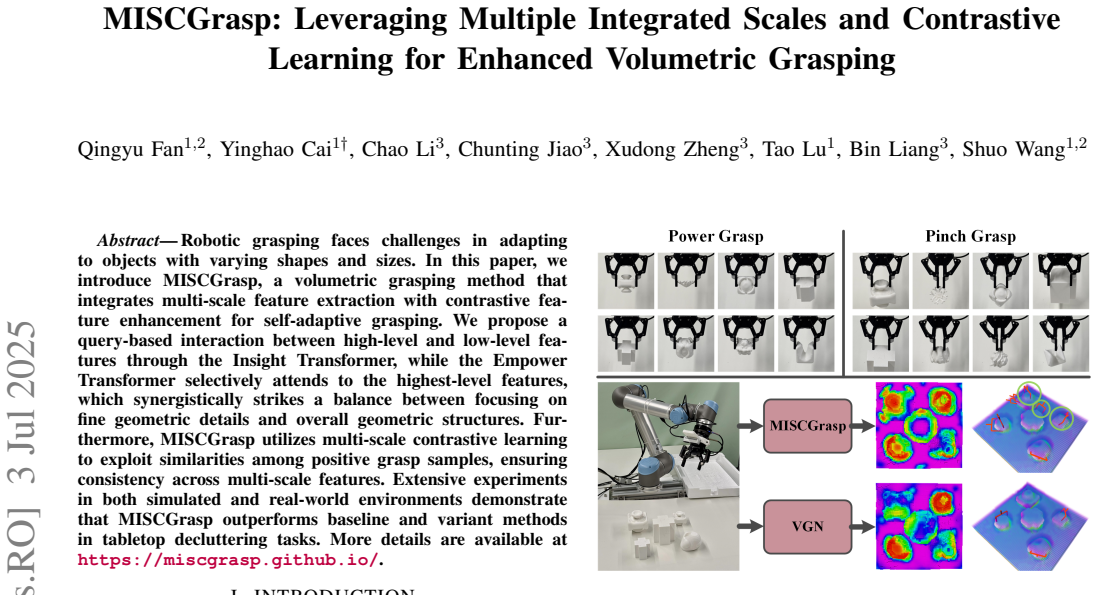
Pith's one-line read The paper claims that multi-scale feature fusion with positive-sample contrastive learning lets one volumetric grasping network produce both power and pinch grasps, beating VGN by 25.5 percentage points in declutter rate on pinch-heavy…
desk verdict A plausible architecture-level improvement over VGN, but the headline 25.5% number conflates dataset gains with method gains; needs a fairer baseline comparison and error bars before the claims hold up. read the letter →
The pith
A machine-rendered reading of the paper's core claim, the machinery that carries it, and where it could break.
The reading
What carries the argument
The load-bearing machinery is a three-level feature pyramid whose outputs are reconciled by two transformers before decoding. The Insight Transformer operates bottom-up: the high-level feature volume is used as a query, a channel attention map is computed from the low-level volume, and the low-level volume is downsampled and added back, so fine geometric details that deep convolutions would wash out are reinserted into the high-level representation. The Empower Transformer operates on the highest-level volume alone, splitting queries and keys into parts and mixing their softmax attention contributions with learned coefficients, which the paper says prevents overemphasis on self-attention and feature redundancy. After these two transformers, the refined features are concatenated and decoded into voxel-wise grasp quality, orientation, and width. A separate contrastive module interpolates embeddings at all feature levels at the positions of positive grasp labels, projects their concatenation with an MLP, stores them in a nearest-neighbor memory bank, and applies a cosine-similarity loss, so good grasps that are geometrically similar stay close in feature space at every scale.
What would settle it
Run the five-keypoint TSDF pre-pruning and full physics grasp trials on EGAD objects with thin protrusions and narrow cavities, and compare the positive/negative labels. Then retrain both MISCGrasp and VGN on full-trial labels; if the 25.5-point gap shrinks, or if the pre-pruning disagrees with physics trials specifically on pinch-grasp geometries, the training labels rather than the multi-scale architecture carry the reported gain.
Extended reading notes
Core claim
The paper's central claim is that the reason existing volumetric grasp networks miss pinch grasps is the loss of fine geometric detail in deeper layers, and that this can be repaired by explicit multi-scale fusion plus contrastive alignment of positive samples. Its MISCGrasp network uses a three-level FPN and two modules: an Insight Transformer that lets high-level features query low-level feature volumes for fine detail, and an Empower Transformer that applies a Mixture-of-Softmax-constrained self-attention to the highest-level volume to keep global structure. A contrastive head interpolates features at each scale at positive grasp positions, concatenates them, projects them into a shared space, and pulls each sample toward its nearest neighbor in a memory bank of positive embeddings. On this basis the authors report a 25.5-point gain in declutter rate over VGN on the pinch-heavy EGAD+Adv-Pile scenario, and a real-world pile declutter rate of 95.0% against VGN's 37.0%. They also show that VGN itself improves when trained on their dataset, which they take as evidence that the dataset's scaled EGAD objects provide the pinch-grasp supervision that earlier datasets lacked.
Load-bearing premise
The load-bearing assumption is that the five-keypoint TSDF collision check used to pre-prune grasp candidates labels positive and negative grasps as accurately as full physics grasp trials would; if it mislabels thin protrusions or narrow cavities, the training data is corrupted and the reported gains over VGN could be artifacts of the labels rather than the multi-scale architecture.
Editorial extensions
If this is right
- A single sparse-supervised volumetric network can handle both power and pinch grasps without a separate pinch planner, if the reported results reproduce.
- Training data diversity, specifically object scale and geometric complexity, is a first-order factor in decluttering performance; the paper shows even the baseline VGN improves when trained on the new dataset.
- The Insight and Empower Transformers do complementary work, with the Insight module mattering most in cluttered scenes and the Empower module mattering most in single-object scenes, so omitting either one degrades overall performance.
- Positive-only contrastive alignment is preferable to contrastive losses with negatives for this task, since the negative-sample variant performed slightly worse in most experiments in the paper.
- The simulation gains carry over to physical decluttering, with the method clearing 95.0% of a real-world pile versus 37.0% for VGN under the reported setup.
Reading between the lines
- Beyond the paper's reported experiments, the cleanest separation of data and architecture is to retrain MISCGrasp and VGN on a dataset labeled by full physics grasp trials instead of the five-keypoint TSDF pre-pruning; if the 25.5-point gap shrinks, the pre-pruning approximation, not the multi-scale design, is doing much of the work.
- The paper excludes point-cloud-based grasp detectors from comparison on input-type grounds, so whether multi-scale contrastive alignment transfers to point-cloud-based or other non-TSDF representations is an open question outside its claims.
- The random scaling range from 0.65 to 1.7 times gripper width is what injects pinch-grasp examples into training; an ablation that sweeps this range would quantify how much of the gain is data augmentation rather than network design.
- The positive-only memory-bank objective suggests a testable variant with a small number of hard negatives mined from near-miss grasps, since the paper's naive negative-sample variant added noise; such negatives might strengthen the representation without the observed degradation.
Signed reviews
Editorial analysis
A structured set of objections, weighed in public.
Referee Report
Summary. The paper proposes MISCGrasp, a volumetric 6-DoF grasp detection method built on a multi-scale Feature Pyramid Network with two transformer modules (Insight and Empower) for cross-scale and self-attention, and a contrastive learning module that pulls multi-scale features of positive grasp samples toward their nearest neighbors in a memory bank. The authors generate a new training dataset using EGAD objects with random scaling to cover both power and pinch grasps, and they evaluate in PyBullet simulation on EGAD single-object, pile, and packed scenes as well as in physical experiments with a UR5 and Robotiq gripper. The central claim is that MISCGrasp outperforms VGN, GIGA, and several variant methods, with a reported 25.5% improvement in declutter rate over VGN in pinch-focused experiments.
Significance. The multi-scale feature utilization and positive-sample contrastive learning are plausible and interesting contributions to the sparse-supervision volumetric grasping line of work, and the EGAD-based dataset with random scaling is a useful resource for studying power versus pinch grasps. The paper provides matched comparisons (MISCGrasp versus VGN trained on the same data) that favor MISCGrasp in most metrics, and the physical experiments support real-world viability. However, the headline improvement is overstated because it mixes dataset and architecture effects, the GIGA baseline is admitted to be at a disadvantage, and all simulation results are single-run point estimates without statistical support. The current evidence is suggestive rather than conclusive; with corrected reporting and additional validation, the method could make a solid contribution.
major comments (4)
- [Abstract; Section IV-B, Tables I and II] The headline improvement of 25.5% in declutter rate over VGN is not the matched comparison. The number corresponds to Table II (EGAD+ADV-Pile) where MISCGrasp (DR 62.3%) is compared to VGN trained on the regenerated VGN dataset (DR 36.8%), whereas VGN trained on the same MISCGrasp training data reaches DR 48.7%. Thus roughly 11.9 of the 25.5 percentage points come from the dataset change, not from the proposed architecture. The paper itself notes that VGN on the new dataset 'outperforms that trained on the VGN dataset by a large margin,' so the claim conflates dataset and method contributions. Please report the dataset-matched comparison as the central result and clearly decompose the contribution of the dataset and the architecture in the abstract and conclusions.
- [Section IV-B, baseline descriptions] The GIGA baseline is not compared on equal terms. The text concedes that GIGA was trained on a smaller dataset than its original design and at TSDF resolution 80 instead of 40. Reporting GIGA's low numbers in Tables I and II as evidence of MISCGrasp's superiority is not valid. Either retrain GIGA under the same data and resolution conditions as the other baselines (with whatever network-depth adjustments are used for VGN), or remove GIGA from the comparative tables and mention it only as an exploratory result with the caveat clearly stated.
- [Section IV-B, 'Results' and Tables I and II] All simulation results in Tables I and II are single-run point estimates with no variance, error bars, or significance tests. Several differences are small in absolute terms (e.g., Table II Packed-Packed DR 83.2% vs 82.6% for VGN on the same data), and some ablations go the other way (e.g., the intra-scene variant has a higher Packed-Packed DR of 87.7%). Without repeated seeds or confidence intervals, the claim that MISCGrasp 'outperforms' baselines and variants is not statistically supported. Please provide mean and standard deviation over at least 3-5 seeds, and indicate which differences are significant.
- [Section III-B, grasp data generation] The pre-pruning step that replaces full grasp attempts with a five-keypoint TSDF collision check is not validated, and the five keypoints are not specified. The text says 'use TSDF to check for collisions instead of performing full grasp attempts,' which suggests the positive/negative labels are derived from a geometric heuristic rather than physics-based grasp trials. If this approximation is inaccurate for thin protrusions, narrow cavities, or other pinch-grasp geometries, the training labels are corrupted and the reported gains relative to VGN could be artifacts. Please either (a) validate the pre-pruned labels against the original physics-based pipeline (e.g., agreement rate on a held-out set of grasp candidates), or (b) clarify that the pre-pruning only filters obvious collisions and that the final labels are still obtained from full grasping trials, and resolve the contradictory wording in Section III-B.
minor comments (5)
- [Section I and Section IV-A] The phrase 'the original implementation of VGN' in the Introduction is imprecise because Section IV-A states that network depths are adjusted and the input resolution is increased for all baselines; please specify exactly which VGN version is being compared.
- [Section III-E] The sentence 'We generate 5100 scenes for each scene type' is unclear because the evaluation uses three distinct scene types (Single, Pile, Packed); please specify which training scene types are used and how they map to the evaluation types.
- [Table I, caption] The 'Score' column in Table I is not defined in the caption or text; please explain how it is computed (for example, as the sum of the declutter rates).
- [Section III-C] The notation for the Insight Transformer uses Q, K, V in a different sense than in the Empower Transformer; please clarify the tensor shapes and the role of Convstride, and define the pooling axes in the AvgPool operation.
- [Section IV-C, Table IV] Table IV reports SR as 90.3% (186/206) but DR as 95.0% (190/200); since the denominators differ (grasp attempts versus objects), consider presenting both counts in the same units or adding a footnote to avoid confusion.
Circularity Check
No construction-level circularity: the grasping gains are externally evaluated, with experimental-fairness caveats that do not amount to circularity.
full rationale
No significant circularity found. MISCGrasp is an empirical learning system: the multi-scale FPN, Insight/Empower Transformers, and contrastive loss are trained with sparse grasp labels produced by a physics-based/TSDF pipeline and evaluated on external object sets (EGAD, Berkeley adversarial) against published baselines. The claimed improvements are not derived from the method's definitions; no equation in Section III reduces a prediction to a fitted input. The contrastive memory-bank target is a self-supervised training signal, but the reported result, declutter rate, is measured externally in simulation and on a physical robot, so it is not the training objective renamed as a prediction. There is no load-bearing self-citation: the cited prior work (VGN, GIGA, EGAD, NNCLR, CBAM, MoS) is external, and the paper's ablations compare against variants rather than invoking any self-authored uniqueness theorem. The paper itself admits evaluation caveats: 'The limited performance of GIGA is likely due to the smaller dataset size used in our experiments compared to the one used in GIGA. Additionally, the TSDF grid resolution is set to 80 in our experiments, differing from the 40 used in GIGA.' Also, the headline 25.5% improvement over VGN uses VGN trained on the original VGN dataset, whereas Table II shows VGN trained on the authors' matched dataset reaches 48.7% DR versus MISCGrasp's 62.3%, narrowing but not eliminating the gap. These are experimental-fairness concerns, not construction-level circularity, so they do not raise the circularity score above 1.
Assumptions & free parameters
free parameters (7)
- contrastive loss weight =
0.5
- TSDF grid resolution =
80
- object scaling range =
U(0.65,1.7)
- memory bank size =
32768
- embedding dimension =
128
- positive/negative BCE weight =
2:1
- ET mixture parts N =
2
assumptions (5)
- domain assumption Five-keypoint gripper simplification yields correct grasp labels.
- domain assumption The VGN-style sparse grasp trial pipeline provides sufficient supervision.
- domain assumption PyBullet physics transfer to the real UR5/Robotiq platform.
- domain assumption Multi-scale features from an FPN capture grasp-relevant geometry at the needed scales.
- domain assumption The NNCLR memory bank approximates the full positive-sample distribution.
Cite this review
Pith. "Pith review of MISCGrasp: Leveraging Multiple Integrated Scales and Contrastive Learning for Enhanced Volumetric Grasping." pith.science (2026). https://pith.science/paper/C46MMESR
@misc{pith2026250702672,
  author       = {Pith},
  title        = {Pith review of: MISCGrasp: Leveraging Multiple Integrated Scales and Contrastive Learning for Enhanced Volumetric Grasping},
  year         = {2026},
  howpublished = {\url{https://pith.science/paper/C46MMESR}},
  note         = {Machine review of arXiv:2507.02672}
}
read the original abstract
Robotic grasping faces challenges in adapting to objects with varying shapes and sizes. In this paper, we introduce MISCGrasp, a volumetric grasping method that integrates multi-scale feature extraction with contrastive feature enhancement for self-adaptive grasping. We propose a query-based interaction between high-level and low-level features through the Insight Transformer, while the Empower Transformer selectively attends to the highest-level features, which synergistically strikes a balance between focusing on fine geometric details and overall geometric structures. Furthermore, MISCGrasp utilizes multi-scale contrastive learning to exploit similarities among positive grasp samples, ensuring consistency across multi-scale features. Extensive experiments in both simulated and real-world environments demonstrate that MISCGrasp outperforms baseline and variant methods in tabletop decluttering tasks. More details are available at https://miscgrasp.github.io/.
Figures


Figures from the paper (1 more)

Reference graph
Works this paper leans on
-
[1]
Graspnet-1billion: A large- scale benchmark for general object grasping,
H.-S. Fang, C. Wang, M. Gou, and C. Lu, “Graspnet-1billion: A large- scale benchmark for general object grasping,” in Proceedings of the IEEE/CVF CVPR, 2020, pp. 11 444–11 453
work page 2020
-
[2]
Contact- graspnet: Efficient 6-dof grasp generation in cluttered scenes,
M. Sundermeyer, A. Mousavian, R. Triebel, and D. Fox, “Contact- graspnet: Efficient 6-dof grasp generation in cluttered scenes,” in 2021 IEEE ICRA. IEEE, 2021, pp. 13 438–13 444
work page 2021
-
[3]
Grasp- ness discovery in clutters for fast and accurate grasp detection,
C. Wang, H.-S. Fang, M. Gou, H. Fang, J. Gao, and C. Lu, “Grasp- ness discovery in clutters for fast and accurate grasp detection,” in Proceedings of the IEEE/CVF ICCV , 2021, pp. 15 964–15 973
work page 2021
-
[4]
V olumetric grasping network: Real-time 6 dof grasp detection in clutter,
M. Breyer, J. J. Chung, L. Ott, R. Siegwart, and J. Nieto, “V olumetric grasping network: Real-time 6 dof grasp detection in clutter,” in CoRL. PMLR, 2021, pp. 1602–1611
work page 2021
-
[5]
Synergies between affordance and geometry: 6-dof grasp detection via implicit representations,
Z. Jiang, Y . Zhu, M. Svetlik, K. Fang, and Y . Zhu, “Synergies between affordance and geometry: 6-dof grasp detection via implicit representations,” RSS, 2021
work page 2021
-
[6]
Orbitgrasp: Se (3)-equivariant grasp learning,
B. Hu, X. Zhu, D. Wang, Z. Dong, H. Huang, C. Wang, R. Walters, and R. Platt, “Orbitgrasp: Se (3)-equivariant grasp learning,” in CoRL. PMLR, 2024, pp. 2456–2474
work page 2024
-
[7]
X.-Y . Zhang, Y . Nakamura, K. Goda, and K. Yoshimoto, “Robustness of power grasp,” in 1994 IEEE ICRA . IEEE, 1994, pp. 2828–2835
work page 1994
-
[8]
The grasp taxonomy of human grasp types,
T. Feix, J. Romero, H.-B. Schmiedmayer, A. M. Dollar, and D. Kragic, “The grasp taxonomy of human grasp types,” IEEE Transactions on human-machine systems, vol. 46, no. 1, pp. 66–77, 2015
work page 2015
Show all 43 references
-
[9]
Human grasping database for activities of daily living with depth, color and kinematic data streams,
A. Saudabayev, Z. Rysbek, R. Khassenova, and H. A. Varol, “Human grasping database for activities of daily living with depth, color and kinematic data streams,” Scientific data, vol. 5, no. 1, pp. 1–13, 2018
2018
-
[10]
Softness-adaptive pinch-grasp strategy using fingertip tactile information of robot hand,
S. Park and D. Hwang, “Softness-adaptive pinch-grasp strategy using fingertip tactile information of robot hand,” IEEE RAL, vol. 6, no. 4, pp. 6370–6377, 2021
2021
-
[11]
Emergent hand morphology and control from optimizing robust grasps of diverse objects,
X. Pan, A. Garg, A. Anandkumar, and Y . Zhu, “Emergent hand morphology and control from optimizing robust grasps of diverse objects,” in 2021 IEEE ICRA . IEEE, 2021, pp. 7540–7547
2021
-
[12]
Acronym: A large-scale grasp dataset based on simulation,
C. Eppner, A. Mousavian, and D. Fox, “Acronym: A large-scale grasp dataset based on simulation,” in 2021 IEEE ICRA . IEEE, 2021, pp. 6222–6227
2021
-
[13]
Egad! an evolved grasping analysis dataset for diversity and reproducibility in robotic manipula- tion,
D. Morrison, P. Corke, and J. Leitner, “Egad! an evolved grasping analysis dataset for diversity and reproducibility in robotic manipula- tion,” IEEE RAL, vol. 5, no. 3, pp. 4368–4375, 2020
2020
-
[14]
An economic framework for 6-dof grasp detection,
X.-M. Wu, J.-F. Cai, J.-J. Jiang, D. Zheng, Y .-L. Wei, and W.-S. Zheng, “An economic framework for 6-dof grasp detection,” in ECCV. Springer, 2024, pp. 357–375
2024
-
[15]
Bigbird: A large-scale 3d database of object instances,
A. Singh, J. Sha, K. S. Narayan, T. Achim, and P. Abbeel, “Bigbird: A large-scale 3d database of object instances,” in 2014 IEEE ICRA . IEEE, 2014, pp. 509–516
2014
-
[16]
The ycb object and model set: Towards common benchmarks for manipulation research,
B. Calli, A. Singh, A. Walsman, S. Srinivasa, P. Abbeel, and A. M. Dollar, “The ycb object and model set: Towards common benchmarks for manipulation research,” in 2015 IEEE International Conference on Advanced Robotics. IEEE, 2015, pp. 510–517
2015
-
[17]
The princeton shape benchmark,
P. Shilane, P. Min, M. Kazhdan, and T. Funkhouser, “The princeton shape benchmark,” in Proceedings Shape Modeling Applications,
-
[18]
Dex-net 1.0: A cloud-based network of 3d objects for robust grasp planning using a multi-armed bandit model with correlated rewards,
J. Mahler, F. T. Pokorny, B. Hou, M. Roderick, M. Laskey, M. Aubry, K. Kohlhoff, T. Kr ¨oger, J. Kuffner, and K. Goldberg, “Dex-net 1.0: A cloud-based network of 3d objects for robust grasp planning using a multi-armed bandit model with correlated rewards,” in 2016 IEEE ICRA. ...
2016
-
[19]
3dnet: Large- scale object class recognition from cad models,
W. Wohlkinger, A. Aldoma, R. B. Rusu, and M. Vincze, “3dnet: Large- scale object class recognition from cad models,” in 2012 IEEE ICRA . IEEE, 2012, pp. 5384–5391
2012
-
[20]
The kit object models database: An object model database for object recognition, localization and manipulation in service robotics,
A. Kasper, Z. Xue, and R. Dillmann, “The kit object models database: An object model database for object recognition, localization and manipulation in service robotics,” IJRR, vol. 31, no. 8, pp. 927–934, 2012
2012
-
[21]
Domain randomization and generative models for robotic grasping,
J. Tobin, L. Biewald, R. Duan, M. Andrychowicz, A. Handa, V . Kumar, B. McGrew, A. Ray, J. Schneider, P. Welinder et al. , “Domain randomization and generative models for robotic grasping,” in 2018 IEEE/RSJ IROS. IEEE, 2018, pp. 3482–3489
2018
-
[22]
Efficient grasping from rgbd images: Learning using a new rectangle representation,
Y . Jiang, S. Moseson, and A. Saxena, “Efficient grasping from rgbd images: Learning using a new rectangle representation,” in 2011 IEEE ICRA. IEEE, 2011, pp. 3304–3311
2011
-
[23]
Dimensionality reduction by learning an invariant mapping,
R. Hadsell, S. Chopra, and Y . LeCun, “Dimensionality reduction by learning an invariant mapping,” in Proceedings of the IEEE/CVF CVPR, vol. 2. IEEE, 2006, pp. 1735–1742
2006
-
[24]
A simple frame- work for contrastive learning of visual representations,
T. Chen, S. Kornblith, M. Norouzi, and G. Hinton, “A simple frame- work for contrastive learning of visual representations,” in ICML. PMLR, 2020, pp. 1597–1607
2020
-
[25]
Momentum contrast for unsupervised visual representation learning,
K. He, H. Fan, Y . Wu, S. Xie, and R. Girshick, “Momentum contrast for unsupervised visual representation learning,” in Proceedings of the IEEE/CVF CVPR, 2020, pp. 9729–9738
2020
-
[26]
Exploring simple siamese representation learn- ing,
X. Chen and K. He, “Exploring simple siamese representation learn- ing,” in Proceedings of the IEEE/CVF CVPR, 2021, pp. 15 750–15 758
2021
-
[27]
With a little help from my friends: Nearest-neighbor contrastive learning of visual representations,
D. Dwibedi, Y . Aytar, J. Tompson, P. Sermanet, and A. Zisserman, “With a little help from my friends: Nearest-neighbor contrastive learning of visual representations,” in Proceedings of the IEEE/CVF ICCV, 2021, pp. 9588–9597
2021
-
[28]
6-dof contrastive grasp proposal network,
X. Zhu, L. Sun, Y . Fan, and M. Tomizuka, “6-dof contrastive grasp proposal network,” in 2021 IEEE ICRA. IEEE, 2021, pp. 6371–6377
2021
-
[29]
A self-supervised contrastive learning method for grasp outcomes prediction,
C. Liu, B. Huang, Y . Liu, Y . Su, K. Mai, Y . Zhang, Z. Yi, and X. Wu, “A self-supervised contrastive learning method for grasp outcomes prediction,” in 2023 IEEE International Conference on Real-time Computing and Robotics (RCAR) . IEEE, 2023, pp. 737–742
2023
-
[30]
Graspcontrast: Self-supervised contrastive learning with false negative elimination for 6-dof grasp detection,
W. Wang, H. Zhu, and M. H. Ang, “Graspcontrast: Self-supervised contrastive learning with false negative elimination for 6-dof grasp detection,” in 2024 IEEE/RSJ IROS . IEEE, 2024, pp. 7294–7300
2024
-
[31]
Feature pyramid networks for object detection,
T.-Y . Lin, P. Doll´ar, R. Girshick, K. He, B. Hariharan, and S. Belongie, “Feature pyramid networks for object detection,” in Proceedings of the IEEE CVPR, 2017, pp. 2117–2125
2017
-
[32]
Cbam: Convolutional block attention module,
S. Woo, J. Park, J.-Y . Lee, and I. S. Kweon, “Cbam: Convolutional block attention module,” in ECCV. Springer, 2018, pp. 3–19
2018
-
[33]
Breaking the softmax bottleneck: A high-rank rnn language model,
Z. Yang, Z. Dai, R. Salakhutdinov, and W. W. Cohen, “Breaking the softmax bottleneck: A high-rank rnn language model,” in 2018 ICLR, 2018
2018
-
[34]
Pytorch: An imperative style, high-performance deep learning library,
A. Paszke, S. Gross, F. Massa, A. Lerer, J. Bradbury, G. Chanan, T. Killeen, Z. Lin, N. Gimelshein, L. Antiga et al. , “Pytorch: An imperative style, high-performance deep learning library,” NeurIPS, vol. 32, 2019
2019
-
[35]
Adam: A method for stochastic optimiza- tion,
D. P. Kingma and J. Ba, “Adam: A method for stochastic optimiza- tion,” in 2015 ICLR, 2015
2015
-
[36]
Super-convergence: Very fast training of neural networks using large learning rates,
L. N. Smith and N. Topin, “Super-convergence: Very fast training of neural networks using large learning rates,” in Artificial intelligence and machine learning for multi-domain operations applications , vol. 11006. SPIE, 2019, pp. 369–386
2019
-
[37]
Edge grasp network: A graph-based se (3)-invariant approach to grasp detection,
H. Huang, D. Wang, X. Zhu, R. Walters, and R. Platt, “Edge grasp network: A graph-based se (3)-invariant approach to grasp detection,” in 2023 IEEE ICRA . IEEE, 2023, pp. 3882–3888
2023
-
[38]
Icgnet: A unified approach for instance-centric grasping,
R. Zurbr ¨ugg, Y . Liu, F. Engelmann, S. Kumar, M. Hutter, V . Patil, and F. Yu, “Icgnet: A unified approach for instance-centric grasping,” in 2024 IEEE ICRA . IEEE, 2024, pp. 4140–4146
2024
-
[39]
Pybullet, a python module for physics simulation for games, robotics and machine learning,
E. Coumans and Y . Bai, “Pybullet, a python module for physics simulation for games, robotics and machine learning,” 2016–2021, [Online]. Available: http://pybullet.org
2016
-
[40]
Open3d: A modern library for 3d data processing,
Q. Zhou, J. Park, and V . Koltun, “Open3d: A modern library for 3d data processing,” CoRR, vol. abs/1801.09847, 2018
2018 arXiv
-
[41]
Learning ambidextrous robot grasping policies,
J. Mahler, M. Matl, V . Satish, M. Danielczuk, B. DeRose, S. McKinley, and K. Goldberg, “Learning ambidextrous robot grasping policies,” Science Robotics, vol. 4, no. 26, p. eaau4984, 2019
2019
-
[42]
U-net: Convolutional networks for biomedical image segmentation,
O. Ronneberger, P. Fischer, and T. Brox, “U-net: Convolutional networks for biomedical image segmentation,” in MICCAI. Springer, 2015, pp. 234–241
2015
-
[2004]
IEEE, 2004, pp. 167–178
2004
Reviewed August 6, 2026 · model on record in the stance chip above.
Discussion (0). Continue with ORCID to comment.