REVIEW 3 major objections 5 minor 1 cited by
A Large Language Model-Empowered Agent for Reliable and Robust Structural Analysis
T0 review · 3 major / 5 minor · reviewed 2026-08-06 · deepseek-v4-flash
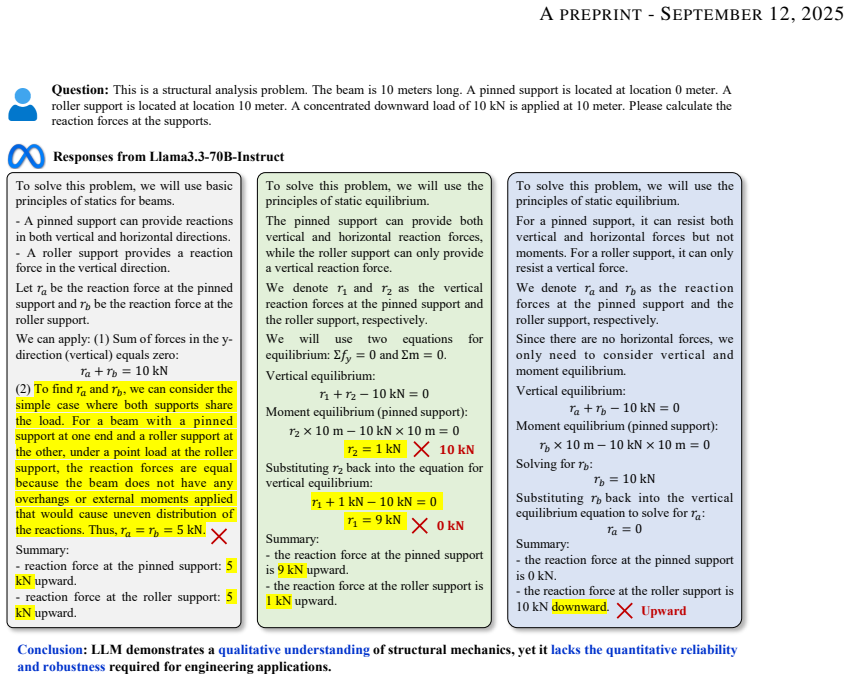
Pith's one-line read The paper's central claim is that turning beam analysis into a code-generation task—with chain-of-thought, a complete worked example, and automatic execution of the generated solver code—makes the Llama-3.3 70B Instruct model accurate on…
desk verdict A clean, honest ablation shows the agent's >99% reliability is real but almost entirely inherited from a few-shot template that closely matches the test problems; the paper deserves peer review but should be asked to release artifacts and scope the claim. read the letter →
The pith
A machine-rendered reading of the paper's core claim, the machinery that carries it, and where it could break.
The reading
What carries the argument
The central object is the agent's five-part prompt template: role specification, chain-of-thought reasoning steps, one complete worked example with full solver code, several function usage examples showing node placement and load application, and prescriptive constraints that force mandatory code blocks. The agent executes the generated code automatically in a finite-element solver and visualizes the results. The complete example and function usage examples do most of the work, since removing the complete example drops reliability to 0.000 and removing the function usage examples drops it to between 0.026 and 0.623 on the extended tasks.
What would settle it
Give the agent beam problems whose support and load pattern cannot be matched to any example in its prompt—for instance, a beam with an internal hinge or an inclined point load—and measure reliability over 500 runs; if it stays near 1.0 the agent generalizes, and if it falls toward the raw model's levels, the claimed robustness is an artifact of the hand-selected example library.
Extended reading notes
Core claim
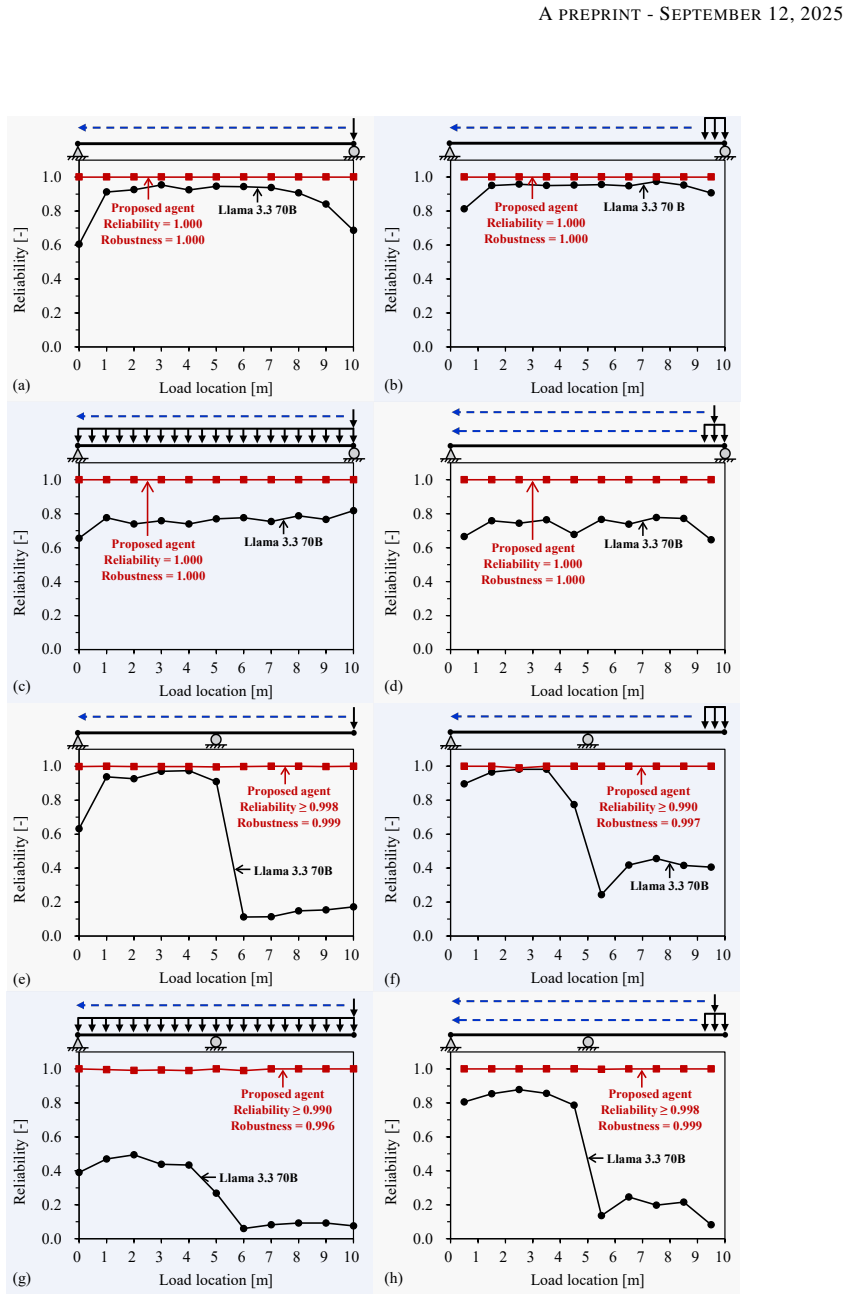
In the paper's own terms, the discovery is that reframing structural analysis from open-ended text generation to structured code generation converts a model with qualitative understanding but unreliable numerics into a consistent engineering tool. Reliability, defined as the fraction of correct outputs over 500 independent runs, reaches or exceeds 0.990 in every benchmark condition, and robustness, defined through the coefficient of variation of reliability across load positions, stays between 0.996 and 1.000; the same raw model scores as low as 0.060. The paper also establishes, through ablation, that the complete worked example and the function usage examples are the load-bearing components of this success.
Load-bearing premise
The near-perfect reliability numbers depend on each prompt carrying a complete worked example and function usage examples that closely match the target problem; the paper's own ablation shows that removing the complete example drops reliability to 0.000 on all three extended tasks.
Editorial extensions
If this is right
- A language model that currently fails the hardest beam cases can be made engineering-grade for statically determinate beams by letting it write code instead of doing arithmetic.
- The same code-generation shift should apply to a wider class of structural problems, because it removes arithmetic and sign conventions from the model's failure surface.
- The ablation result is a deployment warning: any practical tool built this way must ship a library of worked examples covering each structural topology, since the complete example alone is worth the entire performance margin.
- The two documented failure modes—hallucinated boundary conditions and misapplied load ranges—define exactly the cases a safety review must sample before release.
Reading between the lines
- Because the complete example in the prompt is nearly identical to the benchmark tasks, the claimed 99 percent is best understood as the reliability of a code-template-adaptation pipeline, not of a general structural-analysis capability.
- Testing on topologically novel beams—continuous beams with three supports, frames, or supports not matching any example—would likely drop reliability close to the raw model's level, since the removal experiments point to example matching as the source of accuracy.
- The robustness metric averages over load positions; a deployment that needs certifiable per-case correctness should report the worst-case reliability position, not the mean.
- A natural next step the paper does not test is execution-feedback self-correction: feeding the solver's error message back into the model could catch hallucinated supports and boundary conditions without larger example libraries.
Editorial analysis
A structured set of objections, weighed in public.
Referee Report
Summary. This paper evaluates the reliability and robustness of Llama-3.3 70B Instruct on eight beam structural-analysis problems and proposes an LLM-empowered agent that reframes the task as OpenSeesPy code generation. The agent uses a structured prompt with role specification, chain-of-thought, a complete worked example, function-usage examples, and prescriptive constraints, then automatically executes the generated code. The authors report that the agent achieves reliability above 0.990 and robustness above 0.996 on the benchmark, outperforming the baseline LLM, and they present ablation results on three extended tasks showing that removing the complete example or the function-usage examples sharply degrades performance.
Significance. If the central claim were established, this would be a useful demonstration that a code-generation agent with a deterministic solver can make a general-purpose LLM reliable for a narrow class of structural-analysis problems. The paper has several strengths: it adopts a concrete reliability definition based on repeated sampling, uses a deterministic solver for the executed code, and includes an ablation study that honestly exposes which prompt components matter. The visualization module and the reframing of text output into executable code are sensible contributions. However, the paper's headline claim of an agent that is 'reliable and robust across diverse conditions' is not supported by the evidence as presented, because the high performance is inherited from few-shot exemplars that closely match the test distribution.
major comments (3)
- [Section 4.3, Table 1] The ablation results undermine the central claim that the agent is reliable and robust. Removing the complete example drops reliability to 0.000 on all three extended tasks, and removing the function-usage examples drops reliability to 0.026, 0.296, and 0.623. Since the complete example and function-usage examples in Section 3.3 (Fig. 7) explicitly demonstrate the same load configuration that dominates the benchmark and extended tasks—a distributed load overlapping a point load—the reported >99% reliability is only established for problems that are near-duplicates of the prompt's worked examples. The abstract and Section 4.1 should be revised to scope the claim to template-matched problems, or the agent should be evaluated on problems whose load/geometry patterns are not present in the prompt.
- [Section 2.2, Eq. (1); Section 4.1, Fig. 8] No confidence intervals or sampling parameters (temperature, seed, decoding strategy) are reported for the 500-run reliability estimates. For n=500, the binomial standard error is about 0.004 to 0.022 depending on the proportion; several differences between reported reliability values in Fig. 4 and Fig. 8 are comparable to or smaller than this noise. The statement in Section 4.1 that the agent 'significantly outperforms' the baseline therefore lacks statistical support. The authors should report the sampling configuration and provide confidence intervals or hypothesis tests for the reliability proportions.
- [Section 2.2, Eq. (2); Section 4.1] The robustness metric is computed from the coefficient of variation of reliability across load locations. For the agent, reliability is at or near 1.0 in almost every subplot of Fig. 8, so the robustness values (0.996 to 1.000) largely reflect the saturation of the reliability measure rather than a meaningful invariance property. The interpretation of 'robustness over 0.996' should be tempered, and the metric should be discussed in light of its degeneracy when reliability is near its upper bound.
minor comments (5)
- [Abstract] The abstract contains a typo: 'OpeeSeesPy' should read 'OpenSeesPy'.
- [Section 2.2] The heading 'Workflows to assess reliabity and robustness' contains a typo: 'reliabity' should be 'reliability'.
- [Section 2.1] The phrase 'as an first step' should be 'as a first step'.
- [Throughout] The model name is inconsistently spelled as 'Llama' and 'LLaMA'; please standardize.
- [Section 4.1, Fig. 8] The figure labels alternate between 'Reliability = 1.000' and 'Reliability ≥ 0.990' without explaining why the lower bound differs across subplots; a consistent annotation would improve clarity.
Circularity Check
The >99% reliability claim is an in-sample evaluation: the prompt is iteratively tuned on the benchmark, and Table 1 shows reliability collapses to 0.000 without the complete example, which itself mirrors the test loading pattern.
-
fitted input called prediction
[Sec. 2.2 (Workflows to assess reliability and robustness), Sec. 4.1]
"Recognizing the sensitivity of LLM performance to prompt formulation, a series of prompt variants are designed and tested in a preliminary step. These variants explore different levels of descriptive detail and structural formatting. The prompt presented here represents the most effective formulation identified through iterative experiments, consistently yielding the highest reliability across various problems."
The prompt is explicitly selected to maximize reliability on the problems under study, then Sec. 4.1 reports 'the proposed agent consistently achieves reliability over 0.990' on the same benchmark. The reported reliability is therefore an in-sample score of a tuned input, not an out-of-sample prediction. The paper's own ablation (Table 1) confirms that the two tuned components—complete example and function usage examples—are the primary drivers of this score, so the 99% result is forced by prompt selection rather than by the model's general structural-analysis ability.
-
fitted input called prediction
[Sec. 3.3 (Fig. 7), Sec. 4.2, Sec. 4.3 (Table 1)]
"This is followed by three applied examples that demonstrate how to construct models in which a concentrated load lies within the span of a distributed load."
The complete example in Fig. 7 is a 10 kN point load at 7.5 m inside a 10 kN/m distributed load from 6 to 10 m, and the function usage examples teach exactly the same pattern. All three extended tasks in Fig. 9 combine a point load inside a distributed load. Table 1 shows that removing the complete example drops reliability to 0.000 on all three extended tasks, and removing the function usage examples drops it to 0.026/0.296/0.623. Thus the reported 'generalization' (1.000, 0.998, 0.996) is essentially the model copying the embedded template; the prediction reduces to the few-shot input by construction.
full rationale
No self-citation load-bearing chain or imported uniqueness theorem is present; the references are external and the OpenSeesPy executions are machine-checkable. The circularity concern is centered on the agent's evaluation protocol. Section 2.2 states the prompt was iteratively selected for the highest reliability on the benchmark problems, and Section 4.1 then reports that same benchmark as the agent's headline result; this is an in-sample, tuned-input evaluation. The stronger structural issue is template matching: the complete example and the function usage examples encode the exact combined-load configuration (a concentrated load within the span of a distributed load) that appears in benchmark conditions III/IV and in all three extended tasks. Table 1 shows that without these components reliability falls to 0.000 or to 0.026-0.623. Therefore the >99% accuracy is largely inherited from few-shot examples that are near-duplicates of the test distribution, and the 'robust and reliable across diverse conditions' claim is established only for template-matched problems. The paper is transparent about the ablation, which is why this is partial circularity (score 6) rather than a fully forced result (8 or 10).
Assumptions & free parameters
assumptions (5)
- domain assumption Static equilibrium equations (sum of forces and moments equal zero) are the correct and sufficient model for the beam reaction forces in the benchmark.
- domain assumption OpenSeesPy with a linear elastic beam-column element and static analysis produces the correct ground-truth reactions for these problems.
- ad hoc to paper The eight benchmark problems and three extended tasks are representative of structural analysis sufficient to support claims of reliability and robustness.
- ad hoc to paper Llama-3.3 70B Instruct is representative of current LLMs for drawing general conclusions about LLM reliability.
- ad hoc to paper The baseline prompt selected through iterative experiments is a fair and typical prompt for the baseline model.
Cite this review
Pith. "Pith review of A Large Language Model-Empowered Agent for Reliable and Robust Structural Analysis." pith.science (2026). https://pith.science/paper/LCTSLPYJ
@misc{pith2026250702938,
  author       = {Pith},
  title        = {Pith review of: A Large Language Model-Empowered Agent for Reliable and Robust Structural Analysis},
  year         = {2026},
  howpublished = {\url{https://pith.science/paper/LCTSLPYJ}},
  note         = {Machine review of arXiv:2507.02938}
}
read the original abstract
Large language models (LLMs) have exhibited remarkable capabilities across diverse open-domain tasks, yet their application in specialized domains such as civil engineering remains largely unexplored. This paper starts bridging this gap by evaluating and enhancing the reliability and robustness of LLMs in structural analysis of beams. Reliability is assessed through the accuracy of correct outputs under repetitive runs of the same problems, whereas robustness is evaluated via the performance across varying load and boundary conditions. A benchmark dataset, comprising eight beam analysis problems, is created to test the Llama-3.3 70B Instruct model. Results show that, despite a qualitative understanding of structural mechanics, the LLM lacks the quantitative reliability and robustness for engineering applications. To address these limitations, a shift is proposed that reframes the structural analysis as code generation tasks. Accordingly, an LLM-empowered agent is developed that (a) integrates chain-of-thought and few-shot prompting to generate accurate OpeeSeesPy code, and (b) automatically executes the code to produce structural analysis results. Experimental results demonstrate that the agent achieves accuracy exceeding 99.0% on the benchmark dataset, exhibiting reliable and robust performance across diverse conditions. Ablation studies highlight the complete example and function usage examples as the primary contributors to the agent's enhanced performance.
Figures


Figures from the paper (9 more)





Forward citations
Cited by 1 Pith paper
-
Automating structural reliability analysis with a multi-agent large language model framework
A multi-agent LLM framework automates structural reliability analysis from natural-language input to interpreted β and Pf, with a QLoRA-tuned method-planning agent.
Reference graph
Works this paper leans on
-
[1]
Ahn, J., Verma, R., Lou, R., Liu, D., Zhang, R., and Yin, W. (2024). ``Large language models for mathematical reasoning: Progresses and challenges.''\ arXiv preprint arXiv:2402.00157
arXiv 2024
-
[2]
Arora, A. and Arora, A. (2023). ``The promise of large language models in health care.''\ The Lancet , 401(10377), 641
work page 2023
-
[3]
Gao, Y., Xiong, Y., Gao, X., Jia, K., Pan, J., Bi, Y., Dai, Y., Sun, J., Wang, H., and Wang, H. (2023). ``Retrieval-augmented generation for large language models: A survey.''\ arXiv preprint arXiv:2312.10997 , 2, 1
arXiv 2023
-
[4]
Graham, S. G., Soltani, H., and Isiaq, O. (2023). ``Natural language processing for legal document review: categorising deontic modalities in contracts.''\ Artificial Intelligence and Law , 1--22
work page 2023
-
[5]
``The llama 3 herd of models.''\ arXiv preprint arXiv:2407.21783
Grattafiori, A., Dubey, A., Jauhri, A., Pandey, A., Kadian, A., Al-Dahle, A., Letman, A., Mathur, A., Schelten, A., Vaughan, A., et al.\@ (2024). ``The llama 3 herd of models.''\ arXiv preprint arXiv:2407.21783
arXiv 2024
-
[6]
Guo, D., Yang, D., Zhang, H., Song, J., Zhang, R., Xu, R., Zhu, Q., Ma, S., Wang, P., Bi, X., et al.\@ (2025). ``Deepseek-r1: Incentivizing reasoning capability in llms via reinforcement learning.''\ arXiv preprint arXiv:2501.12948
arXiv 2025
-
[7]
Hoes, P., Hensen, J. L., Loomans, M. G., de Vries, B., and Bourgeois, D. (2009). ``User behavior in whole building simulation.''\ Energy and buildings , 41(3), 295--302
work page 2009
-
[8]
J., Shen, Y., Wallis, P., Allen-Zhu, Z., Li, Y., Wang, S., Wang, L., Chen, W., et al.\@ (2022)
Hu, E. J., Shen, Y., Wallis, P., Allen-Zhu, Z., Li, Y., Wang, S., Wang, L., Chen, W., et al.\@ (2022). ``Lora: Low-rank adaptation of large language models..''\ ICLR , 1(2), 3
work page 2022
Show all 40 references
-
[9]
``A survey on hallucination in large language models: Principles, taxonomy, challenges, and open questions.''\ ACM Transactions on Information Systems , 43(2), 1--55
Huang, L., Yu, W., Ma, W., Zhong, W., Feng, Z., Wang, H., Chen, Q., Peng, W., Feng, X., Qin, B., et al.\@ (2025). ``A survey on hallucination in large language models: Principles, taxonomy, challenges, and open questions.''\ ACM Transactions on Information Systems , 43(2), 1--55
2025
-
[10]
Imani, S., Du, L., and Shrivastava, H. (2023). ``Mathprompter: Mathematical reasoning using large language models.''\ arXiv preprint arXiv:2303.05398
2023 arXiv
-
[11]
Jeoung, J., Jung, S., and Hong, T. (2025). ``Zero-shot framework for construction equipment task monitoring.''\ Computer-Aided Civil and Infrastructure Engineering
2025
-
[12]
Ji, B., Duan, X., Zhang, Y., Wu, K., and Zhang, M. (2024). ``Zero-shot prompting for llm-based machine translation using in-domain target sentences.''\ IEEE/ACM Transactions on Audio, Speech, and Language Processing
2024
-
[13]
Joffe, I., Felobes, G., Elgouhari, Y., Talebi Kalaleh, M., Mei, Q., and Chui, Y. H. (2025). ``The framework and implementation of using large language models to answer questions about building codes and standards.''\ Journal of Computing in Civil Engineering , 39(4), 05025004
2025
-
[14]
Kim, M.-Y., Rabelo, J., Babiker, H. K. B., Rahman, M. A., and Goebel, R. (2024). ``Legal information retrieval and entailment using transformer-based approaches.''\ The Review of Socionetwork Strategies , 18(1), 101--121
2024
-
[15]
S., and Suh, H
Kim, T., Yun, T. S., and Suh, H. S. (2025). ``Can chatgpt implement finite element models for geotechnical engineering applications?.''\ International Journal for Numerical and Analytical Methods in Geomechanics
2025
-
[16]
Kokot, S. (2024). ``Opsvis documentation. Accessed: 2025-06-07
2024
-
[17]
and Shi, C
Li, H. and Shi, C. (2025). ``Few-shot learning of geological cross-sections from sparse data using large language model.''\ Geodata and AI , 2, 100010
2025
-
[18]
B., Zi, Y., Muennighoff, N., Kocetkov, D., Mou, C., Marone, M., Akiki, C., Li, J., Chim, J., et al.\@ (2023)
Li, R., Allal, L. B., Zi, Y., Muennighoff, N., Kocetkov, D., Mou, C., Marone, M., Akiki, C., Li, J., Chim, J., et al.\@ (2023). ``Starcoder: may the source be with you!.''\ arXiv preprint arXiv:2305.06161
2023 arXiv
-
[19]
and Tang, Y
Lopez-Lira, A. and Tang, Y. (2023). ``Can chatgpt forecast stock price movements? return predictability and large language models.''\ arXiv preprint arXiv:2304.07619
2023
-
[20]
Lu, Y., Zhu, W., Li, L., Qiao, Y., and Yuan, F. (2024). ``Llamax: Scaling linguistic horizons of llm by enhancing translation capabilities beyond 100 languages.''\ arXiv preprint arXiv:2407.05975
2024 arXiv
-
[21]
Lv, K., Yang, Y., Liu, T., Gao, Q., Guo, Q., and Qiu, X. (2023). ``Full parameter fine-tuning for large language models with limited resources.''\ arXiv preprint arXiv:2306.09782
2023 arXiv
-
[22]
``Gpt-4o: Openai's multimodal flagship model
OpenAI (2024). ``Gpt-4o: Openai's multimodal flagship model. Accessed: 2025-05-21
2024
-
[23]
Pandey, S., Xu, R., Wang, W., and Chu, X. (2025). ``Openfoamgpt: A retrieval-augmented large language model (llm) agent for openfoam-based computational fluid dynamics.''\ Physics of Fluids , 37(3)
2025
-
[24]
and Shi, C
Qian, Z. and Shi, C. (2025). ``Large language model-empowered paradigm for automated geotechnical site planning and geological characterization.''\ Automation in Construction , 173, 106103
2025
-
[25]
E., Adi, Y., Liu, J., Sauvestre, R., Remez, T., et al.\@ (2023)
Roziere, B., Gehring, J., Gloeckle, F., Sootla, S., Gat, I., Tan, X. E., Adi, Y., Liu, J., Sauvestre, R., Remez, T., et al.\@ (2023). ``Code llama: Open foundation models for code.''\ arXiv preprint arXiv:2308.12950
2023 arXiv
-
[26]
B., Alvarez-Melis, D., and Fusi, N
Shen, J., Tenenholtz, N., Hall, J. B., Alvarez-Melis, D., and Fusi, N. (2024). ``Tag-llm: Repurposing general-purpose llms for specialized domains.''\ arXiv preprint arXiv:2402.05140
2024 arXiv
-
[27]
H., Wu, J., Washington, C., Sadler, B
Song, C. H., Wu, J., Washington, C., Sadler, B. M., Chao, W.-L., and Su, Y. (2023). ``Llm-planner: Few-shot grounded planning for embodied agents with large language models.''\ Proceedings of the IEEE/CVF international conference on computer vision , 2998--3009
2023
-
[28]
J., Ting, D
Thirunavukarasu, A. J., Ting, D. S. J., Elangovan, K., Gutierrez, L., Tan, T. F., and Ting, D. S. W. (2023). ``Large language models in medicine.''\ Nature medicine , 29(8), 1930--1940
2023
-
[29]
Tonmoy, S., Zaman, S., Jain, V., Rani, A., Rawte, V., Chadha, A., and Das, A. (2024). ``A comprehensive survey of hallucination mitigation techniques in large language models.''\ arXiv preprint arXiv:2401.01313 , 6
2024 arXiv
-
[30]
V., Zhou, D., et al.\@ (2022)
Wei, J., Wang, X., Schuurmans, D., Bosma, M., Xia, F., Chi, E., Le, Q. V., Zhou, D., et al.\@ (2022). ``Chain-of-thought prompting elicits reasoning in large language models.''\ Advances in neural information processing systems , 35, 24824--24837
2022
-
[31]
Wei, J., Zhuo, L., Fu, X., Zeng, X., Wang, L., Zou, Q., and Cao, D. (2024). ``Drugrealign: a multisource prompt framework for drug repurposing based on large language models.''\ BMC biology , 22(1), 226
2024
-
[32]
Wu, T., Terry, M., and Cai, C. J. (2022). ``Ai chains: Transparent and controllable human-ai interaction by chaining large language model prompts.''\ Proceedings of the 2022 CHI conference on human factors in computing systems , 1--22
2022
-
[33]
Yang, X., Li, Y., Zhang, X., Chen, H., and Cheng, W. (2023). ``Exploring the limits of chatgpt for query or aspect-based text summarization.''\ arXiv preprint arXiv:2302.08081
2023 arXiv
-
[34]
Yu, T., Jing, Y., Zhang, X., Jiang, W., Wu, W., Wang, Y., Hu, W., Du, B., and Tao, D. (2025). ``Benchmarking reasoning robustness in large language models.''\ arXiv preprint arXiv:2503.04550
2025 arXiv
-
[35]
Zhang, B., Yang, H., Zhou, T., Ali Babar, M., and Liu, X.-Y. (2023). ``Enhancing financial sentiment analysis via retrieval augmented large language models.''\ Proceedings of the fourth ACM international conference on AI in finance , 349--356
2023
-
[36]
Zhang, T., Ladhak, F., Durmus, E., Liang, P., McKeown, K., and Hashimoto, T. B. (2024a). ``Benchmarking large language models for news summarization.''\ Transactions of the Association for Computational Linguistics , 12, 39--57
2024
-
[37]
Zhang, W., Li, Y., Dong, Z., Wu, Y., Zhou, Y., Wang, D., Xing, S., Zhou, C., and Shen, D. (2024b). ``Renaissance of literate programming in the era of llms: Enhancing llm-based code generation in large-scale projects.''\ arXiv preprint arXiv:2502.17441
2024 arXiv
-
[38]
and Goodfellow, S
Zhong, Y. and Goodfellow, S. D. (2024). ``Domain-specific language models pre-trained on construction management systems corpora.''\ Automation in Construction , 160, 105316
2024
-
[39]
Zhu, M., McKenna, F., and Scott, M. H. (2018). ``Openseespy: Python library for the opensees finite element framework.''\ SoftwareX , 7, 6--11
2018
-
[40]
Zhu, W., Liu, H., Dong, Q., Xu, J., Huang, S., Kong, L., Chen, J., and Li, L. (2023). ``Multilingual machine translation with large language models: Empirical results and analysis.''\ arXiv preprint arXiv:2304.04675
2023 arXiv
Reviewed August 6, 2026 · model on record in the stance chip above.
Discussion (0). Sign in to comment.