REVIEW 4 major objections 5 minor 23 references
Iterative Zoom-In: Temporal Interval Exploration for Long Video Understanding
T0 review · 4 major / 5 minor · reviewed 2026-08-06 · deepseek-v4-flash
Pith's one-line read The paper argues that a model's own confidence across temporal intervals is a reliable guide to where the answer lies, and that iteratively zooming into confident intervals improves long-video question answering across multiple models…
desk verdict A useful training-free temporal search for long-video QA with a real ablative gap: confidence guidance isn't yet isolated from raw compute. read the letter →
The pith
A machine-rendered reading of the paper's core claim, the machinery that carries it, and where it could break.
The reading
What carries the argument
The central machinery is a temporal-interval confidence signal and a best-first tree search over intervals. A node is a pair $(s,e)$ of start and end frame indices together with a predicted answer and a score; the score combines $\mathrm{Conf}(I,Q)$, the average token log-probability of the generated answer tokens from Equation (2), with a prompted binary self-evaluation of whether the predicted answer is correct. Because the number of sampled frames per interval is fixed, shorter intervals force finer temporal perception, so repeated zooming into a high-confidence interval is the mechanism that resolves fine detail. Each selected node is expanded in two ways: the model proposes sub-intervals it thinks are relevant, and the interval is split uniformly. A global keyframe memory carries descriptions of promising frames forward so later steps retain cross-interval awareness. The same prompts, thresholds, and eight-frame budget are reused across models, which is what makes the framework training-free and model-agnostic.
What would settle it
On a held-out long-video benchmark, bin interval-level predictions by the confidence score from Equation (2) and check whether accuracy rises as confidence rises; if it does not, or if expanding randomly chosen intervals instead of high-confidence ones matches TS-BFS's accuracy, the central signal is not doing the work.
Extended reading notes
Core claim
The paper's discovery claim is that confidence, computed as the average log-probability of the generated answer tokens, is a reliable search signal for temporal localization in long-video question answering. Across the tested models, correct predictions receive higher average confidence than incorrect ones at both the video level and the interval level, and accuracy climbs as the confidence threshold rises. The authors turn this correlation into a procedure: the model proposes or splits candidate temporal intervals, answers using a fixed small frame budget sampled from each interval, scores each node by confidence plus a model self-evaluation of correctness, and repeats until a high-confidence answer is found. The headline result is that this search, without any finetuning, consistently beats uniform sampling and static temporal voting, and on the largest tested model raises accuracy by about six points on both benchmarks.
Load-bearing premise
The method stands on the premise that a model's average token confidence over a temporal interval tracks the chance its answer is correct, so the search can trust higher confidence as a sign that it has zoomed into the right place.
Editorial extensions
If this is right
- Any vision-language model that exposes token log-probabilities can get an immediate, training-free accuracy gain on long-video QA by running TS or TS-BFS.
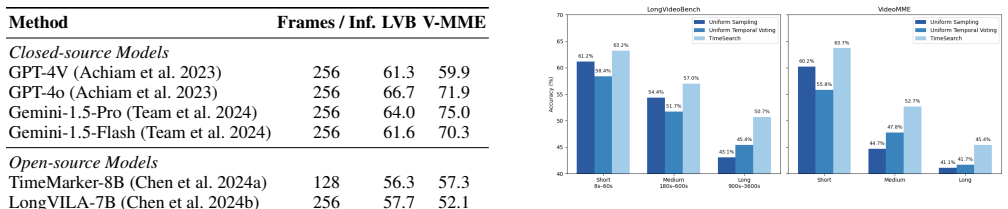
- With only eight frames per inference, TS-BFS on a 7B model surpasses single-pass baselines that use 128 or 256 frames, so the method changes the expected compute-accuracy tradeoff for hour-long videos.
- Accuracy improves as the number of search iterations grows, unlike uniform sampling and static voting, meaning inference budget can be spent adaptively rather than uniformly.
- Stored keyframe descriptions let the model answer from cross-interval evidence, so the gain is not just from local zooming but from accumulated global context.
- The gain persists across multiple model families and across short, medium, and long video durations, suggesting the confidence signal generalizes.
Reading between the lines
- A testable extension is to apply confidence-guided interval search to other modalities with a one-dimensional ordering, such as long audio, text documents, or long transcripts, where the same question of where the evidence lives arises.
- The node-scoring scheme could be combined with cheaper visual token pruning: prune tokens within an interval but keep the interval search, potentially raising the effective frame budget without raising memory.
- Because the method is training-free, the searched intervals and their keyframe descriptions could be logged as pseudo-labels for training a lightweight temporal proposer that predicts relevant intervals in a single pass.
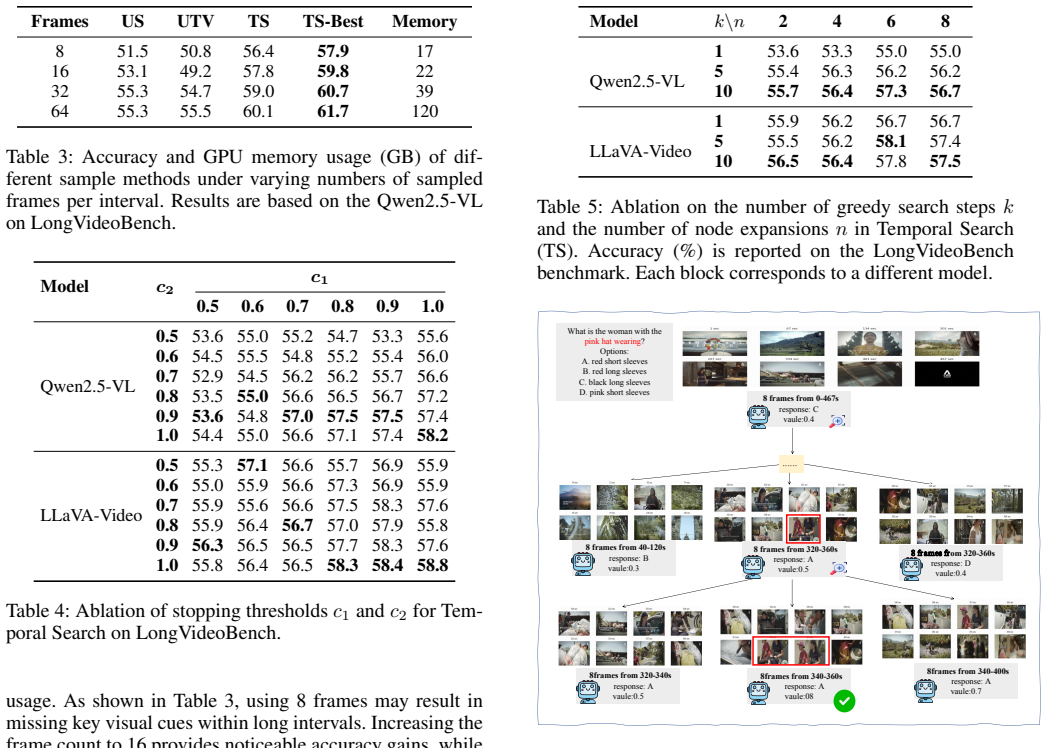
- The dependence on thresholds $c_1=0.9$ and $c_2=0.7$ suggests the method will need recalibration on models with differently calibrated confidence, since absolute log-probability scales vary across checkpoints.
Editorial analysis
A structured set of objections, weighed in public.
Referee Report
Summary. The paper introduces Temporal Search (TS) and its best-first variant TS-BFS, training-free inference-time procedures that iteratively zoom into temporal intervals of long videos for video question answering. The core assumption is that a model's average token log-probability over an interval, computed via Equation (2), is strongly correlated with prediction accuracy, and that this confidence signal can guide a search over temporal intervals. TS proposes one new interval per step, while TS-BFS maintains a priority queue of intervals, expands nodes by heuristic proposal and uniform splitting, evaluates children by confidence plus a self-evaluation score, and stores keyframe descriptions in a global memory. Experiments on LongVideoBench and VideoMME with Qwen2.5-VL, LLaVA-Video, and LLaVA-OV report consistent accuracy gains over uniform sampling and uniform temporal voting, with the headline result being 51.5% to 57.9% on LongVideoBench for Qwen2.5-VL.
Significance. If the empirical claim holds, the contribution is practically valuable: a training-free method that improves long-video QA by several points across multiple model families, using only a fixed small number of frames per inference call. The paper is honest in presenting the method as an empirical search procedure, and the ablations over frame counts, thresholds, search depth, and video duration provide useful evidence of robustness. However, the central mechanism of the method is confidence-guided node selection, and the current experiments do not isolate this mechanism from the confounding factor of increased total inference compute. The manuscript also contains a concrete algorithmic bug in the early-stopping logic and an under-specified node-value formula. These issues prevent the paper from being accepted in its current form, but they are addressable with additional controlled experiments and clarifications.
major comments (4)
- [§4.2, Table 2; Algorithm 2] The reported gains are not shown to come from confidence-guided selection rather than from the much larger number of inference passes. With k=5 and n=6, TS-BFS makes approximately 2 + k(1 + 2n) = 67 pθ calls per video (plus additional keyframe calls when γ′ > c2), whereas Uniform Sampling makes one call and the call count for Uniform Temporal Voting is not specified. The paper reports only frames per inference, which masks the total compute. To support the central claim, the authors should add a compute-matched baseline that uses the same number of inference calls and the same hierarchical interval coverage but without the confidence-based selection rule (for example, a uniform breadth-first tree with the same node budget), and they should report total inference calls and end-to-end latency for all methods.
- [Algorithm 2, lines 22–27] The early-return branch is unreachable because the thresholds are ordered incorrectly. Since c2 < c1 (default c2=0.7, c1=0.9), the condition γ′ > c2 is satisfied whenever γ′ > c1, so the outer branch always executes and the else-if branch that returns the high-confidence prediction never runs. This means the described termination behavior — stopping when a segment's confidence exceeds c1 — is not actually implemented in TS-BFS. The two conditions must be reordered so that γ′ > c1 is checked before γ′ > c2. This is load-bearing for the efficiency claim of early stopping and for reproducibility.
- [§3.2, Node Evaluation] The formula for the node value score is not given in a usable form. The text states "Value(S, Q) =· Conf(S, Q) +· Eval(y)" with the weights α and β missing, and no ablation of these weights is provided. Since node selection in TS-BFS depends directly on this score, the paper must specify the exact formula, how the Eval score is computed from the binary yes/no probability, and whether α and β are fixed or tuned. Without this, the search algorithm cannot be reproduced from the manuscript.
- [Tables 1–5] All accuracy numbers are reported as single-run point estimates with no variance, confidence intervals, or significance tests. Given that several reported gains are small (e.g., UTV vs. TS on VideoMME for LLaVA-Video is 54.7 vs. 55.6, and several threshold combinations in Table 4 differ by less than a point), the reader cannot assess whether the improvements are stable or within run-to-run noise. The authors should report averaged results over multiple runs or at least provide statistical significance measures for the headline comparisons.
minor comments (5)
- [Abstract and §1] The abstract and Section 1 attribute the 57.9% LongVideoBench and 55.1% VideoMME results to "TS" and "TS-BFS" interchangeably, but Table 2 shows these numbers are for TS-BFS, while vanilla TS achieves 56.4% and 53.6% respectively. Please correct the attribution.
- [Table 4] The table axes appear to be inconsistent with the text. The text says "moderately high values of the key-frame acceptance threshold c1" and "stricter early termination thresholds c2", but the table is labeled with c2 on rows and c1 on columns, and the described effect directions do not match the table entries. Please clarify which axis corresponds to which threshold and align the description with the data.
- [Figure 7 and Table 3] There are typos in Figure 7 ("vaule" for "value") and in Table 3 ("TS-Best" should be "TS-BFS"). Also, the intervals in Figure 7 are formatted inconsistently (e.g., "40-120s" vs. "340-360s" vs. "0-467s").
- [Figure 4 legend] The legend contains garbled model names, including "LLaV A-One" (presumably LLaVA-OneVision), "LLaV A-Video", and "Qwen2.5-VL" with inconsistent spacing and diacritics. Please clean up the legend and ensure the model names match the rest of the paper.
- [§4.4, paragraph after Table 4] The sentence "moderately high values of the key-frame acceptance threshold c1 help avoid premature convergence" is confusing because c1 is the stopping threshold in Algorithm 1, not the keyframe acceptance threshold (which is c2). Please rephrase to avoid conflating the two thresholds.
Circularity Check
No significant circularity: the confidence–accuracy premise is measured before use, and the search gains are evaluated on external benchmarks.
full rationale
The paper makes an empirical, not definitional, claim: Eq. (2) defines confidence as average token log-probability, and Section 4.1 measures the correlation between this quantity and answer correctness (Table 1, Figure 4) before using it to guide interval selection. The central result (TS/TS-BFS accuracy on LongVideoBench and VideoMME, Table 2) is an externally evaluated outcome rather than a restatement of a fitted parameter: no accuracy number is fitted to the test set and then reported as a prediction. The stopping thresholds, search depth, and expansion count are tuned via ablations on the benchmark; this is a potential overfitting or selection concern, not circularity. References to prior work are baseline model and evaluation-protocol citations and are not load-bearing in the sense of importing an unverified premise that already assumes the conclusion. The lack of a compute-matched, confidence-free control is a legitimate experimental-rigor critique, but it does not make any equation or result equivalent to its own input by construction.
Assumptions & free parameters
free parameters (6)
- c1 (stopping confidence threshold) =
0.9
- c2 (keyframe acceptance threshold) =
0.7
- k (maximum iterations) =
5
- n (expansions per step) =
6
- nf (frames per interval) =
8
- alpha and beta weights in Value(S,Q)
assumptions (4)
- domain assumption Model confidence computed as average token log-probability (Eq. 2) is positively correlated with answer correctness at video and interval levels.
- domain assumption The VideoLLM can propose useful temporal intervals via Expand_Prompt.
- domain assumption Uniformly sampling nf frames from a shorter interval captures finer temporal detail than from the full video.
- domain assumption Textual keyframe descriptions stored in K preserve cross-segment context without frame-level details.
Cite this review
Pith. "Pith review of Iterative Zoom-In: Temporal Interval Exploration for Long Video Understanding." pith.science (2026). https://pith.science/paper/RLZI2BRX
@misc{pith2026250702946,
  author       = {Pith},
  title        = {Pith review of: Iterative Zoom-In: Temporal Interval Exploration for Long Video Understanding},
  year         = {2026},
  howpublished = {\url{https://pith.science/paper/RLZI2BRX}},
  note         = {Machine review of arXiv:2507.02946}
}
read the original abstract
Multimodal Large Language Models (MLLMs) have shown strong performance in video understanding tasks. However, they continue to struggle with long-form videos because of an inefficient perception of temporal intervals. Unlike humans, who can dynamically adjust their temporal focus to locate query-relevant moments, current MLLMs often rely on dense, uniform sampling across the video timeline, leading to high memory consumption and a risk of missing crucial information. To address this challenge, we introduce Temporal Search, a training-free framework that enables MLLMs to explore temporal regions for improved long video understanding iteratively. TS is based on a key observation: the model's generation confidence across different temporal intervals is highly correlated with prediction accuracy. TS operates through two main iterative stages. First, the MLLM proposes a temporal interval that is likely to contain task-relevant information. Then, it samples a fixed number of frames from the interval, regardless of length, and feeds them into the model to produce a refined response and confidence score. TS refines the focus of the model by iteratively shifting attention to more fine-grained temporal intervals, improving its understanding of long videos. Additionally, keyframe-level descriptions are collected to facilitate cross-interval perception throughout the video. To further improve efficiency, we introduce TS-BFS, a best-first search strategy over a tree. Each node represents a candidate interval and is expanded via two methods: self-driven proposals and uniform partitioning. Nodes are scored based on confidence and self-evaluation, and the most promising one is selected for continued exploration.
Figures


Figures from the paper (4 more)


Reference graph
Works this paper leans on
-
[3]
Qwen2. 5-vl technical report. arXiv preprint arXiv:2502.13923. Chen, S.; Lan, X.; Yuan, Y .; Jie, Z.; and Ma, L. 2024a. Timemarker: A versatile video-llm for long and short video understanding with superior temporal localization ability. arXiv preprint arXiv:2411.18211. Chen, X.; Lin, Y .; Zhang, Y .; and Huang, W
-
[4]
arXiv preprint arXiv:2311.14906
Autoeval- video: An automatic benchmark for assessing large vision language models in open-ended video question answering. arXiv preprint arXiv:2311.14906. Chen, Y .; Xue, F.; Li, D.; Hu, Q.; Zhu, L.; Li, X.; Fang, Y .; Tang, H.; Yang, S.; Liu, Z.; et al. 2024b. Longvila: Scaling long-context visual language models for long videos. arXiv preprint arXiv:24...
-
[5]
arXiv preprint arXiv:2504.02438
Scaling Video-Language Models to 10K Frames via Hierarchical Differential Distillation. arXiv preprint arXiv:2504.02438. Dechter, R.; and Pearl, J
-
[7]
arXiv preprint arXiv:2503.21776
Video-r1: Reinforcing video reasoning in mllms. arXiv preprint arXiv:2503.21776. Frederick, S
-
[8]
arXiv preprint arXiv:2405.21075
Video- mme: The first-ever comprehensive evaluation benchmark of multi-modal llms in video analysis. arXiv preprint arXiv:2405.21075. Hao, S.; Gu, Y .; Ma, H.; Hong, J. J.; Wang, Z.; Wang, D. Z.; and Hu, Z
-
[9]
arXiv preprint arXiv:2305.14992
Reasoning with language model is plan- ning with world model. arXiv preprint arXiv:2305.14992. Huang, S.; Zhang, H.; Gao, Y .; Hu, Y .; and Qin, Z
-
[10]
From Image to Video, what do we need in multimodal LLMs? arXiv preprint arXiv:2404.11865. Korf, R. E
-
[12]
arXiv preprint arXiv:2305.06355
Videochat: Chat-centric video understanding. arXiv preprint arXiv:2305.06355. Li, K.; Wang, Y .; He, Y .; Li, Y .; Wang, Y .; Liu, Y .; Wang, Z.; Xu, J.; Chen, G.; Luo, P.; et al. 2024b. Mvbench: A com- prehensive multi-modal video understanding benchmark. In Proceedings of the IEEE/CVF Conference on Computer Vi- sion and Pattern Recognition, 22195–22206....
Show all 23 references
-
[13]
arXiv preprint arXiv:2311.10122
Video-llava: Learning united visual representation by align- ment before projection. arXiv preprint arXiv:2311.10122. Liu, H.; Li, C.; Wu, Q.; and Lee, Y . J
-
[14]
arXiv preprint arXiv:2411.02327
Ppllava: Varied video sequence understanding with prompt guidance. arXiv preprint arXiv:2411.02327. Nguyen, T.; Bin, Y .; Xiao, J.; Qu, L.; Li, Y .; Wu, J. Z.; Nguyen, C.-D.; Ng, S.-K.; and Tuan, L. A
-
[15]
arXiv preprint arXiv:2406.05615
Video- language understanding: A survey from model architec- ture, model training, and data perspectives. arXiv preprint arXiv:2406.05615. Nie, Y .; Wang, H.; Wang, Y .; Huang, C.; Lin, L.; and Li, G. ???? Video Q-Former: Multimodal Large Language Model with Spatio-Temporal Qu...
-
[16]
arXiv preprint arXiv:2311.16103
Video-bench: A comprehensive benchmark and toolkit for evaluating video-based large lan- guage models. arXiv preprint arXiv:2311.16103. Paternoster, R.; and Pogarsky, G
-
[17]
Shu, Y .; Liu, Z.; Zhang, P.; Qin, M.; Zhou, J.; Liang, Z.; Huang, T.; and Zhao, B
ZoomEye: Enhancing Multimodal LLMs with Human-Like Zooming Capabilities through Tree- Based Image Exploration.arXiv preprint arXiv:2411.16044. Shu, Y .; Liu, Z.; Zhang, P.; Qin, M.; Zhou, J.; Liang, Z.; Huang, T.; and Zhao, B
-
[18]
arXiv preprint arXiv:2409.14485
Video-xl: Extra-long vision language model for hour-scale video understanding. arXiv preprint arXiv:2409.14485. Tang, Y .; Bi, J.; Xu, S.; Song, L.; Liang, S.; Wang, T.; Zhang, D.; An, J.; Lin, J.; Zhu, R.; et al
-
[19]
arXiv preprint arXiv:2403.05530
Gemini 1.5: Unlocking multimodal understand- ing across millions of tokens of context. arXiv preprint arXiv:2403.05530. Wang, H.; Nie, Y .; Ye, Y .; GuanYu, D.; Wang, Y .; Li, S.; Yu, H.; Lu, J.; and Huang, C. 2024a. Dynamic-VLM: Simple Dynamic Visual Token Compression for Vid...
-
[21]
arXiv preprint arXiv:2404.16994
Pllava: Parameter-free llava extension from im- ages to videos for video dense captioning. arXiv preprint arXiv:2404.16994. Yao, S.; Yu, D.; Zhao, J.; Shafran, I.; Griffiths, T.; Cao, Y .; and Narasimhan, K
-
[23]
arXiv preprint arXiv:2306.02858
Video-llama: An instruction-tuned audio-visual language model for video un- derstanding. arXiv preprint arXiv:2306.02858. Zhang, K.; Li, B.; Zhang, P.; Pu, F.; Cahyono, J. A.; Hu, K.; Liu, S.; Zhang, Y .; Yang, J.; Li, C.; and Liu, Z. 2024b. LMMs-Eval: Reality Check on the Eva...
-
[1985]
Artificial intelligence, 27(1): 97–109
Depth-first iterative-deepening: An op- timal admissible tree search. Artificial intelligence, 27(1): 97–109. Li, B.; Zhang, Y .; Guo, D.; Zhang, R.; Li, F.; Zhang, H.; Zhang, K.; Zhang, P.; Li, Y .; Liu, Z.; et al. 2024a. Llava-onevision: Easy visual task transfer. arXiv prep...
-
[2007]
Current directions in psychological science, 16(2): 80–84
Event segmentation. Current directions in psychological science, 16(2): 80–84. Zhang, D.; Huang, X.; Zhou, D.; Li, Y .; and Ouyang, W. 2024a. Accessing gpt-4 level mathematical olympiad solu- tions via monte carlo tree self-refine with llama-3 8b. arXiv preprint arXiv:2406.073...
-
[2022]
arXiv preprint arXiv:2203.11171
Self-consistency improves chain of thought reasoning in language models. arXiv preprint arXiv:2203.11171. Wang, X.; Zhang, Y .; Zohar, O.; and Yeung-Levy, S. 2024c. Videoagent: Long-form video understanding with large lan- guage model as agent. In European Conference on Com- p...
-
[2023]
arXiv preprint arXiv:2303.08774
Gpt-4 technical report. arXiv preprint arXiv:2303.08774. Alvar, S. R.; Singh, G.; Akbari, M.; and Zhang, Y
-
[2024]
arXiv preprint arXiv:2406.14515
MMBench-Video: A Long-Form Multi- Shot Benchmark for Holistic Video Understanding. arXiv preprint arXiv:2406.14515. Feng, K.; Gong, K.; Li, B.; Guo, Z.; Wang, Y .; Peng, T.; Wang, B.; and Yue, X
-
[2025]
arXiv preprint arXiv:2503.02175
Di- vprune: Diversity-based visual token pruning for large mul- timodal models. arXiv preprint arXiv:2503.02175. Bai, S.; Chen, K.; Liu, X.; Wang, J.; Ge, W.; Song, S.; Dang, K.; Wang, P.; Wang, S.; Tang, J.; et al
Reviewed August 6, 2026 · model on record in the stance chip above.
Discussion (0). Sign in to comment.