REVIEW 5 major objections 6 minor 3 cited by
Dyn-O: Building Structured World Models with Object-Centric Representations
T0 review · 5 major / 6 minor · reviewed 2026-08-06 · deepseek-v4-flash
Pith's one-line read Dyn-O shows object-centric world models can beat monolithic DreamerV3 on complex Procgen games.
desk verdict Object-centric slots plus Mamba dynamics beat a frozen-tokenizer DreamerV3 on Procgen, but the headline comparison is not clean and the abstract overreaches. read the letter →
The pith
A machine-rendered reading of the paper's core claim, the machinery that carries it, and where it could break.
The reading
What carries the argument
The central machinery is segmentation-mask-guided slot attention over frozen pretrained tokenizer features: each slot attends only to image patches inside a SAM2-provided object mask during training, and the mask is gradually dropped so the encoder works without it at inference. Dynamics are modeled by a permutation-equivariant self-attention step followed by a shared Mamba state-space model per slot, with separate prediction heads for the next slots, reward, and termination. The static-dynamic disentanglement is carried by a time-invariance plus InfoNCE loss for static features and a reconstruction plus Wasserstein adversarial loss that drives dynamic features to carry minimal static information.
What would settle it
Evaluate Dyn-O and SOLV on a set of scenes whose object masks come from an independent source (for example human annotation) rather than from SAM2; if Dyn-O's foreground adjusted Rand index advantage over SOLV largely disappears on those masks, then the object-discovery claim reduces to segmentation-mask distillation, not general object-centric discovery.
Extended reading notes
Core claim
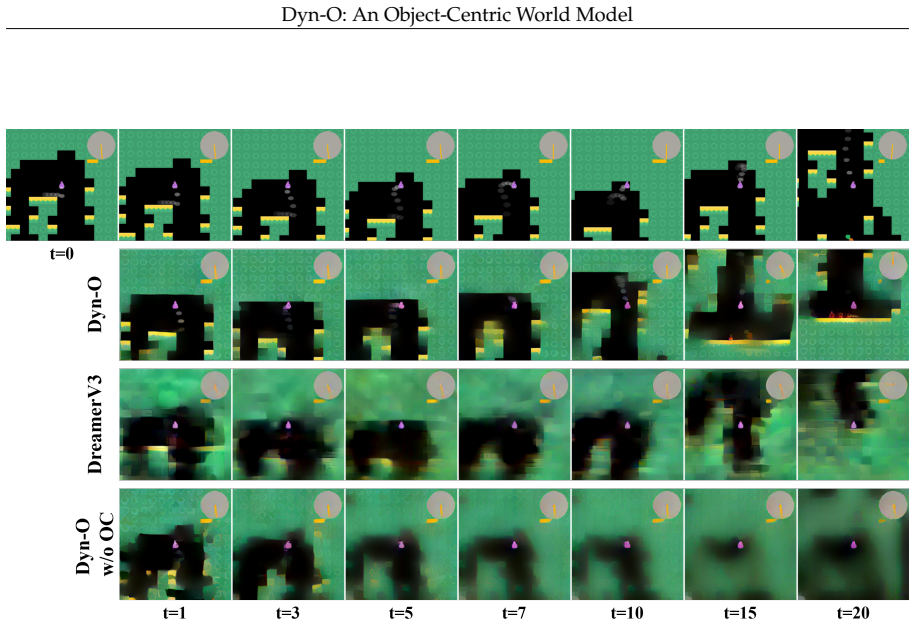
The central claim is that object-centric world models are viable in complex visual environments and can outperform monolithic ones at predicting rollouts. Dyn-O learns object slots from pixels using a frozen pretrained image tokenizer plus slot attention, with a segmentation mask guiding the attention during training and a logarithmic dropout schedule removing the mask at inference. A Mamba state-space model then predicts the next set of slots, and the reported experiments show that this object-slot dynamics model beats DreamerV3 on rollout quality in seven Procgen games, including a drop in average FVD from 692.5 to 361.3 and LPIPS from 0.42 to 0.33. The paper also claims that decoupling each slot into dynamics-agnostic static features and dynamics-aware dynamic features, trained with time-invariance and mutual-information penalties, supports swapping static attributes between objects to produce dynamically consistent 30-step rollouts.
Load-bearing premise
The object-binding evaluation assumes the SAM2 segmentation masks used during training are correct ground-truth objects, so the reported gains in object discovery may mostly show how faithfully Dyn-O copies those masks rather than how well it finds objects on its own.
Editorial extensions
If this is right
- Object-centric world models can be trained directly from pixels in cluttered, textured environments, not only in toy domains with basic shapes.
- Predicting in object-slot space can be both more accurate and more compact than predicting in patch-level latent space, since 31 or 47 object slots outperform 196 patch slots.
- World model rollouts can be manipulated at the object level, for example by swapping static features to change colors while preserving motion.
- The mask-dropout schedule keeps inference cheap, since the segmentation model is not needed when the trained encoder is deployed.
- The design separates representation learning from dynamics learning, making it possible to upgrade either component independently.
Reading between the lines
- The FG-ARI object-binding results compare against SAM2 masks used during training, so the reported advantage over fully unsupervised slot learning may partly measure distillation fidelity rather than object discovery from scratch; a more decisive test would use held-out masks or human annotations not derived from SAM2.
- Because Dyn-O's encoder relies on a frozen pretrained tokenizer and segmentation model, the 'from pixels' claim is conditioned on these foundation-model priors; a natural extension is testing how much of the gain survives when those priors are trained on different domains or removed.
- The static-dynamic split suggests a concrete use the paper does not demonstrate: generating counterfactual training data for offline reinforcement learning by swapping appearances across trajectories while preserving dynamics.
- The same architecture could be probed in partially observable or 3D environments, where the slot structure might help track occluded objects across longer rollouts.
Editorial analysis
A structured set of objections, weighed in public.
Referee Report
Summary. The paper proposes Dyn-O, an object-centric world model that combines Cosmos tokenizer features with SAM2-mask-guided slot attention and a Mamba state-space dynamics model, and further disentangles each slot into static and dynamic components. The method is evaluated on seven Procgen environments, where the authors report higher rollout prediction accuracy than a DreamerV3 baseline and a patch-based ablation, improved slot binding over SOLV, and evidence for static-dynamic disentanglement.
Significance. If validated, Dyn-O would be a useful step toward object-centric world models in visually complex environments, since most prior work has been confined to simple shapes. The paper has several strengths: it leverages strong frozen visual encoders/decoders, introduces a practical mask-dropout schedule to avoid SAM2 inference overhead, evaluates on unseen levels, and reports standard video metrics. The controlled Dyn-O w/o OC ablation is a useful comparison, and the probing protocol for disentanglement is thoughtful. However, the central claim that Dyn-O outperforms DreamerV3 is not cleanly supported: the DreamerV3 baseline is handicapped by a frozen Cosmos tokenizer, the caveflyer results partly contradict the blanket claim, and the FG-ARI evaluation appears to be at least partly circular. These issues, while fixable, are load-bearing for the paper's headline conclusions.
major comments (5)
- [Abstract, Section 4.2, Table 1] The claim that Dyn-O 'outperforms DreamerV3 in rollout prediction accuracy' is not supported by the experimental design as presented. The authors state that DreamerV3 is run 'with the same frozen Cosmos tokenizer,' which prevents DreamerV3 from learning its own task-adapted encoder, discrete latent space, and decoder from pixels. This likely handicaps the baseline. The controlled Dyn-O w/o OC ablation is the right comparison for the benefit of object-centric structure; the DreamerV3 comparison should be presented as an additional, clearly qualified result rather than as the basis for the abstract's blanket claim.
- [Table 6, caveflyer row] The per-environment results contradict the statement in Section 4.2 that 'Dyn-O significantly outperforms dreamer': on caveflyer, Dyn-O is worse than DreamerV3 on LPIPS (0.61 vs 0.53), SSIM (0.26 vs 0.44), and PSNR (10.82 vs 11.99). The aggregate Table 1 therefore masks a real failure mode. Please qualify the claim to reflect per-environment performance and discuss possible reasons (e.g., object count, dynamics, or segmentation quality in caveflyer).
- [Section 4.1, Figure 4, Table 5] The FG-ARI evaluation compares slot masks against masks that appear to be the same SAM2 masks used to supervise training. If this is the case, the metric largely measures fidelity to the teacher model, not independent object discovery. The paper should explicitly state the source of the 'ground-truth' masks and, ideally, report FG-ARI against an independent annotation source or a synthetic environment with known object masks. The low Oracle coinrun value (0.33) also indicates that SAM2 masks may be noisy, which further undermines their use as ground truth without clarification.
- [Section 3.2 and Section 4.2] Since the paper claims improved dynamics modeling over prior object-centric world models, the absence of any comparison to SlotSSM, Dreamweaver, or other object-centric world models leaves this claim incomplete. Please either add an adapted baseline on Procgen or clearly state why those methods cannot be applied to these settings, with supporting evidence rather than an assertion.
- [Section 3.1 and Appendix A.1] The mask-dropout schedule is described only as log(1 + # updates)/log(1 + # total updates), but the exact schedule parameters (start probability, end probability, and the point at which the mask is fully dropped) are not given, and no sensitivity analysis is provided. Since the ability to run without SAM2 at inference is a core contribution, this detail needs to be fully specified and, ideally, ablated.
minor comments (6)
- [Section 4.2] The phrase 'accurate and and generalizable' in Section 4.2 contains a typo and should read 'accurate and generalizable.'
- [Table 5] The table header uses 'FR-ARI' while the text in Section 4.1 uses 'FG-ARI'; please make the acronym consistent.
- [Table 5] The environment name 'dogeball' in Table 5 is misspelled; it should be 'dodgeball' as elsewhere in the paper.
- [Reference [38]] The reference title contains a typo, 'Regularing', which should be 'Regularizing'.
- [Equation (2)] The loss in Eq. (2) uses a fixed horizon T for both the slot prediction and reward/termination terms; please clarify how variable-length episodes are handled in the summation bounds.
- [Table 1] Table 1 reports only aggregate means without standard errors; please include per-environment standard errors or confidence intervals, as in Table 6, so the reader can assess variability.
Circularity Check
No significant circularity: the derivation chain is self-contained and externally evaluated; the one self-citation is not load-bearing.
full rationale
The paper's derivation chain—learning object-centric slots from Cosmos features with SAM2-guided slot attention, then training a Mamba SSM to predict slot transitions—does not reduce any claimed result to its own input. The rollout comparison against DreamerV3 is against an external baseline, and the Dyn-O w/o OC ablation isolates the object-centric grouping while keeping the same Cosmos encoder/decoder and SSM backbone. The FG-ARI evaluation is not shown to be circular: the paper never states that the ground-truth masks are the same SAM2 masks used in training, and the Oracle baseline, which explicitly uses SAM2 masks at inference, scores only 0.33 on coinrun in Table 5, which is inconsistent with evaluating against those very masks. The static-dynamic probing is partly a consistency check of the time-invariance and adversarial disentanglement objectives, but the informative results—static features retaining color and dynamic features predicting position—are not forced by construction. The only self-citation is [24] (CAGrad), used in Appendix A.2 to balance slot reconstruction and disentanglement gradients; it is an implementation detail and is not load-bearing. Concerns about DreamerV3 being handicapped by a frozen Cosmos tokenizer are experimental-design issues, not circularity, and do not change the circularity verdict.
Assumptions & free parameters
free parameters (2)
- Slot count K per environment =
31 (bigfish, coinrun, dodgeball, jumper), 47 (ninja, starpilot), 63 (caveflyer)
- Mask dropout schedule shape =
log(1 + updates) / log(1 + total_updates)
assumptions (6)
- domain assumption SAM2-generated segmentation masks provide correct object boundaries in Procgen.
- domain assumption Frozen Cosmos tokenizer features preserve enough visual information for slot extraction and future-frame decoding.
- domain assumption Slot Attention with reconstruction pressure yields meaningful object slots after mask-guided pretraining.
- domain assumption Mamba state-space models can capture object interaction dynamics across slots.
- domain assumption InfoNCE and adversarial discrimination reduce mutual information between static and dynamic features enough for true disentanglement.
- domain assumption DreamerV3 with a frozen Cosmos tokenizer is a fair proxy for DreamerV3's capability.
Cite this review
Pith. "Pith review of Dyn-O: Building Structured World Models with Object-Centric Representations." pith.science (2026). https://pith.science/paper/ZMZHHLHO
@misc{pith2026250703298,
  author       = {Pith},
  title        = {Pith review of: Dyn-O: Building Structured World Models with Object-Centric Representations},
  year         = {2026},
  howpublished = {\url{https://pith.science/paper/ZMZHHLHO}},
  note         = {Machine review of arXiv:2507.03298}
}
read the original abstract
World models aim to capture the dynamics of the environment, enabling agents to predict and plan for future states. In most scenarios of interest, the dynamics are highly centered on interactions among objects within the environment. This motivates the development of world models that operate on object-centric rather than monolithic representations, with the goal of more effectively capturing environment dynamics and enhancing compositional generalization. However, the development of object-centric world models has largely been explored in environments with limited visual complexity (such as basic geometries). It remains underexplored whether such models can generalize to more complex settings with diverse textures and cluttered scenes. In this paper, we fill this gap by introducing Dyn-O, an enhanced structured world model built upon object-centric representations. Compared to prior work in object-centric representations, Dyn-O improves in both learning representations and modeling dynamics. On the challenging Procgen games, we find that our method can learn object-centric world models directly from pixel observations, outperforming DreamerV3 in rollout prediction accuracy. Furthermore, by decoupling object-centric features into dynamics-agnostic and dynamics-aware components, we enable finer-grained manipulation of these features and generate more diverse imagined trajectories.
Figures


Figures from the paper (7 more)



Forward citations
Cited by 3 Pith papers
-
World Action Verifier: Self-Improving World Models via Forward-Inverse Asymmetry
WAV self-improves action-conditioned world models by cycle-consistent verification of state plausibility and sparse action reachability, doubling sample efficiency and lifting policy reward by over 22% on nine tasks.
-
Factored Latent Action World Models
FLAM splits a scene into separate factors, each with its own latent action, and reports better video prediction and downstream policy learning than monolithic latent-action models.
-
A Comprehensive Survey on World Models for Embodied AI
A unified three-axis taxonomy — functionality, temporal modeling, spatial representation — organizes the world-model literature for embodied AI.
Reference graph
Works this paper leans on
-
[1]
Self-supervised Object-centric Learning for Videos
Aydemir, G., Xie, W., and Güney, F. Self-supervised Object-centric Learning for Videos. InAdvances in Neural Information Processing Systems, 2023
work page 2023
-
[2]
Dreamweaver: Learning compositional world representa- tions from pixels
Baek, J., Wu, Y.-F., Singh, G., and Ahn, S. Dreamweaver: Learning compositional world representa- tions from pixels. arXiv preprint arXiv: 2501.14174, 2025
arXiv 2025
-
[3]
Bai, J., Wang, W., and Gomes, C. P . Contrastively disentangled sequential variational autoencoder. Advances in Neural Information Processing Systems, 34:10105–10118, 2021
work page 2021
-
[4]
Sequential disentanglement by extracting static information from a single sequence element
Berman, N., Naiman, I., Arbiv, I., Fadlon, G., and Azencot, O. Sequential disentanglement by extracting static information from a single sequence element. arXiv preprint arXiv:2406.18131, 2024
arXiv 2024
-
[5]
P ., Matthey, L., Watters, N., Kabra, R., Higgins, I., Botvinick, M., and Lerchner, A
Burgess, C. P ., Matthey, L., Watters, N., Kabra, R., Higgins, I., Botvinick, M., and Lerchner, A. Monet: Unsupervised scene decomposition and representation. arXiv preprint arXiv: 1901.11390, 2019
arXiv 1901
-
[6]
Leveraging procedural generation to benchmark reinforcement learning
Cobbe, K., Hesse, C., Hilton, J., and Schulman, J. Leveraging procedural generation to benchmark reinforcement learning. arXiv preprint arXiv:1912.01588, 2019
arXiv 1912
-
[7]
W., Hilton, J., Klimov, O., and Schulman, J
Cobbe, K. W., Hilton, J., Klimov, O., and Schulman, J. Phasic policy gradient. In International Conference on Machine Learning, pp. 2020–2027. PMLR, 2021
work page 2020
-
[8]
Improving token-based world models with parallel observation prediction
Cohen, L., Wang, K., Kang, B., and Mannor, S. Improving token-based world models with parallel observation prediction. In Forty-first International Conference on Machine Learning, ICML 2024, Vienna, Austria, July 21-27, 2024. OpenReview.net, 2024. URL https://openreview.net/forum?id= Lfp5Dk1xb6
work page 2024
Show all 45 references
-
[9]
F., Mahendran, A., van Steenkiste, S., Greff, K., Mozer, M., and Kipf, T
Elsayed, G. F., Mahendran, A., van Steenkiste, S., Greff, K., Mozer, M., and Kipf, T. Savi++: Towards end-to-end object-centric learning from real-world videos. Neural Information Processing Systems,
-
[10]
R., Jones, O
Engelcke, M., Kosiorek, A. R., Jones, O. P ., and Posner, I. Genesis: Generative scene inference and sampling with object-centric latent representations. arXiv preprint arXiv: 1907.13052, 2019
1907 arXiv
-
[11]
et. al., N. Cosmos world foundation model platform for physical ai. arXiv preprint arXiv:2501.03575, 2025
2025 arXiv
-
[12]
Focus: Object-centric world models for robotics manipulation
Ferraro, S., Mazzaglia, P ., Verbelen, T., and Dhoedt, B. Focus: Object-centric world models for robotics manipulation. arXiv preprint arXiv: 2307.02427, 2023
2023 arXiv
-
[13]
and Lempitsky, V
Ganin, Y. and Lempitsky, V . Unsupervised domain adaptation by backpropagation. InInternational conference on machine learning, pp. 1180–1189. PMLR, 2015
2015
-
[14]
and Dao, T
Gu, A. and Dao, T. Mamba: Linear-time sequence modeling with selective state spaces. arXiv preprint arXiv: 2312.00752, 2023
2023 arXiv
-
[15]
and Schmidhuber, J
Ha, D. and Schmidhuber, J. Recurrent world models facilitate policy evolution. In Bengio, S., Wallach, H., Larochelle, H., Grauman, K., Cesa-Bianchi, N., and Garnett, R. (eds.),Advances in Neural Information Processing Systems, volume 31. Curran Associates, Inc., 2018. URLhttp...
2018
-
[16]
Dream to control: Learning behaviors by latent imagination
Hafner, D., Lillicrap, T., Ba, J., and Norouzi, M. Dream to control: Learning behaviors by latent imagination. arXiv preprint arXiv: 1912.01603, 2019
1912 arXiv
-
[17]
Mastering atari with discrete world models
Hafner, D., Lillicrap, T., Norouzi, M., and Ba, J. Mastering atari with discrete world models. International Conference on Learning Representations, 2020. 10 Dyn-O: An Object-Centric World Model
2020
-
[18]
Mastering diverse domains through world models
Hafner, D., Pasukonis, J., Ba, J., and Lillicrap, T. Mastering diverse domains through world models. arXiv preprint arXiv:2301.04104, 2023
2023 arXiv
-
[19]
Mastering diverse control tasks through world models
Hafner, D., Pasukonis, J., Ba, J., and Lillicrap, T. Mastering diverse control tasks through world models. Nature, 640(8059):647–653, April 2025
2025
-
[20]
Td-mpc2: Scalable, robust world models for continuous control
Hansen, N., Su, H., and Wang, X. Td-mpc2: Scalable, robust world models for continuous control. arXiv preprint arXiv:2310.16828, 2023
2023 arXiv
- [21]
-
[22]
Slot state space models
Jiang, J., Deng, F., Singh, G., Lee, M., and Ahn, S. Slot state space models. arXiv preprint arXiv: 2406.12272, 2024
2024 arXiv
-
[23]
F., Mahendran, A., Stone, A., Sabour, S., Heigold, G., Jonschkowski, R., Dosovitskiy, A., and Greff, K
Kipf, T., Elsayed, G. F., Mahendran, A., Stone, A., Sabour, S., Heigold, G., Jonschkowski, R., Dosovitskiy, A., and Greff, K. Conditional object-centric learning from video. arXiv preprint arXiv:2111.12594, 2021
2021 arXiv
-
[24]
Conflict-averse gradient descent for multi-task learning
Liu, B., Liu, X., Jin, X., Stone, P ., and Liu, Q. Conflict-averse gradient descent for multi-task learning. Advances in Neural Information Processing Systems, 34, 2021
2021
-
[25]
Challenging common assumptions in the unsupervised learning of disentangled representations
Locatello, F., Bauer, S., Lucic, M., Raetsch, G., Gelly, S., Schölkopf, B., and Bachem, O. Challenging common assumptions in the unsupervised learning of disentangled representations. In international conference on machine learning, pp. 4114–4124. PMLR, 2019
2019
-
[26]
Object-centric learning with slot attention, 2020
Locatello, F., Weissenborn, D., Unterthiner, T., Mahendran, A., Heigold, G., Uszkoreit, J., Dosovitskiy, A., and Kipf, T. Object-centric learning with slot attention, 2020
2020
-
[27]
Transformers are sample-efficient world models.International Conference on Learning Representations, 2022
Micheli, V ., Alonso, E., and Fleuret, F. Transformers are sample-efficient world models.International Conference on Learning Representations, 2022. doi: 10.48550/arXiv.2209.00588
-
[28]
Efficient world models with context-aware tokenization
Micheli, V ., Alonso, E., and Fleuret, F. Efficient world models with context-aware tokenization. In Forty-first International Conference on Machine Learning , 2024. URL https://openreview.net/ forum?id=BiWIERWBFX
2024
-
[29]
W., Schölkopf, B., Buhmann, J
Miladinovi´ c, Ð., Gondal, M. W., Schölkopf, B., Buhmann, J. M., and Bauer, S. Disentangled state space representations. arXiv preprint arXiv:1906.03255, 2019
1906 arXiv
-
[30]
Interaction-based disentanglement of entities for object- centric world models
Nakano, A., Suzuki, M., and Matsuo, Y. Interaction-based disentanglement of entities for object- centric world models. In The Eleventh International Conference on Learning Representations, 2023. URL https://openreview.net/forum?id=JQc2VowqCzz
2023
-
[31]
Oord, A. v. d., Li, Y., and Vinyals, O. Representation learning with contrastive predictive coding. arXiv preprint arXiv:1807.03748, 2018
2018 arXiv
-
[32]
Oquab, M., Darcet, T., Moutakanni, T., Vo, H. V ., Szafraniec, M., Khalidov, V ., Fernandez, P ., Haziza, D., Massa, F., El-Nouby, A., Howes, R., Huang, P .-Y., Xu, H., Sharma, V ., Li, S.-W., Galuba, W., Rabbat, M., Assran, M., Ballas, N., Synnaeve, G., Misra, I., Jegou, H., ...
2023
-
[33]
V ., Carion, N., Wu, C.-Y., Girshick, R., Dollár, P ., and Feichtenhofer, C
Ravi, N., Gabeur, V ., Hu, Y.-T., Hu, R., Ryali, C., Ma, T., Khedr, H., Rädle, R., Rolland, C., Gustafson, L., Mintun, E., Pan, J., Alwala, K. V ., Carion, N., Wu, C.-Y., Girshick, R., Dollár, P ., and Feichtenhofer, C. Sam 2: Segment anything in images and videos. arXiv prepr...
2024 arXiv
-
[34]
J., and Chaudhuri, S
Sehgal, A., Grayeli, A., Sun, J. J., and Chaudhuri, S. Neurosymbolic grounding for compositional world models. International Conference on Learning Representations, 2023. doi: 10.48550/arXiv.2310. 12690
2023 doi
-
[35]
Bridging the gap to real-world object-centric learning
Seitzer, M., Horn, M., Zadaianchuk, A., Zietlow, D., Xiao, T., Simon-Gabriel, C.-J., He, T., Zhang, Z., Schölkopf, B., Brox, T., and Locatello, F. Bridging the gap to real-world object-centric learning. arXiv preprint arXiv: 2209.14860, 2022. 11 Dyn-O: An Object-Centric World Model
2022 arXiv
-
[36]
C., Frossard, P ., and Vleeschouwer, C
Simon, M. C., Frossard, P ., and Vleeschouwer, C. D. Sequential representation learning via static- dynamic conditional disentanglement. In European Conference on Computer Vision , pp. 110–126. Springer, 2024
2024
-
[37]
Sutton, R. S. Integrated architectures for learning, planning, and reacting based on approximating dynamic programming. In Machine learning proceedings 1990, pp. 216–224. Elsevier, 1990
1990
-
[38]
Regularing generative adversarial networks under limited data
Tseng, H.-Y., Jiang, L., Liu, C., Yang, M.-H., and Yang, W. Regularing generative adversarial networks under limited data. In CVPR, 2021
2021
-
[39]
Pre-training contextualized world models with in-the-wild videos for reinforcement learning
Wu, J., Ma, H., Deng, C., and Long, M. Pre-training contextualized world models with in-the-wild videos for reinforcement learning. Advances in Neural Information Processing Systems, 36, 2024
2024
-
[40]
Slotformer: Unsupervised visual dynamics simulation with object-centric models
Wu, Z., Dvornik, N., Greff, K., Kipf, T., and Garg, A. Slotformer: Unsupervised visual dynamics simulation with object-centric models. International Conference on Learning Representations, 2022. doi: 10.48550/arXiv.2210.05861
-
[41]
Slotdiffusion: Object-centric generative modeling with diffusion models
Wu, Z., Hu, J., Lu, W., Gilitschenski, I., and Garg, A. Slotdiffusion: Object-centric generative modeling with diffusion models. Advances in Neural Information Processing Systems, 36:50932–50958, 2023
2023
-
[42]
and Mandt, S
Yingzhen, L. and Mandt, S. Disentangled sequential autoencoder. In International Conference on Machine Learning, pp. 5670–5679. PMLR, 2018
2018
-
[43]
Zhao, L., Kong, L., Walters, R., and Wong, L. L. Toward compositional generalization in object- oriented world modeling. In Chaudhuri, K., Jegelka, S., Song, L., Szepesvari, C., Niu, G., and Sabato, S. (eds.), Proceedings of the 39th International Conference on Machine Learnin...
2022
-
[44]
Robodreamer: Learning compositional world models for robot imagination
Zhou, S., Du, Y., Chen, J., Li, Y., Yeung, D., and Gan, C. Robodreamer: Learning compositional world models for robot imagination. In Forty-first International Conference on Machine Learning, ICML 2024, Vienna, Austria, July 21-27, 2024. OpenReview.net, 2024. URL https://openr...
2024
- [2022]
Reviewed August 6, 2026 · model on record in the stance chip above.
Discussion (0). Sign in to comment.