REVIEW 5 major objections 5 minor 44 references
GRAFT: A Graph-based Flow-aware Agentic Framework for Document-level Machine Translation
T0 review · 5 major / 5 minor · reviewed 2026-08-06 · deepseek-v4-flash
Pith's one-line read The paper claims that representing a source document as a directed acyclic graph of discourse segments, with LLM-selected edges and structured memory passed along those edges, gives large and consistent document-level translation gains…
desk verdict A well-built, clearly-documented document-MT pipeline whose headline gains are plausible but not yet distinguishable from noise, because the main benchmark is ten to twelve documents per direction. read the letter →
The pith
A machine-rendered reading of the paper's core claim, the machinery that carries it, and where it could break.
The reading
What carries the argument
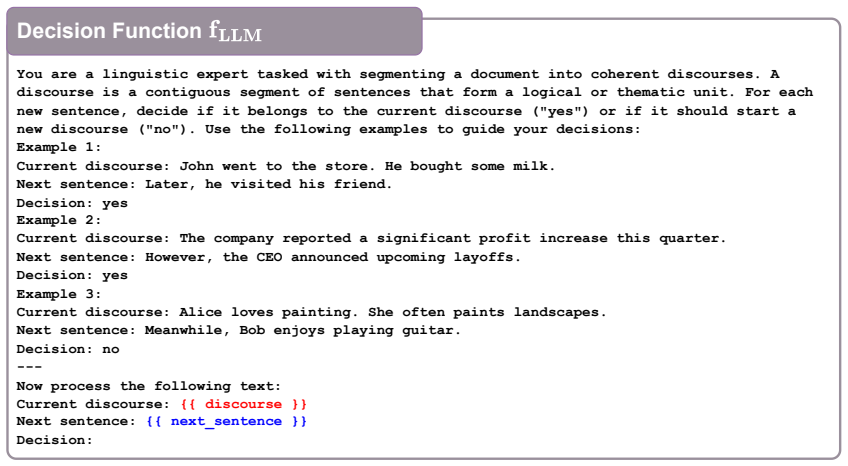
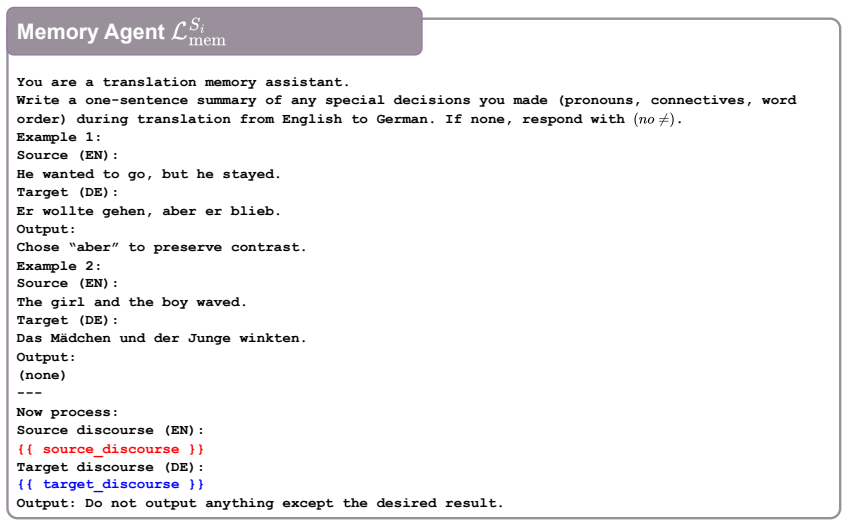
Four cooperating LLM agents organized as a DAG pipeline. The Discourse Agent decides sentence by sentence whether a sentence continues the current discourse segment; the Edge Agent decides, for each pair of earlier and later segments, whether translation of the later segment needs context from the earlier one, with the immediately preceding segment always included; the Memory Agent extracts a five-component local memory from each translated segment; and the Translation Agent translates each segment using its source text plus the memories of all graph predecessors. The DAG is what carries the argument: it replaces flat or heuristic context with a routable structure whose edges decide which memories a segment sees.
What would settle it
Run GRAFT on the same eight TED directions with the same number of edges but chosen uniformly at random from all earlier segments (keeping the mandatory previous-segment edge), and compare d-BLEU; if random edges close the 2.0 d-BLEU gap over the chain graph, the claim that LLM-selected edges carry the improvement is falsified.
Extended reading notes
Core claim
The paper's central claim is that the way context is selected and propagated matters as much as the language model behind the translation. GRAFT models a document as a directed acyclic graph whose nodes are LLM-chosen discourse segments and whose edges are LLM-judged dependencies: every segment always depends on its immediate predecessor, and the Edge Agent adds long-range edges when later text needs earlier text for coherent translation. Each translated segment deposits a small structured memory consisting of noun-to-pronoun mappings, entity translations, phrase translations, discourse connectives, and a one-line summary, and each segment is translated using the union of memories from its graph predecessors, with earlier dependencies prioritized. The paper reports that this graph routing, rather than the backbone, drives the gains: on eight language directions the full system beats strong baselines by 2.8 d-BLEU on TED, beats a strong closed-source model by 2.3 d-BLEU on domain-specific Chinese-to-English tests, and loses 2.0 d-BLEU when the graph edges are replaced by a chain or TF-IDF graph.
Load-bearing premise
The Edge Agent's yes/no relevance judgments are assumed to identify the dependencies that actually matter for translation quality; if those judgments are frequently wrong or simply mirror local adjacency, the reported gains could come mostly from the mandatory edge to the previous segment rather than from LLM-selected long-range dependencies.
Editorial extensions
If this is right
- The reported 2.8 d-BLEU average on TED tst2017 across eight directions, if replicated, makes discourse-graph routing a stronger lever than swapping the LLM backbone for document translation.
- The 2.3 d-BLEU gain over a strong closed-source model on four Chinese-to-English domains, achieved with a smaller open-weight backbone, suggests domain-specific terminology and zero-pronoun recovery can be improved through structured memory rather than model scale.
- The 2.0 d-BLEU loss when the DAG edges are replaced by chain or TF-IDF edges implies that the identity of the edges, not just the number of context segments, determines document-level quality.
- Because removing memory entirely costs 5.7 d-BLEU, the translation agent's later outputs depend on accumulated structured memory in a way that flat windowed context cannot reproduce.
- The long-novel experiment, translating a whole 16.9K-sentence novel as one document and beating chapter-by-chapter translation by 4.3 d-BLEU, implies the DAG representation scales to very long documents without content omission.
Reading between the lines
- If edge selection is what matters, then distilling the Edge Agent's judgments into a small trained classifier could cut cost while keeping most of the gains; the paper does not test this.
- The graph idea should transfer to other long-context generation tasks where selective context is key, such as summarization or storytelling, where a document DAG could route relevant earlier content to each new segment.
- A controlled ablation that matches the number of LLM-selected edges with randomly chosen edges would separate the value of edge choice from the value of simply having more context; this is a direct test the paper does not run.
- Memory components are not equally valuable: phrase and entity mappings appear to carry more of the gain than the summary or noun-pronoun mappings, so future work could shrink memory to the highest-leverage fields and reduce the reported threefold latency overhead.
Editorial analysis
A structured set of objections, weighed in public.
Referee Report
Summary. This paper proposes GRAFT, an LLM-agent-based document-level machine translation framework. The source document is segmented into discourse units by a Discourse Agent, a DAG of dependencies is built by an Edge Agent (with mandatory consecutive edges plus LLM-selected non-consecutive edges), a Memory Agent extracts structured memory from each translated segment, and a Translation Agent translates each segment conditioned on memories of its predecessors. The authors report d-BLEU gains on TED tst2017 for eight translation directions (Table 1), on Zh→En domain-specific data across four domains (Table 2), and ablations of the segmentation, edge, and memory components (Tables 5-7), plus human evaluation of discourse phenomena. The headline claims are that GRAFT improves 2.8 d-BLEU over strong baselines on TED and 2.3 d-BLEU on domain-specific translation, and that the DAG structure, not the LLM backbone, drives the gains.
Significance. If correct, the contribution is a structured, interpretable way to select and propagate context in document-level MT, replacing flat or heuristic context aggregation with LLM-mediated segmentation and dependency modeling. The paper is transparent in providing prompt templates, detailed ablations, human evaluation guidelines, and a cost/latency analysis, and it makes its code and data available through an anonymized link. However, the support for the quantitative headline claims is currently insufficient: the main benchmark has only 10-12 documents per direction, the quoted averages are inconsistent across the abstract, contributions, and results sections, and the edge-selection effect is not isolated from the effect of adding edges. The DAG-based representation is a plausible and interesting direction, but the paper needs stronger statistics and internal consistency before the central claim can be accepted.
major comments (5)
- [Abstract; Section 4.3; Table 1; Table 2] The headline numbers are not reproducible from the reported tables. The abstract states a 2.8 d-BLEU average improvement over 'strong baselines' on TED, but Table 1 shows GRAFT (Llama-3.1-70B-Instruct) gains of about 0.9 d-BLEU over GPT-4o-mini and about 1.2 d-BLEU over DELTA (Qwen2-72B-Instruct) on average, which matches Section 4.3's 1.0 and 1.1 rather than 2.8. The contributions bullet claims 3.4 d-BLEU over 'similar LLM-based approaches,' which does not appear in any table. In addition, the abstract's domain-specific claim of 2.3 d-BLEU from English to Chinese does not match Table 2, which reports an average 2.0 d-BLEU gain over GPT-4o-mini on Chinese-to-English (Zh→En), not English-to-Chinese. Please define the baseline set for each headline number and reconcile all quoted averages with the tables.
- [Table 4; Tables 1, 5, 6, 7] The TED tst2017 benchmark contains only |D|=10-12 documents per translation direction (Table 4), yet all reported d-BLEU scores are corpus-level aggregates with no bootstrap confidence intervals, per-document variance, or paired significance tests. A 1-3 point average difference over 10-12 documents is within sampling noise. Table 6's central comparison (CG/TF-IDF versus Edge Agent) even goes against the claimed trend for Zh→En (24.8 vs 24.6), and Table 1 shows a 17.6-point gain on Fr→En alongside a 2.5-point loss on Ja→En. Without uncertainty quantification, the paper's central causal claim that DAG structure and edge selection drive the improvement cannot be evaluated.
- [Eq. (1); Table 6; Appendix G.2] The contribution of the Edge Agent is not isolated. Equation (1) always adds the consecutive edge dj→di for j+1=i, so the Edge Agent only adds non-consecutive edges. Table 6 compares the chain graph (consecutive edges only) with the full Edge Agent (consecutive plus LLM-selected edges); the 2.0 d-BLEU average gain therefore conflates the value of having any additional edges with the value of the LLM's edge selection. The 76.3% human-rated edge accuracy in Appendix G.2 is reported without inter-annotator agreement or error analysis, and no experiments quantify how a wrong edge label degrades translations. Please add a control that matches the number of extra edges (e.g., random edges) and report how edge precision affects translation quality.
- [Figure 5; Section 5] The consistency analysis in Section 5 is not supported as reported. Figure 5's second panel is labeled 'Frequency of Consistency Ratios (Simulated Rising Trend),' which suggests the distribution may be simulated rather than measured from GRAFT outputs, yet the text cites it as evidence that 'most paths show a consistency ratio greater than 0.6.' If this panel is an illustration, the surrounding claims must be revised; if it is real data, the label must be corrected. The definition of 'consistency maintained' in CL(P) is also not formalized.
- [Section 5; Table 4] The 'ultra-long document' experiment in Section 5 states that the Web Novel subset contains 16.9K source sentences, but Table 4 reports |S|=860 sentences for the Novel row, with 16.9K source words. The claimed scale of the long-range dependency test is therefore unsupported as written. Please correct the sentence/word counts and re-state the experimental scale accordingly.
minor comments (5)
- [Section 4.3; Table 1] Section 4.3 refers to 'DELTA (Qwen2.5-72B-Instruct)', while Table 1 lists 'DELTA (Qwen2-72B-Instruct)'; please make the model names consistent.
- [Section 4.2; Table 7] The statement that 'the least impactful component, M_np, improves performance by 4.9 d-BLEU for De ⇒ En' is ambiguous: Table 7 shows that removing M_np lowers De⇒En from 31.5 to 26.6 (a 4.9 drop), which makes M_np impactful for that direction even if it is least impactful on average. Please clarify the wording.
- [Appendix C.3] The cTT formula appears typeset incorrectly: the denominator 'C2_k TT' is unclear, and the summation indices over terminology words need a precise definition. Please provide a cleaner formulation.
- [References] There are several typographical issues in the references, such as 'V oita' for Voita and 'Rethorical structure theory' for Rhetorical Structure Theory. Please proofread the bibliography.
- [Figure 5] The right panel of Figure 5 has a truncated y-axis label ('Frequency of Consistency Ratios (Simulated Rising Trend)') and the legend items ('Target Noun Target Pronoun', 'Source Entity Target Entity', 'Source Phrase Target Phrase') are ambiguous; please provide clear captions and legends.
Circularity Check
No circular derivation: GRAFT's components are evaluated against external d-BLEU references and ablations; no fitted quantity is renamed as a prediction.
full rationale
The paper's core claim that its DAG representation and graph-based memory propagation improve document-level translation is tested with d-BLEU against human references on IWSLT2017 TED, mZPRT/WMT2022, and Guofeng benchmarks, and against several external baselines including commercial systems and prior LLM-based agents. The Discourse, Edge, Memory, and Translation agents are implemented via few-shot prompting of pretrained LLMs, with no parameters fitted to maximize d-BLEU on the test set; hyperparameters such as temperature are selected heuristically, not by optimizing the reported evaluation metric and then presenting that optimum as a prediction. Ablations compare complete versus incomplete GRAFT configurations empirically, and the edge/segmentation alternatives are also empirical comparisons rather than restatements of the method's definitions. The consistency-ratio analysis is descriptive and does not feed back into training or system selection. No load-bearing self-citation appears; prior-work citations (e.g., DELTA, Hu and Wan) are external baselines. The observed internal inconsistencies in the abstract's headline d-BLEU averages versus Table 1 and the small number of documents per direction are legitimate statistical-reporting concerns, but they are not circularity. Under the review rules, this is a self-contained external evaluation, so the circularity score is 0.
Assumptions & free parameters
free parameters (4)
- TF-IDF edge threshold tau =
not reported numerically
- temperature =
0.1 to 0.3, best at 0.1
- number of few-shot examples =
3
- memory size cap =
not reported
assumptions (4)
- domain assumption An LLM's binary segmentation decision and binary edge relevance decision are reliable enough to improve translation quality.
- domain assumption d-BLEU is a valid proxy for document-level translation quality on these test sets.
- domain assumption The few-shot prompts and examples shown in Appendix I generalize across all eight language directions and domains.
- domain assumption The TED tst2017 set (10 to 12 documents per direction) is representative enough to support claims of consistent gains.
Cite this review
Pith. "Pith review of GRAFT: A Graph-based Flow-aware Agentic Framework for Document-level Machine Translation." pith.science (2026). https://pith.science/paper/6LWWXLTE
@misc{pith2026250703311,
  author       = {Pith},
  title        = {Pith review of: GRAFT: A Graph-based Flow-aware Agentic Framework for Document-level Machine Translation},
  year         = {2026},
  howpublished = {\url{https://pith.science/paper/6LWWXLTE}},
  note         = {Machine review of arXiv:2507.03311}
}
read the original abstract
Document level Machine Translation (DocMT) approaches often struggle with effectively capturing discourse level phenomena. Existing approaches rely on heuristic rules to segment documents into discourse units, which rarely align with the true discourse structure required for accurate translation. Otherwise, they fail to maintain consistency throughout the document during translation. To address these challenges, we propose Graph Augmented Agentic Framework for Document Level Translation (GRAFT), a novel graph based DocMT system that leverages Large Language Model (LLM) agents for document translation. Our approach integrates segmentation, directed acyclic graph (DAG) based dependency modelling, and discourse aware translation into a cohesive framework. Experiments conducted across eight translation directions and six diverse domains demonstrate that GRAFT achieves significant performance gains over state of the art DocMT systems. Specifically, GRAFT delivers an average improvement of 2.8 d BLEU on the TED test sets from IWSLT2017 over strong baselines and 2.3 d BLEU for domain specific translation from English to Chinese. Moreover, our analyses highlight the consistent ability of GRAFT to address discourse level phenomena, yielding coherent and contextually accurate translations.
Figures


Figures from the paper (9 more)




Reference graph
Works this paper leans on
-
[1]
Guangsheng Bao, Yue Zhang, Zhiyang Teng, Boxing Chen, and Weihua Luo. 2021. https://doi.org/10.18653/v1/2021.acl-long.267 G -transformer for document-level machine translation . In Proceedings of the 59th Annual Meeting of the Association for Computational Linguistics and the 11th International Joint Conference on Natural Language Processing (Volume 1: Lo...
-
[2]
Rachel Bawden, Rico Sennrich, Alexandra Birch, and Barry Haddow. 2018. https://doi.org/10.18653/v1/N18-1118 Evaluating discourse phenomena in neural machine translation . In Proceedings of the 2018 Conference of the North A merican Chapter of the Association for Computational Linguistics: Human Language Technologies, Volume 1 (Long Papers) , pages 1304--1...
-
[3]
Mauro Cettolo, Christian Girardi, and Marcello Federico. 2012. https://aclanthology.org/2012.eamt-1.60/ WIT 3: Web inventory of transcribed and translated talks . In Proceedings of the 16th Annual Conference of the European Association for Machine Translation, pages 261--268, Trento, Italy. European Association for Machine Translation
work page 2012
-
[4]
Harrison Chase. 2023. https://python.langchain.com/ Langchain: A framework for developing applications powered by language models . Version as of 2023
work page 2023
-
[5]
Marta R Costa-Juss \`a , James Cross, Onur C elebi, Maha Elbayad, Kenneth Heafield, Kevin Heffernan, Elahe Kalbassi, Janice Lam, Daniel Licht, Jean Maillard, et al. 2022. No language left behind: Scaling human-centered machine translation. arXiv preprint arXiv:2207.04672
arXiv 2022
-
[6]
Cade Daniel, Zihang Dai, Yiming Yang, Quanquan Gu, Cho-Jui Hsieh, Denny Zhou, and Cho-Jui Hsieh. 2023. vLLM : A high-throughput and memory-efficient inference and serving engine for large language models. https://github.com/vllm-project/vllm. Accessed: 2025-05-14
work page 2023
-
[7]
Barbara J Grosz and Candace L Sidner. 1986. Attention, intentions, and the structure of discourse. In Computational Models of Discourse, pages 31--51. MIT Press
work page 1986
-
[8]
Chawla, Olaf Wiest, and Xiangliang Zhang
Taicheng Guo, Xiuying Chen, Yaqi Wang, Ruidi Chang, Shichao Pei, Nitesh V. Chawla, Olaf Wiest, and Xiangliang Zhang. 2024. https://doi.org/10.24963/ijcai.2024/890 Large language model based multi-agents: A survey of progress and challenges . In Proceedings of the Thirty-Third International Joint Conference on Artificial Intelligence, IJCAI-24 , pages 8048...
Show all 44 references
-
[9]
Zhiyu Guo and Minh Le Nguyen. 2020. https://doi.org/10.18653/v1/2020.aacl-srw.15 Document-level neural machine translation using BERT as context encoder . In Proceedings of the 1st Conference of the Asia-Pacific Chapter of the Association for Computational Linguistics and the ...
2020 doi
-
[10]
Xinyu Hu and Xiaojun Wan. 2023. https://doi.org/10.18653/v1/2023.emnlp-main.857 Exploring discourse structure in document-level machine translation . In Proceedings of the 2023 Conference on Empirical Methods in Natural Language Processing, pages 13889--13902, Singapore. Assoc...
2023 doi
-
[11]
Sebastien Jean, Stanislas Lauly, Orhan Firat, and Kyunghyun Cho. 2017. Does neural machine translation benefit from larger context? arXiv preprint arXiv:1704.05135
2017 arXiv
-
[12]
Linghao Jin, Jacqueline He, Jonathan May, and Xuezhe Ma. 2023. https://doi.org/10.18653/v1/2023.emnlp-main.943 Challenges in context-aware neural machine translation . In Proceedings of the 2023 Conference on Empirical Methods in Natural Language Processing, pages 15246--15263...
2023 doi
-
[13]
Tom Kocmi, Rachel Bawden, Ond r ej Bojar, Anton Dvorkovich, Christian Federmann, Mark Fishel, Thamme Gowda, Yvette Graham, Roman Grundkiewicz, Barry Haddow, Rebecca Knowles, Philipp Koehn, Christof Monz, Makoto Morishita, Masaaki Nagata, Toshiaki Nakazawa, Michal Nov \'a k, Ma...
2022
-
[14]
Sai Koneru, Miriam Exel, Matthias Huck, and Jan Niehues. 2024. https://doi.org/10.18653/v1/2024.naacl-long.148 Contextual refinement of translations: Large language models for sentence and document-level post-editing . In Proceedings of the 2024 Conference of the North America...
2024 doi
-
[15]
Shaohui Kuang, Deyi Xiong, Weihua Luo, and Guodong Zhou. 2017. https://api.semanticscholar.org/CorpusID:195346279 Cache-based document-level neural machine translation . ArXiv, abs/1711.11221
2017 arXiv
-
[16]
Zongyao Li, Zhiqiang Rao, Hengchao Shang, Jiaxin Guo, Shaojun Li, Daimeng Wei, and Hao Yang. 2025. https://aclanthology.org/2025.coling-main.591/ Enhancing large language models for document-level translation post-editing using monolingual data . In Proceedings of the 31st Int...
2025
-
[17]
Yinhan Liu, Jiatao Gu, Naman Goyal, Xian Li, Sergey Edunov, Marjan Ghazvininejad, Mike Lewis, and Luke Zettlemoyer. 2020. https://doi.org/10.1162/tacl_a_00343 Multilingual denoising pre-training for neural machine translation . Transactions of the Association for Computational...
2020 doi
-
[18]
Aman Madaan, Niket Tandon, Prakhar Gupta, Skyler Hallinan, Luyu Gao, Sarah Wiegreffe, Uri Alon, Nouha Dziri, Shrimai Prabhumoye, Yiming Yang, et al. 2023. Self-refine: Iterative refinement with self-feedback. Advances in Neural Information Processing Systems, 36:46534--46594
2023
-
[19]
William Mann and Sandra Thompson. 1988. https://doi.org/10.1515/text.1.1988.8.3.243 Rethorical structure theory: Toward a functional theory of text organization . Text, 8:243--281
1988 doi
-
[21]
Sameen Maruf, Fahimeh Saleh, and Gholamreza Haffari. 2021 b . https://doi.org/10.1145/3441691 A survey on document-level neural machine translation: Methods and evaluation . ACM Comput. Surv., 54(2)
2021 doi
-
[22]
Lesly Miculicich, Dhananjay Ram, Nikolaos Pappas, and James Henderson. 2018. https://doi.org/10.18653/v1/D18-1325 Document-level neural machine translation with hierarchical attention networks . In Proceedings of the 2018 Conference on Empirical Methods in Natural Language Pro...
2018 doi
-
[23]
Hideya Mino, Hitoshi Ito, Isao Goto, Ichiro Yamada, and Takenobu Tokunaga. 2020. https://doi.org/10.18653/v1/2020.coling-main.396 Effective use of target-side context for neural machine translation . In Proceedings of the 28th International Conference on Computational Linguist...
2020 doi
-
[24]
Graham Neubig and Zhiwei He. 2023. Zeno gpt machine translation report. https://hub.zenoml.com/report/1/GPT
2023
-
[25]
Takumi Ohtani, Hidetaka Kamigaito, Masaaki Nagata, and Manabu Okumura. 2019. https://doi.org/10.18653/v1/D19-6505 Context-aware neural machine translation with coreference information . In Proceedings of the Fourth Workshop on Discourse in Machine Translation (DiscoMT 2019), p...
2019 doi
-
[26]
Jianhui Pang, Fanghua Ye, Derek Fai Wong, Dian Yu, Shuming Shi, Zhaopeng Tu, and Longyue Wang. 2025. https://doi.org/10.1162/tacl_a_00730 Salute the classic: Revisiting challenges of machine translation in the age of large language models . Transactions of the Association for ...
2025 doi
-
[27]
Joon Sung Park, Joseph O'Brien, Carrie Jun Cai, Meredith Ringel Morris, Percy Liang, and Michael S Bernstein. 2023. Generative agents: Interactive simulacra of human behavior. In Proceedings of the 36th annual acm symposium on user interface software and technology, pages 1--22
2023
-
[28]
Pedregosa, G
F. Pedregosa, G. Varoquaux, A. Gramfort, V. Michel, B. Thirion, O. Grisel, M. Blondel, P. Prettenhofer, R. Weiss, V. Dubourg, J. Vanderplas, A. Passos, D. Cournapeau, M. Brucher, M. Perrot, and E. Duchesnay. 2011. Scikit-learn: Machine learning in P ython. Journal of Machine L...
2011
-
[29]
Hongjin Qian, Zheng Liu, Peitian Zhang, Kelong Mao, Defu Lian, Zhicheng Dou, and Tiejun Huang. 2025. https://doi.org/10.1145/3696410.3714805 Memorag: Boosting long context processing with global memory-enhanced retrieval augmentation . In Proceedings of the ACM on Web Conferen...
2025
-
[30]
Yiqi Tong, Jiangbin Zheng, Hongkang Zhu, Yidong Chen, and Xiaodong Shi. 2020. https://doi.org/10.18653/v1/2020.coling-main.388 A document-level neural machine translation model with dynamic caching guided by theme-rheme information . In Proceedings of the 28th International Co...
2020 doi
-
[31]
Zhaopeng Tu, Yang Liu, Shuming Shi, and Tong Zhang. 2018. https://doi.org/10.1162/tacl_a_00029 Learning to remember translation history with a continuous cache . Transactions of the Association for Computational Linguistics, 6:407--420
2018 doi
-
[32]
Elena Voita, Rico Sennrich, and Ivan Titov. 2019. https://doi.org/10.18653/v1/P19-1116 When a good translation is wrong in context: Context-aware machine translation improves on deixis, ellipsis, and lexical cohesion . In Proceedings of the 57th Annual Meeting of the Associati...
2019 doi
-
[33]
Elena Voita, Pavel Serdyukov, Rico Sennrich, and Ivan Titov. 2018. https://doi.org/10.18653/v1/P18-1117 Context-aware neural machine translation learns anaphora resolution . In Proceedings of the 56th Annual Meeting of the Association for Computational Linguistics (Volume 1: L...
2018 doi
-
[34]
Longyue Wang, Siyou Liu, Chenyang Lyu, Wenxiang Jiao, Xing Wang, Jiahao Xu, Zhaopeng Tu, Yan Gu, Weiyu Chen, Minghao Wu, Liting Zhou, Philipp Koehn, Andy Way, and Yulin Yuan. 2024. https://doi.org/10.18653/v1/2024.wmt-1.58 Findings of the WMT 2024 shared task on discourse-leve...
2024 doi
-
[35]
Longyue Wang, Chenyang Lyu, Tianbo Ji, Zhirui Zhang, Dian Yu, Shuming Shi, and Zhaopeng Tu. 2023 a . https://doi.org/10.18653/v1/2023.emnlp-main.1036 Document-level machine translation with large language models . In Proceedings of the 2023 Conference on Empirical Methods in N...
2023 doi
-
[36]
Longyue Wang, Zhaopeng Tu, Yan Gu, Siyou Liu, Dian Yu, Qingsong Ma, Chenyang Lyu, Liting Zhou, Chao-Hong Liu, Yufeng Ma, Weiyu Chen, Yvette Graham, Bonnie Webber, Philipp Koehn, Andy Way, Yulin Yuan, and Shuming Shi. 2023 b . https://doi.org/10.18653/v1/2023.wmt-1.3 Findings o...
2023 doi
-
[38]
Longyue Wang, Zhaopeng Tu, Andy Way, and Qun Liu. 2017 b . https://doi.org/10.18653/v1/D17-1301 Exploiting cross-sentence context for neural machine translation . In Proceedings of the 2017 Conference on Empirical Methods in Natural Language Processing, pages 2826--2831, Copen...
2017 doi
-
[39]
Wong, Fandong Meng, Jie Zhou, and Min Zhang
Yutong Wang, Jiali Zeng, Xuebo Liu, Derek F. Wong, Fandong Meng, Jie Zhou, and Min Zhang. 2025. https://openreview.net/forum?id=hoYFLRNbhc Del TA : An online document-level translation agent based on multi-level memory . In The Thirteenth International Conference on Learning R...
2025
-
[40]
Minghao Wu, George Foster, Lizhen Qu, and Gholamreza Haffari. 2023. https://doi.org/10.18653/v1/2023.eacl-main.33 Document flattening: Beyond concatenating context for document-level neural machine translation . In Proceedings of the 17th Conference of the European Chapter of ...
2023 doi
-
[41]
Minghao Wu, Thuy-Trang Vu, Lizhen Qu, George Foster, and Gholamreza Haffari. 2024. Adapting large language models for document-level machine translation. arXiv preprint arXiv:2401.06468
2024 arXiv
-
[42]
Wong, Hongye Liu, Linfeng Song, Lidia S
Mingzhou Xu, Longyue Wang, Derek F. Wong, Hongye Liu, Linfeng Song, Lidia S. Chao, Shuming Shi, and Zhaopeng Tu. 2022. https://doi.org/10.18653/v1/2022.emnlp-main.774 G uo F eng: A benchmark for zero pronoun recovery and translation . In Proceedings of the 2022 Conference on E...
2022 doi
-
[43]
Yusen Zhang, Ruoxi Sun, Yanfei Chen, Tomas Pfister, Rui Zhang, and Sercan Arik. 2024. Chain of agents: Large language models collaborating on long-context tasks. Advances in Neural Information Processing Systems, 37:132208--132237
2024
-
[44]
Andrew Zhao, Daniel Huang, Quentin Xu, Matthieu Lin, Yong-Jin Liu, and Gao Huang. 2024. https://doi.org/10.1609/aaai.v38i17.29936 Expel: Llm agents are experiential learners . In Proceedings of the Thirty-Eighth AAAI Conference on Artificial Intelligence and Thirty-Sixth Confe...
2024 doi
-
[45]
online" 'onlinestring :=
ENTRY address archivePrefix author booktitle chapter edition editor eid eprint eprinttype howpublished institution journal key month note number organization pages publisher school series title type volume year doi pubmed url lastchecked label extra.label sort.label short.list...
-
[46]
write newline
" write newline "" before.all 'output.state := FUNCTION n.dashify 't := "" t empty not t #1 #1 substring "-" = t #1 #2 substring "--" = not "--" * t #2 global.max substring 't := t #1 #1 substring "-" = "-" * t #2 global.max substring 't := while if t #1 #1 substring * t #2 gl...
Reviewed August 6, 2026 · model on record in the stance chip above.
Discussion (0). Sign in to comment.