REVIEW 4 major objections 5 minor 22 references
Personalized Image Generation from an Author Writing Style
T0 review · 4 major / 5 minor · reviewed 2026-08-06 · deepseek-v4-flash
Pith's one-line read A structured summary of an author's writing style, translated by an LLM into image prompts and rendered by Stable Diffusion, produces images human raters judge as a good stylistic match (mean 4.08/5).
desk verdict A transparent little pipeline paper whose descriptive rating is probably accurate but whose central claim about style translation is undercut by a missing baseline condition. read the letter →
The pith
A machine-rendered reading of the paper's core claim, the machinery that carries it, and where it could break.
The reading
What carries the argument
The central object is the Author Writing Sheet (AWS): a structured, multi-faceted textual description of an author's writing characteristics. The mechanism is a two-stage off-the-shelf translation: Claude 3.7 Sonnet acts as a visual semiotician that converts the AWS into three comma-separated text-to-image prompts, explicitly told to synthesize aesthetic essence rather than literalize every claim; then Stable Diffusion 3.5 Medium renders each prompt into an image. The three-prompt design is meant to explore several visual facets of one style, and the human evaluation protocol (two raters per author, Likert style-match and distinctiveness questions plus open justifications) carries the empirical argument.
What would settle it
Run the same survey with images generated from generic prompts or from a randomly mismatched author's AWS: if style-match ratings stay near $4.08/5$, the claimed translation is not carrying the result. Also, removing style-specific vocabulary from prompts should lower match scores if true visual translation is occurring.
Extended reading notes
Core claim
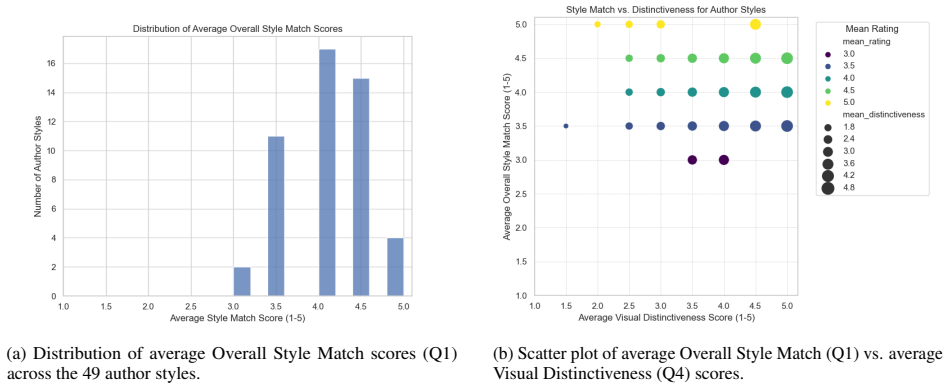
The paper argues that a structured Author Writing Sheet (AWS), containing an author's tendencies in Plot, Creativity, Development, and Language Use, carries enough stylistic signal to drive visual generation. Interpreting that sheet with Claude 3.7 Sonnet and rendering three generated prompts with Stable Diffusion 3.5 Medium produced image sets that raters perceived as a good match to the textual profile (mean $4.08/5$, SD $0.50$) and as moderately distinctive (mean $3.62/5$, SD $0.81$). Qualitative responses indicate that mood and atmosphere translate well, while complex abstract narrative elements—such as destiny resistance or surprise twists—resist static visualization.
Load-bearing premise
The load-bearing premise is that raters' style-match scores reflect the images' visual translation of the author's style, rather than the written style sheet prompting the rater to see a match or the LLM echoing the sheet's own words in the prompts.
Editorial extensions
If this is right
- Visual authorial style personalization is achievable without fine-tuning or per-author training; any author with a written style profile can be visualized with public text-to-image models.
- Mood and atmosphere descriptors are the most reliable visual signals, so prompts for creative aids should prioritize tone, palette, and setting over plot mechanics.
- Generating multiple prompt variants per author yields genuinely different but comparably valid visual readings, since no single prompt won consistently.
- The mixed human-evaluation design—quantitative Likert scores plus qualitative justifications—can serve as a reusable template for judging cross-modal style consistency.
- Applications such as writer's mood boards, character and setting concept art, and visualization of literary techniques are plausible next targets.
Reading between the lines
- A test the paper does not run is to rate images generated from generic prompts, or from another author's AWS, in the same survey; without that control, the numbers cannot distinguish prompt-level style transfer from a general text-to-image quality effect.
- Because raters saw the AWS alongside the images, some of the measured match may reflect the LLM reusing AWS vocabulary (e.g., 'vivid', 'magical', 'suspenseful twists') rather than true visual translation; blind rating or vocabulary-scrubbed prompts would resolve this.
- A stronger claim would be to predict image features (color palette, lighting, composition) from specific AWS categories and verify them automatically with a vision-language model, making the translation auditable.
- The same pipeline could be applied in reverse—turning visual styles into author-like text—as a way to test how symmetric cross-modal style transfer is.
Editorial analysis
A structured set of objections, weighed in public.
Referee Report
Summary. The paper proposes an end-to-end pipeline that converts Author Writing Sheets (AWS), structured textual summaries of an author's writing style, into three text-to-image prompts via an LLM (Claude 3.7 Sonnet) and renders those prompts with Stable Diffusion 3.5 Medium. The authors evaluate the pipeline on 49 Reddit authors with 10 human raters (two ratings per author), reporting a mean Overall Style Match of 4.08/5 and a mean Visual Distinctiveness of 3.62/5, together with qualitative feedback on mood/atmosphere capture and on difficulties with abstract narrative elements. The paper claims this demonstrates effective cross-modal translation of authorial style.
Significance. If the central claim were established, the paper would contribute a novel, training-free pipeline for visual authorial style personalization that could be useful for creative assistance and cross-modal understanding. The work is honestly reported: the limitations section acknowledges the small rater pool, subjectivity of perception, and text-to-image model constraints, and the paper does not overclaim quantitative rigor elsewhere. However, the evidence as presented supports only the descriptive claim that raters gave high match scores; it does not yet support the interpretive claim that the images genuinely translate the authors' textual styles, because the evaluation lacks a control condition and is vulnerable to prompt-vocabulary leakage. The contribution is promising but needs a controlled evaluation before the central claim can be accepted.
major comments (4)
- [§4.2, §5.1.1, §6.1 (RQ1)] The central claim that the pipeline 'effectively translates' authorial style is supported only by an absolute rating with no baseline or control condition. Raters see the AWS text first and are then asked how well the pipeline's images match that same text, so the 4.08/5 mean (Section 5.1.1) may reflect generic image quality, demand characteristics, or a desire for consistency with the text just read, rather than author-specific visual transfer. A control condition that swaps in generic prompts or mismatched AWS profiles is necessary to interpret the rating; without it, the RQ1 conclusion in Section 6.1 is not supported.
- [Table 1, §5.2.1] The evaluation loop is partially closed by construction: the LLM generates prompts from the AWS, the prompts visibly reuse AWS vocabulary (e.g., 'vivid', 'magical', 'suspenseful twists', 'thematic depth' for Monsoon77), and raters are shown the same AWS text as the reference. This textual overlap likely inflates perceived match, because raters can recognize AWS adjectives in the prompt-derived images. The paper should either use prompt conditions that do not directly echo AWS wording or ask raters to match images to unseen/mismatched profiles, in order to isolate genuine visual correspondence from verbal priming.
- [§4.3, §5.1.3] The inter-rater reliability analysis is too weak to support the interpretive claims. With only two raters per item, the reported 'within ±1 point' agreement (89.80% for Q1, 63.27% for Q4) has a high chance baseline and is not a chance-corrected measure; Cohen's kappa, weighted kappa, or ICC should be reported. Similarly, the 40.82% agreement for Q3 (four choices, 25% chance) is not interpretable without a kappa statistic. The statement that raters show 'a strong tendency for raters to be in close agreement' (Section 5.1.3) is therefore not supported.
- [§6.1 (RQ2, RQ3)] RQ2 (role of the intermediary LLM) and RQ3 (visual personalization versus generic artwork) are answered only by inference from the overall scores. There is no ablation that removes or replaces the LLM interpreter, and the Visual Distinctiveness rating is not compared against a generic-artwork baseline. As a result, the conclusions that the LLM was 'largely successful' and that images are 'leaning away from being purely generic' are not empirically grounded in the current design. Adding a direct-prompt baseline and a generic-image control would convert these inferences into testable comparisons.
minor comments (5)
- [Footnote 1, Section 4.1] The dataset link is left as '[Link to your GitHub/Zenodo repository - to be added]', which prevents reproducibility; a working link or a statement of availability is needed.
- [References, Sections 1 and 2.1] The citation of the AWS source is inconsistent: the introduction and Section 2.2 refer to 'Lan et al. [1]' while Section 2.1 refers to 'Kumar et al. [1]'; the reference entry itself lists 'Kumar, Nischal Ashok' as the first author. Please reconcile the author attribution.
- [Figure 1, Section 3] Figure 1 is referenced in Section 3 ('as illustrated in Figure 1') but the corresponding image is not included in the manuscript text; please insert the figure or remove the reference.
- [References [10] and [15]] References [10] and [15] are identical (both are Rombach et al., 'High-Resolution Image Synthesis with Latent Diffusion Models'); duplicate entries should be removed.
- [Section 5.1.1] The overall mean and SD are reported but no confidence intervals or per-item variability are given; given the small rater pool, a confidence interval around the 4.08 mean would help readers assess precision.
Circularity Check
No significant circularity: the pipeline is an empirical human-rating study with no fitted parameters, no self-citation chain, and no result equivalent to its input by construction.
full rationale
The paper's central evidence is the mean Overall Style Match of 4.08 from human raters (Section 5.1.1). This is not a prediction derived from fitted parameters, and no equation relates the AWS input to the rating output. The AWS itself is taken from Lan et al. [1], a non-overlapping group, so the citation is external rather than self-referential. The LLM prompt-generation step (Section 3.2) is an untrained, prompted transformation, not a fit to the evaluation data, and the human ratings are a genuinely external dependent measure that could in principle have been low. The absence of a control condition is a real internal-validity limitation: because raters see the AWS text and then images generated from prompts derived from that same text, the 4.08 mean may partly reflect prompt vocabulary echoing and demand characteristics. However, that is a confound in the interpretation of an empirical result, not a logical circularity in a derivation: the image is not identical to the AWS, the LLM and Stable Diffusion introduce substantial lossy transformations, and the rating is a measured judgment rather than a constructed equality. Accordingly, the circularity score is 0.
Assumptions & free parameters
free parameters (3)
- Positive prompt modifier suffix =
"8k, highly detailed, masterpiece, perfect composition, intricate details, professional quality, cinematic lighting"
- Number of prompts per author =
3
- IRR agreement tolerance =
within ±1 Likert point
assumptions (5)
- domain assumption The AWS accurately summarizes each author's writing style.
- domain assumption An author's literary style has stable visual correlates expressible by a text-to-image model.
- domain assumption Ten raters with general creative-content familiarity can judge stylistic match reliably.
- domain assumption The LLM's prompt interpretations and the diffusion model's renders faithfully instantiate the intended style.
- ad hoc to paper The preprocessing step preserves all style-relevant content while removing artifacts.
Cite this review
Pith. "Pith review of Personalized Image Generation from an Author Writing Style." pith.science (2026). https://pith.science/paper/VCSSI5R4
@misc{pith2026250703313,
  author       = {Pith},
  title        = {Pith review of: Personalized Image Generation from an Author Writing Style},
  year         = {2026},
  howpublished = {\url{https://pith.science/paper/VCSSI5R4}},
  note         = {Machine review of arXiv:2507.03313}
}
abstract
Translating nuanced, textually-defined authorial writing styles into compelling visual representations presents a novel challenge in generative AI. This paper introduces a pipeline that leverages Author Writing Sheets (AWS) - structured summaries of an author's literary characteristics - as input to a Large Language Model (LLM, Claude 3.7 Sonnet). The LLM interprets the AWS to generate three distinct, descriptive text-to-image prompts, which are then rendered by a diffusion model (Stable Diffusion 3.5 Medium). We evaluated our approach using 49 author styles from Reddit data, with human evaluators assessing the stylistic match and visual distinctiveness of the generated images. Results indicate a good perceived alignment between the generated visuals and the textual authorial profiles (mean style match: $4.08/5$), with images rated as moderately distinctive. Qualitative analysis further highlighted the pipeline's ability to capture mood and atmosphere, while also identifying challenges in representing highly abstract narrative elements. This work contributes a novel end-to-end methodology for visual authorial style personalization and provides an initial empirical validation, opening avenues for applications in creative assistance and cross-modal understanding.
Figures


Reference graph
Works this paper leans on
-
[1]
Whose Story Is It? Personalizing Story Generation by Inferring Author Styles
Kumar, Nischal Ashok, Chau Minh Pham, Mohit Iyyer, and Andrew Lan. “Whose Story Is It? Personalizing Story Generation by Inferring Author Styles.” In arXiv preprint arXiv:2502.13028, 2025
arXiv 2025
-
[2]
Task Supportive and Personalized Human-Large Language Model Interaction: A User Study
Wang, Ben, Jiqun Liu, Jamshed Karimnazarov, and Nicolas Thompson. “Task Supportive and Personalized Human-Large Language Model Interaction: A User Study.” In Proceedings of the 2024 Conference on Human Information Interaction and Retrieval, pp. 370–375, 2024
work page 2024
-
[3]
Personalized Feedback Generation Using LLMs: Enhancing Student Learning in STEM Education
Zheng, Qichang, Tianjun Mo, and Xu Wang. “Personalized Feedback Generation Using LLMs: Enhancing Student Learning in STEM Education.” Journal of Advanced Computing Systems , vol. 3, no. 10, 2023, pp. 8–22
work page 2023
-
[4]
The Oscars of AI Theater: A Survey on Role-Playing with Language Models
Chen, Nuo, Yan Wang, Yang Deng, and Jia Li. “The Oscars of AI Theater: A Survey on Role-Playing with Language Models.” arXiv preprint arXiv:2407.11484, 2024
arXiv 2024
-
[5]
Goodfellow, Ian J., Jean Pouget-Abadie, Mehdi Mirza, Bing Xu, David Warde-Farley, Sherjil Ozair, Aaron Courville, and Yoshua Bengio. “Generative Adversarial Nets.” In Advances in Neural Information Processing Systems 27 (NIPS 2014) , pp. 2672–2680, 2014
work page 2014
-
[6]
Deep Unsupervised Learning using Nonequilibrium Thermodynamics
Sohl-Dickstein, Jascha, Eric A. Weiss, Niru Maheswaranathan, and Surya Ganguli. “Deep Unsupervised Learning using Nonequilibrium Thermodynamics.” In Proceedings of the 32nd International Conference on Machine Learning (ICML), pp. 2256–2265, 2015
work page 2015
-
[7]
Denoising Diffusion Probabilistic Models
Ho, Jonathan, Ajay Jain, and Pieter Abbeel. “Denoising Diffusion Probabilistic Models.” In Advances in Neural Information Processing Systems 33 (NeurIPS 2020) , pp. 6840–6851, 2020
work page 2020
-
[8]
Zero-Shot Text-to-Image Generation
Ramesh, Aditya, Mikhail Pavlov, Gabriel Goh, Scott Gray, Chelsea V oss, Alec Radford, Mark Chen, and Ilya Sutskever. “Zero-Shot Text-to-Image Generation.” In Proceedings of the 38th International Conference on Machine Learning (ICML), pp. 8821–8831, 2021
work page 2021
Show all 22 references
-
[9]
Photorealistic Text-to-Image Diffusion Models with Deep Language Understanding
Saharia, Chitwan, William Chan, Saurabh Saxena, Lala Li, Jay Whang, Emily Denton, Seyed Kamyar Seyed Ghasemipour, Burcu Karagol Ayan, S. Sara Mahdavi, Rapha Gontijo Lopes, Tim Salimans, Jonathan Ho, David J. Fleet, and Mohammad Norouzi. “Photorealistic Text-to-Image Diffusion ...
2022
-
[10]
High-Resolution Image Synthesis with Latent Diffusion Models
Rombach, Robin, Andreas Blattmann, Dominik Lorenz, Patrick Esser, and Björn Ommer. “High-Resolution Image Synthesis with Latent Diffusion Models.” In Proceedings of the IEEE/CVF Conference on Computer Vision and Pattern Recognition (CVPR), pp. 10684–10695, 2022. 10
2022
-
[11]
Learning Transferable Visual Models From Natural Language Supervision
Radford, Alec, Jong Wook Kim, Chris Hallacy, Aditya Ramesh, Gabriel Goh, Sandhini Agarwal, Girish Sastry, Amanda Askell, Pamela Mishkin, Jack Clark, Gretchen Krueger, and Ilya Sutskever. “Learning Transferable Visual Models From Natural Language Supervision.” In Proceedings of...
2021
-
[12]
Adding Conditional Control to Text-to-Image Diffusion Models
Zhang, Lvmin, Anyi Rao, and Maneesh Agrawala. “Adding Conditional Control to Text-to-Image Diffusion Models.” In Proceedings of the IEEE/CVF International Conference on Computer Vision (ICCV) , pp. 3686–3697, 2023
2023
-
[13]
Image Style Transfer Using Convolutional Neural Networks
Gatys, Leon A., Alexander S. Ecker, and Matthias Bethge. “Image Style Transfer Using Convolutional Neural Networks.” In Proceedings of the IEEE Conference on Computer Vision and Pattern Recognition (CVPR) , pp. 2414–2423, 2016
2016
-
[14]
MusicLM: Generating Music From Text
Agostinelli, Andrea, Timo I. Denk, Zalán Borsos, Jesse Engel, Mauro Verzetti, Antoine Caillon, Qingqing Huang, Aren Jansen, Adam Roberts, Marco Tagliasacchi, Matt Sharifi, Neil Zeghidour, and Christian Frank. “MusicLM: Generating Music From Text.” arXiv preprint arXiv:2301.11325, 2023
2023 arXiv
-
[15]
High-Resolution Image Synthesis with Latent Diffusion Models
Rombach, Robin, Andreas Blattmann, Dominik Lorenz, Patrick Esser, and Björn Ommer. “High-Resolution Image Synthesis with Latent Diffusion Models.” In Proceedings of the IEEE/CVF Conference on Computer Vision and Pattern Recognition (CVPR), pp. 10684–10695, 2022
2022
-
[16]
An Image is Worth One Word: Personalizing Text-to-Image Generation using Textual Inversion
Gal, Rinon, Yuval Alaluf, Yuval Atzmon, Or Patashnik, Amit H. Bermano, Gal Chechik, and Daniel Cohen-Or. “An Image is Worth One Word: Personalizing Text-to-Image Generation using Textual Inversion.” InInternational Conference on Learning Representations (ICLR), 2023. (Note: Of...
2023
-
[17]
DreamBooth: Fine-Tuning Text-to-Image Diffusion Models for Subject-Driven Generation
Ruiz, Nataniel, Yuanzhen Li, Varun Jampani, Yael Pritch, Michael Rubinstein, and Kfir Aberman. “DreamBooth: Fine-Tuning Text-to-Image Diffusion Models for Subject-Driven Generation.” InProceedings of the IEEE/CVF Conference on Computer Vision and Pattern Recognition (CVPR) , p...
2023
-
[18]
Personalization of Large Language Models: A Survey
Zhang, Zhehao, Ryan A. Rossi, Branislav Kveton, Yijia Shao, Diyi Yang, Hamed Zamani, Franck Dernoncourt, et al. “Personalization of Large Language Models: A Survey.” arXiv preprint arXiv:2411.00027, 2024
2024 arXiv
-
[19]
Towards Unified Uni- and Multi-Modal News Headline Generation
Krubi´nski, Mateusz, and Pavel Pecina. “Towards Unified Uni- and Multi-Modal News Headline Generation.” In Findings of the Association for Computational Linguistics: EACL 2024 , pp. 437–450, 2024
2024
-
[20]
Towards Controllable and Personalized Review Generation
Li, Pan, and Alexander Tuzhilin. “Towards Controllable and Personalized Review Generation.” arXiv preprint arXiv:1910.03506, 2019
1910 arXiv
-
[21]
Automatic Generation of Multimedia Teaching Materials Based on Generative AI: Taking Tang Poetry as an Example
Chen, Xu, and Di Wu. “Automatic Generation of Multimedia Teaching Materials Based on Generative AI: Taking Tang Poetry as an Example.” IEEE Transactions on Learning Technologies, 2024
2024
-
[22]
Personalized Prompt Learning for Explainable Recommendation
Li, Lei, Yongfeng Zhang, and Li Chen. “Personalized Prompt Learning for Explainable Recommendation.” ACM Transactions on Information Systems, vol. 41, no. 4, 2023, pp. 1–26. 11
2023
Reviewed August 6, 2026 · model on record in the stance chip above.
Discussion (0). Sign in to comment.