REVIEW 5 major objections 5 minor 52 references
Source-Free Domain Adaptation via Multi-view Contrastive Learning
T0 review · 5 major / 5 minor · reviewed 2026-08-06 · deepseek-v4-flash
Pith's one-line read A three-phase source-free domain adaptation method screens target samples with adaptive self-entropy thresholds and trains on variance-weighted contrastive views, claiming roughly 2–6 percent higher accuracy than 13 existing approaches on…
desk verdict Plausible SFUDA recipe, but a malformed loss and a 19-point discrepancy between the ablation and main tables make the headline numbers unreliable. read the letter →
The pith
A machine-rendered reading of the paper's core claim, the machinery that carries it, and where it could break.
The reading
What carries the argument
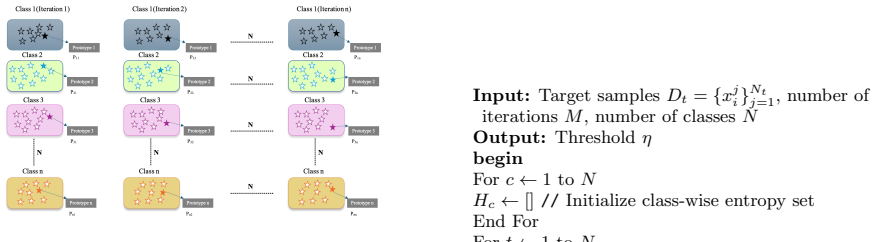
The central machinery is a pair of adaptive thresholds built from self-entropy. Equation (1) defines $\eta$ as the maximum, over $M$ iterations, of the class-wise minimum normalized entropy: $\eta = \max_i \{ \min_j E_{i,j} \}$. This single number controls which target samples are 'reliable' enough to serve as prototypes (RSM) and, in the final phase, which pseudo-labels to keep; the authors argue a fixed threshold would discard informative samples from classes with typically higher entropy. The second piece is variance-weighted multi-view feature concatenation: each augmented view's features are scaled by the normalized average variance of that view's feature matrix, then joined into one vector that k-means clusters. The contrastive loss (Equation 8) and clustering loss (Equation 9) are added to a cross-entropy loss on the pseudo-labeled samples, with coefficients that sum to one and shift weight from pseudo-labels to the distribution-consistency terms as training proceeds.
What would settle it
Train the method on a source-target pair in which the source classifier's logits are deliberately miscalibrated (for example, by adding uniform noise to the logits while keeping the feature extractor fixed), and check whether the RSM-selected low-entropy samples still have above-chance true-label accuracy; if they do not, the entropy-threshold pipeline is not the source of the reported gains.
Extended reading notes
Core claim
The paper's central claim is that high-quality pseudo-labels are the key to source-free domain adaptation, and that they can be obtained by a three-stage pipeline. First, the Reliable Sample Memory (RSM) uses the per-class minimum of normalized self-entropy values, taken over iterations, as an adaptive threshold $\eta$ to pick a balanced set of representative target samples per class and build better prototypes. Second, Multi-View Contrastive Learning creates several augmented views of each target sample, extracts features per view, weights each view by the average variance of its feature matrix, and concatenates the weighted views into a single representation that is clustered with k-means to assign pseudo-labels. Third, an attention-weighted average of iteration-wise adaptive thresholds filters out labels whose self-entropy is too high. The paper reports that on VisDA-2017 the method reaches 89.23 percent average accuracy (against 87.8 for SHOT++), on Office-31 91.57 percent (against 91.25 for SHOT++), and on Office-Home 73.41 percent (against 72.93 for SHOT++), and that the ablation study shows each of the three phases adds a few points of accuracy.
Load-bearing premise
The load-bearing premise is that a per-class minimum of normalized self-entropy, tracked over iterations, reliably identifies trustworthy target samples, and that the variance-weighted concatenated features form class-consistent k-means clusters; if the frozen source features are miscalibrated on the target domain, the entropy threshold, the prototypes, and the pseudo-labels all degrade together.
Editorial extensions
If this is right
- If the reported numbers hold, the method outperforms source-dependent approaches on Office-Home, reaching 73.41 percent against 67.84 for DAN and 71.24 for DANN, which would mean source-free adaptation need not sacrifice accuracy to privacy.
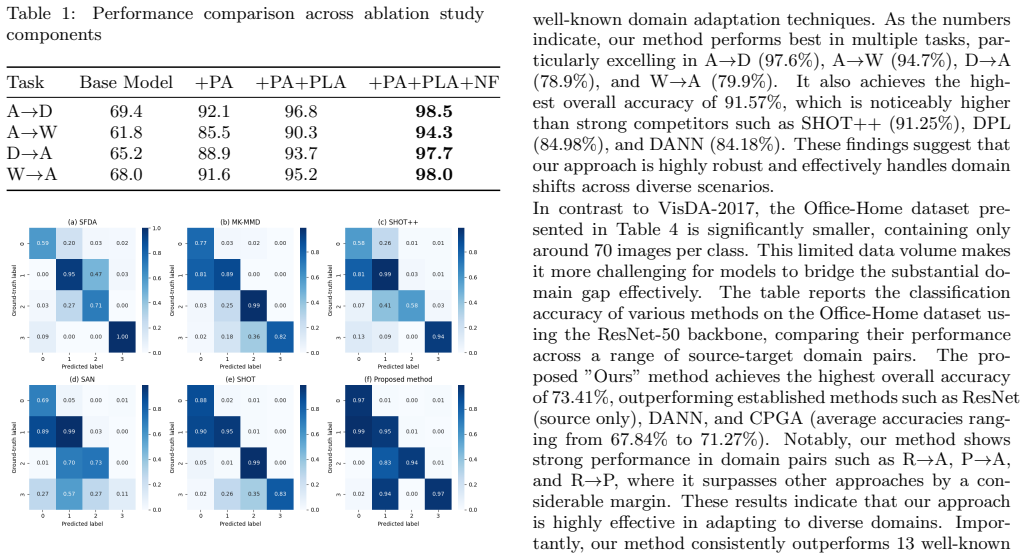
- The ablation study indicates the gains are cumulative: adding pseudo-label assignment raises accuracy by roughly 24–28 points, adding prototype learning adds about 3.7–4.8 points, and noisy-label filtering adds another 3.4–4.0 points, so each phase carries a measurable share of the final result.
- The adaptive entropy threshold stabilizes early: the paper reports $\eta$ fluctuates between about 0.1 and 0.8 in initial iterations and settles near zero after roughly 20 iterations, meaning the model converges to a consistent pool of high-confidence samples.
- The method shows strong per-task results across dataset sizes, including 100 percent on the W→D task of Office-31 and 98.6 percent on the plane class of VisDA-2017, suggesting the gains are not driven by a single easy benchmark.
Reading between the lines
- Editorial inference: the entropy-gating mechanism implicitly assumes the frozen source feature extractor is reasonably calibrated on target data; a domain shift that miscalibrates prediction confidence could make low self-entropy select confidently wrong samples, and both the prototype and pseudo-label stages would degrade together.
- Editorial inference: treating per-view feature variance as a proxy for discriminative signal is a testable design choice; a direct comparison against uniform weighting or learned attention would show whether the reported gains depend specifically on the variance weighting.
- Editorial inference: because all source-model weights stay frozen, the method's gains come almost entirely from target-side pseudo-label engineering, so it could plausibly be combined with other target-only regularizers without changing the privacy model.
- Editorial inference: the claimed 6 percent edge over the 'average of 13 methods' depends on the composition of that baseline set; comparing only against the strongest source-free baselines (SHOT++, DPL, SAN) would likely show a smaller though still positive margin.
Editorial analysis
A structured set of objections, weighed in public.
Referee Report
Summary. The paper proposes a three-phase source-free unsupervised domain adaptation (SFUDA) method. Phase one uses a Reliable Sample Memory (RSM) module and self-entropy-based thresholds to select prototypes; phase two uses multi-view contrastive learning with variance-weighted feature concatenation and k-means clustering to assign pseudo-labels; phase three applies an adaptive entropy threshold to filter noisy labels. The authors report state-of-the-art results on VisDA-2017, Office-31, and Office-Home, claiming roughly 2% improvement over the second-best method and 6% over the average of 13 prior approaches. The method is described as operating with a frozen pre-trained source model and no access to source data.
Significance. If the reported results were valid and reproducible, the method would be a meaningful contribution to SFUDA, particularly the ideas of entropy-gated prototype selection and multi-view contrastive pseudo-label refinement. The paper is readable at a high level, gives a clear statement of the privacy motivation, and explicitly acknowledges increased computational cost as a limitation. However, the technical content as written does not support the central claim. The main contrastive loss in Eq. (8) is not a well-formed objective, the entropy normalization in Eq. (3) is not the self-entropy of a predictive distribution, and the implementation described in Section 4.4 contradicts the source-free and frozen-source premise by using a domain discriminator with a gradient reversal layer. Most seriously, the ablation results in Table 1 and the main results in Table 3 disagree by about 19 percentage points on the D→A and W→A Office-31 tasks, an inconsistency much larger than the claimed margins over baselines. No code or hyperparameter values are provided, so the headline claim rests entirely on the internal consistency of the manuscript, and that consistency fails at load-bearing points.
major comments (5)
- [Section 3.4, Eq. (8)] The contrastive loss in Eq. (8) is not a valid or implementable objective. The term w_{i,j} appears outside the logarithm but is never defined for the anchor i, and the denominator sums over all k ≠ i, which includes k = j, so the positive pair z_i, z_j is also treated as a negative. The accompanying sentence explaining the indicator function does not resolve this. Since this loss is one of the three terms in Eq. (10), the multi-view contrastive learning component cannot be evaluated as stated.
- [Section 3.3, Eq. (3)] Eq. (3) is labeled as self-entropy after min-max normalization, but it applies min-max normalization to the raw input x and then computes -Σ x' log x'. This is not the entropy of the model's predictive distribution defined in Eq. (2), and it depends on the arbitrary scale of x. Because Algorithm 1 and the threshold η in Eq. (1) are built on this quantity, the prototype-selection criterion is not actually well defined.
- [Section 4.4] The implementation details state that optimization is performed end-to-end on Fs, Cs, and D with a gradient reversal layer and a three-layer domain discriminator, but Sections 1 and 3.2 establish that no source data is available and that all source parameters are fixed. A domain discriminator that separates source and target features cannot be trained without source data, so the experimental pipeline described here is not the source-free, frozen-source method proposed in the rest of the paper.
- [Tables 1 and 3] For the same four Office-31 transfer tasks, the full method is reported at 98.5 (A→D), 94.3 (A→W), 97.7 (D→A), and 98.0 (W→A) in the ablation study, but at 97.6, 94.7, 78.9, and 79.9 in the main results table. The D→A and W→A discrepancies of roughly 19 percentage points are far larger than the claimed 0.3–2 point improvements over the second-best method, and no explanation is provided. This internal inconsistency means the ablation does not verify the model that produced the headline results.
- [Section 3.4, Eqs. (9)–(10)] The clustering loss in Eq. (9) is written as a plain k-means objective with no assignment variable and no mapping from clusters to classes, and the total loss in Eq. (10) includes L_ce, which is never defined, while the text says λ1, λ2, and λ3 control only the contrastive and clustering losses. The constraint that the weights sum to one is stated, but no numerical values are reported, so the overall objective is not reproducible.
minor comments (5)
- [Algorithm 2] Algorithm 2 uses inconsistent notation: the header says 'n2 input from eq(2)', and the matrix row size is N/n, while Algorithm 1 and Eq. (1) use an M × N matrix; these definitions should be reconciled.
- [Section 3.4] The symbol D is redefined as a labeled dataset D = {x_i, y_i} after Section 3.1 introduced D_T as the unlabeled target domain; this redefinition is confusing and should be avoided.
- [Tables 2 and 4] The acronym SFDA is used both for the field 'source-free domain adaptation' and for a specific method in Table 2 and the discussion around Figure 10, which makes the comparison difficult to follow.
- [Eq. (13)] The attention-weighted threshold in Eq. (13) is not followed by any algorithm or pseudo-code showing how θ_i, the attention weights α_i, and ρ are computed or where the weighted average is applied in training.
- [References] The citation to [49] in Section 4.4 for 'established practices' of data augmentation appears mismatched, as [49] is listed as a domain adaptation method, not an augmentation protocol.
Circularity Check
No significant circularity: the paper proposes a standard SFUDA self-training pipeline whose thresholds, pseudo-labels, and losses are computed from target data and frozen-model outputs, then evaluated against target ground-truth labels.
full rationale
The paper does not claim a first-principles derivation; it proposes an empirical three-phase SFUDA pipeline. Pseudo-labels are produced by the pre-trained source model and then used to train the same model, but this is the method's explicit self-training design, not a hidden reduction of a claimed result: final accuracy is measured against target ground-truth labels, and each loss term (contrastive, cross-entropy, clustering) is optimized on target features. The adaptive thresholds in Eqs. (1) and (11) are computed from the model's own entropy outputs; this is the stated operation of the algorithm, not a fitted quantity renamed as a prediction. No load-bearing self-citation appears: references [4,5,6] support background statements about transfer learning and privacy, and no uniqueness theorem is imported from the authors' prior work. The under-specified Eq. (8) and the conflicting Table 1/Table 3 numbers for D->A and W->A are serious correctness and reproducibility concerns, but they are not circularity. The conclusion's stated computational-cost limitation is acknowledged and does not create a circular step. Therefore no circular step can be exhibited under the required quote-and-reduction standard.
Assumptions & free parameters
free parameters (5)
- loss weights λ1, λ2, λ3 =
not reported (sum constrained to 1)
- temperature τ =
not reported
- number of views/augmentations M =
not reported
- threshold η =
computed from data (max-min entropy), not a constant
- learning rate =
0.001 and 0.0005
assumptions (4)
- domain assumption Self-entropy of the model's predictions reflects sample reliability in the target domain.
- domain assumption Features from the frozen source model are informative enough that variance-weighted concatenation and k-means produce class-consistent clusters.
- domain assumption The source model parameters are fixed (frozen) and only target-side modules are trainable.
- standard math Standard contrastive learning assumptions: augmentations preserve semantics, and similarity in feature space corresponds to label similarity.
Cite this review
Pith. "Pith review of Source-Free Domain Adaptation via Multi-view Contrastive Learning." pith.science (2026). https://pith.science/paper/EKM6RBOL
@misc{pith2026250703321,
  author       = {Pith},
  title        = {Pith review of: Source-Free Domain Adaptation via Multi-view Contrastive Learning},
  year         = {2026},
  howpublished = {\url{https://pith.science/paper/EKM6RBOL}},
  note         = {Machine review of arXiv:2507.03321}
}
read the original abstract
Domain adaptation has become a widely adopted approach in machine learning due to the high costs associated with labeling data. It is typically applied when access to a labeled source domain is available. However, in real-world scenarios, privacy concerns often restrict access to sensitive information, such as fingerprints, bank account details, and facial images. A promising solution to this issue is Source-Free Unsupervised Domain Adaptation (SFUDA), which enables domain adaptation without requiring access to labeled target domain data. Recent research demonstrates that SFUDA can effectively address domain discrepancies; however, two key challenges remain: (1) the low quality of prototype samples, and (2) the incorrect assignment of pseudo-labels. To tackle these challenges, we propose a method consisting of three main phases. In the first phase, we introduce a Reliable Sample Memory (RSM) module to improve the quality of prototypes by selecting more representative samples. In the second phase, we employ a Multi-View Contrastive Learning (MVCL) approach to enhance pseudo-label quality by leveraging multiple data augmentations. In the final phase, we apply a noisy label filtering technique to further refine the pseudo-labels. Our experiments on three benchmark datasets - VisDA 2017, Office-Home, and Office-31 - demonstrate that our method achieves approximately 2 percent and 6 percent improvements in classification accuracy over the second-best method and the average of 13 well-known state-of-the-art approaches, respectively.
Figures


Figures from the paper (6 more)


Reference graph
Works this paper leans on
-
[1]
Seungryul Baek, Kwang In Kim, and Tae-Kyun Kim. “Weakly-supervised domain adaptation via gan and mesh model for estimating 3d hand poses interact- ing objects”. In: Proceedings of the IEEE/CVF confer- ence on computer vision and pattern recognition. 2020, pp. 6121–6131
work page 2020
-
[2]
Partial adversarial domain adap- tation
Zhangjie Cao et al. “Partial adversarial domain adap- tation”. In: Proceedings of the European conference on computer vision (ECCV) . 2018, pp. 135–150
work page 2018
-
[3]
Homm: Higher-order moment match- ing for unsupervised domain adaptation
Chao Chen et al. “Homm: Higher-order moment match- ing for unsupervised domain adaptation”. In: Proceed- ings of the AAAI conference on artificial intelligence . Vol. 34. 04. 2020, pp. 3422–3429
work page 2020
-
[4]
Leveraging meta-learning to improve unsupervised domain adap- tation
Amirfarhad Farhadi and Arash Sharifi. “Leveraging meta-learning to improve unsupervised domain adap- tation”. In: The Computer Journal 67.5 (2024), pp. 1838– 1850
work page 2024
-
[5]
Domain adaptation in re- inforcement learning: a comprehensive and systematic study
Amirfarhad Farhadi et al. “Domain adaptation in re- inforcement learning: a comprehensive and systematic study”. In: Frontiers of Information Technology & Elec- tronic Engineering 25.11 (2024), pp. 1446–1465
work page 2024
-
[6]
Leveraging Blockchain and ANFIS for Optimal Supply Chain Management
Amirfarhad Farhadi et al. “Leveraging Blockchain and ANFIS for Optimal Supply Chain Management”. In: arXiv preprint arXiv:2408.17161 (2024)
work page Pith review arXiv 2024
-
[7]
Kenichiro Fukushi et al. “Few-shot generative model for skeleton-based human action synthesis using cross- domain adversarial learning”. In: Proceedings of the IEEE/CVF Winter Conference on Applications of Com- puter Vision . 2024, pp. 3946–3955
work page 2024
-
[8]
Unsupervised domain adaptation by backpropagation
Yaroslav Ganin and Victor Lempitsky. “Unsupervised domain adaptation by backpropagation”. In: Interna- tional conference on machine learning . PMLR. 2015, pp. 1180–1189
work page 2015
Show all 52 references
-
[9]
Domain-adversarial training of neural networks
Yaroslav Ganin et al. “Domain-adversarial training of neural networks”. In: Journal of machine learning re- search 17.59 (2016), pp. 1–35
2016
-
[10]
A kernel two-sample test
Arthur Gretton et al. “A kernel two-sample test”. In: The Journal of Machine Learning Research13.1 (2012), pp. 723–773
2012
-
[11]
Deep residual learning for image recognition
Kaiming He et al. “Deep residual learning for image recognition”. In: Proceedings of the IEEE conference on computer vision and pattern recognition. 2016, pp. 770– 778
2016
-
[12]
Model adaptation: Historical contrastive learning for unsupervised domain adap- tation without source data
Jiaxing Huang et al. “Model adaptation: Historical contrastive learning for unsupervised domain adap- tation without source data”. In: Advances in neural information processing systems 34 (2021), pp. 3635– 3649. Table 4: Accuracy (%) on the Office-Home (ResNet-50) Method Sourc...
2021
-
[13]
Structure preserv- ing cycle-GAN for unsupervised medical image domain adaptation
Paolo Iacono and Naimul Khan. “Structure preserv- ing cycle-GAN for unsupervised medical image domain adaptation”. In: 2024 46th Annual International Con- ference of the IEEE Engineering in Medicine and Bi- ology Society (EMBC) . IEEE. 2024, pp. 1–5
2024
-
[14]
Domain-invariant feature extrac- tion and fusion for cross-domain person re-identification
Zhaoqian Jia et al. “Domain-invariant feature extrac- tion and fusion for cross-domain person re-identification”. In: The visual computer 39.3 (2023), pp. 1205–1216
2023
-
[15]
Visually source-free domain adaptation via adversarial style matching
Mengmeng Jing et al. “Visually source-free domain adaptation via adversarial style matching”. In: IEEE Transactions on Image Processing33 (2024), pp. 1032– 1044
2024
-
[16]
Domain adaptation without source data
Youngeun Kim et al. “Domain adaptation without source data”. In: IEEE Transactions on Artificial Intelligence 2.6 (2021), pp. 508–518
2021
-
[17]
Attribute-aligned domain-invariant feature learning for unsupervised domain adaptation person re-identification
Huafeng Li et al. “Attribute-aligned domain-invariant feature learning for unsupervised domain adaptation person re-identification”. In: IEEE Transactions on Information Forensics and Security 16 (2020), pp. 1480– 1494
2020
-
[18]
A comprehensive survey on source- free domain adaptation
Jingjing Li et al. “A comprehensive survey on source- free domain adaptation”. In: IEEE Transactions on Pattern Analysis and Machine Intelligence (2024)
2024
-
[19]
Domain invariant and class discrim- inative feature learning for visual domain adaptation
Shuang Li et al. “Domain invariant and class discrim- inative feature learning for visual domain adaptation”. In: IEEE transactions on image processing 27.9 (2018), pp. 4260–4273
2018
-
[20]
Intelligent fault diagnosis by fusing domain adversarial training and maximum mean dis- crepancy via ensemble learning
Yibin Li et al. “Intelligent fault diagnosis by fusing domain adversarial training and maximum mean dis- crepancy via ensemble learning”. In: IEEE Transac- tions on Industrial Informatics 17.4 (2020), pp. 2833– 2841
2020
-
[21]
Do we re- ally need to access the source data? source hypothesis transfer for unsupervised domain adaptation
Jian Liang, Dapeng Hu, and Jiashi Feng. “Do we re- ally need to access the source data? source hypothesis transfer for unsupervised domain adaptation”. In: In- ternational conference on machine learning . PMLR. 2020, pp. 6028–6039
2020
-
[22]
Domain adaptation with auxiliary target domain-oriented clas- sifier
Jian Liang, Dapeng Hu, and Jiashi Feng. “Domain adaptation with auxiliary target domain-oriented clas- sifier”. In: Proceedings of the IEEE/CVF conference on computer vision and pattern recognition. 2021, pp. 16632– 16642
2021
-
[23]
Source data-absent unsupervised domain adaptation through hypothesis transfer and labeling transfer
Jian Liang et al. “Source data-absent unsupervised domain adaptation through hypothesis transfer and labeling transfer”. In: IEEE Transactions on Pattern Analysis and Machine Intelligence 44.11 (2021), pp. 8602– 8617
2021
-
[24]
Multi- domain adversarial feature generalization for person re-identification
Shan Lin, Chang-Tsun Li, and Alex C Kot. “Multi- domain adversarial feature generalization for person re-identification”. In: IEEE Transactions on Image Pro- cessing 30 (2020), pp. 1596–1607
2020
-
[25]
An adaptive source-free unsuper- vised domain adaptation method for mechanical fault detection
Jianing Liu et al. “An adaptive source-free unsuper- vised domain adaptation method for mechanical fault detection”. In: Mechanical Systems and Signal Pro- cessing 228 (2025), p. 112475
2025
-
[26]
Deep transfer learning with joint adaptation networks
Mingsheng Long et al. “Deep transfer learning with joint adaptation networks”. In: International confer- ence on machine learning . PMLR. 2017, pp. 2208– 2217
2017
-
[27]
Learning transferable features with deep adaptation networks
Mingsheng Long et al. “Learning transferable features with deep adaptation networks”. In:International con- ference on machine learning. PMLR. 2015, pp. 97–105
2015
-
[28]
Unsupervised domain adapta- tion with residual transfer networks
Mingsheng Long et al. “Unsupervised domain adapta- tion with residual transfer networks”. In: Advances in neural information processing systems 29 (2016)
2016
-
[29]
Source-free domain adaptation via dynamic pseudo labeling and Self-supervision
Qiankun Ma et al. “Source-free domain adaptation via dynamic pseudo labeling and Self-supervision”. In: Pattern Recognition 156 (2024), p. 110793
2024
-
[30]
Overcoming learning bias via Pro- totypical Feature Compensation for source-free domain adaptation
Zicheng Pan et al. “Overcoming learning bias via Pro- totypical Feature Compensation for source-free domain adaptation”. In: Pattern Recognition 158 (2025), p. 111025
2025
-
[31]
Source-free domain adaptation via avatar prototype generation and adaptation
Zhen Qiu et al. “Source-free domain adaptation via avatar prototype generation and adaptation”. In:arXiv preprint arXiv:2106.15326 (2021)
2021 arXiv
-
[32]
Semi-supervised domain adap- tation with auto-encoder via simultaneous learning
Md Mahmudur Rahman, Rameswar Panda, and Mo- hammad Arif Ul Alam. “Semi-supervised domain adap- tation with auto-encoder via simultaneous learning”. In: Proceedings of the IEEE/CVF Winter Conference on Applications of Computer Vision . 2023, pp. 402– 411
2023
-
[33]
Source-free domain adaptation for rgb-d semantic seg- mentation with vision transformers
Giulia Rizzoli, Donald Shenaj, and Pietro Zanuttigh. “Source-free domain adaptation for rgb-d semantic seg- mentation with vision transformers”. In: Proceedings of the IEEE/CVF Winter Conference on Applications of Computer Vision . 2024, pp. 615–624
2024
-
[34]
SS8: Source data-free domain adap- tation via deep clustering with weighted self-labelling
Zihao Song et al. “SS8: Source data-free domain adap- tation via deep clustering with weighted self-labelling”. In: 2022 IEEE International Conference on Network- ing, Sensing and Control (ICNSC). IEEE. 2022, pp. 1– 6
2022
-
[35]
A Two-Stage Multi-Target Domain Adaptation Framework for Prediction of Key Perfor- mance Indicators Based on Adversarial Network
Cheng Su et al. “A Two-Stage Multi-Target Domain Adaptation Framework for Prediction of Key Perfor- mance Indicators Based on Adversarial Network”. In: IEEE Transactions on Emerging Topics in Computa- tional Intelligence 8.2 (2024), pp. 1772–1787
2024
-
[36]
Enhancing aspect-based sentiment analysis using data augmentation based on back-translation
Alireza Taheri, Azadeh Zamanifar, and Amirfarhad Farhadi. “Enhancing aspect-based sentiment analysis using data augmentation based on back-translation”. In: International Journal of Data Science and Analyt- ics (2024), pp. 1–26
2024
-
[37]
Discriminative adversarial do- main adaptation
Hui Tang and Kui Jia. “Discriminative adversarial do- main adaptation”. In: Proceedings of the AAAI confer- ence on artificial intelligence. Vol. 34. 04. 2020, pp. 5940– 5947
2020
-
[38]
Nearest neighborhood-based deep clustering for source data-absent unsupervised domain adaptation
Song Tang et al. “Nearest neighborhood-based deep clustering for source data-absent unsupervised domain adaptation”. In: arXiv preprint arXiv:2107.12585 (2021)
2021 arXiv
-
[39]
Source-free domain adaptation with frozen multimodal foundation model
Song Tang et al. “Source-free domain adaptation with frozen multimodal foundation model”. In: Proceedings of the IEEE/CVF Conference on Computer Vision and Pattern Recognition. 2024, pp. 23711–23720
2024
-
[40]
Robust source-free domain adaptation with anti-adversarial samples training
Zhirui Wang, Liu Yang, and Yahong Han. “Robust source-free domain adaptation with anti-adversarial samples training”. In: Neurocomputing 614 (2025), p. 128777
2025
-
[41]
Instance-invariant domain adaptive object detection via progressive disentanglement
Aming Wu et al. “Instance-invariant domain adaptive object detection via progressive disentanglement”. In: IEEE Transactions on Pattern Analysis and Machine Intelligence 44.8 (2021), pp. 4178–4193
2021
-
[42]
MI 2 GAN: generative adversar- ial network for medical image domain adaptation us- ing mutual information constraint
Xinpeng Xie et al. “MI 2 GAN: generative adversar- ial network for medical image domain adaptation us- ing mutual information constraint”. In: International Conference on Medical Image Computing and Computer- Assisted Intervention. Springer. 2020, pp. 516–525
2020
-
[43]
Unraveling the Mysteries of Label Noise in Source-Free Domain Adaptation: Theory and Practice
Gezheng Xu et al. “Unraveling the Mysteries of Label Noise in Source-Free Domain Adaptation: Theory and Practice”. In: IEEE Transactions on Pattern Analysis and Machine Intelligence (2025)
2025
-
[44]
Adversarial domain adaptation with domain mixup
Minghao Xu et al. “Adversarial domain adaptation with domain mixup”. In: Proceedings of the AAAI conference on artificial intelligence . Vol. 34. 04. 2020, pp. 6502–6509
2020
-
[45]
Cdtrans: Cross-domain transformer for unsupervised domain adaptation
Tongkun Xu et al. “Cdtrans: Cross-domain transformer for unsupervised domain adaptation”. In:arXiv preprint arXiv:2109.06165 (2021)
2021 arXiv
-
[46]
Transformer-based source-free domain adaptation
Guanglei Yang et al. “Transformer-based source-free domain adaptation”. In: arXiv preprint arXiv:2105.14138 (2021)
2021 arXiv
-
[47]
Unsupervised domain adaptation without source data by casting a bait
Shiqi Yang et al. “Unsupervised domain adaptation without source data by casting a bait”. In:arXiv preprint arXiv:2010.12427 1.2 (2020), p. 5
2020 arXiv
-
[48]
Source data-free unsupervised do- main adaptation for semantic segmentation
Mucong Ye et al. “Source data-free unsupervised do- main adaptation for semantic segmentation”. In: Pro- ceedings of the 29th ACM international conference on multimedia. 2021, pp. 2233–2242
2021
-
[49]
Unsupervised domain adaptation us- ing robust class-wise matching
Lei Zhang et al. “Unsupervised domain adaptation us- ing robust class-wise matching”. In: IEEE Transac- tions on Circuits and Systems for Video Technology 29.5 (2018), pp. 1339–1349
2018
-
[50]
Discriminative joint probability maximum mean discrepancy (DJP-MMD) for domain adaptation
Wen Zhang and Dongrui Wu. “Discriminative joint probability maximum mean discrepancy (DJP-MMD) for domain adaptation”. In: 2020 international joint conference on neural networks (IJCNN) . IEEE. 2020, pp. 1–8
2020
-
[51]
Universal source-free domain adaptation method for cross-domain fault diagnosis of machines
Yongchao Zhang et al. “Universal source-free domain adaptation method for cross-domain fault diagnosis of machines”. In: Mechanical Systems and Signal Pro- cessing 191 (2023), p. 110159
2023
-
[52]
Source-free domain adaptation with class prototype discovery
Lihua Zhou et al. “Source-free domain adaptation with class prototype discovery”. In: Pattern recognition 145 (2024), p. 109974
2024
Reviewed August 6, 2026 · model on record in the stance chip above.
Discussion (0). Sign in to comment.