REVIEW 4 major objections 6 minor 21 references
Read Quietly, Think Aloud: Decoupling Comprehension and Reasoning in LLMs
T0 review · 4 major / 6 minor · reviewed 2026-08-06 · deepseek-v4-flash
Pith's one-line read Giving LLMs a silent-reading phase—by masking early-token loss and adding a small reading buddy—improves reasoning accuracy by several points.
desk verdict A simple training trick and a genuinely different auxiliary-reader architecture, but the headline gains are not yet distinguishable from contamination-amplified memorization because K is unreported and no decontamination is described. read the letter →
The pith
A machine-rendered reading of the paper's core claim, the machinery that carries it, and where it could break.
The reading
What carries the argument
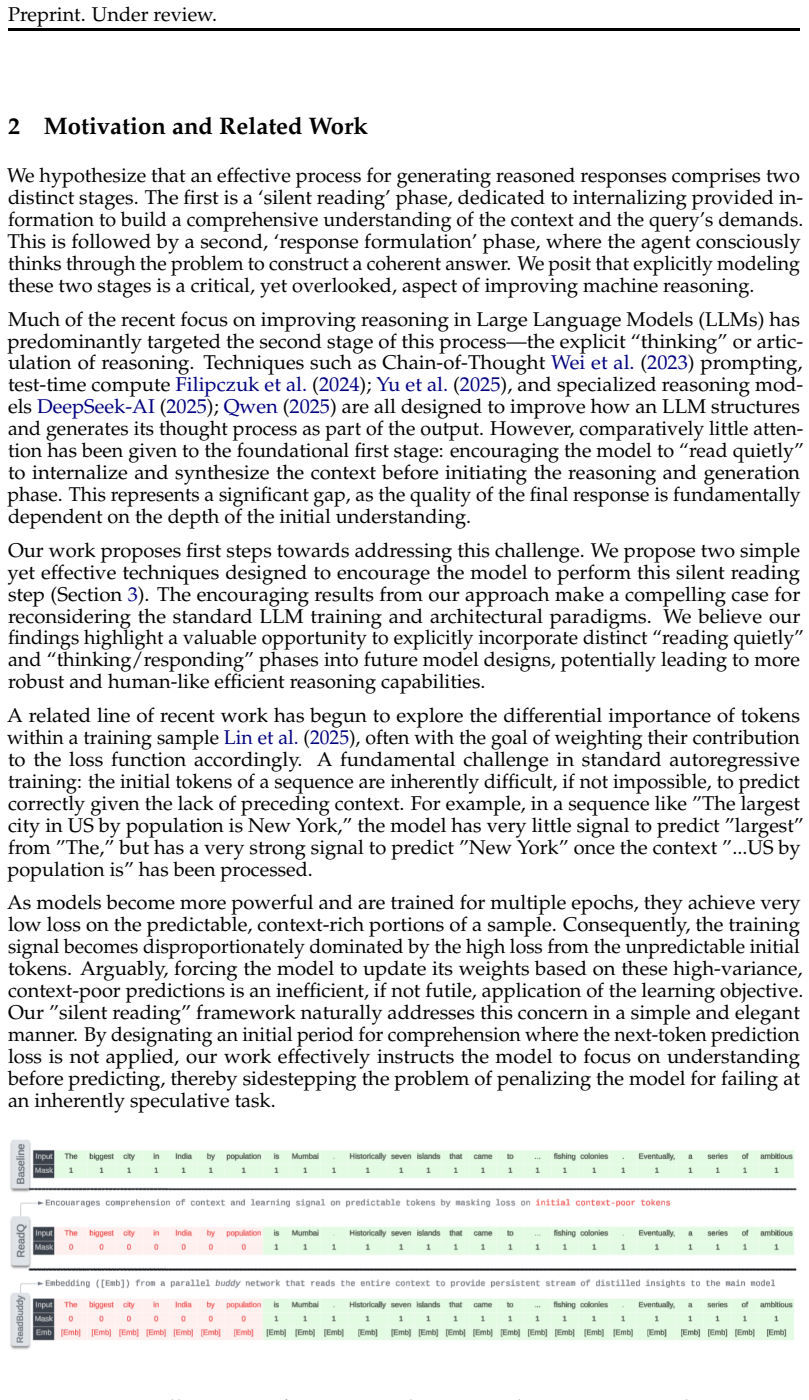
The machinery is next-token prediction loss masking, extended by an auxiliary-model embedding injection. READQ's loss mask sets the loss contribution of the first K predictions after each BOS token to zero, which both removes noisy gradients from context-poor early tokens and, the paper hypothesizes, lets the model learn to build an internal representation before it has to generate. READQBUDDY's buddy is a second, smaller LLM that reads the entire input in parallel; its penultimate-layer embedding is summed with the main model's embedding-layer output at every generation step, so the context summary is available when every output token is predicted. That persistent embedding sum is what carries the READQBUDDY result, while the zero-loss window carries READQ.
What would settle it
Run the same continued-pretraining recipe on a corpus from which all six evaluation benchmarks have been explicitly removed, then evaluate on a private set of new questions in the same formats; if the multi-point gains disappear, memorized test items are responsible, not silent reading. If the gains persist on the private set, the mechanism is confirmed.
Extended reading notes
Core claim
The paper's central claim is that comprehension and reasoning can be separated in an LLM's training objective: a model should first read quietly, without being forced to predict, and only then think and speak. READQ implements the reading phase by zeroing the autoregressive loss on the first K predictions after each beginning-of-sequence token, so the model is never penalized for failing to guess words it has no context to know. READQBUDDY extends the reading phase across the whole response by running a second, smaller LLM over the input and adding that model's penultimate-layer embedding to the main model's input embedding at every step. The authors report that both techniques improve accuracy over the same training recipe on every benchmark they test, that the gains hold on a base model with no instruction tuning, and that the effect scales to a 70B model, where MedQA rises from 66.8% to 74.7%. They present the results as early evidence and note that their READQBUDDY recipe likely under-trains the auxiliary component, which they read as headroom rather than a ceiling.
Load-bearing premise
The evaluation benchmarks are not part of the continued-pretraining corpus, so the measured accuracy gains reflect the reading techniques rather than the model having already memorized the test questions.
Editorial extensions
If this is right
- READQ can be added to any continued-pretraining recipe with no change to the architecture and no extra inference-time compute, so any future training run can capture the reported gain just by choosing a loss-mask window size.
- The loss mask concentrates gradients on tokens the model has enough context to learn from, so the same training budget should produce a model that is better calibrated on early-context and long-context material.
- The buddy architecture means a small auxiliary model can supply persistent context to a large generator, so the main model does not need to re-read or hold all context in its own activations.
- The 70B MedQA result indicates the effect is not an artifact of small-scale training: on dense specialized reasoning, the silent-reading window can move accuracy by multiple points.
- Silent reading and explicit chain-of-thought target different phases of response generation, so combining READQ with a thinking-trace stage is a natural next step the paper proposes.
Reading between the lines
- Not claimed in the paper, but a direct extension: the loss-mask window size K has not been swept, and the reported gains are from a single fixed choice; a proper sweep could reveal the effect is even larger or peaks near zero.
- If the two-phase view is correct, then RL-heavy reasoning training may be optimizing the wrong phase; the highest-value configuration could be reinforcement learning applied on top of a silent-reading base, which the paper neither confirms nor rules out.
- Because READQBUDDY's buddy reads the whole input once and its embedding is reused at every step, the method should shine on long-context, retrieval-augmented, or multi-turn tasks where the model must keep a large context in mind; testing that is an obvious next experiment.
- The benchmark suite is multiple-choice and classification heavy; open-ended generation is untested, so whether silent reading improves free-form reasoning quality rather than answer selection is an open question.
Editorial analysis
A structured set of objections, weighed in public.
Referee Report
Summary. The paper proposes two training-time modifications intended to give LLMs a 'silent reading' phase before generation. READQ masks the next-token prediction loss on the first K tokens of each sequence, and READQBUDDY adds an auxiliary model whose penultimate-layer embedding is summed into the main model's input embedding at every step. The authors report multi-point accuracy gains over same-data baselines on ARC-Challenge, HellaSwag, OpenBookQA, PubMedQA, and Winogrande for a 3B model, and on MedQA and related scientific benchmarks for a 70B model. The paper is an early-stage empirical report; no code, checkpoints, repeated seeds, or decontamination analysis are provided.
Significance. If the reported gains are real and reproducible, this would be a notably cheap way to improve performance on several standard reasoning benchmarks, and the 70B MedQA improvement would be practically interesting. The experimental design has a real strength: every comparison is against a baseline trained on the same data, so the method, rather than the data mixture, is the intended variable. The paper also honestly flags that READQBUDDY may be under-trained and that the training recipe was not exhaustively tuned. However, the evidence as presented is not yet sufficient to support the headline claim: there are no repeated seeds or uncertainty estimates, the key hyperparameter K is never reported, the READQBUDDY architecture is underspecified, and no decontamination check is described for a training corpus composed of public web-scale datasets.
major comments (4)
- [§3.1, App. A.1] The masking window length K is never reported. READQ's behavior is defined entirely by K, and the contamination risk depends on how much of each sequence is masked, because masking shifts the training signal to later, context-rich tokens. Without K, the experiments are irreproducible and the mechanism cannot be assessed. Please report K for every configuration and include a sensitivity analysis over K.
- [§4, Tables 1 and 2] All reported numbers appear to come from a single training run, with no error bars, no multiple seeds, and no statistical tests. Several benchmarks are small (OpenBookQA has roughly 500 examples, PubMedQA roughly 1000), so differences of 2–10 points cannot be evaluated for significance without variance estimates. Please provide at least three independent runs per condition and report standard deviations or bootstrap confidence intervals.
- [§4, App. A.1] The continued-pretraining corpus consists of Fineweb, the Pile, Cosmopedia, UltraBooks, and DeepMind Math, all public and web-scale, while the evaluated benchmarks are standard public datasets that commonly appear in such corpora. The paper describes no decontamination step. This is load-bearing because READQ's loss masking preferentially weights later tokens, which in a leaked benchmark instance are frequently the answer tokens; the measured gains are therefore not yet distinguishable from contamination-amplified memorization. Please report an n-gram overlap analysis between the training mixture and each test set, and rerun the main comparisons on any uncontaminated subset.
- [§3.2, Algorithm 1] READQBUDDY is underspecified to the point of irreproducibility. Table 1 reports SW16 and SW64 variants, but Algorithm 1 contains no sliding-window parameter; the paper does not state the buddy model's context limit, the layer index from which the embedding is taken, the projection layer's initialization and hidden size, or how the 'entire input context' is handled when it exceeds the buddy's window. These details are necessary to reproduce the method and to interpret the difference between READQ and READQBUDDY.
minor comments (6)
- [Table 1] The column headers 'P UBMEDQA' and 'W INOGRANDE' contain spacing errors that make the table difficult to read.
- [Table 1, §3.2] The abbreviations SW16 and SW64 appear in the table but are explained only in the caption; please define them in the body of Section 3.2.
- [Abstract] The phrase 'multiple point accuracy boost' is unclear; consider rewording to 'multi-point accuracy improvements' or giving specific numbers.
- [§2] The discussion of Rho-1 is brief and does not state how READQ's loss masking differs from Rho-1's selective token loss, which would help position the contribution.
- [References] The bibliography entry for DeepMind Math appears as 'Grefenstette Saxton and Kohli Hill' with garbled author order; the correct citation should be checked.
- [App. A.1, Table 2] The 70B experiment uses a different training mixture ('pretraining and supervised fine-tuning') from the 3B experiments; this difference is stated only in the appendix and should be noted in the main text where Table 2 is discussed.
Circularity Check
No material circularity: READQ and READQBUDDY are empirical training and architecture changes evaluated against same-data baselines, and no benchmark gain is derived from a fitted quantity or from a load-bearing self-citation.
full rationale
The paper's central claims are empirical: READQ masks the next-token loss on the first K tokens (Section 3.1), READQBUDDY injects an auxiliary model's embedding into the main model (Section 3.2 and Algorithm 1), and both are evaluated against baselines trained on the same datasets (Section 4). No symbol or fitted parameter is defined in terms of the benchmark outcomes it later claims to improve; K and the buddy projection layer are training and architectural choices, not quantities solved from the evaluation results. The 'silent reading' explanation is a post-hoc interpretation of observed gains, not a derivation that assumes the gains. The only author self-citation (CEPO, Filipczuk et al. 2024) is invoked as an example of test-time-compute prior work and does not carry any load-bearing premise; no uniqueness theorem or prior result by these authors is used to force the method. The absence of a decontamination analysis for the public benchmarks relative to the continued-pretraining mixture (Appendix A.1) is a validity and contamination risk, but it is not circularity: memorization is a confound, not a reduction of the reported outcomes to the method's own inputs. The derivation chain is therefore self-contained, and any concerns belong to correctness risk rather than circularity.
Assumptions & free parameters
free parameters (4)
- K (silent reading window length) =
Not reported
- READQBUDDY sliding window size =
16 and 64
- Buddy embedding layer index =
Second-last layer
- Buddy projection warm-up steps =
500
assumptions (4)
- domain assumption The continued-pretraining corpus does not contain the evaluation benchmarks or their answer patterns.
- ad hoc to paper Loss masking on the first K tokens induces a beneficial silent-reading behavior rather than mere loss attenuation.
- ad hoc to paper Summing the buddy model's second-last-layer embedding into the main model's input embedding is a valid and sufficient way to transfer comprehension.
- domain assumption Continued pretraining with low loss leaves the base model's capabilities intact except for the method-induced changes.
Cite this review
Pith. "Pith review of Read Quietly, Think Aloud: Decoupling Comprehension and Reasoning in LLMs." pith.science (2026). https://pith.science/paper/XYHURRVS
@misc{pith2026250703327,
  author       = {Pith},
  title        = {Pith review of: Read Quietly, Think Aloud: Decoupling Comprehension and Reasoning in LLMs},
  year         = {2026},
  howpublished = {\url{https://pith.science/paper/XYHURRVS}},
  note         = {Machine review of arXiv:2507.03327}
}
read the original abstract
Large Language Models (LLMs) have demonstrated remarkable proficiency in understanding text and generating high-quality responses. However, a critical distinction from human cognition is their typical lack of a distinct internal `reading' or deliberation phase before `speaking' (i.e., generating text). Humans often engage in silent reading to comprehend context and formulate thoughts prior to articulation. This paper investigates methods to imbue LLMs with a similar capacity for internal processing. We introduce and evaluate techniques that encourage LLMs to `read silently.' Our findings indicate that even a straightforward approach, such as providing the model with an initial contextual prompt or `reading space' before it begins predicting subsequent tokens for the final output, can yield significant performance improvements. We further enhance this concept by developing a `reading buddy' architecture, where an auxiliary component silently processes the input and provides refined contextual insights to the primary generation model. These approaches aim to foster deeper understanding from LLMs so that they can produce better reasoned responses, moving them one step closer to more human-like text processing. Our results indicate that these simple techniques can provide surprisingly strong impact on accuracy with multiple point accuracy boost.
Figures
Reference graph
Works this paper leans on
-
[1]
Loubna Ben Allal, Anton Lozhkov, Guilherme Penedo, Thomas Wolf, and Leandro von Werra. Cosmopedia, 2024. URL https://huggingface.co/datasets/HuggingFaceTB/cosmopedia
work page 2024
-
[2]
Deepseek-r1: Incentivizing reasoning capability in llms via reinforcement learning, 2025
DeepSeek-AI. Deepseek-r1: Incentivizing reasoning capability in llms via reinforcement learning, 2025. URL https://arxiv.org/abs/2501.12948
arXiv 2025
-
[3]
Cepo: Empowering llama with reasoning using test-time compute
Pawel Filipczuk, Vithursan Thangarasa, Eric Huang, Amaan Dhada, Michael Wang, Rohan Deshpande, Emma Call, and Ganesh Venkatesh. Cepo: Empowering llama with reasoning using test-time compute. https://cerebras.ai/blog/cepo, 2024
work page 2024
-
[4]
The pile: An 800gb dataset of diverse text for language modeling, 2020
Leo Gao, Stella Biderman, Sid Black, Laurence Golding, Travis Hoppe, Charles Foster, Jason Phang, Horace He, Anish Thite, Noa Nabeshima, Shawn Presser, and Connor Leahy. The pile: An 800gb dataset of diverse text for language modeling, 2020. URL https://arxiv.org/abs/2101.00027
arXiv 2020
-
[5]
Gemini 1.5: Unlocking multimodal understanding across millions of tokens of context
Team Gemini, Petko Georgiev, Ving Ian Lei, Ryan Burnell, Libin Bai, Anmol Gulati, Garrett Tanzer, Damien Vincent, Zhufeng Pan, Shibo Wang, et al. Gemini 1.5: Unlocking multimodal understanding across millions of tokens of context. arXiv preprint arXiv:2403.05530, 2024
arXiv 2024
-
[6]
Aaron Grattafiori, Abhimanyu Dubey, Abhinav Jauhri, Abhinav Pandey, Abhishek Kadian, Ahmad Al-Dahle, Aiesha Letman, Akhil Mathur, Alan Schelten, Alex Vaughan, et al. The llama 3 herd of models. arXiv preprint arXiv:2407.21783, 2024
arXiv 2024
-
[7]
Di Jin, Eileen Pan, Nassim Oufattole, Wei-Hung Weng, Hanyi Fang, and Peter Szolovits. What disease does this patient have? a large-scale open domain question answering dataset from medical exams. Applied Sciences, 11 0 (14): 0 6421, 2021
work page 2021
-
[8]
Rho-1: Not all tokens are what you need, 2025
Zhenghao Lin, Zhibin Gou, Yeyun Gong, Xiao Liu, Yelong Shen, Ruochen Xu, Chen Lin, Yujiu Yang, Jian Jiao, Nan Duan, and Weizhu Chen. Rho-1: Not all tokens are what you need, 2025. URL https://arxiv.org/abs/2404.07965
arXiv 2025
Show all 21 references
-
[9]
Introducing openai o1
OpenAI . Introducing openai o1. https://openai.com/o1/
-
[10]
The fineweb datasets: Decanting the web for the finest text data at scale
Guilherme Penedo, Hynek Kydl \' c ek, Loubna Ben allal, Anton Lozhkov, Margaret Mitchell, Colin Raffel, Leandro Von Werra, and Thomas Wolf. The fineweb datasets: Decanting the web for the finest text data at scale. In The Thirty-eight Conference on Neural Information Processin...
2024
-
[11]
Qwq-32b: Embracing the power of reinforcement learning, March 2025
Team Qwen. Qwq-32b: Embracing the power of reinforcement learning, March 2025. URL https://qwenlm.github.io/blog/qwq-32b/
2025
-
[12]
Analysing mathematical reasoning abilities of neural models
Grefenstette Saxton and Kohli Hill. Analysing mathematical reasoning abilities of neural models. arXiv:1904.01557, 2019
1904 arXiv
-
[13]
Ultratextbooks-2.0
Sebastian Gabarain . Ultratextbooks-2.0. https://huggingface.co/datasets/Locutusque/UltraTextbooks-2.0
-
[14]
Zhihong Shao, Peiyi Wang, Qihao Zhu, Runxin Xu, Junxiao Song, Xiao Bi, Haowei Zhang, Mingchuan Zhang, Y. K. Li, Y. Wu, and Daya Guo. Deepseekmath: Pushing the limits of mathematical reasoning in open language models, 2024. URL https://arxiv.org/abs/2402.03300
2024 arXiv
-
[15]
Chain-of-thought prompting elicits reasoning in large language models, 2023
Jason Wei, Xuezhi Wang, Dale Schuurmans, Maarten Bosma, Brian Ichter, Fei Xia, Ed Chi, Quoc Le, and Denny Zhou. Chain-of-thought prompting elicits reasoning in large language models, 2023. URL https://arxiv.org/abs/2201.11903
2023 arXiv
-
[16]
Re-reading improves reasoning in large language models, 2024
Xiaohan Xu, Chongyang Tao, Tao Shen, Can Xu, Hongbo Xu, Guodong Long, Jian guang Lou, and Shuai Ma. Re-reading improves reasoning in large language models, 2024. URL https://arxiv.org/abs/2309.06275
2024 arXiv
-
[17]
Exact: Teaching ai agents to explore with reflective-mcts and exploratory learning, 2025
Xiao Yu, Baolin Peng, Vineeth Vajipey, Hao Cheng, Michel Galley, Jianfeng Gao, and Zhou Yu. Exact: Teaching ai agents to explore with reflective-mcts and exploratory learning, 2025. URL https://arxiv.org/abs/2410.02052
2025 arXiv
-
[18]
write newline
" write newline "" before.all 'output.state := FUNCTION n.dashify 't := "" t empty not t #1 #1 substring "-" = t #1 #2 substring "--" = not "--" * t #2 global.max substring 't := t #1 #1 substring "-" = "-" * t #2 global.max substring 't := while if t #1 #1 substring * t #2 gl...
-
[19]
@esa (Ref
\@ifxundefined[1] #1\@undefined \@firstoftwo \@secondoftwo \@ifnum[1] #1 \@firstoftwo \@secondoftwo \@ifx[1] #1 \@firstoftwo \@secondoftwo [2] @ #1 \@temptokena #2 #1 @ \@temptokena \@ifclassloaded agu2001 natbib The agu2001 class already includes natbib coding, so you should ...
-
[20]
\@lbibitem[] @bibitem@first@sw\@secondoftwo \@lbibitem[#1]#2 \@extra@b@citeb \@ifundefined br@#2\@extra@b@citeb \@namedef br@#2 \@nameuse br@#2\@extra@b@citeb \@ifundefined b@#2\@extra@b@citeb @num @parse #2 @tmp #1 NAT@b@open@#2 NAT@b@shut@#2 \@ifnum @merge>\@ne @bibitem@firs...
-
[21]
pretrain with a ``read'' mode ``Read Buddy'' further amplifies benefits Base vs SFT model -- applicable to both Sliding window for read buddy At different model scales enumerate 1
@open @close @open @close and [1] URL: #1 \@ifundefined chapter * \@mkboth \@ifxundefined @sectionbib * \@mkboth * \@mkboth\@gobbletwo \@ifclassloaded amsart * \@ifclassloaded amsbook * \@ifxundefined @heading @heading NAT@ctr thebibliography [1] @ \@biblabel @NAT@ctr \@bibset...
Reviewed August 6, 2026 · model on record in the stance chip above.
Discussion (0). Continue with ORCID to comment.