REVIEW 3 major objections 6 minor 38 references
AFLOW4: heading toward disorder
T0 review · 3 major / 6 minor · reviewed 2026-08-06 · deepseek-v4-flash
Pith's one-line read AFLOW4 is the fourth iteration of the AFLOW materials-discovery toolkit, rebuilt to handle chemically and structurally disordered high-entropy materials with a new optimal-transport descriptor, dielectric-function workflows, and faster…
desk verdict A useful AFLOW release paper with genuinely new workflow pieces, but the speedup claims need a pinned code version and a repeatable benchmark protocol before they can be taken at face value. read the letter →
The pith
A machine-rendered reading of the paper's core claim, the machinery that carries it, and where it could break.
The reading
What carries the argument
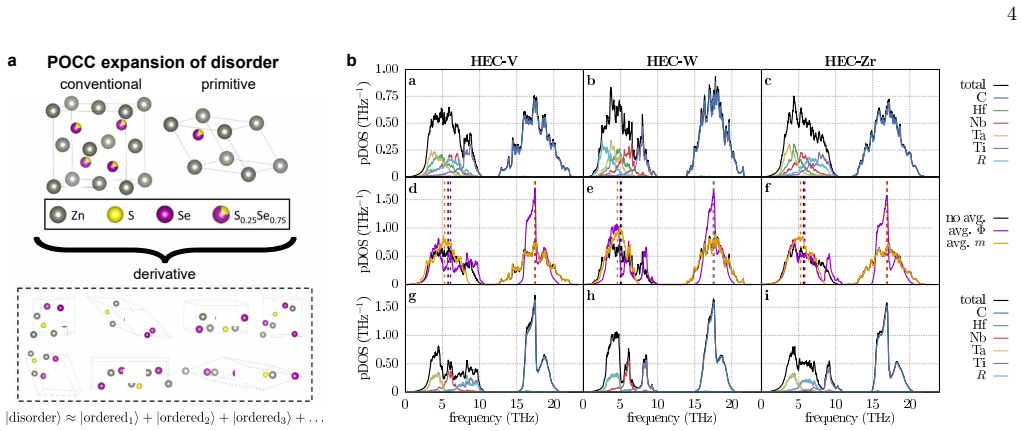
The load-bearing mechanism is the Soliquidy descriptor: it frames the disordered-to-ordered transition as a semi-discrete optimal transport problem, solved with the Kitagawa–Mèrigot–Thibert algorithm on weight-optimized Voronoi cells, where the transport cost (S=24.3 for the example C3Ti4W) is interpreted as a crystallization barrier — lower values favor crystallization, higher values favor glass formation. Around it, the POCC machinery represents a disordered material as a Boltzmann-weighted ensemble of ordered 'tiles' generated from prototype labels or PARTCAR files, with cPOCC convolving complementary subsystems to make multi-component expansions tractable; DEED then balances the ensemble's enthalpy distance to the convex hull against its entropy gain to predict synthesizability. The dielectric function enters as an ensemble average over POCC tiles, computed with a k-grid twice as dense as the static run.
What would settle it
Compile the linked release, run the three headline commands on identical hardware — Soliquidy on C3Ti4W, prototype labeling on a test structure, CHULL on MnPdPt, and CCE on an oxide or nitride set — and compare against the claimed values (S=24.3, 6x, 3.4x, 7.4x, and the dielectric curve for HfNbTaTiZrC5). If the downloaded code lacks the --soliquidy, --export, or DIELECTRIC options, or the speedups vanish under documented conditions, the central claim is falsified.
Extended reading notes
Core claim
On its own terms, the paper's contribution is that disordered materials can be treated as first-class citizens in a high-throughput ab initio workflow. AFLOW4 folds seven capabilities into one toolkit: Soliquidy, a descriptor built on semi-discrete optimal transport over weight-optimized Voronoi cells; independent-particle dielectric-function calculations via a new DIELECTRIC run type; a JSON export mode that serializes ionic relaxation trajectories; prototype labeling against a library of over 2000 crystallographic prototypes; the POCC spectral method for off-stoichiometric disorder, including the cPOCC convolution that cuts tile counts by orders of magnitude; CHULL convex-hull analysis; and CCE coordination-corrected enthalpies. The authors report that the refactor produced substantial speedups — 6x for prototype operations, 3.4x for a MnPdPt convex hull, 7.4x for CCE corrections — and that these improvements together make high-entropy materials discovery, including the DEED synthesizability descriptor, practical at scale.
Load-bearing premise
The argument assumes that the source code users can download from the link in the Data availability section is the same stable release that contains the described modules and delivers the reported speedups, since no commit hash, release tag, or benchmark protocol is supplied.
Editorial extensions
If this is right
- A researcher can run `aflow --soliquidy < STRUCT_FILE` on a candidate composition and get a single number that ranks its tendency to crystallize rather than form a glass, without setting up a bespoke simulation pipeline.
- The DIELECTRIC run type makes optical and plasmonic screening of disordered ceramics a standard high-throughput step, as in the HfNbTaTiZrC5 example, by chaining RELAX_STATIC_DIELECTRIC automatically.
- JSON export of relaxation trajectories removes the need to write custom parsers, so machine-learning interatomic potentials can be trained directly on AFLOW4 output.
- POCC plus cPOCC turns a five-metal carbonitride expansion that would need 17.5 million 20-atom tiles into two 490-tile subsystems, making finite-temperature property averages and phonon spectra feasible.
- CCE corrections renormalize POCC ensemble enthalpies to the convex hull, so DEED synthesizability rankings for ionic high-entropy systems rest on corrected energies rather than raw DFT.
Reading between the lines
- Beyond the paper, Soliquidy's optimal-transport cost could serve as a general order parameter for glass-forming ability across chemistries, and it could be tested against measured critical cooling rates for alloys and oxides not considered here.
- A natural extension is a reproducible benchmark suite with pinned compiler flags, hardware, and input files; without it, the 3.4x/7.4x/6x speedups remain unverifiable and incomparable with competing tools.
- The combination of POCC-averaged dielectric functions with DEED suggests a high-throughput screen that predicts both synthesizability and optical response for candidate high-entropy ceramics, a step the paper does not itself take.
Signed reviews
Editorial analysis
A structured set of objections, weighed in public.
Referee Report
Summary. The paper describes AFLOW4, the latest version of the AFLOW materials science toolkit, with a stated focus on high-entropy disordered materials. It reports two new modules, Soliquidy and a machine-readable export feature, plus a new dielectric-function calculation workflow, and it summarizes improvements to existing modules: prototype identification, the partial occupation (POCC/cPOCC) method, convex-hull construction, and coordination corrected enthalpies (CCE). Development-related changes include a cmake-based build system, Doxygen documentation, migration to GitHub, unit testing, and educational tutorials. The manuscript also claims several performance improvements, including 3.4x faster convex-hull creation, 7.4x faster CCE, over six times faster prototype identification, and a 24% build-time speedup.
Significance. If the claims are supported, AFLOW4 is a valuable contribution to the computational materials community, providing an integrated, open-source platform for studying high-entropy and disordered materials. The paper builds on a substantial body of prior peer-reviewed work from the group, and the described modules are, for the most part, grounded in published methods. The new export module and dielectric workflow address real needs for interoperability and optical-property prediction. However, the quantitative performance claims and the exact code version are not independently verifiable from the manuscript as written, because no benchmark methodology or immutable version identifier is provided. The dielectric-function example also lacks a comparison against independent calculations or experiment. These issues are fixable but currently weaken the release-specific claims.
major comments (3)
- [Convex hull, Coordination corrected enthalpies, Prototypes, Build process] The manuscript reports four distinct performance improvements: 3.4x faster convex-hull construction for MnPdPt, 7.4x faster CCE corrections, over six times speedup for prototype identification, and 24% faster build time on eight CPU cores. No benchmark methodology is given: there is no baseline commit, hardware description, compiler version, input specification, or number of measurement repetitions. Since "substantial speed-up" is a central claim of the release, these figures are unfalsifiable as written. Please provide a reproducible benchmark protocol, including the exact software version, machine, compiler and flags, input structures, and repetition counts, or remove the quantitative speedups and describe the optimizations qualitatively.
- [Data availability, Version control and unit testing] The release-specific claims in the paper must be checkable against an exact code version, but the Data availability section points only to a website (https://aflow.org/install-aflow/) and the text mentions a GitHub repository without identifying a commit hash, release tag, or archive DOI. The README link in the paper references a "release" branch, but this does not pin a specific revision. A user who downloads the current code cannot verify that it matches the version that produced the described results. Please provide an immutable identifier, such as a Zenodo DOI with the associated commit hash, for the exact version of AFLOW4 used in all reported benchmarks and examples.
- [Dielectric function] The dielectric-function workflow is presented as a new capability, illustrated by the HfNbTaTiZrC5 example in Fig. 2, but no validation against independent first-principles calculations, known reference data, or experiment is provided. Given that this is a new module, a brief cross-check on a well-characterized material would substantially strengthen the claim that the workflow produces reliable results, rather than merely demonstrating that the code executes and generates a plausible curve.
minor comments (6)
- [Partial occupation method] In the sentence describing supercell and spectral methods, "primarily approches" should be "primarily approaches".
- [AFLOW4 DEVELOPMENT UPDATE] The phrase "which posess significant computational challenges" contains the typo "posess"; it should be "possess".
- [Figure 3] The compound label in the figure reads "C5HfNbTaTiZ" but the text and the earlier description call the material "C5HfNbTaTiZr" or "HfNbTaTiZrC5"; the figure is missing the "r" in "Zr".
- [Figure 2] The caption does not indicate which curve is the real part and which is the imaginary part. Please clarify the line styles or colors used for εr and εi.
- [References] Reference [16] lists "Masters theses" as the degree type; it should be "Master's thesis".
- [Data availability] The statement that "Processed data used in this project are available from the corresponding author upon reasonable request" is vague; depositing the processed data (e.g., the dielectric-function curves and the prototype/benchmark outputs) in a public repository would improve reproducibility.
Circularity Check
No significant circularity: software release note reports previously published modules, and speedup figures are measurements rather than predictions.
full rationale
This paper is a software release note, not a derivation-based study. There is no equation in which an output is defined in terms of an input, no fitted parameter is renamed as a prediction, and no uniqueness theorem is imported from the authors' prior work to force a choice. Each module is explicitly attributed to external prior peer-reviewed publications: Soliquidy to Ref. 14, POCC to Ref. 29, cPOCC and DEED to Ref. 28, CHULL to Ref. 31, CCE to Refs. 33 and 34, and prototypes to Refs. 5 and 25-27. These citations are appropriate for a release note describing already-published algorithms, and they do not make the argument circular because the current paper makes no independent derivation from them. The release-specific claims are the existence of new code and speedups (e.g., 3.4x for MnPdPt hulls, 7.4x for CCE, 24% build-time improvement). These are empirical performance reports, not predictions that reduce to the inputs by construction. The lack of a pinned commit, benchmark protocol, or hardware details is a reproducibility limitation, not a circularity. Accordingly, the circularity score is 0.
Assumptions & free parameters
assumptions (4)
- domain assumption Density functional theory (PBE, LDA, SCAN) provides accurate ground-state energies and forces for the materials studied.
- standard math The KMT algorithm converges to the optimal transport cost for the weight-optimized Voronoi cells used in Soliquidy.
- domain assumption The POCC ensemble and Boltzmann averaging accurately represent the thermodynamic properties of disordered materials.
- domain assumption The CCE correction scheme, parameterized in prior work (refs 33, 34), improves formation enthalpies for ionic systems.
Cite this review
Pith. "Pith review of AFLOW4: heading toward disorder." pith.science (2026). https://pith.science/paper/MW4FF736
@misc{pith2026250703422,
  author       = {Pith},
  title        = {Pith review of: AFLOW4: heading toward disorder},
  year         = {2026},
  howpublished = {\url{https://pith.science/paper/MW4FF736}},
  note         = {Machine review of arXiv:2507.03422}
}
read the original abstract
AFLOW4 is the latest iteration of the AFLOW toolkit, specifically tailored to study high-entropy disordered materials. This upgrade includes innovative features like the Soliquidy module, based on the Euclidean transport cost between disordered and ordered material states. AFLOW4 can calculate dielectric functions to understand optical and electronic properties of disordered ceramics. The newly introduced human-readable data export feature ensures the uncomplicated incorporation of AFLOW4 in diverse automated workflows. Features relevant to high-entropy research, like prototype identification, partial occupation method, convex hull calculation, and enthalpy corrections based on local atomic environments, have been improved and exhibit substantial speed-up. Together, these enhancements represent a step forward for AFLOW as a valuable tool for research of high-entropy materials.
Figures


Figures from the paper (3 more)


Reference graph
Works this paper leans on
-
[1]
S. Curtarolo, W. Setyawan, G. L. W. Hart, M. Jahnátek, R.V.Chepulskii, R.H.Taylor, S.Wang, J.Xue, K.Yang, O. Levy, M. J. Mehl, H. T. Stokes, D. O. Demchenko, and D. Morgan,AFLOW: An automatic framework for high- throughput materials discovery, Comput. Mater. Sci.58, 218–226 (2012), doi:10.1016/j.commatsci.2012.02.005
-
[2]
M. D. Wilkinson, M. Dumontier, I. J. Aalbersberg, G. Appleton, M. Axton, A. Baak, N. Blomberg, J.-W. Boiten, L. B. da Silva Santos, P. E. Bourne, J. Bouw- man, A. J. Brookes, T. Clark, M. Crosas, I. Dillo, O. Du- mon, S. Edmunds, C. T. Evelo, R. Finkers, A. Gonzalez- Beltran, A. J. G. Gray, P. Groth, C. Goble, J. S. Grethe, J. Heringa, P. A. C. ’t Hoen, R...
2016
-
[3]
W. Setyawan and S. Curtarolo, AFLOWLIB: Ab-initio Electronic Structure Library Database , http://www.aflow.org (2011)
work page 2011
-
[4]
M. Esters, C. Oses, S. Divilov, H. Eckert, R. Friedrich, D. Hicks, M. J. Mehl, F. Rose, A. Smolyanyuk, A. Cal- zolari, X. Campilongo, C. Toher, and S. Curtarolo, aflow.org: A web ecosystem of databases, software and tools, Comput. Mater. Sci. 216, 111808 (2023), doi: 10.1016/j.commatsci.2022.111808
arXiv 2023
- [5]
-
[6]
B.Cantor, Multicomponent and High Entropy Alloys, En- tropy 16, 4749–4768 (2014), doi:10.3390/e16094749
-
[7]
E. P. George, D. Raabe, and R. O. Ritchie, High- entropy alloys, Nat. Rev. Mater.4, 515–534 (2019), doi: 10.1038/s41578-019-0121-4
-
[8]
C. Oses, C. Toher, and S. Curtarolo, High-entropy ceramics, Nat. Rev. Mater. 5, 295–309 (2020), doi: 10.1038/s41578-019-0170-8
Show all 38 references
-
[9]
Calzolari, C
A. Calzolari, C. Oses, C. Toher, M. Esters, X. Campi- longo, S. P. Stepanoff, D. E. Wolfe, and S. Curtarolo, Plasmonic high-entropy carbides, Nat. Commun. 13, 5993 (2022), doi:10.1038/s41467-022-33497-1
2022 doi
-
[10]
Hsu, C.-W
W.-L. Hsu, C.-W. Tsai, A.-C. Yeh, and J.-W. Yeh, Clarifying the four core effects of high-entropy materi- als, Nature Reviews Chemistry8, 471–485 (2024), doi: 10.1038/s41570-024-00602-5
2024 doi
-
[11]
Curtarolo, Coarse-Graining and Data Mining Ap- proaches to the Prediction of Structures and their Dy- namics (Ph.D
S. Curtarolo, Coarse-Graining and Data Mining Ap- proaches to the Prediction of Structures and their Dy- namics (Ph.D. Thesis, MIT, 2003)
2003
-
[12]
Yeh and S.-J
J.-W. Yeh and S.-J. Lin, Breakthrough applications of high-entropy materials, J. Mater. Res. 33, 3129–3137 (2018), doi:10.1557/jmr.2018.283
2018 doi
-
[13]
M. C. Gao, D. B. Miracle, D. Maurice, X. Yan, Y. Zhang, and J. A. Hawk, High-entropy functional materials, J. Mater. Res. 33, 3138–3155 (2018), doi: 10.1557/jmr.2018.323
2018 doi
-
[15]
Kitagawa, Q
J. Kitagawa, Q. Mérigot, and B. Thibert,Convergence of a Newton Algorithm for Semi-Discrete Optimal Trans- port, Journal of the European Mathematical Society21, 2603–2651 (2019), doi:10.4171/JEMS/889
2019 doi
-
[16]
J. E. Stone,An Efficient Library for Parallel Ray Trac- ing and Animation, Masters theses, 1747, Missouri S&T (1998)
1998
-
[17]
W. A. Murra and W. L. Barnes, Plasmonic Ma- terials, Adv. Mater. 19, 3771–3782 (2007), doi: 10.1002/adma.200700678
2007 doi
-
[18]
M. I. Zheludev and Y. S. Kivshar, From metamateri- als to metadevices, Nat. Mater.11, 917–924 (2012), doi: 10.1038/nmat3431
2012 doi
-
[19]
A. F. Koenderink, A. Alù, and A. Polman,Nanophoton- ics: Shrinking light-based technology, Science 348, 516– 521 (2015), doi:10.1126/science.1261243
2015 doi
-
[20]
M. S. Hybertsen and S. G. Louie, Ab initio static di- electric matrices from the density-functional approach. I. Formulation and application to semiconductors and insulators, Phys. Rev. B 35, 5585–5601 (1987), doi: 10.1103/PhysRevB.35.5585
1987 doi
-
[21]
Gajdoš, K
M. Gajdoš, K. Hummer, G. Kresse, J. Furthmüller, and F. Bechstedt, Linear optical properties in the projector- augmented wave methodology, Phys. Rev. B73, 045112 (2006), doi:10.1103/PhysRevB.73.045112
2006 doi
-
[22]
Morgan and R
D. Morgan and R. Jacobs,Opportunities and Challenges for Machine Learning in Materials Science, Annu. Rev. Mater. Res. 50, 71–103 (2020), doi:10.1146/annurev- matsci-070218-010015
2020 doi
-
[23]
Divilov, H
S. Divilov, H. Eckert, C. Toher, R. Friedrich, A. C. Zettel, D. W. Brenner, W. G. Fahrenholtz, D. E. Wolfe, E. Zurek, J.-P. Maria, N. Hotz, X. Campilongo, and S. Curtarolo,A priori procedure to establish spinodal de- composition in alloys, Acta Mater.266, 119667 (2024), doi:10...
2024
-
[24]
Esters, C
M. Esters, C. Oses, D. Hicks, M. J. Mehl, M. Jahnátek, M.D.Hossain, J.-P.Maria, D.W.Brenner, C.Toher, and S. Curtarolo,Settling the matter of the role of vibrations in the stability of high-entropy carbides, Nat. Commun. 12, 5747 (2021), doi:10.1038/s41467-021-25979-5
2021 doi
-
[25]
M. J. Mehl, D. Hicks, C. Toher, O. Levy, R. M. Hanson, G. L. W. Hart, and S. Curtarolo, The AFLOW Library of Crystallographic Prototypes: Part 1, Comput. Mater. Sci. 136, S1–S828 (2017), doi: 10.1016/j.commatsci.2017.01.017
2017 doi
-
[26]
Hicks, M
D. Hicks, M. J. Mehl, E. Gossett, C. Toher, O. Levy, R. M. Hanson, G. L. W. Hart, and S. Curtarolo,The AFLOW Library of Crystallographic Prototypes: Part 2, Comput. Mater. Sci. 161, S1–S1011 (2019), doi: 10.1016/j.commatsci.2018.10.043
2019 doi
-
[27]
Hicks, M
D. Hicks, M. J. Mehl, M. Esters, C. Oses, O. Levy, G. L. W. Hart, C. Toher, and S. Curtarolo, The AFLOW Library of Crystallographic Prototypes: Part 3, Comput. Mater. Sci. 199, 110450 (2021), doi: 10.1016/j.commatsci.2021.110450
2021
-
[28]
Divilov, H
S. Divilov, H. Eckert, D. Hicks, C. Oses, C. Toher, R. Friedrich, M. Esters, M. J. Mehl, A. C. Zettel, Y. Led- erer, E. Zurek, J.-P. Maria, D. W. Brenner, X. Campi- longo, S. Filipovic, W. G. Fahrenholtz, C. J. Ryan, C. M. DeSalle, R. J. Crealese, D. E. Wolfe, A. Calzolari, an...
2024 doi
-
[29]
K. Yang, C. Oses, and S. Curtarolo, Modeling Off- Stoichiometry Materials with a High-Throughput Ab- Initio Approach, Chem. Mater. 28, 6484–6492 (2016), doi:10.1021/acs.chemmater.6b01449
2016 doi
-
[30]
J. F. Nye,Physical Properties of Crystals: Their Repre- sentation by Tensors and Matrices, Oxford science pub- lications (Clarendon Press, 1985)
1985
-
[31]
C. Oses, E. Gossett, D. Hicks, F. Rose, M. J. Mehl, E. Perim, I. Takeuchi, S. Sanvito, M. Schef- fler, Y. Lederer, O. Levy, C. Toher, and S. Curtarolo, AFLOW-CHULL: Cloud-Oriented Platform for Au- tonomous Phase Stability Analysis, J. Chem. Inf. Model. 58, 2477–2490 (2018), do...
2018 doi
-
[32]
Toher, C
C. Toher, C. Oses, D. Hicks, and S. Curtarolo,Unavoid- able disorder and entropy in multi-component systems, npj Comput. Mater. 5, 69 (2019), doi:10.1038/s41524- 019-0206-z
2019 doi
-
[33]
Friedrich, D
R. Friedrich, D. Usanmaz, C. Oses, A. Supka, M. Fornari, M. Buongiorno Nardelli, C. Toher, and S. Curtarolo,Co- ordination corrected ab initio formation enthalpies, npj Comput. Mater. 5, 59 (2019), doi:10.1038/s41524-019- 0192-1
2019 doi
-
[34]
Friedrich and S
R. Friedrich and S. Curtarolo, AFLOW-CCE for the thermodynamics of ionic materials, J. Chem. Phys.160, 042501 (2024), doi:10.1063/5.0184917
2024 doi
-
[35]
J. P. Perdew, K. Burke, and M. Ernzerhof, Gen- eralized Gradient Approximation Made Simple , Phys. Rev. Lett. 77, 3865–3868 (1996), doi: 10.1103/PhysRevLett.77.3865
1996 doi
-
[36]
Kohn and L
W. Kohn and L. J. Sham,Self-Consistent Equations In- cluding Exchange and Correlation Effects, Phys. Rev. 140, A1133 (1965), doi:10.1103/PhysRev.140.A1133
1965 doi
-
[37]
von Barth and L
U. von Barth and L. Hedin,A local exchange-correlation potential for the spin polarized case: I , J. Phys. C: Solid State Phys. 5, 1629 (1972), doi:10.1088/0022- 3719/5/13/012
1972 doi
-
[38]
J. Sun, A. Ruzsinszky, and J. P. Perdew,Strongly Con- strained and Appropriately Normed Semilocal Density Functional, Phys. Rev. Lett. 115, 036402 (2015), doi: 10.1103/PhysRevLett.115.036402
2015 doi
-
[39]
Friedrich, M
R. Friedrich, M. Esters, C. Oses, S. Ki, M. J. Bren- ner, D. Hicks, M. J. Mehl, C. Toher, and S. Cur- tarolo, Automated coordination corrected enthalpies with AFLOW-CCE, Phys. Rev. Materials5, 043803 (2021), doi:10.1103/PhysRevMaterials.5.043803
2021 doi
Reviewed August 6, 2026 · model on record in the stance chip above.
Discussion (0). Continue with ORCID to comment.