Ultrafast manipulation of magnetic skyrmions by microwave fields
Pith reviewed 2026-05-22 00:30 UTC · model grok-4.3
The pith
Skyrmion inertia turns continuous microwave paths into polygonal orbits and sustains gyration after pulses.
A machine-rendered reading of the paper's core claim, the machinery that carries it, and where it could break.
Core claim
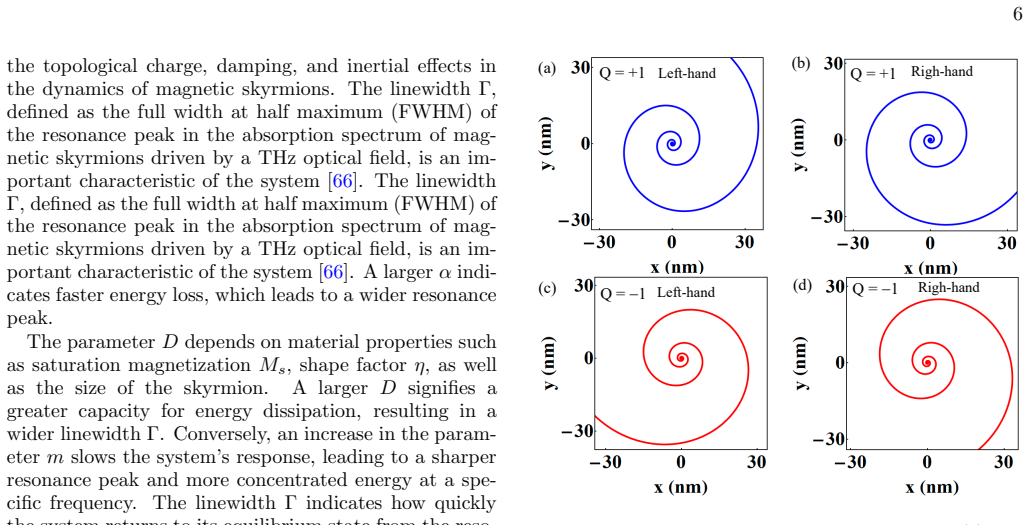
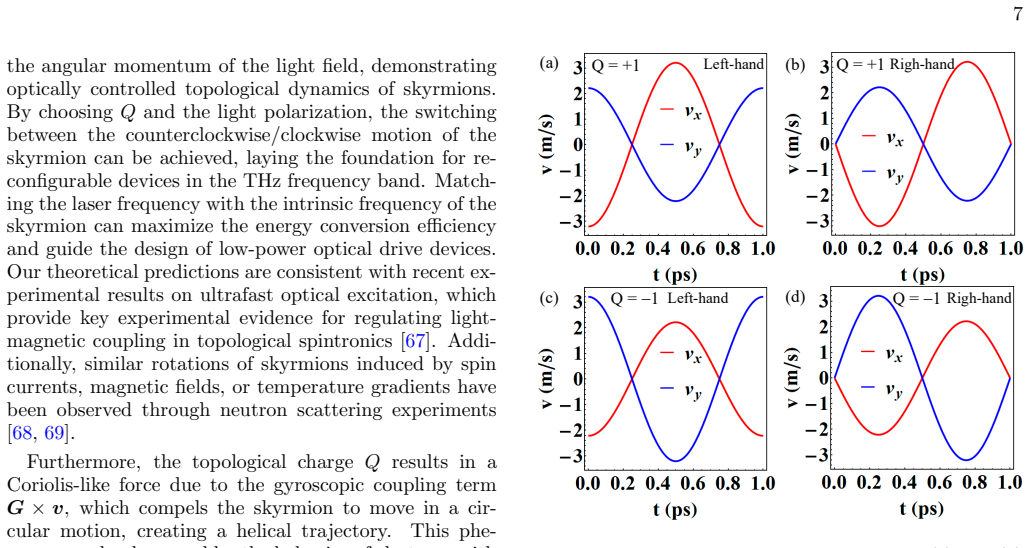
By adding an inertial mass term to the Thiele equation and deriving the forces from the microwave-induced inverse Faraday effect, continuous-wave circularly polarized excitation produces polygonal orbits rather than smooth spirals while pulsed excitation produces sustained post-pulse gyration that reveals intrinsic relaxation dynamics. Handedness is fixed by topological charge and microwave helicity, with left-circular polarization attracting skyrmions to the beam center and right-circular polarization repelling them.
What carries the argument
Inertial mass term added to the Thiele equation under microwave-induced inverse Faraday effect, which governs the change from spiral to polygonal trajectories and the appearance of post-pulse gyration.
Load-bearing premise
The inertial mass term added to the Thiele equation accurately captures the dynamics under microwave-induced inverse Faraday effect without higher-order corrections or material-specific adjustments.
What would settle it
Direct imaging of skyrmion trajectories under continuous circularly polarized microwave irradiation that shows clear polygonal orbits rather than smooth spirals, or continued gyration after the microwave pulse is removed.
Figures
read the original abstract
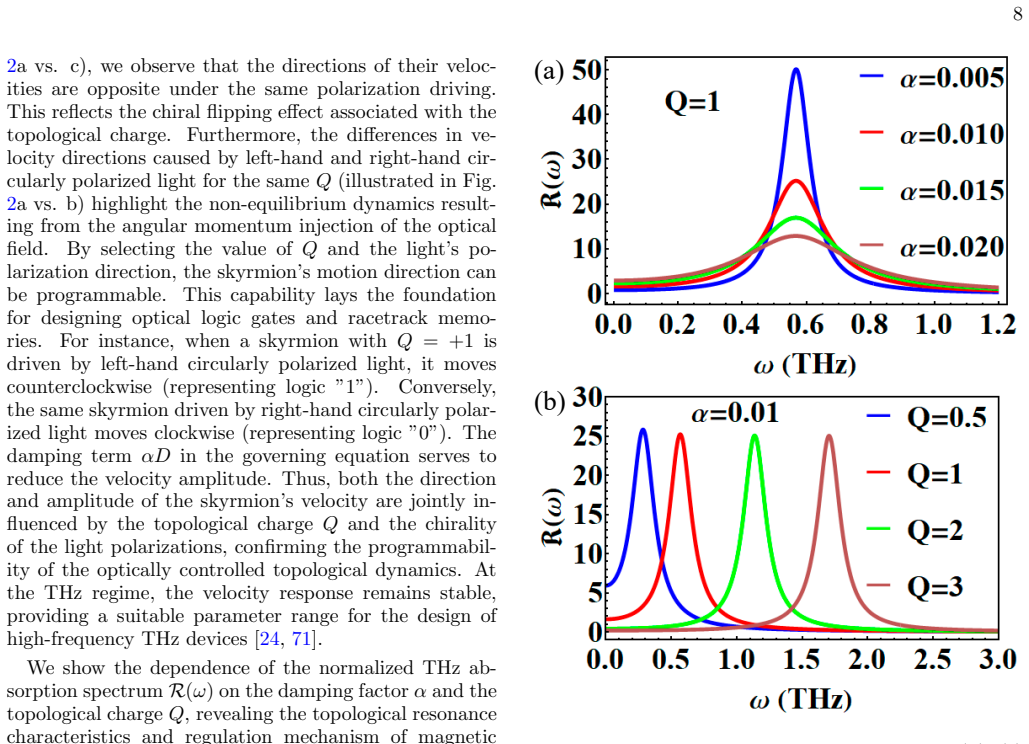
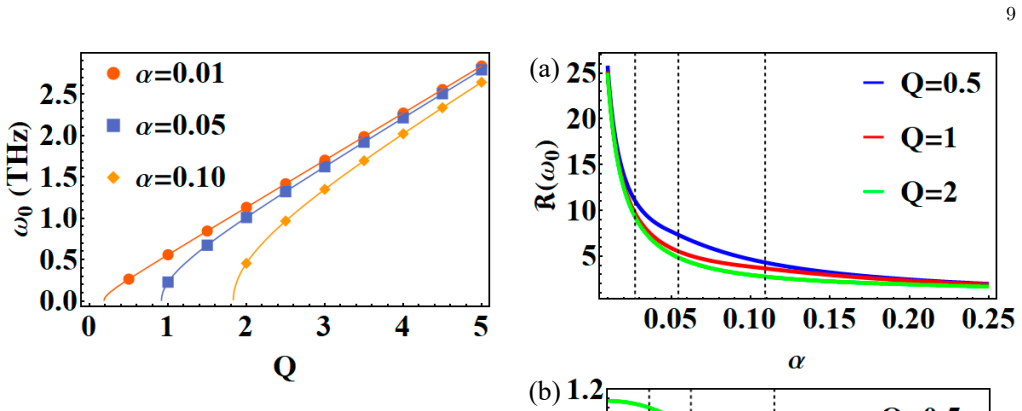
We theoretically investigate the inertial dynamics of magnetic skyrmions driven by circularly polarized microwave-induced inverse Faraday effect (MIFE). By incorporating an inertial mass term into the Thiele equation and analytically deriving the microwave-induced magnetic fields and forces, we demonstrate fundamentally distinct dynamical regimes under continuous-wave (CW) versus pulsed excitation. Skyrmion inertia qualitatively transforms trajectories from smooth spirals to polygonal orbits under continuous driving, while enabling sustained post-pulse gyration that reveals the system's intrinsic relaxation dynamics. The handedness of the trajectory is determined by the topological charge and circularly polarized microwave (CPM) helicity: a left-circularly polarized (LCP) CPM attracts skyrmions toward the beam center, while a right-circularly polarized (RCP) CPM repels them. Systematic parameter analysis reveals how Gilbert damping, the intensity and frequency of CPM, and skyrmion mass control the transition between oscillatory and overdamped dynamical phases. Our work identifies inertia, topological charge, and CPM helicity as essential factors in ultrafast skyrmion manipulation and proposes a novel method for designing topological spin textures.
Editorial analysis
A structured set of objections, weighed in public.
Referee Report
Summary. The paper theoretically investigates the inertial dynamics of magnetic skyrmions driven by circularly polarized microwave-induced inverse Faraday effect (MIFE). By adding a phenomenological inertial mass term to the Thiele equation and analytically deriving the effective forces from the microwave fields, the authors report that inertia qualitatively changes trajectories from smooth spirals to polygonal orbits under continuous-wave driving, enables sustained post-pulse gyration, and sets handedness via topological charge and CPM helicity (LCP attracts skyrmions to the beam center while RCP repels them). Systematic variation of Gilbert damping, CPM intensity/frequency, and skyrmion mass controls transitions between oscillatory and overdamped regimes.
Significance. If the central results hold, the work identifies inertia as a key control knob for ultrafast skyrmion manipulation and proposes a microwave-based protocol that could be relevant for spintronic applications. The analytic derivation of MIFE forces and the explicit demonstration of post-pulse relaxation dynamics are strengths that could be tested experimentally.
major comments (1)
- [Methods] Methods (inertial Thiele equation and force derivation): The central predictions rest on the rigid skyrmion profile assumption underlying both the inertial mass term and the topological force. The analytic MIFE force derivation does not include a self-consistent check (e.g., via micromagnetic simulation or linear stability analysis) that the quoted CPM intensities leave the skyrmion radius and magnetization profile undeformed. If breathing or deformation modes are excited, both the effective mass and the gyroscopic terms acquire corrections that could eliminate the polygonal-orbit regime or reverse the reported handedness.
minor comments (1)
- [Abstract] Abstract: the statement that 'handedness is determined by the topological charge and CPM helicity' should be accompanied by a brief qualifier that this holds within the rigid-profile approximation.
Simulated Author's Rebuttal
We are grateful to the referee for their thorough review and insightful comments on our manuscript. We particularly appreciate the recognition of the potential significance of inertia in skyrmion manipulation. Below, we provide a point-by-point response to the major comment and outline the revisions we will make to address the concerns raised.
read point-by-point responses
-
Referee: [Methods] Methods (inertial Thiele equation and force derivation): The central predictions rest on the rigid skyrmion profile assumption underlying both the inertial mass term and the topological force. The analytic MIFE force derivation does not include a self-consistent check (e.g., via micromagnetic simulation or linear stability analysis) that the quoted CPM intensities leave the skyrmion radius and magnetization profile undeformed. If breathing or deformation modes are excited, both the effective mass and the gyroscopic terms acquire corrections that could eliminate the polygonal-orbit regime or reverse the reported handedness.
Authors: We thank the referee for highlighting this key assumption in our approach. The inertial Thiele equation and the derivation of forces from the MIFE are based on the rigid skyrmion profile, which is a standard approximation in the field when the external drive does not strongly perturb the texture. For the CPM intensities and frequencies used in our calculations, the effective fields are sufficiently weak to justify this approximation, as the skyrmion remains stable against small perturbations. To strengthen the manuscript in response to this comment, we will include an additional paragraph in the Methods section providing a qualitative argument and order-of-magnitude estimate showing that the driving does not excite significant breathing modes. This will involve comparing the MIFE field strength to the effective anisotropy and exchange fields. We maintain that the reported qualitative behaviors, including the polygonal orbits and the handedness, are robust features arising from the inertial term and topology, and small corrections would not eliminate or reverse them. We will update the manuscript accordingly. revision: yes
Circularity Check
No significant circularity; derivation is self-contained
full rationale
The paper adds an inertial mass term to the standard Thiele equation and analytically derives the effective forces from the inverse Faraday effect of circularly polarized microwaves. The reported transitions between spiral and polygonal orbits, post-pulse gyration, and handedness follow directly from solving the resulting differential equation under CW and pulsed driving. No quoted step reduces a prediction to a fitted input by construction, no self-citation is load-bearing for the central claims, and no ansatz is smuggled via prior work by the same authors. The model is presented as an extension with explicit assumptions; results are obtained by integration rather than being tautological with the inputs.
Axiom & Free-Parameter Ledger
free parameters (3)
- Gilbert damping
- CPM intensity and frequency
- Skyrmion inertial mass
axioms (1)
- domain assumption The Thiele equation remains a valid reduced description when an inertial mass term is included for microwave-driven skyrmions.
Lean theorems connected to this paper
-
IndisputableMonolith/Foundation/RealityFromDistinction.leanreality_from_one_distinction unclear?
unclearRelation between the paper passage and the cited Recognition theorem.
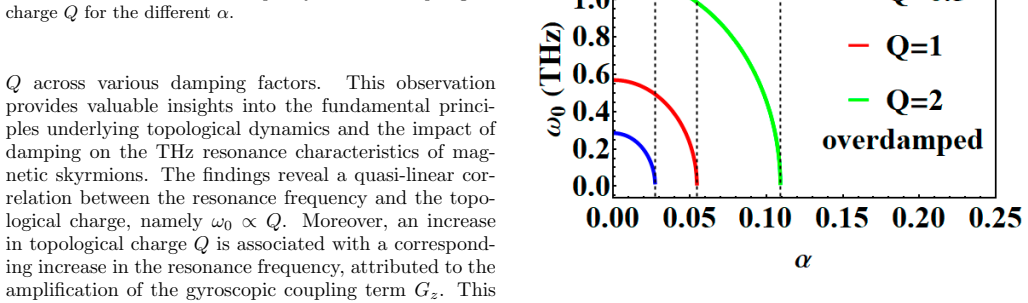
By incorporating an inertial mass term into the Thiele equation ... resonance frequency ω₀ ∝ Q/m ... absorption spectrum P(ω)
What do these tags mean?
- matches
- The paper's claim is directly supported by a theorem in the formal canon.
- supports
- The theorem supports part of the paper's argument, but the paper may add assumptions or extra steps.
- extends
- The paper goes beyond the formal theorem; the theorem is a base layer rather than the whole result.
- uses
- The paper appears to rely on the theorem as machinery.
- contradicts
- The paper's claim conflicts with a theorem or certificate in the canon.
- unclear
- Pith found a possible connection, but the passage is too broad, indirect, or ambiguous to say the theorem truly supports the claim.
Reference graph
Works this paper leans on
-
[1]
[62], we can obtain the simplified approximate expres- sion for ω0, which is ω0 = 1 m |Gz| − α2D 2|Gz| . (31) This result indicates that two terms dominate the reso- nance frequency ω0 driven by the chiral optical field. The principal value of the resonance frequency is expressed as |Gz|/m, which is determined by the gyroscopic coupling term Gz ∝ Q and th...
-
[2]
C. Reichhardt, C. J. O. Reichhardt, and M. V. Miloˇ sevi´ c, Statics and dynamics of skyrmions interacting with disor- der and nanostructures, Reviews of Modern Physics 94, 035005 (2022)
work page 2022
-
[3]
J. Iwasaki, M. Mochizuki, and N. Nagaosa, Current- induced skyrmion dynamics in constricted geometries, Nature Nanotechnology 8, 742 (2013)
work page 2013
-
[4]
Y. Ba, S. Zhuang, Y. Zhang, Y. Wang, Y. Gao, H. Zhou, M. Chen, W. Sun, Q. Liu, G. Chai, J. Ma, Y. Zhang, H. Tian, H. Du, W. Jiang, C. Nan, J.-M. Hu, and Y. Zhao, Electric-field control of skyrmions in multifer- roic heterostructure via magnetoelectric coupling, Nature Communications 12, 322 (2021)
work page 2021
-
[5]
L. R´ ozsa, M. Weißenhofer, and U. Nowak, Spin waves in skyrmionic structures with various topological charges, Journal of Physics: Condensed Matter 33, 054001 (2020)
work page 2020
-
[6]
Z. Wang, M. Guo, H.-A. Zhou, L. Zhao, T. Xu, R. Tomasello, H. Bai, Y. Dong, S.-G. Je, W. Chao, H.-S. Han, S. Lee, K.-S. Lee, Y. Yao, W. Han, C. Song, H. Wu, M. Carpentieri, G. Finocchio, M.-Y. Im, S.-Z. Lin, and W. Jiang, Thermal generation, manipulation and ther- moelectric detection of skyrmions, Nature Electronics 3, 672 (2020)
work page 2020
-
[7]
S. Lepadatu, All-Optical Magnetothermoelastic Skyrmion Motion, Physical Review Applied 19, 044036 (2023). 11
work page 2023
-
[8]
W. Al Saidi, Y. Dusch, M. T. Z. Myint, N. Tiercelin, and R. Sbiaa, Ultrafast skyrmion generation by plasmonic resonance, Physical Review B 109, 184427 (2024)
work page 2024
-
[9]
Y. D. Kato, Y. Okamura, M. Hirschberger, Y. Tokura, and Y. Takahashi, Topological magneto-optical effect from skyrmion lattice, Nature Communications 14, 5416 (2023)
work page 2023
-
[10]
J.-S. B. Tai, A. J. Hess, J.-S. Wu, and I. I. Smalyukh, Field-controlled dynamics of skyrmions and monopoles, Science Advances 10, eadj9373 (2024)
work page 2024
- [11]
-
[12]
L. Fang, H. Wang, Y. Liang, H. Cao, and J. Wang, Spin- orbit mapping of light, Phys. Rev. Lett. 127, 233901 (2021)
work page 2021
-
[13]
E. Vi˜ nas Bostr¨ om, A. Rubio, and C. Verdozzi, Micro- scopic theory of light-induced ultrafast skyrmion excita- tion in transition metal films, npj Computational Mate- rials 8, 62 (2022)
work page 2022
-
[14]
X. Lei, A. Yang, X. Chen, L. Du, P. Shi, Q. Zhan, and X. Yuan, Skyrmionic spin textures in nonparaxial light, Advanced Photonics 7, 016009 (2025)
work page 2025
-
[15]
Lepadatu, Emergence of transient domain wall skyrmions after ultrafast demagnetization, Phys
S. Lepadatu, Emergence of transient domain wall skyrmions after ultrafast demagnetization, Phys. Rev. B 102, 094402 (2020)
work page 2020
-
[16]
H. Fujita and M. Sato, Ultrafast generation of skyrmionic defects with vortex beams: Printing laser profiles on mag- nets, Phys. Rev. B 95, 054421 (2017)
work page 2017
-
[17]
S. H. Guan, Y. Liu, Z. P. Hou, D. Y. Chen, Z. Fan, M. Zeng, X. B. Lu, X. S. Gao, M. H. Qin, and J.-M. Liu, Optically controlled ultrafast dynamics of skyrmion in antiferromagnets, Phys. Rev. B 107, 214429 (2023)
work page 2023
-
[18]
J. Chen, J. Hu, and H. Yu, Chiral emission of exchange spin waves by magnetic skyrmions, ACS Nano 15, 4372 (2021)
work page 2021
- [19]
-
[20]
D. M. Krichevsky, D. O. Ignatyeva, and V. I. Belotelov, Inverse Faraday effect at Mie resonances, Physical Re- view Applied 22, 064087 (2024)
work page 2024
-
[21]
C. D. Stanciu, F. Hansteen, A. V. Kimel, A. Tsukamoto, A. Itoh, A. Kirilyuk, and Th. Rasing, Ultrafast interac- tion of the angular momentum of photons with spins in the metallic amorphous alloy GdFeCo, Physical Review Letters 98, 207401 (2007)
work page 2007
-
[22]
Y. Peng, D. Salomoni, G. Malinowski, W. Zhang, J. Hohlfeld, L. D. Buda-Prejbeanu, J. Gorchon, M. Verg` es, J. X. Lin, D. Lacour, R. C. Sousa, I. L. Pre- jbeanu, S. Mangin, and M. Hehn, In-plane reorientation induced single laser pulse magnetization reversal, Nature Communications 14, 5000 (2023)
work page 2023
-
[23]
R. R. Subkhangulov, R. V. Mikhaylovskiy, A. K. Zvezdin, V. V. Kruglyak, Th. Rasing, and A. V. Kimel, Terahertz modulation of the faraday rotation by laser pulses via the optical kerr effect, Nature Photonics 10, 111 (2016)
work page 2016
-
[24]
J. Shen, H. W. Zhang, and Y. X. Li, Terahertz emission of ferromagnetic Ni-Fe thin films excited by ultrafast laser pulses, Chinese Physics Letters 29, 067502 (2012)
work page 2012
-
[25]
Y. Li, L. Pierobon, M. Charilaou, H.-B. Braun, N. R. Walet, J. F. L¨ offler, J. J. Miles, and C. Moutafis, Tunable terahertz oscillation arising from bloch-point dynamics in chiral magnets, Phys. Rev. Res. 2, 033006 (2020)
work page 2020
- [26]
-
[27]
F. B¨ uttner, C. Moutafis, M. Schneider, B. Kr¨ uger, C. M. G¨ unther, J. Geilhufe, C. v. K. Schmising, J. Mohanty, B. Pfau, S. Schaffert, A. Bisig, M. Foerster, T. Schulz, C. A. F. Vaz, J. H. Franken, H. J. M. Swagten, M. Kl¨ aui, and S. Eisebitt, Dynamics and inertia of skyrmionic spin structures, Nature Physics 11, 225 (2015)
work page 2015
-
[28]
K. Wang, V. Bheemarasetty, J. Duan, S. Zhou, and G. Xiao, Fundamental physics and applications of skyrmions: A review, Journal of Magnetism and Mag- netic Materials 563, 169905 (2022)
work page 2022
-
[29]
I. Makhfudz, B. Kr¨ uger, and O. Tchernyshyov, Inertia and Chiral Edge Modes of a Skyrmion Magnetic Bubble, Physical Review Letters 109, 217201 (2012)
work page 2012
- [30]
-
[31]
X.-g. Wang, G.-h. Guo, V. K. Dugaev, J. Barna´ s, J. Be- rakdar, S. S. P. Parkin, A. Ernst, and L. Chotorlishvili, Steering skyrmions with microwave and terahertz electric pulses, Physical Review B 107, 94404 (2023)
work page 2023
-
[32]
C. Sch¨ utte, J. Iwasaki, A. Rosch, and N. Nagaosa, Iner- tia, diffusion, and dynamics of a driven skyrmion, Phys. Rev. B 90, 174434 (2014)
work page 2014
-
[33]
C. Psaroudaki, S. Hoffman, J. Klinovaja, and D. Loss, Quantum Dynamics of Skyrmions in Chiral Magnets, Phys. Rev. X 7, 41045 (2017)
work page 2017
-
[34]
D. Wang, H.-B. Braun, and Y. Zhou, Dynamical mass generation for ferromagnetic skyrmions in two dimen- sions, Journal of Magnetism and Magnetic Materials564, 170062 (2022)
work page 2022
- [35]
-
[36]
W. Yang, H. Yang, Y. Cao, and P. Yan, Photonic orbital angular momentum transfer and magnetic skyrmion ro- tation, Optics Express 26, 8778 (2018)
work page 2018
-
[37]
A. Kirilyuk, A. V. Kimel, and T. Rasing, Ultrafast opti- cal manipulation of magnetic order, Reviews of Modern Physics 82, 2731 (2010)
work page 2010
-
[38]
J. Liu, C. Song, L. Zhao, L. Cai, H. Feng, B. Zhao, M. Zhao, Y. Zhou, L. Fang, and W. Jiang, Manipulation of skyrmion by magnetic field gradients: A stern–gerlach- like experiment, Nano Letters 23, 4931 (2023)
work page 2023
-
[39]
L. Hong, C. Xu, and H. Xiang, Evaluating gilbert damp- ing in magnetic insulators from first-principles, Phys. Rev. B 109, 094429 (2024)
work page 2024
-
[40]
S.-Z. Lin, Dynamics and inertia of a skyrmion in chi- ral magnets and interfaces: A linear response approach based on magnon excitations, Phys. Rev. B 96, 014407 (2017)
work page 2017
-
[41]
N. Romming, A. Kubetzka, C. Hanneken, K. von Bergmann, and R. Wiesendanger, Field-Dependent Size and Shape of Single Magnetic Skyrmions, Physical Re- view Letters 114, 177203 (2015)
work page 2015
-
[42]
X. S. Wang, H. Y. Yuan, and X. R. Wang, A theory on skyrmion size, Communications Physics 1, 31 (2018). 12
work page 2018
-
[43]
H. M. Dong, P. P. Fu, Y. F. Duan, and K. Chang, Tuning nano-skyrmions and nano-skyrmioniums in Janus mag- nets, Nanoscale 15, 15643 (2023)
work page 2023
-
[44]
G. Finocchio, F. B¨ uttner, R. Tomasello, M. Carpentieri, and M. Kl¨ aui, Magnetic skyrmions: From fundamental to applications, Journal of Physics D: Applied Physics 49, 423001 (2016)
work page 2016
-
[45]
J. P. Van Der Ziel, P. S. Pershan, and L. D. Malmstrom, Optically-induced magnetization resulting from the in- verse faraday effect, Physical Review Letters 15, 190 (1965)
work page 1965
-
[46]
P. S. Pershan, J. P. van der Ziel, and L. D. Malmstrom, Theoretical discussion of the inverse faraday effect, ra- man scattering, and related phenomena, Phys. Rev. 143, 574 (1966)
work page 1966
-
[47]
L. Holleis, J. C. Prestigiacomo, Z. Fan, S. Nishimoto, M. Osofsky, G.-W. Chern, J. Van Den Brink, and B. S. Shivaram, Anomalous and anisotropic nonlinear suscep- tibility in the proximate kitaev magnet α-RuCl3, npj Quantum Materials 6, 66 (2021)
work page 2021
-
[48]
A. Fert, N. Reyren, and V. Cros, Magnetic skyrmions: Advances in physics and potential applications, Nature Reviews Materials 2, 17031 (2017)
work page 2017
-
[49]
P. S. Pershan, Nonlinear optical properties of solids: En- ergy considerations, Physical Review 130, 919 (1963)
work page 1963
-
[50]
P. S. Pershan, J. P. Van Der Ziel, and L. D. Malmstrom, Theoretical discussion of the inverse faraday effect, ra- man scattering, and related phenomena, Phys. Rev. 143, 574 (1966)
work page 1966
-
[51]
O. H.-C. Cheng, D. H. Son, and M. Sheldon, Light- induced magnetism in plasmonic gold nanoparticles, Na- ture Photonics 14, 365 (2020)
work page 2020
-
[52]
S. Mugiraneza and A. M. Hallas, Tutorial: A begin- ner’s guide to interpreting magnetic susceptibility data with the Curie-Weiss law, Communications Physics 5, 95 (2022)
work page 2022
- [53]
-
[54]
N. A. Salmon and S. R. Hoon, A millimeter-wave Bell Test using a ferrite parametric amplifier and a homodyne interferometer, Journal of Magnetism and Magnetic Ma- terials 501, 166435 (2020)
work page 2020
-
[55]
V. Dmitriev, G. Gurzadyan, and D. Nikogosyan, Hand- book of Nonlinear Optical Crystals , Springer Series in Op- tical Sciences (Springer Berlin Heidelberg, 2013)
work page 2013
-
[56]
D. Zhu, Z. Wang, X. Xu, W. Du, W. Huang, Y. Kuai, B. Yu, J. Zheng, Z. Hu, and S. Li, Circularly polarized lasing from chiral metal-organic frameworks, Photonics Research 12, 1654 (2024)
work page 2024
-
[57]
I. Katsantonis, A. C. Tasolamprou, E. N. Economou, T. Koschny, and M. Kafesaki, Ultrathin, dynamically controllable circularly polarized emission laser enabled by resonant chiral metasurfaces, ACS Photonics 12, 71 (2025)
work page 2025
-
[58]
Z. Shao, Q. Dong, D. Yue, H. Teng, Z. Wei, M. Chen, and J. Zhang, Quantum electrodynamics study of polar- ization effects on the properties of high harmonics of an intense ultrashort laser pulse interacting with relativistic electrons, Phys. Rev. A 110, 033117 (2024)
work page 2024
-
[59]
Chen, Skyrmion hall effect, Nature Physics 13, 112 (2017)
G. Chen, Skyrmion hall effect, Nature Physics 13, 112 (2017)
work page 2017
-
[60]
R. Brearton, L. A. Turnbull, J. A. T. Verezhak, G. Bal- akrishnan, P. D. Hatton, G. van der Laan, and T. Hes- jedal, Deriving the skyrmion Hall angle from skyrmion lattice dynamics, Nature Communications 12, 2723 (2021)
work page 2021
-
[61]
W. Wang, D. Song, W. Wei, P. Nan, S. Zhang, B. Ge, M. Tian, J. Zang, and H. Du, Electrical manipulation of skyrmions in a chiral magnet, Nature Communications 13, 1593 (2022)
work page 2022
-
[62]
H. F. Du and X. R. Wang, Progress and challenges in magnetic skyrmionics, Chinese Physics B 31, 087507 (2022)
work page 2022
- [63]
- [64]
-
[65]
S. Azadian, M. Tehranchi, S. M. Mohseni, and S. M. Mohseni, Reduction and control of permalloy thin film damping factor under microwave irradiation, Journal of Alloys and Compounds 723, 960 (2017)
work page 2017
-
[66]
R. Weber, D.-S. Han, I. Boventer, S. Jaiswal, R. Lebrun, G. Jakob, and M. Kl¨ aui, Gilbert damping of cofe-alloys, Journal of Physics D: Applied Physics 52, 325001 (2019)
work page 2019
-
[67]
X. He, Y. Yao, Z. Zhu, M. Chen, L. Zhu, W. Yang, Y. Yang, F. Wu, and J. Jiang, Active graphene meta- material absorber for terahertz absorption bandwidth, intensity and frequency control, Opt. Mater. Express 8, 1031 (2018)
work page 2018
-
[68]
R. Rouzegar, M. A. Wahada, A. L. Chekhov, W. Hoppe, G. Bierhance, J. Jechumt´ al, L. N´ advorn´ ık, M. Wolf, T. S. Seifert, S. S. P. Parkin, G. Woltersdorf, P. W. Brouwer, and T. Kampfrath, Terahertz spin-conductance spectroscopy: Probing coherent and incoherent ultrafast spin tunneling, Nano Letters 24, 7852 (2024)
work page 2024
-
[69]
F. Jonietz, S. M¨ uhlbauer, C. Pfleiderer, A. Neubauer, W. M¨ unzer, A. Bauer, T. Adams, R. Georgii, P. B¨ oni, R. Duine, K. Everschor-Sitte, M. Garst, and A. Rosch, Spin transfer torques in mnsi at ultra-low current densi- ties, Science 330, 1648 (2010)
work page 2010
-
[70]
K. Everschor, M. Garst, B. Binz, F. Jonietz, S. M¨ uhlbauer, C. Pfleiderer, and A. Rosch, Rotating skyrmion lattices by spin torques and field or temper- ature gradients, Phys. Rev. B 86, 054432 (2012)
work page 2012
-
[71]
W. Gerlach and O. Stern, Der experimentelle nachweis der richtungsquantelung im magnetfeld, Z. Phys. 9, 349 (1922)
work page 1922
-
[72]
J. Zhang and Y. Tanimura, Coherent two-dimensional thz magnetic resonance spectroscopies for molecular magnets: Analysis of dzyaloshinskii–moriya interaction, The Journal of Chemical Physics 159, 014102 (2023)
work page 2023
-
[73]
K. M. Dorney, L. Rego, N. J. Brooks, J. San Rom´ an, C.- T. Liao, J. L. Ellis, D. Zusin, C. Gentry, Q. L. Nguyen, J. M. Shaw, A. Pic´ on, L. Plaja, H. C. Kapteyn, M. M. Murnane, and C. Hern´ andez-Garc´ ıa, Controlling the po- larization and vortex charge of attosecond high-harmonic beams via simultaneous spin–orbit momentum conserva- tion, Nature Photoni...
work page 2019
-
[74]
P. Madhurima, S. Tripathi, P. Mishra, K. Choudhury, P. Kumar, S. Kumar, and E. Banoth, Advances in non- destructive optical characterization techniques for engi- neered eye-on-a-chip devices: A comprehensive review, 13 Optics & Laser Technology 175, 110750 (2024)
work page 2024
-
[75]
S. Kim, A. Krasnok, and A. Al` u, Complex-frequency ex- citations in photonics and wave physics, Science 387, eado4128 (2025)
work page 2025
- [76]
- [77]
-
[78]
W. L. Fu, H. M. Dong, and K. Chang, Tilted chiral spin textures in confined nanostructures with in-plane mag- netic anisotropy, Physical Review B 111, 045422 (2025)
work page 2025
- [79]
discussion (0)
Sign in with ORCID, Apple, or X to comment. Anyone can read and Pith papers without signing in.